

Kim Dae-sik's keywords
 |
Description
Book Introduction
- A word from MD
- Professor Kim Dae-sik, who has developed a free-thinking approach that crosses cutting-edge neuroscience and ancient texts, raises topics we should consider in the post-pandemic era.
Let's reflect together on 34 questions that define the present and prepare for the future, including pandemics, conspiracy theories, loneliness, death, machines, and love.
- Son Min-gyu, MD of Humanities
His erudition spans cutting-edge neuroscience and ancient literature,
Questions about the future brought about by free thought and humanistic imagination
KAIST Professor Kim Dae-sik presents a post-pandemic perspective on liberal arts.
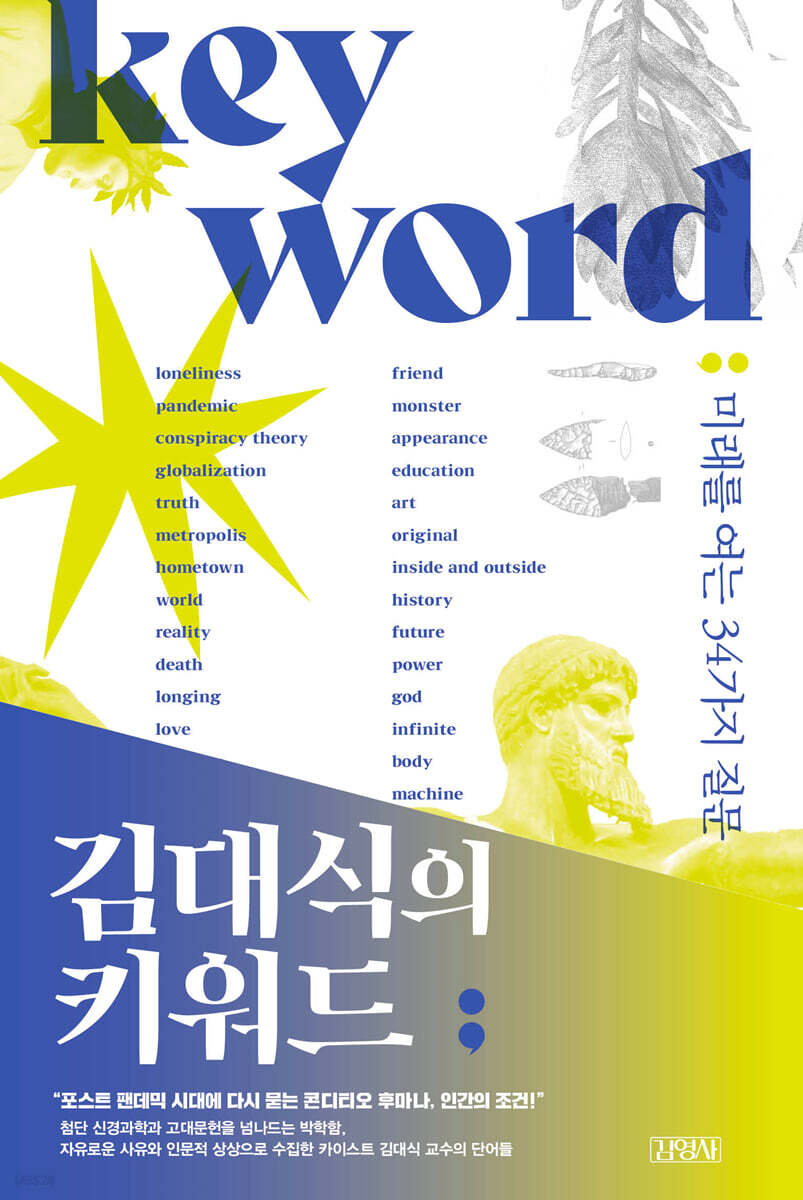
"Keywords," a collection of key words for understanding the post-COVID era compiled by Professor Kim Dae-sik of KAIST, who explores cutting-edge neuroscience and ancient literature through free thought and humanistic imagination.
The author, who has demonstrated vast knowledge and deep insight through teaching, writing, and lecturing, uses words that influence our thoughts and the world, such as pandemic, conspiracy theory, loneliness, death, machines, and love, as keys in this book, to uncover their essential meanings, questioning the human condition again and opening up the future.
In an era where the unfamiliar has become familiar and the familiar has become unfamiliar due to COVID-19, climate change, and the rapid development of artificial intelligence, reading these thirty-four keywords, which extend across science, philosophy, art, mythology, and history, will reveal the real-world problems facing individuals, communities, nations, and humanity, as well as clues to resolving them.
Questions about the future brought about by free thought and humanistic imagination
KAIST Professor Kim Dae-sik presents a post-pandemic perspective on liberal arts.
"Keywords," a collection of key words for understanding the post-COVID era compiled by Professor Kim Dae-sik of KAIST, who explores cutting-edge neuroscience and ancient literature through free thought and humanistic imagination.
The author, who has demonstrated vast knowledge and deep insight through teaching, writing, and lecturing, uses words that influence our thoughts and the world, such as pandemic, conspiracy theory, loneliness, death, machines, and love, as keys in this book, to uncover their essential meanings, questioning the human condition again and opening up the future.
In an era where the unfamiliar has become familiar and the familiar has become unfamiliar due to COVID-19, climate change, and the rapid development of artificial intelligence, reading these thirty-four keywords, which extend across science, philosophy, art, mythology, and history, will reveal the real-world problems facing individuals, communities, nations, and humanity, as well as clues to resolving them.
index
prolog
Part 1.
Loneliness: The Basement of the Heart
Pandemic: A Companion of Humanity
Conspiracy Theory: 'Kui Bono?'
Globalization: A Game of the Chosen
The Truth: The End of History
Big City: The Second Tower of Babel
Hometown: Irreversible
The world: something to see, something to ignore, something to imagine
Reality: The Greatest Invention
Death: A human trying to kill 'Death'
Longing: Another Product
Love: Future Love
Part 2.
Identity: A Meaningless Question
Laziness: The Normalization of Labor
Evil: Is this the best?
Modern: Old and New Generations
Freedom and Equality: The Dilemma
Worldview: The largest shared reality in history
Games: Life Simulation
Friends: Humanity's Killer App
Monsters: Humbaba and the Zombies
Appearance: Why do I look like this?
Education: Countries Preparing for the Historical College Scholastic Ability Test
Part 3.
Art: More! More Bold!
Original: Aura
Inside and Out: The Extended Phenotype
History: Beyond the World Spirit and Will
The Future: Chance and Necessity, Order and Disorder
Power: Henry VIII in the 21st Century
God: Is God really dead?
Infinite: Wrath and Mercy
Body: A Return to the Middle Ages
Machine: What is human to a machine?
Human: Five Stories
Copyright of the painting
Part 1.
Loneliness: The Basement of the Heart
Pandemic: A Companion of Humanity
Conspiracy Theory: 'Kui Bono?'
Globalization: A Game of the Chosen
The Truth: The End of History
Big City: The Second Tower of Babel
Hometown: Irreversible
The world: something to see, something to ignore, something to imagine
Reality: The Greatest Invention
Death: A human trying to kill 'Death'
Longing: Another Product
Love: Future Love
Part 2.
Identity: A Meaningless Question
Laziness: The Normalization of Labor
Evil: Is this the best?
Modern: Old and New Generations
Freedom and Equality: The Dilemma
Worldview: The largest shared reality in history
Games: Life Simulation
Friends: Humanity's Killer App
Monsters: Humbaba and the Zombies
Appearance: Why do I look like this?
Education: Countries Preparing for the Historical College Scholastic Ability Test
Part 3.
Art: More! More Bold!
Original: Aura
Inside and Out: The Extended Phenotype
History: Beyond the World Spirit and Will
The Future: Chance and Necessity, Order and Disorder
Power: Henry VIII in the 21st Century
God: Is God really dead?
Infinite: Wrath and Mercy
Body: A Return to the Middle Ages
Machine: What is human to a machine?
Human: Five Stories
Copyright of the painting
Detailed image
Into the book
Much of the unhappiness and happiness we experience actually happens for no reason.
What does it mean to say there's no reason? It could be a perfectly random phenomenon, like rolling dice, or it could be an extremely complex phenomenon driven by the interplay of too many causal relationships.
The important thing is that both randomness and complexity are far from the simple, linear, one-to-one causal relationships that the brain expects.
--- p.26
The human brain cannot accept that most things that happen in the world are ultimately the result of inevitability and chance.
Because they believe that existence itself becomes meaningless without cause and reason, humans always try to find cause and reason.
In particular, macro phenomena such as famine, war, the Great Depression, and pandemics are utterly incomprehensible.
I just worked hard. I didn't harm anyone. I didn't even eat bats. We always want to believe we're innocent.
Is it because we've always taken others' suffering as our happiness? Now, we're beginning to believe that our suffering is actually someone else's happiness.
“Cui bono?” This is the question the ancient Romans asked.
If something happens that you don't know the cause of, the first thing to ask is who it helps.
It was the historical birth of conspiracy theory.
--- p.35
Until now, both truth and lies could only be created through people.
But now, with artificial intelligence and GANs, it is possible to mass-produce lies.
Truth remains a singular phenomenon, created by humans, while machine-generated lies can be repeated infinitely and possess infinite variety.
A future internet space where a single truth and infinite lies compete.
Isn't it predictable who will win this fight?
--- p.51
What if, thanks to advances in medical science, cells could regenerate forever? What if, thanks to advancements in neuroscience, all my memories and information could be uploaded to another brain or computer? What if my head, severed from my dying body, could be transplanted into a new, young, healthy body? If death makes life meaningful, then the death of death means the "death of meaning."
A meaningful life made possible by a meaningless death, and a death of death that makes the meaning of life impossible.
What should we choose?
--- p.99
Even in a future world where we can see and meet at any time, will we still be able to stay up all night longing for someone? In a future where technological advancements allow us to consume and experience everything at any time, longing may no longer be Plato's photosus, a place that allows us to feel truth and eternity. Instead, it may become just another commodity, available for consumption and production to the fullest extent.
--- p.106~107
The IT-based Third Industrial Revolution and the AI-driven Fourth Industrial Revolution may be reverting the relationship between labor and humanity to its former state.
Because the moment machines begin to replace physical and knowledge labor and mass production begins, human labor becomes optional rather than essential.
And this can be interpreted as ‘normalization of labor.’
Of the 300,000-year history of Homo sapiens, only the last 10,000 years have been spent working for things other than food, clothing, and shelter.
--- p.133
If there are multiple realities, then there are also multiple truths.
In the 21st century, a single truth and morality that everyone can agree on has become impossible.
In a future where 'reality' is no longer absolute, we may end up stuck in a world of 'instant reality' where we can believe and then abandon it at any time, rather than working to improve the shared reality that everyone agrees on.
--- p.167
You can experience anywhere in the world and talk to people on the other side of the globe while lying in the comfort of your own bed.
In the cyber world, body and experience, flesh and soul are separated, so famous German director Etgaard Reitz compares future humanity in the cyber world to those who are already dead.
In most civilizations, death means the separation of the body and soul, so humans in the cyber world have already experienced the world of death.
--- p.237
Weak Homo sapiens, always filled with fear of the future.
Because we cannot predict our own future, we have outsourced the choice of our future to our parents, experts, and governments, believing that our future is already their past.
And now, as we outsource our future choices and decisions to corporations that know more about us than our governments, teachers, and parents, Silicon Valley companies are becoming the new Henry VIII of the 21st century.
What does it mean to say there's no reason? It could be a perfectly random phenomenon, like rolling dice, or it could be an extremely complex phenomenon driven by the interplay of too many causal relationships.
The important thing is that both randomness and complexity are far from the simple, linear, one-to-one causal relationships that the brain expects.
--- p.26
The human brain cannot accept that most things that happen in the world are ultimately the result of inevitability and chance.
Because they believe that existence itself becomes meaningless without cause and reason, humans always try to find cause and reason.
In particular, macro phenomena such as famine, war, the Great Depression, and pandemics are utterly incomprehensible.
I just worked hard. I didn't harm anyone. I didn't even eat bats. We always want to believe we're innocent.
Is it because we've always taken others' suffering as our happiness? Now, we're beginning to believe that our suffering is actually someone else's happiness.
“Cui bono?” This is the question the ancient Romans asked.
If something happens that you don't know the cause of, the first thing to ask is who it helps.
It was the historical birth of conspiracy theory.
--- p.35
Until now, both truth and lies could only be created through people.
But now, with artificial intelligence and GANs, it is possible to mass-produce lies.
Truth remains a singular phenomenon, created by humans, while machine-generated lies can be repeated infinitely and possess infinite variety.
A future internet space where a single truth and infinite lies compete.
Isn't it predictable who will win this fight?
--- p.51
What if, thanks to advances in medical science, cells could regenerate forever? What if, thanks to advancements in neuroscience, all my memories and information could be uploaded to another brain or computer? What if my head, severed from my dying body, could be transplanted into a new, young, healthy body? If death makes life meaningful, then the death of death means the "death of meaning."
A meaningful life made possible by a meaningless death, and a death of death that makes the meaning of life impossible.
What should we choose?
--- p.99
Even in a future world where we can see and meet at any time, will we still be able to stay up all night longing for someone? In a future where technological advancements allow us to consume and experience everything at any time, longing may no longer be Plato's photosus, a place that allows us to feel truth and eternity. Instead, it may become just another commodity, available for consumption and production to the fullest extent.
--- p.106~107
The IT-based Third Industrial Revolution and the AI-driven Fourth Industrial Revolution may be reverting the relationship between labor and humanity to its former state.
Because the moment machines begin to replace physical and knowledge labor and mass production begins, human labor becomes optional rather than essential.
And this can be interpreted as ‘normalization of labor.’
Of the 300,000-year history of Homo sapiens, only the last 10,000 years have been spent working for things other than food, clothing, and shelter.
--- p.133
If there are multiple realities, then there are also multiple truths.
In the 21st century, a single truth and morality that everyone can agree on has become impossible.
In a future where 'reality' is no longer absolute, we may end up stuck in a world of 'instant reality' where we can believe and then abandon it at any time, rather than working to improve the shared reality that everyone agrees on.
--- p.167
You can experience anywhere in the world and talk to people on the other side of the globe while lying in the comfort of your own bed.
In the cyber world, body and experience, flesh and soul are separated, so famous German director Etgaard Reitz compares future humanity in the cyber world to those who are already dead.
In most civilizations, death means the separation of the body and soul, so humans in the cyber world have already experienced the world of death.
--- p.237
Weak Homo sapiens, always filled with fear of the future.
Because we cannot predict our own future, we have outsourced the choice of our future to our parents, experts, and governments, believing that our future is already their past.
And now, as we outsource our future choices and decisions to corporations that know more about us than our governments, teachers, and parents, Silicon Valley companies are becoming the new Henry VIII of the 21st century.
--- p.264
Publisher's Review
“What is your keyword today?”
Why on earth did this happen? ― 'Pandemic'
The driving force behind civilization, science, and art, and the beginning of misfortune? ― Loneliness
What would intelligent machines want? ― Machines
What if the death that gives life meaning dies? ― 'Death'
What is it that I truly want to love? ― Love
Professor Dae-sik Kim of KAIST presents 34 keywords
Past, present, future and humanity!
Professor Kim Dae-sik of KAIST, author of the bestselling books 『Kim Dae-sik's Big Question』 and 『Kim Dae-sik's Human vs. Machine』, has returned with the topic of 'keywords'.
The word 'keyword' has two meanings.
1) A word that provides a clue to understanding a sentence or solving a problem; 2) A word or symbol used to quickly find the information needed when searching data.
The author, who has demonstrated vast knowledge and deep insight through research, teaching, writing, and lectures, uses words that influence our thoughts and the world, such as pandemic, conspiracy theory, loneliness, death, machines, and love, as keys in this book, to uncover their essential meaning, re-examine the human condition, and open up the future.
In an era where the unfamiliar has become familiar and the familiar has become unfamiliar due to COVID-19, climate change, and the rapid development of artificial intelligence, reading these thirty-four keywords, which extend across science, philosophy, art, mythology, and history, will reveal the real-world problems facing individuals, communities, nations, and humanity, as well as clues to resolving them.
Since this book was completed in the era of the 'pandemic', 'loneliness' and 'conspiracy theories' could not be left out.
The past year has been spent playing games every day in the 'big city', receiving online 'education', 'loving' online, and communicating with 'friends' online.
Since we have no reason to go out, we no longer care about our ‘appearances’, and our ‘worldview’ online has become our ‘home’.
As we contemplate 'globalization' and 'freedom and equality' in the 'future' of the post-pandemic era, we begin to ask ourselves many questions.
Where does true "evil" exist: "within" or "outside"? What exactly is "truth"? Does "power" always turn humans into "monsters"? Furthermore, as we experience an era where artificial intelligence, imitating "humans" and gradually surpassing their capabilities, is becoming a reality, we are left with these questions.
Since they don't know the "body" and "death," can "machines" experience an "infinite" future that humans are not allowed to experience? Can they feel "longing" or be "lazy?" In a "modern" "world" where machines create "art" and become the protagonists of "history," will they become new "gods"? Then, what exactly is "identity" as a human, and what does it mean to be an "original" human? _From the "Prologue"
In an age when machines began to understand the world,
Asking again about the human condition
Questions about the future brought about by free thought and humanistic imagination
The author, a neuroscientist, says that future historians will call the era we live in "the era when machines began to understand the world."
Deep learning was born in the 2000s, when most attempts to explain the world to machines through logic and mathematics had failed and the field of artificial intelligence was in a long "winter."
The results of this simple idea of giving machines the ability to learn using artificial neural networks that mimic the human brain are astonishing, and many problems that had remained unsolved for the past 50 years, such as object recognition, are quickly beginning to be solved.
Machines that used to learn from human-created data have now gone a step further and started creating new data on their own through methods such as GANs (generative adversarial networks).
Meanwhile, at the end of the 20th century, humanity created the largest shared reality in history called "globalization," and began sharing all kinds of products, services, dreams, and ideas. However, the dazzling development of the Internet, personal media, SNS news feeds, and recommendation systems in the 21st century seems to be fragmenting the shared reality by creating a personal reality that can be believed and then abandoned at any time.
In a world where artificial intelligence has begun mass-producing fake data and where we consume only the information that best aligns with our preferred reality rather than a single reality, will words like "friend," "love," "identity," "history," "truth," and "hometown" still retain their meaning? If nothing remains constant, who, or rather, what am I? The author's erudition, spanning cutting-edge neuroscience and ancient texts, and his free-thinking and humanistic imagination, interweaves keywords with countless questions, offering an opportunity to reflect on the "conditio humana," the "human condition," and stimulating the reader's thoughts.
★Why are humans so obsessed with causes? "Causes" are a powerful tool that allows us to predict the future through past experiences.
But this tool was originally intended to understand phenomena that could be seen, touched, and confirmed directly.
But perhaps because we couldn't give up the psychological reassurance and existential comfort that comes from the certainty of cause, even after creating cities, civilization, and the Internet, we still cling to the notion of cause and effect, even for invisible phenomena.
(Page 23, from "Pandemic: Humanity's Companion")
★Is the world we see an output, not an input? No two people's brains are 100% identical.
Then, we can conclude that the world we see with our eyes is also different.
If that's true, why do we all see the same things and believe we live in the same world? It's because of the limitations of language.
The visible world cannot be conveyed to others as it is, in its pre-visible state.
The perceived world is already a part of the being called 'I'.
We, who each perceive the world differently, must use the tool called 'language' to understand each other.
But because the resolution of language is lower than the resolution of perception, we end up using the same words to express the world we see differently.
(Page 79, from 'The World - Wanting to See, Wanting to Turn Away, and Imagining')
★What awaits those who seek to kill death? What if, thanks to advances in medical science, cells can regenerate forever? What if, thanks to advances in neuroscience, all my brain's memories and information could be uploaded to another brain or computer? What if my head, severed from my dying body, could be transplanted into a new, young, healthy body? If death enables meaning in life, then the death of death means the "death of meaning."
A meaningful life made possible by a meaningless death, and a death of death that makes the meaning of life impossible.
What Should We Choose? (Page 99, from "Death - Humans Who Want to Kill Death")
★What would a human who became a god want? If God is dead, we must find something else to comfort us.
Yes, that's right.
What if we ourselves became gods? Genetic engineering, robotics, brain engineering, artificial intelligence.
What if our limb bones, which crumble with a single misstep, were replaced with super-strong carbon composite materials? What if we could genetically upgrade our bodies, which can't even last a century? What if we could erase the painful memories of being abandoned by our loved ones, kicking the blankets and drowning ourselves in alcohol? What if we could use brain-reading technology to read and recreate our fading memories? What if, before my fragile body disintegrates, I could upload all my memories, emotions, hopes, and my very existence to a quantum computer? The moment these inherently impossible technologies become reality, humans, having overcome the insecurity and mortality of existence, will finally become godlike beings.
(Page 274, from 'Is God Really Dead?')
★What does humanity mean to a machine? This is the true meaning of intelligent and conscious machines.
To them, humans are just meaningless beings that need neither love nor hate.
Just as the bugs that get trampled to death by our feet as we run late for an appointment are meaningless, we may no longer be the objects of interest to the machines that have finally come to feel the world.
(Page 300, from "Machines: What Humans Mean to Machines")
Crossing cutting-edge neuroscience and ancient literature
Crossing science, philosophy, art, history and mythology
The sacrament of knowledge and wisdom
This book blends science, philosophy, art, history, and mythology.
In terms of weight, there are more stories of philosophy, art, history, and mythology than of science, but since the author's major is brain science, scientific thoughts and questions are embedded throughout.
Each peak usually begins with a famous painting.
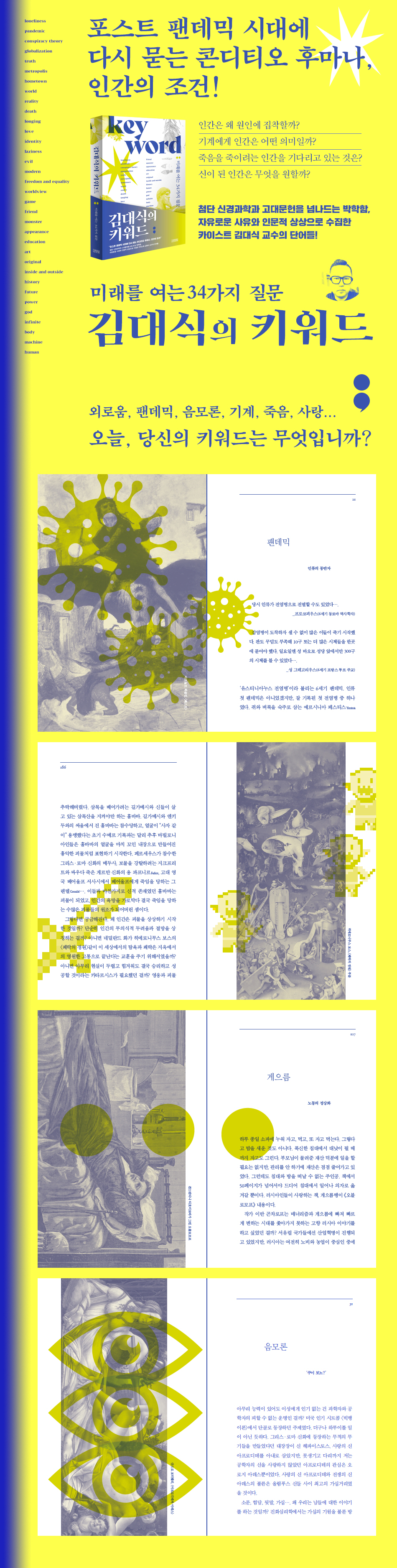
Among the approximately 60 paintings and photographs included in this book, there are some famous ones, such as Leonardo da Vinci's Mona Lisa (p. 223, 'Original') and Michelangelo's The Creation of Adam (p. 266, 'God'), as well as some uncomfortable or unfamiliar works, such as Max Beckmann's Night (p. 134, 'Evil') and Departure (p. 243, 'History'), and Hieronymus Bosch's The Garden of Earthly Delights (p. 187, 'The Monster').
These visuals serve as clues or symbols that unravel each keyword, and sometimes as metaphors that represent the absurdity of human nature, providing the pleasure of viewing and allowing for leisurely reading.
In addition, ancient literature such as 『Odyssey』 『Gilgamesh』 『Iliad』 『Atrahasis』 『Symposium』 and classics of world literature such as 『Animal Farm』 『1984』 『The Man Without Qualities』 『Ulysses』 『Faust』 『Brave New World』 『Wilhelm Meister's Apprenticeship』 as well as various figures from various fields of the East and the West, past and present, such as Jesus, Descartes, Pascal, Leibniz, Hegel, Henry VIII, Walter Benjamin, Bertrand Russell, Hitler, Max Hermann Neisse, Vladimir Mayakovsky, Richard Dawkins, Yuval Harari, Sergei Eisenstein, etc. are summoned.
For today's readers, who thirst for wisdom beyond knowledge, this book will be a sacramental feast where they can find their own wisdom.
Why on earth did this happen? ― 'Pandemic'
The driving force behind civilization, science, and art, and the beginning of misfortune? ― Loneliness
What would intelligent machines want? ― Machines
What if the death that gives life meaning dies? ― 'Death'
What is it that I truly want to love? ― Love
Professor Dae-sik Kim of KAIST presents 34 keywords
Past, present, future and humanity!
Professor Kim Dae-sik of KAIST, author of the bestselling books 『Kim Dae-sik's Big Question』 and 『Kim Dae-sik's Human vs. Machine』, has returned with the topic of 'keywords'.
The word 'keyword' has two meanings.
1) A word that provides a clue to understanding a sentence or solving a problem; 2) A word or symbol used to quickly find the information needed when searching data.
The author, who has demonstrated vast knowledge and deep insight through research, teaching, writing, and lectures, uses words that influence our thoughts and the world, such as pandemic, conspiracy theory, loneliness, death, machines, and love, as keys in this book, to uncover their essential meaning, re-examine the human condition, and open up the future.
In an era where the unfamiliar has become familiar and the familiar has become unfamiliar due to COVID-19, climate change, and the rapid development of artificial intelligence, reading these thirty-four keywords, which extend across science, philosophy, art, mythology, and history, will reveal the real-world problems facing individuals, communities, nations, and humanity, as well as clues to resolving them.
Since this book was completed in the era of the 'pandemic', 'loneliness' and 'conspiracy theories' could not be left out.
The past year has been spent playing games every day in the 'big city', receiving online 'education', 'loving' online, and communicating with 'friends' online.
Since we have no reason to go out, we no longer care about our ‘appearances’, and our ‘worldview’ online has become our ‘home’.
As we contemplate 'globalization' and 'freedom and equality' in the 'future' of the post-pandemic era, we begin to ask ourselves many questions.
Where does true "evil" exist: "within" or "outside"? What exactly is "truth"? Does "power" always turn humans into "monsters"? Furthermore, as we experience an era where artificial intelligence, imitating "humans" and gradually surpassing their capabilities, is becoming a reality, we are left with these questions.
Since they don't know the "body" and "death," can "machines" experience an "infinite" future that humans are not allowed to experience? Can they feel "longing" or be "lazy?" In a "modern" "world" where machines create "art" and become the protagonists of "history," will they become new "gods"? Then, what exactly is "identity" as a human, and what does it mean to be an "original" human? _From the "Prologue"
In an age when machines began to understand the world,
Asking again about the human condition
Questions about the future brought about by free thought and humanistic imagination
The author, a neuroscientist, says that future historians will call the era we live in "the era when machines began to understand the world."
Deep learning was born in the 2000s, when most attempts to explain the world to machines through logic and mathematics had failed and the field of artificial intelligence was in a long "winter."
The results of this simple idea of giving machines the ability to learn using artificial neural networks that mimic the human brain are astonishing, and many problems that had remained unsolved for the past 50 years, such as object recognition, are quickly beginning to be solved.
Machines that used to learn from human-created data have now gone a step further and started creating new data on their own through methods such as GANs (generative adversarial networks).
Meanwhile, at the end of the 20th century, humanity created the largest shared reality in history called "globalization," and began sharing all kinds of products, services, dreams, and ideas. However, the dazzling development of the Internet, personal media, SNS news feeds, and recommendation systems in the 21st century seems to be fragmenting the shared reality by creating a personal reality that can be believed and then abandoned at any time.
In a world where artificial intelligence has begun mass-producing fake data and where we consume only the information that best aligns with our preferred reality rather than a single reality, will words like "friend," "love," "identity," "history," "truth," and "hometown" still retain their meaning? If nothing remains constant, who, or rather, what am I? The author's erudition, spanning cutting-edge neuroscience and ancient texts, and his free-thinking and humanistic imagination, interweaves keywords with countless questions, offering an opportunity to reflect on the "conditio humana," the "human condition," and stimulating the reader's thoughts.
★Why are humans so obsessed with causes? "Causes" are a powerful tool that allows us to predict the future through past experiences.
But this tool was originally intended to understand phenomena that could be seen, touched, and confirmed directly.
But perhaps because we couldn't give up the psychological reassurance and existential comfort that comes from the certainty of cause, even after creating cities, civilization, and the Internet, we still cling to the notion of cause and effect, even for invisible phenomena.
(Page 23, from "Pandemic: Humanity's Companion")
★Is the world we see an output, not an input? No two people's brains are 100% identical.
Then, we can conclude that the world we see with our eyes is also different.
If that's true, why do we all see the same things and believe we live in the same world? It's because of the limitations of language.
The visible world cannot be conveyed to others as it is, in its pre-visible state.
The perceived world is already a part of the being called 'I'.
We, who each perceive the world differently, must use the tool called 'language' to understand each other.
But because the resolution of language is lower than the resolution of perception, we end up using the same words to express the world we see differently.
(Page 79, from 'The World - Wanting to See, Wanting to Turn Away, and Imagining')
★What awaits those who seek to kill death? What if, thanks to advances in medical science, cells can regenerate forever? What if, thanks to advances in neuroscience, all my brain's memories and information could be uploaded to another brain or computer? What if my head, severed from my dying body, could be transplanted into a new, young, healthy body? If death enables meaning in life, then the death of death means the "death of meaning."
A meaningful life made possible by a meaningless death, and a death of death that makes the meaning of life impossible.
What Should We Choose? (Page 99, from "Death - Humans Who Want to Kill Death")
★What would a human who became a god want? If God is dead, we must find something else to comfort us.
Yes, that's right.
What if we ourselves became gods? Genetic engineering, robotics, brain engineering, artificial intelligence.
What if our limb bones, which crumble with a single misstep, were replaced with super-strong carbon composite materials? What if we could genetically upgrade our bodies, which can't even last a century? What if we could erase the painful memories of being abandoned by our loved ones, kicking the blankets and drowning ourselves in alcohol? What if we could use brain-reading technology to read and recreate our fading memories? What if, before my fragile body disintegrates, I could upload all my memories, emotions, hopes, and my very existence to a quantum computer? The moment these inherently impossible technologies become reality, humans, having overcome the insecurity and mortality of existence, will finally become godlike beings.
(Page 274, from 'Is God Really Dead?')
★What does humanity mean to a machine? This is the true meaning of intelligent and conscious machines.
To them, humans are just meaningless beings that need neither love nor hate.
Just as the bugs that get trampled to death by our feet as we run late for an appointment are meaningless, we may no longer be the objects of interest to the machines that have finally come to feel the world.
(Page 300, from "Machines: What Humans Mean to Machines")
Crossing cutting-edge neuroscience and ancient literature
Crossing science, philosophy, art, history and mythology
The sacrament of knowledge and wisdom
This book blends science, philosophy, art, history, and mythology.
In terms of weight, there are more stories of philosophy, art, history, and mythology than of science, but since the author's major is brain science, scientific thoughts and questions are embedded throughout.
Each peak usually begins with a famous painting.
Among the approximately 60 paintings and photographs included in this book, there are some famous ones, such as Leonardo da Vinci's Mona Lisa (p. 223, 'Original') and Michelangelo's The Creation of Adam (p. 266, 'God'), as well as some uncomfortable or unfamiliar works, such as Max Beckmann's Night (p. 134, 'Evil') and Departure (p. 243, 'History'), and Hieronymus Bosch's The Garden of Earthly Delights (p. 187, 'The Monster').
These visuals serve as clues or symbols that unravel each keyword, and sometimes as metaphors that represent the absurdity of human nature, providing the pleasure of viewing and allowing for leisurely reading.
In addition, ancient literature such as 『Odyssey』 『Gilgamesh』 『Iliad』 『Atrahasis』 『Symposium』 and classics of world literature such as 『Animal Farm』 『1984』 『The Man Without Qualities』 『Ulysses』 『Faust』 『Brave New World』 『Wilhelm Meister's Apprenticeship』 as well as various figures from various fields of the East and the West, past and present, such as Jesus, Descartes, Pascal, Leibniz, Hegel, Henry VIII, Walter Benjamin, Bertrand Russell, Hitler, Max Hermann Neisse, Vladimir Mayakovsky, Richard Dawkins, Yuval Harari, Sergei Eisenstein, etc. are summoned.
For today's readers, who thirst for wisdom beyond knowledge, this book will be a sacramental feast where they can find their own wisdom.
GOODS SPECIFICS
- Publication date: February 17, 2021
- Format: Hardcover book binding method guide
- Page count, weight, size: 312 pages | 460g | 124*190*30mm
- ISBN13: 9788934991359
- ISBN10: 8934991356
You may also like
카테고리
korean


korean

![GQ KOREA Mark (Monthly): December [2025]](http://librairie.coreenne.fr/cdn/shop/files/8ef265dbbfbf186523ed75ba7319009d.jpg?v=1765340328&width=3840)


