

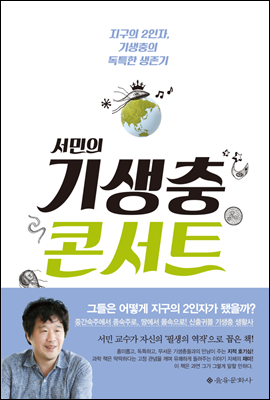
Commoners' Parasite Concert
 |
Description
Book Introduction
How did they become the second most powerful people on Earth?
From intermediate host to definitive host, from the ground to the body! The mysterious life cycle of parasites.
A book containing the fascinating stories of parasites told by Professor Seo Min, a cheerful writer, has been published by Eulyoo Publishing.
The list of parasites introduced in this book is truly a series of surprises.
As you encounter exciting parasites with stories you never imagined, you will find yourself immersed in the world of parasites.
In "The Parasite Chronicles of the Common People," more powerful parasites have arrived!
“『The Parasite Chronicles of the Common People』 was just a series of parasites that appeared and introduced themselves, just like the name suggests, but 『The Parasite Concert of the Common People』 features some really awesome parasites, each with their own story.
These come out and give off a vibe like singers performing and showing off their talents.
So, I decided on this title because I felt that there was no word that could describe this book as well as the word 'concert'.
- Professor Seo Min, from an interview
From intermediate host to definitive host, from the ground to the body! The mysterious life cycle of parasites.
A book containing the fascinating stories of parasites told by Professor Seo Min, a cheerful writer, has been published by Eulyoo Publishing.
The list of parasites introduced in this book is truly a series of surprises.
As you encounter exciting parasites with stories you never imagined, you will find yourself immersed in the world of parasites.
In "The Parasite Chronicles of the Common People," more powerful parasites have arrived!
“『The Parasite Chronicles of the Common People』 was just a series of parasites that appeared and introduced themselves, just like the name suggests, but 『The Parasite Concert of the Common People』 features some really awesome parasites, each with their own story.
These come out and give off a vibe like singers performing and showing off their talents.
So, I decided on this title because I felt that there was no word that could describe this book as well as the word 'concert'.
- Professor Seo Min, from an interview
- You can preview some of the book's contents.
Preview
index
Opening remarks
I. Good Parasite
1.
Cyclospora | The Parasite That Shocked America
2.
Simota Exigua | A Symbol of Responsibility
3.
Yokogawa Fluke | The Yokogawa Family's Love of Parasites
4.
Deworm | The Dracula of the Parasite World
5.
Nematodes | A symbol of opportunism
6.
Giardia | Hateable but Unlovable
7.
Dwarf tapeworm | A parasite that only targets the weak
Living Without Fear of Parasites ① | Parasite Research and the Nobel Prize
II. Unique Parasites
1.
Singamus | Eternal love between men and women
2.
Whale Worm | The Truth About Whale Worm
3.
Previous testicular fluke | A parasite that moves the testicles
4.
Oriental eyeworm | Parasites that live in the eye
5.
Head lice | Parasites still prevalent
6.
The fear of skin-crawling parasites |
7.
Trichomonas vaginalis | A parasite transmitted through sexual contact
8.
Insect | The world's slowest parasite
Living Without Fear of Parasites ② | The Need for Invigorated Animal Parasite Research
III. Bad Parasites
1.
Free-living amoeba fowleri | The identity of the brain-eating amoeba
2.
Liverworm | Is there hope for serial killer liverworm?
3.
Giardia cruziensis | Cause of Chagas disease
4.
Guangdong blood nematode | The fatal lure of snails
5.
Dysentery amoeba | the amoeba that causes dysentery
6.
Donovan Leishmania | Black Fever, the Tragedy of the Sandfly
Living Without Fear of Parasites ③ | Parasitological Delusion
Special Appendix | Are There Parasites in My Body?: Self-Testing Methods
Conclusion
References
Image source
Search
I. Good Parasite
1.
Cyclospora | The Parasite That Shocked America
2.
Simota Exigua | A Symbol of Responsibility
3.
Yokogawa Fluke | The Yokogawa Family's Love of Parasites
4.
Deworm | The Dracula of the Parasite World
5.
Nematodes | A symbol of opportunism
6.
Giardia | Hateable but Unlovable
7.
Dwarf tapeworm | A parasite that only targets the weak
Living Without Fear of Parasites ① | Parasite Research and the Nobel Prize
II. Unique Parasites
1.
Singamus | Eternal love between men and women
2.
Whale Worm | The Truth About Whale Worm
3.
Previous testicular fluke | A parasite that moves the testicles
4.
Oriental eyeworm | Parasites that live in the eye
5.
Head lice | Parasites still prevalent
6.
The fear of skin-crawling parasites |
7.
Trichomonas vaginalis | A parasite transmitted through sexual contact
8.
Insect | The world's slowest parasite
Living Without Fear of Parasites ② | The Need for Invigorated Animal Parasite Research
III. Bad Parasites
1.
Free-living amoeba fowleri | The identity of the brain-eating amoeba
2.
Liverworm | Is there hope for serial killer liverworm?
3.
Giardia cruziensis | Cause of Chagas disease
4.
Guangdong blood nematode | The fatal lure of snails
5.
Dysentery amoeba | the amoeba that causes dysentery
6.
Donovan Leishmania | Black Fever, the Tragedy of the Sandfly
Living Without Fear of Parasites ③ | Parasitological Delusion
Special Appendix | Are There Parasites in My Body?: Self-Testing Methods
Conclusion
References
Image source
Search
Detailed image
.jpg)
Into the book
Besides head lice, there are two other types of lice that parasitize humans.
These are body lice (Pediculus) and pubic lice (Phthirus Pubis). Pubic lice are morphologically completely different, but head lice and body lice are so similar that they are difficult to distinguish at first glance.
It is believed that they were originally the same species, but when they crossed over to humans, some chose the head and some chose the body.
The fact that these two species can mate and lay eggs when placed together makes it difficult to say that they are completely different species.
However, the fates of these two species were very different.
When they first came to Earth as humans and chose a habitat, choosing a body may not have been such a bad choice.
In the past, when washing once a month was considered cultural, body lice would have freely sucked blood all over the body.
Even in our country, 40 years ago, it was a common sight in winter to see people catching and popping lice by the fireplace.
To such a body lice, the head lice that clung to their heads and hid must have seemed suffocating.
But these days, most people shower every day and change their underwear after showering.
Eventually, body lice went extinct, leaving us envious of the still thriving head lice.
A sad beast with short legs, the transmission of lice is possible only when the heads are very close together.
The head-butting and shoving games we sometimes played as children are a good opportunity for head lice to spread.
It can also be transmitted by sharing combs, hats, or towels.
Sharing a bed is also one way that head lice are transmitted.
Someone left this comment on an article about head lice:
“Even if you wash your hair every day and eat well, it won’t happen.”
Washing your hair frequently with shampoo does not prevent head lice.
Even frequent brushing, if it's just a comb, won't help get rid of lice.
You might be wondering what I should do, but please wait a moment.
These are body lice (Pediculus) and pubic lice (Phthirus Pubis). Pubic lice are morphologically completely different, but head lice and body lice are so similar that they are difficult to distinguish at first glance.
It is believed that they were originally the same species, but when they crossed over to humans, some chose the head and some chose the body.
The fact that these two species can mate and lay eggs when placed together makes it difficult to say that they are completely different species.
However, the fates of these two species were very different.
When they first came to Earth as humans and chose a habitat, choosing a body may not have been such a bad choice.
In the past, when washing once a month was considered cultural, body lice would have freely sucked blood all over the body.
Even in our country, 40 years ago, it was a common sight in winter to see people catching and popping lice by the fireplace.
To such a body lice, the head lice that clung to their heads and hid must have seemed suffocating.
But these days, most people shower every day and change their underwear after showering.
Eventually, body lice went extinct, leaving us envious of the still thriving head lice.
A sad beast with short legs, the transmission of lice is possible only when the heads are very close together.
The head-butting and shoving games we sometimes played as children are a good opportunity for head lice to spread.
It can also be transmitted by sharing combs, hats, or towels.
Sharing a bed is also one way that head lice are transmitted.
Someone left this comment on an article about head lice:
“Even if you wash your hair every day and eat well, it won’t happen.”
Washing your hair frequently with shampoo does not prevent head lice.
Even frequent brushing, if it's just a comb, won't help get rid of lice.
You might be wondering what I should do, but please wait a moment.
--- p.173
Publisher's Review
In "The Parasite Chronicles of the Common People," more powerful parasites have arrived!
“『The Parasite Chronicles of the Common People』 was just a series of parasites that appeared and introduced themselves, just like the name suggests, but 『The Parasite Concert of the Common People』 features some really awesome parasites, each with their own story.
These come out and give off a vibe like singers performing and showing off their talents.
So, I decided on this title because I felt that there was no word that could describe this book as well as the word 'concert'.
- Professor Seo Min, from an interview
The beginning of this book was humble.
It felt like a second installment, introducing other parasites that weren't introduced in "The Common People's Parasite Chronicles."
But the parasites in the manuscript were so powerful that they brought to mind phrases like, “Stronger ones have appeared!” and “The real thing has appeared!”
It was so much more interesting and entertaining than the original book that I couldn't resist a sequel.
Because it has gone beyond the level of being a pity.
To live up to the title 'Parasite Concert', the parasites that Park Jin-young likes to sing half air and half voice, and the parasites that sing differently every time they sing a hundred times, continue to surprise us.
It's like being moved by a song sung by one parasite, and then another parasite with a different tone of voice gives you another thrill and resonance in your heart.
Let me introduce you to some parasites that have amazing stories.
Head lice: That's right.
It's the 'lice' that sucks human blood.
But can you believe that head lice are still prevalent? Surprisingly, many children are still found with head lice today.
Fortunately, about 40 percent of the nymphs of this troublesome parasite, which are not easy to eradicate, die before they reach adulthood.
But there is a surprising twist hidden in the reason for the death.
Most parasites seek news.
A slim body is one of the parasite's characteristics.
However, the head lice nymphs die when they eat too much blood and their intestines burst.
It's infuriating that they live on our children's heads, but they die from eating too much. They are truly annoying.
Trichomonas vaginalis: A parasite classified as a sexually transmitted disease, it is a parasite that only infects humans.
Trichomoniasis, what a sexually transmitted disease!
It's uncomfortable enough to be classified as a sexually transmitted disease, but this parasite even discriminates between men and women.
In a man's body, the environment is not very good, so it can't last even ten days, but in a woman's body, it can live for months or even years, causing suffering.
He is a vicious guy who even increases the rate of AIDS infection.
The main cause of infection is men, so it may be unfair for women to suffer.
Cymothoa exigua: This parasite sucks the blood from the tongue of a fish, causing it to fall off and then taking its place as a tongue.
Not just for a moment, but until the fish dies.
Isn't that surprising? That's why the author calls Cymothoa exigua a "symbol of responsibility" and ranks it among the most benevolent parasites.
When the fish it parasitizes dies, Cymothoa exigua emerges from the fish's mouth and clings to the head or body of the dead fish.
This scene gives the impression that when a person dies, they are hanging next to him and saying, “Oh my, oh my.”
Moreover, it is said that a parasitic fish does not enter the body of another fish even after it dies, so I think it should become an 'icon of loyalty'.
Hookworm: Hookworm is the Dracula of the parasitic world, sucking human blood.
As befitting a Dracula parasite, the worm has impressive teeth that rival those of a tiger.
(It has also been selected as a parasite for dry teeth.
(Just kidding.) But why did the author select a parasite that sucks human blood as a good parasite? The amount of blood consumed by a hookworm per day is extremely small, less than 0.15 milliliters, which is less than a single drop of blood.
While the loss is minimal, the utility of the dewormer is quite useful.
It is currently being used as a treatment for allergies and autoimmune diseases, and is also patented and under development as an anticoagulant.
Compared to existing synthetic anticoagulants with various side effects, it is environmentally friendly and could be of great help if research and development proceeds well.
Since they help humans in this way, the parasites are indeed good parasites.
Dwarf tapeworm: There is something called an opportunistic pathogen.
It refers to a pathogen that cannot reach a healthy person, but can invade and cause illness when the body becomes weak.
You might want to call them cowardly for being weak against the strong and strong against the weak, but most pathogens have that characteristic.
It has to enter the human body, but it is burdensome to have to break through various defenses to enter.
But if someone had their defenses lifted, wouldn't they be surprised and go in? The dwarf tapeworm is also a parasite of this type.
Normally docile, when the host's immune system is suppressed, the larvae attack various parts of the body, not only causing death, but also suddenly transforming into cancer cells and threatening humans.
A parasite can turn into cancer. Shouldn't the transformation be moderate? This is truly a "facially mutating parasite."
In addition, you can meet exciting, unique, and scary parasites such as 'Streptococcus keiskei', which infects the human body and survives for decades; 'Trigena cruzi', which destroys the heart while dormant and causes sudden death after 20 years; 'Echinococcus keiskei', which moves the testicles; and 'Naegleria fowleri', a terrifying killer that kills humans who invade its territory.
If you are thinking of reading 『The Parasite Chronicles of the Common People』, which included many Naver serialized articles, online, I am sorry, but you will have a hard time finding these parasites there.
This is because there are only two articles in this book that were published on Naver.
In addition, it contains some quite interesting appendices.
In particular, the 'Parasite Self-Test Method' is a special appendix prepared just for our readers.
Sometimes reclusive, sometimes dominating: a "parasite survival story" that runs rampant.
Even if humans become extinct, parasites will probably survive until the day the Earth is destroyed.
Parasites, which once parasitized and raged within the bodies of most people, are now the second most prevalent pest on Earth after humans, and they thrive by parasitizing almost all living creatures.
How do they survive by parasitizing other organisms? Their survival methods are diverse, from "coexisting parasites," which live so quietly that their hosts are unaware of their presence, to "living alone parasites," which kill intermediate hosts to deliver eggs or larvae to the definitive host.
But they also have something in common.
It is ‘reproduction of offspring’.
They lived only for that.
Helping and abandoning the host.
“『The Parasite Chronicles of the Common People』 was just a series of parasites that appeared and introduced themselves, just like the name suggests, but 『The Parasite Concert of the Common People』 features some really awesome parasites, each with their own story.
These come out and give off a vibe like singers performing and showing off their talents.
So, I decided on this title because I felt that there was no word that could describe this book as well as the word 'concert'.
- Professor Seo Min, from an interview
The beginning of this book was humble.
It felt like a second installment, introducing other parasites that weren't introduced in "The Common People's Parasite Chronicles."
But the parasites in the manuscript were so powerful that they brought to mind phrases like, “Stronger ones have appeared!” and “The real thing has appeared!”
It was so much more interesting and entertaining than the original book that I couldn't resist a sequel.
Because it has gone beyond the level of being a pity.
To live up to the title 'Parasite Concert', the parasites that Park Jin-young likes to sing half air and half voice, and the parasites that sing differently every time they sing a hundred times, continue to surprise us.
It's like being moved by a song sung by one parasite, and then another parasite with a different tone of voice gives you another thrill and resonance in your heart.
Let me introduce you to some parasites that have amazing stories.
Head lice: That's right.
It's the 'lice' that sucks human blood.
But can you believe that head lice are still prevalent? Surprisingly, many children are still found with head lice today.
Fortunately, about 40 percent of the nymphs of this troublesome parasite, which are not easy to eradicate, die before they reach adulthood.
But there is a surprising twist hidden in the reason for the death.
Most parasites seek news.
A slim body is one of the parasite's characteristics.
However, the head lice nymphs die when they eat too much blood and their intestines burst.
It's infuriating that they live on our children's heads, but they die from eating too much. They are truly annoying.
Trichomonas vaginalis: A parasite classified as a sexually transmitted disease, it is a parasite that only infects humans.
Trichomoniasis, what a sexually transmitted disease!
It's uncomfortable enough to be classified as a sexually transmitted disease, but this parasite even discriminates between men and women.
In a man's body, the environment is not very good, so it can't last even ten days, but in a woman's body, it can live for months or even years, causing suffering.
He is a vicious guy who even increases the rate of AIDS infection.
The main cause of infection is men, so it may be unfair for women to suffer.
Cymothoa exigua: This parasite sucks the blood from the tongue of a fish, causing it to fall off and then taking its place as a tongue.
Not just for a moment, but until the fish dies.
Isn't that surprising? That's why the author calls Cymothoa exigua a "symbol of responsibility" and ranks it among the most benevolent parasites.
When the fish it parasitizes dies, Cymothoa exigua emerges from the fish's mouth and clings to the head or body of the dead fish.
This scene gives the impression that when a person dies, they are hanging next to him and saying, “Oh my, oh my.”
Moreover, it is said that a parasitic fish does not enter the body of another fish even after it dies, so I think it should become an 'icon of loyalty'.
Hookworm: Hookworm is the Dracula of the parasitic world, sucking human blood.
As befitting a Dracula parasite, the worm has impressive teeth that rival those of a tiger.
(It has also been selected as a parasite for dry teeth.
(Just kidding.) But why did the author select a parasite that sucks human blood as a good parasite? The amount of blood consumed by a hookworm per day is extremely small, less than 0.15 milliliters, which is less than a single drop of blood.
While the loss is minimal, the utility of the dewormer is quite useful.
It is currently being used as a treatment for allergies and autoimmune diseases, and is also patented and under development as an anticoagulant.
Compared to existing synthetic anticoagulants with various side effects, it is environmentally friendly and could be of great help if research and development proceeds well.
Since they help humans in this way, the parasites are indeed good parasites.
Dwarf tapeworm: There is something called an opportunistic pathogen.
It refers to a pathogen that cannot reach a healthy person, but can invade and cause illness when the body becomes weak.
You might want to call them cowardly for being weak against the strong and strong against the weak, but most pathogens have that characteristic.
It has to enter the human body, but it is burdensome to have to break through various defenses to enter.
But if someone had their defenses lifted, wouldn't they be surprised and go in? The dwarf tapeworm is also a parasite of this type.
Normally docile, when the host's immune system is suppressed, the larvae attack various parts of the body, not only causing death, but also suddenly transforming into cancer cells and threatening humans.
A parasite can turn into cancer. Shouldn't the transformation be moderate? This is truly a "facially mutating parasite."
In addition, you can meet exciting, unique, and scary parasites such as 'Streptococcus keiskei', which infects the human body and survives for decades; 'Trigena cruzi', which destroys the heart while dormant and causes sudden death after 20 years; 'Echinococcus keiskei', which moves the testicles; and 'Naegleria fowleri', a terrifying killer that kills humans who invade its territory.
If you are thinking of reading 『The Parasite Chronicles of the Common People』, which included many Naver serialized articles, online, I am sorry, but you will have a hard time finding these parasites there.
This is because there are only two articles in this book that were published on Naver.
In addition, it contains some quite interesting appendices.
In particular, the 'Parasite Self-Test Method' is a special appendix prepared just for our readers.
Sometimes reclusive, sometimes dominating: a "parasite survival story" that runs rampant.
Even if humans become extinct, parasites will probably survive until the day the Earth is destroyed.
Parasites, which once parasitized and raged within the bodies of most people, are now the second most prevalent pest on Earth after humans, and they thrive by parasitizing almost all living creatures.
How do they survive by parasitizing other organisms? Their survival methods are diverse, from "coexisting parasites," which live so quietly that their hosts are unaware of their presence, to "living alone parasites," which kill intermediate hosts to deliver eggs or larvae to the definitive host.
But they also have something in common.
It is ‘reproduction of offspring’.
They lived only for that.
Helping and abandoning the host.
GOODS SPECIFICS
- Date of issue: May 30, 2016
- Page count, weight, size: 376 pages | 499g | 145*210*22mm
- ISBN13: 9788932473345
- ISBN10: 893247334X
You may also like
카테고리
korean


korean

![ELLE 엘르 스페셜 에디션 A형 : 12월 [2025]](http://librairie.coreenne.fr/cdn/shop/files/b8e27a3de6c9538896439686c6b0e8fb.jpg?v=1766436872&width=3840)


