

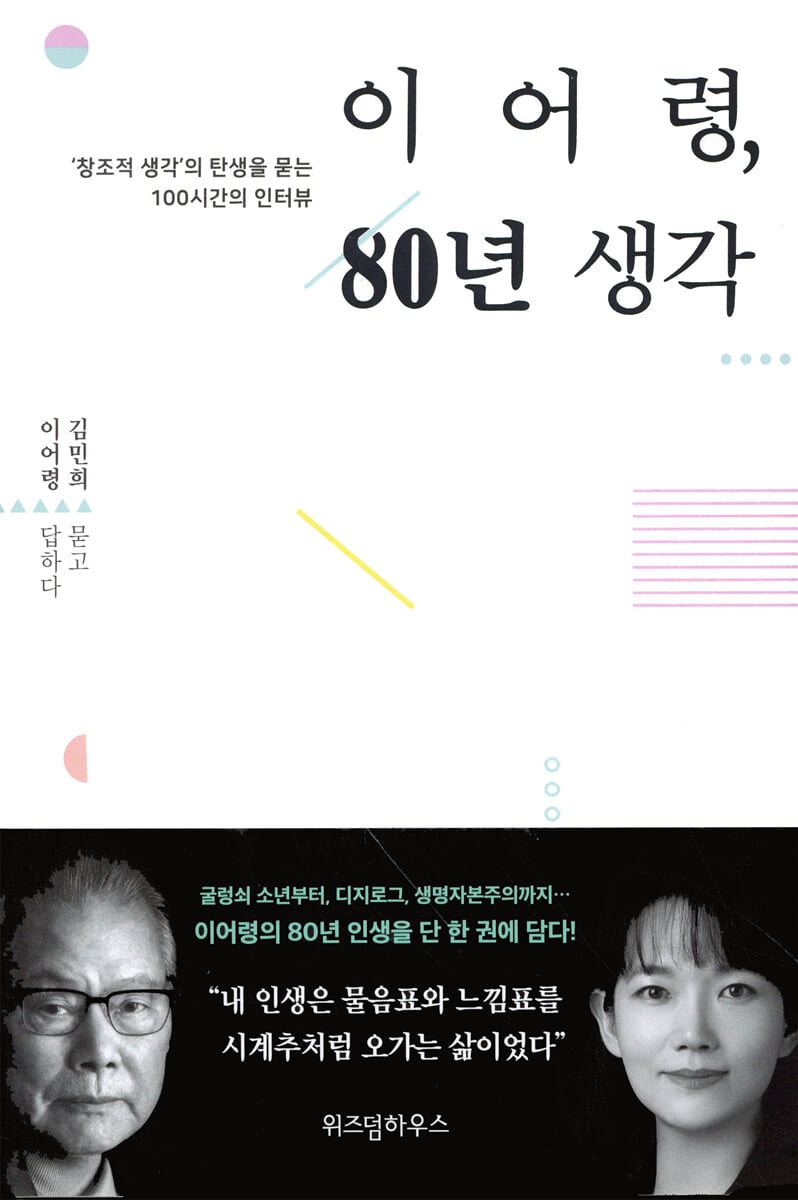
Lee Eo-ryeong, 80 years of thoughts
 |
Description
Book Introduction
Creativity and Insight from Leading Scholar Lee Eo-ryeong
- A word from MD
-
A conversation with leading scholar Lee Eo-ryeongA book compiled by Kim Min-hee, an interview expert and disciple of Professor Lee Eo-ryeong, after interviewing Professor Lee Eo-ryeong for over 100 hours.
It depicts the trajectory of Lee Eo-ryeong's thought, which has explored the essence of human existence and Korean identity while crossing over philosophy and religion.
We hear the secrets of creativity and insight from Professor Lee Eo-ryeong.
January 26, 2021. Humanities PD Son Min-gyu
"This book is like my memoir."
Lee Eo-ryeong, the intellectual of the times, and the essence of his thoughts.
『Lee Eo-ryeong, 80 Years of Thoughts』 is the definitive edition of Lee Eo-ryeong's exploration, created through interviews with Professor Lee Eo-ryeong, a leading Korean intellectual, conducted by Kim Min-hee, an expert interviewer and Professor Lee Eo-ryeong's last disciple, for over 100 hours over a period of five years from 2016 to 2020.
This book is also a journey into the mind of Lee Eo-ryeong, the greatest intellectual of our time, to whom the word 'creation' best suits.
The book contains the entire 'process of growth of thought' of a six-year-old questioning boy until he came up with the grand paradigms of digilog and biocapitalism.
Through this book, we will be able to directly see how one person named Lee Eo-ryeong drew a map of creative thinking and what his unique method of drawing a map is.
Lee Eo-ryeong, the intellectual of the times, and the essence of his thoughts.
『Lee Eo-ryeong, 80 Years of Thoughts』 is the definitive edition of Lee Eo-ryeong's exploration, created through interviews with Professor Lee Eo-ryeong, a leading Korean intellectual, conducted by Kim Min-hee, an expert interviewer and Professor Lee Eo-ryeong's last disciple, for over 100 hours over a period of five years from 2016 to 2020.
This book is also a journey into the mind of Lee Eo-ryeong, the greatest intellectual of our time, to whom the word 'creation' best suits.
The book contains the entire 'process of growth of thought' of a six-year-old questioning boy until he came up with the grand paradigms of digilog and biocapitalism.
Through this book, we will be able to directly see how one person named Lee Eo-ryeong drew a map of creative thinking and what his unique method of drawing a map is.
- You can preview some of the book's contents.
Preview
index
As I begin to write, I wonder what's going on in his head.
Dialogue at the beginning of the book: 80 years of thoughts in 80 minutes
Chapter 1.
The Birth of an Idea
01.
If a question mark is a seed, an exclamation mark is a flower.
_The first seed of creation, question and exclamation mark
02.
Between my father's intellectual curiosity and my mother's literary sensibility
_The Second Seed of Creation: Mother's Book and Father's Machine
03.
Creation and destruction are two sides of the same coin. To create, first destroy.
_〈Destruction of Idols〉 and the excavation of ideals
04.
Don't drink well water when you're thirsty, dig a well.
_The secret of the unspoken debut work
05.
When you put 'words' on 'words', a 'new word' that has never existed in the world comes out.
_Beyond 'In the dirt, in the wind'
06.
Being trapped in a systemic system is the graveyard of creation.
_At the forefront of 『Dawn』 『Generation』 『Literary Thought』
07.
See the world through the eyes of a child
_Japanese Cultural Theory, "The Japanese Who Aim for Minimization," written in Japanese
Chapter 2.
Records of Creation
08 Don't fill, empty
The Birth of the Rolling Boy
09.
New ideas blossom in an old garden
_88 Seoul Olympics opening and closing ceremonies
10.
Glocalism: Embracing and Combining Opposites
_88 Seoul Olympics theme song "Hand in Hand"
11.
Bureaucracy is the enemy of creativity.
_Unconventional actions during his time as the first Minister of Culture
12.
Creative imagination springs from the very bottom of life.
_Ssamji Madang, Friendship Culture Train, Namsan Foothill Park
13.
When you're desperate, you get what you deserve, the magic of desperate times
The Story Behind the Birth of Hanyeong High School: The Miracle of a 5-Minute Speech
14.
Look ahead just half a step
Two-way communication that was too early: the Pestalozzi Project
15.
The power of innocence, think freely
_Nam June Paik and the Daejeon Expo Regeneration Sculpture Hall
16.
Make what everyone says impossible possible.
_Skiers in Hanbok at the Muju-Jeonju Winter Universiade
17.
An idea that everyone agrees with is not an idea.
_The New Millennium Preparation Committee Chairman Gives Birth to Zumundungi
18.
True creation is not creating a crisis.
_Midnight event to welcome the new millennium with 500,000 people
Chapter 3.
Beyond Insight
19.
Fill the idea factory with idea materials.
_Digilog and Life Capital
20.
A theory of civilization written in metalanguage: Reading the chopsticks' chopstick-like nature
Cheongju Chopsticks Festival
21.
Draw an imaginary color different from the real color.
The day AlphaGo took over Korea
22 Look again at the creative genes within us.
Baek-rak, who recognized genius, and the creation he couldn't accomplish.
Conversation at the end of the book: I hope Koreans will stand tall as creative subjects.
Appendix_Eo-ryeong Lee's 80 Years of Thoughts in Pictures
Dialogue at the beginning of the book: 80 years of thoughts in 80 minutes
Chapter 1.
The Birth of an Idea
01.
If a question mark is a seed, an exclamation mark is a flower.
_The first seed of creation, question and exclamation mark
02.
Between my father's intellectual curiosity and my mother's literary sensibility
_The Second Seed of Creation: Mother's Book and Father's Machine
03.
Creation and destruction are two sides of the same coin. To create, first destroy.
_〈Destruction of Idols〉 and the excavation of ideals
04.
Don't drink well water when you're thirsty, dig a well.
_The secret of the unspoken debut work
05.
When you put 'words' on 'words', a 'new word' that has never existed in the world comes out.
_Beyond 'In the dirt, in the wind'
06.
Being trapped in a systemic system is the graveyard of creation.
_At the forefront of 『Dawn』 『Generation』 『Literary Thought』
07.
See the world through the eyes of a child
_Japanese Cultural Theory, "The Japanese Who Aim for Minimization," written in Japanese
Chapter 2.
Records of Creation
08 Don't fill, empty
The Birth of the Rolling Boy
09.
New ideas blossom in an old garden
_88 Seoul Olympics opening and closing ceremonies
10.
Glocalism: Embracing and Combining Opposites
_88 Seoul Olympics theme song "Hand in Hand"
11.
Bureaucracy is the enemy of creativity.
_Unconventional actions during his time as the first Minister of Culture
12.
Creative imagination springs from the very bottom of life.
_Ssamji Madang, Friendship Culture Train, Namsan Foothill Park
13.
When you're desperate, you get what you deserve, the magic of desperate times
The Story Behind the Birth of Hanyeong High School: The Miracle of a 5-Minute Speech
14.
Look ahead just half a step
Two-way communication that was too early: the Pestalozzi Project
15.
The power of innocence, think freely
_Nam June Paik and the Daejeon Expo Regeneration Sculpture Hall
16.
Make what everyone says impossible possible.
_Skiers in Hanbok at the Muju-Jeonju Winter Universiade
17.
An idea that everyone agrees with is not an idea.
_The New Millennium Preparation Committee Chairman Gives Birth to Zumundungi
18.
True creation is not creating a crisis.
_Midnight event to welcome the new millennium with 500,000 people
Chapter 3.
Beyond Insight
19.
Fill the idea factory with idea materials.
_Digilog and Life Capital
20.
A theory of civilization written in metalanguage: Reading the chopsticks' chopstick-like nature
Cheongju Chopsticks Festival
21.
Draw an imaginary color different from the real color.
The day AlphaGo took over Korea
22 Look again at the creative genes within us.
Baek-rak, who recognized genius, and the creation he couldn't accomplish.
Conversation at the end of the book: I hope Koreans will stand tall as creative subjects.
Appendix_Eo-ryeong Lee's 80 Years of Thoughts in Pictures
Detailed image
Into the book
‘Creation’ is newness.
The word creation is a sacred word that can only be named once, at the beginning of all existence.
In the era of the Fourth Industrial Revolution, where information and big data are overflowing, creative thinking is key.
This is because what this era desperately needs is not people armed with obvious information and mechanical thinking, but people who can think for themselves.
In that respect, this book, which talks about the 'birth of Lee Eo-ryeong's thoughts,' is even more urgent in today's times.
The usefulness of this book is contained in the following words of Professor Lee Eo-ryeong.
This is a response that makes you jump up and down to those who call themselves geniuses.
“I am not a genius.
Creation isn't something grand.
What's important is being able to think for yourself.
Anyone can be like me if they think like me.
“I told you it’s true.”
Professor Lee Eo-ryeong said this more than ten times.
At first I thought it was nonsense.
Anyone could say that anyone could become like Professor Lee Eo-ryeong, which was a statement that seemed far-fetched to anyone.
But as I accompanied him on his journey to explore his profound intellectual world, I gradually came to agree with him.
After meeting him, everyday objects seemed different from usual, and as I followed his train of thought, I gradually realized that there is no such thing as 'originally like that' in the world.
--- p.9
After Corona, we practiced 'social distancing'.
As we practice social distancing, we begin to become aware of the 'distance' that we usually forget.
The distance between me and others, the distance between an individual and a group, the distance between a nation and a country, the distance between one's own country and another, the distance between life and death, the distance between digital and analog.
I discovered the distance between myself and all the other players.
It reminds me of the values I had forgotten while living a life different from my previous lifestyle and pace.
In times of chaos, we sometimes rediscover our own inclinations.
--- p.22~23
“Aren’t you afraid of getting scolded?”
He stopped laughing and continued speaking seriously.
“I was often scolded and scolded by adults for asking strange questions.
Of course it's scary when you get scolded.
Who isn't afraid of getting scolded?
But I didn't give in to this reaction.
My intellectual curiosity was so great.
I had to ask that question even though I was prepared to get in trouble.
In the eyes of a child, everything in this world looks wonderful.
The nameless grass and trees, the sounds of insects in the darkness, the shadows in the moonlight—I felt a tingling desire all over my body to talk to them, ask them questions, and peel off their thick shells.
Was it just me? No.
All children in the world are the same.
However, as they were tamed by teachers and adults, they lost their curiosity.
I found out later that the thrill of solving a puzzle is called 'thaumazen' in Greek.
Thaumazen! The moment your curiosity is satisfied, or in other words, the moment when the question mark turns into an exclamation point.
The joy is indescribable.
“I can’t help but let out a gasp.”
On the first day of the interview, he said this.
“The exclamation point is created because there was a question mark.
“Knowledge without thirst is torture.”
--- p.55~56
“When the scab falls off on a wound, new skin grows.
Chinese characters and all those foreign words are like scabs covering the wounds in the hearts of Koreans.
When it falls, the feeling of new flesh growing inside it and the sensitive nerves come alive.
Not all Korean words are like that.
Does it tickle if you touch it anywhere? No, it doesn't.
Just as there are different parts that tickle, there are also sensitive words that have the same meaning.
Even if you say good words, if you keep using them, they will become calluses.
“Everyday language is a language that is calloused like the heel.”
Think in your native language.
The seeds of Professor Lee Eo-ryeong's creativity are embedded in these seemingly obvious words.
--- p.103
“When and how do those brilliant, creative ideas come to life in my head?” I asked the obvious question without realizing it as I watched the note-taking scene.
In fact, it was more like a monologue and not a question that specifically required an answer, but the professor chuckled and said something.
“A good idea should be something you can talk about before you get on the elevator and get off.
Also, an idea that everyone agrees with is not an idea.
“Because it’s proof that it’s an outdated idea.”
We can extract these key words from his answer.
'Flash', 'loneliness', and 'risk'.
Creative ideas are often brilliant, lonely, and difficult to convince others of, and inevitably involve risk.
--- p.158
“But no one is curious about how it was implemented, and no one understands the message that the meaning of life was sent to the world.
How could you possibly predict the moment a child is born? Yet, no one asked about the secret and the story behind the idea.
That's why I'm lonely.
People think I'm the center of the times, but I'm not.
In a way, I've always been alienated from our time."
The footsteps of those ahead of their time are lonely.
If you think about it, Professor Lee Eo-ryeong was way ahead of his time.
The new paradigm he proposed was not half a step ahead, but more than a step ahead.
It was the same with Digilog and biocapitalism.
By the time ordinary people of his time understood, acknowledged, and revered the meaning of the paradigm he presented, he was no longer there, and had moved further ahead, speaking in the language of the next world.
His speed is faster than the criminal's, so the gap may be widening.
--- p.275~276
The day after the interview, an email from Professor Lee Eo-ryeong arrived.
It was a weighty letter containing the insight of a futurist.
It was a question that asked, "What is a human being?" and at the same time, a question that asked, "What is humanity?" that humans should pursue at a time when we are on the verge of overcoming human death through technology.
“We use the term ‘devil’s speed.’
The speed of information, or the speed of semiconductor development according to Moore's Law, is exponential.
However, the life clock of all living things, including humans, remains largely unchanged even after tens of thousands of years.
No matter how fast civilization develops, it still takes 10 months for life to grow in the womb.
But the human body plays a more important role than we imagine.
No matter how much the digital environment changes, life activities in nature, the analog realm, do not change overnight.
As a simple example, there was a time when the prevailing view was that as business moved to the web through networks, overseas business trips would decrease, which would hit airlines hard.
However, contrary to expectations, business trips increased further.
Also, even after people have talked a lot on the phone or through messenger, they say, "Let's meet up and talk about the details."
This is because there is a difference in temperature between what is discussed over the phone and what is discussed in person.
Concerns raised by the rapid rise of telecommuting, small office homes (SOHOs), and smart work arrangements have largely proven to be out of line with expectations.
There is one reason.
Humans are beings with a body.
No matter how digitalized the world becomes, the logic of the cyber world does not apply to the human body.
Digilog is not just about emotional engineering.
“How can we coordinate and harmonize the speed of life and the speed of information?” is the ultimate answer to Digilog theory.”
--- p.304~305
I've been creating, creating all my life.
I hope that every drop of well water born from my hands follows the cycle of life.
I hope that every drop of passion, every spoonful of creativity, every bowl of achievement left behind by a human being will continue to flow and become a river, an ocean, and then vaporize again to fall as rain, pour down into a valley, and that every drop of water will once again give a small resonance to someone's heart.
Isn't this the most beautiful thing a human being can do?
The word creation is a sacred word that can only be named once, at the beginning of all existence.
In the era of the Fourth Industrial Revolution, where information and big data are overflowing, creative thinking is key.
This is because what this era desperately needs is not people armed with obvious information and mechanical thinking, but people who can think for themselves.
In that respect, this book, which talks about the 'birth of Lee Eo-ryeong's thoughts,' is even more urgent in today's times.
The usefulness of this book is contained in the following words of Professor Lee Eo-ryeong.
This is a response that makes you jump up and down to those who call themselves geniuses.
“I am not a genius.
Creation isn't something grand.
What's important is being able to think for yourself.
Anyone can be like me if they think like me.
“I told you it’s true.”
Professor Lee Eo-ryeong said this more than ten times.
At first I thought it was nonsense.
Anyone could say that anyone could become like Professor Lee Eo-ryeong, which was a statement that seemed far-fetched to anyone.
But as I accompanied him on his journey to explore his profound intellectual world, I gradually came to agree with him.
After meeting him, everyday objects seemed different from usual, and as I followed his train of thought, I gradually realized that there is no such thing as 'originally like that' in the world.
--- p.9
After Corona, we practiced 'social distancing'.
As we practice social distancing, we begin to become aware of the 'distance' that we usually forget.
The distance between me and others, the distance between an individual and a group, the distance between a nation and a country, the distance between one's own country and another, the distance between life and death, the distance between digital and analog.
I discovered the distance between myself and all the other players.
It reminds me of the values I had forgotten while living a life different from my previous lifestyle and pace.
In times of chaos, we sometimes rediscover our own inclinations.
--- p.22~23
“Aren’t you afraid of getting scolded?”
He stopped laughing and continued speaking seriously.
“I was often scolded and scolded by adults for asking strange questions.
Of course it's scary when you get scolded.
Who isn't afraid of getting scolded?
But I didn't give in to this reaction.
My intellectual curiosity was so great.
I had to ask that question even though I was prepared to get in trouble.
In the eyes of a child, everything in this world looks wonderful.
The nameless grass and trees, the sounds of insects in the darkness, the shadows in the moonlight—I felt a tingling desire all over my body to talk to them, ask them questions, and peel off their thick shells.
Was it just me? No.
All children in the world are the same.
However, as they were tamed by teachers and adults, they lost their curiosity.
I found out later that the thrill of solving a puzzle is called 'thaumazen' in Greek.
Thaumazen! The moment your curiosity is satisfied, or in other words, the moment when the question mark turns into an exclamation point.
The joy is indescribable.
“I can’t help but let out a gasp.”
On the first day of the interview, he said this.
“The exclamation point is created because there was a question mark.
“Knowledge without thirst is torture.”
--- p.55~56
“When the scab falls off on a wound, new skin grows.
Chinese characters and all those foreign words are like scabs covering the wounds in the hearts of Koreans.
When it falls, the feeling of new flesh growing inside it and the sensitive nerves come alive.
Not all Korean words are like that.
Does it tickle if you touch it anywhere? No, it doesn't.
Just as there are different parts that tickle, there are also sensitive words that have the same meaning.
Even if you say good words, if you keep using them, they will become calluses.
“Everyday language is a language that is calloused like the heel.”
Think in your native language.
The seeds of Professor Lee Eo-ryeong's creativity are embedded in these seemingly obvious words.
--- p.103
“When and how do those brilliant, creative ideas come to life in my head?” I asked the obvious question without realizing it as I watched the note-taking scene.
In fact, it was more like a monologue and not a question that specifically required an answer, but the professor chuckled and said something.
“A good idea should be something you can talk about before you get on the elevator and get off.
Also, an idea that everyone agrees with is not an idea.
“Because it’s proof that it’s an outdated idea.”
We can extract these key words from his answer.
'Flash', 'loneliness', and 'risk'.
Creative ideas are often brilliant, lonely, and difficult to convince others of, and inevitably involve risk.
--- p.158
“But no one is curious about how it was implemented, and no one understands the message that the meaning of life was sent to the world.
How could you possibly predict the moment a child is born? Yet, no one asked about the secret and the story behind the idea.
That's why I'm lonely.
People think I'm the center of the times, but I'm not.
In a way, I've always been alienated from our time."
The footsteps of those ahead of their time are lonely.
If you think about it, Professor Lee Eo-ryeong was way ahead of his time.
The new paradigm he proposed was not half a step ahead, but more than a step ahead.
It was the same with Digilog and biocapitalism.
By the time ordinary people of his time understood, acknowledged, and revered the meaning of the paradigm he presented, he was no longer there, and had moved further ahead, speaking in the language of the next world.
His speed is faster than the criminal's, so the gap may be widening.
--- p.275~276
The day after the interview, an email from Professor Lee Eo-ryeong arrived.
It was a weighty letter containing the insight of a futurist.
It was a question that asked, "What is a human being?" and at the same time, a question that asked, "What is humanity?" that humans should pursue at a time when we are on the verge of overcoming human death through technology.
“We use the term ‘devil’s speed.’
The speed of information, or the speed of semiconductor development according to Moore's Law, is exponential.
However, the life clock of all living things, including humans, remains largely unchanged even after tens of thousands of years.
No matter how fast civilization develops, it still takes 10 months for life to grow in the womb.
But the human body plays a more important role than we imagine.
No matter how much the digital environment changes, life activities in nature, the analog realm, do not change overnight.
As a simple example, there was a time when the prevailing view was that as business moved to the web through networks, overseas business trips would decrease, which would hit airlines hard.
However, contrary to expectations, business trips increased further.
Also, even after people have talked a lot on the phone or through messenger, they say, "Let's meet up and talk about the details."
This is because there is a difference in temperature between what is discussed over the phone and what is discussed in person.
Concerns raised by the rapid rise of telecommuting, small office homes (SOHOs), and smart work arrangements have largely proven to be out of line with expectations.
There is one reason.
Humans are beings with a body.
No matter how digitalized the world becomes, the logic of the cyber world does not apply to the human body.
Digilog is not just about emotional engineering.
“How can we coordinate and harmonize the speed of life and the speed of information?” is the ultimate answer to Digilog theory.”
--- p.304~305
I've been creating, creating all my life.
I hope that every drop of well water born from my hands follows the cycle of life.
I hope that every drop of passion, every spoonful of creativity, every bowl of achievement left behind by a human being will continue to flow and become a river, an ocean, and then vaporize again to fall as rain, pour down into a valley, and that every drop of water will once again give a small resonance to someone's heart.
Isn't this the most beautiful thing a human being can do?
--- p.370
Publisher's Review
“When others run around like crazy, I stand alone.
And then I finally see.
I feel it.
I think.”
Professor Lee Eo-ryeong, the intellectual of our time, and the essence of his thoughts.
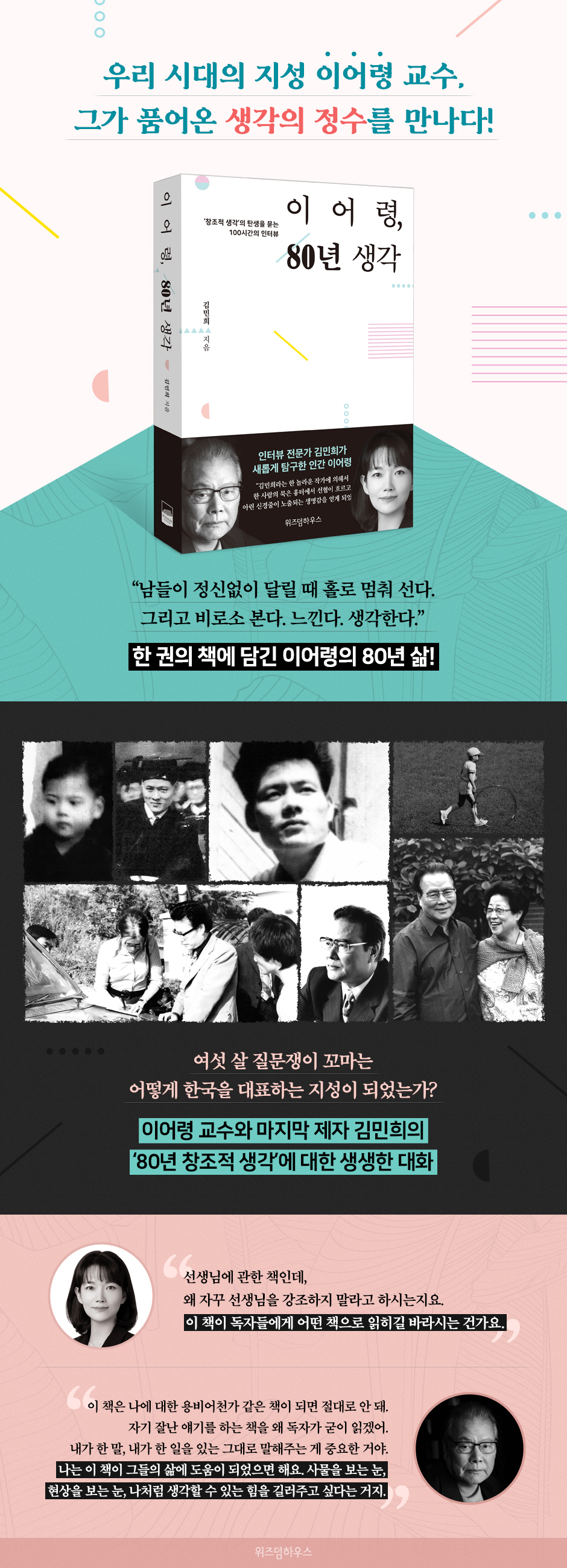
Professor Lee Eo-ryeong and his last disciple, Kim Min-hee
A lively conversation about '80 years of creative thinking'
『Lee Eo-ryeong, 80 Years of Thoughts』 is a book that compiles the honest and sincere stories that Professor Lee Eo-ryeong told to his last student, reporter Kim Min-hee.
Reporter Kim Min-hee is a professional interviewer who has interviewed over 600 people in various fields, including scholars, artists, business managers, and cultural creators who have built their own worlds. Through over 100 hours of interviews with Professor Lee Eo-ryeong, she delved into the mind of one of the greatest intellects of our time and unearthed treasures.
“This book is one that I need to read, not others.
Because, thanks to an amazing writer named Kim Min-hee, a person who had been frozen to a state of numbness was given life, with fresh blood flowing from the old scars and painful nerves exposed.
It's me who's feeling humble.
thank you."
In Korea, there are very few published biographies, that is, books that comment on an individual's life with the author's own thoughts, such as Walter Isaacson's "Steve Jobs" or Stefan Zweig's "Balzac: A Biography."
Rather, there are more autobiographies or memoirs in which the author looks back on his or her life through his or her own words.
The reason there aren't many biographies is probably because there aren't many people worth exploring, and because they are often caught up in political or economic logic, it's difficult to properly evaluate them.
This book deserves attention because it goes beyond the logic of factions and shows the fierce struggles of one man named Lee Eo-ryeong for 80 years.
Professor Lee Eo-ryeong also emphasizes that this book is not a memoir.
It is true that we are looking back on Lee Eo-ryeong's 80-year life through the keyword 'creation', but it is not a story of an unchanging past, but of a 'vibrating present' about thoughts that are still fluttering.
Professor Lee Eo-ryeong said, “I am not a criminal who is certain of what I did in the past.
He said, “If he was a convicted felon, what else would he leave behind besides a will?” and hoped that readers would find this book not a record of the past, but rather an opportunity to “explore the mind of a man who has thought only of one person for over 80 years.”
Representative intellectuals of the Republic of Korea, scholars of our time
A slightly different way of thinking through Lee Eo-ryeong's voice
Professor Lee Eo-ryeong is worthy of such epithets as ‘the intellectual of our time,’ ‘Korea’s greatest scholar,’ and ‘Korea’s representative genius.’
But whenever he hears this expression, he waves his hand and says no.
“I am not a genius.
Creation isn't something grand.
What's important is being able to think for yourself.
Anyone can be like me if they think like me.
“I told you it’s true.”
His statement that anyone can become like Professor Lee Eo-ryeong may seem hard to believe at first, but as you follow his creative path in this book, you will come to understand the meaning of 'thinking with your own head.'
The lines of thought he has followed so far are because he has put into practice the method of seeing everyday objects that we know with 'his own eyes'.
As you follow this journey of dissecting the "thoughts of thought" of an intellectual who never stopped creative thinking even in his late 80s, you will discover your own way of thinking.
Professor Noh, in his 80s, believes in the power of a single tear.
With the world in turmoil due to COVID-19, what does Professor Lee Eo-ryeong think his next keyword will be? To the author's question, Professor Lee Eo-ryeong responds, "'A single tear.' That's the last word I want to leave behind in this era."
He says tears can be the driving force behind thought and creativity.
Just as a single teardrop from Anne Frank hatched into a creative work on the wings of thought and became ‘Anne Frank’s Diary.’
“If Koreans and Korean culture today face a challenge like COVID-19, or are caught up in an unfortunate historical event, they will be able to change the course of history with the power of a single tear from a fragile girl.
That is also the conclusion of my ‘80 years of thinking.’
And then I finally see.
I feel it.
I think.”
Professor Lee Eo-ryeong, the intellectual of our time, and the essence of his thoughts.
Professor Lee Eo-ryeong and his last disciple, Kim Min-hee
A lively conversation about '80 years of creative thinking'
『Lee Eo-ryeong, 80 Years of Thoughts』 is a book that compiles the honest and sincere stories that Professor Lee Eo-ryeong told to his last student, reporter Kim Min-hee.
Reporter Kim Min-hee is a professional interviewer who has interviewed over 600 people in various fields, including scholars, artists, business managers, and cultural creators who have built their own worlds. Through over 100 hours of interviews with Professor Lee Eo-ryeong, she delved into the mind of one of the greatest intellects of our time and unearthed treasures.
“This book is one that I need to read, not others.
Because, thanks to an amazing writer named Kim Min-hee, a person who had been frozen to a state of numbness was given life, with fresh blood flowing from the old scars and painful nerves exposed.
It's me who's feeling humble.
thank you."
In Korea, there are very few published biographies, that is, books that comment on an individual's life with the author's own thoughts, such as Walter Isaacson's "Steve Jobs" or Stefan Zweig's "Balzac: A Biography."
Rather, there are more autobiographies or memoirs in which the author looks back on his or her life through his or her own words.
The reason there aren't many biographies is probably because there aren't many people worth exploring, and because they are often caught up in political or economic logic, it's difficult to properly evaluate them.
This book deserves attention because it goes beyond the logic of factions and shows the fierce struggles of one man named Lee Eo-ryeong for 80 years.
Professor Lee Eo-ryeong also emphasizes that this book is not a memoir.
It is true that we are looking back on Lee Eo-ryeong's 80-year life through the keyword 'creation', but it is not a story of an unchanging past, but of a 'vibrating present' about thoughts that are still fluttering.
Professor Lee Eo-ryeong said, “I am not a criminal who is certain of what I did in the past.
He said, “If he was a convicted felon, what else would he leave behind besides a will?” and hoped that readers would find this book not a record of the past, but rather an opportunity to “explore the mind of a man who has thought only of one person for over 80 years.”
Representative intellectuals of the Republic of Korea, scholars of our time
A slightly different way of thinking through Lee Eo-ryeong's voice
Professor Lee Eo-ryeong is worthy of such epithets as ‘the intellectual of our time,’ ‘Korea’s greatest scholar,’ and ‘Korea’s representative genius.’
But whenever he hears this expression, he waves his hand and says no.
“I am not a genius.
Creation isn't something grand.
What's important is being able to think for yourself.
Anyone can be like me if they think like me.
“I told you it’s true.”
His statement that anyone can become like Professor Lee Eo-ryeong may seem hard to believe at first, but as you follow his creative path in this book, you will come to understand the meaning of 'thinking with your own head.'
The lines of thought he has followed so far are because he has put into practice the method of seeing everyday objects that we know with 'his own eyes'.
As you follow this journey of dissecting the "thoughts of thought" of an intellectual who never stopped creative thinking even in his late 80s, you will discover your own way of thinking.
Professor Noh, in his 80s, believes in the power of a single tear.
With the world in turmoil due to COVID-19, what does Professor Lee Eo-ryeong think his next keyword will be? To the author's question, Professor Lee Eo-ryeong responds, "'A single tear.' That's the last word I want to leave behind in this era."
He says tears can be the driving force behind thought and creativity.
Just as a single teardrop from Anne Frank hatched into a creative work on the wings of thought and became ‘Anne Frank’s Diary.’
“If Koreans and Korean culture today face a challenge like COVID-19, or are caught up in an unfortunate historical event, they will be able to change the course of history with the power of a single tear from a fragile girl.
That is also the conclusion of my ‘80 years of thinking.’
GOODS SPECIFICS
- Date of issue: January 21, 2021
- Page count, weight, size: 412 pages | 634g | 140*210*30mm
- ISBN13: 9791191308303
- ISBN10: 1191308308
You may also like
카테고리
korean


korean

![GQ KOREA Mark (Monthly): December [2025]](http://librairie.coreenne.fr/cdn/shop/files/8ef265dbbfbf186523ed75ba7319009d.jpg?v=1765340328&width=3840)


