

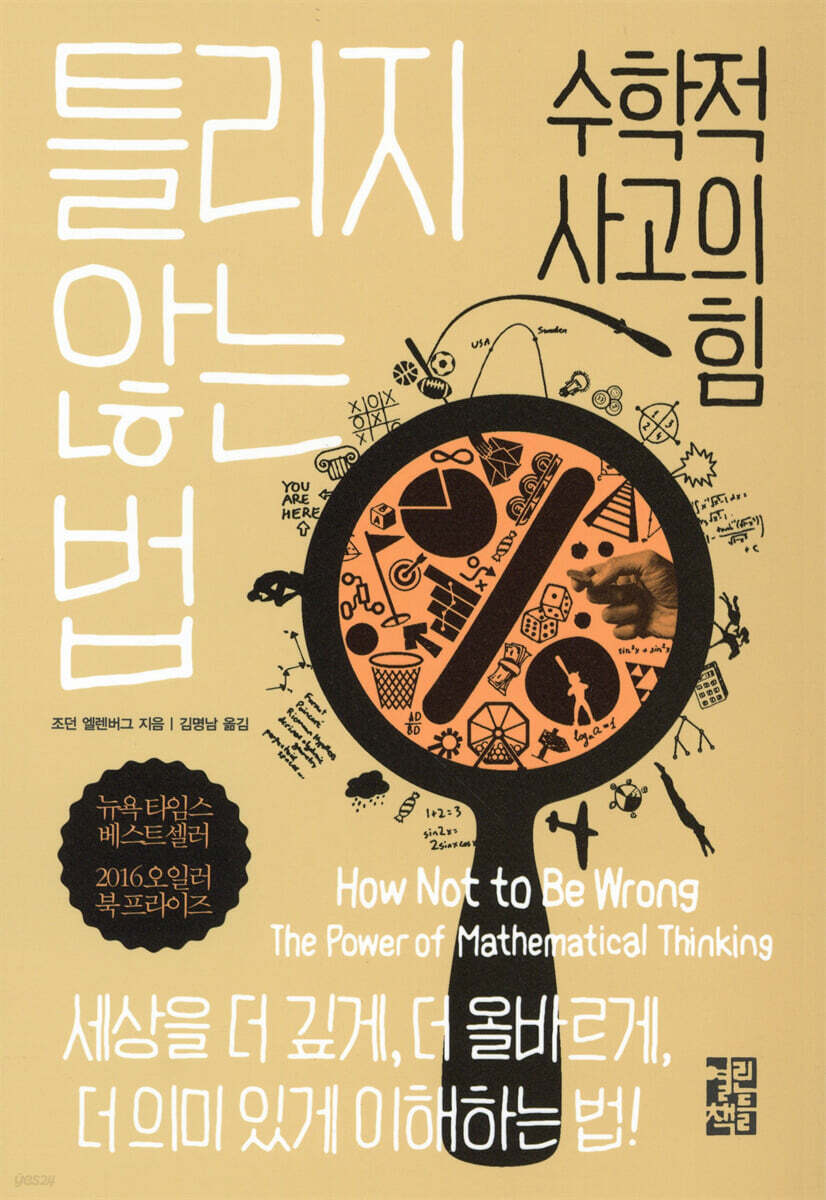
How not to be wrong
 |
Description
Book Introduction
Math books for ordinary people
This is the first popular mathematics book by Jordan Ellenberg, a professor of mathematics at the University of Wisconsin, who is famous for being a mathematician with a child prodigy background.
Combining his signature humor, popular writing style, and the expertise of a promising mathematician, this book has been a New York Times bestseller since its publication in 2014, receiving much love from readers.
It also won the 2016 Euler Book Prize, which is awarded annually by the American Mathematical Society (AMS), and has established itself as an "outstanding mathematical work recognized by mathematicians."
As can be seen from Steven Pinker's evaluation that it follows in the glorious footsteps of Lewis Carroll and Martin Kardner's [Mathematics for Ordinary People], it is a rare masterpiece that succeeds in catching two rabbits: [fun] and [expertise].
While many popular mathematics books simply focus on the topic of interest, this book answers the fundamental questions we have when approaching mathematics.
In other words, it shows why we need mathematics in our lives and how and where we can actually use it more thoroughly, clearly, and pleasantly than any other book.
As one of the world's leading mathematicians, Ellenberg says the world needs more math majors.
We need more doctors who majored in mathematics, more high school teachers who majored in mathematics, more CEOs who majored in mathematics, and more members of the National Assembly who majored in mathematics.
Actually, we need more math.
This book clearly shows how easily we can make mistakes in complex realities without mathematics, and conversely, how mathematics can help us avoid making mistakes.
This is the first popular mathematics book by Jordan Ellenberg, a professor of mathematics at the University of Wisconsin, who is famous for being a mathematician with a child prodigy background.
Combining his signature humor, popular writing style, and the expertise of a promising mathematician, this book has been a New York Times bestseller since its publication in 2014, receiving much love from readers.
It also won the 2016 Euler Book Prize, which is awarded annually by the American Mathematical Society (AMS), and has established itself as an "outstanding mathematical work recognized by mathematicians."
As can be seen from Steven Pinker's evaluation that it follows in the glorious footsteps of Lewis Carroll and Martin Kardner's [Mathematics for Ordinary People], it is a rare masterpiece that succeeds in catching two rabbits: [fun] and [expertise].
While many popular mathematics books simply focus on the topic of interest, this book answers the fundamental questions we have when approaching mathematics.
In other words, it shows why we need mathematics in our lives and how and where we can actually use it more thoroughly, clearly, and pleasantly than any other book.
As one of the world's leading mathematicians, Ellenberg says the world needs more math majors.
We need more doctors who majored in mathematics, more high school teachers who majored in mathematics, more CEOs who majored in mathematics, and more members of the National Assembly who majored in mathematics.
Actually, we need more math.
This book clearly shows how easily we can make mistakes in complex realities without mathematics, and conversely, how mathematics can help us avoid making mistakes.
- You can preview some of the book's contents.
Preview
index
time
Prologue Where can I use this?
Part 1 Linearity
Chapter 1 Less Swedish
Chapter 2 Locally straight, globally curved
Chapter 3: All are obese
Chapter 4: How many Americans died?
A pie bigger than a plate of 5
Part 2 Inference
Chapter 6: The Baltimore Stockbroker and the Bible Code
Chapter 7: Dead Fish Cannot Poison
Chapter 8 Proving by Concluding with Low Probability
Chapter 9 International Journal of Intestinal Molecular Biology
Chapter 10: God, Are You There? It's Me, Bayesian Inference
Looking forward to part 3
Chapter 11: What We Should Really Expect When We Expect to Win the Lottery
Chapter 12 Miss More Flights!
Chapter 13 Where the Rails Meet
Part 4: Regression
Chapter 14: The Triumph of Ordinary
Chapter 15 Galton's Ellipse
Chapter 16: Does Lung Cancer Make You Smoke?
5 parts existence
Chapter 17: There is no public opinion.
Chapter 18 [I Created a Strange New Universe Out of Nothing]
Epilogue: How to Be Right
Acknowledgements
Americas
Search
Translator's Note
Prologue Where can I use this?
Part 1 Linearity
Chapter 1 Less Swedish
Chapter 2 Locally straight, globally curved
Chapter 3: All are obese
Chapter 4: How many Americans died?
A pie bigger than a plate of 5
Part 2 Inference
Chapter 6: The Baltimore Stockbroker and the Bible Code
Chapter 7: Dead Fish Cannot Poison
Chapter 8 Proving by Concluding with Low Probability
Chapter 9 International Journal of Intestinal Molecular Biology
Chapter 10: God, Are You There? It's Me, Bayesian Inference
Looking forward to part 3
Chapter 11: What We Should Really Expect When We Expect to Win the Lottery
Chapter 12 Miss More Flights!
Chapter 13 Where the Rails Meet
Part 4: Regression
Chapter 14: The Triumph of Ordinary
Chapter 15 Galton's Ellipse
Chapter 16: Does Lung Cancer Make You Smoke?
5 parts existence
Chapter 17: There is no public opinion.
Chapter 18 [I Created a Strange New Universe Out of Nothing]
Epilogue: How to Be Right
Acknowledgements
Americas
Search
Translator's Note
Into the book
If you concentrate your armor on the areas of your aircraft that get hit the most, you can get the same protection with less armor.
But exactly how much more armor would they need? That was the answer they wanted from Bald.
But what they got was not the answer.
Bald said.
"You shouldn't put your armor over a bullet hole.
"It should be placed where there are no bullet holes, that is, around the engine." --- p.16
"Why is that math? Isn't that just common sense?" Yes, it is.
Mathematics is common sense.
This fact is absolutely obvious at a fundamental level.
Could you explain to someone why adding seven to five results in the same thing as adding five to seven? Probably not.
This fact is simply built into our thinking about summation.
--- p.23
Not everything in mathematics is as intuitively and perfectly transparent as addition and multiplication.
Calculus cannot be solved with common sense.
However, calculus can be derived from common sense.
--- p.25
The "Obicity" paper hides an even worse crime against mathematics and common sense.
Linear regression is easy.
Once you've done it once, doing it again is a piece of cake.
So Wang and his colleagues further disaggregated the data by racial group and gender.
As a result, black men were less likely to be overweight than the average American.
More importantly, the rate of increase in overweight rates among black men was only half that of the overall rate.
(……) So, do you see the problem? If every American is overweight by 2048, where are all the black men who don't have a weight problem, the one in five of them? Out in the open ocean? --- p.84
Let's say I start flipping a coin and it lands heads ten times in a row.
So what happens then? (……) At this point, our common sense tells us that the chance of getting tails next time is slightly higher.
That way, the existing imbalance will be corrected.
But common sense tells us even more emphatically: the coin has no memory of the results of the last ten times I tossed it! --- p.103
Religious beliefs suit mathematical people well.
The reason we believe in God is not because an angel descended, nor because one day our hearts opened wide and light poured in, nor even because our parents told us to believe, but because God must exist, just as 8 times 6 must be equal to 6 times 8.
--- p.122
When the brains of dead fish were scanned with an fMRI machine and pictures of human faces were shown to them one after another, the fish showed the ability to recognize the emotions of the people in the pictures with surprising accuracy.
Even a dead person or a live fish would be quite impressive, but a dead fish? Nobel Prize worthy! --- p.139
We say that statistical studies that fail to detect phenomena of a certain magnitude have low power.
It's like looking at a planet through binoculars.
Then, there is no need to try it, since the result will be the same whether there is a satellite or not.
You shouldn't ask binoculars to do the work of a telescope.
--- p.169
Saying something is impossible and saying it is extremely unlikely are not the same thing.
It's not even similar.
Impossible things never happen, but unlikely things happen a lot.
--- p.184
Prime numbers are not random at all! There is nothing random or chance-driven about them.
Quite the opposite.
We consider prime numbers to be an immutable property of the universe.
That's why, to show aliens that we're not stupid, we engraved the prime numbers on the gold records Voyager sent into interstellar space.
--- p.189
Many people fear the advent of the big data era.
Part of the fear stems from the implicit assumption that if algorithms are fed enough data, they will be able to make better inferences than we can.
Superhuman abilities are scary.
A being that can transform is scary, a being that dies and is resurrected is scary, and a being that can make inferences that we cannot make is scary.
--- p.219
Question 1: If someone is not a terrorist, what is the probability that they will be on Facebook's risk list?
Question 2: Given someone on Facebook's list, what is the probability that they are not a terrorist?
One way to distinguish between the two questions is to see if the answers are different.
And the answer is really different.
As we saw before, the answer to the first question is 1 in 2,000, but the answer to the second question is 99.99%.
--- p.227
Expected value, like significance, is one of those mathematical terms whose name doesn't quite capture its meaning.
We don't actually expect a lottery ticket to be worth 60 cents.
I don't expect it to be $6 million or $0, I don't expect it to be anything in between.
--- p.263
When I tell people the story of Edmund Halley and the price of annuities, they often interject with something like this:
[But it's obvious that younger people have to pay more!] It's not obvious at all.
(……) If these concepts were truly so obvious, they would not have appeared so late in the history of human thought.
--- p.266
Just as it costs money to get to the airport early, it also costs money to eliminate waste.
While following the rules and remaining vigilant are worthy goals, trying to eliminate all waste carries costs that outweigh the benefits, much like trying to eliminate the possibility of missing a flight altogether.
(……) To borrow Stigler's words, if government doesn't waste at all, we're spending too much time trying to prevent government waste.
--- p.312
Shannon's genius was to see that this view was completely wrong.
Error correction codes are nothing special.
What Shannon proved (and once he understood what he was trying to prove, the proof itself wasn't that difficult) was that almost all codeword sets have error-correcting properties.
(……) This was a truly shocking development, no matter how I put it.
Let's say you're given the task of building a hovercraft.
Wouldn't your first option be to just throw engine parts and rubber tubes on the ground and expect them to float? --- p.372
But among the ugly men, the ones you like, who occupy only a very small corner of the triangle, are all incredibly nice.
That's how it has to be.
Otherwise, it wouldn't even catch your eye in the first place.
It is a very real phenomenon that there is a negative correlation between the appearance and personality of dating candidates.
But if you teach your boyfriend to behave badly in order to improve his appearance, you're falling into the Buckson fallacy.
--- p.467
[Majority Rule] may seem like a simple, clean, and fair technique, but it is only the best technique when deciding between two options.
When there are more than two choices, the majority's preferences begin to become contradictory.
--- p.474
We humans would not be able to come up with a single geometric idea without drawing, without imagining shapes, without considering geometric objects as real entities.
This view, commonly called Platonism, has a generally bad reputation among my philosopher friends.
They ask.
How on earth could a 15-dimensional hypercube be real? I can only reply that it feels as real to me as, say, a mountain peak.
Besides, no matter what anyone says, I know how to define a 15-dimensional hypercube.
Can you do that to a mountain peak? --- p.530
When I first started studying math, I thought the word "effort" was nothing more than a polite insult.
I thought it was an expression used when you can't bring yourself to tell a student that they are smart.
But the ability to make an effort—to focus your attention and energy on a single problem, to think about it systematically, to push through any gaps, and to continue doing so even when there are no visible signs of progress—is not a skill that everyone possesses.
These days, psychologists call that ability [grit], and without grit, you can't do math.
--- p.533
One thing you realize when you do math long enough (and I think this lesson applies much more broadly) is that there will always be someone ahead of you.
(……) There is not a single person in the world who looks in the mirror and mutters, “Let’s admit it, I’m smarter than Gauss.”
Yet, compared to Gauss, all these fools have worked together over the past hundred years to create the richest body of mathematical knowledge in history.
--- p.535
Silver bypassed the rigid conventions of political reporting to tell the public a story closer to the truth.
Instead of saying who would win, or who would get the boost, he said what the odds were.
(……) I never knew something like this was possible.
This unsure thing, this is action!
But exactly how much more armor would they need? That was the answer they wanted from Bald.
But what they got was not the answer.
Bald said.
"You shouldn't put your armor over a bullet hole.
"It should be placed where there are no bullet holes, that is, around the engine." --- p.16
"Why is that math? Isn't that just common sense?" Yes, it is.
Mathematics is common sense.
This fact is absolutely obvious at a fundamental level.
Could you explain to someone why adding seven to five results in the same thing as adding five to seven? Probably not.
This fact is simply built into our thinking about summation.
--- p.23
Not everything in mathematics is as intuitively and perfectly transparent as addition and multiplication.
Calculus cannot be solved with common sense.
However, calculus can be derived from common sense.
--- p.25
The "Obicity" paper hides an even worse crime against mathematics and common sense.
Linear regression is easy.
Once you've done it once, doing it again is a piece of cake.
So Wang and his colleagues further disaggregated the data by racial group and gender.
As a result, black men were less likely to be overweight than the average American.
More importantly, the rate of increase in overweight rates among black men was only half that of the overall rate.
(……) So, do you see the problem? If every American is overweight by 2048, where are all the black men who don't have a weight problem, the one in five of them? Out in the open ocean? --- p.84
Let's say I start flipping a coin and it lands heads ten times in a row.
So what happens then? (……) At this point, our common sense tells us that the chance of getting tails next time is slightly higher.
That way, the existing imbalance will be corrected.
But common sense tells us even more emphatically: the coin has no memory of the results of the last ten times I tossed it! --- p.103
Religious beliefs suit mathematical people well.
The reason we believe in God is not because an angel descended, nor because one day our hearts opened wide and light poured in, nor even because our parents told us to believe, but because God must exist, just as 8 times 6 must be equal to 6 times 8.
--- p.122
When the brains of dead fish were scanned with an fMRI machine and pictures of human faces were shown to them one after another, the fish showed the ability to recognize the emotions of the people in the pictures with surprising accuracy.
Even a dead person or a live fish would be quite impressive, but a dead fish? Nobel Prize worthy! --- p.139
We say that statistical studies that fail to detect phenomena of a certain magnitude have low power.
It's like looking at a planet through binoculars.
Then, there is no need to try it, since the result will be the same whether there is a satellite or not.
You shouldn't ask binoculars to do the work of a telescope.
--- p.169
Saying something is impossible and saying it is extremely unlikely are not the same thing.
It's not even similar.
Impossible things never happen, but unlikely things happen a lot.
--- p.184
Prime numbers are not random at all! There is nothing random or chance-driven about them.
Quite the opposite.
We consider prime numbers to be an immutable property of the universe.
That's why, to show aliens that we're not stupid, we engraved the prime numbers on the gold records Voyager sent into interstellar space.
--- p.189
Many people fear the advent of the big data era.
Part of the fear stems from the implicit assumption that if algorithms are fed enough data, they will be able to make better inferences than we can.
Superhuman abilities are scary.
A being that can transform is scary, a being that dies and is resurrected is scary, and a being that can make inferences that we cannot make is scary.
--- p.219
Question 1: If someone is not a terrorist, what is the probability that they will be on Facebook's risk list?
Question 2: Given someone on Facebook's list, what is the probability that they are not a terrorist?
One way to distinguish between the two questions is to see if the answers are different.
And the answer is really different.
As we saw before, the answer to the first question is 1 in 2,000, but the answer to the second question is 99.99%.
--- p.227
Expected value, like significance, is one of those mathematical terms whose name doesn't quite capture its meaning.
We don't actually expect a lottery ticket to be worth 60 cents.
I don't expect it to be $6 million or $0, I don't expect it to be anything in between.
--- p.263
When I tell people the story of Edmund Halley and the price of annuities, they often interject with something like this:
[But it's obvious that younger people have to pay more!] It's not obvious at all.
(……) If these concepts were truly so obvious, they would not have appeared so late in the history of human thought.
--- p.266
Just as it costs money to get to the airport early, it also costs money to eliminate waste.
While following the rules and remaining vigilant are worthy goals, trying to eliminate all waste carries costs that outweigh the benefits, much like trying to eliminate the possibility of missing a flight altogether.
(……) To borrow Stigler's words, if government doesn't waste at all, we're spending too much time trying to prevent government waste.
--- p.312
Shannon's genius was to see that this view was completely wrong.
Error correction codes are nothing special.
What Shannon proved (and once he understood what he was trying to prove, the proof itself wasn't that difficult) was that almost all codeword sets have error-correcting properties.
(……) This was a truly shocking development, no matter how I put it.
Let's say you're given the task of building a hovercraft.
Wouldn't your first option be to just throw engine parts and rubber tubes on the ground and expect them to float? --- p.372
But among the ugly men, the ones you like, who occupy only a very small corner of the triangle, are all incredibly nice.
That's how it has to be.
Otherwise, it wouldn't even catch your eye in the first place.
It is a very real phenomenon that there is a negative correlation between the appearance and personality of dating candidates.
But if you teach your boyfriend to behave badly in order to improve his appearance, you're falling into the Buckson fallacy.
--- p.467
[Majority Rule] may seem like a simple, clean, and fair technique, but it is only the best technique when deciding between two options.
When there are more than two choices, the majority's preferences begin to become contradictory.
--- p.474
We humans would not be able to come up with a single geometric idea without drawing, without imagining shapes, without considering geometric objects as real entities.
This view, commonly called Platonism, has a generally bad reputation among my philosopher friends.
They ask.
How on earth could a 15-dimensional hypercube be real? I can only reply that it feels as real to me as, say, a mountain peak.
Besides, no matter what anyone says, I know how to define a 15-dimensional hypercube.
Can you do that to a mountain peak? --- p.530
When I first started studying math, I thought the word "effort" was nothing more than a polite insult.
I thought it was an expression used when you can't bring yourself to tell a student that they are smart.
But the ability to make an effort—to focus your attention and energy on a single problem, to think about it systematically, to push through any gaps, and to continue doing so even when there are no visible signs of progress—is not a skill that everyone possesses.
These days, psychologists call that ability [grit], and without grit, you can't do math.
--- p.533
One thing you realize when you do math long enough (and I think this lesson applies much more broadly) is that there will always be someone ahead of you.
(……) There is not a single person in the world who looks in the mirror and mutters, “Let’s admit it, I’m smarter than Gauss.”
Yet, compared to Gauss, all these fools have worked together over the past hundred years to create the richest body of mathematical knowledge in history.
--- p.535
Silver bypassed the rigid conventions of political reporting to tell the public a story closer to the truth.
Instead of saying who would win, or who would get the boost, he said what the odds were.
(……) I never knew something like this was possible.
This unsure thing, this is action!
--- p.554
Publisher's Review
How not to be wrong
The title of this book is very unusual.
For example, why is it [a law that is not wrong] rather than [a law that can be right]?
We understand mathematics, and more broadly science, as a discipline that seeks [the right answer].
In our view, science should provide answers.
That is, it answers questions like whether tax increases or tax cuts would be better in the current economic climate, what the tuberculosis death rate will be in 2050, and even whether it will rain next Tuesday.
But as experience has taught us, while we can predict the weather next week to some extent, we have little idea whether that forecast will be accurate.
Basically, the same goes for math.
Even though mathematics is more rigorous than any other discipline in finding answers, it is almost impossible to provide [correct answers] to many real-world problems.
In the epilogue, Ellenberg cites the example of Nate Silver, author of "The Signal and the Noise," who accurately predicted the U.S. presidential election.
To be misleading, Silver didn't say who would win.
He simply showed the percentage of who was ahead in each state based on opinion polls.
It told me what percentage of Obama's chances of winning were based on probabilities and expectations, and it was right.
In other words, Silver did not speak based on his own political leanings, beliefs, intuition, or the results of fortune-telling with his gut, but rather presented probabilities calculated based on data.
And it wasn't [the right answer], but it was really [hard to get wrong].
The reality is that it is very difficult to even [not be wrong].
Modern people are exposed to countless facts and data.
If we don't handle it right, we are prone to mistakes.
The examples presented in the introduction of the military generals who were obsessed with increasing the survival rate of fighter planes during World War II make us realize how easily we can be wrong.
If we don't handle data properly, we are prone to making mistakes.
To avoid mistakes, you need to set the right assumptions, select the right data set, and apply the right algorithm.
This is what Ellenberg means by [mathematical thinking].
It's about recognizing, verifying, and finding mechanisms for better or more accurate judgment.
Of course, we could just say what we believe without any basis or by interpreting the data as we please.
But we never want to be wrong when it comes to deciding whether tax cuts or increases are better for stimulating the economy, which stock portfolio to invest in, or which presidential candidate has the most support.
For such people, the methodology presented in this book, [How to Not Be Wrong], will be incredibly useful.
Mathematics covered in this book
In this book, Ellenberg divides mathematics into four major categories: simple and complex in terms of structure, and profound and shallow in terms of meaning.
Basic arithmetic facts like 1+2=3 are simple and shallow.
Moving on to the complex/shallow section, there are problems such as multiplying two ten-digit numbers, computing complex definite integrals, and, for those who have studied for a couple of years in graduate school, finding the Frobenius antidiagonal in the modular form of Conductor 2377.
Problems like this are naturally somewhere in between being cumbersome to impossible to solve manually, and in modular form, it takes a lot of study just to understand what's being asked of you.
But knowing these answers won't really enrich your understanding of the world.
The complex/profound section is where professional mathematicians spend most of their time.
Here live famous theorems and conjectures such as the Riemann hypothesis, Fermat's last theorem, the Poincaré conjecture, P vs. NP, Gödel's theorem...
These theorems all concern concepts of profound meaning, fundamental importance, overwhelming beauty, and brutally complex detail, each worthy of its own book.
But that's not the mathematics this book deals with.
This book covers simple yet profound topics.
The mathematical concepts here are problems that anyone can directly and profitably engage with, whether they stopped studying math before progressing to algebra or have learned more.
And these concepts are principles that can be applied broadly beyond the fields we normally think of as mathematics.
Based on these classifications, this book covers the major topics of [linearity], [inference], [regression], [expectation], and [existence].
Going into detail, we can hear answers to the following questions:
What exactly does regression to the mean mean? It's often said that correlation is not causation, but how exactly is correlation defined? What criteria do journals use to determine the significance of a study when publishing it? If a study falls short of that standard, does that mean it's wrong? Conversely, if a study passes that standard, does that mean it's definitely correct? George Stigler, a Nobel laureate in economics, is said to have said, "If you've never missed a flight, you've wasted too much time at the airport." What does that even mean? Mathematicians consistently say that lottery tickets are a waste of money, but is that really true?
Correlation, linear regression, expected value, prior and posterior probabilities, null hypothesis significance testing… .
Ellenberg illustrates how widely these concepts are used today, citing examples from basketball, baseball, lottery games, thesis review, and the relationship between smoking and lung cancer.
He points out that without these concepts, we cannot understand even a little bit of modern news, sports statistics, or political and social decision-making processes.
He also says that the moment you truly understand these concepts, you will realize how many completely wrong things and blind spots the writers of information circulating in the mass media and political circles were unaware of.
So, this book is for ordinary people who don't want to be fooled by clever mathematical rhetoric, but above all, it is a must-read for journalists, politicians, marketers, teachers, and others who want to avoid being fooled by the blind spots of the mathematical tools they wield.
Mathematics is an extension of common sense by other means.
We often tend to think of mathematics as the exclusive domain of geniuses.
Ellenberg explicitly denies this.
Of course, there are many geniuses in the world of mathematics.
What else could someone like Ellenberg, a math prodigy, or Terry Tao, a Fields Medalist, be if not a genius?
But as Ellenberg writes, there is not a single person in the world who looks in the mirror and mutters, "Let's face it, I'm smarter than Gauss."
Yet, compared to Gauss, all these fools have worked together over the past hundred years to create the richest body of mathematical knowledge in history.
In that respect, Ellenberg says that mathematics is a discipline of [effort].
Focusing your attention and energy on a single problem, systematically thinking about it over and over again, and pushing through any gaps that seem to exist—especially when there are no visible signs of progress—is not a skill that everyone possesses.
Psychologists call this ability [grit], and without grit you can't do math.
Conversely, anyone with this attitude can do math.
That is, according to him, mathematics can be [common sense].
We can start from common sense arithmetic and progress to some extent to the more difficult theories of modern mathematics.
That is exactly what this book aims to show.
How successful was this book in its ambitious goal of revealing the utility, appeal, and pitfalls of mathematical thinking as common sense? In conclusion, it was quite successful.
What makes this book stand out from other popular mathematics books is that the author doesn't succumb to the temptation of easy simplification.
For example, it is impossible to explain Bayesian inference, which can be said to be the trend of modern probability theory, so that everyone can understand it right away.
Some areas of mathematics, especially the theory of probability and statistics, which are beyond the capabilities of our meager human cognitive abilities, are difficult to understand intuitively.
Therefore, the explanation cannot be that simple.
The book is honest in that it doesn't avoid or feign the difficulty, and it succeeds in that it explains the difficult story in a way that anyone can follow along with reasonable concentration.
In this book, for example, we will be able to learn calculus in just one page, and we will also be able to understand algebra and logarithms in just one page.
You'll learn how to get partial credit on your math test, and you'll encounter some eye-poppingly clever and beautiful proofs, including [Buffon's Needle].
Chapter 13, which moves from projective geometry to information theory, then abruptly jumps to the problem of stacking oranges as densely as possible, then to the problem of selecting lottery numbers without overlapping, and finally returns to geometry, is a good example of the patterns in which pure mathematics and reality influence and develop, and it is like looking at a magnificent building.
The author said that this book is the result of the wise editors' meticulous polishing of his original intention of "exclaiming to the world at length how wonderful mathematics is," and readers who read to the end will surely be glad that the editors did not shorten it any further.
The title of this book is very unusual.
For example, why is it [a law that is not wrong] rather than [a law that can be right]?
We understand mathematics, and more broadly science, as a discipline that seeks [the right answer].
In our view, science should provide answers.
That is, it answers questions like whether tax increases or tax cuts would be better in the current economic climate, what the tuberculosis death rate will be in 2050, and even whether it will rain next Tuesday.
But as experience has taught us, while we can predict the weather next week to some extent, we have little idea whether that forecast will be accurate.
Basically, the same goes for math.
Even though mathematics is more rigorous than any other discipline in finding answers, it is almost impossible to provide [correct answers] to many real-world problems.
In the epilogue, Ellenberg cites the example of Nate Silver, author of "The Signal and the Noise," who accurately predicted the U.S. presidential election.
To be misleading, Silver didn't say who would win.
He simply showed the percentage of who was ahead in each state based on opinion polls.
It told me what percentage of Obama's chances of winning were based on probabilities and expectations, and it was right.
In other words, Silver did not speak based on his own political leanings, beliefs, intuition, or the results of fortune-telling with his gut, but rather presented probabilities calculated based on data.
And it wasn't [the right answer], but it was really [hard to get wrong].
The reality is that it is very difficult to even [not be wrong].
Modern people are exposed to countless facts and data.
If we don't handle it right, we are prone to mistakes.
The examples presented in the introduction of the military generals who were obsessed with increasing the survival rate of fighter planes during World War II make us realize how easily we can be wrong.
If we don't handle data properly, we are prone to making mistakes.
To avoid mistakes, you need to set the right assumptions, select the right data set, and apply the right algorithm.
This is what Ellenberg means by [mathematical thinking].
It's about recognizing, verifying, and finding mechanisms for better or more accurate judgment.
Of course, we could just say what we believe without any basis or by interpreting the data as we please.
But we never want to be wrong when it comes to deciding whether tax cuts or increases are better for stimulating the economy, which stock portfolio to invest in, or which presidential candidate has the most support.
For such people, the methodology presented in this book, [How to Not Be Wrong], will be incredibly useful.
Mathematics covered in this book
In this book, Ellenberg divides mathematics into four major categories: simple and complex in terms of structure, and profound and shallow in terms of meaning.
Basic arithmetic facts like 1+2=3 are simple and shallow.
Moving on to the complex/shallow section, there are problems such as multiplying two ten-digit numbers, computing complex definite integrals, and, for those who have studied for a couple of years in graduate school, finding the Frobenius antidiagonal in the modular form of Conductor 2377.
Problems like this are naturally somewhere in between being cumbersome to impossible to solve manually, and in modular form, it takes a lot of study just to understand what's being asked of you.
But knowing these answers won't really enrich your understanding of the world.
The complex/profound section is where professional mathematicians spend most of their time.
Here live famous theorems and conjectures such as the Riemann hypothesis, Fermat's last theorem, the Poincaré conjecture, P vs. NP, Gödel's theorem...
These theorems all concern concepts of profound meaning, fundamental importance, overwhelming beauty, and brutally complex detail, each worthy of its own book.
But that's not the mathematics this book deals with.
This book covers simple yet profound topics.
The mathematical concepts here are problems that anyone can directly and profitably engage with, whether they stopped studying math before progressing to algebra or have learned more.
And these concepts are principles that can be applied broadly beyond the fields we normally think of as mathematics.
Based on these classifications, this book covers the major topics of [linearity], [inference], [regression], [expectation], and [existence].
Going into detail, we can hear answers to the following questions:
What exactly does regression to the mean mean? It's often said that correlation is not causation, but how exactly is correlation defined? What criteria do journals use to determine the significance of a study when publishing it? If a study falls short of that standard, does that mean it's wrong? Conversely, if a study passes that standard, does that mean it's definitely correct? George Stigler, a Nobel laureate in economics, is said to have said, "If you've never missed a flight, you've wasted too much time at the airport." What does that even mean? Mathematicians consistently say that lottery tickets are a waste of money, but is that really true?
Correlation, linear regression, expected value, prior and posterior probabilities, null hypothesis significance testing… .
Ellenberg illustrates how widely these concepts are used today, citing examples from basketball, baseball, lottery games, thesis review, and the relationship between smoking and lung cancer.
He points out that without these concepts, we cannot understand even a little bit of modern news, sports statistics, or political and social decision-making processes.
He also says that the moment you truly understand these concepts, you will realize how many completely wrong things and blind spots the writers of information circulating in the mass media and political circles were unaware of.
So, this book is for ordinary people who don't want to be fooled by clever mathematical rhetoric, but above all, it is a must-read for journalists, politicians, marketers, teachers, and others who want to avoid being fooled by the blind spots of the mathematical tools they wield.
Mathematics is an extension of common sense by other means.
We often tend to think of mathematics as the exclusive domain of geniuses.
Ellenberg explicitly denies this.
Of course, there are many geniuses in the world of mathematics.
What else could someone like Ellenberg, a math prodigy, or Terry Tao, a Fields Medalist, be if not a genius?
But as Ellenberg writes, there is not a single person in the world who looks in the mirror and mutters, "Let's face it, I'm smarter than Gauss."
Yet, compared to Gauss, all these fools have worked together over the past hundred years to create the richest body of mathematical knowledge in history.
In that respect, Ellenberg says that mathematics is a discipline of [effort].
Focusing your attention and energy on a single problem, systematically thinking about it over and over again, and pushing through any gaps that seem to exist—especially when there are no visible signs of progress—is not a skill that everyone possesses.
Psychologists call this ability [grit], and without grit you can't do math.
Conversely, anyone with this attitude can do math.
That is, according to him, mathematics can be [common sense].
We can start from common sense arithmetic and progress to some extent to the more difficult theories of modern mathematics.
That is exactly what this book aims to show.
How successful was this book in its ambitious goal of revealing the utility, appeal, and pitfalls of mathematical thinking as common sense? In conclusion, it was quite successful.
What makes this book stand out from other popular mathematics books is that the author doesn't succumb to the temptation of easy simplification.
For example, it is impossible to explain Bayesian inference, which can be said to be the trend of modern probability theory, so that everyone can understand it right away.
Some areas of mathematics, especially the theory of probability and statistics, which are beyond the capabilities of our meager human cognitive abilities, are difficult to understand intuitively.
Therefore, the explanation cannot be that simple.
The book is honest in that it doesn't avoid or feign the difficulty, and it succeeds in that it explains the difficult story in a way that anyone can follow along with reasonable concentration.
In this book, for example, we will be able to learn calculus in just one page, and we will also be able to understand algebra and logarithms in just one page.
You'll learn how to get partial credit on your math test, and you'll encounter some eye-poppingly clever and beautiful proofs, including [Buffon's Needle].
Chapter 13, which moves from projective geometry to information theory, then abruptly jumps to the problem of stacking oranges as densely as possible, then to the problem of selecting lottery numbers without overlapping, and finally returns to geometry, is a good example of the patterns in which pure mathematics and reality influence and develop, and it is like looking at a magnificent building.
The author said that this book is the result of the wise editors' meticulous polishing of his original intention of "exclaiming to the world at length how wonderful mathematics is," and readers who read to the end will surely be glad that the editors did not shorten it any further.
GOODS SPECIFICS
- Date of issue: April 25, 2016
- Format: Hardcover book binding method guide
- Page count, weight, size: 616 pages | 1,010g | 158*232*35mm
- ISBN13: 9788932917658
- ISBN10: 8932917655
You may also like
카테고리
korean


korean

![ELLE 엘르 스페셜 에디션 A형 : 12월 [2025]](http://librairie.coreenne.fr/cdn/shop/files/b8e27a3de6c9538896439686c6b0e8fb.jpg?v=1766436872&width=3840)


