

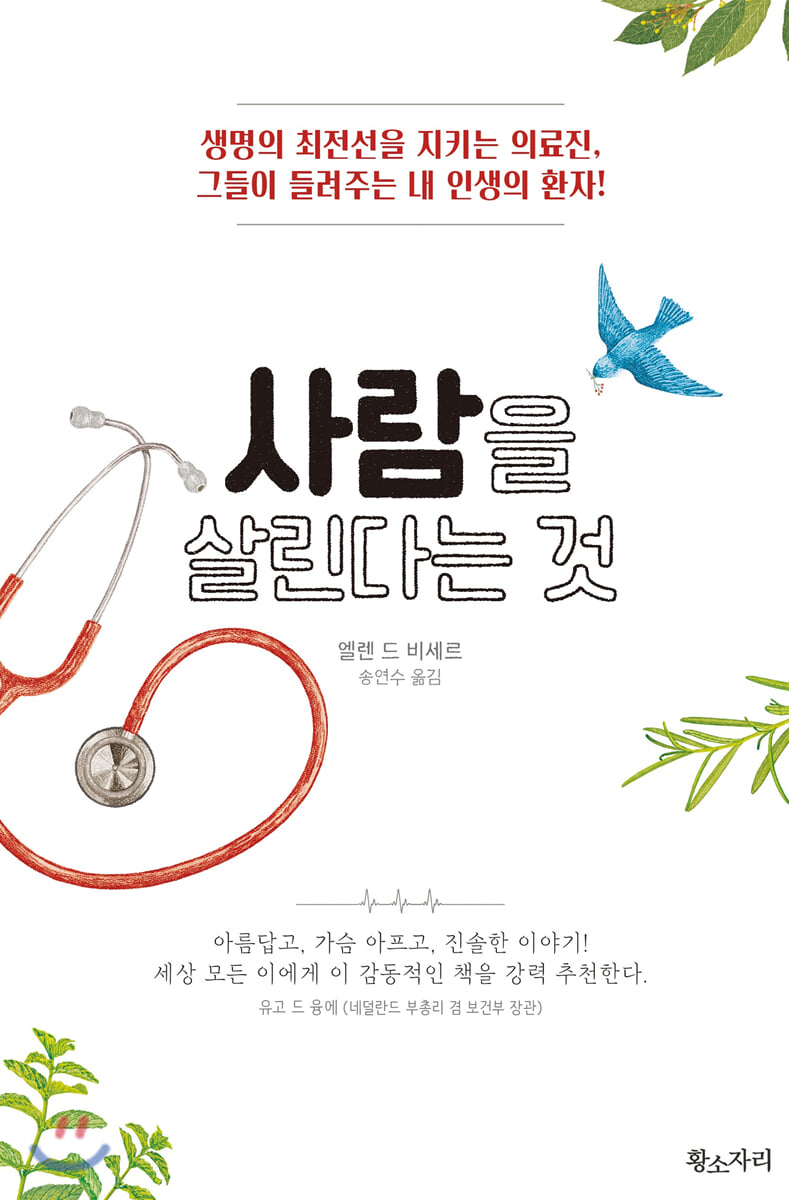
Saving people
 |
Description
Book Introduction
- A word from MD
-
On the border between life and deathThe author, a Dutch journalist, talks to a doctor at his brother-in-law's funeral.
The doctor confessed that he learned a lot from the patient.
From this experience, the series 'The One Patient Who Changed Me and Made Me Grow' was born.
This book contains the stories of over 80 medical staff who experienced life and death.
January 12, 2021. Humanities PD Son Min-gyu
Patients and medical staff crossing the line between life and death together,
A very special story that blossomed on that precarious road!
Medical professionals require a special type of empathy.
They are trained from their student days to maintain composure by establishing a psychological barrier to pay attention to patients but not to be swept away by emotions.
But occasionally, there are patients who break through that solid barrier and leave a decisive mark on the hearts and minds of medical staff, ultimately changing their outlook on life and even the direction of their lives.
This book is a rare masterpiece that contains just such a story.
From budding residents in various fields to nurses, emergency medical technicians, and caregivers, and from Kasper Van Eyck, a surgical oncologist famous for being Steve Jobs's personal physician, to Anthony Fauci, director of the National Institute of Allergy and Infectious Diseases, the stories of "the patients of my life" told by over 80 medical professionals are sometimes tearful, sometimes terrifying, and sometimes deeply moving.
This book, which vividly and honestly tells the memories and special experiences of just one patient among the countless patients met and parted ways in the medical field, will provide special emotion and comfort to all of us living in this icy era due to COVID-19.
A very special story that blossomed on that precarious road!
Medical professionals require a special type of empathy.
They are trained from their student days to maintain composure by establishing a psychological barrier to pay attention to patients but not to be swept away by emotions.
But occasionally, there are patients who break through that solid barrier and leave a decisive mark on the hearts and minds of medical staff, ultimately changing their outlook on life and even the direction of their lives.
This book is a rare masterpiece that contains just such a story.
From budding residents in various fields to nurses, emergency medical technicians, and caregivers, and from Kasper Van Eyck, a surgical oncologist famous for being Steve Jobs's personal physician, to Anthony Fauci, director of the National Institute of Allergy and Infectious Diseases, the stories of "the patients of my life" told by over 80 medical professionals are sometimes tearful, sometimes terrifying, and sometimes deeply moving.
This book, which vividly and honestly tells the memories and special experiences of just one patient among the countless patients met and parted ways in the medical field, will provide special emotion and comfort to all of us living in this icy era due to COVID-19.
- You can preview some of the book's contents.
Preview
index
Recommendation_5
Introduction _ 11
PART 1
Jump to Conclusions, Amazing Misunderstandings 23
The feeling of bottle caps gnawing on your groin 27
One life goes, a new life comes 31
“What would you do if it were your daughter?” 35
39 Moments of Small Victory
After removing the barriers of the mind 43
"See? I told you I'd win in the end." 47
What happened to that child? 51
The Last Night Comes for Everyone 55
The feeling of choosing not to save your daughter 59
A painful, painful Tuesday night, 63
Just by staying by my side 67
71 For those in moments of grief
The Amazing Resilience of Refugee Children 75
My Cold Heart 79
Notes from the Underground 83
PART 2
When I became the father of a sick daughter, 89
93 Faced with a life-or-death decision
The exit is ultimately self-created 97
Excessive kindness becomes an arrow 101
105 Things You Only Realize After Becoming a Patient
Encountering a Strange Face in the Mirror 109
Memories of Terror That Surge Like a Tidal Wave 113
That night, the old lady 117
The Transformation of a Man Who Lost His Voice 121
Small but Clear Comfort 125
Could I have saved that child? 129
Inner strength that surges like a lie 133
After that day, Christmas 137
141 newborns abandoned in plastic bags
145 Clear traces left behind wherever you pass
“Pearl feeds on love” 149
The Potential of Humor 153
PART 3
Death is inherently present in the midst of life 159
Treatment Priority 163
The Irritable Old Man 167
What can you do for someone whose exits are blocked? , 171
Before and After Madness 175
Our Friendship, 60 Years Beyond Time 179
The Sides of Dementia 183
“Here by the river, now I am happy.” 187
Who has the power over life and death? 191
Monica's Courage 195
Doctors are not omnipotent beings 199
Laughter Spreader 203
She is a true fighter 207
Become a patient's guide 211
Her 18 months, equivalent to a lifetime, 215
A couple bravely confronting a designer-driven world 219
PART 4
“I can’t sleep, afraid I’ll be gone forever.” 225
The puppy spoke to me with his eyes 229
Every time there's too much on my plate, 233
Deep Peace Finally Comes 237
Even parental love sometimes requires time. 241
I became a lung cancer patient at 245
My First Euthanasia Patient 249
“They couldn’t see me.” 253
When Rules Become a Straitjacket 257
The day I delivered my baby in the ambulance 261
Hormones attacked her brain 265
Technical Therapy, Psychological Healing 269
Listen to Your Inner Voice 273
277 Good and Bad Experiences That Made Me Who I Am Today
Love Beyond Time 281
PART 5
After eating a peanut butter sandwich 287
Thanks to the patient's support, 291
295 to uncover the truth about the death of her daughter who suddenly passed away
Boy 299 I Met at a Gas Station on a Rainy Night
Patient 303: The Man Who Changed My Life's Course
Things That Are Hard to Bear 307
A Wedding Night to Remember for a Lifetime 311
Courage to brake at the right time 315
“Tomorrow at dawn, you will witness my death.” 319
323 To not forget a lonely girl
My mother, who became terminally ill with cancer, 327
Don't Let Them Leave Empty-Handed 331
An Infinitely Lonely and Desolate Life 335
Laurel's Pain, Laurel's Courage 339
A Young Doctor's Letter to Be Cherished for a Lifetime 343
Helping Patients Beyond Treatment 347
Every doctor has his own graveyard in his heart. 351
Introduction _ 11
PART 1
Jump to Conclusions, Amazing Misunderstandings 23
The feeling of bottle caps gnawing on your groin 27
One life goes, a new life comes 31
“What would you do if it were your daughter?” 35
39 Moments of Small Victory
After removing the barriers of the mind 43
"See? I told you I'd win in the end." 47
What happened to that child? 51
The Last Night Comes for Everyone 55
The feeling of choosing not to save your daughter 59
A painful, painful Tuesday night, 63
Just by staying by my side 67
71 For those in moments of grief
The Amazing Resilience of Refugee Children 75
My Cold Heart 79
Notes from the Underground 83
PART 2
When I became the father of a sick daughter, 89
93 Faced with a life-or-death decision
The exit is ultimately self-created 97
Excessive kindness becomes an arrow 101
105 Things You Only Realize After Becoming a Patient
Encountering a Strange Face in the Mirror 109
Memories of Terror That Surge Like a Tidal Wave 113
That night, the old lady 117
The Transformation of a Man Who Lost His Voice 121
Small but Clear Comfort 125
Could I have saved that child? 129
Inner strength that surges like a lie 133
After that day, Christmas 137
141 newborns abandoned in plastic bags
145 Clear traces left behind wherever you pass
“Pearl feeds on love” 149
The Potential of Humor 153
PART 3
Death is inherently present in the midst of life 159
Treatment Priority 163
The Irritable Old Man 167
What can you do for someone whose exits are blocked? , 171
Before and After Madness 175
Our Friendship, 60 Years Beyond Time 179
The Sides of Dementia 183
“Here by the river, now I am happy.” 187
Who has the power over life and death? 191
Monica's Courage 195
Doctors are not omnipotent beings 199
Laughter Spreader 203
She is a true fighter 207
Become a patient's guide 211
Her 18 months, equivalent to a lifetime, 215
A couple bravely confronting a designer-driven world 219
PART 4
“I can’t sleep, afraid I’ll be gone forever.” 225
The puppy spoke to me with his eyes 229
Every time there's too much on my plate, 233
Deep Peace Finally Comes 237
Even parental love sometimes requires time. 241
I became a lung cancer patient at 245
My First Euthanasia Patient 249
“They couldn’t see me.” 253
When Rules Become a Straitjacket 257
The day I delivered my baby in the ambulance 261
Hormones attacked her brain 265
Technical Therapy, Psychological Healing 269
Listen to Your Inner Voice 273
277 Good and Bad Experiences That Made Me Who I Am Today
Love Beyond Time 281
PART 5
After eating a peanut butter sandwich 287
Thanks to the patient's support, 291
295 to uncover the truth about the death of her daughter who suddenly passed away
Boy 299 I Met at a Gas Station on a Rainy Night
Patient 303: The Man Who Changed My Life's Course
Things That Are Hard to Bear 307
A Wedding Night to Remember for a Lifetime 311
Courage to brake at the right time 315
“Tomorrow at dawn, you will witness my death.” 319
323 To not forget a lonely girl
My mother, who became terminally ill with cancer, 327
Don't Let Them Leave Empty-Handed 331
An Infinitely Lonely and Desolate Life 335
Laurel's Pain, Laurel's Courage 339
A Young Doctor's Letter to Be Cherished for a Lifetime 343
Helping Patients Beyond Treatment 347
Every doctor has his own graveyard in his heart. 351
Detailed image
Into the book
Late one night, a woman was brought into the emergency room.
According to the husband, his wife attempted suicide by jumping from the eighth floor of her apartment.
In order to save the patient whose entire body was damaged, the entire hospital's medical staff, including surgeons, plastic surgeons, otolaryngologists, pain medicine specialists, and dentists, were mobilized to perform surgery and treatment.
But for months, the woman remained unconscious and dependent on a ventilator.
Top Slapendel, a second-year pain medicine resident, asked himself several times.
A woman who tried to take her own life is lying there, and here we are, desperately trying to save her life.
What kind of medical waste is this? After six months, the patient showed some improvement.
Finally, with the ventilator removed from her neck, she was able to speak and tell a story no one expected.
“My husband pushed me off the balcony.” This incident completely changed Slapendel’s outlook on life and career as a novice doctor.
From that day on, he does his best to save the sick whoever comes before him, even if they are criminals or attempted suicide.
Because he believes that it is his mission.
--- p.23
After that experience, my attitude towards patients changed 180 degrees.
It was a realization that every patient, regardless of age, gender, occupation, or previous medical history, whether he or she was a criminal or attempted suicide, was worthy of our care.
This woman's case's unexpected twist not only changed my perspective on my profession as a doctor, but also my outlook on life and the world.
--- p.26
"great.
“Let me try it myself, okay?” I still remember clearly the moment I said this to him.
Because he sat down on the spot and burst into tears.
A fully grown man of strong build was brought to his knees and in tears over a small piece of plastic.
Perhaps it was the relief of finally finding a trustworthy doctor? It was also a moment when I, as a doctor, realized how important it is to listen deeply to a patient's story.
--- p.29
The atmosphere changed in an instant.
The hospital room was filled with energy, and the joy and elation of the families spread throughout the room, almost palpable.
I tried to calm down, but before I knew it, I was absorbed in their happiness.
The patient, who had initially just blinked and remained still, showed a surprising reaction when he saw the baby.
He looked at the monitor for a while and then spoke softly.
“The old life is leaving and now a new life is coming!”
--- p.33
Now, when I see young patients with terminal illnesses, I do everything I can to help them live as long and comfortably as possible.
We encourage you to get out of bed for a while and try to ease your pain by providing you with healthy foods whenever possible.
Anything I can do to make sure they don't think it's over too quickly.
--- p.38
Now, 13 years later, Christopher is not the same person we first met.
I see him once every six months.
Very slowly his condition continues to worsen.
He needs a respirator at night and his vocal cords are damaged, making his speech unclear.
But the moment he went to college, his depression disappeared.
He was trapped behind a barrier to express himself, revealing his sad face in the form of depression, but once the barrier was removed, his life changed completely.
--- p.45
Our last moment, or our last night with our loved ones, will always come eventually.
We usually live without even knowing when that moment will come.
But he had seen it.
He greeted me and thanked me for being honest with him.
Knowing that Irma would not live, he was able to decide for himself how to spend his final hours with her.
--- p.57
She later recalled the moment I entered the intensive care unit:
“That’s when Hanneke walked into my life.” Those words seemed to say it all.
The confidence and trust she showed me in that hospital room at that time was so desperate that I still can't forget it.
Because it was the biggest ordeal of my life, being left alone with my two children.
--- p.74
On a Sunday afternoon, a young woman came to the home of Ted Van Essen, a family doctor, and asked for euthanasia out of the blue.
This was long before the euthanasia law was passed in the Netherlands.
Feeling burdened by this situation, Essen sent her home the next day, telling her to come to the hospital and talk things through properly.
The next day, the woman did not show up.
On Wednesday morning, I received a call from the police.
Police said a woman jumped to her death from a building near Essen's clinic and asked people to come to the morgue to identify her.
How could he ever forget the moment he walked into the small, cramped morgue and saw the woman's horribly mangled body? Even now, 25 years later, Essen feels a pang of guilt whenever he thinks of her.
Because on that Sunday afternoon, she made a heartbreaking choice, taking her hesitation as a rejection.
This incident changed Essen's view on euthanasia.
At least there shouldn't be the same tragedy.
--- p.171
One patient complained of extreme anxiety and difficulty sleeping.
Anne Speckens, a rookie doctor newly assigned to the psychiatry department, asked her patient why she was so anxious.
A male patient in his early 40s said he could not sleep because he was afraid he would die in his sleep.
He said that he felt like he wouldn't be able to wake up once he fell asleep, that he couldn't sleep because he was afraid that he would never see his wife and children again.
Speckens advised him to get enough sleep to get better and prescribed him a sedative.
When I went there the next morning, his bed was empty.
When I asked the nurse, I got a short answer.
“The patient died last night.” I had done my job by administering a tranquilizer, but I found it difficult to accept that I had let the patient down in such a fundamental way.
After that incident, Speckens, who had been wandering for a while, changed his career path to 'mindfulness' and became a pioneer in that field.
According to the husband, his wife attempted suicide by jumping from the eighth floor of her apartment.
In order to save the patient whose entire body was damaged, the entire hospital's medical staff, including surgeons, plastic surgeons, otolaryngologists, pain medicine specialists, and dentists, were mobilized to perform surgery and treatment.
But for months, the woman remained unconscious and dependent on a ventilator.
Top Slapendel, a second-year pain medicine resident, asked himself several times.
A woman who tried to take her own life is lying there, and here we are, desperately trying to save her life.
What kind of medical waste is this? After six months, the patient showed some improvement.
Finally, with the ventilator removed from her neck, she was able to speak and tell a story no one expected.
“My husband pushed me off the balcony.” This incident completely changed Slapendel’s outlook on life and career as a novice doctor.
From that day on, he does his best to save the sick whoever comes before him, even if they are criminals or attempted suicide.
Because he believes that it is his mission.
--- p.23
After that experience, my attitude towards patients changed 180 degrees.
It was a realization that every patient, regardless of age, gender, occupation, or previous medical history, whether he or she was a criminal or attempted suicide, was worthy of our care.
This woman's case's unexpected twist not only changed my perspective on my profession as a doctor, but also my outlook on life and the world.
--- p.26
"great.
“Let me try it myself, okay?” I still remember clearly the moment I said this to him.
Because he sat down on the spot and burst into tears.
A fully grown man of strong build was brought to his knees and in tears over a small piece of plastic.
Perhaps it was the relief of finally finding a trustworthy doctor? It was also a moment when I, as a doctor, realized how important it is to listen deeply to a patient's story.
--- p.29
The atmosphere changed in an instant.
The hospital room was filled with energy, and the joy and elation of the families spread throughout the room, almost palpable.
I tried to calm down, but before I knew it, I was absorbed in their happiness.
The patient, who had initially just blinked and remained still, showed a surprising reaction when he saw the baby.
He looked at the monitor for a while and then spoke softly.
“The old life is leaving and now a new life is coming!”
--- p.33
Now, when I see young patients with terminal illnesses, I do everything I can to help them live as long and comfortably as possible.
We encourage you to get out of bed for a while and try to ease your pain by providing you with healthy foods whenever possible.
Anything I can do to make sure they don't think it's over too quickly.
--- p.38
Now, 13 years later, Christopher is not the same person we first met.
I see him once every six months.
Very slowly his condition continues to worsen.
He needs a respirator at night and his vocal cords are damaged, making his speech unclear.
But the moment he went to college, his depression disappeared.
He was trapped behind a barrier to express himself, revealing his sad face in the form of depression, but once the barrier was removed, his life changed completely.
--- p.45
Our last moment, or our last night with our loved ones, will always come eventually.
We usually live without even knowing when that moment will come.
But he had seen it.
He greeted me and thanked me for being honest with him.
Knowing that Irma would not live, he was able to decide for himself how to spend his final hours with her.
--- p.57
She later recalled the moment I entered the intensive care unit:
“That’s when Hanneke walked into my life.” Those words seemed to say it all.
The confidence and trust she showed me in that hospital room at that time was so desperate that I still can't forget it.
Because it was the biggest ordeal of my life, being left alone with my two children.
--- p.74
On a Sunday afternoon, a young woman came to the home of Ted Van Essen, a family doctor, and asked for euthanasia out of the blue.
This was long before the euthanasia law was passed in the Netherlands.
Feeling burdened by this situation, Essen sent her home the next day, telling her to come to the hospital and talk things through properly.
The next day, the woman did not show up.
On Wednesday morning, I received a call from the police.
Police said a woman jumped to her death from a building near Essen's clinic and asked people to come to the morgue to identify her.
How could he ever forget the moment he walked into the small, cramped morgue and saw the woman's horribly mangled body? Even now, 25 years later, Essen feels a pang of guilt whenever he thinks of her.
Because on that Sunday afternoon, she made a heartbreaking choice, taking her hesitation as a rejection.
This incident changed Essen's view on euthanasia.
At least there shouldn't be the same tragedy.
--- p.171
One patient complained of extreme anxiety and difficulty sleeping.
Anne Speckens, a rookie doctor newly assigned to the psychiatry department, asked her patient why she was so anxious.
A male patient in his early 40s said he could not sleep because he was afraid he would die in his sleep.
He said that he felt like he wouldn't be able to wake up once he fell asleep, that he couldn't sleep because he was afraid that he would never see his wife and children again.
Speckens advised him to get enough sleep to get better and prescribed him a sedative.
When I went there the next morning, his bed was empty.
When I asked the nurse, I got a short answer.
“The patient died last night.” I had done my job by administering a tranquilizer, but I found it difficult to accept that I had let the patient down in such a fundamental way.
After that incident, Speckens, who had been wandering for a while, changed his career path to 'mindfulness' and became a pioneer in that field.
--- p.225
Publisher's Review
The patient receives treatment from a doctor,
It is the patients who make a doctor a true doctor.
On a sunny day in February 2017, journalist Ellen de Visser, who was attending her brother-in-law's funeral, encountered an oncologist paying her respects in the crowded funeral parlor.
The doctor, who was his younger brother's attending physician during his lifetime, said in his greeting that he had taken the time to visit and say his final goodbyes to a patient and friend who had taught him so much.
That statement piqued the curiosity of Visser, who works as a science reporter for the Dutch daily newspaper Volkskrant.
If teaching were to be exchanged, wouldn't it be more common for patients to receive it from their doctors? But the opposite? she wondered.
Perhaps, there are other doctors besides this one who have stories related to certain patients.
So I decided to hear from doctors about a patient who left an indelible mark on their lives or taught them a valuable lesson.
It was initially planned to be a 'recharge series' to fill the summer season when there wasn't much news to write about, and it was only going to have six columns.
Moreover, I anticipated that finding six doctors willing to contribute would not be easy.
When I actually contacted some doctors, the situation turned out to be completely different.
The doctors who met her showed great interest and began to tell surprising stories.
In this way, the corner planned as a short-term series developed into a regular column published every week.
As the column's issues accumulated, the scope of the writing staff expanded to include all-round medical professionals, including nurses, psychologists, forensic pathologists, and emergency medical technicians.
The readers' response also exploded.
Letters, phone calls, and emails piled up, expressing their gratitude for the medical staff's honest stories of mistakes, regrets, rewards, and fears.
A poet dedicated a poem to a psychiatrist.
An elderly woman personally sought out and encouraged a resident who had confessed to a mistake in judgment.
A middle-aged man confessed that while reading the story of an oncologist, he burst into tears at the breakfast table.
After clinical ethicist Erwin Kompanier wrote about Irma, a young woman who died in his hospital 20 years ago (page 55, "The Last Night Comes for Everyone"), the patient's boyfriend at the time once again thanked Kompanier.
A terminally ill liver cancer patient who was staying in a hospice ward with not much time left read his story written by gastroenterologist Just Drens (page 187, “Here by the river, now I am happy”) and cried, “Just, thank you so much for giving me the courage not to leave empty-handed.”
Besides that, countless anecdotes came flying in.
Every doctor in the world has a story in their heart.
This book, "Saving People," is a collection of columns that have moved countless readers' hearts and minds over the past two years.
This special book, which became a bestseller as soon as it was published in the Netherlands, sold its rights to several European countries, the United States, and various Asian countries, and in the process of being introduced to the English-speaking world, medical giants such as Dame Sally Davies (former Chief Medical Officer of the United Kingdom), Karim Brohi (specialist in major trauma at the Royal London Hospital), and Anthony Fauci (director of the National Institute of Allergy and Infectious Diseases) readily added their own experiences to add strength to the story.
We are now going through an unprecedented crisis.
In a situation where daily life that we took for granted is being completely cut off, we are once again realizing how the sense of calling and expertise of medical professionals support this society.
In that sense, this book provides both medical professionals and the general public with many thoughts and healing powers to ponder over and over again.
It is the patients who make a doctor a true doctor.
On a sunny day in February 2017, journalist Ellen de Visser, who was attending her brother-in-law's funeral, encountered an oncologist paying her respects in the crowded funeral parlor.
The doctor, who was his younger brother's attending physician during his lifetime, said in his greeting that he had taken the time to visit and say his final goodbyes to a patient and friend who had taught him so much.
That statement piqued the curiosity of Visser, who works as a science reporter for the Dutch daily newspaper Volkskrant.
If teaching were to be exchanged, wouldn't it be more common for patients to receive it from their doctors? But the opposite? she wondered.
Perhaps, there are other doctors besides this one who have stories related to certain patients.
So I decided to hear from doctors about a patient who left an indelible mark on their lives or taught them a valuable lesson.
It was initially planned to be a 'recharge series' to fill the summer season when there wasn't much news to write about, and it was only going to have six columns.
Moreover, I anticipated that finding six doctors willing to contribute would not be easy.
When I actually contacted some doctors, the situation turned out to be completely different.
The doctors who met her showed great interest and began to tell surprising stories.
In this way, the corner planned as a short-term series developed into a regular column published every week.
As the column's issues accumulated, the scope of the writing staff expanded to include all-round medical professionals, including nurses, psychologists, forensic pathologists, and emergency medical technicians.
The readers' response also exploded.
Letters, phone calls, and emails piled up, expressing their gratitude for the medical staff's honest stories of mistakes, regrets, rewards, and fears.
A poet dedicated a poem to a psychiatrist.
An elderly woman personally sought out and encouraged a resident who had confessed to a mistake in judgment.
A middle-aged man confessed that while reading the story of an oncologist, he burst into tears at the breakfast table.
After clinical ethicist Erwin Kompanier wrote about Irma, a young woman who died in his hospital 20 years ago (page 55, "The Last Night Comes for Everyone"), the patient's boyfriend at the time once again thanked Kompanier.
A terminally ill liver cancer patient who was staying in a hospice ward with not much time left read his story written by gastroenterologist Just Drens (page 187, “Here by the river, now I am happy”) and cried, “Just, thank you so much for giving me the courage not to leave empty-handed.”
Besides that, countless anecdotes came flying in.
Every doctor in the world has a story in their heart.
This book, "Saving People," is a collection of columns that have moved countless readers' hearts and minds over the past two years.
This special book, which became a bestseller as soon as it was published in the Netherlands, sold its rights to several European countries, the United States, and various Asian countries, and in the process of being introduced to the English-speaking world, medical giants such as Dame Sally Davies (former Chief Medical Officer of the United Kingdom), Karim Brohi (specialist in major trauma at the Royal London Hospital), and Anthony Fauci (director of the National Institute of Allergy and Infectious Diseases) readily added their own experiences to add strength to the story.
We are now going through an unprecedented crisis.
In a situation where daily life that we took for granted is being completely cut off, we are once again realizing how the sense of calling and expertise of medical professionals support this society.
In that sense, this book provides both medical professionals and the general public with many thoughts and healing powers to ponder over and over again.
GOODS SPECIFICS
- Date of issue: January 5, 2021
- Page count, weight, size: 356 pages | 442g | 153*224*30mm
- ISBN13: 9791191290004
- ISBN10: 119129000X
You may also like
카테고리
korean


korean

![ELLE 엘르 스페셜 에디션 A형 : 12월 [2025]](http://librairie.coreenne.fr/cdn/shop/files/b8e27a3de6c9538896439686c6b0e8fb.jpg?v=1766436872&width=3840)


