

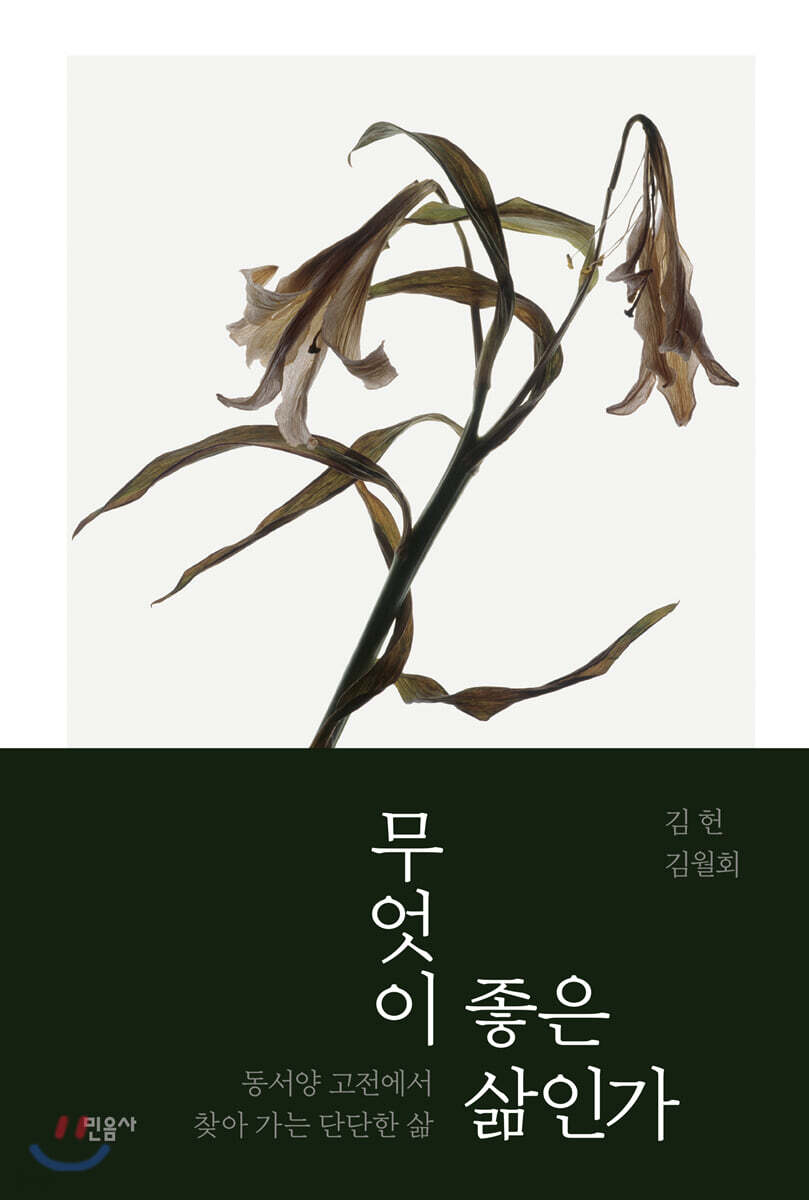
What is a good life
 |
Description
Book Introduction
- A word from MD
-
An East-West Dialogue on the Good LifeThere is nothing new under the sun, and the answers lie in the classics.
Professor Kim Heon, an expert in Western classics, and Professor Kim Wol-hoe, an expert in Eastern classics, extracted the elements that make up a good life from Eastern and Western classics.
We explore how Eastern and Western classics explain 12 values, including justice, beauty, community, and anger.
January 5, 2021. Humanities PD Son Min-gyu
12 Revolutionary Questions Posed by a Western Classics Scholar and a Chinese Literature Scholar
Professor Kim Heon began teaching children as a teacher, but in search of a purpose in life, he returned to studying philosophy and literature, finding the roots of the humanities.
Professor Kim Wol-hoe became interested in modern reinterpretations of Chinese classics as he pondered the conflicts and their roots in modern society.
Whenever I realize that the personal conflicts I face in life are not my own, I often turn to the classics again.
What questions does the classics pose about the pursuit of fame, the goal of life, and death, which is never far away, and what meaning does it have for my life today?
The effort to find a solid foundation in the classics is the innate human desire to become newer.
“These are questions that everyone will inevitably face as long as we live in this world.
For example, honor, destiny, happiness, wealth, justice, beauty, anger, community, history, building, heroes, and death.
The key is not to avoid these topics when you encounter them in life, and to ponder them and build your own thoughts about them. (_Kim Wol-hoe, from "What is a Good Life")
Professor Kim Heon began teaching children as a teacher, but in search of a purpose in life, he returned to studying philosophy and literature, finding the roots of the humanities.
Professor Kim Wol-hoe became interested in modern reinterpretations of Chinese classics as he pondered the conflicts and their roots in modern society.
Whenever I realize that the personal conflicts I face in life are not my own, I often turn to the classics again.
What questions does the classics pose about the pursuit of fame, the goal of life, and death, which is never far away, and what meaning does it have for my life today?
The effort to find a solid foundation in the classics is the innate human desire to become newer.
“These are questions that everyone will inevitably face as long as we live in this world.
For example, honor, destiny, happiness, wealth, justice, beauty, anger, community, history, building, heroes, and death.
The key is not to avoid these topics when you encounter them in life, and to ponder them and build your own thoughts about them. (_Kim Wol-hoe, from "What is a Good Life")
- You can preview some of the book's contents.
Preview
index
prolog
Honor, being mortal
1 What is a good life?
2 Who will be recognized?
Fate, if you can't avoid it
3. Choose independently and judge nobly.
4 A life that follows the truth is open
Happiness, if the purpose of life is different
5. Find it in humanity
6. Achieve harmony inside and out
If you can't give up wealth,
7 Let's dream of a fair life
8. Enjoy it with 'critical distancing'
If justice and greed are the nature
9 A Philosophy That Benefits the Weak
10 The Philosophy That Benefits Become Righteousness
Where beauty and emotion reside
When you discover something worth 11 years old
12 The aesthetics of simplicity
Anger, what kind of anger is it?
13 For the vitality of the community
14 To sustain life
Community: The "Us" We Must Create
15 The power to bring about public consensus
16 The Power to Make Imagined Communities Real
To own history and the future
17 Reconstruct your life wisely
18 Plan the future through the past
About building and creating
19 Tragedy, with solid humanities
20 History Shapes Humanity
Hero, the story of my life
21 When you do not lose your intelligence and virtue
22 On the humanistic soil
Death, the completion of life
23 If you live firmly, you will not be afraid.
24 You must be the master even in death.
Epilogue
Honor, being mortal
1 What is a good life?
2 Who will be recognized?
Fate, if you can't avoid it
3. Choose independently and judge nobly.
4 A life that follows the truth is open
Happiness, if the purpose of life is different
5. Find it in humanity
6. Achieve harmony inside and out
If you can't give up wealth,
7 Let's dream of a fair life
8. Enjoy it with 'critical distancing'
If justice and greed are the nature
9 A Philosophy That Benefits the Weak
10 The Philosophy That Benefits Become Righteousness
Where beauty and emotion reside
When you discover something worth 11 years old
12 The aesthetics of simplicity
Anger, what kind of anger is it?
13 For the vitality of the community
14 To sustain life
Community: The "Us" We Must Create
15 The power to bring about public consensus
16 The Power to Make Imagined Communities Real
To own history and the future
17 Reconstruct your life wisely
18 Plan the future through the past
About building and creating
19 Tragedy, with solid humanities
20 History Shapes Humanity
Hero, the story of my life
21 When you do not lose your intelligence and virtue
22 On the humanistic soil
Death, the completion of life
23 If you live firmly, you will not be afraid.
24 You must be the master even in death.
Epilogue
Detailed image

Publisher's Review
“Choose independently and judge nobly!”
Rather than offering answers like self-help books, classics are texts that constantly demand reflection and help us find our own path.
So, encountering the classics is an active reading revolution that makes me rethink my life from the ground up.
Moreover, the reading journey, which diverges and collides with the different thought systems of Western and Eastern classics, further expands the breadth and depth of reading.
Professor Kim Heon first seeks the answer to the question of 'honor' within the Western philosophical tradition of 'what is a good life?'
In Homer's Odyssey, Odysseus refuses the promise of immortality offered by Calypso.
If "the instinctive desire of all that exists is to resist death and perpetuate existence," how are we to understand Odysseus's refusal? Moreover, Odysseus's chances of surviving the perilous journey home were slim. Yet, the name "Calypso," meaning "the concealer," suggests that if Odysseus were to settle into her embrace, he would be "forever forgotten" by the world.
The desire for honor that humans have to overcome the temptation of immortality and be remembered in the world is all the more desperate because they are mortal beings.
The immortality that Odysseus dreams of is “not a superhuman immortality that transcends the human condition, but a human immortality that is achieved within the human condition of mortality.”
The Eastern classics then pose the question, “Who will be recognized?”
Confucius emphasized rectifying one's name, which means "correcting the value of one's name."
This makes us reconsider the value of our reputations, built on the countless fake reputations produced by today's competitive society.
A gentleman should pursue a good reputation, a name based on 'real virtue', rather than a reputation that is empty and superficial.
Is the honor we pursue truly a tangible honor? Professor Kim Wol-hoe asks if Confucius's words sound "old."
Our era is one in which “the form of existence can be infinitely replicated, even if the unique aura of existence cannot be captured.”
In an age where “names separated from the body and images unrelated to reality can proliferate infinitely,” this age-old question reveals our present even more starkly.
Here, Professor Kim Heon asks again whether a heroic life is truly what we long for, through simple people who practice the wisdom of life without reading great philosophical books.
It reminds us of the fragility of human beings who easily confuse ends with means and fall into competitive selfishness.
We must “reconstruct our lives wisely” and “plan the future through the past.”
That is the purpose of reading classics.
But it doesn't teach you any smooth know-how.
That's where the charm of classics lies.
That is why Western classicists advise, “The effort to overcome limitations is ultimately the force that creates destiny.”
That is why the Oriental classicist says, “A life that follows truth is open, but a life that follows fate is closed.”
“If you live firmly, there is nothing to fear!”
Everyone wants to be guaranteed social honor and personal happiness in a just society.
However, even though I have lived hard, there are times when I feel frustrated when I realize that my efforts alone are not enough to overcome every difficult moment in life.
Even if you want to receive fair compensation for your labor rather than unearned income, you face the limitations of inequality, and even if you want to be free from money and position, you face the reality that you cannot be indifferent.
When our lives become unpeaceful and become battlefields, we must first regroup. The strategy for starting the rest of our lives on a more solid foundation is the classics.
Even for modern people living in a rapidly changing world, classics that have survived for thousands of years still pose fundamental questions.
However, self-help books only provide fragmented know-how, so while they may provide short-term solutions, they fail to shed light on our fundamental wandering.
However, the barrier to entry to those classics that are said to be good is not low.
So, it is a good opportunity to follow the process of two authors who have lived their lives with intense contemplation, seeking answers in the classics.
In fact, the root of the conflicts we face is ultimately fear.
The fear that if I don't jump into real estate speculation now, I will be left behind; the fear that if I fail the entrance exam or get promoted, I will be the only one who fails; the fear that if I make a wrong decision, I will be abandoned by my family and society—this fear is the fundamental cause of human beings falling into the abyss.
However, Professor Kim Heon tells himself, “If you live firmly, you will have nothing to fear.”
Professor Kim Wol-hoe tells himself, “A happy person is one who has emptied himself of desire and falsehood.”
This book contains the intense struggles and conflicts of the two authors, and these courageous declarations are not just words, so if you ponder them for a long time, you will find yourself looking into them as a mirror.
“The feeling of death is growing stronger.
Maybe that's why, these days, every single moment is much more precious and precious than before.
I'm once again wondering how I can live the remaining time happily, joyfully, and meaningfully.
So, I situate my short journey in the long history of humanity, unfolding the classics that have guided me and reorganizing my thoughts.
“That will lead my life again.” - Kim Heon, from “What is a Good Life”
Another artist who has been contemplating a beautiful life participates in "What is a Good Life."
The authors' message is conveyed through works containing the life philosophy of world-renowned photographer Koo Bohnchang, who played a major role in establishing photography as an important genre in the Korean art world.
Rather than offering answers like self-help books, classics are texts that constantly demand reflection and help us find our own path.
So, encountering the classics is an active reading revolution that makes me rethink my life from the ground up.
Moreover, the reading journey, which diverges and collides with the different thought systems of Western and Eastern classics, further expands the breadth and depth of reading.
Professor Kim Heon first seeks the answer to the question of 'honor' within the Western philosophical tradition of 'what is a good life?'
In Homer's Odyssey, Odysseus refuses the promise of immortality offered by Calypso.
If "the instinctive desire of all that exists is to resist death and perpetuate existence," how are we to understand Odysseus's refusal? Moreover, Odysseus's chances of surviving the perilous journey home were slim. Yet, the name "Calypso," meaning "the concealer," suggests that if Odysseus were to settle into her embrace, he would be "forever forgotten" by the world.
The desire for honor that humans have to overcome the temptation of immortality and be remembered in the world is all the more desperate because they are mortal beings.
The immortality that Odysseus dreams of is “not a superhuman immortality that transcends the human condition, but a human immortality that is achieved within the human condition of mortality.”
The Eastern classics then pose the question, “Who will be recognized?”
Confucius emphasized rectifying one's name, which means "correcting the value of one's name."
This makes us reconsider the value of our reputations, built on the countless fake reputations produced by today's competitive society.
A gentleman should pursue a good reputation, a name based on 'real virtue', rather than a reputation that is empty and superficial.
Is the honor we pursue truly a tangible honor? Professor Kim Wol-hoe asks if Confucius's words sound "old."
Our era is one in which “the form of existence can be infinitely replicated, even if the unique aura of existence cannot be captured.”
In an age where “names separated from the body and images unrelated to reality can proliferate infinitely,” this age-old question reveals our present even more starkly.
Here, Professor Kim Heon asks again whether a heroic life is truly what we long for, through simple people who practice the wisdom of life without reading great philosophical books.
It reminds us of the fragility of human beings who easily confuse ends with means and fall into competitive selfishness.
We must “reconstruct our lives wisely” and “plan the future through the past.”
That is the purpose of reading classics.
But it doesn't teach you any smooth know-how.
That's where the charm of classics lies.
That is why Western classicists advise, “The effort to overcome limitations is ultimately the force that creates destiny.”
That is why the Oriental classicist says, “A life that follows truth is open, but a life that follows fate is closed.”
“If you live firmly, there is nothing to fear!”
Everyone wants to be guaranteed social honor and personal happiness in a just society.
However, even though I have lived hard, there are times when I feel frustrated when I realize that my efforts alone are not enough to overcome every difficult moment in life.
Even if you want to receive fair compensation for your labor rather than unearned income, you face the limitations of inequality, and even if you want to be free from money and position, you face the reality that you cannot be indifferent.
When our lives become unpeaceful and become battlefields, we must first regroup. The strategy for starting the rest of our lives on a more solid foundation is the classics.
Even for modern people living in a rapidly changing world, classics that have survived for thousands of years still pose fundamental questions.
However, self-help books only provide fragmented know-how, so while they may provide short-term solutions, they fail to shed light on our fundamental wandering.
However, the barrier to entry to those classics that are said to be good is not low.
So, it is a good opportunity to follow the process of two authors who have lived their lives with intense contemplation, seeking answers in the classics.
In fact, the root of the conflicts we face is ultimately fear.
The fear that if I don't jump into real estate speculation now, I will be left behind; the fear that if I fail the entrance exam or get promoted, I will be the only one who fails; the fear that if I make a wrong decision, I will be abandoned by my family and society—this fear is the fundamental cause of human beings falling into the abyss.
However, Professor Kim Heon tells himself, “If you live firmly, you will have nothing to fear.”
Professor Kim Wol-hoe tells himself, “A happy person is one who has emptied himself of desire and falsehood.”
This book contains the intense struggles and conflicts of the two authors, and these courageous declarations are not just words, so if you ponder them for a long time, you will find yourself looking into them as a mirror.
“The feeling of death is growing stronger.
Maybe that's why, these days, every single moment is much more precious and precious than before.
I'm once again wondering how I can live the remaining time happily, joyfully, and meaningfully.
So, I situate my short journey in the long history of humanity, unfolding the classics that have guided me and reorganizing my thoughts.
“That will lead my life again.” - Kim Heon, from “What is a Good Life”
Another artist who has been contemplating a beautiful life participates in "What is a Good Life."
The authors' message is conveyed through works containing the life philosophy of world-renowned photographer Koo Bohnchang, who played a major role in establishing photography as an important genre in the Korean art world.
GOODS SPECIFICS
- Publication date: December 25, 2020
- Format: Hardcover book binding method guide
- Page count, weight, size: 356 pages | 604g | 135*205*30mm
- ISBN13: 9788937444296
- ISBN10: 8937444291
You may also like
카테고리
korean


korean

![GQ KOREA Mark (Monthly): December [2025]](http://librairie.coreenne.fr/cdn/shop/files/8ef265dbbfbf186523ed75ba7319009d.jpg?v=1765340328&width=3840)


