

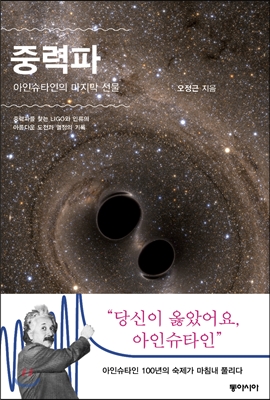
Gravitational Waves, Einstein's Last Gift
 |
Description
Book Introduction
The most easily understandable science textbook on gravitational waves.
The first record of humanity's tearful exploration in search of gravitational waves.
"Gravitational Waves, Einstein's Last Gift" is a history book of gravitational wave detection experiments written by a scientist who participated in the LIGO Scientific Collaboration and contributed to the successful lead of the gravitational wave detection experiment. It vividly describes the history of gravitational wave detection over the past 55 years and the tearful process that led to today's scientific success.
Author Dr. Oh Jeong-geun has compiled in his book the tearful stories of pioneers who influenced the times during that difficult and tedious period of challenge.
Moreover, as the author said, “with the same mindset as a historian writing a historical draft,” this book is a one-of-a-kind record that vividly captures the behind-the-scenes story of the historic discovery that heated up the world in the weeks before and after the announcement of the detection of gravitational waves.
It would be a great fortune for us living in this age to be able to share with our readers the record of a great discovery that will be remembered for the next 100 years, in the year marking the 100th anniversary of Einstein's general theory of relativity.
The first record of humanity's tearful exploration in search of gravitational waves.
"Gravitational Waves, Einstein's Last Gift" is a history book of gravitational wave detection experiments written by a scientist who participated in the LIGO Scientific Collaboration and contributed to the successful lead of the gravitational wave detection experiment. It vividly describes the history of gravitational wave detection over the past 55 years and the tearful process that led to today's scientific success.
Author Dr. Oh Jeong-geun has compiled in his book the tearful stories of pioneers who influenced the times during that difficult and tedious period of challenge.
Moreover, as the author said, “with the same mindset as a historian writing a historical draft,” this book is a one-of-a-kind record that vividly captures the behind-the-scenes story of the historic discovery that heated up the world in the weeks before and after the announcement of the detection of gravitational waves.
It would be a great fortune for us living in this age to be able to share with our readers the record of a great discovery that will be remembered for the next 100 years, in the year marking the 100th anniversary of Einstein's general theory of relativity.
- You can preview some of the book's contents.
Preview
index
The praise poured in for this book
preface
prolog
Chapter 1: Waves of Space and Time
1.
Gravity, Newton and Einstein
2.
The Glorious Moments of General Relativity
3.
The Existence of Gravitational Waves and General Relativity
4.
What are gravitational waves?
5.
Discovery and confirmation of existence
6.
Where do gravitational waves come from?
Chapter 2: Gravitational Waves: In Search of the Last Legacy
1.
The Beginning of History: Weber Detector
2.
Pioneering experiments and discoveries
3.
Criticism, Controversy, and the Fall of an Empire
4.
Healing and Opportunity: The Next Generation Ice Bar
5.
supernova
6.
Legacy of a Fallen Empire
7.
Numerous challenges
Chapter 3: Laser Wars
1.
Preparing for a New Beginning: Beyond the Bar
2.
Prepared skills and ambitious challenges
3.
Beyond criticism
4.
Construction, unscientific for science
Chapter 4: The Unfinished Challenge, Ligo
1.
Would a laser interferometer be possible?
2.
Finding a needle in a haystack
3.
10 years and a little more
4.
A global network is needed
5.
Two excitements
6.
Okay, now we're ready
Chapter 5: Einstein's Last Gift
1.
A very interesting event
2.
Official declaration of discovery
3.
Are these really gravitational waves?
4.
100th Anniversary Event and First Observation Launch
5.
A final gift, a new beginning
Chapter 6: A New Era of Astronomy
1.
Lessons from history
2.
The Beginning of a New Age of Astronomy and Physics
3.
Next-generation gravitational wave observatory
4.
gravitational wave research in Korea
Epilogue
main
supplement
Search
preface
prolog
Chapter 1: Waves of Space and Time
1.
Gravity, Newton and Einstein
2.
The Glorious Moments of General Relativity
3.
The Existence of Gravitational Waves and General Relativity
4.
What are gravitational waves?
5.
Discovery and confirmation of existence
6.
Where do gravitational waves come from?
Chapter 2: Gravitational Waves: In Search of the Last Legacy
1.
The Beginning of History: Weber Detector
2.
Pioneering experiments and discoveries
3.
Criticism, Controversy, and the Fall of an Empire
4.
Healing and Opportunity: The Next Generation Ice Bar
5.
supernova
6.
Legacy of a Fallen Empire
7.
Numerous challenges
Chapter 3: Laser Wars
1.
Preparing for a New Beginning: Beyond the Bar
2.
Prepared skills and ambitious challenges
3.
Beyond criticism
4.
Construction, unscientific for science
Chapter 4: The Unfinished Challenge, Ligo
1.
Would a laser interferometer be possible?
2.
Finding a needle in a haystack
3.
10 years and a little more
4.
A global network is needed
5.
Two excitements
6.
Okay, now we're ready
Chapter 5: Einstein's Last Gift
1.
A very interesting event
2.
Official declaration of discovery
3.
Are these really gravitational waves?
4.
100th Anniversary Event and First Observation Launch
5.
A final gift, a new beginning
Chapter 6: A New Era of Astronomy
1.
Lessons from history
2.
The Beginning of a New Age of Astronomy and Physics
3.
Next-generation gravitational wave observatory
4.
gravitational wave research in Korea
Epilogue
main
supplement
Search
Detailed image
Into the book
It is true that the general theory of relativity presents a revolutionary perspective on the history of science, is a new theory for describing the universe, and overturns the framework of Newtonian thinking.
However, it is a significant misunderstanding to leap to the logic that the overthrow of Newtonian thinking means “the end of Newtonian theory and its replacement with a new theory.”
When Einstein was developing his theory of general relativity, he was considering a theory that included Newton's theory, and indeed, Newton's theory of gravity is still valid in very weak gravitational fields.
Therefore, the success of general relativity is not about replacing the existing theoretical framework with a new theory, but rather about expanding it into a new theory that includes the existing theory and goes beyond its limitations.
Einstein died in 1955, so he did not fully enjoy the glory days of general relativity, which was later proven by experiments in astronomy and physics.
However, the fact that light can be bent was proven by Eddington, which was a great experimental evidence that clearly showed that general relativity could be solidified.
--- pp.32-33
Weber attended the Midwestern Relativity Society meeting in Cincinnati in 1969.
Kip Thorne (1940-) of the California Institute of Technology was present and presented his research on gravitational waves from newly formed neutron stars.
Weber reported on the spot that he had experimentally discovered gravitational waves, and everyone present was shocked.
In fact, Kip Thorne had known Weber for a long time and was very interested in the new technologies he was pioneering.
Kip Thorne was a protégé of Wheeler, with whom Weber had worked for many years.
After his presentation, Weber received a round of applause.
And two weeks later, his Physical Review Letters paper was published.
Since then, Weber has been in the spotlight and making headlines every day.
One prominent media outlet was even more excited by Weber's discovery, claiming it was the most important discovery in physics in the past half-century, and Weber's laboratory became the envy of physicists everywhere.
The press was busy reporting daily on Weber's experiments, and suddenly general relativity became the most popular lecture topic.
At academic conferences on relativity, there were no seats, so it was common to listen to academic presentations standing.
--- pp.72-73
The first reports of very exciting events took place at the LIGO-VIRGO Annual General Meeting in Krakow, Poland, on September 20, 2010.
Among the data from the sixth scientific operation, data from September 16, 2010, just four days before the Krakow conference, was the detection of a signal that could be considered a candidate for gravitational waves.
This signal was first reported by the Burst Analysis Group and later confirmed by the Compact Binary Analysis Group.
The identity of this signal was clearly a gravitational wave signal generated when a black hole binary or a black hole-neutron star binary rotates and merges in less than a second, and the signal was also unusually strong.
At that time, the gravitational wave interferometers were two LIGO interferometers (Hanford and Livingston), the Virgo interferometer, and Geo-600, which were operating in 'science mode'.
However, the signal was detected at Hanford and Livingston, but not at Virgo and Geo.
The reason why it was not detected in the Virgo was that the detection alarm was set to be notified when the signal-to-noise ratio SNR was 5.5 or higher, but it was found that the Virgo did not exceed this, and the detection sensitivity in the Geo 600 did not reach the level to detect it.
--- pp.174-175
At approximately 1:30 a.m. UTC on January 6, 2016, a magnitude 5.1 artificial earthquake, believed to be a North Korean nuclear test, was detected by the United States Geological Survey (USGS) and the European Mediterranean Seismological Centre (EMSC).
On this day, I was performing a Data Quality Shift for the Livingston detector.
After hearing the news, I immediately checked the Livingston detector's gravitational wave channel and the seismometer channel that detects earthquakes.
The artificial seismic vibrations from North Korea reached Livingstone at 2:20 a.m., about 50 minutes later.
However, the Livingston detector was shut down for maintenance around 2 o'clock, and no abnormal signals were detected by the independently operating seismometer.
Likewise, the Hanford detector was down for maintenance, so the seismic tremors from this North Korean nuclear test were not detected on any gravitational wave channel.
Given that earthquakes of this magnitude, typically occurring in Asian countries like Indonesia and Taiwan, have always affected gravitational wave channels more than 10,000 kilometers away, the gravitational wave detector would certainly have been affected if it had been operating normally.
It is said that at the Advanced LIGO exhibition hall set up at the American Astronomical Society in Florida, USA at the time, there were many people asking whether the LIGO detector had detected the signal from North Korea's nuclear test.
However, it is a significant misunderstanding to leap to the logic that the overthrow of Newtonian thinking means “the end of Newtonian theory and its replacement with a new theory.”
When Einstein was developing his theory of general relativity, he was considering a theory that included Newton's theory, and indeed, Newton's theory of gravity is still valid in very weak gravitational fields.
Therefore, the success of general relativity is not about replacing the existing theoretical framework with a new theory, but rather about expanding it into a new theory that includes the existing theory and goes beyond its limitations.
Einstein died in 1955, so he did not fully enjoy the glory days of general relativity, which was later proven by experiments in astronomy and physics.
However, the fact that light can be bent was proven by Eddington, which was a great experimental evidence that clearly showed that general relativity could be solidified.
--- pp.32-33
Weber attended the Midwestern Relativity Society meeting in Cincinnati in 1969.
Kip Thorne (1940-) of the California Institute of Technology was present and presented his research on gravitational waves from newly formed neutron stars.
Weber reported on the spot that he had experimentally discovered gravitational waves, and everyone present was shocked.
In fact, Kip Thorne had known Weber for a long time and was very interested in the new technologies he was pioneering.
Kip Thorne was a protégé of Wheeler, with whom Weber had worked for many years.
After his presentation, Weber received a round of applause.
And two weeks later, his Physical Review Letters paper was published.
Since then, Weber has been in the spotlight and making headlines every day.
One prominent media outlet was even more excited by Weber's discovery, claiming it was the most important discovery in physics in the past half-century, and Weber's laboratory became the envy of physicists everywhere.
The press was busy reporting daily on Weber's experiments, and suddenly general relativity became the most popular lecture topic.
At academic conferences on relativity, there were no seats, so it was common to listen to academic presentations standing.
--- pp.72-73
The first reports of very exciting events took place at the LIGO-VIRGO Annual General Meeting in Krakow, Poland, on September 20, 2010.
Among the data from the sixth scientific operation, data from September 16, 2010, just four days before the Krakow conference, was the detection of a signal that could be considered a candidate for gravitational waves.
This signal was first reported by the Burst Analysis Group and later confirmed by the Compact Binary Analysis Group.
The identity of this signal was clearly a gravitational wave signal generated when a black hole binary or a black hole-neutron star binary rotates and merges in less than a second, and the signal was also unusually strong.
At that time, the gravitational wave interferometers were two LIGO interferometers (Hanford and Livingston), the Virgo interferometer, and Geo-600, which were operating in 'science mode'.
However, the signal was detected at Hanford and Livingston, but not at Virgo and Geo.
The reason why it was not detected in the Virgo was that the detection alarm was set to be notified when the signal-to-noise ratio SNR was 5.5 or higher, but it was found that the Virgo did not exceed this, and the detection sensitivity in the Geo 600 did not reach the level to detect it.
--- pp.174-175
At approximately 1:30 a.m. UTC on January 6, 2016, a magnitude 5.1 artificial earthquake, believed to be a North Korean nuclear test, was detected by the United States Geological Survey (USGS) and the European Mediterranean Seismological Centre (EMSC).
On this day, I was performing a Data Quality Shift for the Livingston detector.
After hearing the news, I immediately checked the Livingston detector's gravitational wave channel and the seismometer channel that detects earthquakes.
The artificial seismic vibrations from North Korea reached Livingstone at 2:20 a.m., about 50 minutes later.
However, the Livingston detector was shut down for maintenance around 2 o'clock, and no abnormal signals were detected by the independently operating seismometer.
Likewise, the Hanford detector was down for maintenance, so the seismic tremors from this North Korean nuclear test were not detected on any gravitational wave channel.
Given that earthquakes of this magnitude, typically occurring in Asian countries like Indonesia and Taiwan, have always affected gravitational wave channels more than 10,000 kilometers away, the gravitational wave detector would certainly have been affected if it had been operating normally.
It is said that at the Advanced LIGO exhibition hall set up at the American Astronomical Society in Florida, USA at the time, there were many people asking whether the LIGO detector had detected the signal from North Korea's nuclear test.
--- p.212
Publisher's Review
Living in the Virgo cluster, 65 million light years away
An alien's hair was detected fluttering on Earth.
-What are gravitational waves and LIGO?
If you throw a stone into still water, ripples will spread out in all directions.
In this way, gravitational waves are like ripples in space-time that spread out in all directions and are created by large events in the universe, such as star explosions.
However, it is very difficult to detect because it is so faint that it spreads throughout the universe.
In reality, gravitational waves are energy waves that rapidly change space-time and propagate in the form of waves, and their magnitude is about 10-21, which is smaller than the magnitude of the Sun vibrating by the size of an atom.
Therefore, it was thought that detecting the signal would only be possible through astronomical phenomena such as the rapid expansion of the universe after the Big Bang or the collision or explosion of stars.
To detect this, experiments and observations around the world began in the 1960s, and the Laser Interferometer Gravitational-Wave Observatory (LIGO) was built in the United States in the 2000s to detect gravitational waves.
Finally, it was successfully detected on September 14, 2015, the 100th anniversary of Einstein's theory of general relativity, and after several stages of verification, it was announced to the world on February 11, 2016.
1.3 billion years ago, waves thrown by two black holes in space opened up a new universe for 21st century humanity.
“We did it!” “You were right, Einstein.”
Gravitational waves usher in a new era of cosmic discovery for humanity.
-Significance of the discovery/detection of gravitational waves
On February 11, 2016 (February 12, 00:30 Korean time), it was announced to the world that gravitational waves, the existence of which had been theoretically predicted 100 years after Einstein published his theory of general relativity, had been successfully detected directly.
The discovery of gravitational waves is a historic feat achieved by the collective intelligence of humanity.
The challenge thrown down by humanity to solve the final riddle predicted by a genius named Einstein, who changed the paradigm of modern science 100 years ago, has finally come to fruition after 55 years.
It would be beyond the common sense of the average person to understand that the United States invested nearly a trillion dollars to discover a single unsolved scientific fact.
However, the reason why advanced countries are competing to invest in basic science is probably due to the historical lessons and beliefs they have personally experienced from the past to the present.
Gravitational waves are not just the discovery and verification of a scientific fact predicted by Einstein.
This discovery heralds the dawn of a new era that will come in the future.
Just as understanding the force of electromagnetic force paved the way for today's wireless communication civilization, it is impossible to predict how a civilization utilizing gravitational waves will unfold in the future.
However, the significance of this discovery in the near future is that it brings us one step closer to understanding the universe.
Just as Galileo's invention of the optical telescope allowed us to observe the universe with our naked eyes in greater detail, and Hertz's discovery of electromagnetic waves allowed us to see new and diverse aspects of our universe through the radio telescope, allowing us to understand the universe better, now humanity can enjoy the wonderful symphony played by the universe using a new observation tool called gravitational waves.
The most easily understandable science textbook on gravitational waves.
The first record of humanity's tearful exploration in search of gravitational waves.
"Gravitational Waves, Einstein's Last Gift" is a history book of gravitational wave detection experiments written by a scientist who participated in the LIGO Scientific Collaboration and contributed to the successful lead of the gravitational wave detection experiment. It vividly describes the history of gravitational wave detection over the past 55 years and the tearful process that led to today's scientific success.
Author Dr. Oh Jeong-geun has compiled in his book the tearful stories of pioneers who influenced the times during that difficult and tedious period of challenge.
Moreover, as the author said, “with the same mindset as a historian writing a historical draft,” this book is a one-of-a-kind record that vividly captures the behind-the-scenes story of the historic discovery that heated up the world in the weeks before and after the announcement of the detection of gravitational waves.
It would be a great fortune for us living in this age to be able to share with our readers the record of a great discovery that will be remembered for the next 100 years, in the year marking the 100th anniversary of Einstein's general theory of relativity.
Why is there a need for such interest and generous investment in basic science?
Scientists' efforts, failures, and constant challenges
-The purpose of writing the book
In 1927, a bizarre debate took place in Brussels, Belgium.
It was similar to the debate on the 'theory of principle and vital energy' discussed by Joseon Dynasty Neo-Confucian scholars.
At this meeting, known as the 'Solvay Conference', the physicists of the time engaged in endless debates and discussions to interpret quantum mechanics, which was being developed at the time.
To the average person, this debate may have seemed of no use whatsoever in their lives.
However, this debate may be one of the events that ultimately established the foundation of quantum mechanics and became the cornerstone of modern civilization.
This is not only a lesson from quantum mechanics, but also a lesson that even though modern science is ahead of its time and is obsessed with facts that are far removed from contemporary reality, it will return to us in the near future under the name of engineering and technological civilization.
This is the great pillar that supports modern science, especially basic science.
Modern science is becoming increasingly gigantic and collectivized on a large scale.
Accordingly, the amount of investment in facilities is also becoming astronomical.
The characteristics of this type of scientific research are unique and different from those previously carried out at the individual laboratory level, but they are still unfamiliar to us.
In a paper of only 15 pages, only 5 pages are devoted to the authors and their affiliated institutions.
This book introduces a side of that unfamiliar modern science.
It vividly conveys how such a large group of scientists strive to achieve their goals of discovery through experiments and discussions, and the process by which decisions are made.
This book also introduces the efforts and failures of a series of scientists to verify Einstein's theory, and the tearful 100-year challenge to reach final success, with specific anecdotes and twists and turns.
The success story will be vividly conveyed to readers through the pages of the book in a very dramatic way.
Main contents of the book
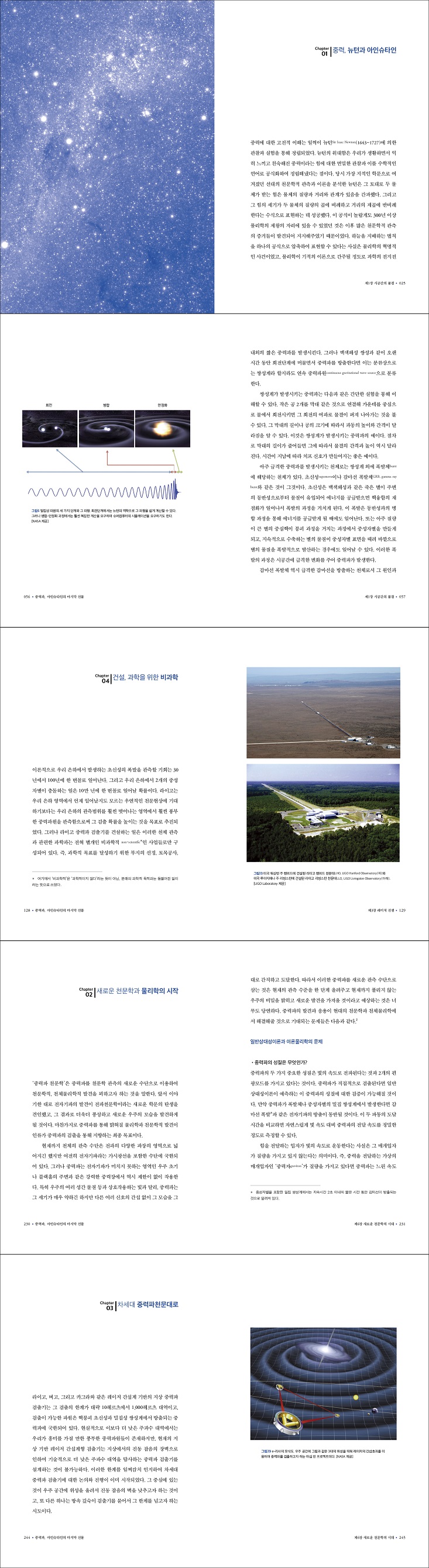
Chapter 1 introduces and briefly reviews Newton's theory of gravity and Einstein's theory of general relativity, focusing on historical events.
And we introduced the nature of gravitational waves predicted by the general theory of relativity and the possibility of experimentally detecting them.
Chapter 2 discusses the pioneering efforts of Joseph Weber, who first initiated a gravitational wave detection experiment, and the historical events related to this, as well as how gravitational wave detectors have evolved from Weber's "Bar detector."
Chapter 3 introduces the history of the development of the Laser Interferometer Gravitational-wave Observatory (LIGO), a new alternative to gravitational wave detectors after Joseph Weber and currently the most promising large-scale project.
Chapter 4 explains how laser interferometry has emerged as the most promising project for the direct detection of gravitational waves.
And he introduced the current status of gravitational wave detection experiments since LIGO began operating in earnest about 10 years ago.
Chapter 5: With the start of Advanced LIGO's observations, we wanted to convey the process of efforts undertaken by scientists to discover gravitational wave signals.
In particular, it organizes in chronological order the efforts undertaken by the LIGO Scientific Collaboration to detect gravitational wave signals, confirm that they are gravitational wave signals, and how they reached their final conclusions.
The process of discovering gravitational waves is depicted most vividly.
Chapter 6 explores the benefits and ramifications of the successful detection of gravitational waves from a physics and astronomical perspective, as well as the scientific possibilities.
In addition, the current status of next-generation gravitational wave detector projects currently underway or planned on Earth, as well as the current status of gravitational wave detection research in Korea, were introduced.
An alien's hair was detected fluttering on Earth.
-What are gravitational waves and LIGO?
If you throw a stone into still water, ripples will spread out in all directions.
In this way, gravitational waves are like ripples in space-time that spread out in all directions and are created by large events in the universe, such as star explosions.
However, it is very difficult to detect because it is so faint that it spreads throughout the universe.
In reality, gravitational waves are energy waves that rapidly change space-time and propagate in the form of waves, and their magnitude is about 10-21, which is smaller than the magnitude of the Sun vibrating by the size of an atom.
Therefore, it was thought that detecting the signal would only be possible through astronomical phenomena such as the rapid expansion of the universe after the Big Bang or the collision or explosion of stars.
To detect this, experiments and observations around the world began in the 1960s, and the Laser Interferometer Gravitational-Wave Observatory (LIGO) was built in the United States in the 2000s to detect gravitational waves.
Finally, it was successfully detected on September 14, 2015, the 100th anniversary of Einstein's theory of general relativity, and after several stages of verification, it was announced to the world on February 11, 2016.
1.3 billion years ago, waves thrown by two black holes in space opened up a new universe for 21st century humanity.
“We did it!” “You were right, Einstein.”
Gravitational waves usher in a new era of cosmic discovery for humanity.
-Significance of the discovery/detection of gravitational waves
On February 11, 2016 (February 12, 00:30 Korean time), it was announced to the world that gravitational waves, the existence of which had been theoretically predicted 100 years after Einstein published his theory of general relativity, had been successfully detected directly.
The discovery of gravitational waves is a historic feat achieved by the collective intelligence of humanity.
The challenge thrown down by humanity to solve the final riddle predicted by a genius named Einstein, who changed the paradigm of modern science 100 years ago, has finally come to fruition after 55 years.
It would be beyond the common sense of the average person to understand that the United States invested nearly a trillion dollars to discover a single unsolved scientific fact.
However, the reason why advanced countries are competing to invest in basic science is probably due to the historical lessons and beliefs they have personally experienced from the past to the present.
Gravitational waves are not just the discovery and verification of a scientific fact predicted by Einstein.
This discovery heralds the dawn of a new era that will come in the future.
Just as understanding the force of electromagnetic force paved the way for today's wireless communication civilization, it is impossible to predict how a civilization utilizing gravitational waves will unfold in the future.
However, the significance of this discovery in the near future is that it brings us one step closer to understanding the universe.
Just as Galileo's invention of the optical telescope allowed us to observe the universe with our naked eyes in greater detail, and Hertz's discovery of electromagnetic waves allowed us to see new and diverse aspects of our universe through the radio telescope, allowing us to understand the universe better, now humanity can enjoy the wonderful symphony played by the universe using a new observation tool called gravitational waves.
The most easily understandable science textbook on gravitational waves.
The first record of humanity's tearful exploration in search of gravitational waves.
"Gravitational Waves, Einstein's Last Gift" is a history book of gravitational wave detection experiments written by a scientist who participated in the LIGO Scientific Collaboration and contributed to the successful lead of the gravitational wave detection experiment. It vividly describes the history of gravitational wave detection over the past 55 years and the tearful process that led to today's scientific success.
Author Dr. Oh Jeong-geun has compiled in his book the tearful stories of pioneers who influenced the times during that difficult and tedious period of challenge.
Moreover, as the author said, “with the same mindset as a historian writing a historical draft,” this book is a one-of-a-kind record that vividly captures the behind-the-scenes story of the historic discovery that heated up the world in the weeks before and after the announcement of the detection of gravitational waves.
It would be a great fortune for us living in this age to be able to share with our readers the record of a great discovery that will be remembered for the next 100 years, in the year marking the 100th anniversary of Einstein's general theory of relativity.
Why is there a need for such interest and generous investment in basic science?
Scientists' efforts, failures, and constant challenges
-The purpose of writing the book
In 1927, a bizarre debate took place in Brussels, Belgium.
It was similar to the debate on the 'theory of principle and vital energy' discussed by Joseon Dynasty Neo-Confucian scholars.
At this meeting, known as the 'Solvay Conference', the physicists of the time engaged in endless debates and discussions to interpret quantum mechanics, which was being developed at the time.
To the average person, this debate may have seemed of no use whatsoever in their lives.
However, this debate may be one of the events that ultimately established the foundation of quantum mechanics and became the cornerstone of modern civilization.
This is not only a lesson from quantum mechanics, but also a lesson that even though modern science is ahead of its time and is obsessed with facts that are far removed from contemporary reality, it will return to us in the near future under the name of engineering and technological civilization.
This is the great pillar that supports modern science, especially basic science.
Modern science is becoming increasingly gigantic and collectivized on a large scale.
Accordingly, the amount of investment in facilities is also becoming astronomical.
The characteristics of this type of scientific research are unique and different from those previously carried out at the individual laboratory level, but they are still unfamiliar to us.
In a paper of only 15 pages, only 5 pages are devoted to the authors and their affiliated institutions.
This book introduces a side of that unfamiliar modern science.
It vividly conveys how such a large group of scientists strive to achieve their goals of discovery through experiments and discussions, and the process by which decisions are made.
This book also introduces the efforts and failures of a series of scientists to verify Einstein's theory, and the tearful 100-year challenge to reach final success, with specific anecdotes and twists and turns.
The success story will be vividly conveyed to readers through the pages of the book in a very dramatic way.
Main contents of the book
Chapter 1 introduces and briefly reviews Newton's theory of gravity and Einstein's theory of general relativity, focusing on historical events.
And we introduced the nature of gravitational waves predicted by the general theory of relativity and the possibility of experimentally detecting them.
Chapter 2 discusses the pioneering efforts of Joseph Weber, who first initiated a gravitational wave detection experiment, and the historical events related to this, as well as how gravitational wave detectors have evolved from Weber's "Bar detector."
Chapter 3 introduces the history of the development of the Laser Interferometer Gravitational-wave Observatory (LIGO), a new alternative to gravitational wave detectors after Joseph Weber and currently the most promising large-scale project.
Chapter 4 explains how laser interferometry has emerged as the most promising project for the direct detection of gravitational waves.
And he introduced the current status of gravitational wave detection experiments since LIGO began operating in earnest about 10 years ago.
Chapter 5: With the start of Advanced LIGO's observations, we wanted to convey the process of efforts undertaken by scientists to discover gravitational wave signals.
In particular, it organizes in chronological order the efforts undertaken by the LIGO Scientific Collaboration to detect gravitational wave signals, confirm that they are gravitational wave signals, and how they reached their final conclusions.
The process of discovering gravitational waves is depicted most vividly.
Chapter 6 explores the benefits and ramifications of the successful detection of gravitational waves from a physics and astronomical perspective, as well as the scientific possibilities.
In addition, the current status of next-generation gravitational wave detector projects currently underway or planned on Earth, as well as the current status of gravitational wave detection research in Korea, were introduced.
GOODS SPECIFICS
- Date of publication: February 29, 2016
- Page count, weight, size: 292 pages | 534g | 153*224*17mm
- ISBN13: 9788962621310
- ISBN10: 8962621312
You may also like
카테고리
korean


korean

![ELLE 엘르 스페셜 에디션 A형 : 12월 [2025]](http://librairie.coreenne.fr/cdn/shop/files/b8e27a3de6c9538896439686c6b0e8fb.jpg?v=1766436872&width=3840)


