

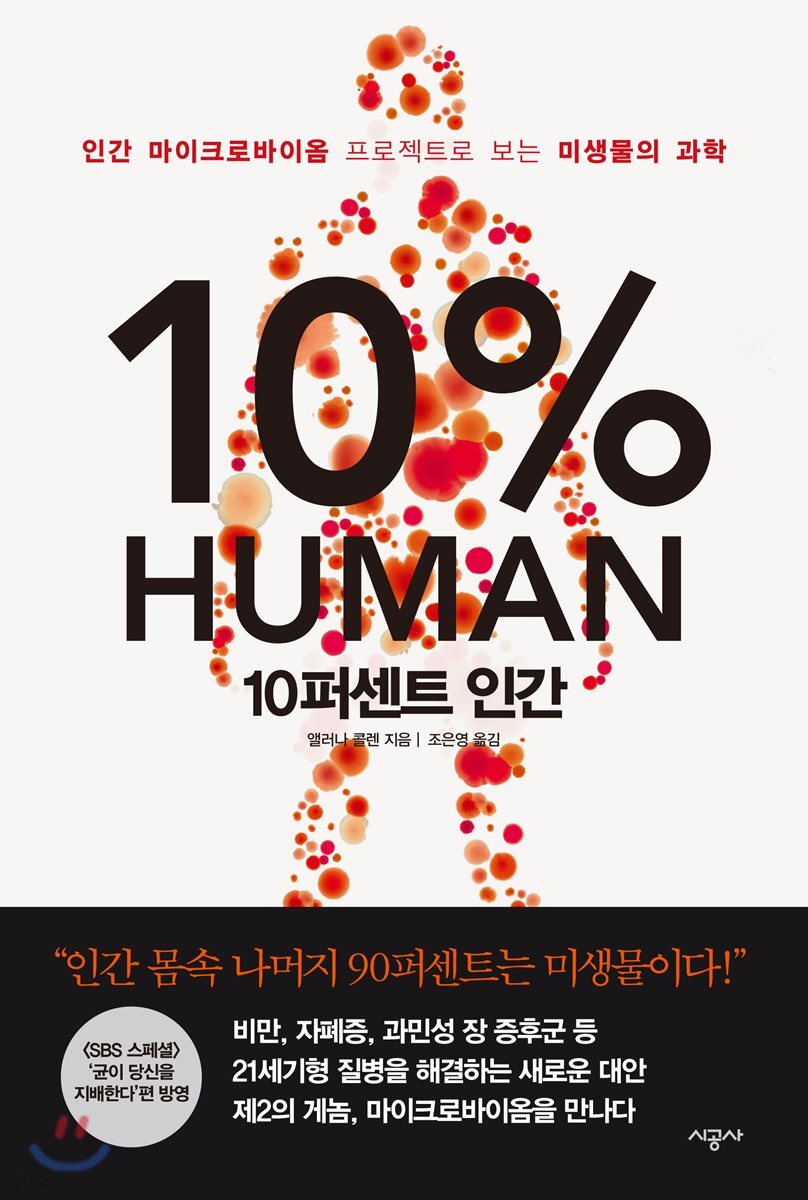
10 percent human
 |
Description
Book Introduction
The disease of cleaner, younger, and better-off people
Are there solutions to 21st century diseases?
The second genome, revealed by the microbiome
The Science of Mysterious Microbes
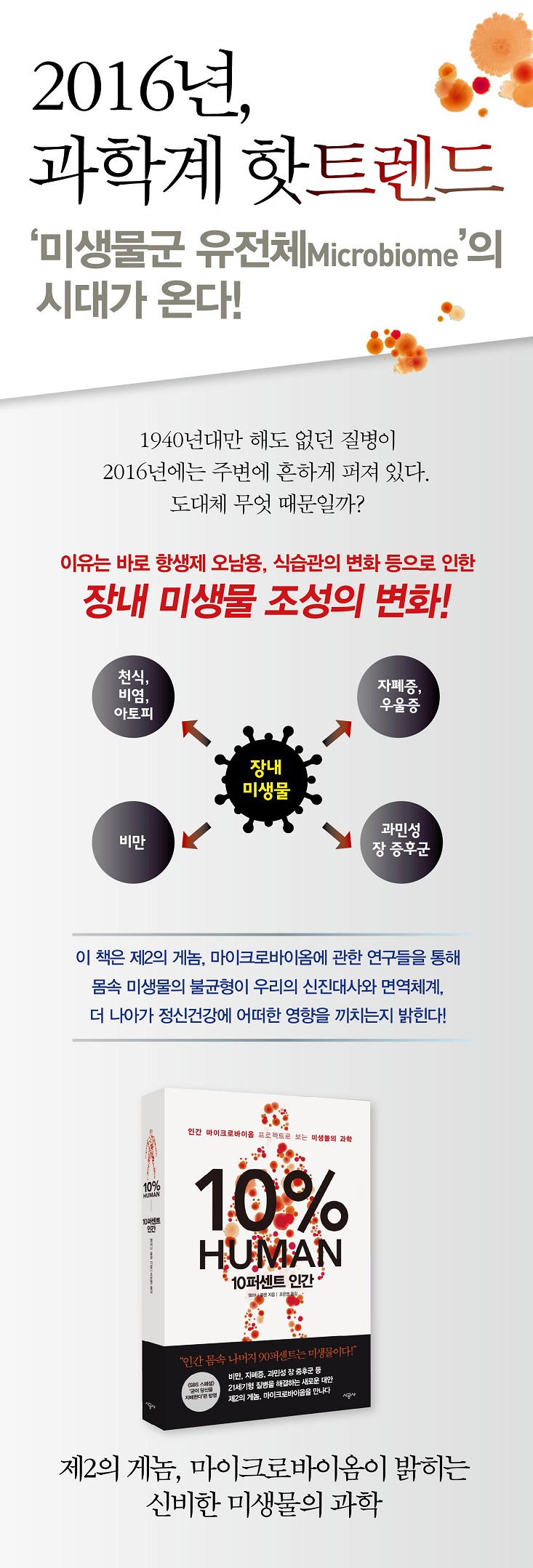
Today, in 2016, we can easily find people like the following around us.
People who clutch their stomachs and run to the bathroom every hour, people who sniff their noses because of allergic rhinitis, people who inject themselves with insulin several times a day because of diabetes, people with autistic children, people whose daily lives are disrupted by anxiety disorders, people who choose non-irritating detergents for their children with atopic dermatitis, people who live with diet supplements to manage their weight…
Although these diseases do not cause serious fear of death or alarm about illness, they clearly significantly reduce the quality of life.
But what if people suffering from these diseases were to go back to the 1940s?
You probably won't have to check for a bathroom everywhere you go, won't have to lose sleep over a stuffy nose, and won't have to stick your own insulin needles.
Not only that, your body will be slimmer, your skin will be clearer, and you will be mentally healthier.
Even in the 1940s, irritable bowel syndrome, rhinitis, diabetes, autism, allergies, and obesity were not common conditions.
But why have so many changes occurred in humanity in less than a century? The book "10% Human" suggests that the root of this problem lies in the microbes that make up 90 percent of our bodies.
Our body is made up of 10 percent human cells, including flesh and blood, brain and skin, bones and muscles, and 90 percent microorganisms, including bacteria, viruses and fungi.
We can see ourselves not as a single entity, but as a collection of countless lives intertwined.
This book explores the second genome, the microbiome, revealing how imbalances in our body's microbiome impact our metabolism, immune system, and even mental health.
We also discuss how antibiotic overuse, indiscriminate cesarean sections, careless formula feeding, and blind faith in antibacterial products have left unexpected traces on our bodies, and discuss the present and future of a groundbreaking treatment: fecal microbiota transplantation.
This book allows us to consider how humans have effectively utilized our ancestors on Earth, microorganisms, and how we have evolved to coexist with them.
Only then will we gain insight into our own bodies.
Are there solutions to 21st century diseases?
The second genome, revealed by the microbiome
The Science of Mysterious Microbes
Today, in 2016, we can easily find people like the following around us.
People who clutch their stomachs and run to the bathroom every hour, people who sniff their noses because of allergic rhinitis, people who inject themselves with insulin several times a day because of diabetes, people with autistic children, people whose daily lives are disrupted by anxiety disorders, people who choose non-irritating detergents for their children with atopic dermatitis, people who live with diet supplements to manage their weight…
Although these diseases do not cause serious fear of death or alarm about illness, they clearly significantly reduce the quality of life.
But what if people suffering from these diseases were to go back to the 1940s?
You probably won't have to check for a bathroom everywhere you go, won't have to lose sleep over a stuffy nose, and won't have to stick your own insulin needles.
Not only that, your body will be slimmer, your skin will be clearer, and you will be mentally healthier.
Even in the 1940s, irritable bowel syndrome, rhinitis, diabetes, autism, allergies, and obesity were not common conditions.
But why have so many changes occurred in humanity in less than a century? The book "10% Human" suggests that the root of this problem lies in the microbes that make up 90 percent of our bodies.
Our body is made up of 10 percent human cells, including flesh and blood, brain and skin, bones and muscles, and 90 percent microorganisms, including bacteria, viruses and fungi.
We can see ourselves not as a single entity, but as a collection of countless lives intertwined.
This book explores the second genome, the microbiome, revealing how imbalances in our body's microbiome impact our metabolism, immune system, and even mental health.
We also discuss how antibiotic overuse, indiscriminate cesarean sections, careless formula feeding, and blind faith in antibacterial products have left unexpected traces on our bodies, and discuss the present and future of a groundbreaking treatment: fecal microbiota transplantation.
This book allows us to consider how humans have effectively utilized our ancestors on Earth, microorganisms, and how we have evolved to coexist with them.
Only then will we gain insight into our own bodies.
- You can preview some of the book's contents.
Preview
index
Living with Microorganisms
Preface_ The remaining 90 percent
Meet the Second Genome / Teaming Up with Microbes / Appendix and Natural Selection / Germ-Free Mice Experiments / What Microbes Do / Communicating with Microbes
Chapter 1: 21st Century Diseases Disguised as Normal
Infectious diseases caused by microorganisms / Vaccinations that eradicated death / Clean hospitals and drinking water / The discovery of antibiotics / The new 'normal' of the 21st century / Replacing infectious diseases / Where do 21st-century diseases come from / Who gets 21st-century diseases / When did 21st-century diseases begin?
Chapter 2: All Disease Begins in the Gut
Fatter Today Than Yesterday / Why on Earth Do We Gain Weight? / The Bacterial Forest Is Destroyed / Peter Turnbow's Experiment / Do Lazy People Get Obese? / Nikhil Duranda's Experiment / The Akkermansia Effect / Finding a Cause Beyond That
Chapter 3: Reaching Out to the Brain
Microorganisms that control their hosts / Why did Andrew become autistic / Is autism congenital? / The connection between gut infections and autism / Microorganisms that change personality / Microorganisms involved in human love / Creating happiness and depression / Efforts to uncover the connection with the brain / From person to person
Chapter 4: Selfish Microbes
The Rise of the Hygiene Hypothesis / The Survival of Microorganisms / Microorganisms and Evolution / The Light and Dark Side of Antibiotic Use / The Collaboration of Microorganisms and the Immune System / Bridging the Gap with Immunity / How to Train the Immune System
Chapter 5: The War on Germs
The Uselessness of Antibiotics / The Tragedy of Antibiotic Abuse / The Ignored Warning / Antibiotics I Unknowingly Received / Suspicious Facts Surrounding Antibiotics / What Antibacterials Benefit You / The Relationship Between Handwashing and Mental Illness / People Who Stay Clean Even Without Washing
Chapter 6: Go as you eat
What Nutrition Can't Explain / Changing Modern Eating Habits / What's Growing on Our Plates / What's Disappearing from Our Plates / Two Things That Help Weight Loss / Returning to a Healthy Diet / A Microbiome-Conscious Diet
Chapter 7: A Gift from Mom
The first thing a baby receives from its mother / The pitfalls of popularizing cesarean sections / The role of microbes in breast milk / Formula increases the risk of disease / Living with microbes for life
Chapter 8: Putting It Back in Place
Autointoxication Theory / The Benefits of Probiotics / Microbial Transplantation via Feces / New Possibilities Open / The Launch of OpenBiome / Efforts to Reverse the Curb
Conclusion_ Staying healthy in the 21st century
New opportunities/social change/personal change/choice of happiness
Coming out_ 100% human
References
Photo list
Search
Preface_ The remaining 90 percent
Meet the Second Genome / Teaming Up with Microbes / Appendix and Natural Selection / Germ-Free Mice Experiments / What Microbes Do / Communicating with Microbes
Chapter 1: 21st Century Diseases Disguised as Normal
Infectious diseases caused by microorganisms / Vaccinations that eradicated death / Clean hospitals and drinking water / The discovery of antibiotics / The new 'normal' of the 21st century / Replacing infectious diseases / Where do 21st-century diseases come from / Who gets 21st-century diseases / When did 21st-century diseases begin?
Chapter 2: All Disease Begins in the Gut
Fatter Today Than Yesterday / Why on Earth Do We Gain Weight? / The Bacterial Forest Is Destroyed / Peter Turnbow's Experiment / Do Lazy People Get Obese? / Nikhil Duranda's Experiment / The Akkermansia Effect / Finding a Cause Beyond That
Chapter 3: Reaching Out to the Brain
Microorganisms that control their hosts / Why did Andrew become autistic / Is autism congenital? / The connection between gut infections and autism / Microorganisms that change personality / Microorganisms involved in human love / Creating happiness and depression / Efforts to uncover the connection with the brain / From person to person
Chapter 4: Selfish Microbes
The Rise of the Hygiene Hypothesis / The Survival of Microorganisms / Microorganisms and Evolution / The Light and Dark Side of Antibiotic Use / The Collaboration of Microorganisms and the Immune System / Bridging the Gap with Immunity / How to Train the Immune System
Chapter 5: The War on Germs
The Uselessness of Antibiotics / The Tragedy of Antibiotic Abuse / The Ignored Warning / Antibiotics I Unknowingly Received / Suspicious Facts Surrounding Antibiotics / What Antibacterials Benefit You / The Relationship Between Handwashing and Mental Illness / People Who Stay Clean Even Without Washing
Chapter 6: Go as you eat
What Nutrition Can't Explain / Changing Modern Eating Habits / What's Growing on Our Plates / What's Disappearing from Our Plates / Two Things That Help Weight Loss / Returning to a Healthy Diet / A Microbiome-Conscious Diet
Chapter 7: A Gift from Mom
The first thing a baby receives from its mother / The pitfalls of popularizing cesarean sections / The role of microbes in breast milk / Formula increases the risk of disease / Living with microbes for life
Chapter 8: Putting It Back in Place
Autointoxication Theory / The Benefits of Probiotics / Microbial Transplantation via Feces / New Possibilities Open / The Launch of OpenBiome / Efforts to Reverse the Curb
Conclusion_ Staying healthy in the 21st century
New opportunities/social change/personal change/choice of happiness
Coming out_ 100% human
References
Photo list
Search
Detailed image
Into the book
We are only 10 percent human.
For every cell in the body we call our own, there are nine rogue cells free-riding on our bodies.
We usually think of the human body as being made up of flesh and blood, muscles and bones, brain and skin.
But we can't leave out bacteria and fungi here.
Strictly speaking, my body is not my body.
Just as coral reefs provide habitat for countless marine life on the ocean floor, our gut is home to over 100 trillion bacteria and fungi.
About 4,000 species of microorganisms have made their home in the 1.5-meter-long large intestine, using the folds of the intestinal wall as a comfortable double bed.
We will likely be hosting the equivalent of five African elephants' worth of microbes throughout our lives.
--- pp.7-8
Following the groundbreaking Human Genome Project, which sequenced all of the human genome, scientists were able to sequence large amounts of DNA at low cost.
Even dead microorganisms excreted from the body through feces can now be identified by analyzing the DNA still remaining within them.
Until now, we thought the microbes in our bodies were nothing special, but modern science now tells a completely different story.
How human life is intertwined with these hitchhikers, how they move the human body, and how they ultimately impact human health.
--- pp.9-10
Ray compared the DNA sequences of the 16S rRNA gene, which serves as a barcode to identify bacteria, to determine which bacteria were present in the gut, and then compared the microbiota of obese and lean mice.
The intestines of the mice were dominated by two groups of bacteria: Bacteria and Firmicutes.
However, compared to lean mice, the number of hepatic bacteria in obese mice was half that of lean mice, and the number of squamous cell bacteria was similar.
Ray was excited by the idea that differences in the ratio of gut bacteria to gut fungi might have a fundamental impact on obesity, so he compared the microbiota of obese and lean people.
Similar results were observed in mice.
Obese people had a much higher proportion of cholangiocarpa, while thin people had a higher proportion of cholangiocarpa.
--- p.118
At this point, Ellen came up with a hypothesis.
Ellen was certain that Andrew had been infected with Clostridium tetani (the bacteria that causes tetanus), a closely related bacterium to Clostridium difficile.
Clostridium tetani usually enters the bloodstream and causes muscle paralysis, but the bacteria that infected Andrew's body entered his intestines, not his bloodstream.
Ellen posited that the antibiotics prescribed to treat Andrew's ear infection had killed off all the protective bacteria in his gut, leaving Clostridium tetani to take their place.
The neurotoxic substance produced by Clostridium tetani in the intestines must have somehow traveled to Andrew's brain.
Ellen excitedly told her doctor about this hypothesis.
--- p.155
Peggy Kahn Hay didn't have any of the disgust she might have felt before she got sick.
Peggy's condition improved significantly within just a few hours of recovering after receiving a colonoscopy and transplanting microbes from her husband's stool at a hospital in California.
For the first time in months, Peggy didn't have to go to the bathroom.
For a full 40 hours, Peggy didn't even go near the bathroom.
After a few days, the diarrhea stopped completely.
After two weeks, Peggy's hair began to grow again, and the acne on her face, now in her forties, cleared up.
I also started to regain my weight.
Treating a C. difficile infection with antibiotics has about a 30 percent chance of cure.
Millions of people become infected with CD4 every year, and tens of thousands of them die.
However, with just one microbial transplant, the cure rate for CDIF increases to 80 percent.
Even in cases where the disease relapses after the first transplant, as in Peggy's case, a second transplant can increase the cure rate to 95 percent.
I can't think of any other way to cure a life-threatening condition with such a high success rate, with a single, non-surgical procedure, and at a cost of only a few hundred dollars, without any prescription drugs.
For every cell in the body we call our own, there are nine rogue cells free-riding on our bodies.
We usually think of the human body as being made up of flesh and blood, muscles and bones, brain and skin.
But we can't leave out bacteria and fungi here.
Strictly speaking, my body is not my body.
Just as coral reefs provide habitat for countless marine life on the ocean floor, our gut is home to over 100 trillion bacteria and fungi.
About 4,000 species of microorganisms have made their home in the 1.5-meter-long large intestine, using the folds of the intestinal wall as a comfortable double bed.
We will likely be hosting the equivalent of five African elephants' worth of microbes throughout our lives.
--- pp.7-8
Following the groundbreaking Human Genome Project, which sequenced all of the human genome, scientists were able to sequence large amounts of DNA at low cost.
Even dead microorganisms excreted from the body through feces can now be identified by analyzing the DNA still remaining within them.
Until now, we thought the microbes in our bodies were nothing special, but modern science now tells a completely different story.
How human life is intertwined with these hitchhikers, how they move the human body, and how they ultimately impact human health.
--- pp.9-10
Ray compared the DNA sequences of the 16S rRNA gene, which serves as a barcode to identify bacteria, to determine which bacteria were present in the gut, and then compared the microbiota of obese and lean mice.
The intestines of the mice were dominated by two groups of bacteria: Bacteria and Firmicutes.
However, compared to lean mice, the number of hepatic bacteria in obese mice was half that of lean mice, and the number of squamous cell bacteria was similar.
Ray was excited by the idea that differences in the ratio of gut bacteria to gut fungi might have a fundamental impact on obesity, so he compared the microbiota of obese and lean people.
Similar results were observed in mice.
Obese people had a much higher proportion of cholangiocarpa, while thin people had a higher proportion of cholangiocarpa.
--- p.118
At this point, Ellen came up with a hypothesis.
Ellen was certain that Andrew had been infected with Clostridium tetani (the bacteria that causes tetanus), a closely related bacterium to Clostridium difficile.
Clostridium tetani usually enters the bloodstream and causes muscle paralysis, but the bacteria that infected Andrew's body entered his intestines, not his bloodstream.
Ellen posited that the antibiotics prescribed to treat Andrew's ear infection had killed off all the protective bacteria in his gut, leaving Clostridium tetani to take their place.
The neurotoxic substance produced by Clostridium tetani in the intestines must have somehow traveled to Andrew's brain.
Ellen excitedly told her doctor about this hypothesis.
--- p.155
Peggy Kahn Hay didn't have any of the disgust she might have felt before she got sick.
Peggy's condition improved significantly within just a few hours of recovering after receiving a colonoscopy and transplanting microbes from her husband's stool at a hospital in California.
For the first time in months, Peggy didn't have to go to the bathroom.
For a full 40 hours, Peggy didn't even go near the bathroom.
After a few days, the diarrhea stopped completely.
After two weeks, Peggy's hair began to grow again, and the acne on her face, now in her forties, cleared up.
I also started to regain my weight.
Treating a C. difficile infection with antibiotics has about a 30 percent chance of cure.
Millions of people become infected with CD4 every year, and tens of thousands of them die.
However, with just one microbial transplant, the cure rate for CDIF increases to 80 percent.
Even in cases where the disease relapses after the first transplant, as in Peggy's case, a second transplant can increase the cure rate to 95 percent.
I can't think of any other way to cure a life-threatening condition with such a high success rate, with a single, non-surgical procedure, and at a cost of only a few hundred dollars, without any prescription drugs.
--- pp.401-402
Publisher's Review
The disease of cleaner, younger, and better-off people
Are there solutions to 21st century diseases?
The second genome, revealed by the microbiome
The Science of Mysterious Microbes
Today, in 2016, we can easily find people like the following around us.
People who clutch their stomachs and run to the bathroom every hour, people who sniff their noses because of allergic rhinitis, people who inject themselves with insulin several times a day because of diabetes, people with autistic children, people whose daily lives are disrupted by anxiety disorders, people who choose non-irritating detergents for their children with atopic dermatitis, people who live with diet supplements to manage their weight…
Although these diseases do not cause serious fear of death or alarm about illness, they clearly significantly reduce the quality of life.
But what if people suffering from these diseases were to go back to the 1940s?
You probably won't have to check for a bathroom everywhere you go, won't have to lose sleep over a stuffy nose, and won't have to stick your own insulin needles.
Not only that, your body will be slimmer, your skin will be clearer, and you will be mentally healthier.
Even in the 1940s, irritable bowel syndrome, rhinitis, diabetes, autism, allergies, and obesity were not common conditions.
But why have so many changes occurred in humanity in less than a century? The book "10% Human" suggests that the root of this problem lies in the microbes that make up 90 percent of our bodies.
Our body is made up of 10 percent human cells, including flesh and blood, brain and skin, bones and muscles, and 90 percent microorganisms, including bacteria, viruses and fungi.
We can see ourselves not as a single entity, but as a collection of countless lives intertwined.
This book explores the second genome, the microbiome, revealing how imbalances in our body's microbiome impact our metabolism, immune system, and even mental health.
We also discuss how antibiotic overuse, indiscriminate cesarean sections, careless formula feeding, and blind faith in antibacterial products have left unexpected traces on our bodies, and discuss the present and future of a groundbreaking treatment: fecal microbiota transplantation.
This book allows us to consider how humans have effectively utilized our ancestors on Earth, microorganisms, and how we have evolved to coexist with them.
Only then will we gain insight into our own bodies.
Do microbes really play a role in obesity and autism?
This book presents interesting hypotheses about several modern diseases.
One of them is about obesity.
The Earth is fat today.
According to a 1999 survey, 64 percent of the U.S. population is overweight or obese, and 34 percent of people who were previously of normal weight have gained weight and become overweight.
Similar results were found in the UK.
Why do I gain weight? Is it just because I'm eating more and moving less?
The various experiments presented in this book reveal surprising facts about obesity.
In an experiment conducted by Ruth Ley, a microbiologist with the research team of Professor Jeffrey Gordon at Washington University in St. Louis, comparing the microbiota of lean and obese mice, the obese mice had half the amount of Bacillus subtilis compared to the lean mice, while the amount of Bacillus subtilis (known as obesity-causing bacteria) was similar.
Also, Indian doctor Nikhil Duranda confirmed the existence of a fattening virus in an experiment with Richard Atkins, a professor of food science and nutrition at the University of Wisconsin.
These experiments suggest that weight gain is not just caused by overeating and lack of exercise, but may also be triggered by infection.
Another experiment found that obesity-causing microbes can be transmitted from person to person.
This means that 'obesity bacteria' really exist.
There is another interesting hypothesis.
This is a story about autism.
This book tells the story of a child named Andrew, who was born normal but became autistic due to the wrong use of antibiotics.
Andrew's mother, Ellen Bolt, became suspicious that her son had suddenly developed autism symptoms while on antibiotics and delved into the science of microbiology to find out what had caused her son's condition.
Ellen suspected that the antibiotics prescribed to treat Andrew's ear infection had killed off all the protective bacteria in his gut, leaving their place for other bacteria that produced neurotoxins.
And research has shown that her hypothesis was ultimately correct.
It is quite surprising that the author reveals in this book that the composition of the gut microbiota can cause obesity and even affect autism symptoms.
But the author doesn't stop there, and even raises the possibility that mental illnesses such as depression, skin diseases such as allergies, and intestinal diseases such as irritable bowel syndrome may also be caused by microbial imbalances.
A New Alternative: The Present and Future of Fecal Microbiota Transplantation
The microbiome of modern humans is deteriorating due to the overuse of antibiotics, changes in eating habits, and blind faith in antibacterial products.
This has led to increased stomach aches, more sensitive skin, mental health problems, and even more serious autoimmune diseases like Clostridium difficile (Cidiff) infection.
Antibiotics are mostly used to treat these diseases.
However, the number of patients who do not respond to repeated antibiotic treatment due to resistance is increasing.
Additionally, by failing to selectively kill bacteria, the composition of intestinal microflora is further deteriorated.
So, microbiologists came up with a new treatment method to solve this problem.
This is fecal microbiota transplantation.
If you mention fecal transplant, most people would frown and look embarrassed.
However, this fecal microbiota transplant is a very simple and groundbreaking treatment that can make humans healthier and happier.
This treatment, which is based on a very simple idea of transplanting microorganisms extracted from the stool of a healthy person into the colon of a patient, has actually saved many people from serious diseases.
According to a case reported by the author, a patient with multiple sclerosis who had suffered from constipation for a long time showed improvement in both constipation and multiple sclerosis after receiving a transplant.
Another patient who was treated for a serious traffic accident and contracted Clostridium difficile, suffered terrible diarrhea, vision and hearing loss, and rapid weight loss. After receiving a fecal microbiota transplant from her husband, she recovered enough to enjoy various sports.
This fecal microbiota transplant comes from the same idea as the probiotic capsules we eat.
The idea is to deliver beneficial bacteria directly to the intestines.
But this groundbreaking treatment has a faster and more powerful effect than probiotics.
Currently, 180 hospitals in 33 U.S. states are affiliated with OpenBiome, a nonprofit stool bank.
As such, this treatment is rapidly spreading, and its future looks even more promising.
This book, 10 Percent Human, talks about the importance of microorganisms that we have neglected so far.
In other words, microbes are our most trusted and reliable companions in life, and an imbalance in microbes can have unexpectedly large consequences for us.
The science of these microbes offers us one great hope.
The fact is that, unlike human cells, which we cannot easily change, the microorganisms in our bodies can be changed for the better through our efforts.
The beginning is to properly understand and know microorganisms, our lifelong companions and the hidden rulers of the human body.
Are there solutions to 21st century diseases?
The second genome, revealed by the microbiome
The Science of Mysterious Microbes
Today, in 2016, we can easily find people like the following around us.
People who clutch their stomachs and run to the bathroom every hour, people who sniff their noses because of allergic rhinitis, people who inject themselves with insulin several times a day because of diabetes, people with autistic children, people whose daily lives are disrupted by anxiety disorders, people who choose non-irritating detergents for their children with atopic dermatitis, people who live with diet supplements to manage their weight…
Although these diseases do not cause serious fear of death or alarm about illness, they clearly significantly reduce the quality of life.
But what if people suffering from these diseases were to go back to the 1940s?
You probably won't have to check for a bathroom everywhere you go, won't have to lose sleep over a stuffy nose, and won't have to stick your own insulin needles.
Not only that, your body will be slimmer, your skin will be clearer, and you will be mentally healthier.
Even in the 1940s, irritable bowel syndrome, rhinitis, diabetes, autism, allergies, and obesity were not common conditions.
But why have so many changes occurred in humanity in less than a century? The book "10% Human" suggests that the root of this problem lies in the microbes that make up 90 percent of our bodies.
Our body is made up of 10 percent human cells, including flesh and blood, brain and skin, bones and muscles, and 90 percent microorganisms, including bacteria, viruses and fungi.
We can see ourselves not as a single entity, but as a collection of countless lives intertwined.
This book explores the second genome, the microbiome, revealing how imbalances in our body's microbiome impact our metabolism, immune system, and even mental health.
We also discuss how antibiotic overuse, indiscriminate cesarean sections, careless formula feeding, and blind faith in antibacterial products have left unexpected traces on our bodies, and discuss the present and future of a groundbreaking treatment: fecal microbiota transplantation.
This book allows us to consider how humans have effectively utilized our ancestors on Earth, microorganisms, and how we have evolved to coexist with them.
Only then will we gain insight into our own bodies.
Do microbes really play a role in obesity and autism?
This book presents interesting hypotheses about several modern diseases.
One of them is about obesity.
The Earth is fat today.
According to a 1999 survey, 64 percent of the U.S. population is overweight or obese, and 34 percent of people who were previously of normal weight have gained weight and become overweight.
Similar results were found in the UK.
Why do I gain weight? Is it just because I'm eating more and moving less?
The various experiments presented in this book reveal surprising facts about obesity.
In an experiment conducted by Ruth Ley, a microbiologist with the research team of Professor Jeffrey Gordon at Washington University in St. Louis, comparing the microbiota of lean and obese mice, the obese mice had half the amount of Bacillus subtilis compared to the lean mice, while the amount of Bacillus subtilis (known as obesity-causing bacteria) was similar.
Also, Indian doctor Nikhil Duranda confirmed the existence of a fattening virus in an experiment with Richard Atkins, a professor of food science and nutrition at the University of Wisconsin.
These experiments suggest that weight gain is not just caused by overeating and lack of exercise, but may also be triggered by infection.
Another experiment found that obesity-causing microbes can be transmitted from person to person.
This means that 'obesity bacteria' really exist.
There is another interesting hypothesis.
This is a story about autism.
This book tells the story of a child named Andrew, who was born normal but became autistic due to the wrong use of antibiotics.
Andrew's mother, Ellen Bolt, became suspicious that her son had suddenly developed autism symptoms while on antibiotics and delved into the science of microbiology to find out what had caused her son's condition.
Ellen suspected that the antibiotics prescribed to treat Andrew's ear infection had killed off all the protective bacteria in his gut, leaving their place for other bacteria that produced neurotoxins.
And research has shown that her hypothesis was ultimately correct.
It is quite surprising that the author reveals in this book that the composition of the gut microbiota can cause obesity and even affect autism symptoms.
But the author doesn't stop there, and even raises the possibility that mental illnesses such as depression, skin diseases such as allergies, and intestinal diseases such as irritable bowel syndrome may also be caused by microbial imbalances.
A New Alternative: The Present and Future of Fecal Microbiota Transplantation
The microbiome of modern humans is deteriorating due to the overuse of antibiotics, changes in eating habits, and blind faith in antibacterial products.
This has led to increased stomach aches, more sensitive skin, mental health problems, and even more serious autoimmune diseases like Clostridium difficile (Cidiff) infection.
Antibiotics are mostly used to treat these diseases.
However, the number of patients who do not respond to repeated antibiotic treatment due to resistance is increasing.
Additionally, by failing to selectively kill bacteria, the composition of intestinal microflora is further deteriorated.
So, microbiologists came up with a new treatment method to solve this problem.
This is fecal microbiota transplantation.
If you mention fecal transplant, most people would frown and look embarrassed.
However, this fecal microbiota transplant is a very simple and groundbreaking treatment that can make humans healthier and happier.
This treatment, which is based on a very simple idea of transplanting microorganisms extracted from the stool of a healthy person into the colon of a patient, has actually saved many people from serious diseases.
According to a case reported by the author, a patient with multiple sclerosis who had suffered from constipation for a long time showed improvement in both constipation and multiple sclerosis after receiving a transplant.
Another patient who was treated for a serious traffic accident and contracted Clostridium difficile, suffered terrible diarrhea, vision and hearing loss, and rapid weight loss. After receiving a fecal microbiota transplant from her husband, she recovered enough to enjoy various sports.
This fecal microbiota transplant comes from the same idea as the probiotic capsules we eat.
The idea is to deliver beneficial bacteria directly to the intestines.
But this groundbreaking treatment has a faster and more powerful effect than probiotics.
Currently, 180 hospitals in 33 U.S. states are affiliated with OpenBiome, a nonprofit stool bank.
As such, this treatment is rapidly spreading, and its future looks even more promising.
This book, 10 Percent Human, talks about the importance of microorganisms that we have neglected so far.
In other words, microbes are our most trusted and reliable companions in life, and an imbalance in microbes can have unexpectedly large consequences for us.
The science of these microbes offers us one great hope.
The fact is that, unlike human cells, which we cannot easily change, the microorganisms in our bodies can be changed for the better through our efforts.
The beginning is to properly understand and know microorganisms, our lifelong companions and the hidden rulers of the human body.
GOODS SPECIFICS
- Date of issue: February 15, 2016
- Page count, weight, size: 480 pages | 722g | 153*224*23mm
- ISBN13: 9788952775757
- ISBN10: 8952775759
You may also like
카테고리
korean


korean

![GQ KOREA Mark (Monthly): December [2025]](http://librairie.coreenne.fr/cdn/shop/files/8ef265dbbfbf186523ed75ba7319009d.jpg?v=1765340328&width=3840)


