

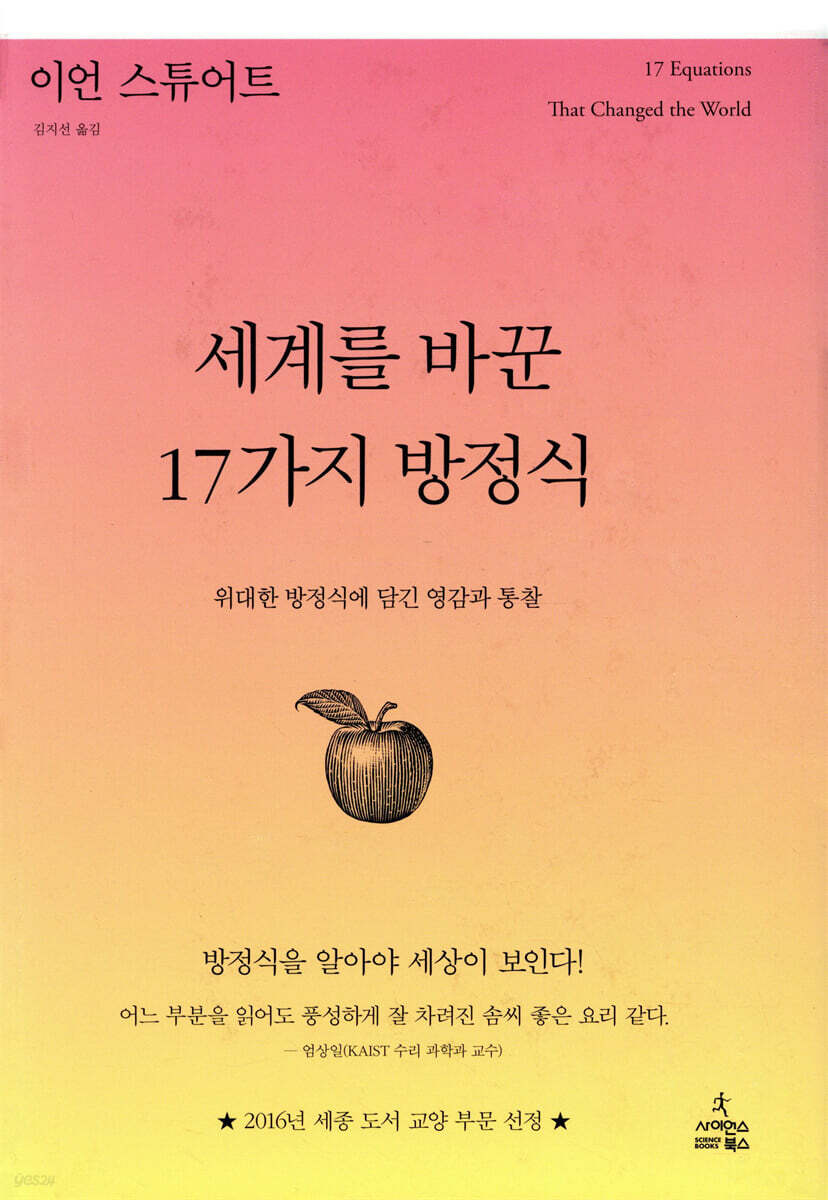
17 Equations That Changed the World
 |
Description
Book Introduction
Essential knowledge for the "Age of Insight"! The world of great equations.
Our greatest insights into the laws of nature will come in the form of equations, and we must learn to understand and recognize them.
Equations have truly changed the world so far.
And it will continue to be so in the future.
- In the text
Jack Ma, the world's richest man and chairman of Alibaba, declared that the IT (Information Technology) era is over and the DT (Data Technology) era is coming.
Park Hyung-joo, director of the National Institute of Mathematical Sciences, emphasizes that in an age of knowledge overload and infinite information, insight into the essence of things is a key quality for future society.
We have entered the "age of insight," where it is crucial to organically and systematically connect vast amounts of data and apply them to problem solving.
Mathematics is gaining attention as an essential liberal arts subject in the new era.
In particular, mathematical equations that explain the essence of nature and the universe through simple and clear relationships between various variables are very useful for developing the creative and logical thinking required in the age of insight.
However, even for math majors, it is not easy to understand and enjoy mathematical equations.
Moreover, for those who have been away from mathematics for a long time, mathematical equations may seem scary and boring.
This time, 『17 Equations That Changed the World: Inspiration and Insights in Great Equations』, published by Science Books, is an exciting mathematics book that introduces a selection of 17 mathematical equations that led to technological advancements and paradigm shifts and changed the course of human history.
Author Ian Stewart has compiled the essentials of each mathematical equation into one book, with concise concepts and rich stories.
Ian Stewart is Professor of Mathematics at the University of Warwick and the UK's best-selling author of mathematics, hailed by the Guardian as 'Britain's finest mathematics writer'.
The author, with the skill of a "mathematical master," explains the history of equations, anecdotes of related mathematicians, and their practical applications in real life, as well as the concepts and principles essential to understanding equations, allowing readers to enjoy learning, fun, and knowledge all at once.
Following 『The Mathematics of Life』, which contains the mystery of mathematics in life, and 『The Cow in the Maze』, which introduces interesting mathematical problems, 『17 Equations That Changed the World』, which concludes the Ian Stewart trilogy, demonstrates the great power of mathematics that has led the history of human civilization.
This book is the best mathematics textbook that can be read with interest not only by general adult readers who are trying to study mathematics again, but also by general student readers suffering from 'math depression'.
Our greatest insights into the laws of nature will come in the form of equations, and we must learn to understand and recognize them.
Equations have truly changed the world so far.
And it will continue to be so in the future.
- In the text
Jack Ma, the world's richest man and chairman of Alibaba, declared that the IT (Information Technology) era is over and the DT (Data Technology) era is coming.
Park Hyung-joo, director of the National Institute of Mathematical Sciences, emphasizes that in an age of knowledge overload and infinite information, insight into the essence of things is a key quality for future society.
We have entered the "age of insight," where it is crucial to organically and systematically connect vast amounts of data and apply them to problem solving.
Mathematics is gaining attention as an essential liberal arts subject in the new era.
In particular, mathematical equations that explain the essence of nature and the universe through simple and clear relationships between various variables are very useful for developing the creative and logical thinking required in the age of insight.
However, even for math majors, it is not easy to understand and enjoy mathematical equations.
Moreover, for those who have been away from mathematics for a long time, mathematical equations may seem scary and boring.
This time, 『17 Equations That Changed the World: Inspiration and Insights in Great Equations』, published by Science Books, is an exciting mathematics book that introduces a selection of 17 mathematical equations that led to technological advancements and paradigm shifts and changed the course of human history.
Author Ian Stewart has compiled the essentials of each mathematical equation into one book, with concise concepts and rich stories.
Ian Stewart is Professor of Mathematics at the University of Warwick and the UK's best-selling author of mathematics, hailed by the Guardian as 'Britain's finest mathematics writer'.
The author, with the skill of a "mathematical master," explains the history of equations, anecdotes of related mathematicians, and their practical applications in real life, as well as the concepts and principles essential to understanding equations, allowing readers to enjoy learning, fun, and knowledge all at once.
Following 『The Mathematics of Life』, which contains the mystery of mathematics in life, and 『The Cow in the Maze』, which introduces interesting mathematical problems, 『17 Equations That Changed the World』, which concludes the Ian Stewart trilogy, demonstrates the great power of mathematics that has led the history of human civilization.
This book is the best mathematics textbook that can be read with interest not only by general adult readers who are trying to study mathematics again, but also by general student readers suffering from 'math depression'.
- You can preview some of the book's contents.
Preview
index
Recommendation: The Exciting World of Equations
Introduction: Why Equations?
1 Measuring the Universe: The Pythagorean Theorem
2 The magic of turning multiplication into addition: logarithms
3 The Screwdriver of Modern Science: Calculus
4 The Hidden Structure of the Solar System: Newton's Law of Gravitation
5 Euler's Beautiful Gift: The Square Root of -1
6 All the knots in the world: Euler's polyhedron formulas
7 There are patterns in chance: the normal distribution
8 Harmonic Vibrations: The Wave Equation
9. The protagonist of the digital age: Fourier transform
10 The Formulas That Rule the Sky: The Navier-Stokes Equations
11 Light is an electromagnetic wave: Maxwell's equations
12 Disorder increases: The Second Law of Thermodynamics
13 The Birth and Evolution of the Universe: Theory of Relativity
14 The Weird World of Quantum: Schrödinger's Equation
15 Communication Revolution: Information Theory
16 The Illusion of Nature as a State of Balance: Chaos Theory
17 The Golden Hand: The Black-Scholes Equation
Conclusion: Where to next?
Introduction: Why Equations?
1 Measuring the Universe: The Pythagorean Theorem
2 The magic of turning multiplication into addition: logarithms
3 The Screwdriver of Modern Science: Calculus
4 The Hidden Structure of the Solar System: Newton's Law of Gravitation
5 Euler's Beautiful Gift: The Square Root of -1
6 All the knots in the world: Euler's polyhedron formulas
7 There are patterns in chance: the normal distribution
8 Harmonic Vibrations: The Wave Equation
9. The protagonist of the digital age: Fourier transform
10 The Formulas That Rule the Sky: The Navier-Stokes Equations
11 Light is an electromagnetic wave: Maxwell's equations
12 Disorder increases: The Second Law of Thermodynamics
13 The Birth and Evolution of the Universe: Theory of Relativity
14 The Weird World of Quantum: Schrödinger's Equation
15 Communication Revolution: Information Theory
16 The Illusion of Nature as a State of Balance: Chaos Theory
17 The Golden Hand: The Black-Scholes Equation
Conclusion: Where to next?
Detailed image
Publisher's Review
Essential knowledge for the "Age of Insight"! The world of great equations.
Our greatest insights into the laws of nature will come in the form of equations, and we must learn to understand and recognize them.
Equations have truly changed the world so far.
And it will continue to be so in the future.
- In the text
Jack Ma, the world's richest man and chairman of Alibaba, declared that the IT (Information Technology) era is over and the DT (Data Technology) era is coming.
Park Hyung-joo, director of the National Institute of Mathematical Sciences, emphasizes that in an age of knowledge overload and infinite information, insight into the essence of things is a key quality for future society.
We have entered the "age of insight," where it is crucial to organically and systematically connect vast amounts of data and apply them to problem solving.
Mathematics is gaining attention as an essential liberal arts subject in the new era.
In particular, mathematical equations that explain the essence of nature and the universe through simple and clear relationships between various variables are very useful for developing the creative and logical thinking required in the age of insight.
However, even for math majors, it is not easy to understand and enjoy mathematical equations.
Moreover, for those who have been away from mathematics for a long time, mathematical equations may seem scary and boring.
This time, 『17 Equations That Changed the World: Inspiration and Insights in Great Equations』, published by Science Books, is an exciting mathematics book that introduces a selection of 17 mathematical equations that led to technological advancements and paradigm shifts and changed the course of human history.
Author Ian Stewart has compiled the essentials of each mathematical equation into one book, with concise concepts and rich stories.
Ian Stewart is Professor of Mathematics at the University of Warwick and the UK's best-selling author of mathematics, hailed by the Guardian as 'Britain's finest mathematics writer'.
The author, with the skill of a "mathematical master," explains the history of equations, anecdotes of related mathematicians, and their practical applications in real life, as well as the concepts and principles essential to understanding equations, allowing readers to enjoy learning, fun, and knowledge all at once.
Following 『The Mathematics of Life』, which contains the mystery of mathematics in life, and 『The Cow in the Maze』, which introduces interesting mathematical problems, 『17 Equations That Changed the World』, which concludes the Ian Stewart trilogy, demonstrates the great power of mathematics that has led the history of human civilization.
This book is the best mathematics textbook that can be read with interest not only by general adult readers who are trying to study mathematics again, but also by general student readers suffering from 'math depression'.
Ian Stewart was a skilled cook who used formulas that were difficult to cover in a textbook as main ingredients, but mixed them with scholarly stories and stories about the formulas to create all kinds of dishes.
No matter which part you read, it is a feast of rich and well-laid dishes, so I hope you enjoy the 17 equation stories through this book.
- Sang-il Eom (Professor, Department of Mathematical Sciences, KAIST)
Leading the development of scientific and technological civilization and spiritual culture
17 Mathematical Equations
Equations are models that represent the profound patterns in the outside world.
By truly understanding the value of equations and learning to read the stories they tell, we can begin to recognize important properties of the world around us.
-In the text
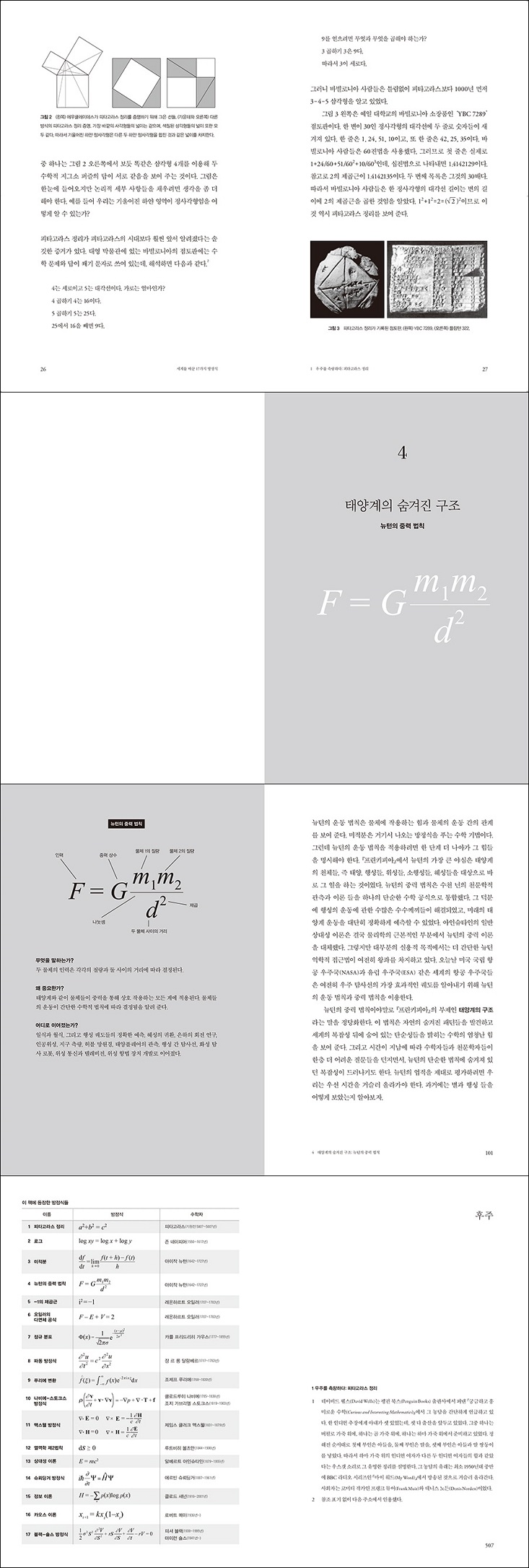
From the Pythagorean equation to the Black-Scholes equation, "17 Equations That Changed the World" features 17 mathematical equations that have played a pivotal role in human history.
The first page of each chapter contains a neat summary of the core mathematical equations in the chapter, along with their meaning, importance, and practical applications.
By keeping these milestones in mind as you read the book, you can gain an overview of the entire content without missing any key points, even if your mathematical foundation is lacking.
In fact, there are countless mathematical equations that influence us, whether we know it or not.
The alarm sound that announces the morning comes to our ears through the Schrödinger equation and Maxwell equations that appear in this book.
Shannon's information theory also plays a major role in exchanging massive amounts of data using digital devices.
And the mechanism for compressing, storing, and processing that much data uses the Fourier transform, which was developed from the wave equation.
The Navier-Stokes equations are widely applied to the streamlined design of automobiles and airplanes, as well as to predict atmospheric phenomena and climate change.
And thanks to the parallax adjustment of satellite navigation using the theory of relativity, we can utilize the correct position information.
Additionally, the normal distribution is used to quantitatively analyze complex social phenomena, and the Black-Scholes equation is used to trade numerous derivative products.
In this way, mathematical equations have literally driven modern scientific and technological civilization.
I want to make it clear that equations have played a central role in creating the world we live in today.
From mapmaking to satellite navigation, from music to television, from discovering America to exploring Jupiter's moons.
- In the text
Mathematical equations have revolutionized our worldview of understanding nature and the universe.
As Galileo Galilei said, “Nature is written in the language of mathematics.” The laws and principles of nature, which cannot be easily seen or imagined, are clearly understood through mathematical equations.
For example, using the Pythagorean theorem, we can deduce that the Earth is round without going outside of space.
We can also use Newton's law of gravitation to draw a map of the solar system's topography created by gravity.
Mathematical equations have provided breakthroughs in problem solving and expanded the realm of mathematics and science.
Logarithms, which allow us to quantitatively handle extremely large numbers, and calculus, which allows us to analyze the constantly changing nature, were important conceptual tools that led to the scientific revolution.
When imaginary numbers were introduced, complex and difficult mathematical problems were magically solved.
Euler's polyhedron formula also marked the beginning of the mysterious mathematics of topology.
Not only did he uncover the secret patterns of the universe, the laws of nature, but he also developed mathematical tools to accurately represent those laws and deduce their consequences.
The world's system was mathematical.
- In the text
Moreover, mathematical equations have broadened the horizons of thought and led humanity into a new world.
The second law of thermodynamics, which states that the entropy of the universe increases, has opened up mysterious philosophical conundrums beyond practical aspects such as the efficiency of heat engines, stimulating imaginations such as time machines and time travel.
Chaos theory took the scientific community by storm by showing that simple causes can lead to complex effects, and that complex effects do not necessarily have complex causes.
Of course, much more was needed to create the world we know today, but the 17 equations in this book undoubtedly played a pivotal role.
Sometimes created out of pure curiosity, sometimes out of practical necessity, and sometimes by unintentional coincidence, mathematical equations have revolutionized the world by leading to advancements in science and technology and paradigm shifts.
Some equations are universally valid.
Some describe the world very accurately, but not perfectly.
Some are less precise and cover a limited range of topics, but they provide key insights.
Some are fundamentally and completely wrong, but they serve as stepping stones to something better.
They can still have a huge impact.
- In the text
The ultimate math guide for those who are challenging themselves with math!
Equations have been the driving force of human civilization for thousands of years.
Throughout human history, equations have exerted influence across society.
Even if it was hidden behind the scenes and people didn't notice it, its influence was clearly still there.
This book is a story about the human spirit spreading its wings through 17 equations.
- In the text
Math is difficult.
In particular, mathematical equations, which can be called the integers of algebra, are even more difficult.
But the true value and beauty of mathematical equations lies not in the complex formulas and calculations, but in the inspiration and insight hidden behind them.
Mathematical equations have revealed the mysteries of the universe and nature, and have been the driving force behind civilization.
Mathematical equations, which led to the advancement of science and technology and innovation in thinking, ushered in a new era and were the pillars of civilization and the roots of science.
"17 Equations That Changed the World" guides readers through moments of great inspiration and insight revealed through mathematical equations.
Above all, "17 Equations That Changed the World" will serve as an excellent guide that leads readers into the true charm of mathematics.
Recommendation
Readers will embark on a journey with Ian Stewart into the world of mathematics, a key force that shaped the world we live in today.
-Scientific American
Seemingly simple equations have allowed us to build earthquake-resistant buildings, predict eclipses, and even create and use refrigerators.
Ian Stewart covers the 17 equations that form the foundation of modern scientific civilization in one book.
-《Discover》
A fun and authoritative book - BBC Focus
Ian Stewart's remarkable world of mathematics and holistic thinking is not only innovative but also romantic.
-"times"
Ian Stewart, Britain's brightest mind and star mathematician, treats readers to a 'delicious' treat.
-The Guardian
Our greatest insights into the laws of nature will come in the form of equations, and we must learn to understand and recognize them.
Equations have truly changed the world so far.
And it will continue to be so in the future.
- In the text
Jack Ma, the world's richest man and chairman of Alibaba, declared that the IT (Information Technology) era is over and the DT (Data Technology) era is coming.
Park Hyung-joo, director of the National Institute of Mathematical Sciences, emphasizes that in an age of knowledge overload and infinite information, insight into the essence of things is a key quality for future society.
We have entered the "age of insight," where it is crucial to organically and systematically connect vast amounts of data and apply them to problem solving.
Mathematics is gaining attention as an essential liberal arts subject in the new era.
In particular, mathematical equations that explain the essence of nature and the universe through simple and clear relationships between various variables are very useful for developing the creative and logical thinking required in the age of insight.
However, even for math majors, it is not easy to understand and enjoy mathematical equations.
Moreover, for those who have been away from mathematics for a long time, mathematical equations may seem scary and boring.
This time, 『17 Equations That Changed the World: Inspiration and Insights in Great Equations』, published by Science Books, is an exciting mathematics book that introduces a selection of 17 mathematical equations that led to technological advancements and paradigm shifts and changed the course of human history.
Author Ian Stewart has compiled the essentials of each mathematical equation into one book, with concise concepts and rich stories.
Ian Stewart is Professor of Mathematics at the University of Warwick and the UK's best-selling author of mathematics, hailed by the Guardian as 'Britain's finest mathematics writer'.
The author, with the skill of a "mathematical master," explains the history of equations, anecdotes of related mathematicians, and their practical applications in real life, as well as the concepts and principles essential to understanding equations, allowing readers to enjoy learning, fun, and knowledge all at once.
Following 『The Mathematics of Life』, which contains the mystery of mathematics in life, and 『The Cow in the Maze』, which introduces interesting mathematical problems, 『17 Equations That Changed the World』, which concludes the Ian Stewart trilogy, demonstrates the great power of mathematics that has led the history of human civilization.
This book is the best mathematics textbook that can be read with interest not only by general adult readers who are trying to study mathematics again, but also by general student readers suffering from 'math depression'.
Ian Stewart was a skilled cook who used formulas that were difficult to cover in a textbook as main ingredients, but mixed them with scholarly stories and stories about the formulas to create all kinds of dishes.
No matter which part you read, it is a feast of rich and well-laid dishes, so I hope you enjoy the 17 equation stories through this book.
- Sang-il Eom (Professor, Department of Mathematical Sciences, KAIST)
Leading the development of scientific and technological civilization and spiritual culture
17 Mathematical Equations
Equations are models that represent the profound patterns in the outside world.
By truly understanding the value of equations and learning to read the stories they tell, we can begin to recognize important properties of the world around us.
-In the text
From the Pythagorean equation to the Black-Scholes equation, "17 Equations That Changed the World" features 17 mathematical equations that have played a pivotal role in human history.
The first page of each chapter contains a neat summary of the core mathematical equations in the chapter, along with their meaning, importance, and practical applications.
By keeping these milestones in mind as you read the book, you can gain an overview of the entire content without missing any key points, even if your mathematical foundation is lacking.
In fact, there are countless mathematical equations that influence us, whether we know it or not.
The alarm sound that announces the morning comes to our ears through the Schrödinger equation and Maxwell equations that appear in this book.
Shannon's information theory also plays a major role in exchanging massive amounts of data using digital devices.
And the mechanism for compressing, storing, and processing that much data uses the Fourier transform, which was developed from the wave equation.
The Navier-Stokes equations are widely applied to the streamlined design of automobiles and airplanes, as well as to predict atmospheric phenomena and climate change.
And thanks to the parallax adjustment of satellite navigation using the theory of relativity, we can utilize the correct position information.
Additionally, the normal distribution is used to quantitatively analyze complex social phenomena, and the Black-Scholes equation is used to trade numerous derivative products.
In this way, mathematical equations have literally driven modern scientific and technological civilization.
I want to make it clear that equations have played a central role in creating the world we live in today.
From mapmaking to satellite navigation, from music to television, from discovering America to exploring Jupiter's moons.
- In the text
Mathematical equations have revolutionized our worldview of understanding nature and the universe.
As Galileo Galilei said, “Nature is written in the language of mathematics.” The laws and principles of nature, which cannot be easily seen or imagined, are clearly understood through mathematical equations.
For example, using the Pythagorean theorem, we can deduce that the Earth is round without going outside of space.
We can also use Newton's law of gravitation to draw a map of the solar system's topography created by gravity.
Mathematical equations have provided breakthroughs in problem solving and expanded the realm of mathematics and science.
Logarithms, which allow us to quantitatively handle extremely large numbers, and calculus, which allows us to analyze the constantly changing nature, were important conceptual tools that led to the scientific revolution.
When imaginary numbers were introduced, complex and difficult mathematical problems were magically solved.
Euler's polyhedron formula also marked the beginning of the mysterious mathematics of topology.
Not only did he uncover the secret patterns of the universe, the laws of nature, but he also developed mathematical tools to accurately represent those laws and deduce their consequences.
The world's system was mathematical.
- In the text
Moreover, mathematical equations have broadened the horizons of thought and led humanity into a new world.
The second law of thermodynamics, which states that the entropy of the universe increases, has opened up mysterious philosophical conundrums beyond practical aspects such as the efficiency of heat engines, stimulating imaginations such as time machines and time travel.
Chaos theory took the scientific community by storm by showing that simple causes can lead to complex effects, and that complex effects do not necessarily have complex causes.
Of course, much more was needed to create the world we know today, but the 17 equations in this book undoubtedly played a pivotal role.
Sometimes created out of pure curiosity, sometimes out of practical necessity, and sometimes by unintentional coincidence, mathematical equations have revolutionized the world by leading to advancements in science and technology and paradigm shifts.
Some equations are universally valid.
Some describe the world very accurately, but not perfectly.
Some are less precise and cover a limited range of topics, but they provide key insights.
Some are fundamentally and completely wrong, but they serve as stepping stones to something better.
They can still have a huge impact.
- In the text
The ultimate math guide for those who are challenging themselves with math!
Equations have been the driving force of human civilization for thousands of years.
Throughout human history, equations have exerted influence across society.
Even if it was hidden behind the scenes and people didn't notice it, its influence was clearly still there.
This book is a story about the human spirit spreading its wings through 17 equations.
- In the text
Math is difficult.
In particular, mathematical equations, which can be called the integers of algebra, are even more difficult.
But the true value and beauty of mathematical equations lies not in the complex formulas and calculations, but in the inspiration and insight hidden behind them.
Mathematical equations have revealed the mysteries of the universe and nature, and have been the driving force behind civilization.
Mathematical equations, which led to the advancement of science and technology and innovation in thinking, ushered in a new era and were the pillars of civilization and the roots of science.
"17 Equations That Changed the World" guides readers through moments of great inspiration and insight revealed through mathematical equations.
Above all, "17 Equations That Changed the World" will serve as an excellent guide that leads readers into the true charm of mathematics.
Recommendation
Readers will embark on a journey with Ian Stewart into the world of mathematics, a key force that shaped the world we live in today.
-Scientific American
Seemingly simple equations have allowed us to build earthquake-resistant buildings, predict eclipses, and even create and use refrigerators.
Ian Stewart covers the 17 equations that form the foundation of modern scientific civilization in one book.
-《Discover》
A fun and authoritative book - BBC Focus
Ian Stewart's remarkable world of mathematics and holistic thinking is not only innovative but also romantic.
-"times"
Ian Stewart, Britain's brightest mind and star mathematician, treats readers to a 'delicious' treat.
-The Guardian
GOODS SPECIFICS
- Date of issue: February 15, 2016
- Format: Hardcover book binding method guide
- Page count, weight, size: 528 pages | 836g | 145*215*33mm
- ISBN13: 9788983717436
- ISBN10: 8983717432
You may also like
카테고리
korean


korean

![ELLE 엘르 스페셜 에디션 A형 : 12월 [2025]](http://librairie.coreenne.fr/cdn/shop/files/b8e27a3de6c9538896439686c6b0e8fb.jpg?v=1766436872&width=3840)


