

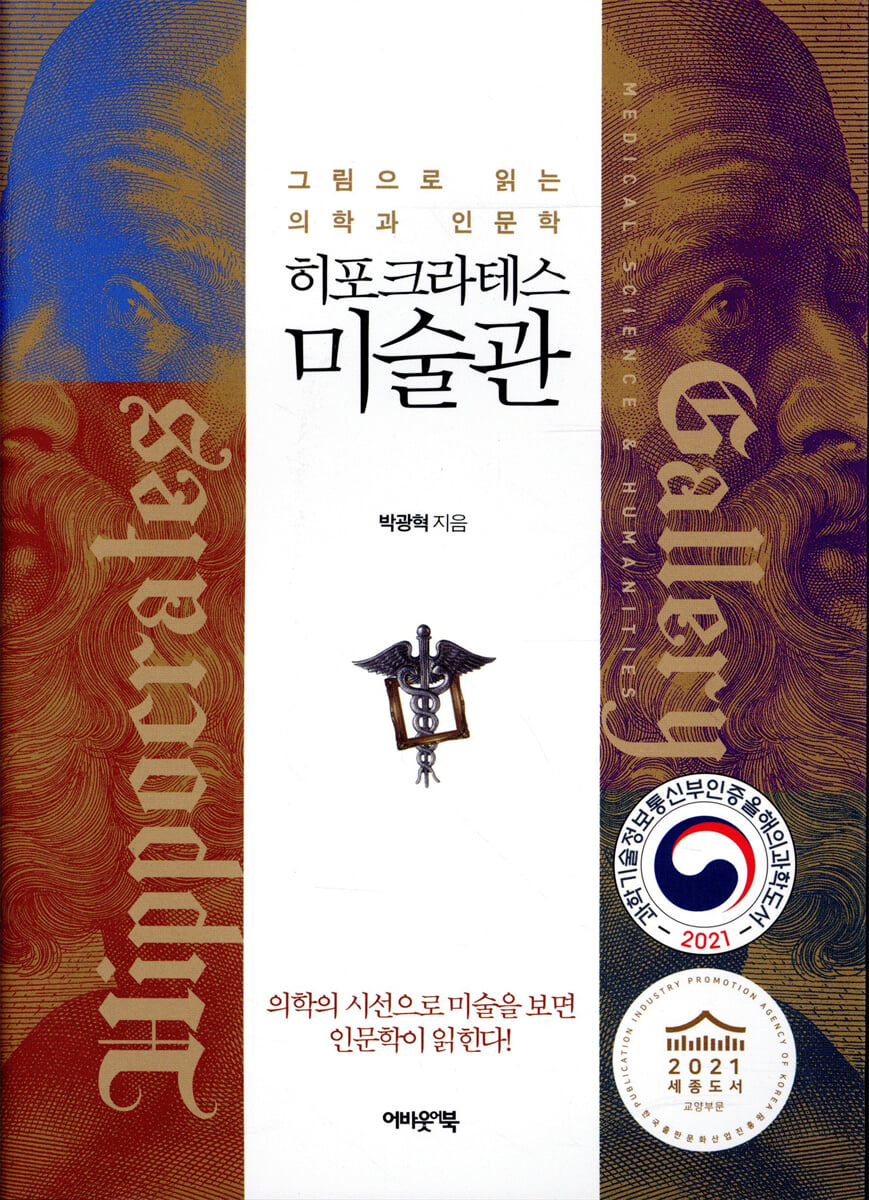
Hippocrates Museum
 |
Description
Book Introduction
A pilgrimage to art museums around the world, filled with medicine and humanities
He opened an art gallery by collecting famous paintings.
Name it
Hippocrates Museum!
This is the second book by Dr. Park Gwang-hyeok, who goes back and forth between his clinic and art gallery to unravel the medical stories hidden in paintings through writing and lectures.
The author is renowned for his extensive knowledge of art, capable of telling outrageous stories all night long from a single painting.
The reason why the art story told by the author is called 'Galleria Night' is because it is a metaphor for 'Arabian Night'.
For the past 20 years, he has been touring art museums around the world, including France, England, Germany, Spain, Italy, the Netherlands, Belgium, Denmark, Russia, Switzerland, Austria, the United States, and Japan, observing and recording the medical and humanistic codes contained in paintings.
The results were compiled into this book, “The Hippocratic Museum.”
The statement on the cover of the book, “If you look at art through a medical lens, you can understand all the humanities (from mythology to literature, art, history, and anthropology)” is by no means an exaggeration, as the Hippocrates Museum unfolds in fifteen stories.
In front of the 『At Eternity's Gate』 at the Van Gogh Museum in Amsterdam, we medically investigated Tchaikovsky's last symphony, 『Pathétique』, and his death, and discussed the 'evolutionary biology of head lice' in the paintings of 17th-century Flemish painters hanging in the Rijksmuseum.
The author, a doctor, adds to the enjoyment of art appreciation with his unique interpretation, such as examining the 'Face of Hippocrates', which signifies the expression of a person facing death, from the perspective of medical history in the portrait of his wife painted by Claude Monet, the 'painter of light'.
It is also very interesting to examine how medicine and art met with mythology and religion to create narratives, such as those in Cain and Abel, the wicked Lilith, and the Good Samaritan.
While the author's first book, "The Doctor Who Went to the Art Museum," focused on medicine, this book, "The Hippocrates Museum," expands the scope of medicine by crossing over various fields such as literature, history, art, mythology, religion, and anthropology through famous paintings.
The pleasure of encountering masterpieces by artists not found in existing books on Western art history or famous paintings is a bonus.
He opened an art gallery by collecting famous paintings.
Name it
Hippocrates Museum!
This is the second book by Dr. Park Gwang-hyeok, who goes back and forth between his clinic and art gallery to unravel the medical stories hidden in paintings through writing and lectures.
The author is renowned for his extensive knowledge of art, capable of telling outrageous stories all night long from a single painting.
The reason why the art story told by the author is called 'Galleria Night' is because it is a metaphor for 'Arabian Night'.
For the past 20 years, he has been touring art museums around the world, including France, England, Germany, Spain, Italy, the Netherlands, Belgium, Denmark, Russia, Switzerland, Austria, the United States, and Japan, observing and recording the medical and humanistic codes contained in paintings.
The results were compiled into this book, “The Hippocratic Museum.”
The statement on the cover of the book, “If you look at art through a medical lens, you can understand all the humanities (from mythology to literature, art, history, and anthropology)” is by no means an exaggeration, as the Hippocrates Museum unfolds in fifteen stories.
In front of the 『At Eternity's Gate』 at the Van Gogh Museum in Amsterdam, we medically investigated Tchaikovsky's last symphony, 『Pathétique』, and his death, and discussed the 'evolutionary biology of head lice' in the paintings of 17th-century Flemish painters hanging in the Rijksmuseum.
The author, a doctor, adds to the enjoyment of art appreciation with his unique interpretation, such as examining the 'Face of Hippocrates', which signifies the expression of a person facing death, from the perspective of medical history in the portrait of his wife painted by Claude Monet, the 'painter of light'.
It is also very interesting to examine how medicine and art met with mythology and religion to create narratives, such as those in Cain and Abel, the wicked Lilith, and the Good Samaritan.
While the author's first book, "The Doctor Who Went to the Art Museum," focused on medicine, this book, "The Hippocrates Museum," expands the scope of medicine by crossing over various fields such as literature, history, art, mythology, religion, and anthropology through famous paintings.
The pleasure of encountering masterpieces by artists not found in existing books on Western art history or famous paintings is a bonus.
- You can preview some of the book's contents.
Preview
index
Preface: The Joy of Reading the "True Face" of a Masterpiece
Gallery 01 On the incurable diseases of 'sorrow' and 'despair'
Gallery 02: The Story of Evolutionary Biology Told by 'Lee'
Gallery 03: Drawing the Melancholy of an Era - A Portrait of a Poet Who Has Lost His Emotions
Gallery 04 Conditions of a 'Good Doctor'
Gallery 05 Why Her Thin Waist Is Sad
Gallery 06 Surviving is a tearfully difficult task.
Gallery 07 When life requires a dialogue
Gallery 08 The Origins of the 'Brothers' Rebellion'
Gallery 09 Memories of an intelligent and elegant French woman
Gallery 10 Why must we save it?
Gallery 11 The Man Called 'Dr. Love'
Gallery 12 Portrait of an intellectual oxidized by carbon monoxide
Gallery 13: A Humanistic Reflection on "The Birth of a Villainess"
Gallery 14 At 3:00 a.m. on July 2, 1904, he passed away.
Gallery 15 Hippocrates' Room
Browse works
Gallery 01 On the incurable diseases of 'sorrow' and 'despair'
Gallery 02: The Story of Evolutionary Biology Told by 'Lee'
Gallery 03: Drawing the Melancholy of an Era - A Portrait of a Poet Who Has Lost His Emotions
Gallery 04 Conditions of a 'Good Doctor'
Gallery 05 Why Her Thin Waist Is Sad
Gallery 06 Surviving is a tearfully difficult task.
Gallery 07 When life requires a dialogue
Gallery 08 The Origins of the 'Brothers' Rebellion'
Gallery 09 Memories of an intelligent and elegant French woman
Gallery 10 Why must we save it?
Gallery 11 The Man Called 'Dr. Love'
Gallery 12 Portrait of an intellectual oxidized by carbon monoxide
Gallery 13: A Humanistic Reflection on "The Birth of a Villainess"
Gallery 14 At 3:00 a.m. on July 2, 1904, he passed away.
Gallery 15 Hippocrates' Room
Browse works
Detailed image
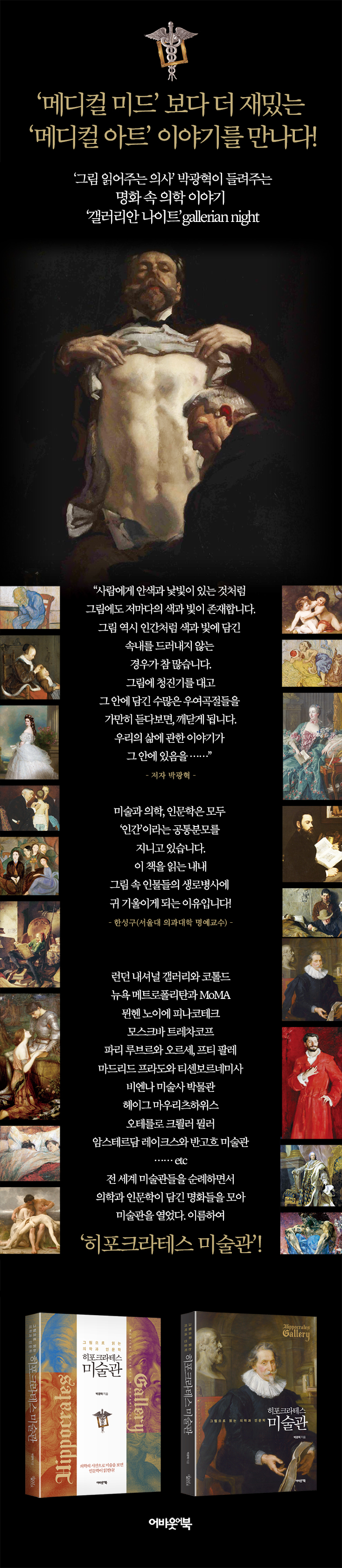
Publisher's Review
| A word from the author |
If medicine begins with the question, 'How can we save lives?'
The humanities are about finding answers to the question, 'How should we live?'
Ultimately, both disciplines are questions and answers about human life!
▣ The story of art by Park Gwang-hyeok, the 'doctor who reads pictures'
Why it's called 'Galleria Night'
The second book by Dr. Park Gwang-hyeok, an internist known by nicknames such as “the doctor who reads pictures” and “the doctor who goes to the art museum,” has been published.
While the author's first book, [The Medical Man Who Went to the Art Museum], focused on medicine, this book, [The Hippocrates Museum], expands the scope of medicine by crossing over various fields such as literature, history, art, mythology, religion, and anthropology through famous paintings.
The pleasure of encountering masterpieces by artists not found in existing books on Western art history or famous paintings is a bonus.
The author is renowned for his extensive knowledge of art, capable of telling outrageous stories all night long from a single painting.
This is why the art story told by the author is called 'Galleria Night', comparing it to 'Arabian Night'.
The author's comprehensive knowledge of art was not acquired solely through browsing the Internet or reading art textbooks.
For the past 20 years, he has been on a pilgrimage to large and small art museums around the world, including France, England, Germany, Spain, Italy, the Netherlands, Belgium, Denmark, Russia, Switzerland, Austria, the United States, and Japan, observing and recording the medical and humanistic codes contained in paintings.
It is by no means an easy task for a practicing doctor.
Whenever he went on a business trip to an overseas academic seminar, he always made a pilgrimage to the art galleries, museums, or cathedrals (that housed paintings) there.
He has been writing manuscripts and giving lectures based on works he has personally observed and recorded at overseas art museums.
This is evidenced by the part where I went to Amsterdam, Netherlands, and then to Otterlo (Kröller-Müller Museum) to see Vincent van Gogh's paintings in order to write this book.
“The reason I took a plane for over ten hours to Amsterdam, Netherlands, was to meet Vincent van Gogh.
There is a Van Gogh Museum in that city.
Van Gogh is the one who made me, a doctor, leave my office whenever I had time and wander around art museums around the world.
I willingly board a plane to see the hundreds of Van Gogh paintings displayed in museums around the world, willingly bearing the burden of countless stamps in my passport.
Although it is something that no one knows about, it is like a rite of passage to become a ‘Van Gogh fanatic.’
After spending the night wide awake in my hotel room due to jet lag, I wake up with a cup of bitter espresso and head to the art gallery.
If you wander among Van Gogh's works all day long from morning to night, your feet will become numb and your eyes will become red and swollen.
“I look like a weary pilgrim wandering through the art gallery.” _Page 15
The reason the author continues to visit art galleries, despite the time and financial burden, is because he wants to introduce newer artists and works to his readers.
The author does not stop at finding, observing, and recording masterpieces rarely seen in Korea, but also richly unfolds the medical stories contained within the paintings.
The painter Mikhail Vrubel and his representative work, the 'Demon' series, which he met at the Moscow Tretyakov Gallery, are not works that can be easily accessed.
The pitiful antics of the demon in the painting, who tries to win over the woman he loves, are directly reflected in the life of the painter Mikhail Vrubel.
The author's interpretation of why Vrubel had to die like a demon, from a medical perspective, is the true face of this book, something only he can do (page 116 and below).
▣From evolutionary biology to genetics,
Breaking down the boundaries of knowledge with a single picture!
You can also read the author's unique interpretation in 'Evolutionary Biology Stories Told by Lice', which was inspired by a genre painting depicting the daily life of a mother catching lice.
The title of the painting by Pieter de Hooch, which I saw at the Rijksmuseum in Amsterdam, which depicts a mother catching lice in her child's head, is surprisingly 'A Mother's Duty'.
It's true that removing lice from a child's head is a mother's job, but calling it a "mother's duty" seems a bit excessive.
However, if you look at the writings of Erasmus, the humanist introduced in this book, you will find it convincing.
The author does not stop at a life history interpretation of the painting, but expands it into a story of evolutionary biology of 'this'.
When you hear the story of how humanity was forced to face a huge disaster because of a tiny pest belonging to the order of the order of the beetles, you nod your head in agreement as to how eradicating 'lice' has gone from being a 'mother's duty' to a 'national duty' and then a 'homework for all of humanity'.
This is why the author was particularly drawn to Gerard ter Borch's [Mother Combing Her Daughter's Hair] over Vermeer's [Girl with a Pearl Earring] at the Mauritshuis Museum in The Hague.
“Just as the area in front of the [Mona Lisa] at the Louvre is always crowded with people, the room in the Mauritshuis in The Hague where the [Girl with a Pearl Earring] is displayed is the most crowded.
But, surprisingly, the painting by Borch that I really wanted to see was displayed to the left of this celebrity(!).
Celebrities are often surrounded by people who are shunned or marginalized.
But in this article, it is not [Girl with a Pearl Earring] but Borch's work that is the main character.” _Page 39 of the text
The author's 'Origin of the Sibling War', written after seeing Rubens' painting [Cain Smiting Abel] in the small gallery 'Courtauld' inside the building (Somerset House) where he took refuge from the pouring rain in London, is also very interesting.
As we proceed from the Jewish Biblical commentary 'Midrash' on 'Cain and Abel' in the Old Testament, through the Sumerian myth of Inanna, and to the Islamic scripture [Quran], we encounter the moment of 'humanity's first war' and 'humanity's first sorrow'.
The author goes a step further here and enriches the interpretation of myths and scriptures through the genetic theory of 'sibling rivalry' and 'parental investment theory.'
Along with this, appreciating William-Adolphe Bouguereau's masterpieces [War] and [The First Sorrow] cannot but be a virtue of this book (page 157 and below).
“The first sorrow of mankind is that of mother Eve who lost her child Abel.
Eve's sorrow is even more intense because she is both the mother of the victim and the mother of the perpetrator.
The title of the painting by French neoclassical painter Bouguereau is also [The First Sorrow].
A pale corpse lies bent like a bow on Abi Adam's lap.
The red blood on the floor reminds us of the horrific moment just moments ago.
Behind the unfortunate family, a smoking altar can be seen in the distance.
Smoke merges with storm clouds, blurring the line between sky and earth.
The sight is Eve's gaze, filled with such desperate tears that it is impossible to tell where the sky begins and where the earth begins.
Bugreau depicted the mother's heart, filled with unfathomable sorrow, in a pyramidal composition.
It is reminiscent of Michelangelo's Pietà, which depicts Mary holding the dead Jesus.” _Page 170
If we look at art through the lens of medicine, it covers everything from mythology to literature, art, history,
Almost all humanities, including anthropology, are read!
It is also interesting to note that the author remembered Hippocrates from Claude Monet's [Camille on Her Deathbed], which he encountered at the Musée d'Orsay in Paris, France.
“A woman’s face is faintly visible against a background painted entirely in dark blue paint.
Monet captured the image of his wife Camille on the brink of death.
Monet, the 'painter of light' who was ecstatic while painting the ever-changing haystacks in the fields, saying that still objects look different every moment because of light, would never have dreamed that he would see the saddest look on his dying wife's face.
If Monet painted ‘brilliant light’ in his masterpiece [Impression, Sunrise], he painted ‘the light of death’ in [Camille on the Verge of Death].”
_Preface, page 006
The first person to medically observe and record the 'light of death' was Hippocrates.
Over 2000 years ago, he left a record of his thoughtful observations of the 'faces' of those facing death.
Hippocrates recognized the signs of death in the patient, who was extremely pale, had a very gaunt face, had prominent cheekbones, had dull eyes, and was almost unconscious.
It is surprising that in those ancient times, when there was no concept of medicine, they observed and recorded in such detail a person who was near death.
In medicine, the face of a dying person is called the 'Hippocratic face (facies hippocratica)' in his honor.
The reason the author brought up the story of Hippocrates in Monet's [Camille on Her Deathbed] is because in medicine, death is not the end but the beginning.
Because medicine begins with the question, 'Why did he die?'
This is why Hippocrates observed and recorded the faces of dying people in detail more than 2000 years ago (p. 300).
The author demonstrates in fifteen stories that the statement on the book's cover, "If you look at art through a medical lens, you can understand almost all of the humanities (from mythology to literature, art, history, and anthropology)" is not an exaggeration.
In front of [At Eternity's Gate] at the Van Gogh Museum in Amsterdam, Tchaikovsky's last symphony [Pathétique] and his death were medically explained, and while listening to the reason why the poet Guillaume Apollinaire, the subject of Marie Laurencin's group portrait [Apollinaire and His Friends] hanging at the Picasso Museum in Paris, lost his poetic inspiration, you also have the experience of encountering 'Apollinaire Syndrome', a unique research topic in modern neurosurgery.
Through Spanish master Francisco Goya's [Self-Portrait with Doctor Arietta], you can encounter the sufferings of medicine, and through portraits of Madame de Pompadour, who pioneered Rococo art, you can hear heartbreaking stories of the diseases that royal women had to endure.
Also, as you listen to the stories of the lives of great writers such as Chekhov, Cervantes, Lermontov, and Émile Zola depicted in the paintings, and the medical stories in literature, you will enjoy an intellectual feast where art, literature, and medicine come together.
It is also quite interesting to examine the narratives that medicine and art, mythology and religion, created through the encounters in the stories of Cain and Abel, the wicked Lilith, and the Good Samaritan.
If medicine begins with the question, 'How can we save lives?'
The humanities are about finding answers to the question, 'How should we live?'
Ultimately, both disciplines are questions and answers about human life!
▣ The story of art by Park Gwang-hyeok, the 'doctor who reads pictures'
Why it's called 'Galleria Night'
The second book by Dr. Park Gwang-hyeok, an internist known by nicknames such as “the doctor who reads pictures” and “the doctor who goes to the art museum,” has been published.
While the author's first book, [The Medical Man Who Went to the Art Museum], focused on medicine, this book, [The Hippocrates Museum], expands the scope of medicine by crossing over various fields such as literature, history, art, mythology, religion, and anthropology through famous paintings.
The pleasure of encountering masterpieces by artists not found in existing books on Western art history or famous paintings is a bonus.
The author is renowned for his extensive knowledge of art, capable of telling outrageous stories all night long from a single painting.
This is why the art story told by the author is called 'Galleria Night', comparing it to 'Arabian Night'.
The author's comprehensive knowledge of art was not acquired solely through browsing the Internet or reading art textbooks.
For the past 20 years, he has been on a pilgrimage to large and small art museums around the world, including France, England, Germany, Spain, Italy, the Netherlands, Belgium, Denmark, Russia, Switzerland, Austria, the United States, and Japan, observing and recording the medical and humanistic codes contained in paintings.
It is by no means an easy task for a practicing doctor.
Whenever he went on a business trip to an overseas academic seminar, he always made a pilgrimage to the art galleries, museums, or cathedrals (that housed paintings) there.
He has been writing manuscripts and giving lectures based on works he has personally observed and recorded at overseas art museums.
This is evidenced by the part where I went to Amsterdam, Netherlands, and then to Otterlo (Kröller-Müller Museum) to see Vincent van Gogh's paintings in order to write this book.
“The reason I took a plane for over ten hours to Amsterdam, Netherlands, was to meet Vincent van Gogh.
There is a Van Gogh Museum in that city.
Van Gogh is the one who made me, a doctor, leave my office whenever I had time and wander around art museums around the world.
I willingly board a plane to see the hundreds of Van Gogh paintings displayed in museums around the world, willingly bearing the burden of countless stamps in my passport.
Although it is something that no one knows about, it is like a rite of passage to become a ‘Van Gogh fanatic.’
After spending the night wide awake in my hotel room due to jet lag, I wake up with a cup of bitter espresso and head to the art gallery.
If you wander among Van Gogh's works all day long from morning to night, your feet will become numb and your eyes will become red and swollen.
“I look like a weary pilgrim wandering through the art gallery.” _Page 15
The reason the author continues to visit art galleries, despite the time and financial burden, is because he wants to introduce newer artists and works to his readers.
The author does not stop at finding, observing, and recording masterpieces rarely seen in Korea, but also richly unfolds the medical stories contained within the paintings.
The painter Mikhail Vrubel and his representative work, the 'Demon' series, which he met at the Moscow Tretyakov Gallery, are not works that can be easily accessed.
The pitiful antics of the demon in the painting, who tries to win over the woman he loves, are directly reflected in the life of the painter Mikhail Vrubel.
The author's interpretation of why Vrubel had to die like a demon, from a medical perspective, is the true face of this book, something only he can do (page 116 and below).
▣From evolutionary biology to genetics,
Breaking down the boundaries of knowledge with a single picture!
You can also read the author's unique interpretation in 'Evolutionary Biology Stories Told by Lice', which was inspired by a genre painting depicting the daily life of a mother catching lice.
The title of the painting by Pieter de Hooch, which I saw at the Rijksmuseum in Amsterdam, which depicts a mother catching lice in her child's head, is surprisingly 'A Mother's Duty'.
It's true that removing lice from a child's head is a mother's job, but calling it a "mother's duty" seems a bit excessive.
However, if you look at the writings of Erasmus, the humanist introduced in this book, you will find it convincing.
The author does not stop at a life history interpretation of the painting, but expands it into a story of evolutionary biology of 'this'.
When you hear the story of how humanity was forced to face a huge disaster because of a tiny pest belonging to the order of the order of the beetles, you nod your head in agreement as to how eradicating 'lice' has gone from being a 'mother's duty' to a 'national duty' and then a 'homework for all of humanity'.
This is why the author was particularly drawn to Gerard ter Borch's [Mother Combing Her Daughter's Hair] over Vermeer's [Girl with a Pearl Earring] at the Mauritshuis Museum in The Hague.
“Just as the area in front of the [Mona Lisa] at the Louvre is always crowded with people, the room in the Mauritshuis in The Hague where the [Girl with a Pearl Earring] is displayed is the most crowded.
But, surprisingly, the painting by Borch that I really wanted to see was displayed to the left of this celebrity(!).
Celebrities are often surrounded by people who are shunned or marginalized.
But in this article, it is not [Girl with a Pearl Earring] but Borch's work that is the main character.” _Page 39 of the text
The author's 'Origin of the Sibling War', written after seeing Rubens' painting [Cain Smiting Abel] in the small gallery 'Courtauld' inside the building (Somerset House) where he took refuge from the pouring rain in London, is also very interesting.
As we proceed from the Jewish Biblical commentary 'Midrash' on 'Cain and Abel' in the Old Testament, through the Sumerian myth of Inanna, and to the Islamic scripture [Quran], we encounter the moment of 'humanity's first war' and 'humanity's first sorrow'.
The author goes a step further here and enriches the interpretation of myths and scriptures through the genetic theory of 'sibling rivalry' and 'parental investment theory.'
Along with this, appreciating William-Adolphe Bouguereau's masterpieces [War] and [The First Sorrow] cannot but be a virtue of this book (page 157 and below).
“The first sorrow of mankind is that of mother Eve who lost her child Abel.
Eve's sorrow is even more intense because she is both the mother of the victim and the mother of the perpetrator.
The title of the painting by French neoclassical painter Bouguereau is also [The First Sorrow].
A pale corpse lies bent like a bow on Abi Adam's lap.
The red blood on the floor reminds us of the horrific moment just moments ago.
Behind the unfortunate family, a smoking altar can be seen in the distance.
Smoke merges with storm clouds, blurring the line between sky and earth.
The sight is Eve's gaze, filled with such desperate tears that it is impossible to tell where the sky begins and where the earth begins.
Bugreau depicted the mother's heart, filled with unfathomable sorrow, in a pyramidal composition.
It is reminiscent of Michelangelo's Pietà, which depicts Mary holding the dead Jesus.” _Page 170
If we look at art through the lens of medicine, it covers everything from mythology to literature, art, history,
Almost all humanities, including anthropology, are read!
It is also interesting to note that the author remembered Hippocrates from Claude Monet's [Camille on Her Deathbed], which he encountered at the Musée d'Orsay in Paris, France.
“A woman’s face is faintly visible against a background painted entirely in dark blue paint.
Monet captured the image of his wife Camille on the brink of death.
Monet, the 'painter of light' who was ecstatic while painting the ever-changing haystacks in the fields, saying that still objects look different every moment because of light, would never have dreamed that he would see the saddest look on his dying wife's face.
If Monet painted ‘brilliant light’ in his masterpiece [Impression, Sunrise], he painted ‘the light of death’ in [Camille on the Verge of Death].”
_Preface, page 006
The first person to medically observe and record the 'light of death' was Hippocrates.
Over 2000 years ago, he left a record of his thoughtful observations of the 'faces' of those facing death.
Hippocrates recognized the signs of death in the patient, who was extremely pale, had a very gaunt face, had prominent cheekbones, had dull eyes, and was almost unconscious.
It is surprising that in those ancient times, when there was no concept of medicine, they observed and recorded in such detail a person who was near death.
In medicine, the face of a dying person is called the 'Hippocratic face (facies hippocratica)' in his honor.
The reason the author brought up the story of Hippocrates in Monet's [Camille on Her Deathbed] is because in medicine, death is not the end but the beginning.
Because medicine begins with the question, 'Why did he die?'
This is why Hippocrates observed and recorded the faces of dying people in detail more than 2000 years ago (p. 300).
The author demonstrates in fifteen stories that the statement on the book's cover, "If you look at art through a medical lens, you can understand almost all of the humanities (from mythology to literature, art, history, and anthropology)" is not an exaggeration.
In front of [At Eternity's Gate] at the Van Gogh Museum in Amsterdam, Tchaikovsky's last symphony [Pathétique] and his death were medically explained, and while listening to the reason why the poet Guillaume Apollinaire, the subject of Marie Laurencin's group portrait [Apollinaire and His Friends] hanging at the Picasso Museum in Paris, lost his poetic inspiration, you also have the experience of encountering 'Apollinaire Syndrome', a unique research topic in modern neurosurgery.
Through Spanish master Francisco Goya's [Self-Portrait with Doctor Arietta], you can encounter the sufferings of medicine, and through portraits of Madame de Pompadour, who pioneered Rococo art, you can hear heartbreaking stories of the diseases that royal women had to endure.
Also, as you listen to the stories of the lives of great writers such as Chekhov, Cervantes, Lermontov, and Émile Zola depicted in the paintings, and the medical stories in literature, you will enjoy an intellectual feast where art, literature, and medicine come together.
It is also quite interesting to examine the narratives that medicine and art, mythology and religion, created through the encounters in the stories of Cain and Abel, the wicked Lilith, and the Good Samaritan.
GOODS SPECIFICS
- Publication date: October 29, 2020
- Page count, weight, size: 328 pages | 560g | 154*210*17mm
- ISBN13: 9791187150787
- ISBN10: 1187150789
You may also like
카테고리
korean


korean

![GQ KOREA Mark (Monthly): December [2025]](http://librairie.coreenne.fr/cdn/shop/files/8ef265dbbfbf186523ed75ba7319009d.jpg?v=1765340328&width=3840)


