

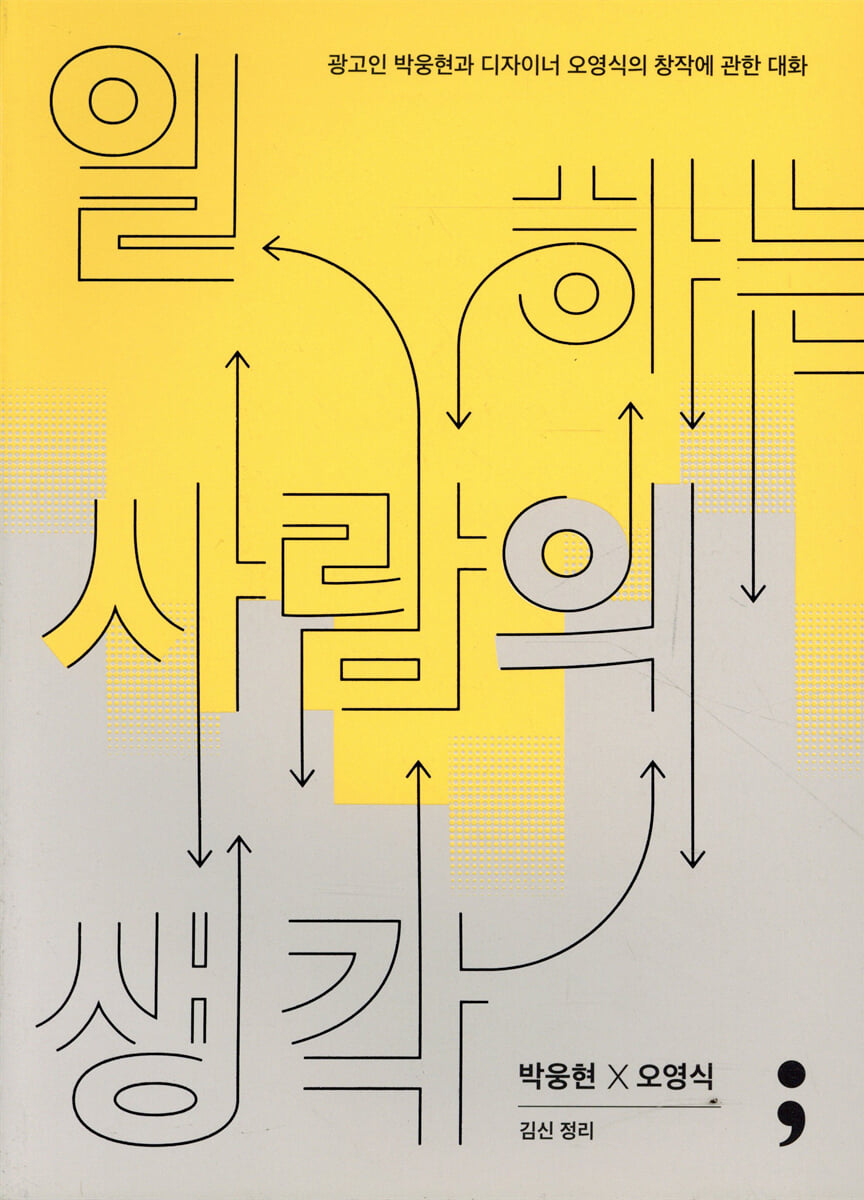
The thoughts of a working person
 |
Description
Book Introduction
Park Woong-hyun, Korea's leading advertising figure, and Oh Young-sik, brand identity designer, A conversation between two creative masters about creation. The world of work requiring creativity has expanded its scope with the changing times. People who make a living by creating and expressing things are continuing their careers with creativity as their driving force even in a world that changes every day. In countless fields of modern industry, including advertising, planning, marketing, branding, and design, creativity has become a core competency. Among them, advertising interprets products and services, creates content, and delivers it to the public. Design interprets and visualizes the image of a company and its products and presents it to the world. Advertising is about creating content, and design is about creating visuals; both are at the forefront of creativity. "Thoughts of a Working Person" is a collection of conversations between advertising professional Park Woong-hyun and designer Oh Young-sik about creative work. As senior creators with over 30 years of experience in their respective fields of advertising and design, Park Woong-hyun and Oh Young-sik published this book with the hope of sharing their learnings with their juniors by sharing stories of the creative process they have seen, heard, and experienced. Park Woong-hyun, a renowned Korean advertising figure and creative genius, has received love and support from countless readers across diverse backgrounds as a life mentor, conveying humanistic insights through bestsellers such as “Books are Axes,” “Eight Words,” and “Advertising with Humanities.” Oh Young-sik, who spoke with Park Woong-hyun, is a brand identity design expert who created the system and foundation of Hyundai Card design and breathed life into the designs of leading domestic companies such as SK Telecom, JTBC, and Lotte Card's 'Loca', and has produced dazzling results. Although they operate in different fields, both advertising and design are creative activities that produce visible results, and they both focus on problem-solving through creativity and originality as core competencies. What they focus on in this book is their livelihood called 'creation'. These vivid and honest stories, based on the experiences and insights gained from over 30 years of intense work in the field, guide readers into the creative process, revealing the processes through which each individual solved problems in their respective workplaces and the concerns they faced before producing results. |
- You can preview some of the book's contents.
Preview
index
Confession - Park Woong-hyun
Entering─Oh Young-sik
Becoming the first bold creator
1. The Middle School Student Who Wears Yellow Pants: Oh Young-sik's Childhood
2. Nourished by Books, Movies, and Music: Park Woong-hyun's Childhood
3 Failing the journalism exam and becoming an advertiser
4. Giving up metalworking to become a graphic designer
5. Counter-Teachers and Teachers
6 The place to learn for advertisers is not the classroom, but the streets.
Second Bold Branding: The Intersection of Advertising and Design
1. Truthfulness of Advertising
2 Brand design is about making a first impression.
3 Brand Names, Names Imprinted in People's Minds
4. Brand Heritage Created by Sustainability
About the inspiration for the third conversation
1 How does inspiration come?
2 Observation, the ability to see the extraordinary in the ordinary
3 Collections and Reading, Depth Over Quantity
4 Creative Interests
5. For the first inspiration, the seed of an idea, to sprout
Fourth Dialogue: Between Art and Business
1. Artistic sense of design
2. Literary quality of advertising copy
3 Advertising and Design as Comprehensive Arts
4 Autonomy and Innovation
5. Will you be ahead or follow the trend?
Fifth Dialogue Client
1 Relationship with clients
2. Reading the Client's Mind
3 Persuasion and Motivation
4. Responding to Clients
5 The value of being a client
Sixth Dialogue: The Changing Environment
1. The digital mobile era
2 Designers and advertisers in the era of the 4th industrial revolution
Attitudes toward the three-generation gap
4 Gender Issues
Seventh Dialogue: Work Life
1 Employees and Managers
2 Office environment and corporate culture
3 Time at work and rituals
Density of 4 meetings
The eighth bold creation
1 The Joy of Creation
2 Idea generation
3 Creation and Immersion
4 Products and Works
5 Distillation of Thoughts, Refining of Images
6 Motivation, Why I Do What I Do
7 The Meaning of Passion and Authenticity
More stories to share - about the changes we've faced
Review - Kim Shin
Entering─Oh Young-sik
Becoming the first bold creator
1. The Middle School Student Who Wears Yellow Pants: Oh Young-sik's Childhood
2. Nourished by Books, Movies, and Music: Park Woong-hyun's Childhood
3 Failing the journalism exam and becoming an advertiser
4. Giving up metalworking to become a graphic designer
5. Counter-Teachers and Teachers
6 The place to learn for advertisers is not the classroom, but the streets.
Second Bold Branding: The Intersection of Advertising and Design
1. Truthfulness of Advertising
2 Brand design is about making a first impression.
3 Brand Names, Names Imprinted in People's Minds
4. Brand Heritage Created by Sustainability
About the inspiration for the third conversation
1 How does inspiration come?
2 Observation, the ability to see the extraordinary in the ordinary
3 Collections and Reading, Depth Over Quantity
4 Creative Interests
5. For the first inspiration, the seed of an idea, to sprout
Fourth Dialogue: Between Art and Business
1. Artistic sense of design
2. Literary quality of advertising copy
3 Advertising and Design as Comprehensive Arts
4 Autonomy and Innovation
5. Will you be ahead or follow the trend?
Fifth Dialogue Client
1 Relationship with clients
2. Reading the Client's Mind
3 Persuasion and Motivation
4. Responding to Clients
5 The value of being a client
Sixth Dialogue: The Changing Environment
1. The digital mobile era
2 Designers and advertisers in the era of the 4th industrial revolution
Attitudes toward the three-generation gap
4 Gender Issues
Seventh Dialogue: Work Life
1 Employees and Managers
2 Office environment and corporate culture
3 Time at work and rituals
Density of 4 meetings
The eighth bold creation
1 The Joy of Creation
2 Idea generation
3 Creation and Immersion
4 Products and Works
5 Distillation of Thoughts, Refining of Images
6 Motivation, Why I Do What I Do
7 The Meaning of Passion and Authenticity
More stories to share - about the changes we've faced
Review - Kim Shin
Detailed image

Into the book
In a way, compared to those who do pure creative work, the creative activity is similar, but I would say that we start with different goals.
Artists have to solve their own invisible homework.
In contrast, I liked commercial design better because the homework was clear.
The process of problem-solving is difficult and arduous, but there is joy and elation when the value of the results is immediately apparent.
And while the process of realizing pure art is very long, design is relatively short.
I'm a practical person, so designs that produce results within a set period of time suit me well.
--- From "About Youngsik Oh's Inspiration"
When I go to a client meeting myself, I usually sketch on the way back after the interview.
Among the five final drafts that go into the Xi'an PT, the idea that first came to mind at that time is definitely included.
I pay very close attention when my client speaks, and as I listen, I try to imagine what he or she wants to portray.
This is what my work is like.
It's a job where you draw what the client wants to draw because they can't draw it themselves.
So I try really hard to catch what the client is saying.
And I keep thinking about it as I come back so I don't forget it.
Of course, not all of those sketches are accepted, but this process is also a kind of immersion.
--- From "About Youngsik Oh's Inspiration"
I don't think advertising is art.
Advertising is strictly a corporate marketing activity.
However, since the people who receive this company's marketing message are so indifferent, it has to be well-refined to make it resonate with them.
To do that, some literary training is required.
I think it's only natural that people who are good at writing are also good at copywriting.
--- From "Park Woong-hyun_Between Art and Business"
What creators like us do is problem solving.
I think it's a question of whether you can find a good solution within the conditions.
So when I get a request, I ask about the conditions first.
First, we build a wall of restrictions, such as how much is the budget and what kind of personality does the client have.
If a wall is impenetrable, then that wall should be treated as a fixed variable.
The fixed variable will soon become what we call the grid in design.
Next is tactics.
Within a given budget, within a given period of time, what decisions need to be made, what resources are available - these are fixed variables that we have to set and start the game from there.
--- From "Park Woong-hyun_Between Art and Business"
Although the work we've done isn't a masterpiece, I believe that the well-designed signs used as signs have contributed to the city's appearance to some extent.
And sometimes when I have the opportunity to meet foreigners, they ask me what I do.
When you answer that you do branding design, you say that when you come to Korea, you can see our designs at least twice a day.
I feel proud even then.
--- From "Oh Young-sik_Client"
We've moved from the era of broadcasting to the era of narrowcasting, so we don't 'broadcast' anymore.
All YouTube channels are broadcasts.
There are so many personal media outlets that the wires are gone.
You can see that the word 'crowd' has disappeared and has become 'group'.
That's why it's difficult to target advertisements.
There is an audience, but the target is vague.
So everyone is having a hard time.
In this situation, what we came up with in the dark was to create a more comprehensive branding communication tool.
We're trying to find fundamental solutions, and we're not just hanging on to the advertising itself anymore.
--- From "Park Woong-hyun_Changing Environment"
I think immersion is a sense of urgency.
Without urgency, immersion doesn't work well.
So I guess I have to have deadline syndrome.
The moments when I become immersed are always when I am in a rush.
I don't think I can get immersed if I don't feel like I have to do anything, don't have to do anything by a certain date, and don't lose 3 billion won without coming up with an idea.
So, immersion is driven by urgency.
The more desperate you are, the stronger the spark becomes.
The moment of immersion is truly thrilling.
That's like work addiction.
Even when things are so difficult, there are times when you have a few experiences, when you focus and inspiration flashes, or when you have a conversation with a few people and sparks fly between them, and those moments are thrilling.
--- From "Park Woong-hyun_The Work of Creation"
My goal is to become a good adult.
My goal is to create many good adults around me.
Until that happens, we can't just sit back and do nothing.
However, I don't think everyone can participate in social movements.
So I think it's important to constantly think about things like, what can I do, did I make today worthwhile, did I grow a little more, did I meet a good person, did I waste the day, am I feeling helpless, how can I get better?
These are the small efforts I want to tell the younger generation.
Artists have to solve their own invisible homework.
In contrast, I liked commercial design better because the homework was clear.
The process of problem-solving is difficult and arduous, but there is joy and elation when the value of the results is immediately apparent.
And while the process of realizing pure art is very long, design is relatively short.
I'm a practical person, so designs that produce results within a set period of time suit me well.
--- From "About Youngsik Oh's Inspiration"
When I go to a client meeting myself, I usually sketch on the way back after the interview.
Among the five final drafts that go into the Xi'an PT, the idea that first came to mind at that time is definitely included.
I pay very close attention when my client speaks, and as I listen, I try to imagine what he or she wants to portray.
This is what my work is like.
It's a job where you draw what the client wants to draw because they can't draw it themselves.
So I try really hard to catch what the client is saying.
And I keep thinking about it as I come back so I don't forget it.
Of course, not all of those sketches are accepted, but this process is also a kind of immersion.
--- From "About Youngsik Oh's Inspiration"
I don't think advertising is art.
Advertising is strictly a corporate marketing activity.
However, since the people who receive this company's marketing message are so indifferent, it has to be well-refined to make it resonate with them.
To do that, some literary training is required.
I think it's only natural that people who are good at writing are also good at copywriting.
--- From "Park Woong-hyun_Between Art and Business"
What creators like us do is problem solving.
I think it's a question of whether you can find a good solution within the conditions.
So when I get a request, I ask about the conditions first.
First, we build a wall of restrictions, such as how much is the budget and what kind of personality does the client have.
If a wall is impenetrable, then that wall should be treated as a fixed variable.
The fixed variable will soon become what we call the grid in design.
Next is tactics.
Within a given budget, within a given period of time, what decisions need to be made, what resources are available - these are fixed variables that we have to set and start the game from there.
--- From "Park Woong-hyun_Between Art and Business"
Although the work we've done isn't a masterpiece, I believe that the well-designed signs used as signs have contributed to the city's appearance to some extent.
And sometimes when I have the opportunity to meet foreigners, they ask me what I do.
When you answer that you do branding design, you say that when you come to Korea, you can see our designs at least twice a day.
I feel proud even then.
--- From "Oh Young-sik_Client"
We've moved from the era of broadcasting to the era of narrowcasting, so we don't 'broadcast' anymore.
All YouTube channels are broadcasts.
There are so many personal media outlets that the wires are gone.
You can see that the word 'crowd' has disappeared and has become 'group'.
That's why it's difficult to target advertisements.
There is an audience, but the target is vague.
So everyone is having a hard time.
In this situation, what we came up with in the dark was to create a more comprehensive branding communication tool.
We're trying to find fundamental solutions, and we're not just hanging on to the advertising itself anymore.
--- From "Park Woong-hyun_Changing Environment"
I think immersion is a sense of urgency.
Without urgency, immersion doesn't work well.
So I guess I have to have deadline syndrome.
The moments when I become immersed are always when I am in a rush.
I don't think I can get immersed if I don't feel like I have to do anything, don't have to do anything by a certain date, and don't lose 3 billion won without coming up with an idea.
So, immersion is driven by urgency.
The more desperate you are, the stronger the spark becomes.
The moment of immersion is truly thrilling.
That's like work addiction.
Even when things are so difficult, there are times when you have a few experiences, when you focus and inspiration flashes, or when you have a conversation with a few people and sparks fly between them, and those moments are thrilling.
--- From "Park Woong-hyun_The Work of Creation"
My goal is to become a good adult.
My goal is to create many good adults around me.
Until that happens, we can't just sit back and do nothing.
However, I don't think everyone can participate in social movements.
So I think it's important to constantly think about things like, what can I do, did I make today worthwhile, did I grow a little more, did I meet a good person, did I waste the day, am I feeling helpless, how can I get better?
These are the small efforts I want to tell the younger generation.
--- From "Park Woong-hyun_The Work of Creation"
Publisher's Review
At the forefront of advertising, design and creativity
What do good seniors think?
Creation, inspiration, motivation, zeitgeist, environment, client…
A record of conversations that cross various topics and discover commonalities and differences.
This book is based on the contents of conversations conducted over ten sessions starting in May 2019.
The conversation was held with three people: Park Woong-hyun, Oh Young-sik, and the moderator, Kim Shin, sharing stories with each other.
Kim Shin, who works as a design writer, provided topics and asked questions to Park Woong-hyun and Oh Young-sik, helping to establish the context of the conversation and organize it.
The conversation, which took place in this way, became richer and deeper with each passing hour, allowing us to closely examine their thoughts on the work of creation.
It also contains expert opinions, wisdom and reflection based on experience and seniority, and sincere advice on attitude and mindset toward work.
The contents of the conversation were reorganized into eight topics and included in the book.
The first part condenses the story of Park Woong-hyun and Oh Young-sik finding their careers in advertising and design, respectively.
As individuals who have achieved success in their respective fields, they talk about how they entered their fields, what their childhood interests were, and how they influenced them.
The conversation between Park Woong-hyun and Oh Young-sik continues in an interesting way, going back and forth between similarities and differences depending on the topic.
The second topic of discussion, 'branding', is the process of creating a brand's value and image, and is where advertising and design meet.
They discuss strategies for increasing brand value and the direction the brand should pursue, citing projects they have worked on so far as examples, and they all agree on the importance of brand sustainability and heritage.
The third and fourth conversations are about inspiration, ideas, artistry, and expression, issues that cannot be avoided by anyone who creates.
Not all creative people are artists, but like artists, they wait for inspiration to strike and work tirelessly to come up with creative ideas.
The story of the thrill of inspiration, the struggle to sprout an idea, and the yearning to solve a problem illustrates the process of finding a balance between art and business.
The fifth conversation, "Client," the sixth, "Changing Environment," and the seventh, "Work Life," discuss situations that those engaged in the creative industry inevitably face.
Through the thoughts and impressive experiences I had while dealing with clients and receiving work, I can feel the joys and sorrows of an office worker who walks the tightrope between the positions of A and B while also being a creator.
We also discuss what kind of awareness and sensitivity creators need about the environment they are in, how changes in the media environment affect creative work, generational differences, gender sensitivity, and the work environment and culture.
Finally, the eighth conversation is a part where we can look into deep thoughts and ultimate goals regarding the work of creation.
The fact that the creator's motivation for working is also his/her 'livelihood' shows that creation is not something that is accomplished in a noble and mysterious way in the mind, but rather that it can only be achieved through fierce struggle in reality.
It also reminds us of the importance of relationships, passion, and motivation, as it is achieved through collaborative work rather than solo effort.
"Authenticity is not a persuasion point, it's a survival point."
Why Authenticity Matters to Creators
Presenting the unchanging values and essence of work in a changing era.
No matter how much the times change and society changes rapidly, there will always be working people.
Even though countless keywords emerge to discuss new paradigms like the Fourth Industrial Revolution, the COVID-19 pandemic, contactless, and the new normal, some people are working and must continue to work.
The world of creation is no different.
The conversation between Park Woong-hyun and Oh Young-sik proves that they have accumulated experience by directly immersing themselves in the world of creation.
Thus, it clearly presents the values that a creator should pursue.
That is the value of authenticity.
Park Woong-hyun and Oh Young-sik have personally experienced the changing times and environments and witnessed the process of the nature and value of work changing, but they insist that the value that never changes is authenticity.
While sharing various stories across eight topics, they mentioned the need to approach work with sincerity, the need to approach it with sincerity, and the need to create authentic content.
In the final interview, when asked how to convince others of the value of authenticity, Park Woong-hyun answered, “Authenticity is not a point of persuasion, but a point of survival.”
The argument is that if you don't think authenticity is important, you won't be able to survive, and if you don't approach work with authenticity, you won't be able to survive.
These thoughts become even more persuasive when we consider what's happening in our society today: good businesses surviving, authentic content gaining more popularity, and celebrities falling into the abyss after being judged by lax standards.
The thoughts of those who seek unchanging values in a changing environment and examine the essence of work are a voice of encouragement and teaching that empowers those who are fighting individual battles in all workplaces, including the creative field, and those who wish to jump into the field of such workplaces.
In an age where true mentors and empathetic adults are scarce, whether at work or in life, their thoughts and words resonate even more deeply.
What do good seniors think?
Creation, inspiration, motivation, zeitgeist, environment, client…
A record of conversations that cross various topics and discover commonalities and differences.
This book is based on the contents of conversations conducted over ten sessions starting in May 2019.
The conversation was held with three people: Park Woong-hyun, Oh Young-sik, and the moderator, Kim Shin, sharing stories with each other.
Kim Shin, who works as a design writer, provided topics and asked questions to Park Woong-hyun and Oh Young-sik, helping to establish the context of the conversation and organize it.
The conversation, which took place in this way, became richer and deeper with each passing hour, allowing us to closely examine their thoughts on the work of creation.
It also contains expert opinions, wisdom and reflection based on experience and seniority, and sincere advice on attitude and mindset toward work.
The contents of the conversation were reorganized into eight topics and included in the book.
The first part condenses the story of Park Woong-hyun and Oh Young-sik finding their careers in advertising and design, respectively.
As individuals who have achieved success in their respective fields, they talk about how they entered their fields, what their childhood interests were, and how they influenced them.
The conversation between Park Woong-hyun and Oh Young-sik continues in an interesting way, going back and forth between similarities and differences depending on the topic.
The second topic of discussion, 'branding', is the process of creating a brand's value and image, and is where advertising and design meet.
They discuss strategies for increasing brand value and the direction the brand should pursue, citing projects they have worked on so far as examples, and they all agree on the importance of brand sustainability and heritage.
The third and fourth conversations are about inspiration, ideas, artistry, and expression, issues that cannot be avoided by anyone who creates.
Not all creative people are artists, but like artists, they wait for inspiration to strike and work tirelessly to come up with creative ideas.
The story of the thrill of inspiration, the struggle to sprout an idea, and the yearning to solve a problem illustrates the process of finding a balance between art and business.
The fifth conversation, "Client," the sixth, "Changing Environment," and the seventh, "Work Life," discuss situations that those engaged in the creative industry inevitably face.
Through the thoughts and impressive experiences I had while dealing with clients and receiving work, I can feel the joys and sorrows of an office worker who walks the tightrope between the positions of A and B while also being a creator.
We also discuss what kind of awareness and sensitivity creators need about the environment they are in, how changes in the media environment affect creative work, generational differences, gender sensitivity, and the work environment and culture.
Finally, the eighth conversation is a part where we can look into deep thoughts and ultimate goals regarding the work of creation.
The fact that the creator's motivation for working is also his/her 'livelihood' shows that creation is not something that is accomplished in a noble and mysterious way in the mind, but rather that it can only be achieved through fierce struggle in reality.
It also reminds us of the importance of relationships, passion, and motivation, as it is achieved through collaborative work rather than solo effort.
"Authenticity is not a persuasion point, it's a survival point."
Why Authenticity Matters to Creators
Presenting the unchanging values and essence of work in a changing era.
No matter how much the times change and society changes rapidly, there will always be working people.
Even though countless keywords emerge to discuss new paradigms like the Fourth Industrial Revolution, the COVID-19 pandemic, contactless, and the new normal, some people are working and must continue to work.
The world of creation is no different.
The conversation between Park Woong-hyun and Oh Young-sik proves that they have accumulated experience by directly immersing themselves in the world of creation.
Thus, it clearly presents the values that a creator should pursue.
That is the value of authenticity.
Park Woong-hyun and Oh Young-sik have personally experienced the changing times and environments and witnessed the process of the nature and value of work changing, but they insist that the value that never changes is authenticity.
While sharing various stories across eight topics, they mentioned the need to approach work with sincerity, the need to approach it with sincerity, and the need to create authentic content.
In the final interview, when asked how to convince others of the value of authenticity, Park Woong-hyun answered, “Authenticity is not a point of persuasion, but a point of survival.”
The argument is that if you don't think authenticity is important, you won't be able to survive, and if you don't approach work with authenticity, you won't be able to survive.
These thoughts become even more persuasive when we consider what's happening in our society today: good businesses surviving, authentic content gaining more popularity, and celebrities falling into the abyss after being judged by lax standards.
The thoughts of those who seek unchanging values in a changing environment and examine the essence of work are a voice of encouragement and teaching that empowers those who are fighting individual battles in all workplaces, including the creative field, and those who wish to jump into the field of such workplaces.
In an age where true mentors and empathetic adults are scarce, whether at work or in life, their thoughts and words resonate even more deeply.
GOODS SPECIFICS
- Publication date: October 19, 2020
- Page count, weight, size: 300 pages | 518g | 152*210*15mm
- ISBN13: 9791190403238
- ISBN10: 1190403234
You may also like
카테고리
korean


korean

![GQ KOREA Mark (Monthly): December [2025]](http://librairie.coreenne.fr/cdn/shop/files/8ef265dbbfbf186523ed75ba7319009d.jpg?v=1765340328&width=3840)


