

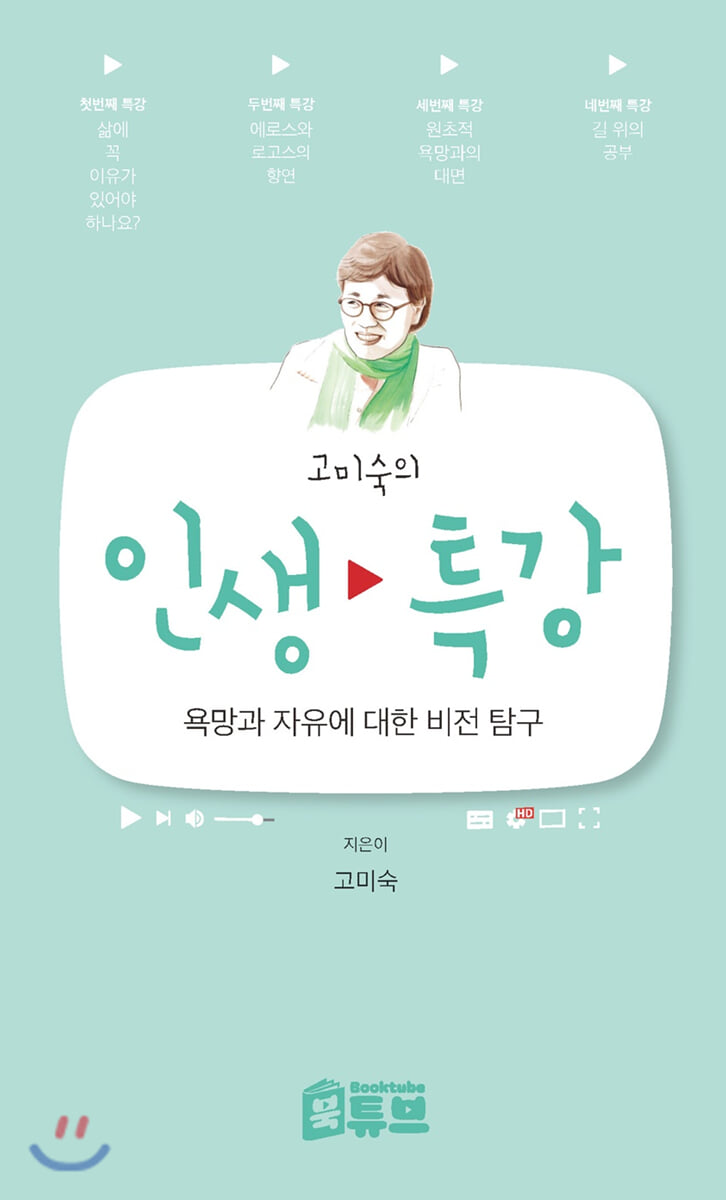
Gomisuk's Special Lecture on Life
 |
Description
Book Introduction
“Stop, reflect, and connect!!”
Classical critic Go Mi-sook shares her tips on how to live as the master of your own life!
The flood of goods and consumption, and the poverty and polarization behind it.
Global disasters such as pandemics and climate crisis.
How should we navigate this time of crisis? Classical critic Go Mi-sook, in her book "Gomi-sook's Special Lecture on Life," suggests "stopping the rush and completely changing the direction of our desires" as the solution.
"From consumption and pleasure to rest and reflection, from external expansion to internal fulfillment, from instrumentalizing nature to coexisting with it!" The author's message to us is that we must shift our direction along this new path if we are to sustain life and live in peace and freedom.
This book is a compilation of four lectures the author gave at different times and places.
From the first lecture ("Does Life Always Have a Reason?") that emphasizes the importance of life itself rather than grandiose "values" that can be converted into money to the last lecture ("Studying on the Road") that provides practical guidelines for connecting and studying "on the road," the author consistently emphasizes "stopping, connecting, and reflecting."
We must reflect with 'Logos' wisdom on where the 'dreams', 'values', and 'meanings' we pursue are headed and whether they are eating away at our 'eros' life force. The path to that opens when we leave home, connect with the classics, and connect with the world.
Classical critic Go Mi-sook shares her tips on how to live as the master of your own life!
The flood of goods and consumption, and the poverty and polarization behind it.
Global disasters such as pandemics and climate crisis.
How should we navigate this time of crisis? Classical critic Go Mi-sook, in her book "Gomi-sook's Special Lecture on Life," suggests "stopping the rush and completely changing the direction of our desires" as the solution.
"From consumption and pleasure to rest and reflection, from external expansion to internal fulfillment, from instrumentalizing nature to coexisting with it!" The author's message to us is that we must shift our direction along this new path if we are to sustain life and live in peace and freedom.
This book is a compilation of four lectures the author gave at different times and places.
From the first lecture ("Does Life Always Have a Reason?") that emphasizes the importance of life itself rather than grandiose "values" that can be converted into money to the last lecture ("Studying on the Road") that provides practical guidelines for connecting and studying "on the road," the author consistently emphasizes "stopping, connecting, and reflecting."
We must reflect with 'Logos' wisdom on where the 'dreams', 'values', and 'meanings' we pursue are headed and whether they are eating away at our 'eros' life force. The path to that opens when we leave home, connect with the classics, and connect with the world.
- You can preview some of the book's contents.
Preview
index
At the beginning of the book
First Special Lecture _ Does life always need a reason?
'Dreams' cannot be more important than 'life'.
Life, a Journey to Knowledge
Indra's Net of Knowledge, Intelligence, and Wisdom
Excessive self-consciousness that ignores 'wisdom'
Son Oh-gong and Seong-jin, the incarnation of Eros, rush to violence.
The infinitely enlarged ego of modern people
Ontological Questions and Their Connection to Wisdom
Life is enough in itself!
Second Special Lecture _ A Feast of Eros and Logos
Youth and Eros
Youth, the spring of life!
But! Powerless and empty youth!
Release the energy of youth!
The combination of erotic impulse and logos vision
From possession and obsession to the network of logos
Questions about study and life
Connection, the power to change the world
Third Special Lecture: Confronting Primal Desires
Let's break the dichotomy between desire and life!
Eros and Logos and the Spirit, Energy, and God
Convergence and Divergence: The Political Economy of Life
The chaotic nature of desire
Capitalism, the end of civilization
The universal nature of desire
Logos, confront the scene of desire.
Turning while standing
Fourth Special Lecture _ Studying on the Road
North-Indra's Net, Meeting on the Road
Democracy and Desire
Activity, not money
For a life worth living
The path of self-care (curas) and exploration (quest)
Connect the surplus
Studying on the road
First Special Lecture _ Does life always need a reason?
'Dreams' cannot be more important than 'life'.
Life, a Journey to Knowledge
Indra's Net of Knowledge, Intelligence, and Wisdom
Excessive self-consciousness that ignores 'wisdom'
Son Oh-gong and Seong-jin, the incarnation of Eros, rush to violence.
The infinitely enlarged ego of modern people
Ontological Questions and Their Connection to Wisdom
Life is enough in itself!
Second Special Lecture _ A Feast of Eros and Logos
Youth and Eros
Youth, the spring of life!
But! Powerless and empty youth!
Release the energy of youth!
The combination of erotic impulse and logos vision
From possession and obsession to the network of logos
Questions about study and life
Connection, the power to change the world
Third Special Lecture: Confronting Primal Desires
Let's break the dichotomy between desire and life!
Eros and Logos and the Spirit, Energy, and God
Convergence and Divergence: The Political Economy of Life
The chaotic nature of desire
Capitalism, the end of civilization
The universal nature of desire
Logos, confront the scene of desire.
Turning while standing
Fourth Special Lecture _ Studying on the Road
North-Indra's Net, Meeting on the Road
Democracy and Desire
Activity, not money
For a life worth living
The path of self-care (curas) and exploration (quest)
Connect the surplus
Studying on the road
Into the book
If you live only with knowledge and intelligence, your ego will become very inflated.
For example, teenagers don't say, "I want to love someone."
I want to be popular with really beautiful women, that's what it is.
And “I want to be successful” doesn’t mean “I want to live proudly with the work I want to do”, but “I want to become someone who can handle a huge amount of money”, but because their reality is so far away, they fall.
You're falling on your own.
This is the obesity of the ego, self-consciousness.
So once you get on this track, there's no stopping it.
--- p.25
This knowing is like a horizon because it is a world of silence and spirituality.
The horizon can be reached but not reached.
There is no need to reach it.
So, I believe that the path that humans can take, step by step, by endlessly asking and asking questions, is the horizon of knowledge.
And I think when we connect to that horizon, that's where we encounter this cosmic wave we call wisdom.
--- p.44
When I become obsessed with decorating myself, I experience tremendous neglect of my body.
What comes from there is emptiness.
No matter how pretty I become, this is a problem that will never end.
It only creates deficiencies.
The same goes for male students.
When you start showing off like that, other men start becoming your competitors.
So, men are having a hard time right now too.
I need to take care of my skin, build abs, and wear luxury brand clothes.
But why on earth are we doing this? This is the question we must ask ourselves.
The more you do this, the more the energy of youth is suppressed.
It's being blocked.
So, we need the courage to boldly reject the standards that money and consumption provide.
Young people should be sufficient with just the energy of youth, not that kind of thing.
There's no need to add anything else, really.
Only then will the older generation begin to fear the youth.
When young people become so pretty, adorn themselves, and are trapped in the gaze of others, they are treated like children.
It's spring, but nothing new is being created.
Then it becomes a flower.
Plants need to be continuously cared for by someone.
How can youth culture be created here?
--- pp.57~58
It should be directed not toward proliferation, but toward the constant creation of my being.
If you go down the path toward possession, you will inevitably become a cosmic outcast.
There's no way you'll make friends if you own and multiply.
Only by changing direction can we move forward into this infinite sea of empathy.
We must not forget that this is the path that even Pigsy took.
Then, instead of doing foolish things like hiding your desires or saving them and using them secretly, you can embrace them as they are and move forward step by step.
I believe that here we can finally find the path to liberation from desire and becoming the masters of our own lives.
--- p.112
Now, how will I go towards the horizon with this body?
That's this quest, 'Vision Quest'.
This is the area where we can say, 'asking on the street', 'asking questions while walking'.
If you miss a question, your life is over.
Because without questions, life cannot be created or circulated.
And to constantly generate questions, you have to be on the road.
--- pp.148~149
You don't necessarily have to leave the border.
It can be done anywhere, even within the borders or nearby.
Didn't Zhuge Liang say he could see the entire world from his room? And Tibetan ascetics spend years in caves on the plateau, journeying into the abyss of existence.
The key is, 'I'm on the road,' 'I'm living entirely on my own,' 'I have a place to get up and walk today, and I can meet someone and have a conversation,' and 'I don't stop asking questions about life and the world.' That's what's important.
That's exactly what 'studying on the road' is.
For example, teenagers don't say, "I want to love someone."
I want to be popular with really beautiful women, that's what it is.
And “I want to be successful” doesn’t mean “I want to live proudly with the work I want to do”, but “I want to become someone who can handle a huge amount of money”, but because their reality is so far away, they fall.
You're falling on your own.
This is the obesity of the ego, self-consciousness.
So once you get on this track, there's no stopping it.
--- p.25
This knowing is like a horizon because it is a world of silence and spirituality.
The horizon can be reached but not reached.
There is no need to reach it.
So, I believe that the path that humans can take, step by step, by endlessly asking and asking questions, is the horizon of knowledge.
And I think when we connect to that horizon, that's where we encounter this cosmic wave we call wisdom.
--- p.44
When I become obsessed with decorating myself, I experience tremendous neglect of my body.
What comes from there is emptiness.
No matter how pretty I become, this is a problem that will never end.
It only creates deficiencies.
The same goes for male students.
When you start showing off like that, other men start becoming your competitors.
So, men are having a hard time right now too.
I need to take care of my skin, build abs, and wear luxury brand clothes.
But why on earth are we doing this? This is the question we must ask ourselves.
The more you do this, the more the energy of youth is suppressed.
It's being blocked.
So, we need the courage to boldly reject the standards that money and consumption provide.
Young people should be sufficient with just the energy of youth, not that kind of thing.
There's no need to add anything else, really.
Only then will the older generation begin to fear the youth.
When young people become so pretty, adorn themselves, and are trapped in the gaze of others, they are treated like children.
It's spring, but nothing new is being created.
Then it becomes a flower.
Plants need to be continuously cared for by someone.
How can youth culture be created here?
--- pp.57~58
It should be directed not toward proliferation, but toward the constant creation of my being.
If you go down the path toward possession, you will inevitably become a cosmic outcast.
There's no way you'll make friends if you own and multiply.
Only by changing direction can we move forward into this infinite sea of empathy.
We must not forget that this is the path that even Pigsy took.
Then, instead of doing foolish things like hiding your desires or saving them and using them secretly, you can embrace them as they are and move forward step by step.
I believe that here we can finally find the path to liberation from desire and becoming the masters of our own lives.
--- p.112
Now, how will I go towards the horizon with this body?
That's this quest, 'Vision Quest'.
This is the area where we can say, 'asking on the street', 'asking questions while walking'.
If you miss a question, your life is over.
Because without questions, life cannot be created or circulated.
And to constantly generate questions, you have to be on the road.
--- pp.148~149
You don't necessarily have to leave the border.
It can be done anywhere, even within the borders or nearby.
Didn't Zhuge Liang say he could see the entire world from his room? And Tibetan ascetics spend years in caves on the plateau, journeying into the abyss of existence.
The key is, 'I'm on the road,' 'I'm living entirely on my own,' 'I have a place to get up and walk today, and I can meet someone and have a conversation,' and 'I don't stop asking questions about life and the world.' That's what's important.
That's exactly what 'studying on the road' is.
--- p.159
Publisher's Review
▶Author's Note
The first mission we must now undertake is ‘reconstruction of the streets.’
Namely, beyond ‘social distancing’ to ‘distancing from desire’.
Social distancing is the basic principle of quarantine.
But for this to be done properly, it must be accompanied by ‘distancing from desire.’
And this is a more fundamental prescription.
I repeat, we cannot go back to the way things were before.
I can no longer live in a way that alternates between enthusiasm and isolation.
If the coronavirus has intelligence, its message is simple.
It's time to stop running.
To completely change the direction of desire.
How? From consumption and pleasure to relaxation and reflection.
From external expansion to internal fullness.
From instrumentalization of nature to coexistence with nature.
In fact, this was an issue that was constantly raised in the humanities even before the coronavirus outbreak.
Corona has just made it clear and starkly visible.
Therein lies the source of immunity that will enable us to deal not only with COVID-19 but also with other viruses that may come in the future.
- From 'Introduction'
A vision of a "different life" for those navigating the COVID-19 era!!
How to live as the master of your own life, as told by classical critic Go Mi-sook!
How should we navigate the COVID-19 era? And how should life continue after it's overcome? Classical critic Go Mi-sook, in her book "Gomi-sook's Special Lecture on Life," suggests "stopping the rush and completely shifting the direction of our desires" as the solution.
“From consumption and pleasure to rest and reflection, from external expansion to internal fulfillment, from instrumentalization of nature to coexistence with nature!” (p. 7) The author’s message to us is that we must move forward on this new path to overcome COVID-19 and live our lives afterward.
This book is a compilation of four lectures given by the author at different times and places.
From the first lecture, which emphasizes the importance of life itself over grandiose "values" that can be converted into monetary value, to the final lecture, which provides practical guidelines for connecting and studying "on the road," the author consistently emphasizes "stopping, connecting, and reflecting."
We must reflect with 'Logos' wisdom on where the 'dreams', 'values', and 'meanings' we pursue are headed and whether they are eating away at our 'eros' life force. The path to that opens when we leave home, connect with the classics, and connect with the world.
Nothing can be more precious than life!
“For example, teenagers don’t say, ‘I want to love someone.’
I want to be popular with really beautiful women, that's what it is.
And “I want to be successful” doesn’t mean “I want to live proudly with the work I want to do”, but “I want to become someone who can handle a huge amount of money”, but because their reality is so far away, they fall.
You're falling on your own.
This is the obesity of the ego, self-consciousness.
So once you get on this track, there's no stopping it." (p. 25)
Author Gomi Sook talks about her experience meeting teenagers who were troubled by their lack of dreams while giving lectures to them.
In fact, many teenagers and parents of teenagers worry a lot about this 'no dreams', 'no motivation', or 'nothing they want to do'.
On the other hand, the older generation is clicking their tongues at the reality that the dreams of young people are becoming extremely 'practical' - becoming a civil servant, a doctor, a real estate tycoon, a startup founder, a popular YouTuber, a stock tycoon...
In the book's first lecture, "Does Life Always Have a Purpose?", the author points out that teenagers and young adults often believe that only grandiose dreams "translated into monetary terms" are worth pursuing, and when that reality seems distant, they have no choice but to settle for momentary consumption and pleasure.
In a situation where it is difficult to even find a job, he came to think that “for me to live well, I have to be tall, good-looking, have a good education, make a lot of money, and have some grand goal” (page 34), and that this is what a true dream is.
The author argues that now is the time to let go and say, 'We don't need such values.'
It's not just young people.
This is because the lives of middle-aged and elderly people, who live each day based solely on the amount of money they have, are the same.
Unless everyone breaks free from this race, individual lives will inevitably become difficult, and the very existence of humanity will be put at risk by pandemics and climate catastrophes.
To avoid such suffering and crisis, we must connect with the waves of wisdom passed down from ancient times and ask fundamental questions about life.
By doing so, we must realize the truth that 'life itself is enough.'
Only then can we create a path that will fundamentally change the civilization and technology that humanity has achieved so far, and enable us to live a life free from the pain of burning ourselves and the Earth.
From possession and obsession to vibrant life (eros) and wisdom (logos)
If Eros is a very dynamic, impulsive, and chaotic force, then the horizon that gives rhythm and direction to this force is Logos.
The horizon is never reachable.
But it's right in front of me.
So what do you do? You just keep running endlessly.
No matter how much I run, I can't reach it.
But why are you running? I'm running because there's a horizon.
So the very fact that you are running is the power of the horizon.
So, there is no end to studying.
There is no purpose.
If you have a purpose, life itself is a purpose.
So every moment of life should be a study. (pp. 70-71)
'Eros', the dynamic energy of life, and 'Logos', which gives rhythm and direction to that energy.
The author uses these two keywords to give us hints on what kind of life we should live.
The Eros the author talks about is different from the possession and obsession that are commonly considered love.
Whether it's a friend, a lover, or a family member, being obsessed with making something 'mine' is depleting and sickening life, whereas Eros is a dynamic force that overflows and extends.
Here, only when the 'Logos', which wants to leave oneself and become a new being, is combined can one feel the physical joy that truth gives and be free from possession and obsession.
Therefore, the author argues that the problems many people face in life today cannot be solved simply by increasing and distributing economic wealth.
What we really need are networks, places of activity where people can get up today, get active, and meet people.
Life fundamentally likes 'activity' and 'network', but if we become obsessed with possessions, success, and money, our bodies will become blocked and our lives will fall apart.
The author, who has been conducting community experiments for the past 20 years, introduces the MVQ (Moving Vision Quest) program of Namsan Academy and Gamidang, where he is currently working, and presents a model for how to form a network of such activities.
The idea is that we should use the community's surplus to help young people get out on the road, connect with communities and networks, and open up paths to learning within them. Middle-aged and older people should also be active in forming and connecting with those networks.
In fact, the young people of Namsan Academy and Gamidang are opening up their path to study by walking the rugged paths of the Tiger Leaping Rocks in Yunnan Province, China, reciting classics, following in the footsteps of Lu Xun, and even strolling through New York's Central Park.
In the age of COVID-19, crossing borders has become increasingly difficult.
But the point of being on the road isn't to cross borders.
Just as Zhuge Liang looked down on the world from his room, and just as Tibetan ascetics spent years journeying into the abyss of existence in caves on the plateau, if we explore civilization and gain wisdom through the classics, that place can become a place of study.
The author's message to those of us navigating the COVID-19 era is that we must "never stop questioning life and the world," and that we must reflect on our desires and change the direction of our lives based on that study.
The first mission we must now undertake is ‘reconstruction of the streets.’
Namely, beyond ‘social distancing’ to ‘distancing from desire’.
Social distancing is the basic principle of quarantine.
But for this to be done properly, it must be accompanied by ‘distancing from desire.’
And this is a more fundamental prescription.
I repeat, we cannot go back to the way things were before.
I can no longer live in a way that alternates between enthusiasm and isolation.
If the coronavirus has intelligence, its message is simple.
It's time to stop running.
To completely change the direction of desire.
How? From consumption and pleasure to relaxation and reflection.
From external expansion to internal fullness.
From instrumentalization of nature to coexistence with nature.
In fact, this was an issue that was constantly raised in the humanities even before the coronavirus outbreak.
Corona has just made it clear and starkly visible.
Therein lies the source of immunity that will enable us to deal not only with COVID-19 but also with other viruses that may come in the future.
- From 'Introduction'
A vision of a "different life" for those navigating the COVID-19 era!!
How to live as the master of your own life, as told by classical critic Go Mi-sook!
How should we navigate the COVID-19 era? And how should life continue after it's overcome? Classical critic Go Mi-sook, in her book "Gomi-sook's Special Lecture on Life," suggests "stopping the rush and completely shifting the direction of our desires" as the solution.
“From consumption and pleasure to rest and reflection, from external expansion to internal fulfillment, from instrumentalization of nature to coexistence with nature!” (p. 7) The author’s message to us is that we must move forward on this new path to overcome COVID-19 and live our lives afterward.
This book is a compilation of four lectures given by the author at different times and places.
From the first lecture, which emphasizes the importance of life itself over grandiose "values" that can be converted into monetary value, to the final lecture, which provides practical guidelines for connecting and studying "on the road," the author consistently emphasizes "stopping, connecting, and reflecting."
We must reflect with 'Logos' wisdom on where the 'dreams', 'values', and 'meanings' we pursue are headed and whether they are eating away at our 'eros' life force. The path to that opens when we leave home, connect with the classics, and connect with the world.
Nothing can be more precious than life!
“For example, teenagers don’t say, ‘I want to love someone.’
I want to be popular with really beautiful women, that's what it is.
And “I want to be successful” doesn’t mean “I want to live proudly with the work I want to do”, but “I want to become someone who can handle a huge amount of money”, but because their reality is so far away, they fall.
You're falling on your own.
This is the obesity of the ego, self-consciousness.
So once you get on this track, there's no stopping it." (p. 25)
Author Gomi Sook talks about her experience meeting teenagers who were troubled by their lack of dreams while giving lectures to them.
In fact, many teenagers and parents of teenagers worry a lot about this 'no dreams', 'no motivation', or 'nothing they want to do'.
On the other hand, the older generation is clicking their tongues at the reality that the dreams of young people are becoming extremely 'practical' - becoming a civil servant, a doctor, a real estate tycoon, a startup founder, a popular YouTuber, a stock tycoon...
In the book's first lecture, "Does Life Always Have a Purpose?", the author points out that teenagers and young adults often believe that only grandiose dreams "translated into monetary terms" are worth pursuing, and when that reality seems distant, they have no choice but to settle for momentary consumption and pleasure.
In a situation where it is difficult to even find a job, he came to think that “for me to live well, I have to be tall, good-looking, have a good education, make a lot of money, and have some grand goal” (page 34), and that this is what a true dream is.
The author argues that now is the time to let go and say, 'We don't need such values.'
It's not just young people.
This is because the lives of middle-aged and elderly people, who live each day based solely on the amount of money they have, are the same.
Unless everyone breaks free from this race, individual lives will inevitably become difficult, and the very existence of humanity will be put at risk by pandemics and climate catastrophes.
To avoid such suffering and crisis, we must connect with the waves of wisdom passed down from ancient times and ask fundamental questions about life.
By doing so, we must realize the truth that 'life itself is enough.'
Only then can we create a path that will fundamentally change the civilization and technology that humanity has achieved so far, and enable us to live a life free from the pain of burning ourselves and the Earth.
From possession and obsession to vibrant life (eros) and wisdom (logos)
If Eros is a very dynamic, impulsive, and chaotic force, then the horizon that gives rhythm and direction to this force is Logos.
The horizon is never reachable.
But it's right in front of me.
So what do you do? You just keep running endlessly.
No matter how much I run, I can't reach it.
But why are you running? I'm running because there's a horizon.
So the very fact that you are running is the power of the horizon.
So, there is no end to studying.
There is no purpose.
If you have a purpose, life itself is a purpose.
So every moment of life should be a study. (pp. 70-71)
'Eros', the dynamic energy of life, and 'Logos', which gives rhythm and direction to that energy.
The author uses these two keywords to give us hints on what kind of life we should live.
The Eros the author talks about is different from the possession and obsession that are commonly considered love.
Whether it's a friend, a lover, or a family member, being obsessed with making something 'mine' is depleting and sickening life, whereas Eros is a dynamic force that overflows and extends.
Here, only when the 'Logos', which wants to leave oneself and become a new being, is combined can one feel the physical joy that truth gives and be free from possession and obsession.
Therefore, the author argues that the problems many people face in life today cannot be solved simply by increasing and distributing economic wealth.
What we really need are networks, places of activity where people can get up today, get active, and meet people.
Life fundamentally likes 'activity' and 'network', but if we become obsessed with possessions, success, and money, our bodies will become blocked and our lives will fall apart.
The author, who has been conducting community experiments for the past 20 years, introduces the MVQ (Moving Vision Quest) program of Namsan Academy and Gamidang, where he is currently working, and presents a model for how to form a network of such activities.
The idea is that we should use the community's surplus to help young people get out on the road, connect with communities and networks, and open up paths to learning within them. Middle-aged and older people should also be active in forming and connecting with those networks.
In fact, the young people of Namsan Academy and Gamidang are opening up their path to study by walking the rugged paths of the Tiger Leaping Rocks in Yunnan Province, China, reciting classics, following in the footsteps of Lu Xun, and even strolling through New York's Central Park.
In the age of COVID-19, crossing borders has become increasingly difficult.
But the point of being on the road isn't to cross borders.
Just as Zhuge Liang looked down on the world from his room, and just as Tibetan ascetics spent years journeying into the abyss of existence in caves on the plateau, if we explore civilization and gain wisdom through the classics, that place can become a place of study.
The author's message to those of us navigating the COVID-19 era is that we must "never stop questioning life and the world," and that we must reflect on our desires and change the direction of our lives based on that study.
GOODS SPECIFICS
- Publication date: October 10, 2020
- Page count, weight, size: 160 pages | 188g | 110*182*12mm
- ISBN13: 9791190351300
- ISBN10: 1190351307
You may also like
카테고리
korean


korean

![GQ KOREA Mark (Monthly): December [2025]](http://librairie.coreenne.fr/cdn/shop/files/8ef265dbbfbf186523ed75ba7319009d.jpg?v=1765340328&width=3840)


