

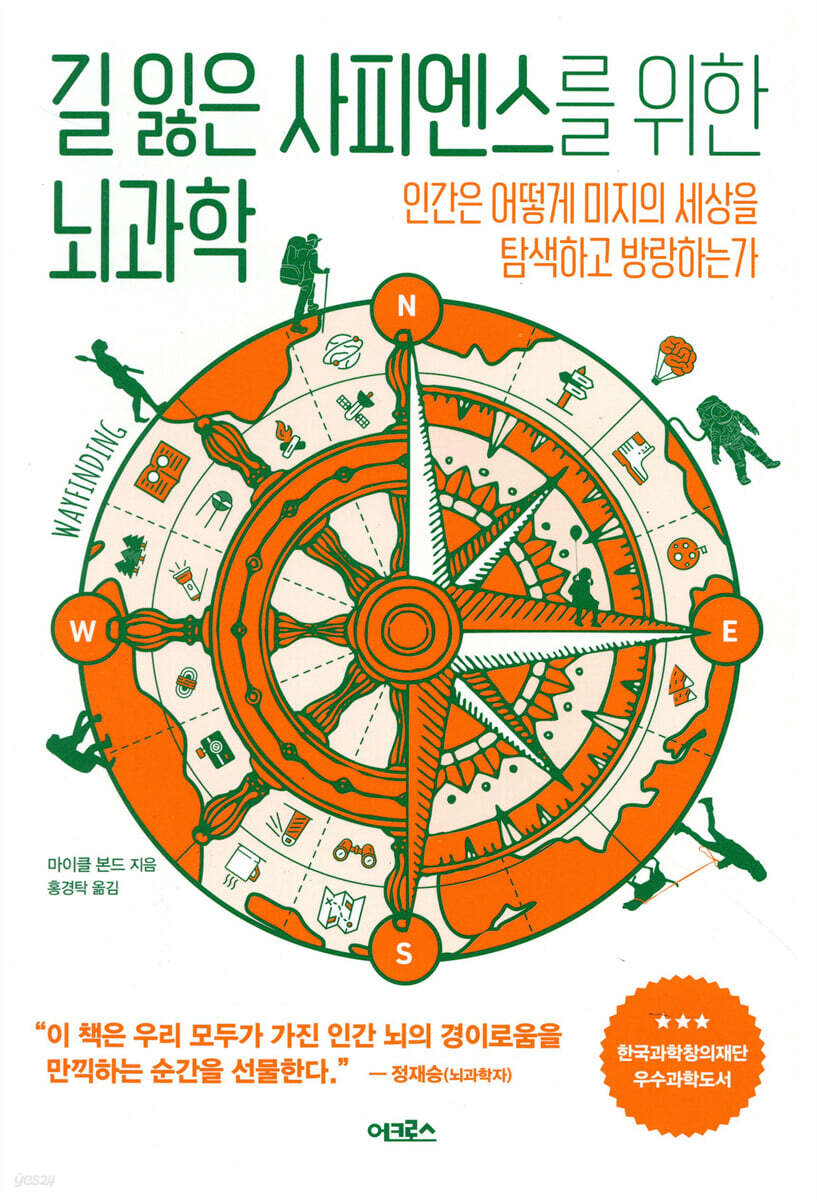
Brain Science for Lost Sapiens
 |
Description
Book Introduction
- A word from MD
-
Human history viewed through 'finding the way'Finding one's way is closely related to spatial perception and territory defense.
The fact that humans have become top predators means that our navigation skills have been that effective.
This book unfolds a fascinating story that crosses anthropology, psychology, and history on the theme of 'finding one's way.'
October 20, 2020. Humanities PD Son Min-gyu
How do we find our way in unfamiliar places? Why does our childhood instinct for exploration fade with age? Why are some people so much better at finding their way than others? Why do lost people engage in unusual behaviors? What does navigation mean for people with dementia? "Brain Science for Lost Sapiens" is the new book by British Psychological Society Award-winning author Michael Bond. It is a comprehensive exploration of how humans navigate the world and develop their navigational abilities, drawing on neuroscience, behavioral science, anthropology, and psychology.
The ability to find one's way is a key requirement for survival.
The navigational skills our ancestors developed to locate food sources and identify enemies enabled us to understand the world, communicate and cooperate with others, and explore the unknown.
Furthermore, the ability to find one's way is closely related to essential cognitive abilities such as abstract thinking, imagination, memory, and language, and governs not only our bodies but also our minds.
Modern people, who turn on map apps and follow the directions even for short distances, are seriously undermining their ability to find their way.
This book explores how GPS devices affect our spatial abilities, as well as how we can enhance our own innate navigational abilities.
The ability to find one's way is a key requirement for survival.
The navigational skills our ancestors developed to locate food sources and identify enemies enabled us to understand the world, communicate and cooperate with others, and explore the unknown.
Furthermore, the ability to find one's way is closely related to essential cognitive abilities such as abstract thinking, imagination, memory, and language, and governs not only our bodies but also our minds.
Modern people, who turn on map apps and follow the directions even for short distances, are seriously undermining their ability to find their way.
This book explores how GPS devices affect our spatial abilities, as well as how we can enhance our own innate navigational abilities.
- You can preview some of the book's contents.
Preview
index
preface
Chapter 1: Why Homo sapiens set out on the road
Chapter 2: Why Children Get Lost So Easily
Chapter 3: What Happens in Our Brains When We Walk
Chapter 4: The Impact of Space on the Mind
Chapter 5: Some Strategies for Finding Your Way in Unfamiliar Places
Chapter 6: Finding a Woman's Path, Finding a Man's Path
Chapter 7: The Path of the Great Explorer
Chapter 8: The Psychology of Disappearance
Chapter 9: A Livable City Has Readability
Chapter 10: The Moment When Your Mind Loses Its Way
Chapter 11 Epilogue: What You Get When You Turn Off GPS
main
Chapter 1: Why Homo sapiens set out on the road
Chapter 2: Why Children Get Lost So Easily
Chapter 3: What Happens in Our Brains When We Walk
Chapter 4: The Impact of Space on the Mind
Chapter 5: Some Strategies for Finding Your Way in Unfamiliar Places
Chapter 6: Finding a Woman's Path, Finding a Man's Path
Chapter 7: The Path of the Great Explorer
Chapter 8: The Psychology of Disappearance
Chapter 9: A Livable City Has Readability
Chapter 10: The Moment When Your Mind Loses Its Way
Chapter 11 Epilogue: What You Get When You Turn Off GPS
main
Into the book
One of the most fascinating concepts in recent anthropology is that our ability to find our way has been essential to the success of our species.
Because such abilities enable one to build a wide range of human relationships.
In prehistoric times, when people lived in small family units and spent most of their time searching for food and shelter, the ability to share information with other groups about resource locations and predator movements would have been evolutionarily advantageous.
Friends were an asset for survival.
When food ran low and they needed someone to hunt with, they had a friend.
--- p.21
It's no exaggeration to say that being cut off from the outside world means children are missing out on great opportunities.
To some extent, you may be able to socialize, explore, and roam freely online.
But no matter how sophisticated we may be, we are still spatial beings, evolved to move around.
There are things we can only learn through our interactions with the physical world, like measuring size or knocking on a door.
If we don't have that learning in our earliest years, when we are most curious and least restricted, we may never get the chance again.
--- p.50
Schiller found that blood flow in the left hippocampus changed while participants interacted with the characters.
She thinks the hippocampus measures the dimensions of sociality (in this case, power and belonging) much like it measures the dimensions of space.
This study was not the first to find a link between spatial cognition and social cognition.
In 2004, researchers at the University of Texas found that students who had negative views of Mexicans believed Mexico was much further away than it actually was.
According to Schiller's theory, the students seemed to be using geographic distance in place of social distance.
--- p.130
One reason Inuit women are as good at spatial training as men may be that they grew up in the Arctic tundra, where they had as much freedom as one could imagine.
Young girls are just as eager as boys to forage for food, explore, and expand their world.
And before they turn eight, they've covered a lot of ground.
After that, cultural influences or parental influences begin to take their toll on women.
Ultimately, it is these factors, not biological problems, that are holding women back.
--- p.187
Jerry survived alone in the wilderness for over 19 days before succumbing to starvation and helplessness.
It was longer than experts thought possible.
The search dog team passed about a hundred meters from Jerry, and there was a trail just half a mile in a straight line from where her tent had been, and if she had followed it down the hill, there was an old railroad track that would have led her straight out of the forest in either direction.
--- p.231
The tragedy for Alzheimer's patients is that the compass they always had is now gone and the map becomes smaller.
Disorientation has become a common condition for people with Alzheimer's disease, causing them to become lost in places they have always known.
Despite this, the majority choose to walk instead of staying put.
It may seem strange to try to confront one's limited horizons without a map and compass, but it's not so different from our behavior when lost in the wilderness, preferring to venture into the unknown rather than wait for rescue.
The terrible truth about dementia is that no one is coming to save me.
I am alone.
At least if you keep moving you are given a choice.
Because such abilities enable one to build a wide range of human relationships.
In prehistoric times, when people lived in small family units and spent most of their time searching for food and shelter, the ability to share information with other groups about resource locations and predator movements would have been evolutionarily advantageous.
Friends were an asset for survival.
When food ran low and they needed someone to hunt with, they had a friend.
--- p.21
It's no exaggeration to say that being cut off from the outside world means children are missing out on great opportunities.
To some extent, you may be able to socialize, explore, and roam freely online.
But no matter how sophisticated we may be, we are still spatial beings, evolved to move around.
There are things we can only learn through our interactions with the physical world, like measuring size or knocking on a door.
If we don't have that learning in our earliest years, when we are most curious and least restricted, we may never get the chance again.
--- p.50
Schiller found that blood flow in the left hippocampus changed while participants interacted with the characters.
She thinks the hippocampus measures the dimensions of sociality (in this case, power and belonging) much like it measures the dimensions of space.
This study was not the first to find a link between spatial cognition and social cognition.
In 2004, researchers at the University of Texas found that students who had negative views of Mexicans believed Mexico was much further away than it actually was.
According to Schiller's theory, the students seemed to be using geographic distance in place of social distance.
--- p.130
One reason Inuit women are as good at spatial training as men may be that they grew up in the Arctic tundra, where they had as much freedom as one could imagine.
Young girls are just as eager as boys to forage for food, explore, and expand their world.
And before they turn eight, they've covered a lot of ground.
After that, cultural influences or parental influences begin to take their toll on women.
Ultimately, it is these factors, not biological problems, that are holding women back.
--- p.187
Jerry survived alone in the wilderness for over 19 days before succumbing to starvation and helplessness.
It was longer than experts thought possible.
The search dog team passed about a hundred meters from Jerry, and there was a trail just half a mile in a straight line from where her tent had been, and if she had followed it down the hill, there was an old railroad track that would have led her straight out of the forest in either direction.
--- p.231
The tragedy for Alzheimer's patients is that the compass they always had is now gone and the map becomes smaller.
Disorientation has become a common condition for people with Alzheimer's disease, causing them to become lost in places they have always known.
Despite this, the majority choose to walk instead of staying put.
It may seem strange to try to confront one's limited horizons without a map and compass, but it's not so different from our behavior when lost in the wilderness, preferring to venture into the unknown rather than wait for rescue.
The terrible truth about dementia is that no one is coming to save me.
I am alone.
At least if you keep moving you are given a choice.
--- p.305
Publisher's Review
The ability to find one's way determines the survival of humanity!
The source of cooperation and communication that allowed Homo sapiens to survive,
A deep and fascinating exploration of our ability to find our way.
Recommended by neuroscientist Jaeseung Jeong
○ A new work by the British Psychological Society Writing Award-winning author
○ Books featured in Nature, Science, and The Times
The secret to how Homo sapiens became the ultimate victor
When Homo sapiens began to spread across the globe from Africa across the Red Sea, many parts of Europe and Asia were already inhabited by humans such as Neanderthals and Denisovans.
Modern anthropology suggests that it was our desire to explore and our instinct for finding our way that allowed Homo sapiens to overcome these and become the ultimate victors.
For prehistoric humans, who spent most of their time finding food and safe shelter, the ability to share information about resource locations and predator movements with other groups would have been evolutionarily advantageous.
Fossil evidence shows that 130,000 years ago, our ancestors interacted with groups as far away as 240 kilometers.
To accurately find your desired destination, you need spatial perception, a sense of direction, and the ability to turn the scenery into a map and store it in your head.
Michael Bond, citing Canadian anthropologist Ariane Burke, argues that these traits likely developed as our ancestors interacted with other groups.
In this way, wayfinding ability and sociality are closely related.
In a time without any distinct landmarks, how did our ancestors find their way without maps or compasses? Place names are one answer.
The way the Inuit people name places is particularly interesting.
The Arctic region where the Inuit live appears to outsiders as a bland and monotonous region.
But the Inuit gave names to every stream, lake, island, and even pile of stones.
They were given names that carefully describe the features of the terrain, such as Nuluyak, meaning "two islands shaped like buttocks," and Kaumajualuk, meaning "a lake with a bright-colored bottom that appears to shine."
Thus, the Inuit incorporated unfamiliar places into their own world, making it easier to find their way around.
Michael Bond says these names can "help us explore the present" and "envision what might happen in the future."
Do people with depression have trouble finding their way?
: The ability to find one's way, which governs cognitive abilities, language abilities, and even psychological survival.
Pathfinding abilities, such as sense of direction and spatial perception, are closely related to human cognition.
The most widely known is the relationship between space and memory.
When I think of an event related to me, it is difficult to think of it without mentioning the place where it happened.
An ancient mnemonic technique known as the "Rosi method" exploits this characteristic, involving imagining yourself walking through a familiar space while recalling memories associated with key points.
Citing numerous neuroscience studies, Michael Bond reminds readers that the hippocampus, the part of the brain that stores information about space and navigation, also controls memory.
Professor Eleanor Maguire of University College London, who made a sensational discovery that experienced London taxi drivers have larger posterior hippocampi than average people, discovered while studying patients with brain damage that the hippocampus's spatial functions and ability to construct scenes play a crucial role not only in navigating but also in remembering the past and imagining the future.
Howard Eichenbaum, an authority on hippocampus research, also said, “The hippocampus plays a basic and essential role in navigation, but it also plays a broader role in organizing memories.”
Moreover, we perceive relationships with other people as we perceive space.
John O'Keefe, who discovered place cells and won the 2014 Nobel Prize in Physiology or Medicine, pointed out that almost all prepositions (such as above, in front of, under, beyond, etc.) express spatial relationships between places and objects, and raised the possibility that the human language system may be built on a spatial framework.
And we use spatial expressions when expressing social relationships with other people (close friends, growing apart, etc.).
Michael Bond cites these scientists to suggest that if the brain attempts to solve social tasks in a similar way to spatial problems, then these two abilities may be closely related.
Meanwhile, Michael Bond mentions in this book the psychological similarities between lost people and those with depression.
These include distorted decision-making, a sense of alienation from everything, and a certainty of death.
Lost people are terrified by the thought of being cut off from the world, and out of fear, they lose their reason, unable to properly perceive their surroundings.
However, this same reaction is also seen in people suffering from mental illness.
Researchers at the University of Calgary found that people who suffer from neuroticism or low self-esteem have more difficulty creating cognitive maps, or mentally mapping spatial relationships between landmarks.
This is because stress hormones weaken the place cells in the hippocampus.
In addition, it interestingly explores the impact of wayfinding ability on the human body and mind, such as why people's anxiety and stress increase in cities where similar scenery is repeated, and why Alzheimer's patients who have lost their sense of direction keep trying to go somewhere else.
From 4 kilometers to 100 meters
: Our ability to find our way is under threat.
Most people today leave finding their way to GPS and don't worry about anything else.
You can easily reach your destination by following the route drawn on the smartphone app or by simply following the voice guidance of the navigation system.
There is no need to know what is on the way, nor to choose which way to go.
The Scottish Mountaineering Council has reported that today's walkers and mountaineers no longer learn how to read maps, believing that GPS devices will do the job.
These seemingly convenient changes have rendered humans powerless to use the spatial abilities that have enabled them to survive for tens of thousands of years.
We give up our sense of position in exchange for absolute certainty about our location.
This means that as we follow the GPS, we become less aware of our surroundings and lose the ability to glean information from the landscape.
Our reduced range of motion also leads to a decline in our ability to find our way.
In 2015, researchers at the University of Sheffield interviewed three generations of a city-dwelling family about how they got around as children.
As a result, my grandmother, who grew up in the 1960s, would walk three to four kilometers alone to meet her friends, while the furthest my ten-year-old grandson went alone was to a friend's house, which was 100 meters away.
In just three generations, the radius of action has been reduced to one-thirtieth.
Finding one's way is inherently a social activity.
Michael Bond says that finding your way around, whether using a map or referring to signs, relies on the knowledge of others, and asking someone for directions is a great way to tap into the culture of a place.
If we rely on map apps or navigation to find our way, we no longer have these opportunities for interaction.
Through a journey that traces the paths of humankind from prehistoric times to the present day, this book asks what we must hold onto even as we hand over difficult and complex tasks to technology.
“A rich meditation on how we find our way and how we get lost… From the brain circuitry of wandering rats to the negative impact of satellite navigation, this book is a revelation.”
─ 〈Nature〉
“Michael Bond is a brave explorer who explores the twists and turns of the brain.”
─ The Daily Telegraph
“Michael Bond suggests that we can rejuvenate our ability to find our way simply by putting aside our GPS devices, redesigning our cities and play areas, and sometimes even allowing ourselves to get lost.”
─ 〈Science〉
The source of cooperation and communication that allowed Homo sapiens to survive,
A deep and fascinating exploration of our ability to find our way.
Recommended by neuroscientist Jaeseung Jeong
○ A new work by the British Psychological Society Writing Award-winning author
○ Books featured in Nature, Science, and The Times
The secret to how Homo sapiens became the ultimate victor
When Homo sapiens began to spread across the globe from Africa across the Red Sea, many parts of Europe and Asia were already inhabited by humans such as Neanderthals and Denisovans.
Modern anthropology suggests that it was our desire to explore and our instinct for finding our way that allowed Homo sapiens to overcome these and become the ultimate victors.
For prehistoric humans, who spent most of their time finding food and safe shelter, the ability to share information about resource locations and predator movements with other groups would have been evolutionarily advantageous.
Fossil evidence shows that 130,000 years ago, our ancestors interacted with groups as far away as 240 kilometers.
To accurately find your desired destination, you need spatial perception, a sense of direction, and the ability to turn the scenery into a map and store it in your head.
Michael Bond, citing Canadian anthropologist Ariane Burke, argues that these traits likely developed as our ancestors interacted with other groups.
In this way, wayfinding ability and sociality are closely related.
In a time without any distinct landmarks, how did our ancestors find their way without maps or compasses? Place names are one answer.
The way the Inuit people name places is particularly interesting.
The Arctic region where the Inuit live appears to outsiders as a bland and monotonous region.
But the Inuit gave names to every stream, lake, island, and even pile of stones.
They were given names that carefully describe the features of the terrain, such as Nuluyak, meaning "two islands shaped like buttocks," and Kaumajualuk, meaning "a lake with a bright-colored bottom that appears to shine."
Thus, the Inuit incorporated unfamiliar places into their own world, making it easier to find their way around.
Michael Bond says these names can "help us explore the present" and "envision what might happen in the future."
Do people with depression have trouble finding their way?
: The ability to find one's way, which governs cognitive abilities, language abilities, and even psychological survival.
Pathfinding abilities, such as sense of direction and spatial perception, are closely related to human cognition.
The most widely known is the relationship between space and memory.
When I think of an event related to me, it is difficult to think of it without mentioning the place where it happened.
An ancient mnemonic technique known as the "Rosi method" exploits this characteristic, involving imagining yourself walking through a familiar space while recalling memories associated with key points.
Citing numerous neuroscience studies, Michael Bond reminds readers that the hippocampus, the part of the brain that stores information about space and navigation, also controls memory.
Professor Eleanor Maguire of University College London, who made a sensational discovery that experienced London taxi drivers have larger posterior hippocampi than average people, discovered while studying patients with brain damage that the hippocampus's spatial functions and ability to construct scenes play a crucial role not only in navigating but also in remembering the past and imagining the future.
Howard Eichenbaum, an authority on hippocampus research, also said, “The hippocampus plays a basic and essential role in navigation, but it also plays a broader role in organizing memories.”
Moreover, we perceive relationships with other people as we perceive space.
John O'Keefe, who discovered place cells and won the 2014 Nobel Prize in Physiology or Medicine, pointed out that almost all prepositions (such as above, in front of, under, beyond, etc.) express spatial relationships between places and objects, and raised the possibility that the human language system may be built on a spatial framework.
And we use spatial expressions when expressing social relationships with other people (close friends, growing apart, etc.).
Michael Bond cites these scientists to suggest that if the brain attempts to solve social tasks in a similar way to spatial problems, then these two abilities may be closely related.
Meanwhile, Michael Bond mentions in this book the psychological similarities between lost people and those with depression.
These include distorted decision-making, a sense of alienation from everything, and a certainty of death.
Lost people are terrified by the thought of being cut off from the world, and out of fear, they lose their reason, unable to properly perceive their surroundings.
However, this same reaction is also seen in people suffering from mental illness.
Researchers at the University of Calgary found that people who suffer from neuroticism or low self-esteem have more difficulty creating cognitive maps, or mentally mapping spatial relationships between landmarks.
This is because stress hormones weaken the place cells in the hippocampus.
In addition, it interestingly explores the impact of wayfinding ability on the human body and mind, such as why people's anxiety and stress increase in cities where similar scenery is repeated, and why Alzheimer's patients who have lost their sense of direction keep trying to go somewhere else.
From 4 kilometers to 100 meters
: Our ability to find our way is under threat.
Most people today leave finding their way to GPS and don't worry about anything else.
You can easily reach your destination by following the route drawn on the smartphone app or by simply following the voice guidance of the navigation system.
There is no need to know what is on the way, nor to choose which way to go.
The Scottish Mountaineering Council has reported that today's walkers and mountaineers no longer learn how to read maps, believing that GPS devices will do the job.
These seemingly convenient changes have rendered humans powerless to use the spatial abilities that have enabled them to survive for tens of thousands of years.
We give up our sense of position in exchange for absolute certainty about our location.
This means that as we follow the GPS, we become less aware of our surroundings and lose the ability to glean information from the landscape.
Our reduced range of motion also leads to a decline in our ability to find our way.
In 2015, researchers at the University of Sheffield interviewed three generations of a city-dwelling family about how they got around as children.
As a result, my grandmother, who grew up in the 1960s, would walk three to four kilometers alone to meet her friends, while the furthest my ten-year-old grandson went alone was to a friend's house, which was 100 meters away.
In just three generations, the radius of action has been reduced to one-thirtieth.
Finding one's way is inherently a social activity.
Michael Bond says that finding your way around, whether using a map or referring to signs, relies on the knowledge of others, and asking someone for directions is a great way to tap into the culture of a place.
If we rely on map apps or navigation to find our way, we no longer have these opportunities for interaction.
Through a journey that traces the paths of humankind from prehistoric times to the present day, this book asks what we must hold onto even as we hand over difficult and complex tasks to technology.
“A rich meditation on how we find our way and how we get lost… From the brain circuitry of wandering rats to the negative impact of satellite navigation, this book is a revelation.”
─ 〈Nature〉
“Michael Bond is a brave explorer who explores the twists and turns of the brain.”
─ The Daily Telegraph
“Michael Bond suggests that we can rejuvenate our ability to find our way simply by putting aside our GPS devices, redesigning our cities and play areas, and sometimes even allowing ourselves to get lost.”
─ 〈Science〉
GOODS SPECIFICS
- Publication date: October 15, 2020
- Page count, weight, size: 372 pages | 516g | 147*215*20mm
- ISBN13: 9791190030687
- ISBN10: 1190030683
You may also like
카테고리
korean


korean

![GQ KOREA Mark (Monthly): December [2025]](http://librairie.coreenne.fr/cdn/shop/files/8ef265dbbfbf186523ed75ba7319009d.jpg?v=1765340328&width=3840)


