

Physics of the World
 |
Description
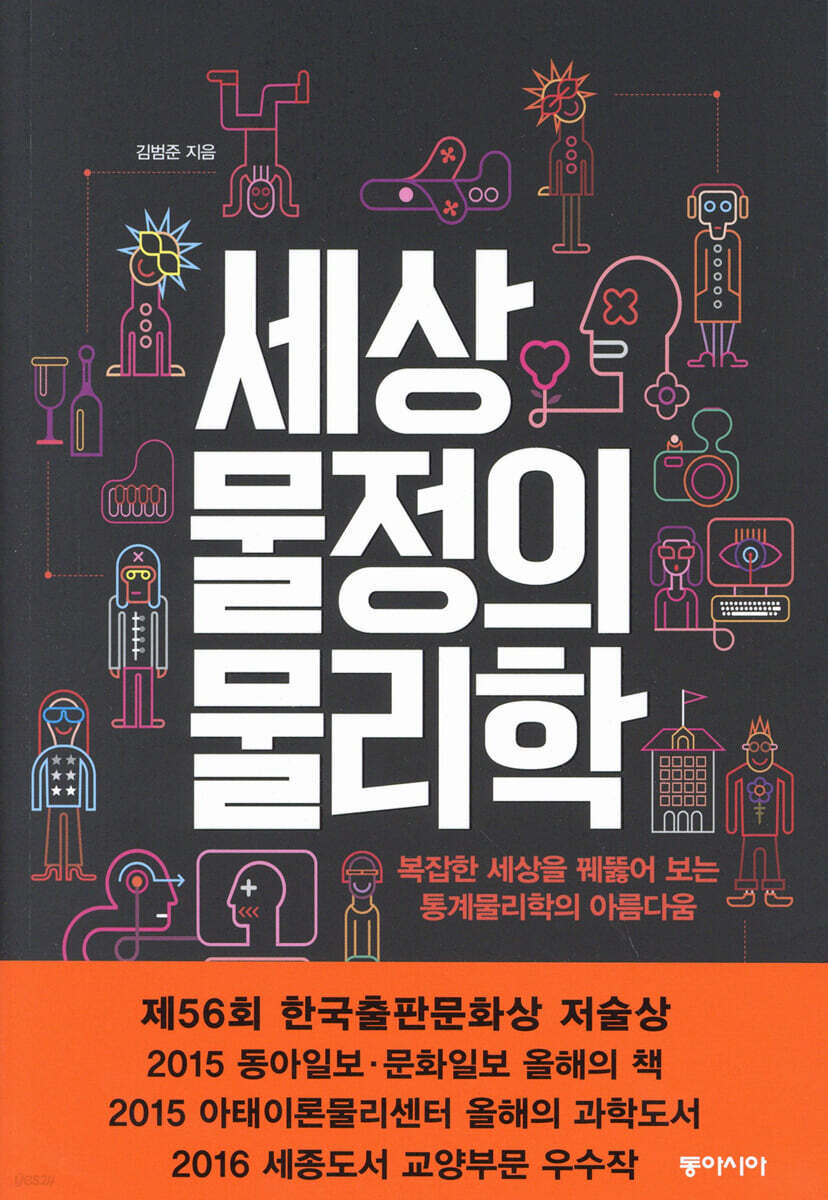
Book Introduction
The meeting of "The Physics of Worldly Affairs" and "The Sociology of Worldly Affairs"
A few years ago, Professor Kim Beom-jun of the Department of Physics at Sungkyunkwan University sat across from a sociologist (Noh Myung-woo, author of “Sociology of Worldly Affairs,” wrote a recommendation for “Physics of Worldly Affairs”) at a table where the question “worldly affairs” was posed.
What kind of conversations might take place at a table where physicists and sociologists sit face to face, where it's difficult to imagine anything other than silence? Considering the research subjects of sociology and physics, the intersection between the two disciplines seems elusive at first glance.
But when sociological concerns and physics-statistics philosophy and methodology meet, we have the opportunity to see the world in a different way.
Kim Beom-jun's main research topics are directed towards the 'here and now' society and justice.
Using big data to discuss communication methods in a democratic society, he 'encourages gossip', and analyzing the MERS outbreak with network science, he 'scientifically' criticizes the initial quarantine failure and the government's 'non-disclosure' principle as the main culprits for the worsening situation.
He argues that regionalism in the Yeongnam region is a misunderstanding or misguided behavior stemming from "intentional standards." He also uses "connection centrality" to understand where social media influence originates and what factors determine its success, suggesting strategic ways to leverage it.
When I read articles discussing the secrets that ants know but politicians don't, the possibility of collective intelligence, or the dilemma between schools and hospitals, publicness and economic efficiency, I can't help but be captivated by the physicist Kim Beom-jun's resonance with the sociologist who talks about a good life and a prosperous society 'here and now.'
A few years ago, Professor Kim Beom-jun of the Department of Physics at Sungkyunkwan University sat across from a sociologist (Noh Myung-woo, author of “Sociology of Worldly Affairs,” wrote a recommendation for “Physics of Worldly Affairs”) at a table where the question “worldly affairs” was posed.
What kind of conversations might take place at a table where physicists and sociologists sit face to face, where it's difficult to imagine anything other than silence? Considering the research subjects of sociology and physics, the intersection between the two disciplines seems elusive at first glance.
But when sociological concerns and physics-statistics philosophy and methodology meet, we have the opportunity to see the world in a different way.
Kim Beom-jun's main research topics are directed towards the 'here and now' society and justice.
Using big data to discuss communication methods in a democratic society, he 'encourages gossip', and analyzing the MERS outbreak with network science, he 'scientifically' criticizes the initial quarantine failure and the government's 'non-disclosure' principle as the main culprits for the worsening situation.
He argues that regionalism in the Yeongnam region is a misunderstanding or misguided behavior stemming from "intentional standards." He also uses "connection centrality" to understand where social media influence originates and what factors determine its success, suggesting strategic ways to leverage it.
When I read articles discussing the secrets that ants know but politicians don't, the possibility of collective intelligence, or the dilemma between schools and hospitals, publicness and economic efficiency, I can't help but be captivated by the physicist Kim Beom-jun's resonance with the sociologist who talks about a good life and a prosperous society 'here and now.'
- You can preview some of the book's contents.
Preview
index
Physicists and Sociologists Meet at the Table of Convergence: "Worldly Affairs" _ Noh Myung-woo
Physicists See the World Too _ Kim Beom-jun
1.
The world of social physics: speaking of the 'here and now'
1) I encourage gossip.
The Façade of a Democratic Society Seen Through Big Data
2) A belated comment from a physicist from a developing country on MERS
How Network Science Explains the Spread of Infection
3) Who creates regional sentiment?
The annoying yardstick of Yeongnam and Honam confirmed by graphs
4) The Secret to the Success of [Interstellar] and Honey Butter Chips
The secret to fashion that determines the threshold
5) The story of a dragon born in a stream falling into a sewer
The End of a "Winner-Takes-All" Society: A Graph of Child Education Costs
6) A secret that ants know but politicians don't
'Collective intelligence' is generally correct.
7) Where is the origin of retweets?
Judge the influence of social media by its centrality.
8) Why Seoul is Seoul
The Light and Dark of a Tightly Networked World
9) The circumstances of schools, hospitals, and coffee shops
The Dilemma of Publicness and Economic Efficiency: Opportunity Cost
10) It's not like I'll just do business once or twice.
A true showdown over ice cream: "The Prisoner's Dilemma"
2.
The beauty of statistical physics that sees through the complex world
1) Minimize the difference in travel distance between professional baseball teams.
The secret to a fair schedule lies in the Monte Carlo method.
2) Unidentified traffic jam
Highways are jammed during the Lunar New Year holidays; density is the problem.
3) If you throw a stone from Namsan, who will be hit?
Distribution of Korean surnames following the 80/8 rule
4) Should I pick it up or hold it?
Yut Nori Winning Strategy Based on Probability
5) Do you really know 'someone you might know'?
My relationship with the world drawn with dots and lines
6) Youngja's Golden Age, Stay Strong, Geumsoon
The history of name trends seen on the network
7) Research started because I am a timid type A person
Correlation between blood type and personality
8) Right-hand driving is the correct answer?
Pedestrian Problem: Density is the Answer
9) Fund Manager vs. Physicist
Anyone can become a fund manager if they know the fractal model.
10) Anyone can use it, but no one uses it
Physicist Recommends Stock Investment and Long-Term Holding Strategies
3.
Physicists don't know the ways of the world?
1) Invisible order
The law of fit and timing
2) Story of a teenage daughter
Is naturalness natural?
3) No one reads poetry through a microscope.
The Secret to Irreducible Beauty: Relationships
4) Why are sad stories never wrong?
Love and hate are asymmetrical
5) “Let’s shake hands with our left hands.
“Because you are close to my heart.”
Symmetry that is out of alignment
6) There's a reptile living in my head.
The Evolution of the Human Brain: A History of Makeshift Expedients
7) The secret of the human brain, the 'king of all creation'
Brain size is proportional to primate population size.
8) One, two, infinity?
Why Physicists Can't Count to Three
9) Wonderland's drinking culture
The secret story behind the birth of the Yeongilman Game
10) How to choose a well-fed fish
The unique human body mass index due to its two legs
Physicists See the World Too _ Kim Beom-jun
1.
The world of social physics: speaking of the 'here and now'
1) I encourage gossip.
The Façade of a Democratic Society Seen Through Big Data
2) A belated comment from a physicist from a developing country on MERS
How Network Science Explains the Spread of Infection
3) Who creates regional sentiment?
The annoying yardstick of Yeongnam and Honam confirmed by graphs
4) The Secret to the Success of [Interstellar] and Honey Butter Chips
The secret to fashion that determines the threshold
5) The story of a dragon born in a stream falling into a sewer
The End of a "Winner-Takes-All" Society: A Graph of Child Education Costs
6) A secret that ants know but politicians don't
'Collective intelligence' is generally correct.
7) Where is the origin of retweets?
Judge the influence of social media by its centrality.
8) Why Seoul is Seoul
The Light and Dark of a Tightly Networked World
9) The circumstances of schools, hospitals, and coffee shops
The Dilemma of Publicness and Economic Efficiency: Opportunity Cost
10) It's not like I'll just do business once or twice.
A true showdown over ice cream: "The Prisoner's Dilemma"
2.
The beauty of statistical physics that sees through the complex world
1) Minimize the difference in travel distance between professional baseball teams.
The secret to a fair schedule lies in the Monte Carlo method.
2) Unidentified traffic jam
Highways are jammed during the Lunar New Year holidays; density is the problem.
3) If you throw a stone from Namsan, who will be hit?
Distribution of Korean surnames following the 80/8 rule
4) Should I pick it up or hold it?
Yut Nori Winning Strategy Based on Probability
5) Do you really know 'someone you might know'?
My relationship with the world drawn with dots and lines
6) Youngja's Golden Age, Stay Strong, Geumsoon
The history of name trends seen on the network
7) Research started because I am a timid type A person
Correlation between blood type and personality
8) Right-hand driving is the correct answer?
Pedestrian Problem: Density is the Answer
9) Fund Manager vs. Physicist
Anyone can become a fund manager if they know the fractal model.
10) Anyone can use it, but no one uses it
Physicist Recommends Stock Investment and Long-Term Holding Strategies
3.
Physicists don't know the ways of the world?
1) Invisible order
The law of fit and timing
2) Story of a teenage daughter
Is naturalness natural?
3) No one reads poetry through a microscope.
The Secret to Irreducible Beauty: Relationships
4) Why are sad stories never wrong?
Love and hate are asymmetrical
5) “Let’s shake hands with our left hands.
“Because you are close to my heart.”
Symmetry that is out of alignment
6) There's a reptile living in my head.
The Evolution of the Human Brain: A History of Makeshift Expedients
7) The secret of the human brain, the 'king of all creation'
Brain size is proportional to primate population size.
8) One, two, infinity?
Why Physicists Can't Count to Three
9) Wonderland's drinking culture
The secret story behind the birth of the Yeongilman Game
10) How to choose a well-fed fish
The unique human body mass index due to its two legs
Into the book
“However, it is interesting that if various communication structures exist, the unilateral orders of the top leader can be modified by other correct opinions of the entire group.
There is room for consideration in relation to the political structure of Korean society and the decision-making structure within large corporations.
We can think of this alongside expressions that frequently appear in newspapers, such as 'uncommunicative leadership' or 'imperial presidency.'
Much of the research conducted at Korean universities is primarily conducted by groups consisting of professors and graduate students leading the research team.
In this culture, it's difficult for a graduate student in the group to point out even if a professor like me says something ridiculous about research.
How can I overcome my advisor's nonsense?
If you've read this article, you probably already know the answer.
The answer is to activate 'gossip'.
“It would be the icing on the cake if graduate students could point out my nonsense, which I corrected through gossip.” --- p.25
“Along with the initial failure of quarantine, there is one more thing that has made the situation worse.
This is the government's 'non-disclosure' principle.
If they had been transparent about which ward MERS was first discovered in, and had notified recent visitors to that ward and properly quarantined them, the situation could have been very different.
Everyone knows.
When rumors are passed on through whispers, the original content can easily be distorted.
Distorted whispers spread as unfounded rumors.
In the absence of credible announcements from a credible government, ghost stories can create panic.” --- p.31
“Regionalism is not promoted for the benefit of ordinary people who exercise their right to vote, but for the benefit of politicians who hope to be elected by that vote.
There are several studies that show that when people of similar backgrounds are divided into two groups based on arbitrary criteria and then internal solidarity is strengthened while communication with the other group is cut off, over time one group will spontaneously develop a belief that it is superior to the other group and hostility toward the other group.
Those who hinder national unity are not ordinary people like us.
“They are the ones who hoped (and still hope) to exaggerate the invisible, subtle differences to distinguish us from one another and to use this to easily get elected.” --- p.40
“The conclusion is that for ants to create an efficient path, there must be a delicate mix of following and wandering.
The ants' pathfinding also provides important implications for Korean society.
What would happen if the majority of society followed the path set by one person?
That path may be the optimal way to reach your goal.
But what if that path is one that countless ants blindly follow and end up dying?
Conversely, what if the majority just wander around?
Then, even if someone comes up with a good solution, no one will listen.
“To successfully develop collective intelligence in Korean society, both following and wandering are necessary.” --- p.66
Again, all works of art are ultimately a matter of relationships.
The relationship between the elements that make up a work, and the relationship between the work that becomes a whole through such relationships and the person who views it.
Half of the success of the Impressionist painters came from us, the viewers of their paintings.
In this type of relationship-building, isn't the artist's job ultimately not to provide specific details of the relationship between the work and the viewer, but rather to provide a platform for that relationship, that is, a "yard where the viewer can participate and play."
What is specifically shown and what we see on that platform is not decided until we stand before the work.
There is room for consideration in relation to the political structure of Korean society and the decision-making structure within large corporations.
We can think of this alongside expressions that frequently appear in newspapers, such as 'uncommunicative leadership' or 'imperial presidency.'
Much of the research conducted at Korean universities is primarily conducted by groups consisting of professors and graduate students leading the research team.
In this culture, it's difficult for a graduate student in the group to point out even if a professor like me says something ridiculous about research.
How can I overcome my advisor's nonsense?
If you've read this article, you probably already know the answer.
The answer is to activate 'gossip'.
“It would be the icing on the cake if graduate students could point out my nonsense, which I corrected through gossip.” --- p.25
“Along with the initial failure of quarantine, there is one more thing that has made the situation worse.
This is the government's 'non-disclosure' principle.
If they had been transparent about which ward MERS was first discovered in, and had notified recent visitors to that ward and properly quarantined them, the situation could have been very different.
Everyone knows.
When rumors are passed on through whispers, the original content can easily be distorted.
Distorted whispers spread as unfounded rumors.
In the absence of credible announcements from a credible government, ghost stories can create panic.” --- p.31
“Regionalism is not promoted for the benefit of ordinary people who exercise their right to vote, but for the benefit of politicians who hope to be elected by that vote.
There are several studies that show that when people of similar backgrounds are divided into two groups based on arbitrary criteria and then internal solidarity is strengthened while communication with the other group is cut off, over time one group will spontaneously develop a belief that it is superior to the other group and hostility toward the other group.
Those who hinder national unity are not ordinary people like us.
“They are the ones who hoped (and still hope) to exaggerate the invisible, subtle differences to distinguish us from one another and to use this to easily get elected.” --- p.40
“The conclusion is that for ants to create an efficient path, there must be a delicate mix of following and wandering.
The ants' pathfinding also provides important implications for Korean society.
What would happen if the majority of society followed the path set by one person?
That path may be the optimal way to reach your goal.
But what if that path is one that countless ants blindly follow and end up dying?
Conversely, what if the majority just wander around?
Then, even if someone comes up with a good solution, no one will listen.
“To successfully develop collective intelligence in Korean society, both following and wandering are necessary.” --- p.66
Again, all works of art are ultimately a matter of relationships.
The relationship between the elements that make up a work, and the relationship between the work that becomes a whole through such relationships and the person who views it.
Half of the success of the Impressionist painters came from us, the viewers of their paintings.
In this type of relationship-building, isn't the artist's job ultimately not to provide specific details of the relationship between the work and the viewer, but rather to provide a platform for that relationship, that is, a "yard where the viewer can participate and play."
What is specifically shown and what we see on that platform is not decided until we stand before the work.
--- p.224
Publisher's Review
A different way of looking at the world
If we recall the fact that “humans who are the subject of sociological questions and humans who are the subject of physics questions are no different” (Noh Myeong-woo), then 『Physics of Worldly Affairs』, with its interdisciplinary encounters, stimulation, and countless exchanges of insights, is an opportunity to look into the deep inner workings of ‘worldly affairs’ and gain a wise understanding.
“Fusion is not a list of methodologies, but rather a gathering of experts around a table with a problem to solve.
How can ‘worldly affairs’ be a field of interest only to sociologists?
Even physicists can sit at the table where the question of 'worldly affairs' is posed.
“If we focus on the value of the common questions we ask about ‘worldly affairs,’ then questioning the boundaries between disciplines is futile.” (From Noh Myung-woo’s recommendation)
It's been a decade since the buzzwords "consilience" and "fusion" of natural science and humanities heated up academia and society, but we've always understood it to mean that a single person must know physics, sociology, philosophy, and even literature.
Convergence is not a list of methodologies, but rather a gathering of experts around a table with a problem to solve.
Like a table where Kim Beom-jun and Noh Myung-woo, a physicist and a sociologist, face each other.
MERS, Body Mass Index, and Type B Men
Chapter 1 of 『Physics of Worldly Affairs』 presents a physicist's 'scientific' opinions on Korean society, democracy, and justice; Chapter 2 presents an interesting 'statistical' analysis and discovery of meaning in complex world events; and Chapter 3 contains a physicist's words imbued with literary sensibility about art, beauty, the brain, body mass index, and naturalness.
Seeing the unique, if not unique, perspectives, methods, and writing style of a physicist who seems to be isolated from the world and confined to his laboratory, one feels as if one has been invited to a rich feast of convergence and integration.
The introduction to each chapter is refreshing, and the conclusion, which is full of humor and insight, has a lighthearted flavor.
As Professor Jeong Ha-woong of KAIST, who wrote the recommendation, said, the expression “an advanced course in science concerts” is very fitting.
How can professional baseball teams schedule away games to minimize the travel distance gap? This can be done by using a physics calculation method called the Monte Carlo method to identify conditions with the lowest energy-distance ratio.
How else can we understand the correlation between blood type and personality (the Type B Male Syndrome)? By analyzing the specific blood type patterns of 377 married couples and their psychological test data (MBTI and blood type), we can uncover the truth.
A physicist at the center of world affairs
Complex network science, used by Professor Kim Beom-jun of Sungkyunkwan University and author of "The Physics of the World," is a fascinating discipline that explains the operating principles of the world we live in.
As a politician, you need to know your network to predict and judge people's voting tendencies.
Knowing the properties of infectious disease networks like MERS can help us figure out how to block them.
Understanding the relationship between networks and density can also help us understand rational behaviors that can help us avoid holiday traffic jams.
The list can be expanded endlessly.
Of course, the meaning of 'complex' in complexity science is different from that in everyday life.
Complexity refers to self-organization, meaning that entities like people or neurons interact and weave various patterns together on their own.
Complexity science focuses on patterns.
In other words, complexity science is called a form of 'social physics' or 'statistical physics' that unravels the intricately intertwined various knots of a phenomenon one by one and explains them in an easy-to-understand way.
If you want solace from science, come to this table of fusion.
“When you look at what happens in society, there are many absurd things that happen.
We need to be able to look at them rationally and rationally.
It is important to learn scientific thinking, not just the content of science.
I wish people would learn how to think rationally.
I was asked this question a while ago.
Do scientists read poetry too?
"Why do you ask a poet who reads science books? The more you know about the world, the better and more beautiful it seems." (Korea University Newspaper, August 18, 2014)
Author Kim Beom-jun, who emphasizes communication with the world, said this in an interview with a university newspaper.
As he said, 『The Physics of Worldly Affairs』 has the charm of unraveling humanistic imagination and ideas through science.
Art and the inner workings of humanity may not be the province of the humanities, but perhaps science.
If you want solace in science, you should sit down at this table of convergence.
Recommendation
Physicists and Sociologists Meet at the Table of Convergence: "The Sociology of the World" - Noh Myung-woo (Professor of Sociology, Ajou University, Author of "The Sociology of the World")
Humans who are the subject of sociological questions and humans who are the subject of physical questions are not different.
Humans are the same.
The only difference between each discipline is the way they ask questions about the same subject and the process by which they solve those questions.
What happens when we become fixated on the uniqueness of each discipline's method of asking questions and the process of resolving them? The moment we package our unique methods as academic traditions and express the process of resolving questions with the formidable word "methodology," magic happens.
Each discipline becomes an institutional device that reduces even creative people to standard experts.
And thus the infamous 'expert fool' was born.
That 'expert fool' never looks like a 'fool' at all.
In fact, that person, who is practically an idiot, appears to be a flawless 'expert' wherever you look.
A student who fails in a branch of science does not turn into an 'expert fool'.
Rather, most of the expert fools that each field of study constantly produces are model students of that field.
'Fusion' is an emergency measure to save those 'expert fools'.
Convergence is not achieved by simply paralleling disciplines.
Forcing physics majors to take sociology as a required subject does not create convergent talent.
Convergence does not mean that one person must know physics, sociology, and even philosophy and literature.
The era when such integration was possible has already passed.
Convergence is not a list of methodologies, but rather a gathering of experts around a table with a problem to solve.
How can ‘worldly affairs’ be a field of interest only to sociologists?
Even physicists can sit at the table where the question of 'worldly affairs' is posed.
If we focus on the value of the common questions we ask about the world, then questioning the boundaries between disciplines is futile.
I was invited as a sociologist to a table where the common question of 'worldly affairs' was being discussed.
And listened.
The commonality of questions about 'worldly affairs' made the vast distance between physics and sociology disappear in an instant.
As long as sociologists and physicists are curious about the "worldly affairs" of this same world we live in, the differences between their respective disciplines have become surprisingly insignificant.
Sociologists and physicists have confirmed once again that they are contemporaries living in the same world at the table of convergence called 'Worldly Affairs'.
A sociologist who knew nothing about physics could follow the physicist's story at the table without missing a beat and was amazed by his insights.
Sociology and physics met through the question of 'worldly affairs,' and that encounter left a deep thrill.
If you want to know more about the inside story of the book
The reason for the success of [Interstellar] and Honey Butter Chips
Several experts gather at a table to discuss the box office success of a film with an unprecedented score.
In an atmosphere like [Wednesday Food Talk] or [Inside Story Salon], countless analyses of the cause are poured out.
Whether we look for the box office elements within a film (the acting and directing are outstanding) or within its social context (it reflects societal needs and desires), one assumption they all agree on is that a successful film will have dozens of times more box office elements than a unsuccessful film.
Professor Kim Beom-jun, a physicist who was considered to be a person who had built a wall between himself and the world, joined the conversation and said he would summarize the reason for the box office success in one word.
“The truly decisive change in the film industry is happening in the way consumers connect.”
What does this mean?
Here is what he said, as he began to quietly show off the tools he was holding in his hands: statistics, graphs, and network maps.
Ideas spread in networks where many people are connected.
When a certain number of people share certain thoughts and opinions, they begin to influence each other and the ideas spread.
The key is ‘more than a certain number.’
This is called the 'threshold'.
The vast majority of ideas fail to pass this threshold and are eliminated from the network, but the few that do pass the feedback threshold, where ideas reinforce and propagate each other, are endlessly amplified through the network.
So, this is what I'm saying.
Whether it's a movie (Interstellar) or a snack (Honey Butter Chips), whether it's fun or not, whether it tastes good or not, as long as it's good enough to cross the threshold, that's all that matters.
Illuminating Justice and Democracy Through the Lens of Kim Beom-jun
However, physicist Kim Beom-jun goes beyond simply analyzing phenomena with scientific tools and adds a word.
He compares the dangers of the 'threshold' to the choices of Korean society and its citizens, and speaks of the need for a critical and wise perspective.
For example, let's think about the threshold for a certain important choice that will determine the future of Korean society.
When discussing a problem in a society, the solution that the majority agrees on will often be the most effective solution to the given problem.
In reality, democracy in reality is also established and maintained through such social agreements.
However, there are cases where group members, whether voluntarily or involuntarily, are too wary of each other and their choices can actually be detrimental to society.
There is a fine line between 'collective intelligence' and 'the ignorant masses'.
Kim Beom-jun points out that the moment a solution to a problem crosses a threshold, its rightness or wrongness takes a back seat, and a situation arises where a loud group suppresses a quiet majority.
This concert, a strong fusion of science and society, consisting of thirty sections, allows us to see the world in a different and more rational way.
Recommendation
Do you think science books are difficult and boring? I encourage you to open this book and read any page.
Professor Kim Beom-jun approaches questions that are easy to overlook at first glance but have always existed around us in a scientific and systematic way, providing easy-to-understand answers.
This book, which explains the relationship between physics and the world in a rigorous yet accessible way, is a scientific commentary that deserves to be loved by the public.
- Jeong Ha-woong (KAIST Distinguished Professor, Science Division Steering Committee Member, Health Science Research Institute)
In today's rapidly changing society, if you don't know how the world works, you can easily fall behind and be eliminated from society.
"The Physics of Worldly Affairs" helps us deeply understand the unknown principles of the world through the fresh perspective and unique wit of physicist Professor Kim Beom-jun.
Like the author, I am someone who wants to communicate with the world and society, and as a participant in the 'Yeongilman Game,' I want to share this book with readers and become more enlightened about the ways of the world.
- Seung-Hwan Kim (President of the Korean Physical Society, Professor at Pohang University of Science and Technology, Chairman of the Korea Foundation for the Advancement of Science and Creativity)
'Physics' means 'the law of things'.
Physics is so closely related to our daily lives that it can be said to be its foundation.
It is not difficult to understand the world through physics.
It's just that there wasn't an easy opportunity to come into contact with it.
Not enlightenment, but meaning, fun, and communication! This book, imbued with the charm and essence of Professor Kim Beom-jun, is a beacon erected by a wise man.
Kim Du-cheol (Director of the Institute for Basic Science, Professor Emeritus, Seoul National University)
If we recall the fact that “humans who are the subject of sociological questions and humans who are the subject of physics questions are no different” (Noh Myeong-woo), then 『Physics of Worldly Affairs』, with its interdisciplinary encounters, stimulation, and countless exchanges of insights, is an opportunity to look into the deep inner workings of ‘worldly affairs’ and gain a wise understanding.
“Fusion is not a list of methodologies, but rather a gathering of experts around a table with a problem to solve.
How can ‘worldly affairs’ be a field of interest only to sociologists?
Even physicists can sit at the table where the question of 'worldly affairs' is posed.
“If we focus on the value of the common questions we ask about ‘worldly affairs,’ then questioning the boundaries between disciplines is futile.” (From Noh Myung-woo’s recommendation)
It's been a decade since the buzzwords "consilience" and "fusion" of natural science and humanities heated up academia and society, but we've always understood it to mean that a single person must know physics, sociology, philosophy, and even literature.
Convergence is not a list of methodologies, but rather a gathering of experts around a table with a problem to solve.
Like a table where Kim Beom-jun and Noh Myung-woo, a physicist and a sociologist, face each other.
MERS, Body Mass Index, and Type B Men
Chapter 1 of 『Physics of Worldly Affairs』 presents a physicist's 'scientific' opinions on Korean society, democracy, and justice; Chapter 2 presents an interesting 'statistical' analysis and discovery of meaning in complex world events; and Chapter 3 contains a physicist's words imbued with literary sensibility about art, beauty, the brain, body mass index, and naturalness.
Seeing the unique, if not unique, perspectives, methods, and writing style of a physicist who seems to be isolated from the world and confined to his laboratory, one feels as if one has been invited to a rich feast of convergence and integration.
The introduction to each chapter is refreshing, and the conclusion, which is full of humor and insight, has a lighthearted flavor.
As Professor Jeong Ha-woong of KAIST, who wrote the recommendation, said, the expression “an advanced course in science concerts” is very fitting.
How can professional baseball teams schedule away games to minimize the travel distance gap? This can be done by using a physics calculation method called the Monte Carlo method to identify conditions with the lowest energy-distance ratio.
How else can we understand the correlation between blood type and personality (the Type B Male Syndrome)? By analyzing the specific blood type patterns of 377 married couples and their psychological test data (MBTI and blood type), we can uncover the truth.
A physicist at the center of world affairs
Complex network science, used by Professor Kim Beom-jun of Sungkyunkwan University and author of "The Physics of the World," is a fascinating discipline that explains the operating principles of the world we live in.
As a politician, you need to know your network to predict and judge people's voting tendencies.
Knowing the properties of infectious disease networks like MERS can help us figure out how to block them.
Understanding the relationship between networks and density can also help us understand rational behaviors that can help us avoid holiday traffic jams.
The list can be expanded endlessly.
Of course, the meaning of 'complex' in complexity science is different from that in everyday life.
Complexity refers to self-organization, meaning that entities like people or neurons interact and weave various patterns together on their own.
Complexity science focuses on patterns.
In other words, complexity science is called a form of 'social physics' or 'statistical physics' that unravels the intricately intertwined various knots of a phenomenon one by one and explains them in an easy-to-understand way.
If you want solace from science, come to this table of fusion.
“When you look at what happens in society, there are many absurd things that happen.
We need to be able to look at them rationally and rationally.
It is important to learn scientific thinking, not just the content of science.
I wish people would learn how to think rationally.
I was asked this question a while ago.
Do scientists read poetry too?
"Why do you ask a poet who reads science books? The more you know about the world, the better and more beautiful it seems." (Korea University Newspaper, August 18, 2014)
Author Kim Beom-jun, who emphasizes communication with the world, said this in an interview with a university newspaper.
As he said, 『The Physics of Worldly Affairs』 has the charm of unraveling humanistic imagination and ideas through science.
Art and the inner workings of humanity may not be the province of the humanities, but perhaps science.
If you want solace in science, you should sit down at this table of convergence.
Recommendation
Physicists and Sociologists Meet at the Table of Convergence: "The Sociology of the World" - Noh Myung-woo (Professor of Sociology, Ajou University, Author of "The Sociology of the World")
Humans who are the subject of sociological questions and humans who are the subject of physical questions are not different.
Humans are the same.
The only difference between each discipline is the way they ask questions about the same subject and the process by which they solve those questions.
What happens when we become fixated on the uniqueness of each discipline's method of asking questions and the process of resolving them? The moment we package our unique methods as academic traditions and express the process of resolving questions with the formidable word "methodology," magic happens.
Each discipline becomes an institutional device that reduces even creative people to standard experts.
And thus the infamous 'expert fool' was born.
That 'expert fool' never looks like a 'fool' at all.
In fact, that person, who is practically an idiot, appears to be a flawless 'expert' wherever you look.
A student who fails in a branch of science does not turn into an 'expert fool'.
Rather, most of the expert fools that each field of study constantly produces are model students of that field.
'Fusion' is an emergency measure to save those 'expert fools'.
Convergence is not achieved by simply paralleling disciplines.
Forcing physics majors to take sociology as a required subject does not create convergent talent.
Convergence does not mean that one person must know physics, sociology, and even philosophy and literature.
The era when such integration was possible has already passed.
Convergence is not a list of methodologies, but rather a gathering of experts around a table with a problem to solve.
How can ‘worldly affairs’ be a field of interest only to sociologists?
Even physicists can sit at the table where the question of 'worldly affairs' is posed.
If we focus on the value of the common questions we ask about the world, then questioning the boundaries between disciplines is futile.
I was invited as a sociologist to a table where the common question of 'worldly affairs' was being discussed.
And listened.
The commonality of questions about 'worldly affairs' made the vast distance between physics and sociology disappear in an instant.
As long as sociologists and physicists are curious about the "worldly affairs" of this same world we live in, the differences between their respective disciplines have become surprisingly insignificant.
Sociologists and physicists have confirmed once again that they are contemporaries living in the same world at the table of convergence called 'Worldly Affairs'.
A sociologist who knew nothing about physics could follow the physicist's story at the table without missing a beat and was amazed by his insights.
Sociology and physics met through the question of 'worldly affairs,' and that encounter left a deep thrill.
If you want to know more about the inside story of the book
The reason for the success of [Interstellar] and Honey Butter Chips
Several experts gather at a table to discuss the box office success of a film with an unprecedented score.
In an atmosphere like [Wednesday Food Talk] or [Inside Story Salon], countless analyses of the cause are poured out.
Whether we look for the box office elements within a film (the acting and directing are outstanding) or within its social context (it reflects societal needs and desires), one assumption they all agree on is that a successful film will have dozens of times more box office elements than a unsuccessful film.
Professor Kim Beom-jun, a physicist who was considered to be a person who had built a wall between himself and the world, joined the conversation and said he would summarize the reason for the box office success in one word.
“The truly decisive change in the film industry is happening in the way consumers connect.”
What does this mean?
Here is what he said, as he began to quietly show off the tools he was holding in his hands: statistics, graphs, and network maps.
Ideas spread in networks where many people are connected.
When a certain number of people share certain thoughts and opinions, they begin to influence each other and the ideas spread.
The key is ‘more than a certain number.’
This is called the 'threshold'.
The vast majority of ideas fail to pass this threshold and are eliminated from the network, but the few that do pass the feedback threshold, where ideas reinforce and propagate each other, are endlessly amplified through the network.
So, this is what I'm saying.
Whether it's a movie (Interstellar) or a snack (Honey Butter Chips), whether it's fun or not, whether it tastes good or not, as long as it's good enough to cross the threshold, that's all that matters.
Illuminating Justice and Democracy Through the Lens of Kim Beom-jun
However, physicist Kim Beom-jun goes beyond simply analyzing phenomena with scientific tools and adds a word.
He compares the dangers of the 'threshold' to the choices of Korean society and its citizens, and speaks of the need for a critical and wise perspective.
For example, let's think about the threshold for a certain important choice that will determine the future of Korean society.
When discussing a problem in a society, the solution that the majority agrees on will often be the most effective solution to the given problem.
In reality, democracy in reality is also established and maintained through such social agreements.
However, there are cases where group members, whether voluntarily or involuntarily, are too wary of each other and their choices can actually be detrimental to society.
There is a fine line between 'collective intelligence' and 'the ignorant masses'.
Kim Beom-jun points out that the moment a solution to a problem crosses a threshold, its rightness or wrongness takes a back seat, and a situation arises where a loud group suppresses a quiet majority.
This concert, a strong fusion of science and society, consisting of thirty sections, allows us to see the world in a different and more rational way.
Recommendation
Do you think science books are difficult and boring? I encourage you to open this book and read any page.
Professor Kim Beom-jun approaches questions that are easy to overlook at first glance but have always existed around us in a scientific and systematic way, providing easy-to-understand answers.
This book, which explains the relationship between physics and the world in a rigorous yet accessible way, is a scientific commentary that deserves to be loved by the public.
- Jeong Ha-woong (KAIST Distinguished Professor, Science Division Steering Committee Member, Health Science Research Institute)
In today's rapidly changing society, if you don't know how the world works, you can easily fall behind and be eliminated from society.
"The Physics of Worldly Affairs" helps us deeply understand the unknown principles of the world through the fresh perspective and unique wit of physicist Professor Kim Beom-jun.
Like the author, I am someone who wants to communicate with the world and society, and as a participant in the 'Yeongilman Game,' I want to share this book with readers and become more enlightened about the ways of the world.
- Seung-Hwan Kim (President of the Korean Physical Society, Professor at Pohang University of Science and Technology, Chairman of the Korea Foundation for the Advancement of Science and Creativity)
'Physics' means 'the law of things'.
Physics is so closely related to our daily lives that it can be said to be its foundation.
It is not difficult to understand the world through physics.
It's just that there wasn't an easy opportunity to come into contact with it.
Not enlightenment, but meaning, fun, and communication! This book, imbued with the charm and essence of Professor Kim Beom-jun, is a beacon erected by a wise man.
Kim Du-cheol (Director of the Institute for Basic Science, Professor Emeritus, Seoul National University)
GOODS SPECIFICS
- Date of issue: September 16, 2015
- Page count, weight, size: 280 pages | 474g | 145*215*17mm
- ISBN13: 9788962621150
- ISBN10: 8962621150
You may also like
카테고리
korean


korean

![ELLE 엘르 스페셜 에디션 A형 : 12월 [2025]](http://librairie.coreenne.fr/cdn/shop/files/b8e27a3de6c9538896439686c6b0e8fb.jpg?v=1766436872&width=3840)


