

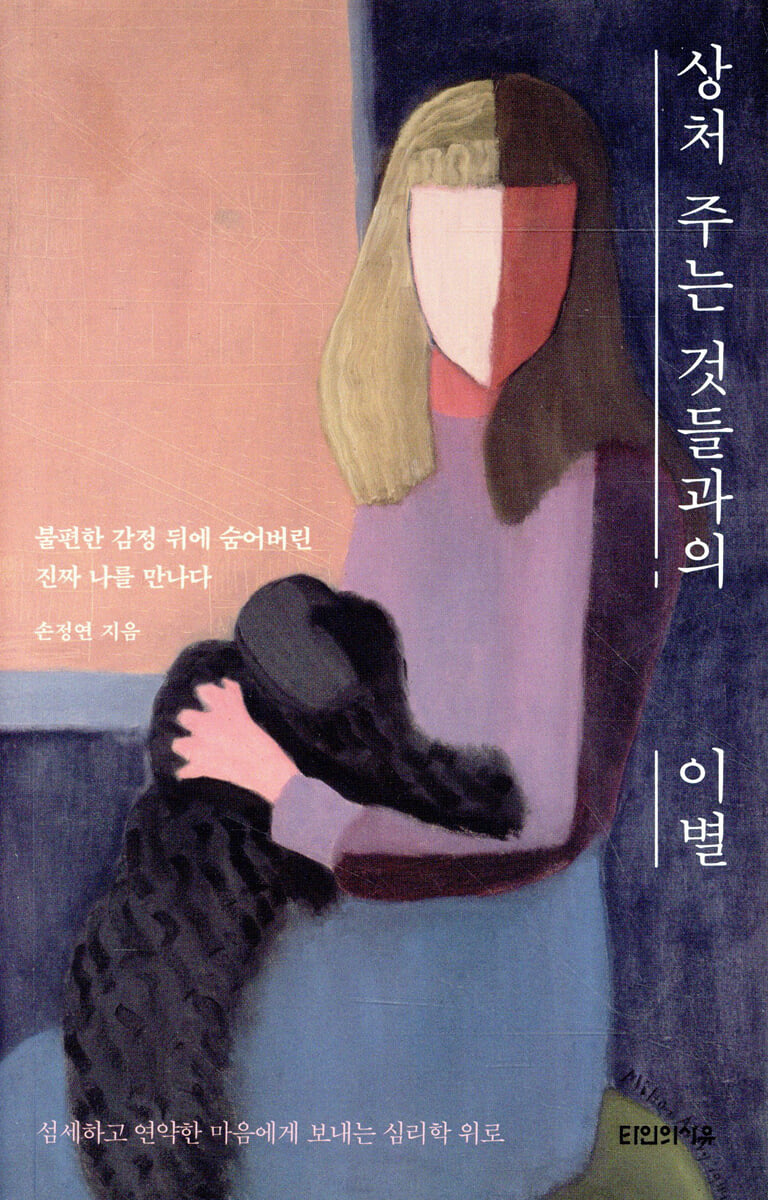
Parting with things that hurt
 |
Description
Book Introduction
“I knew it, but I still got hurt.”
A psychological prescription for those who want to become more confident.
People who are afraid of forming new relationships because of the hurt they received from a loved one, people who have lost confidence due to criticism and criticism from their boss at work, people who are unable to trust others because of their parents' constant fighting, people who have become cautious in interpersonal relationships due to rejection from friends, people who treat others aggressively because of the hurt they have received from being ignored by those around them…
We all live our lives getting hurt and causing hurt.
From trauma sustained since childhood to the small and large wounds inflicted in interpersonal relationships, the types and scope are countless.
But not everyone deals with pain and hurt in the same way.
Some people manage to heal their wounds and use them as an opportunity to reflect on themselves and grow into a more mature person, but some people embrace their wounds and react emotionally, ultimately creating even greater wounds.
So we need to know how to properly clean up wounds.
Let's learn about the warm healing methods offered by psychology so that we don't lose self-esteem and doubt our worth due to the wounds we're currently receiving, and so that we don't hold onto uncomfortable emotions and suffer from the pain caused by interpersonal relationships.
A psychological prescription for those who want to become more confident.
People who are afraid of forming new relationships because of the hurt they received from a loved one, people who have lost confidence due to criticism and criticism from their boss at work, people who are unable to trust others because of their parents' constant fighting, people who have become cautious in interpersonal relationships due to rejection from friends, people who treat others aggressively because of the hurt they have received from being ignored by those around them…
We all live our lives getting hurt and causing hurt.
From trauma sustained since childhood to the small and large wounds inflicted in interpersonal relationships, the types and scope are countless.
But not everyone deals with pain and hurt in the same way.
Some people manage to heal their wounds and use them as an opportunity to reflect on themselves and grow into a more mature person, but some people embrace their wounds and react emotionally, ultimately creating even greater wounds.
So we need to know how to properly clean up wounds.
Let's learn about the warm healing methods offered by psychology so that we don't lose self-esteem and doubt our worth due to the wounds we're currently receiving, and so that we don't hold onto uncomfortable emotions and suffer from the pain caused by interpersonal relationships.
- You can preview some of the book's contents.
Preview
index
prolog
Part 1: Why on Earth Do They Do This?: People Who Hurt and Are Hurt
- So what are you trying to say?
- I just wanted to do well.
- The problem is the emotions that come up in an instant.
- I can't believe it at all
Part 2 I hope my hungry heart reaches you
- I was able to keep my pride.
- The time I want to run away, 9 PM
- When the same pattern repeats itself in a relationship
- This is clearly his fault, so why should I?
- You're so good, it's a big deal.
- The person who hurts me the most is my mother
- I decided to change the memory of emotions.
Part 3 To the heart that I have kept tightly shut
- I'm afraid I might look strange to others.
- The reason why I keep thinking negatively
- Is that really the case?
- When I am filled with unreasonable anxiety
- One day, a feeling of guilt came to me.
- A heart that has never been comforted
- All losses are equally important
Part 4 Five Keys to Emptying the House of Wounds
- The first key: Dealing with rusty emotions
- The second key: Keeping distance from myself
- Third Key_Add Empathy
- The Fourth Key: Changing the Context of Memory
- The Fifth Key_Letting Go
Part 1: Why on Earth Do They Do This?: People Who Hurt and Are Hurt
- So what are you trying to say?
- I just wanted to do well.
- The problem is the emotions that come up in an instant.
- I can't believe it at all
Part 2 I hope my hungry heart reaches you
- I was able to keep my pride.
- The time I want to run away, 9 PM
- When the same pattern repeats itself in a relationship
- This is clearly his fault, so why should I?
- You're so good, it's a big deal.
- The person who hurts me the most is my mother
- I decided to change the memory of emotions.
Part 3 To the heart that I have kept tightly shut
- I'm afraid I might look strange to others.
- The reason why I keep thinking negatively
- Is that really the case?
- When I am filled with unreasonable anxiety
- One day, a feeling of guilt came to me.
- A heart that has never been comforted
- All losses are equally important
Part 4 Five Keys to Emptying the House of Wounds
- The first key: Dealing with rusty emotions
- The second key: Keeping distance from myself
- Third Key_Add Empathy
- The Fourth Key: Changing the Context of Memory
- The Fifth Key_Letting Go
Detailed image

Into the book
The ambiguous language used by Kim Soo-seok, whose intentions are unclear, falls under the first trap, the 'double bind'.
A double bind refers to a conversation that is inconsistent and contradictory.
This is when the message expressed outwardly and the message held in the heart are different.
People who use this kind of speech style respond to someone saying, “This plan is good,” with, “So, that means it wasn’t that great until now.”
There are two types of cake, chocolate and cheese. If you choose chocolate, the response you get is, “I guess you don’t like cheese?”
The person speaking may think they are just having a normal conversation, but the other person may feel embarrassed and confused because they don't know which beat to dance to.
--- From "So what do you want to say?"
It is helpful to consistently work on naming your emotions at this time.
Also known as 'affect labeling', it acts as a brake on the brain from heightened emotions.
It's about labeling the emotions I'm currently experiencing with words.
And the intensity of that emotion is expressed as a number from 0 (the weakest) to 100 (the strongest).
- I feel angry right now, I'm about 70.
- I feel lonely now.
I feel like a size 50.
Once I've labeled my emotions this way, I can calculate whether it's beneficial for me to maintain that emotional state or whether it's beneficial to stop or lower it.
This is 'emotion recognition'.
In a broad sense, recognizing emotions means being aware of the emotions I feel and anticipating and noticing their impact on my thoughts, actions, and other people and situations.
--- From "When the same pattern repeats itself in a relationship"
Addiction isn't always about what you see on the outside.
Some people live addicted to intense emotions like anger, sadness, or joy.
These are light, small, and weak stages in which no mood changes can be felt.
I want something heavier, bigger, more exciting and more intense.
Even if it means destroying oneself, one cannot stop in the middle and pursues it even more strongly.
Some people also maintain a state of 'cognitive addiction' such as 'I'm fine' or 'I'm a mature person who doesn't feel pain' to avoid unpleasant feelings.
“I have never been angry or upset with anyone in my life.
If someone says, "If you think about it, there's nothing I don't understand," and someone else says, "I'm so angry these days because of XX," which one do you think is more honest and healthy? We need to recognize exactly what we're feeling in order to properly regulate it.
There is no one who does not get angry.
You're just addicted to the thought that keeps you from noticing that you're angry.
--- From "9 PM, the time I want to run away"
People believe that the emotions they feel are their true feelings.
Of course, there are times when emotions reflect my thoughts and unconscious desires and expectations, but on the other hand, there are times when they do not and block my true inner desires.
When two different desires coexist, it is inevitable that you will suffer because you will not know what is real.
And we express that pain as a rather strange emotion called anger or rage.
So, if you want to get to the real root of your hurt, you have to be able to focus on noticing the needs hidden beneath your emotions.
For example, you have a date with your lover on the weekend evening.
But my lover canceled the appointment on the same day, saying something urgent came up.
In general, the feeling of 'disappointment' will be felt, and the frustrated desire will be 'pleasure'.
However, some people may feel the emotion of 'anger' and may choose 'self-esteem' as a frustrated desire.
Even though it is the same situation, my feelings change depending on what desire I was trying to satisfy through it.
A double bind refers to a conversation that is inconsistent and contradictory.
This is when the message expressed outwardly and the message held in the heart are different.
People who use this kind of speech style respond to someone saying, “This plan is good,” with, “So, that means it wasn’t that great until now.”
There are two types of cake, chocolate and cheese. If you choose chocolate, the response you get is, “I guess you don’t like cheese?”
The person speaking may think they are just having a normal conversation, but the other person may feel embarrassed and confused because they don't know which beat to dance to.
--- From "So what do you want to say?"
It is helpful to consistently work on naming your emotions at this time.
Also known as 'affect labeling', it acts as a brake on the brain from heightened emotions.
It's about labeling the emotions I'm currently experiencing with words.
And the intensity of that emotion is expressed as a number from 0 (the weakest) to 100 (the strongest).
- I feel angry right now, I'm about 70.
- I feel lonely now.
I feel like a size 50.
Once I've labeled my emotions this way, I can calculate whether it's beneficial for me to maintain that emotional state or whether it's beneficial to stop or lower it.
This is 'emotion recognition'.
In a broad sense, recognizing emotions means being aware of the emotions I feel and anticipating and noticing their impact on my thoughts, actions, and other people and situations.
--- From "When the same pattern repeats itself in a relationship"
Addiction isn't always about what you see on the outside.
Some people live addicted to intense emotions like anger, sadness, or joy.
These are light, small, and weak stages in which no mood changes can be felt.
I want something heavier, bigger, more exciting and more intense.
Even if it means destroying oneself, one cannot stop in the middle and pursues it even more strongly.
Some people also maintain a state of 'cognitive addiction' such as 'I'm fine' or 'I'm a mature person who doesn't feel pain' to avoid unpleasant feelings.
“I have never been angry or upset with anyone in my life.
If someone says, "If you think about it, there's nothing I don't understand," and someone else says, "I'm so angry these days because of XX," which one do you think is more honest and healthy? We need to recognize exactly what we're feeling in order to properly regulate it.
There is no one who does not get angry.
You're just addicted to the thought that keeps you from noticing that you're angry.
--- From "9 PM, the time I want to run away"
People believe that the emotions they feel are their true feelings.
Of course, there are times when emotions reflect my thoughts and unconscious desires and expectations, but on the other hand, there are times when they do not and block my true inner desires.
When two different desires coexist, it is inevitable that you will suffer because you will not know what is real.
And we express that pain as a rather strange emotion called anger or rage.
So, if you want to get to the real root of your hurt, you have to be able to focus on noticing the needs hidden beneath your emotions.
For example, you have a date with your lover on the weekend evening.
But my lover canceled the appointment on the same day, saying something urgent came up.
In general, the feeling of 'disappointment' will be felt, and the frustrated desire will be 'pleasure'.
However, some people may feel the emotion of 'anger' and may choose 'self-esteem' as a frustrated desire.
Even though it is the same situation, my feelings change depending on what desire I was trying to satisfy through it.
--- From "I decided to change the memory of emotions"
Publisher's Review
│Even if depression, anxiety, and anger appear similar on the outside, the true nature of those emotions is different!
Uncomfortable feelings signal my wounds
Several times a day, we experience wounds, big and small.
And these wounds manifest as uncomfortable emotions like anger, jealousy, envy, disgust, shame, anxiety, sadness, and frustration, making us suffer.
The wounds that have taken root in my heart without me knowing suddenly surface, sometimes turning me into an aggressive and sensitive person, and other times making me an extremely pathetic person.
But even though they may seem like the same emotions on the outside, the reality hidden within them is different.
For example, someone's anger is an inferiority complex caused by distorted narcissism.
People who have a strong compulsive need to be superior to others tend to blame others when they experience disappointment or frustration in order to escape the pain and shame.
Another person's anger is a desire to be loved.
The feeling of not wanting to be abandoned leads to constant obsession, and if the other person fails to satisfy this, it leads to extreme emotional expression.
Another person's anger is guilt.
People who suffer from chronic guilt over everything being their fault become their own watchdogs, evaluating their own actions and venting anger at their perceived shortcomings.
Even if they have the same emotions, they each contain different signals of hurt.
Therefore, to properly part ways with the wounds that disrupt our daily lives and make our relationships tiring, we need to understand the true nature of the wounds hidden behind the uncomfortable emotions and develop a method of mental organization to heal them.
│I get hurt even though I know it, and I get hurt out of habit…
Psychological comfort for the delicate and fragile mind
Of course, there are bound to be negative emotions that arise in natural situations, such as when you break up with a loved one or fail to achieve a desired goal.
These feelings are not a problem at all.
Rather, at this time, you need time to fully acknowledge the negative emotions you feel and accept them as they are.
The author says that what we need to pay close attention to are the wounds that repeat like patterns, the wounds we receive like habits, and the wounds we create ourselves.
In particular, if you frequently ask yourself questions like, “It was their fault, so why do I have to get hurt?”, “Why do the same patterns repeat themselves every time I meet someone?”, “Am I the one who gets hurt because I’m weird?”, or “Why do I keep getting hurt even though I know it?”, I advise you to figure out where the wounds that cause negative emotions originate.
For example, people with strong internal rules may unconsciously believe that others should follow the rules they believe are natural, which can lead to difficulties in interpersonal relationships.
People like this talk like it's a habit.
“Of course you should do that.” Some people get hurt alone because of the cognitive error of automatically thinking and believing that it is always true, and end up becoming victims without a perpetrator.
For example, if the other person frowns during a conversation, we overgeneralize by saying, "They must hate me" or "They must not have liked what I said."
The other person ends up feeling wronged and misunderstood.
I just had a toothache and grimaced for a moment.
In this way, this book identifies thought patterns that create wounds when they are not wounds, or thought patterns that magnify negative emotions and make wounds worse, and presents various practice exercises to change them.
│“I’ve decided to accept the imperfect and clumsy me!”
Five Keys to Emptying the House of Wounds in My Heart
When we hear the word "wound," we tend to think of only traumatic events, but in fact, the wounds that threaten our daily lives often begin with a small word or a glance exchanged in a relationship rather than a major trauma.
So, this book contains the method of properly parting with the wounds that make our lives difficult, from old wounds that have accumulated since childhood to small wounds that we receive moment by moment in our daily lives.
It introduces methods for healthy healing, dividing them into parts focusing on situations where wounds are expressed outwardly and situations where wounds are endured. In addition, it introduces mental vaccines that are good to have internally to prevent the problem of a wounded heart from recurring.
- One, don't suppress your emotions any longer!
- Two, look at me from a third-person perspective!
- Three, speak to me the language of acceptance!
- Fourth, I will edit and update the memories that were hurt!
- Five, instead of looking for reasons for unhappiness, focus on how to become happy!
The author says that overcoming a wound may mean becoming less distressed by it and, over time, gaining the confidence to overcome it.
This is also a process of accepting the imperfect and clumsy me.
Now, let's equip ourselves with the five heart vaccines through this book and take some time for healing to empty the house of wounds.
Uncomfortable feelings signal my wounds
Several times a day, we experience wounds, big and small.
And these wounds manifest as uncomfortable emotions like anger, jealousy, envy, disgust, shame, anxiety, sadness, and frustration, making us suffer.
The wounds that have taken root in my heart without me knowing suddenly surface, sometimes turning me into an aggressive and sensitive person, and other times making me an extremely pathetic person.
But even though they may seem like the same emotions on the outside, the reality hidden within them is different.
For example, someone's anger is an inferiority complex caused by distorted narcissism.
People who have a strong compulsive need to be superior to others tend to blame others when they experience disappointment or frustration in order to escape the pain and shame.
Another person's anger is a desire to be loved.
The feeling of not wanting to be abandoned leads to constant obsession, and if the other person fails to satisfy this, it leads to extreme emotional expression.
Another person's anger is guilt.
People who suffer from chronic guilt over everything being their fault become their own watchdogs, evaluating their own actions and venting anger at their perceived shortcomings.
Even if they have the same emotions, they each contain different signals of hurt.
Therefore, to properly part ways with the wounds that disrupt our daily lives and make our relationships tiring, we need to understand the true nature of the wounds hidden behind the uncomfortable emotions and develop a method of mental organization to heal them.
│I get hurt even though I know it, and I get hurt out of habit…
Psychological comfort for the delicate and fragile mind
Of course, there are bound to be negative emotions that arise in natural situations, such as when you break up with a loved one or fail to achieve a desired goal.
These feelings are not a problem at all.
Rather, at this time, you need time to fully acknowledge the negative emotions you feel and accept them as they are.
The author says that what we need to pay close attention to are the wounds that repeat like patterns, the wounds we receive like habits, and the wounds we create ourselves.
In particular, if you frequently ask yourself questions like, “It was their fault, so why do I have to get hurt?”, “Why do the same patterns repeat themselves every time I meet someone?”, “Am I the one who gets hurt because I’m weird?”, or “Why do I keep getting hurt even though I know it?”, I advise you to figure out where the wounds that cause negative emotions originate.
For example, people with strong internal rules may unconsciously believe that others should follow the rules they believe are natural, which can lead to difficulties in interpersonal relationships.
People like this talk like it's a habit.
“Of course you should do that.” Some people get hurt alone because of the cognitive error of automatically thinking and believing that it is always true, and end up becoming victims without a perpetrator.
For example, if the other person frowns during a conversation, we overgeneralize by saying, "They must hate me" or "They must not have liked what I said."
The other person ends up feeling wronged and misunderstood.
I just had a toothache and grimaced for a moment.
In this way, this book identifies thought patterns that create wounds when they are not wounds, or thought patterns that magnify negative emotions and make wounds worse, and presents various practice exercises to change them.
│“I’ve decided to accept the imperfect and clumsy me!”
Five Keys to Emptying the House of Wounds in My Heart
When we hear the word "wound," we tend to think of only traumatic events, but in fact, the wounds that threaten our daily lives often begin with a small word or a glance exchanged in a relationship rather than a major trauma.
So, this book contains the method of properly parting with the wounds that make our lives difficult, from old wounds that have accumulated since childhood to small wounds that we receive moment by moment in our daily lives.
It introduces methods for healthy healing, dividing them into parts focusing on situations where wounds are expressed outwardly and situations where wounds are endured. In addition, it introduces mental vaccines that are good to have internally to prevent the problem of a wounded heart from recurring.
- One, don't suppress your emotions any longer!
- Two, look at me from a third-person perspective!
- Three, speak to me the language of acceptance!
- Fourth, I will edit and update the memories that were hurt!
- Five, instead of looking for reasons for unhappiness, focus on how to become happy!
The author says that overcoming a wound may mean becoming less distressed by it and, over time, gaining the confidence to overcome it.
This is also a process of accepting the imperfect and clumsy me.
Now, let's equip ourselves with the five heart vaccines through this book and take some time for healing to empty the house of wounds.
GOODS SPECIFICS
- Publication date: October 15, 2020
- Page count, weight, size: 240 pages | 296g | 120*188*14mm
- ISBN13: 9791136249883
- ISBN10: 1136249885
You may also like
카테고리
korean


korean

![GQ KOREA Mark (Monthly): December [2025]](http://librairie.coreenne.fr/cdn/shop/files/8ef265dbbfbf186523ed75ba7319009d.jpg?v=1765340328&width=3840)


