

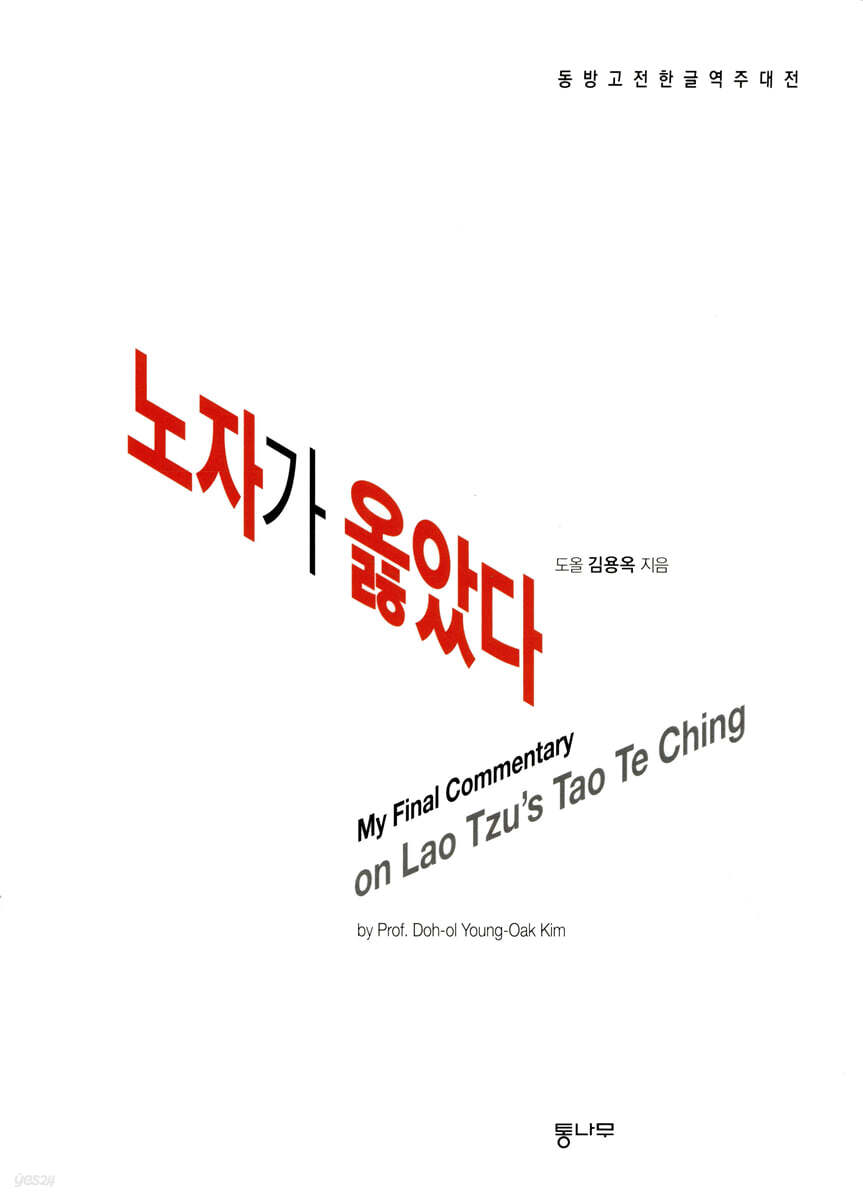
Lao Tzu was right
 |
Description
Book Introduction
- A word from MD
- Philosopher Do-ol Kim Yong-ok translates the immortal classic Tao Te Ching by Lao-tzu into Korean and clearly explains its profound meaning.
- Humanities MD Son Min-gyu
Lao-tzu's philosophy is solved with this one book!
Philosopher Do-ol Kim Yong-ok has translated [Lao-tzu's Tao Te Ching], one of the most outstanding classics of human philosophy and wisdom, into elegant Korean and clearly explains its profound meaning.
In "Lao Tzu Was Right," the author defines the current human civilization, which is facing climate change due to global warming and the coronavirus outbreak, as a crisis.
And, as an idea to overcome this difficulty, Lao-tzu's philosophy is presented as the only hope.
As a philosophy for the 21st century, Lao Tzu was already prepared 2,500 years ago.
Through his writings and lectures, Dool has consistently internalized Lao-tzu's philosophy into the lives of Koreans.
Lao-tzu is the most crucial figure in the ideological trajectory of Do-ol Kim Yong-ok, who began his full-fledged philosophy after meeting Lao-tzu 50 years ago.
He considers Lao Tzu to be the greatest philosophy of mankind.
This book is the culmination and final version of 50 years of Taoist philosophy.
This one book conveys to us the profound philosophy of Lao-tzu.
Philosopher Do-ol Kim Yong-ok has translated [Lao-tzu's Tao Te Ching], one of the most outstanding classics of human philosophy and wisdom, into elegant Korean and clearly explains its profound meaning.
In "Lao Tzu Was Right," the author defines the current human civilization, which is facing climate change due to global warming and the coronavirus outbreak, as a crisis.
And, as an idea to overcome this difficulty, Lao-tzu's philosophy is presented as the only hope.
As a philosophy for the 21st century, Lao Tzu was already prepared 2,500 years ago.
Through his writings and lectures, Dool has consistently internalized Lao-tzu's philosophy into the lives of Koreans.
Lao-tzu is the most crucial figure in the ideological trajectory of Do-ol Kim Yong-ok, who began his full-fledged philosophy after meeting Lao-tzu 50 years ago.
He considers Lao Tzu to be the greatest philosophy of mankind.
This book is the culmination and final version of 50 years of Taoist philosophy.
This one book conveys to us the profound philosophy of Lao-tzu.
- You can preview some of the book's contents.
Preview
index
Lao Tzu's "Tao Te Ching": The Bible of the Way
Chapter 1, Chapter 12
… …
Chapter 37, 314
Lao Tzu's "Tao Te Ching": The Bible of Gain
Chapter 38, 318
… …
Chapter 81, 494
Sulfur and Deception 500
Chapter 1, Chapter 12
… …
Chapter 37, 314
Lao Tzu's "Tao Te Ching": The Bible of Gain
Chapter 38, 318
… …
Chapter 81, 494
Sulfur and Deception 500
Into the book
In this space-time from which we can never escape, there is no such thing as “immutability.”
All “constancy” is not changelessness, but rather the duration of change.
--- p.19
The Greek arche?, which asks about the origin of the universe, is somewhat different in nature from our Eastern Tao.
The Greeks began the history of philosophy with a natural philosophical concern about the ultimate reality of the universe.
… … But rather than being interested in such ultimate reality or primordiality, we Eastern people asked about the moral meaning of the regularity of the operation of the great nature of heaven and earth, called the “way.”
--- p.22
In other words, if we translate the object of Lao Tzu's criticism into modern terms, it is the fiction of the theory of ideas that gave rise to the history of Western ontology, which is characterized by the "loss of existence."
--- p.30
For Cho Won-il, there is no longer Zhu Xi, Yangming, Buddhism, or Laozi.
… … The “Damno” of the grassland is truly the end point, the starting point, the unusual flower, and the ultimate point of the history of Joseon thought.
--- p.48
It can be said that Choe Won was the first person to understand the text of the Tao Te Ching within the mainstream of Xuanxue.
--- p.53
The meaning of the concept of “true emptiness and wonderful existence,” which is a term often used in the Prajna lineage sutras, is that in order for emptiness to be true and not false, it must first be wonderful existence.
--- p.76
Sunja never said anything about vocal music, she only said “song-o.”
Human nature has never been defined as ontologically evil.
… … If nature itself is defined as evil, then where can the value of education or acquired talents stand?
--- p.104
Chowon was well aware of how stubborn prejudices and absolutist claims about beauty and goodness had devastated the Joseon intellectual world.
… … Looking back at the history of mankind, there is no system of thought so poor as the absolute embodiment of good and evil that has brought disaster to mankind.
--- p.107
Even a single leaf of a mountain, river, or tree goes through a continuous process of creation.
In the process of a new shoot giving birth to another new shoot, the old shoot does not possess the new shoot.
Old shoots become the material for the symbiosis of new shoots.
So, the process of life can only be achieved through freedom of newness without shrinking, without possession.
--- p.117
Creation without ownership, action without self-will, growth without domination! Russell saw these three words as the essence of Chinese civilization, something Westerners lacked.
--- pp.119-120
As we listen to Lao Tzu's counter-civilizational warning, we must correct our blind faith and vague expectations about social progress.
--- p.128
Unlike Buddhist thinkers, Lao Tzu considered emptying the mind to be the secret to health, filling the stomach and strengthening the bones.
Non-self aims at liberation, while inaction aims at health.
--- p.130
For Lao Tzu, existence is creation.
But what is created must have a beam--- p. 虛).
Therefore, what exists is empty.
… …Beam is the potential of all possibilities and the source of creativity.
--- p.134
The femininity that Lao Tzu speaks of is not a claim to women's rights or equality determined by social demands, but rather a cosmological praise of the characteristics of the present existence of women.
--- p.144
While Laozi is thoroughly worldly, Zhuangzi can be said to be generally worldly.
Lao-tzu discusses the thoroughly realistic art of non-action, while Zhuang-tzu advocates transcendental freedom.
--- pp.189-190
The “God who is not God,” the “God who is beyond God,” of which Eckhart speaks, is described in Lao Tzu not as a noun but as an adjective or adverb: “yellow and dazzling.”
All “constancy” is not changelessness, but rather the duration of change.
--- p.19
The Greek arche?, which asks about the origin of the universe, is somewhat different in nature from our Eastern Tao.
The Greeks began the history of philosophy with a natural philosophical concern about the ultimate reality of the universe.
… … But rather than being interested in such ultimate reality or primordiality, we Eastern people asked about the moral meaning of the regularity of the operation of the great nature of heaven and earth, called the “way.”
--- p.22
In other words, if we translate the object of Lao Tzu's criticism into modern terms, it is the fiction of the theory of ideas that gave rise to the history of Western ontology, which is characterized by the "loss of existence."
--- p.30
For Cho Won-il, there is no longer Zhu Xi, Yangming, Buddhism, or Laozi.
… … The “Damno” of the grassland is truly the end point, the starting point, the unusual flower, and the ultimate point of the history of Joseon thought.
--- p.48
It can be said that Choe Won was the first person to understand the text of the Tao Te Ching within the mainstream of Xuanxue.
--- p.53
The meaning of the concept of “true emptiness and wonderful existence,” which is a term often used in the Prajna lineage sutras, is that in order for emptiness to be true and not false, it must first be wonderful existence.
--- p.76
Sunja never said anything about vocal music, she only said “song-o.”
Human nature has never been defined as ontologically evil.
… … If nature itself is defined as evil, then where can the value of education or acquired talents stand?
--- p.104
Chowon was well aware of how stubborn prejudices and absolutist claims about beauty and goodness had devastated the Joseon intellectual world.
… … Looking back at the history of mankind, there is no system of thought so poor as the absolute embodiment of good and evil that has brought disaster to mankind.
--- p.107
Even a single leaf of a mountain, river, or tree goes through a continuous process of creation.
In the process of a new shoot giving birth to another new shoot, the old shoot does not possess the new shoot.
Old shoots become the material for the symbiosis of new shoots.
So, the process of life can only be achieved through freedom of newness without shrinking, without possession.
--- p.117
Creation without ownership, action without self-will, growth without domination! Russell saw these three words as the essence of Chinese civilization, something Westerners lacked.
--- pp.119-120
As we listen to Lao Tzu's counter-civilizational warning, we must correct our blind faith and vague expectations about social progress.
--- p.128
Unlike Buddhist thinkers, Lao Tzu considered emptying the mind to be the secret to health, filling the stomach and strengthening the bones.
Non-self aims at liberation, while inaction aims at health.
--- p.130
For Lao Tzu, existence is creation.
But what is created must have a beam--- p. 虛).
Therefore, what exists is empty.
… …Beam is the potential of all possibilities and the source of creativity.
--- p.134
The femininity that Lao Tzu speaks of is not a claim to women's rights or equality determined by social demands, but rather a cosmological praise of the characteristics of the present existence of women.
--- p.144
While Laozi is thoroughly worldly, Zhuangzi can be said to be generally worldly.
Lao-tzu discusses the thoroughly realistic art of non-action, while Zhuang-tzu advocates transcendental freedom.
--- pp.189-190
The “God who is not God,” the “God who is beyond God,” of which Eckhart speaks, is described in Lao Tzu not as a noun but as an adjective or adverb: “yellow and dazzling.”
--- p.236
Publisher's Review
Lao Tzu is the philosophy of philosophies!
Lao Tzu thinks fundamentally, thinks holistically, and thinks comprehensively.
Lao Tzu calls for the overthrow of fixed thinking.
The first sentence of Lao Tzu is “The Tao is not the way, but the way is the way.”
If you confine the Way to a certain fixed concept, that Way is not always the constant Way.
Lao Tzu rejects the violence of metaphysics.
Lao Tzu firmly asserts the constancy of change and continuity, that phenomena that change from moment to moment in the flow of time always continue to do so.
Lao Tzu is a philosophy of life.
It explores the clear and unwavering order of nature and discusses how people should live well.
It teaches us an attitude towards life, telling us not to live like that, but to live like this.
Lao Tzu speaks of non-conflict and demands a fundamental change in the attitude of our civilization.
They say our future is one of cooperation, not competition.
Lao Tzu is a political philosophy.
The true subject of the entire Lao-tzu is the sage.
The saint's surname is also a sound.
A ruler who knows how to listen to the voices of the people.
The teaching given to adults is precisely the question of political leadership.
Building trust among people through the philosophy of ignorance, non-desire, and inaction taught by Lao Tzu is proper political leadership, and it is the source of peace.
Lao Tzu is a great cosmological thinker.
Lao Tzu tells us to abandon all respect for existing authority.
They say that weakness overcomes strength, softness overcomes hardness, and that we should return to the innocence of a child.
A person who follows Lao Tzu becomes a magnificent personality, not a petty one.
Lao Tzu is a philosophy waiting for the 21st century.
Lao-tzu is a philosophy of integrated vision whose comprehensive system of thought is consistently recognized as the origin of human thought.
This is an urgent thought for humanity suffering from the coronavirus.
The final fruit of 50 years of research on Dool Noja!
Do-ol Kim Yong-ok, a philosopher of our time, was introduced to Lao-tzu by professors Kim Gyeong-tak and Kim Chung-ryeol when he was a college student in his early twenties, and since then he has firmly decided on the path of his studies as Eastern philosophy.
Afterwards, he received training from the best teachers in this field at prestigious universities in China, Japan, and the United States, and for over 50 years, he has refined his philosophy by accumulating various academic disciplines from the East and the West, with Lao-tzu as the core.
And he did not neglect his efforts to inform the public about Lao-tzu's thoughts.
In particular, the explosive popularity of the Lao-tzu lectures on EBS in 2000, the year of the millennium, internalized the profound ideas of Lao-tzu among our people and became an opportunity to form intellectual discourse through broadcasting.
After that, a boom in humanities through broadcast lectures exploded in our society.
After 20 more years of maturation, this book, "Lao-tzu Was Right," is a masterpiece that summarizes Do-ol's 50 years of research on Lao-tzu.
Timing is important in thinking.
Twenty years after the millennium, even when talking about the same Lao Tzu, the tension is completely different.
If the EBS Lao-tzu lectures of 20 years ago were a version that evaluated the 20th century and conveyed a vision for a new era, the message of Lao-tzu in this book, "Lao-tzu Was Right," delivered at this point in time, amidst a global crisis in the 21st century, is a thunderous force that urgently commands humanity to transform its civilization.
And the most outstanding charm of this book, which is a special work of Dool, is its translation of the original text of Lao-tzu.
It is a miracle that the original text of Lao-tzu is conveyed so clearly, with such a poetic feel, so movingly, and so completely in our Korean language.
Even if you just read the Korean translation of Chapter 81 of the Tao Te Ching, Lao Tzu's wisdom will soak into your heart.
The 2,500-year-old philosophy of Lao-tzu has reappeared fatefully in the 21st century!
Lao Tzu is not a system of thought.
It is a wisdom, a lifestyle, and a way of thinking that has been ingrained in our lives for thousands of years.
Lao Tzu had a long journey along with the history of the Chinese character civilization.
It starts from the simple wisdom of life, tells us how to govern the human world, and tells us what the truth of the universe is.
It became the origin of the Hundred Schools of Thought during the Spring and Autumn Period and the Warring States Period, the ideological basis for all civil unrest, and the framework for accepting Buddhism.
It was also the inspiration for all art.
In the 20th century, it also became the source of all anti-civilizational thinking that led to a critical acceptance of Western civilization.
Now, in the 21st century, when a fundamental transformation of human civilization is imminent, Lao-tzu's philosophy is once again making a full-fledged appearance in the history of world thought.
Now, humanity must realize that we share a common destiny and fundamentally rethink our civilization.
At a turning point in civilization, Lao Tzu is humanity's last hope!
Our current civilization is a capitalist economic development that stimulates human desire and encourages consumption, based on the competitive structure and spirit of competition fostered by the Industrial Revolution and imperialism that began in earnest in the 19th century.
The consequences of this civilizational development are the global climate change and COVID-19 pandemic we are witnessing now.
The author of this book appeals to reverse the values of existing civilization from the perspective of Lao-tzu's philosophy.
Lao Tzu contains numerous warnings against civilization, such as the importance of contention rather than competition, selflessness to control desires, frugality to reduce consumption, and environmental responsibility to maintain the natural order of the universe.
Lao-tzu's philosophy is a philosophy of non-action and respects emptiness.
Lao Tzu calls human actions aimed at filling something “action” and human efforts or wisdom aimed at maximizing emptiness “actionless”.
Modern industrial civilization is a civilization of maximized convenience.
So, the philosophy of non-action, which aims for emptiness, is anti-civilizational to existing civilization.
The Earth's ecological environment is cyclical.
The field of that cycle is “emptiness.”
In Laozi, permission is the function of the Tao and the life force of the universe.
Permission is necessary for the cycle of nature, the cycle of human existence, and the cycle of civilization.
At this point in the 21st century, any thinking person will realize the urgency of embracing Lao Tzu's wisdom and reshaping human civilization.
Lao-tzu's philosophy still remains a hope for humanity, but perhaps it is the last hope.
In this book, the author earnestly persuades and appeals for the necessity of accepting Lao Tzu's insights and building a new civilization of emptiness from now on.
Lao Tzu thinks fundamentally, thinks holistically, and thinks comprehensively.
Lao Tzu calls for the overthrow of fixed thinking.
The first sentence of Lao Tzu is “The Tao is not the way, but the way is the way.”
If you confine the Way to a certain fixed concept, that Way is not always the constant Way.
Lao Tzu rejects the violence of metaphysics.
Lao Tzu firmly asserts the constancy of change and continuity, that phenomena that change from moment to moment in the flow of time always continue to do so.
Lao Tzu is a philosophy of life.
It explores the clear and unwavering order of nature and discusses how people should live well.
It teaches us an attitude towards life, telling us not to live like that, but to live like this.
Lao Tzu speaks of non-conflict and demands a fundamental change in the attitude of our civilization.
They say our future is one of cooperation, not competition.
Lao Tzu is a political philosophy.
The true subject of the entire Lao-tzu is the sage.
The saint's surname is also a sound.
A ruler who knows how to listen to the voices of the people.
The teaching given to adults is precisely the question of political leadership.
Building trust among people through the philosophy of ignorance, non-desire, and inaction taught by Lao Tzu is proper political leadership, and it is the source of peace.
Lao Tzu is a great cosmological thinker.
Lao Tzu tells us to abandon all respect for existing authority.
They say that weakness overcomes strength, softness overcomes hardness, and that we should return to the innocence of a child.
A person who follows Lao Tzu becomes a magnificent personality, not a petty one.
Lao Tzu is a philosophy waiting for the 21st century.
Lao-tzu is a philosophy of integrated vision whose comprehensive system of thought is consistently recognized as the origin of human thought.
This is an urgent thought for humanity suffering from the coronavirus.
The final fruit of 50 years of research on Dool Noja!
Do-ol Kim Yong-ok, a philosopher of our time, was introduced to Lao-tzu by professors Kim Gyeong-tak and Kim Chung-ryeol when he was a college student in his early twenties, and since then he has firmly decided on the path of his studies as Eastern philosophy.
Afterwards, he received training from the best teachers in this field at prestigious universities in China, Japan, and the United States, and for over 50 years, he has refined his philosophy by accumulating various academic disciplines from the East and the West, with Lao-tzu as the core.
And he did not neglect his efforts to inform the public about Lao-tzu's thoughts.
In particular, the explosive popularity of the Lao-tzu lectures on EBS in 2000, the year of the millennium, internalized the profound ideas of Lao-tzu among our people and became an opportunity to form intellectual discourse through broadcasting.
After that, a boom in humanities through broadcast lectures exploded in our society.
After 20 more years of maturation, this book, "Lao-tzu Was Right," is a masterpiece that summarizes Do-ol's 50 years of research on Lao-tzu.
Timing is important in thinking.
Twenty years after the millennium, even when talking about the same Lao Tzu, the tension is completely different.
If the EBS Lao-tzu lectures of 20 years ago were a version that evaluated the 20th century and conveyed a vision for a new era, the message of Lao-tzu in this book, "Lao-tzu Was Right," delivered at this point in time, amidst a global crisis in the 21st century, is a thunderous force that urgently commands humanity to transform its civilization.
And the most outstanding charm of this book, which is a special work of Dool, is its translation of the original text of Lao-tzu.
It is a miracle that the original text of Lao-tzu is conveyed so clearly, with such a poetic feel, so movingly, and so completely in our Korean language.
Even if you just read the Korean translation of Chapter 81 of the Tao Te Ching, Lao Tzu's wisdom will soak into your heart.
The 2,500-year-old philosophy of Lao-tzu has reappeared fatefully in the 21st century!
Lao Tzu is not a system of thought.
It is a wisdom, a lifestyle, and a way of thinking that has been ingrained in our lives for thousands of years.
Lao Tzu had a long journey along with the history of the Chinese character civilization.
It starts from the simple wisdom of life, tells us how to govern the human world, and tells us what the truth of the universe is.
It became the origin of the Hundred Schools of Thought during the Spring and Autumn Period and the Warring States Period, the ideological basis for all civil unrest, and the framework for accepting Buddhism.
It was also the inspiration for all art.
In the 20th century, it also became the source of all anti-civilizational thinking that led to a critical acceptance of Western civilization.
Now, in the 21st century, when a fundamental transformation of human civilization is imminent, Lao-tzu's philosophy is once again making a full-fledged appearance in the history of world thought.
Now, humanity must realize that we share a common destiny and fundamentally rethink our civilization.
At a turning point in civilization, Lao Tzu is humanity's last hope!
Our current civilization is a capitalist economic development that stimulates human desire and encourages consumption, based on the competitive structure and spirit of competition fostered by the Industrial Revolution and imperialism that began in earnest in the 19th century.
The consequences of this civilizational development are the global climate change and COVID-19 pandemic we are witnessing now.
The author of this book appeals to reverse the values of existing civilization from the perspective of Lao-tzu's philosophy.
Lao Tzu contains numerous warnings against civilization, such as the importance of contention rather than competition, selflessness to control desires, frugality to reduce consumption, and environmental responsibility to maintain the natural order of the universe.
Lao-tzu's philosophy is a philosophy of non-action and respects emptiness.
Lao Tzu calls human actions aimed at filling something “action” and human efforts or wisdom aimed at maximizing emptiness “actionless”.
Modern industrial civilization is a civilization of maximized convenience.
So, the philosophy of non-action, which aims for emptiness, is anti-civilizational to existing civilization.
The Earth's ecological environment is cyclical.
The field of that cycle is “emptiness.”
In Laozi, permission is the function of the Tao and the life force of the universe.
Permission is necessary for the cycle of nature, the cycle of human existence, and the cycle of civilization.
At this point in the 21st century, any thinking person will realize the urgency of embracing Lao Tzu's wisdom and reshaping human civilization.
Lao-tzu's philosophy still remains a hope for humanity, but perhaps it is the last hope.
In this book, the author earnestly persuades and appeals for the necessity of accepting Lao Tzu's insights and building a new civilization of emptiness from now on.
GOODS SPECIFICS
- Publication date: October 9, 2020
- Format: Hardcover book binding method guide
- Page count, weight, size: 504 pages | 1,056g | 180*245*35mm
- ISBN13: 9788982641473
- ISBN10: 8982641475
You may also like
카테고리
korean


korean

![GQ KOREA Mark (Monthly): December [2025]](http://librairie.coreenne.fr/cdn/shop/files/8ef265dbbfbf186523ed75ba7319009d.jpg?v=1765340328&width=3840)


