

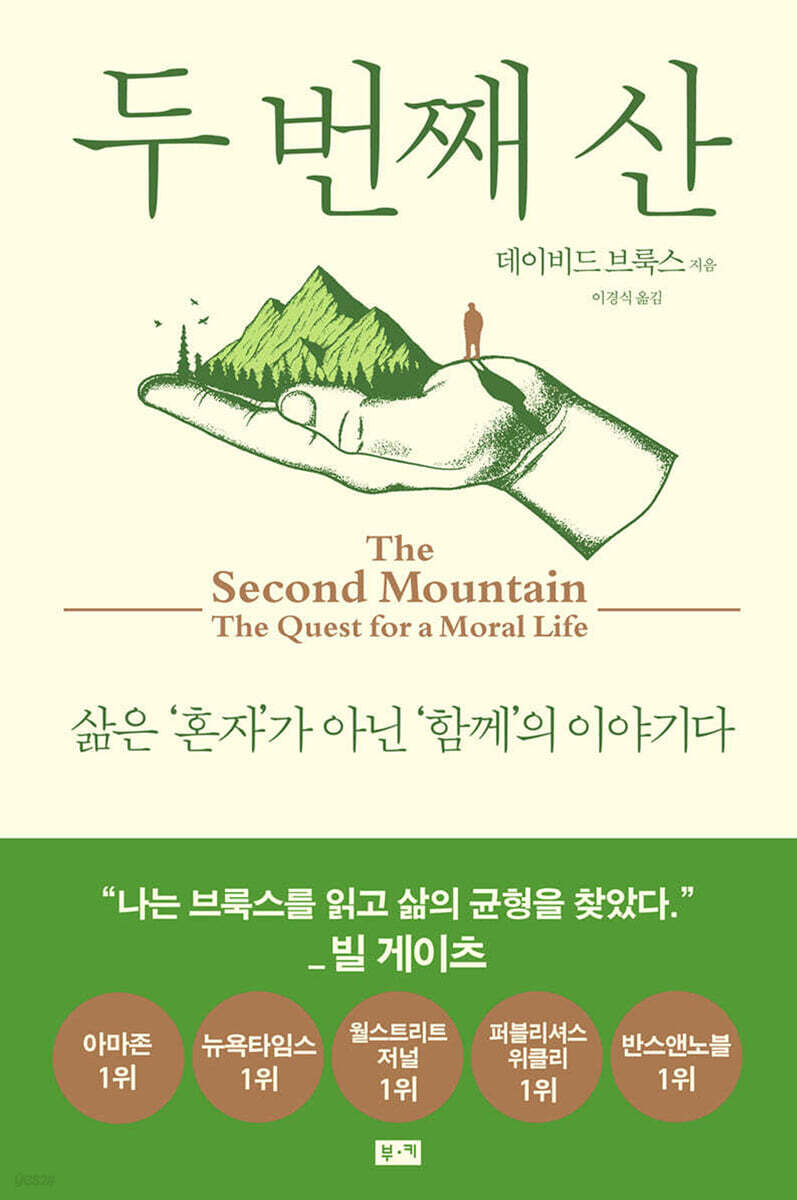
Second mountain
 |
Description
Book Introduction
David Brooks, author of the international bestseller "The Character of Man" Reawakening the Value of "Living Together" in Times of Suffering Times of suffering come to everyone. When life hits a crisis, life feels absurd and meaningless. No matter how high the wealth and fame, they cannot provide comfort or recovery. Some people become overly withdrawn when faced with this kind of pain. They live their entire lives terrified and carrying a sorrow that will never heal. And so life becomes increasingly narrow and lonely. But some people try to fully accept this pain. They have the courage to look at familiar things with new eyes. And finally, we use this pain as an opportunity for self-discovery and growth. People's lives are defined differently by how they respond to the most difficult times. In The Second Mountain, David Brooks says that we go through times of suffering to re-evaluate our attitude toward life. Learning to overcome life's pain and start over requires a fundamental change in our attitude toward life, both on an individual and societal level. The author argues that it is time for us to move beyond the ostensible values of individual happiness, independence, and autonomy to reclaim moral joy, interdependence, and relatedness. The result of overemphasizing the aforementioned values over the past 60 years has been the disintegration of communities, the breakdown of bonds between individuals, and the spread of loneliness. This situation, which can be called 'social isolation,' not only deepens the suffering of life, but also makes self-discovery and growth more difficult. The author argues that living a good life requires a shift of a much larger scale. The center of gravity of the cultural paradigm must shift from the first mountain, individualism, to the second mountain, relationalism. |
- You can preview some of the book's contents.
Preview
index
Recommendation
Climbing the second mountain in life
PART 1 Two Mountains
CHAPTER 1 What is the most desirable life?
CHAPTER 2 Life is not just a series of experiences.
CHAPTER 3 Competition Promotes Soul Laziness
CHAPTER 4 Pain is sometimes the gateway to wisdom.
CHAPTER 5 Listening to Your Own Life
CHAPTER 6 A New Life Comes After a Happy Fall
CHAPTER 7 A Deep Commitment to Good Influence
CHAPTER 8 Through the Valley of Life to the Second Mountain
Four Decisions of Commitment
PART 2 About Occupations
CHAPTER 9: Where Does Vocation Come From?
CHAPTER 10 A Beautiful and Wonderful Moment of Enlightenment
CHAPTER 11 A mentor is not a generous person.
CHAPTER 12 Awakening the Heart and Stimulating the Soul
CHAPTER 13 Find Your Calling and Advance to Mastery
PART 3 About Marriage
CHAPTER 14 A Revolution of Hope Carried Out by Two People Together
CHAPTER 15 The Stages of Intimacy
CHAPTER 16 The Stages of Intimacy
CHAPTER 17 QUESTIONS TO ASK YOURSELF BEFORE MARRIAGE
CHAPTER 18 Marriage is a school we build together
PART 4 On Philosophy and Faith
CHAPTER 19 The Best Education Teach the Best Desires
CHAPTER 20 A Mysterious Experience That Seeps In Like a Ray of Light
CHAPTER 21 How I Came to Faith
CHAPTER 22 Live with Humility and a Middle Voice
PART 5 ABOUT THE COMMUNITY
CHAPTER 23 Community Recovery is Very Slow and Complicated
CHAPTER 24 Taking Root and Living Together
Conclusion: Beyond individualism to relationism
Acknowledgements
main
Climbing the second mountain in life
PART 1 Two Mountains
CHAPTER 1 What is the most desirable life?
CHAPTER 2 Life is not just a series of experiences.
CHAPTER 3 Competition Promotes Soul Laziness
CHAPTER 4 Pain is sometimes the gateway to wisdom.
CHAPTER 5 Listening to Your Own Life
CHAPTER 6 A New Life Comes After a Happy Fall
CHAPTER 7 A Deep Commitment to Good Influence
CHAPTER 8 Through the Valley of Life to the Second Mountain
Four Decisions of Commitment
PART 2 About Occupations
CHAPTER 9: Where Does Vocation Come From?
CHAPTER 10 A Beautiful and Wonderful Moment of Enlightenment
CHAPTER 11 A mentor is not a generous person.
CHAPTER 12 Awakening the Heart and Stimulating the Soul
CHAPTER 13 Find Your Calling and Advance to Mastery
PART 3 About Marriage
CHAPTER 14 A Revolution of Hope Carried Out by Two People Together
CHAPTER 15 The Stages of Intimacy
CHAPTER 16 The Stages of Intimacy
CHAPTER 17 QUESTIONS TO ASK YOURSELF BEFORE MARRIAGE
CHAPTER 18 Marriage is a school we build together
PART 4 On Philosophy and Faith
CHAPTER 19 The Best Education Teach the Best Desires
CHAPTER 20 A Mysterious Experience That Seeps In Like a Ray of Light
CHAPTER 21 How I Came to Faith
CHAPTER 22 Live with Humility and a Middle Voice
PART 5 ABOUT THE COMMUNITY
CHAPTER 23 Community Recovery is Very Slow and Complicated
CHAPTER 24 Taking Root and Living Together
Conclusion: Beyond individualism to relationism
Acknowledgements
main
Detailed image
Into the book
When does that person's inner self reveal itself?
The period of suffering experienced by those who fall into the valley reveals the innermost self of that person, and makes them realize that who they thought they were was not, in fact, their true self.
In the process, they expose inner selves that they were not even aware of.
He finally realizes that the many images he puts on display are not his real self.
(…)
Some people cringe when faced with this kind of pain.
They appear to be more fearful and resentful than average.
They are so scared that they turn away from their inner self.
And so life becomes increasingly narrow and lonely.
It is common to see elderly people around us living with a sadness that never heals.
They live their lives constantly angry about some wrong that happened to them long ago, without receiving the respect they deserve.
But for others, this valley is a place of self-discovery and growth.
Times of suffering interrupt the superficial flow of daily life, allowing us to look deeper into our inner selves.
During this period, people realize that deep within their being there is an essential capacity for care, a desire to transcend the self and care for others.
When faced with this aspiration, these people are ready to become whole people.
They look at familiar things with new eyes.
And finally, you can love your neighbor as yourself.
Not just as a slogan, but as a real practice.
People's lives are defined differently by how they respond to the most difficult times.
--- p.15~16
If you want to know which mountain you are climbing now
This is the definitive way to know whether you are climbing the first mountain or the second.
What is it that you ultimately desire? Is it your inner self, or something outside of yourself?
If the first mountain is about establishing the ego and defining the self, the second mountain is about abandoning the ego and letting go of the self.
If the first mountain is about acquiring something, the second mountain is about giving something to others.
If the first mountain is an elitist one of upward mobility, the second mountain is an egalitarian one, rooting oneself firmly among those who lack something and walking hand in hand with them.
The way to climb the second mountain is completely different from the way to climb the first mountain.
The first mountain is conquered.
'I' am the one who conquers this mountain.
After checking from afar where the summit is, I strive to climb towards it.
But the second mountain is different.
The second mountain conquers 'me'.
I surrender to a calling.
And in response to that calling, I do whatever it takes to address any injustice or problem that comes my way.
On the first mountain, you are ambitious, strategic, and independent, but on the second mountain, you are consistent in your approach, valuing human relationships, being friendly, and not yielding to anything.
--- p.21~22
Can gaining experience change your life?
Pursuing an aesthetic lifestyle may make each day enjoyable, but it doesn't lead to the accumulation of anything meaningful.
The theory behind this kind of life is that people should accumulate as many experiences as possible.
But if we live life as a series of continuous adventures, we end up wandering aimlessly amidst the uncertainty of fleeting emotions and easily fickle passions.
In this case, this person's life is not a collection of achievements, but rather a collection of temporary moments.
It's like wasting your power by randomly scattering it all over the place.
And yet, we are constantly gripped by the fear that we might miss out on something precious.
This person's potential may be endless, but the decision-making landscape is hopelessly dull.
(…)
Our natural human enthusiasm trains us to be people pleasers, people who say “yes” to others.
But if you never say “no” to anything, if you never give up on anything, you probably won’t get deeply involved in anything.
A life of dedication is saying “no” a thousand times for a precious “yes” a few times.
(…)
In the smartphone era, friction costs—the costs associated with forming or breaking a transaction or relationship—are approaching zero.
The Internet constantly encourages you to click on things and try them out.
Living online often means living in a state of transition.
In this state, you can't really get deeply immersed in anything.
Online life is filled with all sorts of devices and gadgets that block our commitment and immersion.
If you can't focus for even 30 seconds, how can you possibly accomplish anything in life and dedicate yourself to it?
--- p.83~84
Two types of people who lose their purpose and wander
A person in a telos crisis does not know what his purpose is.
When this happens, people become easily broken.
Philosopher Nietzsche said that a person who has a 'why' to live can endure any 'how'.
It means that if you know your purpose, you can handle all the hardships you encounter along the way.
But a person who does not know his purpose will fall down even at the slightest hardship.
(…)
In my experience, the telos crisis comes in two forms.
One is a walking form, and the other is a sleeping form.
In the walking form, the sufferer just keeps trudging along.
This person is in a state of shock or deep boredom, but does not know what he wants or how to change his life.
So he just keeps doing what he was doing.
Same job, same place, same routine, same life… .
This person lives with the psychological awareness that he is complacent.
(…)
The second type of telos crisis is sleeping.
In this case, the person suffering just lies in bed and lazes around, watching Netflix dramas.
This man's confidence is at rock bottom.
This person is paralyzed by the autofocus setting.
And he is caught up in the strange, completely unproven belief that it is already too late and that his life has already passed him by.
The achievements of others begin to cause him real pain.
The greater the gap between others' rapid (or rather, seemingly rapid) rise and one's own helplessness, the deeper the pain becomes.
--- p.102~103
Even if you don't believe in God, believe in the existence of the soul.
Another part of consciousness is the soul.
I'm not trying to tell you to believe in God or not.
I am a writer, not a missionary.
Missionary work is not my specialty.
But I want to make it clear that you too must believe that you have a soul.
(…)
The soul is that part of your consciousness that holds moral values and bears moral obligations.
There is a river.
This river is not morally responsible for what it flows through.
Even tigers are not morally responsible for the animals they prey on.
However, since humans have a soul, they are morally responsible for the actions they do or do not do.
(…)
The soul is the seat of moral consciousness and ethical sense.
CS
As Lewis said, there has never been a case in any country, past or present, where a deserter who ran from a battlefield or a person who betrayed someone they were grateful to was praised.
Just as some animals rely on magnetic fields to find their bearings, we humans rely on these moral senses to guide our actions.
(…)
The main thing the soul does is yearn.
If the heart longs to be one with another person or a cause, the soul longs for righteousness and to be one with what is good.
Socrates said that the purpose of life is to perfect one's soul, that is, to realize the goodness for which the soul longs.
Everyone I've ever met wanted to live a good and meaningful life.
People feel lost when they do not experience purpose and meaning in their lives.
Even criminals and sociopaths can make excuses for their evil deeds, claiming that they were actually good deeds or at least forgivable given the circumstances.
Because no one lives with the thought that they are a complete evil person.
--- p.131~133
What kind of life do you pursue on the second mountain?
Individualism tells us to strive for personal happiness, but people on the second mountain put more effort into pursuing meaning and moral joy in life.
Individualism tells us to praise independence, but those on the second mountain praise interdependence.
Praise the opportunity to depend on those you love and praise them for coming to depend on you.
Individualism celebrates autonomy, but the second mountain celebrates relatedness.
Individualism speaks with an active voice (preaching, arguing), never with a passive voice.
But the second mountain rebellion wants to listen and respond.
Communicate in an intimate voice that gives and takes.
Individualism thrives in a secular world, a world that values career choice and worldly achievement.
The spirit of the second mountain says that the secular world is nothing but an enchanted world, a moral and emotional drama.
Individualism tolerates and promotes individual self-interest, but the spirit of the second mountain says that a worldview focused on self-interest cannot fully capture the full range of human nature.
We humans are capable of great acts of love that cannot be fathomed by our own selfishness, and we are also capable of cruel and outrageous acts that cannot be explained by our own selfishness.
Individualism says that the main act of life is buying and selling, but the person on the second mountain says that the main act of life is giving.
The highest level of human beings are those who give gifts.
Individualism says that you must love yourself first before you can love others.
But the spirit of the second mountain says that to understand love, one must first be loved, and to know whether one is worthy of love, one must actively love others.
On the first mountain, each person makes a personal choice and leaves several options open.
The second mountain is a place overflowing with promises.
Here, the greatest concern is dedication, self-sacrifice, and self-disclosure.
It is about giving up oneself and dedicating oneself.
--- p.141~142
To move from a fragmented life to an integrated life
Few people experience such a complete personal transformation as Hillesum.
Few people live as self-sacrificingly as community activists.
But their lives serve as an example.
There are many reasons why they are exemplary, but if I had to pick one, it would be that they prove the core idea that 'the one task of life is integration.'
Integration is the act of gathering all the fragmented pieces of oneself and weaving them together into a whole so that one can move consistently toward a single vision.
Some people never achieve integration and live fragmented lives.
Some people achieve integration only at a low level.
However, Hillesum achieved integration at a very high level.
Although the external conditions of her life had changed drastically and catastrophically, her inner state had become more peaceful than before.
The way she achieved integration was not through a constant internal process of self-examination, but through an external process of complete self-letting go and giving.
--- p.192~193
What does life ask of me?
World War II broke out and the Nazis occupied Austria.
Frankl was taken to a concentration camp.
He realized that career-focused questions like, “What do I want to achieve in life?” and “What should I do to make myself happy?” were not the right questions.
The real question he realized was this:
“What does life demand of me?” Frankl realized that the psychiatrist in the Jewish concentration camps had a duty to study suffering and to alleviate it.
“What we expect from life doesn’t matter at all.
What matters is what life expects from us.
We needed to stop asking questions about the meaning of life.
Instead, I needed to think of myself as someone who is being questioned by life every hour of every day.
Our answer must not be conversation or meditation, but right action and right conduct.
“Life is ultimately about finding the right answers to the questions life poses and fulfilling the tasks life constantly assigns to each individual.”
A sense of calling arises from the question, “What is my duty here and now?”
Frankl worked as a psychotherapist in the concentration camps, reminding the desperate of what the world still expected of them.
They still had a purpose and a duty to pursue.
--- p.205~206
What Mentors Teach Us
A mentor balances giving love with high standards, while also being ruthless in demanding when it comes to something he or she cares deeply about.
We think we want things to be easy and comfortable.
Of course, sometimes that happens.
But there is something within us that longs for a calling that requires dedication and sacrifice.
(…)
Mentors can also elicit humility from mentees by presenting them with something exceptional.
A mentor teaches a mentee how to humbly submit to a task.
The natural way is to throw yourself into the middle of some action.
It's best to ask the question, "What should I do?" only once.
It's a terrible thing to have this question on your mind all the time.
A pitcher who is obsessed with how to throw the ball well in a baseball game cannot throw the ball well.
Because the focus is on yourself, not the task of throwing the ball.
(…)
Mentors also teach you how to deal with mistakes.
The more experience you have, the more you become aware of your mistakes and understand through experience how to correct them.
Mentors give mentees a sense of what it means to revise a manuscript two, four, or ten times.
It also gives you the freedom to move forward without fear of failure, with the confidence that any mistakes can be corrected later, and the willingness to embrace those mistakes.
--- p.227~228
What touches my deepest desires?
He is still a model of someone who listens to his own life, figures out what his desires are, and asks himself the following questions:
What challenges lie ahead of me? What has my life prepared me for? How can these two things work hand in hand? (…)
This is not about career development.
It asks, “What touches my deepest desires?” and “What activities bring me the deepest satisfaction?”
Second, it's a question of finding something that fits just right.
When it comes to career decision-making, it's not about finding the biggest or most glamorous problem in the world.
Rather, it is important to find a link between pleasurable activities and social needs.
This is the same inner journey we looked at earlier.
It is about falling inwardly and expanding outwardly.
It's about finding that place within yourself where you can't help but connect with others, that place where, as the writer and theologian Frederick Buechner famously said, your deep joy meets the deep longing of the world.
--- p.259~260
To become a person who can live with others
Even today, an overwhelming majority of people still want to get married.
However, sociologists see marriage today as a decorative capstone rather than a foundational keystone.
In the past, it was believed that getting married first would make you a person with the self-control and integrity to build a good career.
But now things are different.
There are more and more people who want to settle down first and then get married.
In this way, the social perception of marriage has completely changed.
As always, one problem with the individualistic perspective is that the individual becomes trapped in a little prison called 'self'.
People who marry in pursuit of self-fulfillment will continue to experience frustration.
Because married life and especially raising children will always hinder this person from fully achieving his goals and will lead him astray.
Another problem with the individualistic perspective is that it doesn't give us clear answers to fulfill our deepest desires.
The heart longs to merge with others and become one.
But this problem is not solved by combining each other's autonomy.
It is only resolved when both parties abandon themselves.
The soul longs to pursue certain ideals and seek joy.
This is only possible when we transcend the ego and serve the marriage.
--- p.295~296
If you don't learn, you can't see the world properly.
The University of Chicago professors taught us how to see objects.
Seeing reality for what it is may seem simple.
All you have to do is raise your head and look around the world.
But anyone who's been around politics knows just how many people view the world through the distorted glasses of partisanship, how many see only what they want to see, and how many view the world through the filters of their own fears, anxieties, and narcissism.
Seeing the target clearly doesn't come naturally.
This is an act of humility.
This means that one must completely break away from oneself, from what one needs or desires.
This is because only then can you see the object of your desires as it is, not as a reflection of your own interests.
Seeing things clearly is a skill we can learn from others who have been able to see reality clearly (e.g., Leonardo da Vinci, George Eliot, George Orwell, Jane Jacobs, James Baldwin, Leo Tolstoy, etc.).
John Ruskin, the 19th-century British art critic and social thinker, wrote:
“The greatest thing the human soul does in this world is to ‘see’ something and to explain what it ‘sees’ in a simple way.
“If there are hundreds who can speak, only one can think; if there are thousands who can think, only one can see.”
--- p.385~386
When we can pay attention to the suffering of the community
In times of suffering, we tend to put excessive pressure on the steering wheel, trying to somehow steer the course of our lives.
But sometimes, we get so caught up in defeat that we let go of the wheel and let things be.
But at this time, strange things start to happen.
Not surprisingly, Henri Nouwen also wrote:
“If you focus on the specific circumstances of your suffering, you will easily become angry, hostile, and vengeful.
(…) But true healing begins with the realization that one’s own particular suffering is actually part of the suffering of all humanity.
(…) It becomes much easier to bear one’s own suffering when one can turn away from the external circumstances that have caused one’s suffering and focus on the suffering of the community in which one participates.”
Knowledge acquired through suffering can be clearly expressed, but those who have not endured the path of suffering can never make that knowledge their own.
When I came out of that pit of suffering, I wasn't empty-handed.
It was only when life beat me so hard that I became soft enough to be touched by anything.
Pain has opened up my deepest wellsprings, revealing fresh, healthy soil for new growth.
--- p.444~445
If you are a believer, live with humility and a neutral voice.
A believer approaches God with humble reverence, and through study, prayer, and spiritual training, he comes to feel God's love, even if it is only a speck of dust.
In this way, this person gradually learns to live by following God's love, no matter how small it may be, without going against it.
Mastering life is not some will-filled attempt, nor is it complete surrender and self-destruction.
Passionate responses are what govern life.
It is a complex engagement, a substitution of one's own will for God's greater will.
As Peterson says, it is neither about trying to live with an active voice (which is dominance) nor about trying to live with a passive voice (which is submission).
It is about trying to live with a middle voice, that is, dialogue and response.
(…)
Faith and grace are not about giving up one's subjectivity.
Faith and grace are about strengthening and empowering subjectivity, while also transforming it.
When grace abounds, it presents us with better objects to desire and gives us more power to desire them.
Letting go of yourself means letting go of your old desires and taking on a new and better set of desires.
--- p.487~488
A war between two camps over the future of the community
The very foundation of American society—the web of trust, human relationships, and commitment on which everything, including the state and the market, depends—is crumbling.
The result is as bloody and savage as any war.
Perhaps now is the time to start viewing this phenomenon as a war.
On one side are the forces that promote division, discord, and isolation; on the other side are all the forces of society that strengthen attachment, connection, and solidarity.
It seems we are witnessing the final showdown between those who seek to tear apart the social fabric and those who seek to strengthen it.
But there is something particularly tricky about this war.
This is not a war between a group of good people and a group of evil people.
This war is going on in everyone's mind.
What this means is that most people belong to both camps at the same time.
(…)
When there is a lack of attention and care, the group called neighborhood can easily break apart and its members become fragmented.
People still live with their neighbors as before, but the stream of trust that once flowed between them has dried up.
When bad things happen, there aren't many people you can rely on closely.
People all yearn for a sense of belonging.
But it is not clear where to find this sense of belonging.
(…) interest and care have already been replaced by longing and distrust.
So how can we restore community? Fundamentally, it's restored by those who live on the second mountain, those who are loyal to someone other than themselves.
--- p.510~512
Another way to find meaning and purpose in life
The world is now going through a moment of transition.
The individualistic moral ecosystem is collapsing around us.
As a result, people are left naked and shivering alone.
For many people, the first instinctive response is the evolutionary response of “Revert to Tribe.”
If we respond to the excess of “I am free” on a societal level with an era of “let’s go back to the tribe,” the 21st century will be an era of childish conflict and violence.
There is another way to find belonging.
There is another way to find meaning and purpose.
There is another vision for a healthy society.
This is the path that leads directly to relationalism.
This path is about going deep within ourselves to discover our infinite capacity to care for others, and thus expand our own being to serve others.
In this manifesto, I oppose the hyper-individualism of the present time and advocate relationalism as a better way of life.
The period of suffering experienced by those who fall into the valley reveals the innermost self of that person, and makes them realize that who they thought they were was not, in fact, their true self.
In the process, they expose inner selves that they were not even aware of.
He finally realizes that the many images he puts on display are not his real self.
(…)
Some people cringe when faced with this kind of pain.
They appear to be more fearful and resentful than average.
They are so scared that they turn away from their inner self.
And so life becomes increasingly narrow and lonely.
It is common to see elderly people around us living with a sadness that never heals.
They live their lives constantly angry about some wrong that happened to them long ago, without receiving the respect they deserve.
But for others, this valley is a place of self-discovery and growth.
Times of suffering interrupt the superficial flow of daily life, allowing us to look deeper into our inner selves.
During this period, people realize that deep within their being there is an essential capacity for care, a desire to transcend the self and care for others.
When faced with this aspiration, these people are ready to become whole people.
They look at familiar things with new eyes.
And finally, you can love your neighbor as yourself.
Not just as a slogan, but as a real practice.
People's lives are defined differently by how they respond to the most difficult times.
--- p.15~16
If you want to know which mountain you are climbing now
This is the definitive way to know whether you are climbing the first mountain or the second.
What is it that you ultimately desire? Is it your inner self, or something outside of yourself?
If the first mountain is about establishing the ego and defining the self, the second mountain is about abandoning the ego and letting go of the self.
If the first mountain is about acquiring something, the second mountain is about giving something to others.
If the first mountain is an elitist one of upward mobility, the second mountain is an egalitarian one, rooting oneself firmly among those who lack something and walking hand in hand with them.
The way to climb the second mountain is completely different from the way to climb the first mountain.
The first mountain is conquered.
'I' am the one who conquers this mountain.
After checking from afar where the summit is, I strive to climb towards it.
But the second mountain is different.
The second mountain conquers 'me'.
I surrender to a calling.
And in response to that calling, I do whatever it takes to address any injustice or problem that comes my way.
On the first mountain, you are ambitious, strategic, and independent, but on the second mountain, you are consistent in your approach, valuing human relationships, being friendly, and not yielding to anything.
--- p.21~22
Can gaining experience change your life?
Pursuing an aesthetic lifestyle may make each day enjoyable, but it doesn't lead to the accumulation of anything meaningful.
The theory behind this kind of life is that people should accumulate as many experiences as possible.
But if we live life as a series of continuous adventures, we end up wandering aimlessly amidst the uncertainty of fleeting emotions and easily fickle passions.
In this case, this person's life is not a collection of achievements, but rather a collection of temporary moments.
It's like wasting your power by randomly scattering it all over the place.
And yet, we are constantly gripped by the fear that we might miss out on something precious.
This person's potential may be endless, but the decision-making landscape is hopelessly dull.
(…)
Our natural human enthusiasm trains us to be people pleasers, people who say “yes” to others.
But if you never say “no” to anything, if you never give up on anything, you probably won’t get deeply involved in anything.
A life of dedication is saying “no” a thousand times for a precious “yes” a few times.
(…)
In the smartphone era, friction costs—the costs associated with forming or breaking a transaction or relationship—are approaching zero.
The Internet constantly encourages you to click on things and try them out.
Living online often means living in a state of transition.
In this state, you can't really get deeply immersed in anything.
Online life is filled with all sorts of devices and gadgets that block our commitment and immersion.
If you can't focus for even 30 seconds, how can you possibly accomplish anything in life and dedicate yourself to it?
--- p.83~84
Two types of people who lose their purpose and wander
A person in a telos crisis does not know what his purpose is.
When this happens, people become easily broken.
Philosopher Nietzsche said that a person who has a 'why' to live can endure any 'how'.
It means that if you know your purpose, you can handle all the hardships you encounter along the way.
But a person who does not know his purpose will fall down even at the slightest hardship.
(…)
In my experience, the telos crisis comes in two forms.
One is a walking form, and the other is a sleeping form.
In the walking form, the sufferer just keeps trudging along.
This person is in a state of shock or deep boredom, but does not know what he wants or how to change his life.
So he just keeps doing what he was doing.
Same job, same place, same routine, same life… .
This person lives with the psychological awareness that he is complacent.
(…)
The second type of telos crisis is sleeping.
In this case, the person suffering just lies in bed and lazes around, watching Netflix dramas.
This man's confidence is at rock bottom.
This person is paralyzed by the autofocus setting.
And he is caught up in the strange, completely unproven belief that it is already too late and that his life has already passed him by.
The achievements of others begin to cause him real pain.
The greater the gap between others' rapid (or rather, seemingly rapid) rise and one's own helplessness, the deeper the pain becomes.
--- p.102~103
Even if you don't believe in God, believe in the existence of the soul.
Another part of consciousness is the soul.
I'm not trying to tell you to believe in God or not.
I am a writer, not a missionary.
Missionary work is not my specialty.
But I want to make it clear that you too must believe that you have a soul.
(…)
The soul is that part of your consciousness that holds moral values and bears moral obligations.
There is a river.
This river is not morally responsible for what it flows through.
Even tigers are not morally responsible for the animals they prey on.
However, since humans have a soul, they are morally responsible for the actions they do or do not do.
(…)
The soul is the seat of moral consciousness and ethical sense.
CS
As Lewis said, there has never been a case in any country, past or present, where a deserter who ran from a battlefield or a person who betrayed someone they were grateful to was praised.
Just as some animals rely on magnetic fields to find their bearings, we humans rely on these moral senses to guide our actions.
(…)
The main thing the soul does is yearn.
If the heart longs to be one with another person or a cause, the soul longs for righteousness and to be one with what is good.
Socrates said that the purpose of life is to perfect one's soul, that is, to realize the goodness for which the soul longs.
Everyone I've ever met wanted to live a good and meaningful life.
People feel lost when they do not experience purpose and meaning in their lives.
Even criminals and sociopaths can make excuses for their evil deeds, claiming that they were actually good deeds or at least forgivable given the circumstances.
Because no one lives with the thought that they are a complete evil person.
--- p.131~133
What kind of life do you pursue on the second mountain?
Individualism tells us to strive for personal happiness, but people on the second mountain put more effort into pursuing meaning and moral joy in life.
Individualism tells us to praise independence, but those on the second mountain praise interdependence.
Praise the opportunity to depend on those you love and praise them for coming to depend on you.
Individualism celebrates autonomy, but the second mountain celebrates relatedness.
Individualism speaks with an active voice (preaching, arguing), never with a passive voice.
But the second mountain rebellion wants to listen and respond.
Communicate in an intimate voice that gives and takes.
Individualism thrives in a secular world, a world that values career choice and worldly achievement.
The spirit of the second mountain says that the secular world is nothing but an enchanted world, a moral and emotional drama.
Individualism tolerates and promotes individual self-interest, but the spirit of the second mountain says that a worldview focused on self-interest cannot fully capture the full range of human nature.
We humans are capable of great acts of love that cannot be fathomed by our own selfishness, and we are also capable of cruel and outrageous acts that cannot be explained by our own selfishness.
Individualism says that the main act of life is buying and selling, but the person on the second mountain says that the main act of life is giving.
The highest level of human beings are those who give gifts.
Individualism says that you must love yourself first before you can love others.
But the spirit of the second mountain says that to understand love, one must first be loved, and to know whether one is worthy of love, one must actively love others.
On the first mountain, each person makes a personal choice and leaves several options open.
The second mountain is a place overflowing with promises.
Here, the greatest concern is dedication, self-sacrifice, and self-disclosure.
It is about giving up oneself and dedicating oneself.
--- p.141~142
To move from a fragmented life to an integrated life
Few people experience such a complete personal transformation as Hillesum.
Few people live as self-sacrificingly as community activists.
But their lives serve as an example.
There are many reasons why they are exemplary, but if I had to pick one, it would be that they prove the core idea that 'the one task of life is integration.'
Integration is the act of gathering all the fragmented pieces of oneself and weaving them together into a whole so that one can move consistently toward a single vision.
Some people never achieve integration and live fragmented lives.
Some people achieve integration only at a low level.
However, Hillesum achieved integration at a very high level.
Although the external conditions of her life had changed drastically and catastrophically, her inner state had become more peaceful than before.
The way she achieved integration was not through a constant internal process of self-examination, but through an external process of complete self-letting go and giving.
--- p.192~193
What does life ask of me?
World War II broke out and the Nazis occupied Austria.
Frankl was taken to a concentration camp.
He realized that career-focused questions like, “What do I want to achieve in life?” and “What should I do to make myself happy?” were not the right questions.
The real question he realized was this:
“What does life demand of me?” Frankl realized that the psychiatrist in the Jewish concentration camps had a duty to study suffering and to alleviate it.
“What we expect from life doesn’t matter at all.
What matters is what life expects from us.
We needed to stop asking questions about the meaning of life.
Instead, I needed to think of myself as someone who is being questioned by life every hour of every day.
Our answer must not be conversation or meditation, but right action and right conduct.
“Life is ultimately about finding the right answers to the questions life poses and fulfilling the tasks life constantly assigns to each individual.”
A sense of calling arises from the question, “What is my duty here and now?”
Frankl worked as a psychotherapist in the concentration camps, reminding the desperate of what the world still expected of them.
They still had a purpose and a duty to pursue.
--- p.205~206
What Mentors Teach Us
A mentor balances giving love with high standards, while also being ruthless in demanding when it comes to something he or she cares deeply about.
We think we want things to be easy and comfortable.
Of course, sometimes that happens.
But there is something within us that longs for a calling that requires dedication and sacrifice.
(…)
Mentors can also elicit humility from mentees by presenting them with something exceptional.
A mentor teaches a mentee how to humbly submit to a task.
The natural way is to throw yourself into the middle of some action.
It's best to ask the question, "What should I do?" only once.
It's a terrible thing to have this question on your mind all the time.
A pitcher who is obsessed with how to throw the ball well in a baseball game cannot throw the ball well.
Because the focus is on yourself, not the task of throwing the ball.
(…)
Mentors also teach you how to deal with mistakes.
The more experience you have, the more you become aware of your mistakes and understand through experience how to correct them.
Mentors give mentees a sense of what it means to revise a manuscript two, four, or ten times.
It also gives you the freedom to move forward without fear of failure, with the confidence that any mistakes can be corrected later, and the willingness to embrace those mistakes.
--- p.227~228
What touches my deepest desires?
He is still a model of someone who listens to his own life, figures out what his desires are, and asks himself the following questions:
What challenges lie ahead of me? What has my life prepared me for? How can these two things work hand in hand? (…)
This is not about career development.
It asks, “What touches my deepest desires?” and “What activities bring me the deepest satisfaction?”
Second, it's a question of finding something that fits just right.
When it comes to career decision-making, it's not about finding the biggest or most glamorous problem in the world.
Rather, it is important to find a link between pleasurable activities and social needs.
This is the same inner journey we looked at earlier.
It is about falling inwardly and expanding outwardly.
It's about finding that place within yourself where you can't help but connect with others, that place where, as the writer and theologian Frederick Buechner famously said, your deep joy meets the deep longing of the world.
--- p.259~260
To become a person who can live with others
Even today, an overwhelming majority of people still want to get married.
However, sociologists see marriage today as a decorative capstone rather than a foundational keystone.
In the past, it was believed that getting married first would make you a person with the self-control and integrity to build a good career.
But now things are different.
There are more and more people who want to settle down first and then get married.
In this way, the social perception of marriage has completely changed.
As always, one problem with the individualistic perspective is that the individual becomes trapped in a little prison called 'self'.
People who marry in pursuit of self-fulfillment will continue to experience frustration.
Because married life and especially raising children will always hinder this person from fully achieving his goals and will lead him astray.
Another problem with the individualistic perspective is that it doesn't give us clear answers to fulfill our deepest desires.
The heart longs to merge with others and become one.
But this problem is not solved by combining each other's autonomy.
It is only resolved when both parties abandon themselves.
The soul longs to pursue certain ideals and seek joy.
This is only possible when we transcend the ego and serve the marriage.
--- p.295~296
If you don't learn, you can't see the world properly.
The University of Chicago professors taught us how to see objects.
Seeing reality for what it is may seem simple.
All you have to do is raise your head and look around the world.
But anyone who's been around politics knows just how many people view the world through the distorted glasses of partisanship, how many see only what they want to see, and how many view the world through the filters of their own fears, anxieties, and narcissism.
Seeing the target clearly doesn't come naturally.
This is an act of humility.
This means that one must completely break away from oneself, from what one needs or desires.
This is because only then can you see the object of your desires as it is, not as a reflection of your own interests.
Seeing things clearly is a skill we can learn from others who have been able to see reality clearly (e.g., Leonardo da Vinci, George Eliot, George Orwell, Jane Jacobs, James Baldwin, Leo Tolstoy, etc.).
John Ruskin, the 19th-century British art critic and social thinker, wrote:
“The greatest thing the human soul does in this world is to ‘see’ something and to explain what it ‘sees’ in a simple way.
“If there are hundreds who can speak, only one can think; if there are thousands who can think, only one can see.”
--- p.385~386
When we can pay attention to the suffering of the community
In times of suffering, we tend to put excessive pressure on the steering wheel, trying to somehow steer the course of our lives.
But sometimes, we get so caught up in defeat that we let go of the wheel and let things be.
But at this time, strange things start to happen.
Not surprisingly, Henri Nouwen also wrote:
“If you focus on the specific circumstances of your suffering, you will easily become angry, hostile, and vengeful.
(…) But true healing begins with the realization that one’s own particular suffering is actually part of the suffering of all humanity.
(…) It becomes much easier to bear one’s own suffering when one can turn away from the external circumstances that have caused one’s suffering and focus on the suffering of the community in which one participates.”
Knowledge acquired through suffering can be clearly expressed, but those who have not endured the path of suffering can never make that knowledge their own.
When I came out of that pit of suffering, I wasn't empty-handed.
It was only when life beat me so hard that I became soft enough to be touched by anything.
Pain has opened up my deepest wellsprings, revealing fresh, healthy soil for new growth.
--- p.444~445
If you are a believer, live with humility and a neutral voice.
A believer approaches God with humble reverence, and through study, prayer, and spiritual training, he comes to feel God's love, even if it is only a speck of dust.
In this way, this person gradually learns to live by following God's love, no matter how small it may be, without going against it.
Mastering life is not some will-filled attempt, nor is it complete surrender and self-destruction.
Passionate responses are what govern life.
It is a complex engagement, a substitution of one's own will for God's greater will.
As Peterson says, it is neither about trying to live with an active voice (which is dominance) nor about trying to live with a passive voice (which is submission).
It is about trying to live with a middle voice, that is, dialogue and response.
(…)
Faith and grace are not about giving up one's subjectivity.
Faith and grace are about strengthening and empowering subjectivity, while also transforming it.
When grace abounds, it presents us with better objects to desire and gives us more power to desire them.
Letting go of yourself means letting go of your old desires and taking on a new and better set of desires.
--- p.487~488
A war between two camps over the future of the community
The very foundation of American society—the web of trust, human relationships, and commitment on which everything, including the state and the market, depends—is crumbling.
The result is as bloody and savage as any war.
Perhaps now is the time to start viewing this phenomenon as a war.
On one side are the forces that promote division, discord, and isolation; on the other side are all the forces of society that strengthen attachment, connection, and solidarity.
It seems we are witnessing the final showdown between those who seek to tear apart the social fabric and those who seek to strengthen it.
But there is something particularly tricky about this war.
This is not a war between a group of good people and a group of evil people.
This war is going on in everyone's mind.
What this means is that most people belong to both camps at the same time.
(…)
When there is a lack of attention and care, the group called neighborhood can easily break apart and its members become fragmented.
People still live with their neighbors as before, but the stream of trust that once flowed between them has dried up.
When bad things happen, there aren't many people you can rely on closely.
People all yearn for a sense of belonging.
But it is not clear where to find this sense of belonging.
(…) interest and care have already been replaced by longing and distrust.
So how can we restore community? Fundamentally, it's restored by those who live on the second mountain, those who are loyal to someone other than themselves.
--- p.510~512
Another way to find meaning and purpose in life
The world is now going through a moment of transition.
The individualistic moral ecosystem is collapsing around us.
As a result, people are left naked and shivering alone.
For many people, the first instinctive response is the evolutionary response of “Revert to Tribe.”
If we respond to the excess of “I am free” on a societal level with an era of “let’s go back to the tribe,” the 21st century will be an era of childish conflict and violence.
There is another way to find belonging.
There is another way to find meaning and purpose.
There is another vision for a healthy society.
This is the path that leads directly to relationalism.
This path is about going deep within ourselves to discover our infinite capacity to care for others, and thus expand our own being to serve others.
In this manifesto, I oppose the hyper-individualism of the present time and advocate relationalism as a better way of life.
--- p.560
Publisher's Review
· “I found balance in my life by reading Brooks.” _Bill Gates
· New works by David Brooks, including "The Dignity of Man," "The Social Animal," and "Bobos."
· Amazon, [New York Times], [Wall Street Journal] bestseller
· Highly recommended by [The Guardian], [The Washington Post], and [Publisher's Weekly]
· Strongly recommended by Heo Ji-woong, Lee Da-hye, Nam Goong-in, and Shin Gi-yul
How to overcome pain and start over again
Times of suffering come to everyone.
Pain takes many forms.
Some people lose their jobs and are forced into the position of indefinite job seekers.
Some people collapse from heart attacks, cancer, strokes, etc.
Some people experience extreme grief when they lose a loved one.
For some people, this suffering is not a dramatic crisis, but rather a gradual onset of apathy, depression, or burnout.
When life hits a crisis, life feels absurd and meaningless.
No matter how high the wealth and fame, they do not provide comfort or recovery (pp. 99-100).
Some people become overly withdrawn when faced with this kind of pain.
They live their entire lives terrified and carrying a sorrow that will never heal.
And so life becomes increasingly narrow and lonely.
But some people try to fully accept this pain.
They have the courage to look at familiar things with new eyes.
And finally, we use this pain as an opportunity for self-discovery and growth.
“Everyone’s life is defined differently by how they respond to the most difficult times.” (p. 16)
David Brooks, author of the international bestseller "The Character of Man," says in "The Second Mountain" that we go through times of suffering to re-establish our attitude toward life.
Learning to overcome life's pain and start over requires a fundamental change in our attitude toward life, both on an individual and societal level.
In the book, he confesses that the pain of divorce left him “lonely, humiliated, aimless and adrift” (p. 444).
He also confesses that he has lived a completely unsatisfactory life, having fallen into the trap of individualism that dominates our society and “valuing time over people and productivity over human relationships” (p. 30).
The author argues that it is time for us to move beyond the ostensible values of individual happiness, independence, and autonomy to reclaim moral joy, interdependence, and relatedness.
The result of overemphasizing the aforementioned values over the past 60 years is that “communities have disintegrated, ties between individuals have been broken, and loneliness has spread” (p. 74).
This situation, which can be called 'social isolation,' not only deepens the suffering of life, but also makes self-discovery and growth more difficult.
The author argues that living a good life requires a shift of a much larger scale.
The center of gravity of the cultural paradigm must shift from the first mountain of individualism to the second mountain of relationalism (p. 29).
Climbing the second mountain
The author says that life is like climbing two mountains.
On the first mountain, we all perform a specific life task.
It involves establishing one's own identity, becoming independent from one's parents, honing one's talents, and striving to leave one's mark on the world.
We spend a lot of time managing our reputations and believing that what the world says about us is who we really are.
They also pursue the typical goals defined by their culture, such as a nice home, a harmonious family, a nice vacation, delicious food, and good friends (p. 14).
Then suddenly something happens.
Some people reach the top of the first mountain and taste success, but they are not satisfied.
'Is this all I've ever wanted?' Some people experience a terrible ordeal of failure while climbing a mountain and fall down.
Some people encounter something completely unexpected and end up unexpectedly sidetracked.
“When you get to know it, you realize that life has a different side, a more disappointing side.” Whatever the cause, these people are no longer on the mountain.
“They all wander in a valley of bewilderment and pain.” (p. 15)
Climbing the second mountain, the author says, means using this valley as “an opportunity for self-discovery and growth” (p. 16).
The valley is a place of suffering, but at the same time, it is a place where we can let go of our old selves and meet our new selves.
When we look closely at what suffering is teaching us, when we listen to our lives in that way, we can achieve growth, not success, and spiritual joy, not material happiness.
It is to reach the peak of insight through the purification of the desert in the valley of agony (page 117).
If the first mountain was about satisfying the desires of the ego and following the mainstream culture, those who climb the second mountain rebel against these desires and culture.
They raise the bar for their desires and begin to desire things that are truly worth desiring.
The world demands of them independence, personal freedom, and worldly success, but they turn their attention to interdependence, altruistic devotion, and spiritual joy (pp. 16-17).
Those who have grown up in pain have changed their motivation from being self-centered to being other-centered.
They believe that “a good personality is a byproduct of the process of letting go of oneself” (p. 28).
“If the first mountain is about establishing the ego and defining the self, the second mountain is about abandoning the ego and letting go of the self.
If the first mountain is about acquiring something, the second mountain is about giving something to others.
“If the first mountain is an elitist one of upward mobility, the second mountain is an egalitarian one, firmly rooting oneself among the disadvantaged and walking hand in hand with them.” (p. 21)
When a society is sustained solely by selfish interests, its members become separated and isolated from one another.
The author points out that this is exactly what has been happening to us all along (page 33).
Many of life's problems—loneliness and alienation, loss of value and meaning, and the absence of community—come from a culture of extreme individualism, leaving people naked and trembling in loneliness.
In addition, as an instinctive reaction to this, so-called tribalism is rampant, and an uncompromising struggle for survival is taking place between each political tribe (p. 560).
It is time to realize that life is a story of 'togetherness' rather than 'aloneness'.
Life Lessons from an Empty Box
According to the author, today's society hands countless young people a very large empty box: freedom, possibility, authenticity, and autonomy.
In short, “don’t be bound by any standards that exist outside of you, but find it for yourself.”
But they struggle and squirm in the formless desert of 'uncertainty'.
Our society “not only fails to give them a compass, but also dumps buckets of sand on their heads” (p. 78).
“In a culture of ‘I am free,’ individuals are lonely and their attachment to one another is loose.
Communities disintegrate, ties between individuals are broken, and loneliness spreads.
This situation makes it even more difficult to live a good life, to fulfill the deep human longing for love and connection.
People of all ages struggle, but young people especially.
They are thrown into a world that is unstructured and uncertain.
There is little authority or safeguards to trust and rely on.
Those things must be created by oneself.
“It is surprisingly difficult to put oneself on one’s own life’s journey.” (p. 74)
This is a kind of crisis of telos, of purpose.
A person in a telos crisis does not know what his purpose is.
As philosopher Nietzsche said, those who have a 'why' to live can endure any 'how', but those who do not will collapse even at the slightest hardship.
In the author's view, the telos crisis manifests itself in two forms.
One is a life plagued by deep boredom, and the other is a life consumed by defeat and jealousy (pp. 102-103).
As a result, they become members of a “society in which they live in increasingly distant relationships, socially, emotionally, and even physically” (p. 105).
In a society where purpose and community have disappeared, loneliness, distrust, meaninglessness, and disgust are rampant.
For example, 35 percent of Americans over the age of 45 feel chronically lonely (p. 106).
Additionally, while about 60 percent of Americans in the 1940s said they trusted their neighbors, today it's only 32 percent, and among millennials alone, it's only 18 percent (p. 108).
And that's not all.
William Damon, an education professor at Stanford University, points out in his book, “What Are We Living For?” that only 20 percent of young people have a clear purpose in life (p. 109).
Moreover, political fanatics all over the world are drawing a battle line of 'us versus them' and playing a 'kill or be killed' game (p. 112).
“For many people these days, partisanship isn’t about which party has better policies.
It is a conflict between those who should be saved and those who should be damned.
When other attachments like race, region, religion, group, and family wither and disappear, people often fill the void with partisanship.
This demands more from politics than it can deliver.
Once politics becomes a matter of racial and moral identity, compromise becomes impossible.
Because compromise is dishonorable.
(…) This tribalism turns individuals who are separated from their attachment relationships into monsters.” (p. 112)
The author says that the entire society surrounding us can also fall into the valley of pain.
Just as individuals climb the second mountain, societies as a whole can either ascend to a "good society" or descend to a "bad society" depending on how they respond to suffering.
According to the author, ‘a good life’ and ‘a good society’ are never separate (p. 579).
We cannot live a 'good life' alone, and a 'good society' cannot be established among people who pursue happiness alone.
And the keyword that connects the two is ‘human relationships’ (page 505).
This means that individuals and society as a whole must move toward forming stronger human relationships.
What is the first step toward community recovery?
Most of us make four major commitments throughout our lives.
About career, about spouse and family, about philosophy and faith.
And about the community.
Although we consider these commitment decisions to be different, the author believes that the actual process of putting commitment into practice is similar for all of them.
“It involves making a vow, investing time and effort, willingly giving up freedom of choice, and then fearlessly plunging down a slope steeper and more uneven than it appears, like a skier.” (p. 143)
A decision to commit is different from a 'contract'.
The people who sign the contract don't change at all.
They simply adjust the terms of the contract to suit their current interests and interests.
In contrast, commitment transforms us into a different person or places us into a completely new set of relationships.
Not just a man and a woman, but a husband and wife.
They are not just adults, they are teachers who teach students and nurses who care for patients.
A person who lives with dedication binds his future self to certain obligations (p. 147).
“A contract is a ‘transaction.’
A promise is a 'relationship'.
To put it a little differently, a contract is about interests, and a promise is about identity.
It's a matter of you and I coming together to become 'us'.
This is why transactions bring ‘profit’ and promises bring ‘change’ (p. 147)
Although dedication is created in the spirit of giving something to others, it brings considerable benefits to those who practice it.
According to the author, identity and purpose are not formed alone, because “true freedom is not the absence of constraints, but rather the search for the right constraints” (pp. 150-151).
Moreover, people can suppress bad desires only when they can turn their attention to better desires.
“When we live a life of deep commitment, the distinction between selfishness and altruism begins to disappear” (p. 153).
Community restoration begins with this commitment.
When there is a lack of attention and care, the group called neighborhood can easily break apart and its members become fragmented.
Also, the stream of trust that flowed between people dries up completely (p. 513).
But when someone decides to live a life that prioritizes others over themselves—when, as this book puts it, the number of people living on the second mountain begins to increase—this community begins to recover.
Of course, the process is “very slow and complex,” but only the transition from the story of “I” to the story of “we” can create a “healthy community,” that is, “a system in which human relationships are deeply formed” (p. 505).
From individualism to relationalism
“The core of the argument I have made so far is that we have lived our lives with an excessive emphasis on the individualistic worldview.
By thinking of ourselves as independent and autonomous selves, we have torn apart our societies, made them divisive and tribal, worshipped the principles of individual status and self-sufficiency, and covered up and made invisible the most beautiful things in each individual's heart and soul.” (p. 559)
If the first mountain is an individualistic worldview that centers on the desires of the self, the second mountain is a relational worldview that centers on the desire for human relationships and commitment.
The author argues that “we need to clearly state the truth we all know: that we are shaped by, nourished by, and yearning for human relationships.”
Because life is not a “lonely journey,” but rather “building a home together.”
“Life is a series of processes that are shaped by attachments and, in turn, form attachments.” Also, “Life is a great chain of generations that passes on gifts to future generations.” (p. 565)
“The best life an adult can live is one in which he or she is devoted to his or her profession, his or her family, his or her philosophy or faith, and his or her community, and continues to faithfully fulfill that dedication.
Living as an adult means making promises to others and faithfully fulfilling those promises.
“A beautiful life is about giving unconditional gifts to one another.” (p. 566)
According to the author, “relationism is a middle way between individualism and collectivism.”
Individualism separates the individual from all solidarity and unity, while collectivism buries the individual within the group and erases it.
However, relationalism “sees each individual as a link in a thick and fascinating web of warm commitments” (p. 566). Nor does relationalism seek to control life through sheer willpower.
While individualism holds the steering wheel tightly and tries to plan one's life without any gaps, relationalism makes oneself capable of doing anything.
“Because we open ourselves wide, we can hear any calling and respond to it.” (p. 571) Finally, relationalism is the only link between a ‘good life’ and a ‘good society.’
“Individual change and social change occur simultaneously.
“When you reach out and help build community, this act enriches you.” (p. 578)
· New works by David Brooks, including "The Dignity of Man," "The Social Animal," and "Bobos."
· Amazon, [New York Times], [Wall Street Journal] bestseller
· Highly recommended by [The Guardian], [The Washington Post], and [Publisher's Weekly]
· Strongly recommended by Heo Ji-woong, Lee Da-hye, Nam Goong-in, and Shin Gi-yul
How to overcome pain and start over again
Times of suffering come to everyone.
Pain takes many forms.
Some people lose their jobs and are forced into the position of indefinite job seekers.
Some people collapse from heart attacks, cancer, strokes, etc.
Some people experience extreme grief when they lose a loved one.
For some people, this suffering is not a dramatic crisis, but rather a gradual onset of apathy, depression, or burnout.
When life hits a crisis, life feels absurd and meaningless.
No matter how high the wealth and fame, they do not provide comfort or recovery (pp. 99-100).
Some people become overly withdrawn when faced with this kind of pain.
They live their entire lives terrified and carrying a sorrow that will never heal.
And so life becomes increasingly narrow and lonely.
But some people try to fully accept this pain.
They have the courage to look at familiar things with new eyes.
And finally, we use this pain as an opportunity for self-discovery and growth.
“Everyone’s life is defined differently by how they respond to the most difficult times.” (p. 16)
David Brooks, author of the international bestseller "The Character of Man," says in "The Second Mountain" that we go through times of suffering to re-establish our attitude toward life.
Learning to overcome life's pain and start over requires a fundamental change in our attitude toward life, both on an individual and societal level.
In the book, he confesses that the pain of divorce left him “lonely, humiliated, aimless and adrift” (p. 444).
He also confesses that he has lived a completely unsatisfactory life, having fallen into the trap of individualism that dominates our society and “valuing time over people and productivity over human relationships” (p. 30).
The author argues that it is time for us to move beyond the ostensible values of individual happiness, independence, and autonomy to reclaim moral joy, interdependence, and relatedness.
The result of overemphasizing the aforementioned values over the past 60 years is that “communities have disintegrated, ties between individuals have been broken, and loneliness has spread” (p. 74).
This situation, which can be called 'social isolation,' not only deepens the suffering of life, but also makes self-discovery and growth more difficult.
The author argues that living a good life requires a shift of a much larger scale.
The center of gravity of the cultural paradigm must shift from the first mountain of individualism to the second mountain of relationalism (p. 29).
Climbing the second mountain
The author says that life is like climbing two mountains.
On the first mountain, we all perform a specific life task.
It involves establishing one's own identity, becoming independent from one's parents, honing one's talents, and striving to leave one's mark on the world.
We spend a lot of time managing our reputations and believing that what the world says about us is who we really are.
They also pursue the typical goals defined by their culture, such as a nice home, a harmonious family, a nice vacation, delicious food, and good friends (p. 14).
Then suddenly something happens.
Some people reach the top of the first mountain and taste success, but they are not satisfied.
'Is this all I've ever wanted?' Some people experience a terrible ordeal of failure while climbing a mountain and fall down.
Some people encounter something completely unexpected and end up unexpectedly sidetracked.
“When you get to know it, you realize that life has a different side, a more disappointing side.” Whatever the cause, these people are no longer on the mountain.
“They all wander in a valley of bewilderment and pain.” (p. 15)
Climbing the second mountain, the author says, means using this valley as “an opportunity for self-discovery and growth” (p. 16).
The valley is a place of suffering, but at the same time, it is a place where we can let go of our old selves and meet our new selves.
When we look closely at what suffering is teaching us, when we listen to our lives in that way, we can achieve growth, not success, and spiritual joy, not material happiness.
It is to reach the peak of insight through the purification of the desert in the valley of agony (page 117).
If the first mountain was about satisfying the desires of the ego and following the mainstream culture, those who climb the second mountain rebel against these desires and culture.
They raise the bar for their desires and begin to desire things that are truly worth desiring.
The world demands of them independence, personal freedom, and worldly success, but they turn their attention to interdependence, altruistic devotion, and spiritual joy (pp. 16-17).
Those who have grown up in pain have changed their motivation from being self-centered to being other-centered.
They believe that “a good personality is a byproduct of the process of letting go of oneself” (p. 28).
“If the first mountain is about establishing the ego and defining the self, the second mountain is about abandoning the ego and letting go of the self.
If the first mountain is about acquiring something, the second mountain is about giving something to others.
“If the first mountain is an elitist one of upward mobility, the second mountain is an egalitarian one, firmly rooting oneself among the disadvantaged and walking hand in hand with them.” (p. 21)
When a society is sustained solely by selfish interests, its members become separated and isolated from one another.
The author points out that this is exactly what has been happening to us all along (page 33).
Many of life's problems—loneliness and alienation, loss of value and meaning, and the absence of community—come from a culture of extreme individualism, leaving people naked and trembling in loneliness.
In addition, as an instinctive reaction to this, so-called tribalism is rampant, and an uncompromising struggle for survival is taking place between each political tribe (p. 560).
It is time to realize that life is a story of 'togetherness' rather than 'aloneness'.
Life Lessons from an Empty Box
According to the author, today's society hands countless young people a very large empty box: freedom, possibility, authenticity, and autonomy.
In short, “don’t be bound by any standards that exist outside of you, but find it for yourself.”
But they struggle and squirm in the formless desert of 'uncertainty'.
Our society “not only fails to give them a compass, but also dumps buckets of sand on their heads” (p. 78).
“In a culture of ‘I am free,’ individuals are lonely and their attachment to one another is loose.
Communities disintegrate, ties between individuals are broken, and loneliness spreads.
This situation makes it even more difficult to live a good life, to fulfill the deep human longing for love and connection.
People of all ages struggle, but young people especially.
They are thrown into a world that is unstructured and uncertain.
There is little authority or safeguards to trust and rely on.
Those things must be created by oneself.
“It is surprisingly difficult to put oneself on one’s own life’s journey.” (p. 74)
This is a kind of crisis of telos, of purpose.
A person in a telos crisis does not know what his purpose is.
As philosopher Nietzsche said, those who have a 'why' to live can endure any 'how', but those who do not will collapse even at the slightest hardship.
In the author's view, the telos crisis manifests itself in two forms.
One is a life plagued by deep boredom, and the other is a life consumed by defeat and jealousy (pp. 102-103).
As a result, they become members of a “society in which they live in increasingly distant relationships, socially, emotionally, and even physically” (p. 105).
In a society where purpose and community have disappeared, loneliness, distrust, meaninglessness, and disgust are rampant.
For example, 35 percent of Americans over the age of 45 feel chronically lonely (p. 106).
Additionally, while about 60 percent of Americans in the 1940s said they trusted their neighbors, today it's only 32 percent, and among millennials alone, it's only 18 percent (p. 108).
And that's not all.
William Damon, an education professor at Stanford University, points out in his book, “What Are We Living For?” that only 20 percent of young people have a clear purpose in life (p. 109).
Moreover, political fanatics all over the world are drawing a battle line of 'us versus them' and playing a 'kill or be killed' game (p. 112).
“For many people these days, partisanship isn’t about which party has better policies.
It is a conflict between those who should be saved and those who should be damned.
When other attachments like race, region, religion, group, and family wither and disappear, people often fill the void with partisanship.
This demands more from politics than it can deliver.
Once politics becomes a matter of racial and moral identity, compromise becomes impossible.
Because compromise is dishonorable.
(…) This tribalism turns individuals who are separated from their attachment relationships into monsters.” (p. 112)
The author says that the entire society surrounding us can also fall into the valley of pain.
Just as individuals climb the second mountain, societies as a whole can either ascend to a "good society" or descend to a "bad society" depending on how they respond to suffering.
According to the author, ‘a good life’ and ‘a good society’ are never separate (p. 579).
We cannot live a 'good life' alone, and a 'good society' cannot be established among people who pursue happiness alone.
And the keyword that connects the two is ‘human relationships’ (page 505).
This means that individuals and society as a whole must move toward forming stronger human relationships.
What is the first step toward community recovery?
Most of us make four major commitments throughout our lives.
About career, about spouse and family, about philosophy and faith.
And about the community.
Although we consider these commitment decisions to be different, the author believes that the actual process of putting commitment into practice is similar for all of them.
“It involves making a vow, investing time and effort, willingly giving up freedom of choice, and then fearlessly plunging down a slope steeper and more uneven than it appears, like a skier.” (p. 143)
A decision to commit is different from a 'contract'.
The people who sign the contract don't change at all.
They simply adjust the terms of the contract to suit their current interests and interests.
In contrast, commitment transforms us into a different person or places us into a completely new set of relationships.
Not just a man and a woman, but a husband and wife.
They are not just adults, they are teachers who teach students and nurses who care for patients.
A person who lives with dedication binds his future self to certain obligations (p. 147).
“A contract is a ‘transaction.’
A promise is a 'relationship'.
To put it a little differently, a contract is about interests, and a promise is about identity.
It's a matter of you and I coming together to become 'us'.
This is why transactions bring ‘profit’ and promises bring ‘change’ (p. 147)
Although dedication is created in the spirit of giving something to others, it brings considerable benefits to those who practice it.
According to the author, identity and purpose are not formed alone, because “true freedom is not the absence of constraints, but rather the search for the right constraints” (pp. 150-151).
Moreover, people can suppress bad desires only when they can turn their attention to better desires.
“When we live a life of deep commitment, the distinction between selfishness and altruism begins to disappear” (p. 153).
Community restoration begins with this commitment.
When there is a lack of attention and care, the group called neighborhood can easily break apart and its members become fragmented.
Also, the stream of trust that flowed between people dries up completely (p. 513).
But when someone decides to live a life that prioritizes others over themselves—when, as this book puts it, the number of people living on the second mountain begins to increase—this community begins to recover.
Of course, the process is “very slow and complex,” but only the transition from the story of “I” to the story of “we” can create a “healthy community,” that is, “a system in which human relationships are deeply formed” (p. 505).
From individualism to relationalism
“The core of the argument I have made so far is that we have lived our lives with an excessive emphasis on the individualistic worldview.
By thinking of ourselves as independent and autonomous selves, we have torn apart our societies, made them divisive and tribal, worshipped the principles of individual status and self-sufficiency, and covered up and made invisible the most beautiful things in each individual's heart and soul.” (p. 559)
If the first mountain is an individualistic worldview that centers on the desires of the self, the second mountain is a relational worldview that centers on the desire for human relationships and commitment.
The author argues that “we need to clearly state the truth we all know: that we are shaped by, nourished by, and yearning for human relationships.”
Because life is not a “lonely journey,” but rather “building a home together.”
“Life is a series of processes that are shaped by attachments and, in turn, form attachments.” Also, “Life is a great chain of generations that passes on gifts to future generations.” (p. 565)
“The best life an adult can live is one in which he or she is devoted to his or her profession, his or her family, his or her philosophy or faith, and his or her community, and continues to faithfully fulfill that dedication.
Living as an adult means making promises to others and faithfully fulfilling those promises.
“A beautiful life is about giving unconditional gifts to one another.” (p. 566)
According to the author, “relationism is a middle way between individualism and collectivism.”
Individualism separates the individual from all solidarity and unity, while collectivism buries the individual within the group and erases it.
However, relationalism “sees each individual as a link in a thick and fascinating web of warm commitments” (p. 566). Nor does relationalism seek to control life through sheer willpower.
While individualism holds the steering wheel tightly and tries to plan one's life without any gaps, relationalism makes oneself capable of doing anything.
“Because we open ourselves wide, we can hear any calling and respond to it.” (p. 571) Finally, relationalism is the only link between a ‘good life’ and a ‘good society.’
“Individual change and social change occur simultaneously.
“When you reach out and help build community, this act enriches you.” (p. 578)
GOODS SPECIFICS
- Publication date: September 24, 2020
- Page count, weight, size: 600 pages | 808g | 147*218*30mm
- ISBN13: 9788960517776
- ISBN10: 8960517771
You may also like
카테고리
korean


korean

![ELLE 엘르 스페셜 에디션 A형 : 12월 [2025]](http://librairie.coreenne.fr/cdn/shop/files/b8e27a3de6c9538896439686c6b0e8fb.jpg?v=1766436872&width=3840)


