

What is study?
 |
Description
Book Introduction
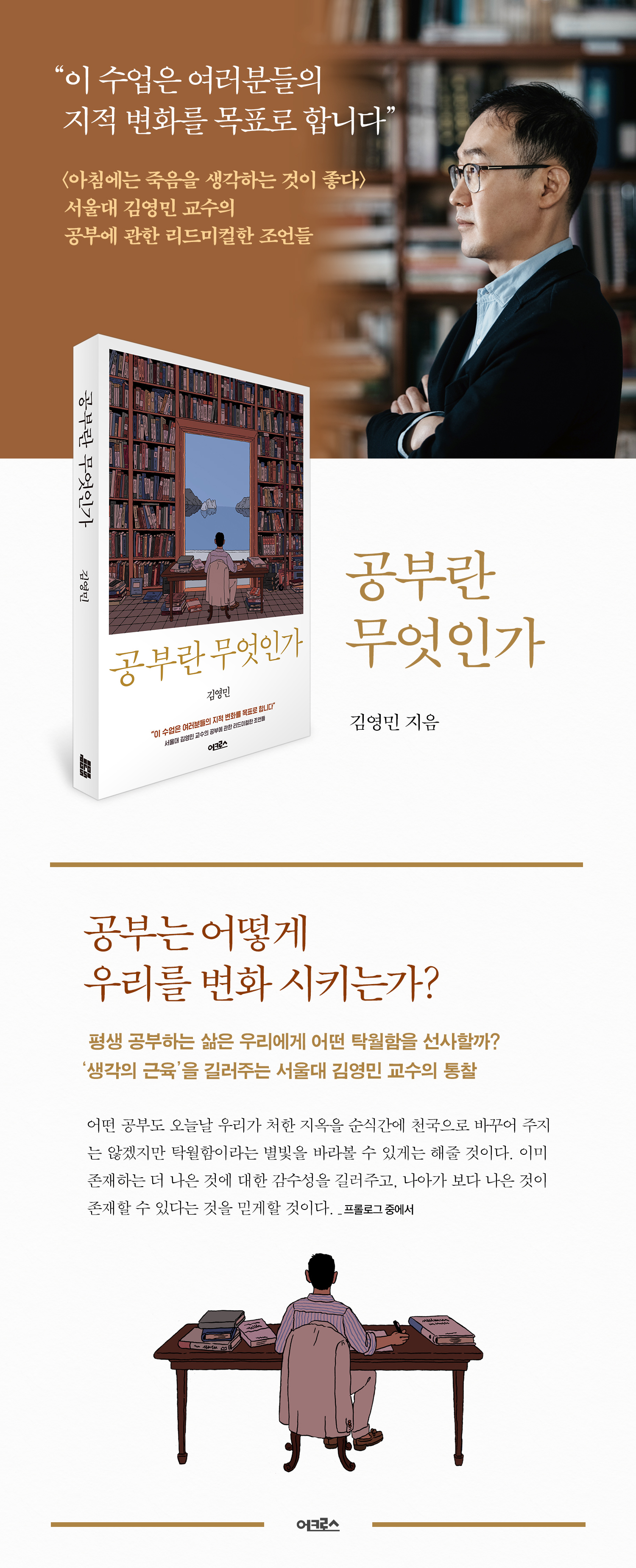
“This class aims to transform your intellectual abilities.” "It's Good to Think About Death in the Morning" by Professor Kim Young-min of Seoul National University Rhythmic tips to develop your "thinking muscles." What is Chuseok? Professor Kim Young-min of Seoul National University shook Korean society with a single, fundamental question. He says, “Questions about identity are usually raised in times of crisis,” and in addition to the question, “What is Chuseok?” he has consistently raised questions about Korean society, asking questions such as what growth is, what power is, and what Korea is. Professor Kim Young-min returns with a new question: “What is studying?” In today's world, where discussions about studying have been reduced to discussions about the college entrance exam system, Professor Kim Young-min discusses what and how we should study to become mature citizens in his new book, "What is Studying?" “In a time when there is no blueprint to rescue this society from the mud of meaninglessness, no amount of study will instantly transform the hell we find ourselves in today into heaven, but it will enable us to gaze upon the starlight of excellence. “It will cultivate a sensitivity to the better things that already exist, and furthermore, it will make you believe that better things can exist.” (Page 14, Prologue) In "What is Studying?", Professor Kim Young-min offers rhythmic study advice that cultivates the "muscles of thinking," from the basics to advanced study. This gives readers the opportunity to develop their own views on the meaning and direction of their studies, focusing on writing, reading, thinking, and questioning. Beginning with a trivial episode of everyday life, Kim Young-min's writing presents serious reflections on humanity and the world, wrapped in humor and wit, leading readers into a realm of higher thought. |
- You can preview some of the book's contents.
Preview
index
In publishing a book
Prologue: Not all that falls from Nakhwaam Rock are flowers.
Part 1: The Path of Study: The Process of Intellectual Maturity
Clarity makes people angry. Use words correctly.
We need to define the concept by calling it by its appropriate name.
To write an essay about the world, you must write without contradictions.
Ambiguity is sometimes a weapon of the powerful. Things to avoid in essays.
Social Implications of Words and Society
I also often find it cumbersome to give titles. The utility of titles
Part 2: A Life of Study: A Passion for the Seemingly Useless
This class aims to change your mind. First hour of class
The expected effect of studying to erect the erector spinae of the mind
There is no grand slam that turns your life around. The life cycle of study.
If you don't want to talk nonsense intellectually, you need to study and be physically fit.
What is studying abroad? Solitude and autonomy
A research year is necessary for everyone; it is a time for in-depth study.
Part 3: The Foundations of Studying: Creating Questions and Context
If you find it difficult to decide to study, study and be proactive.
Just having the attitude of a model student isn't enough. Studying and creativity
What is reading to find the sharp axe of the mind?
What is a book review? Talking about a book as a whole
It's a good idea to create your own index to organize your data.
How to ask questions right away even if your pelvis is crooked
Part 4: Deepening Your Study: Refining Your Thinking
Jump into a controversial area and set the topic.
Things to Consider Before Indulging in the Pleasures of Speaking: Audience and Readers
It's the nature of planning that things don't go as planned, but how to write a research plan
He who knows his desires well, the more he should restrain himself.
The virtue of criticism so as not to make stupid criticisms of stupid claims
The Art of Debating What It Means to Have Your Own Opinion
Lazy moderators ruin discussions. The art of socializing.
How to Present the Essentials of an Analytical Summary
How to Enjoy Seminars Beyond the Tragedy of Seminars
Part 5: A Conversation About Studying: Seek Learning Opportunities Like a Thirsty Person
Moments of learning, like love, come in unexpected moments - Interview with JoongAng Sunday reporter Yoo Ju-hyun
College: Learning to Speak and Write - Interviews with Seoul National University Students
Epilogue: A Fantasy of Rest
List of pictures
Prologue: Not all that falls from Nakhwaam Rock are flowers.
Part 1: The Path of Study: The Process of Intellectual Maturity
Clarity makes people angry. Use words correctly.
We need to define the concept by calling it by its appropriate name.
To write an essay about the world, you must write without contradictions.
Ambiguity is sometimes a weapon of the powerful. Things to avoid in essays.
Social Implications of Words and Society
I also often find it cumbersome to give titles. The utility of titles
Part 2: A Life of Study: A Passion for the Seemingly Useless
This class aims to change your mind. First hour of class
The expected effect of studying to erect the erector spinae of the mind
There is no grand slam that turns your life around. The life cycle of study.
If you don't want to talk nonsense intellectually, you need to study and be physically fit.
What is studying abroad? Solitude and autonomy
A research year is necessary for everyone; it is a time for in-depth study.
Part 3: The Foundations of Studying: Creating Questions and Context
If you find it difficult to decide to study, study and be proactive.
Just having the attitude of a model student isn't enough. Studying and creativity
What is reading to find the sharp axe of the mind?
What is a book review? Talking about a book as a whole
It's a good idea to create your own index to organize your data.
How to ask questions right away even if your pelvis is crooked
Part 4: Deepening Your Study: Refining Your Thinking
Jump into a controversial area and set the topic.
Things to Consider Before Indulging in the Pleasures of Speaking: Audience and Readers
It's the nature of planning that things don't go as planned, but how to write a research plan
He who knows his desires well, the more he should restrain himself.
The virtue of criticism so as not to make stupid criticisms of stupid claims
The Art of Debating What It Means to Have Your Own Opinion
Lazy moderators ruin discussions. The art of socializing.
How to Present the Essentials of an Analytical Summary
How to Enjoy Seminars Beyond the Tragedy of Seminars
Part 5: A Conversation About Studying: Seek Learning Opportunities Like a Thirsty Person
Moments of learning, like love, come in unexpected moments - Interview with JoongAng Sunday reporter Yoo Ju-hyun
College: Learning to Speak and Write - Interviews with Seoul National University Students
Epilogue: A Fantasy of Rest
List of pictures
Detailed image
Into the book
Wouldn't it be an insult to that glorious time to deprive young people of the opportunity to study something that cannot be reduced to college entrance exams or employment?
As if, on a day with such good weather, it were an insult to the time to rush past a scenic road without looking back.
If, looking back later, you think that your best years were only about how well you did on the college entrance exam or whether you got into a prestigious university, then that is just a self-confession that you have never had a more interesting intellectual experience.
---From the "Prologue"
To live in this world is to live in such contradictions, tensions, or confusions.
To write an essay on this world means to confront such contradictions, tensions, and confusions, and to present one's argument in sentences that are as consistent as possible.
---From "To Write an Essay About the World"
If you lift dumbbells that are too light, you won't build any muscle.
Muscle is only built when you repeatedly lift slightly heavier weights than usual.
The same goes for the muscles of thought.
We have all lived and breathed our entire lives.
So, did you become a master of breathing? Just living life breathing roughly doesn't make you a master of breathing.
The same goes for studying.
If you feel completely comfortable while studying, there's a good chance you're doing something wrong.
---From "This class aims to change your intellectual outlook"
The ability to take control of your life is the key to a successful study abroad experience.
More than ever, it's important to remind yourself why you've come all the way to a foreign land and paid such a high price, maintain the passion necessary to reach your goals, maintain your health through regular routines, cultivate self-objectivity to avoid falling into delusion, and live your life in a way that doesn't require you to rely so heavily on others.
---From "What is Studying Abroad?"
The more profound the study, the more arduous the training period is required until one can feel pleasure in it.
If you give up studying before you finish your training, you will not be able to fully enjoy the pleasure that studying provides.
Olympic marathon gold medalist Hwang Young-jo once said that he feels like giving up much more strongly right before the start than during the race.
Once your studies get on track, things will progress more or less smoothly.
If so, what is more difficult than the process of studying is deciding to study hard.
Difficult studies always require determination.
---From "If deciding to study is difficult"
A book review says as much about the person who wrote it as it does about the book it is reviewing.
Book reviews are a great opportunity to promote not only the book being reviewed, but also the reviewer's own intelligence, charm, stupidity, and biases.
---From "Talking about the book as a whole"
Only those who have devoted themselves to their studies can truly rest.
Just as only a pulled bowstring can relax, only those who have experienced the tension of studying can experience this relaxation called rest.
It's not shameful to not be able to study, but it is shameful to not be able to rest properly because you didn't study.
The harder you study, the easier it becomes to rest.
As if, on a day with such good weather, it were an insult to the time to rush past a scenic road without looking back.
If, looking back later, you think that your best years were only about how well you did on the college entrance exam or whether you got into a prestigious university, then that is just a self-confession that you have never had a more interesting intellectual experience.
---From the "Prologue"
To live in this world is to live in such contradictions, tensions, or confusions.
To write an essay on this world means to confront such contradictions, tensions, and confusions, and to present one's argument in sentences that are as consistent as possible.
---From "To Write an Essay About the World"
If you lift dumbbells that are too light, you won't build any muscle.
Muscle is only built when you repeatedly lift slightly heavier weights than usual.
The same goes for the muscles of thought.
We have all lived and breathed our entire lives.
So, did you become a master of breathing? Just living life breathing roughly doesn't make you a master of breathing.
The same goes for studying.
If you feel completely comfortable while studying, there's a good chance you're doing something wrong.
---From "This class aims to change your intellectual outlook"
The ability to take control of your life is the key to a successful study abroad experience.
More than ever, it's important to remind yourself why you've come all the way to a foreign land and paid such a high price, maintain the passion necessary to reach your goals, maintain your health through regular routines, cultivate self-objectivity to avoid falling into delusion, and live your life in a way that doesn't require you to rely so heavily on others.
---From "What is Studying Abroad?"
The more profound the study, the more arduous the training period is required until one can feel pleasure in it.
If you give up studying before you finish your training, you will not be able to fully enjoy the pleasure that studying provides.
Olympic marathon gold medalist Hwang Young-jo once said that he feels like giving up much more strongly right before the start than during the race.
Once your studies get on track, things will progress more or less smoothly.
If so, what is more difficult than the process of studying is deciding to study hard.
Difficult studies always require determination.
---From "If deciding to study is difficult"
A book review says as much about the person who wrote it as it does about the book it is reviewing.
Book reviews are a great opportunity to promote not only the book being reviewed, but also the reviewer's own intelligence, charm, stupidity, and biases.
---From "Talking about the book as a whole"
Only those who have devoted themselves to their studies can truly rest.
Just as only a pulled bowstring can relax, only those who have experienced the tension of studying can experience this relaxation called rest.
It's not shameful to not be able to study, but it is shameful to not be able to rest properly because you didn't study.
The harder you study, the easier it becomes to rest.
---From the "Epilogue"
Publisher's Review
“What awaits us at the final destination of the express train we are riding?”
Why people ask, "What is study?" in Korea today
The author asks in the prologue:
Do you know what awaits us at the final destination of the express train we are riding called entrance exams or studying?
According to him, Korea is a country famous for its passion for education, with students devoting their passion to entrance exams from a young age, but it is also a country extremely indifferent to education, in that no one really asks what and how to study.
“Not everyone who falls from Nakhwaam Rock becomes a flower, and not everyone who goes to school becomes an academic.
As college students or job seekers, students must now become accustomed to simply living life rather than striving to make life worth living.” (Page 11, Prologue)
In Korean society, students forget that the effort and time that goes into the process itself is life.
Professor Kim Young-min suggests that we shift our perspective on 'what is studying?'
Quoting Oscar Wilde, who said, “We all live in the gutter, but some of us look up at the stars,” he encourages us to look up, not down, into the gutter.
So we say that we can become different human beings, that we can change into human beings with the goal of excellence.
"Why do I study? Because I can't just survive."
Studying is a passion for something that seems useless,
It is an effort to escape from ambiguity.
In the first half of the book (Parts 1 and 2), Professor Kim Young-min presents philosophical and reflective essays on what one must have to embark on the journey of study and what it means to live a life of lifelong study.
What does a life of study mean to us? He says that studying is both a means of intellectual transformation and a process of unleashing a passion for the seemingly useless.
“I look forward to experiencing a better version of myself than I was yesterday through the pursuit of knowledge born from curiosity.
I look forward to the fun of escaping from my ignorant past through studying.
Being better than others isn't much fun.
“After all, it’s someone else.” (Page 82, to strengthen the erector spinae of the mind)
Meanwhile, studying is a process of moving from ambiguity to clarity.
He discusses the basics of intellectual maturity for those just starting out in the world of study, including the correct use of vocabulary, the need for defining concepts, and how to write without contradictions.
Studying is the most basic training for writing essays about the world, so it leads us to be 'consciously' wary of issues that seem obvious to us.
The idea is to ask how the new word "disabled person" sounds to people with disabilities, and how the meaning of the word "good" has changed.
He says that words like nation, government, society, and community, or words like nation, people, and race, which are used when making grand claims, are similar but different words, and that in order to communicate precisely, it is very important to properly determine the meaning of the words and use them appropriately in context.
“To find the sharp axe of the mind”
Learn the basics and in-depth study
The latter part of the book tells you how to internalize knowledge (study as learning, such as reading, listening, and asking questions/Part 3 'Basics of Studying') and how to convey your studies to others (study as expression, such as writing, speaking, and arguing/Part 4 'Deepening Studying').
Professor Kim Young-min asks:
What do you want to gain from your studies?
“We can demand that speech and writing that are largely flawless but leave no strong impression—that they collect and string together stories circulating in the market, add a level of critical awareness that this society readily allows, lightly add empathy for others that many people like, and attach cautious suggestions for the future—be a little more creative.” (p. 131, model student attitude alone is not enough)
He says that studying is about formulating elaborate questions for yourself and having the courage to enter the realm of debate with them.
Therefore, rather than providing self-development methodologies for studying, which are usually included in books about studying, he presents a practical questionnaire that examines what perspectives and attitudes should be used to create one's own questions and context, and what should be examined to deepen one's thinking.
The Socratic method of questioning, which encourages people to discover the truth for themselves rather than directly teaching them knowledge, is repeated here as well.
For example, it is like this.
What is reading? "The paradoxical act of reading as an escape from society, but conversely enriching one's language for communication."
As your language skills become richer, even if you don't go out into society and interact with people, you'll find yourself spending your days like a small festival." How to avoid making foolish criticisms? "You need to engage in critical discussion by confronting the strengths of your opponent's argument rather than its weaknesses.
“Even if the opponent’s core argument has strengths, we should not dwell on the opponent’s weaknesses and consider them to be his ‘essence.’”
Beyond that, we can gain concrete ways to train our thinking muscles by asking ourselves questions about the art of setting a topic, what it means to have a style, and how to organize material.
“Those who learn never give up.”
Year 0 of COVID: How to Get to the Essence of Studying
In the year 0 of COVID-19, with unprecedented online lectures, we cannot help but ask ourselves what studying is and what school is.
It is becoming clear once again that a good class is not simply about conveying information, but rather about providing insight, perspective, and perspective that can penetrate the information.
I hope that more people will share their learning experiences in the classroom taught by Professor Kim Young-min in "What is Studying?"
As he said, “Because people who learn don’t give up.”
Why people ask, "What is study?" in Korea today
The author asks in the prologue:
Do you know what awaits us at the final destination of the express train we are riding called entrance exams or studying?
According to him, Korea is a country famous for its passion for education, with students devoting their passion to entrance exams from a young age, but it is also a country extremely indifferent to education, in that no one really asks what and how to study.
“Not everyone who falls from Nakhwaam Rock becomes a flower, and not everyone who goes to school becomes an academic.
As college students or job seekers, students must now become accustomed to simply living life rather than striving to make life worth living.” (Page 11, Prologue)
In Korean society, students forget that the effort and time that goes into the process itself is life.
Professor Kim Young-min suggests that we shift our perspective on 'what is studying?'
Quoting Oscar Wilde, who said, “We all live in the gutter, but some of us look up at the stars,” he encourages us to look up, not down, into the gutter.
So we say that we can become different human beings, that we can change into human beings with the goal of excellence.
"Why do I study? Because I can't just survive."
Studying is a passion for something that seems useless,
It is an effort to escape from ambiguity.
In the first half of the book (Parts 1 and 2), Professor Kim Young-min presents philosophical and reflective essays on what one must have to embark on the journey of study and what it means to live a life of lifelong study.
What does a life of study mean to us? He says that studying is both a means of intellectual transformation and a process of unleashing a passion for the seemingly useless.
“I look forward to experiencing a better version of myself than I was yesterday through the pursuit of knowledge born from curiosity.
I look forward to the fun of escaping from my ignorant past through studying.
Being better than others isn't much fun.
“After all, it’s someone else.” (Page 82, to strengthen the erector spinae of the mind)
Meanwhile, studying is a process of moving from ambiguity to clarity.
He discusses the basics of intellectual maturity for those just starting out in the world of study, including the correct use of vocabulary, the need for defining concepts, and how to write without contradictions.
Studying is the most basic training for writing essays about the world, so it leads us to be 'consciously' wary of issues that seem obvious to us.
The idea is to ask how the new word "disabled person" sounds to people with disabilities, and how the meaning of the word "good" has changed.
He says that words like nation, government, society, and community, or words like nation, people, and race, which are used when making grand claims, are similar but different words, and that in order to communicate precisely, it is very important to properly determine the meaning of the words and use them appropriately in context.
“To find the sharp axe of the mind”
Learn the basics and in-depth study
The latter part of the book tells you how to internalize knowledge (study as learning, such as reading, listening, and asking questions/Part 3 'Basics of Studying') and how to convey your studies to others (study as expression, such as writing, speaking, and arguing/Part 4 'Deepening Studying').
Professor Kim Young-min asks:
What do you want to gain from your studies?
“We can demand that speech and writing that are largely flawless but leave no strong impression—that they collect and string together stories circulating in the market, add a level of critical awareness that this society readily allows, lightly add empathy for others that many people like, and attach cautious suggestions for the future—be a little more creative.” (p. 131, model student attitude alone is not enough)
He says that studying is about formulating elaborate questions for yourself and having the courage to enter the realm of debate with them.
Therefore, rather than providing self-development methodologies for studying, which are usually included in books about studying, he presents a practical questionnaire that examines what perspectives and attitudes should be used to create one's own questions and context, and what should be examined to deepen one's thinking.
The Socratic method of questioning, which encourages people to discover the truth for themselves rather than directly teaching them knowledge, is repeated here as well.
For example, it is like this.
What is reading? "The paradoxical act of reading as an escape from society, but conversely enriching one's language for communication."
As your language skills become richer, even if you don't go out into society and interact with people, you'll find yourself spending your days like a small festival." How to avoid making foolish criticisms? "You need to engage in critical discussion by confronting the strengths of your opponent's argument rather than its weaknesses.
“Even if the opponent’s core argument has strengths, we should not dwell on the opponent’s weaknesses and consider them to be his ‘essence.’”
Beyond that, we can gain concrete ways to train our thinking muscles by asking ourselves questions about the art of setting a topic, what it means to have a style, and how to organize material.
“Those who learn never give up.”
Year 0 of COVID: How to Get to the Essence of Studying
In the year 0 of COVID-19, with unprecedented online lectures, we cannot help but ask ourselves what studying is and what school is.
It is becoming clear once again that a good class is not simply about conveying information, but rather about providing insight, perspective, and perspective that can penetrate the information.
I hope that more people will share their learning experiences in the classroom taught by Professor Kim Young-min in "What is Studying?"
As he said, “Because people who learn don’t give up.”
GOODS SPECIFICS
- Date of publication: August 26, 2020
- Page count, weight, size: 272 pages | 412g | 135*210*20mm
- ISBN13: 9791190030632
- ISBN10: 1190030632
You may also like
카테고리
korean


korean

![GQ KOREA Mark (Monthly): December [2025]](http://librairie.coreenne.fr/cdn/shop/files/8ef265dbbfbf186523ed75ba7319009d.jpg?v=1765340328&width=3840)


