

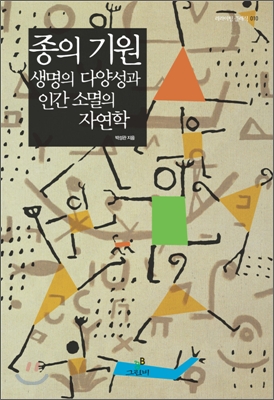
The Origin of Species, the Diversity of Life, and the Natural Sciences of Human Extinction
 |
Description
Book Introduction
This book, which rewrites Darwin's "Origin of Species" from the perspective of a humanities researcher, focuses on the subversive nature of "Origin of Species" that dismantles modern views of life and anthropocentrism, and reconstructs that subversive nature for the present.
Darwin's theory of evolution, which emerged while criticizing the creationism of his time and even the museum science of that time that was obsessed with creative providence and teleology, is still a valid topic of debate even today when anthropocentrism is justified in the name of science.
This book meticulously follows the Origin of Species, explaining not only its content but also the contemporary and current issues surrounding Darwin in a plain language, thereby reviving the Origin of Species as a subversive 'contemporary classic.'
The author says that Darwin's ultimate goal was to show that humans are just one species of animal, one of many creatures, and therefore not a uniquely special being.
Not only creationists of the past, but many scientists today still consider humans to be the most special beings in the world.
People readily accept stories like hydrogen and oxygen mixing to form water, the oxygen we breathe being produced through photosynthesis, or the information about life being contained in DNA as simple, obvious scientific facts. However, these same people quickly change their minds when told that humans are a type of animal and have evolved according to the same laws of evolution.
The reason is the wall called anthropocentrism, and overcoming that wall must begin from the point of extinction of anthropocentrism, which was already raised by Darwin 150 years ago.
Darwin's theory of evolution, which emerged while criticizing the creationism of his time and even the museum science of that time that was obsessed with creative providence and teleology, is still a valid topic of debate even today when anthropocentrism is justified in the name of science.
This book meticulously follows the Origin of Species, explaining not only its content but also the contemporary and current issues surrounding Darwin in a plain language, thereby reviving the Origin of Species as a subversive 'contemporary classic.'
The author says that Darwin's ultimate goal was to show that humans are just one species of animal, one of many creatures, and therefore not a uniquely special being.
Not only creationists of the past, but many scientists today still consider humans to be the most special beings in the world.
People readily accept stories like hydrogen and oxygen mixing to form water, the oxygen we breathe being produced through photosynthesis, or the information about life being contained in DNA as simple, obvious scientific facts. However, these same people quickly change their minds when told that humans are a type of animal and have evolved according to the same laws of evolution.
The reason is the wall called anthropocentrism, and overcoming that wall must begin from the point of extinction of anthropocentrism, which was already raised by Darwin 150 years ago.
- You can preview some of the book's contents.
Preview
index
Prologue _ “Let’s read ‘The Origin of Species’!”
Chapter 0 - 'The Mystery of Mysteries' Solved
Interlude _ The World Just Before 『The Origin of Species』
Chapter 1: Confinement, Mutation, Deformity, and Goodness
The workings of habit | Correlated mutations | Darwin's pigeon mania | The principles of selection practiced since ancient times | Methodological and unconscious selection
Chapter 2: A crucible seething with differences and variations
Individual differences | Lamarck and Cuvier | Darwin's critique of Lamarck | Cuvier | Creationism, Cuvier, and Lamarck | Paris Academy debate | Doubtful species | Darwin's Copernican shift | The universal species varies the most | Species in large genera vary more than species in small genera
Chapter 3 - My family is my enemy!
My family is my enemy | Reading Paley before Malthus | The struggle for survival in a broader sense | The more different you are from your parents, the better | The complex relationships among all plants and animals in nature
Chapter 4 _ The Tree of Cognition = The Tree of Life
A story that seems obvious | Two tasks and one difficulty | The depth and richness of 'natural selection' | The theory of survival of the fittest that defied common sense | Darwin's language | A new image of nature | Sexual selection | An imaginary example of natural selection | Darwin's weak point | Crossbreeding and interbreeding | Darwin, who took the thorny path | Crossbreeding common in the plant kingdom | Crossbreeding common in the animal kingdom | Hybridization: An extremely difficult and important problem | Continent or island? | The decisive reason why extinction is important | Divergence of characters | The tree of life, the tree of evolution | The tree of life, giant animals | The world of the gods | The science of process and pattern | Different histories discovered simultaneously | Darwin's strange family | Boron: The idea of the more the better - Twisted Malthus
Chapter 5: Science: Reading Patterns of Change
The sterility of the 'nature vs. nurture' debate | The contemporary conventional wisdom of 'mixed inheritance' | Mutation, heredity, and natural selection | Why do mutations occur? | Cause and uncertainty | Contradictory conclusions from identical facts | Inheritance of used or acquired traits | Which traits are more likely to change?
Chapter 6 _ In fact, the weakness of evolution theory is…
Darwin's Note-taking | The Problems of Darwin's Theory of Evolution | Where Did Wings Arise in the First Place? | How Did Bats Learn to Fly? | The Story of Metamorphosis | A Bear Became a Whale? | Half an Eye? What's the Use of That? | Who the Heck Designed This? | Darwin's Method: Implementation | Seemingly Insignificant Organs | Darwin's Criticism of Utilitarianism | Wallace and Darwin's Showdown | The Dwelling Place of Anthropocentrism | Why is the World Beautiful?
Chapter 7 - Oh my goodness, instincts evolve?
Treating instincts separately | Natural theology, Lamarck, and Darwin | How Darwin framed the problem | “Lamarck, don’t move!” | Darwin again resorts to artificial selection | The instincts of domestic animals, their origin and loss | Four very special cases | The weak points of natural theology | The instinct of the cuckoo | The instinct that creates slaves | Who is the master and who is the slave? | Begging and charity, diligence-self-help-cooperation | It is not the individual but the flock, not love but solidarity | The instinct of bees to build a hive | Darwin’s scary thoughts | The challenge of a lifetime | The key to the solution | The profundity of difference
Chapter 8 - Adultery is Powerful
Infertility and Conception | The Science of Change | The Remaining Issue 1.
Natural Selection and Sterility | Remaining Issue 2.
Are Species Barriers Real? | Darwin's Plant Study, "The Modification of Plants"
Chapters 9 & 10: The Global Drama of Extinction and Evolution
Darwin Against Paleontologists and Geologists | The Discontinuity of Nature | The Discontinuity of Species | Sedimentation and Erosion, Vast Time | "A Problem That Cannot Be Explained" | Digging Further into the Cambrian Layer... | A Twist | A New Twist and a Real Showdown | Continuity vs. Discontinuity | Was Gould Right: The Case of Meyer | Dawkins' Powerful Counterpunch
Chapter 11: Footsteps of the Gods
Alpine creatures with scattered spots | Memories of the Ice Age | Changes just before writing "The Origin of Species"
Chapter 12: The Wandering Story of Eggs and Seeds
Attention Wanderers! | Similar but different | Is this the American continent?
Chapter 13: The End of Museum Studies, the Birth of Natural Science
Classification | What is the system of nature? | Vital organs are important? | Characteristics that are too trivial | The reality of classification | Embryos are more important than adults? | Too complex and radial | A new start in taxonomy | The circumstances under which Chapter 13 was written | Morphology | Beyond the limitations of the Darwinian era: Homeotic genes | Embryology | New content added | Vestigial organs, atrophic organs, and embryonic organs | The system of nature depicted by modern biology | The main driving force and mechanism of evolution | Darwin's hesitation | Boron: Bacteria always excite me
Chapter 14: Final Anxiety, Agony, and Joy
The World's Longest Debate | Darwin's Paradox? | The Ultimate Problem | A Difficult Problem, and a Problem I Longed to Solve
supplement
Table of Contents for "The Origin of Species" | Books I encountered while writing this book | Search
Chapter 0 - 'The Mystery of Mysteries' Solved
Interlude _ The World Just Before 『The Origin of Species』
Chapter 1: Confinement, Mutation, Deformity, and Goodness
The workings of habit | Correlated mutations | Darwin's pigeon mania | The principles of selection practiced since ancient times | Methodological and unconscious selection
Chapter 2: A crucible seething with differences and variations
Individual differences | Lamarck and Cuvier | Darwin's critique of Lamarck | Cuvier | Creationism, Cuvier, and Lamarck | Paris Academy debate | Doubtful species | Darwin's Copernican shift | The universal species varies the most | Species in large genera vary more than species in small genera
Chapter 3 - My family is my enemy!
My family is my enemy | Reading Paley before Malthus | The struggle for survival in a broader sense | The more different you are from your parents, the better | The complex relationships among all plants and animals in nature
Chapter 4 _ The Tree of Cognition = The Tree of Life
A story that seems obvious | Two tasks and one difficulty | The depth and richness of 'natural selection' | The theory of survival of the fittest that defied common sense | Darwin's language | A new image of nature | Sexual selection | An imaginary example of natural selection | Darwin's weak point | Crossbreeding and interbreeding | Darwin, who took the thorny path | Crossbreeding common in the plant kingdom | Crossbreeding common in the animal kingdom | Hybridization: An extremely difficult and important problem | Continent or island? | The decisive reason why extinction is important | Divergence of characters | The tree of life, the tree of evolution | The tree of life, giant animals | The world of the gods | The science of process and pattern | Different histories discovered simultaneously | Darwin's strange family | Boron: The idea of the more the better - Twisted Malthus
Chapter 5: Science: Reading Patterns of Change
The sterility of the 'nature vs. nurture' debate | The contemporary conventional wisdom of 'mixed inheritance' | Mutation, heredity, and natural selection | Why do mutations occur? | Cause and uncertainty | Contradictory conclusions from identical facts | Inheritance of used or acquired traits | Which traits are more likely to change?
Chapter 6 _ In fact, the weakness of evolution theory is…
Darwin's Note-taking | The Problems of Darwin's Theory of Evolution | Where Did Wings Arise in the First Place? | How Did Bats Learn to Fly? | The Story of Metamorphosis | A Bear Became a Whale? | Half an Eye? What's the Use of That? | Who the Heck Designed This? | Darwin's Method: Implementation | Seemingly Insignificant Organs | Darwin's Criticism of Utilitarianism | Wallace and Darwin's Showdown | The Dwelling Place of Anthropocentrism | Why is the World Beautiful?
Chapter 7 - Oh my goodness, instincts evolve?
Treating instincts separately | Natural theology, Lamarck, and Darwin | How Darwin framed the problem | “Lamarck, don’t move!” | Darwin again resorts to artificial selection | The instincts of domestic animals, their origin and loss | Four very special cases | The weak points of natural theology | The instinct of the cuckoo | The instinct that creates slaves | Who is the master and who is the slave? | Begging and charity, diligence-self-help-cooperation | It is not the individual but the flock, not love but solidarity | The instinct of bees to build a hive | Darwin’s scary thoughts | The challenge of a lifetime | The key to the solution | The profundity of difference
Chapter 8 - Adultery is Powerful
Infertility and Conception | The Science of Change | The Remaining Issue 1.
Natural Selection and Sterility | Remaining Issue 2.
Are Species Barriers Real? | Darwin's Plant Study, "The Modification of Plants"
Chapters 9 & 10: The Global Drama of Extinction and Evolution
Darwin Against Paleontologists and Geologists | The Discontinuity of Nature | The Discontinuity of Species | Sedimentation and Erosion, Vast Time | "A Problem That Cannot Be Explained" | Digging Further into the Cambrian Layer... | A Twist | A New Twist and a Real Showdown | Continuity vs. Discontinuity | Was Gould Right: The Case of Meyer | Dawkins' Powerful Counterpunch
Chapter 11: Footsteps of the Gods
Alpine creatures with scattered spots | Memories of the Ice Age | Changes just before writing "The Origin of Species"
Chapter 12: The Wandering Story of Eggs and Seeds
Attention Wanderers! | Similar but different | Is this the American continent?
Chapter 13: The End of Museum Studies, the Birth of Natural Science
Classification | What is the system of nature? | Vital organs are important? | Characteristics that are too trivial | The reality of classification | Embryos are more important than adults? | Too complex and radial | A new start in taxonomy | The circumstances under which Chapter 13 was written | Morphology | Beyond the limitations of the Darwinian era: Homeotic genes | Embryology | New content added | Vestigial organs, atrophic organs, and embryonic organs | The system of nature depicted by modern biology | The main driving force and mechanism of evolution | Darwin's hesitation | Boron: Bacteria always excite me
Chapter 14: Final Anxiety, Agony, and Joy
The World's Longest Debate | Darwin's Paradox? | The Ultimate Problem | A Difficult Problem, and a Problem I Longed to Solve
supplement
Table of Contents for "The Origin of Species" | Books I encountered while writing this book | Search
Into the book
For the past 150 years, the bourgeoisie (or modern people) have been constantly operating and reshaping Darwin's ideas with a modern scalpel.
First of all, Darwin's criticism of science was narrowed down to a criticism of religion.
Natural selection has transformed natural selection into survival of the fittest, and the struggle for existence and interdependence have been transformed into competition for existence.
Thus, Darwin was degraded into a critic of religion and a spokesman for bourgeois values.
This is how the Darwin we know was born.
Now Darwin only growls at creationism and has no complaints about the modern system of knowledge.
No, it has become an icon that firmly guarantees the modern system of knowledge.
Darwin, who questioned the world and all systems of knowledge of his time 150 years ago, has disappeared.
Like Darwin, I have been questioning the world I live in and the system of knowledge I have.
Then I came across 『The Origin of Species』 and discovered Darwin's questions, subversion, and charm.
… … So we must understand why Darwin had to criticize both the existing mainstream scientists and evolutionists.
Then we will be able to understand how seditious his thoughts were and why that seditiousness had to be suppressed.
At that very moment, The Origin of Species will cease to be merely a relic of the past, a denouement of creationism, and will begin to seethe with the subversive ideas of the 21st century. ---pp. 17-18
The idea that plants cannot move, that they have souls that are dormant, is a foolish misunderstanding of humans who, despite living less than a hundred years, measure all things in the world by their own standards.
As Darwin depicted, all living things have the ability to move and live by fully utilizing that ability.
Moreover, when connected to other living and non-living things, the power is beyond imagination (however, it is impossible not to connect with others).
All beings can only differ in the way they connect, but it is impossible for them not to connect.
Activity is not the movement of a subject against the backdrop of dead conditions, but rather the creation of a new flow by connecting this with that.
Whether this or that is animate or inanimate, and whether it does so of its own volition or not, are secondary.
All things connect with others by expressing themselves, and by connecting, they transform.
When people asked how plants could travel such great distances without legs or wings, Darwin pointed to plant seeds, birds and fish, wind, water and soil, glaciers and climate change.
Plants gave birth to other selves (seeds) in the world and connected them to all things in the world.
Their wings were of various creatures and inanimate objects that were active from time to time.
First of all, Darwin's criticism of science was narrowed down to a criticism of religion.
Natural selection has transformed natural selection into survival of the fittest, and the struggle for existence and interdependence have been transformed into competition for existence.
Thus, Darwin was degraded into a critic of religion and a spokesman for bourgeois values.
This is how the Darwin we know was born.
Now Darwin only growls at creationism and has no complaints about the modern system of knowledge.
No, it has become an icon that firmly guarantees the modern system of knowledge.
Darwin, who questioned the world and all systems of knowledge of his time 150 years ago, has disappeared.
Like Darwin, I have been questioning the world I live in and the system of knowledge I have.
Then I came across 『The Origin of Species』 and discovered Darwin's questions, subversion, and charm.
… … So we must understand why Darwin had to criticize both the existing mainstream scientists and evolutionists.
Then we will be able to understand how seditious his thoughts were and why that seditiousness had to be suppressed.
At that very moment, The Origin of Species will cease to be merely a relic of the past, a denouement of creationism, and will begin to seethe with the subversive ideas of the 21st century. ---pp. 17-18
The idea that plants cannot move, that they have souls that are dormant, is a foolish misunderstanding of humans who, despite living less than a hundred years, measure all things in the world by their own standards.
As Darwin depicted, all living things have the ability to move and live by fully utilizing that ability.
Moreover, when connected to other living and non-living things, the power is beyond imagination (however, it is impossible not to connect with others).
All beings can only differ in the way they connect, but it is impossible for them not to connect.
Activity is not the movement of a subject against the backdrop of dead conditions, but rather the creation of a new flow by connecting this with that.
Whether this or that is animate or inanimate, and whether it does so of its own volition or not, are secondary.
All things connect with others by expressing themselves, and by connecting, they transform.
When people asked how plants could travel such great distances without legs or wings, Darwin pointed to plant seeds, birds and fish, wind, water and soil, glaciers and climate change.
Plants gave birth to other selves (seeds) in the world and connected them to all things in the world.
Their wings were of various creatures and inanimate objects that were active from time to time.
---p.666
Publisher's Review
Reviving Darwin's current and subversive nature, rewriting "The Origin of Species"!!
The definitive edition of Darwin's research, written by a domestic researcher!
This book, "On the Origin of Species: The Diversity of Life and the Natural Science of Human Extinction" (hereafter referred to as "Rewriting the Origin of Species"), is a rewriting of Charles Darwin's "On the Origin of Species" from the perspective of a humanities researcher.
Darwin's "Origin of Species," written in 1859, pioneered a new theory of evolution called "the evolution of life by natural selection," which had a huge impact on the formation of modern society.
It would not be an exaggeration to say that modern paradigms, not only in science but also in philosophy, history, and art, began with Darwin's "Origin of Species" and the theory of evolution.
However, Park Seong-gwan, author of "The Origin of Species," points out that despite its importance, "The Origin of Species" is actually being ignored by people.
The sheer volume, Darwin's Victorian digression, and the sheer number of examples that modern people find difficult to understand…
Because of these barriers blocking the path to "The Origin of Species," it ended up becoming a classic that "everyone thinks is important, but no one reads."
"Rewriting the Origin of Species" aims to revive "The Origin of Species" as a "contemporary classic" by dusting off the accumulated layers of dust on it and explaining not only its content but also the contemporary and current issues surrounding "The Origin of Species" in a plain language.
In particular, "The Origin of Species" focuses on the subversive nature of "The Origin of Species" in dismantling modern views of life and anthropocentrism, and seeks to reconstruct that subversive nature in the present.
In fact, the author points out that perhaps no book has been as misunderstood as "The Origin of Species."
Darwin's theory is often misunderstood as a science that only talks about ruthless competition, with expressions like 'struggle for existence' and 'survival of the fittest', and although he is the 'father' of modern neo-Darwinism, he is also disparaged as an old science that is of little help in today's 'dazzling' development of genetics and biology.
However, Darwin's theory of evolution, which appeared while criticizing the creationism of his time and even the museum science of his time that was obsessed with creative providence and teleology, can still be read as subversive even today.
This is because the anthropocentric teleology that Darwin sought to overturn with his theory (humans are superior to other living beings, humans are the pinnacle of evolution, evolution is a one-way progressive process, etc.) still exerts influence in modern science (including neo-Darwinism, which is said to be the successor to Darwin) and in the common sense of modern people.
The author of this book, Park Seong-gwan, wrote this book of over 900 pages to address these two tasks: reviving the 'relevance' and 'subversiveness' of "The Origin of Species."
This is the result of research focused on Darwin through seminars and lectures held at [Research Space 'Suyu+Beyond'] for over ten years, and it is also significant in that it shows the cutting edge of modern evolutionary theory by comprehensively covering the achievements of modern evolutionary theory such as those of Dawkins and Gould, and especially domestic and international research results produced in commemoration of the 200th anniversary of Darwin's birth and the 150th anniversary of the publication of "Origin of Species" in 2009.
The battle lines Darwin faced
1 Darwin's theory of evolution, like the fate of many great ideas, has been understood in a linear way.
It is a theory that established the theory of evolution in opposition to creationism, and is said to be one stage in the development of the theory of evolution that goes from 'Lamarck → Darwin → Mendel → discovery of genes → modern genetics'.
The author explains throughout the book that the complexity of Darwin's ideas is too great to be understood and passed over so simply.
Darwin's ideas were at odds not only with the clergy of his time, but also with the naturalists, his own followers, and modern scientists.
Darwin was fighting a battle on many fronts.
Criticism of contemporary clergy/naturalists
Darwin's theory of evolution, of course, arose from criticism of existing creationism.
From today's perspective, when we have already accumulated a lot of scientific knowledge, it may seem ridiculous to advocate creationism, and Darwin's theory of evolution may seem so obvious, but in reality, at the time of Darwin, creationism had much more reasonable and plausible logic.
In fact, many of the museum researchers who conducted scientific research at the time were also priests, and their work was used to prove the scientific knowledge of the time.
In comparison, the pre-Darwinian theory of evolution (e.g., Lamarck), which was confronted with such things, seemed to be repeating illogical, old-fashioned common sense.
However, the numerous fossils discovered by large-scale mining projects of the time extended the history of the Earth to the distant past, and Linnaeus' classification system, which symbolized a stable world created by God, became tattered.
In this era when the foundations of creationism were being shaken, Darwin appeared and decisively defeated creationism.
Criticism of Lamarck
It is often said that Darwin's theory of evolution removed the speculative aspects of Lamarck's view and refined it to be more scientific and concrete.
However, the author points out that there is a fundamental difference between Darwin's ideas and Lamarck's ideas.
The core of Lamarck's theory of evolution is not the commonly known 'theory of use and disuse' or 'inheritance of acquired characteristics', but rather an evolutionary theory based on a linear developmental view.
Lamarck's theory of evolution (see pages 116-122), which states that living things evolved from inanimate objects and became more sophisticated over time until humans were finally born, appears at first glance to be no different from modern evolutionary theory.
The general perception of evolution today also does not deviate significantly from this.
However, in Darwin's view, Lamarck's theory returned to the mechanism of creationism by introducing the transhistorical law of 'progressive tendency' instead of 'divine intervention'.
Moreover, when the counterargument that the superiority of living things is not originally that clear is added, Lamarck's theory only shows how weak the evolutionary theory of his time was.
Confrontation with Wallace
Wallace, the unfortunate scientist who discovered 'evolution by natural selection' almost at the same time as Darwin, but now only appears once when Darwin is mentioned.
But in contrast to their initial discoveries, Darwin and Wallace took very different paths in their later years.
While Darwin succeeded in making 'evolution by natural selection' flexible and robust by incorporating other mechanisms such as sexual selection in addition to natural selection, Wallace pushed the principle of 'natural selection' too far and fell into mysticism in his later years.
By explaining all the characteristics of living things based on natural selection, the omnipotent power of 'natural selection' was put in place of God.
The dogma that some features of living things appear useless simply because our own knowledge is incomplete.
Now, Willis's theory of natural selection is beyond any falsification.
Darwin also gave this earnest advice:
"I beg you not to kill so perfectly what is your child and also mine." (p. 429)
The grandeur of nature depicted through differences and variations
Darwin tried to explain the evolution of species through the concept of natural selection, or in other words, the concept of 'natural selection'.
Natural selection at this time is a new view of nature discovered by Darwin, that is, the natural world is full of selection, and selection at this time is not clearly distinguished between organic and inorganic, active and passive.
Furthermore, for Darwin, natural selection is different from simply meaning that traits are selected by the environment.
What "On the Origin of Species" most emphasizes is that Darwin placed the greatest importance on the interaction between organisms in natural selection.
For example, if the weather becomes cold, it is not that certain organisms disappear because of the cold weather, but rather that weaker organisms that are at a disadvantage in the struggle for existence due to the cold weather disappear first.
At this point, the difference with Lamarck, who claimed that a linear evolution from inanimate objects to humans occurred in response to environmental changes, while overlooking the important element of 'relationships between living things', is also revealed.
For Darwin, evolution, the result of natural selection, was a ‘deviation from the order of species.’
As deviations from the established order of species were repeated over a long period of time, new species were eventually created, and those that broke away from the order and the hierarchy created new orders and hierarchy.
Mutants who deviate from the path that each individual should follow, and the traces they take as they deviate endlessly become the path for future generations.
His descendants followed in his footsteps diligently, but also consistently deviated from his path.
In Darwin's theory of evolution, what gradually accumulated was actually an endless deviation from the existing order.
A constant repetition of deviations that never return to the existing order.
The variant is infinitely farther from the original.
It has produced countless evolutions.
This book follows the table of contents of "The Origin of Species," which consists of 14 chapters, and reveals in detail how Darwin explains evolution.
And in the process, it also introduces readers to the magnificent nature that Darwin is showing.
From domesticated plants and animals to wild flowers and butterflies, from animals in glaciers to birds on oceanic islands, from mutually destructive struggles to mutually incompatible relationships, Darwin's experiments and observations on the entire planet are vividly and entertainingly presented to readers.
To this end, about one-third of "The Origin of Species" was directly translated and quoted in "Rewriting the Origin of Species," and through these quotes, readers will be able to feel Darwin's breath firsthand.
"The Origin of Species," a subversive book that sings of human extinction
What Park Seong-gwan, the author of "Rewriting the Origin of Species," wants to show us through the numerous controversies Darwin had to face in the process of establishing his theory of evolution is clear.
The very fact that "The Origin of Species" was written to overcome anthropocentrism and teleology through the theory of evolution.
From the beginning of his research until the end of his life, Darwin's ultimate goal was to demonstrate that humans are just one species of animal, one of many creatures, and therefore not a uniquely special being.
We humans, who feel infinitely anxious in the world of chance and comfortable in the world of necessity, easily fall into anthropocentrism and teleology.
Because we fear emptiness and sadness, and secretly hope that this world will be something magnificent and meaningful.
Therefore, not only creationists of the past, but also many scientists today still claim that humans are the most special beings in the world.
People readily accept as simple, obvious scientific facts things like hydrogen and oxygen combining to form water, the oxygen we breathe being produced through photosynthesis, or the information for life being contained in DNA.
But the reason why those same people immediately change their faces when told that humans are a type of animal and have evolved according to the same laws of evolution is because it is difficult to overcome the wall of anthropocentrism.
The core basis of anthropocentrism is that humans are social animals and have moral sense and intelligence that are qualitatively different from animal instincts.
In other words, the argument is that humans can form a society because they have morality and intelligence that other animals do not have.
Darwin, who recognized that this anthropocentrism was at the core of creationism, devoted his life to overcoming it.
This is precisely why "The Origin of Species" remains a subversive book, challenging established values, even today.
Anthropocentrism operates when we divide between white and black, male and female, native and immigrant workers, humans and other living things, living and non-living things, and claim that one side is superior, and this is where many of the problems of the modern world arise.
The solution to these problems must begin at the point of extinction of anthropocentrism, which was already raised by Darwin 150 years ago.
The definitive edition of Darwin's research, written by a domestic researcher!
This book, "On the Origin of Species: The Diversity of Life and the Natural Science of Human Extinction" (hereafter referred to as "Rewriting the Origin of Species"), is a rewriting of Charles Darwin's "On the Origin of Species" from the perspective of a humanities researcher.
Darwin's "Origin of Species," written in 1859, pioneered a new theory of evolution called "the evolution of life by natural selection," which had a huge impact on the formation of modern society.
It would not be an exaggeration to say that modern paradigms, not only in science but also in philosophy, history, and art, began with Darwin's "Origin of Species" and the theory of evolution.
However, Park Seong-gwan, author of "The Origin of Species," points out that despite its importance, "The Origin of Species" is actually being ignored by people.
The sheer volume, Darwin's Victorian digression, and the sheer number of examples that modern people find difficult to understand…
Because of these barriers blocking the path to "The Origin of Species," it ended up becoming a classic that "everyone thinks is important, but no one reads."
"Rewriting the Origin of Species" aims to revive "The Origin of Species" as a "contemporary classic" by dusting off the accumulated layers of dust on it and explaining not only its content but also the contemporary and current issues surrounding "The Origin of Species" in a plain language.
In particular, "The Origin of Species" focuses on the subversive nature of "The Origin of Species" in dismantling modern views of life and anthropocentrism, and seeks to reconstruct that subversive nature in the present.
In fact, the author points out that perhaps no book has been as misunderstood as "The Origin of Species."
Darwin's theory is often misunderstood as a science that only talks about ruthless competition, with expressions like 'struggle for existence' and 'survival of the fittest', and although he is the 'father' of modern neo-Darwinism, he is also disparaged as an old science that is of little help in today's 'dazzling' development of genetics and biology.
However, Darwin's theory of evolution, which appeared while criticizing the creationism of his time and even the museum science of his time that was obsessed with creative providence and teleology, can still be read as subversive even today.
This is because the anthropocentric teleology that Darwin sought to overturn with his theory (humans are superior to other living beings, humans are the pinnacle of evolution, evolution is a one-way progressive process, etc.) still exerts influence in modern science (including neo-Darwinism, which is said to be the successor to Darwin) and in the common sense of modern people.
The author of this book, Park Seong-gwan, wrote this book of over 900 pages to address these two tasks: reviving the 'relevance' and 'subversiveness' of "The Origin of Species."
This is the result of research focused on Darwin through seminars and lectures held at [Research Space 'Suyu+Beyond'] for over ten years, and it is also significant in that it shows the cutting edge of modern evolutionary theory by comprehensively covering the achievements of modern evolutionary theory such as those of Dawkins and Gould, and especially domestic and international research results produced in commemoration of the 200th anniversary of Darwin's birth and the 150th anniversary of the publication of "Origin of Species" in 2009.
The battle lines Darwin faced
1 Darwin's theory of evolution, like the fate of many great ideas, has been understood in a linear way.
It is a theory that established the theory of evolution in opposition to creationism, and is said to be one stage in the development of the theory of evolution that goes from 'Lamarck → Darwin → Mendel → discovery of genes → modern genetics'.
The author explains throughout the book that the complexity of Darwin's ideas is too great to be understood and passed over so simply.
Darwin's ideas were at odds not only with the clergy of his time, but also with the naturalists, his own followers, and modern scientists.
Darwin was fighting a battle on many fronts.
Criticism of contemporary clergy/naturalists
Darwin's theory of evolution, of course, arose from criticism of existing creationism.
From today's perspective, when we have already accumulated a lot of scientific knowledge, it may seem ridiculous to advocate creationism, and Darwin's theory of evolution may seem so obvious, but in reality, at the time of Darwin, creationism had much more reasonable and plausible logic.
In fact, many of the museum researchers who conducted scientific research at the time were also priests, and their work was used to prove the scientific knowledge of the time.
In comparison, the pre-Darwinian theory of evolution (e.g., Lamarck), which was confronted with such things, seemed to be repeating illogical, old-fashioned common sense.
However, the numerous fossils discovered by large-scale mining projects of the time extended the history of the Earth to the distant past, and Linnaeus' classification system, which symbolized a stable world created by God, became tattered.
In this era when the foundations of creationism were being shaken, Darwin appeared and decisively defeated creationism.
Criticism of Lamarck
It is often said that Darwin's theory of evolution removed the speculative aspects of Lamarck's view and refined it to be more scientific and concrete.
However, the author points out that there is a fundamental difference between Darwin's ideas and Lamarck's ideas.
The core of Lamarck's theory of evolution is not the commonly known 'theory of use and disuse' or 'inheritance of acquired characteristics', but rather an evolutionary theory based on a linear developmental view.
Lamarck's theory of evolution (see pages 116-122), which states that living things evolved from inanimate objects and became more sophisticated over time until humans were finally born, appears at first glance to be no different from modern evolutionary theory.
The general perception of evolution today also does not deviate significantly from this.
However, in Darwin's view, Lamarck's theory returned to the mechanism of creationism by introducing the transhistorical law of 'progressive tendency' instead of 'divine intervention'.
Moreover, when the counterargument that the superiority of living things is not originally that clear is added, Lamarck's theory only shows how weak the evolutionary theory of his time was.
Confrontation with Wallace
Wallace, the unfortunate scientist who discovered 'evolution by natural selection' almost at the same time as Darwin, but now only appears once when Darwin is mentioned.
But in contrast to their initial discoveries, Darwin and Wallace took very different paths in their later years.
While Darwin succeeded in making 'evolution by natural selection' flexible and robust by incorporating other mechanisms such as sexual selection in addition to natural selection, Wallace pushed the principle of 'natural selection' too far and fell into mysticism in his later years.
By explaining all the characteristics of living things based on natural selection, the omnipotent power of 'natural selection' was put in place of God.
The dogma that some features of living things appear useless simply because our own knowledge is incomplete.
Now, Willis's theory of natural selection is beyond any falsification.
Darwin also gave this earnest advice:
"I beg you not to kill so perfectly what is your child and also mine." (p. 429)
The grandeur of nature depicted through differences and variations
Darwin tried to explain the evolution of species through the concept of natural selection, or in other words, the concept of 'natural selection'.
Natural selection at this time is a new view of nature discovered by Darwin, that is, the natural world is full of selection, and selection at this time is not clearly distinguished between organic and inorganic, active and passive.
Furthermore, for Darwin, natural selection is different from simply meaning that traits are selected by the environment.
What "On the Origin of Species" most emphasizes is that Darwin placed the greatest importance on the interaction between organisms in natural selection.
For example, if the weather becomes cold, it is not that certain organisms disappear because of the cold weather, but rather that weaker organisms that are at a disadvantage in the struggle for existence due to the cold weather disappear first.
At this point, the difference with Lamarck, who claimed that a linear evolution from inanimate objects to humans occurred in response to environmental changes, while overlooking the important element of 'relationships between living things', is also revealed.
For Darwin, evolution, the result of natural selection, was a ‘deviation from the order of species.’
As deviations from the established order of species were repeated over a long period of time, new species were eventually created, and those that broke away from the order and the hierarchy created new orders and hierarchy.
Mutants who deviate from the path that each individual should follow, and the traces they take as they deviate endlessly become the path for future generations.
His descendants followed in his footsteps diligently, but also consistently deviated from his path.
In Darwin's theory of evolution, what gradually accumulated was actually an endless deviation from the existing order.
A constant repetition of deviations that never return to the existing order.
The variant is infinitely farther from the original.
It has produced countless evolutions.
This book follows the table of contents of "The Origin of Species," which consists of 14 chapters, and reveals in detail how Darwin explains evolution.
And in the process, it also introduces readers to the magnificent nature that Darwin is showing.
From domesticated plants and animals to wild flowers and butterflies, from animals in glaciers to birds on oceanic islands, from mutually destructive struggles to mutually incompatible relationships, Darwin's experiments and observations on the entire planet are vividly and entertainingly presented to readers.
To this end, about one-third of "The Origin of Species" was directly translated and quoted in "Rewriting the Origin of Species," and through these quotes, readers will be able to feel Darwin's breath firsthand.
"The Origin of Species," a subversive book that sings of human extinction
What Park Seong-gwan, the author of "Rewriting the Origin of Species," wants to show us through the numerous controversies Darwin had to face in the process of establishing his theory of evolution is clear.
The very fact that "The Origin of Species" was written to overcome anthropocentrism and teleology through the theory of evolution.
From the beginning of his research until the end of his life, Darwin's ultimate goal was to demonstrate that humans are just one species of animal, one of many creatures, and therefore not a uniquely special being.
We humans, who feel infinitely anxious in the world of chance and comfortable in the world of necessity, easily fall into anthropocentrism and teleology.
Because we fear emptiness and sadness, and secretly hope that this world will be something magnificent and meaningful.
Therefore, not only creationists of the past, but also many scientists today still claim that humans are the most special beings in the world.
People readily accept as simple, obvious scientific facts things like hydrogen and oxygen combining to form water, the oxygen we breathe being produced through photosynthesis, or the information for life being contained in DNA.
But the reason why those same people immediately change their faces when told that humans are a type of animal and have evolved according to the same laws of evolution is because it is difficult to overcome the wall of anthropocentrism.
The core basis of anthropocentrism is that humans are social animals and have moral sense and intelligence that are qualitatively different from animal instincts.
In other words, the argument is that humans can form a society because they have morality and intelligence that other animals do not have.
Darwin, who recognized that this anthropocentrism was at the core of creationism, devoted his life to overcoming it.
This is precisely why "The Origin of Species" remains a subversive book, challenging established values, even today.
Anthropocentrism operates when we divide between white and black, male and female, native and immigrant workers, humans and other living things, living and non-living things, and claim that one side is superior, and this is where many of the problems of the modern world arise.
The solution to these problems must begin at the point of extinction of anthropocentrism, which was already raised by Darwin 150 years ago.
GOODS SPECIFICS
- Date of issue: April 20, 2010
- Page count, weight, size: 920 pages | 1,110g | 140*205*40mm
- ISBN13: 9788976823465
- ISBN10: 897682346X
You may also like
카테고리
korean


korean

![GQ KOREA Mark (Monthly): December [2025]](http://librairie.coreenne.fr/cdn/shop/files/8ef265dbbfbf186523ed75ba7319009d.jpg?v=1765340328&width=3840)


