

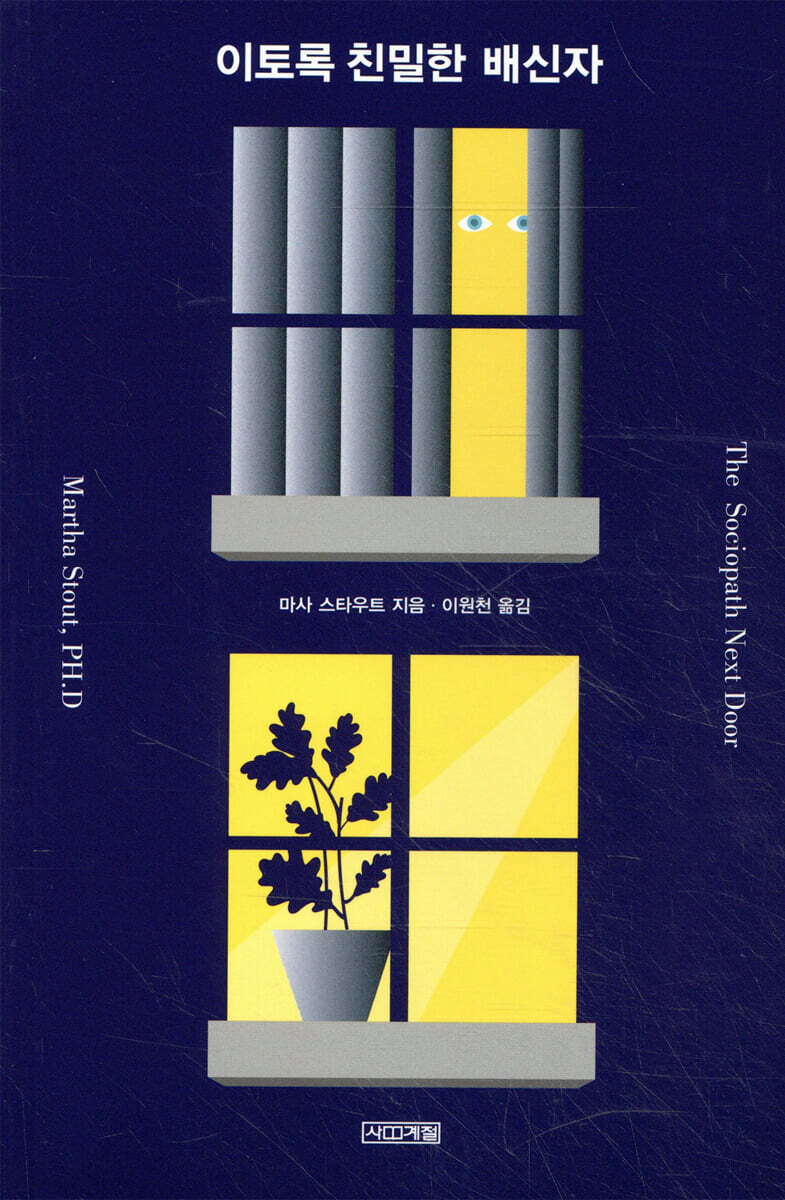
Such an intimate traitor
 |
Description
Book Introduction
- A word from MD
-
Sociopaths around usWe come across reports that the perpetrator of a brutal serial murder and sexual assault was a sociopath.
But not all criminals are sociopaths, and not all sociopaths are criminals.
Sociopaths exist even among people living ordinary lives.
This book introduces five cases to identify and deal with sociopaths in everyday life.
June 26, 2020. Humanities PD Son Min-gyu
It is a complete misconception that psychopaths and sociopaths are murderers and extremely evil criminals.
Rather, they are excellent actors who hide in our ordinary daily lives and inflict psychological violence.
They are cunning, sneaky, desperate for sympathy, and parasitic, living right next to us.
It's so attractive that it's easy to fall for it.
Statistically, there is one sociopath like that among us in 25 people.
So, Dr. Martha Stout, a professor of psychiatry at Harvard Medical School and a psychologist with nearly 40 years of clinical experience, wrote this book to protect us, the conscientious ones, from those without conscience.
This book presents guidelines for identifying sociopaths, who are often more vulnerable and vulnerable because they are not easily revealed, and, based on extensive counseling experience, exposes their true nature.
As society becomes more developed and individualism intensifies, sociopaths become more rampant.
"The Traitor So Intimate" promises psychological counseling for victims and the ability to recognize and prevent such behavior for those who haven't yet been victims.
Rather, they are excellent actors who hide in our ordinary daily lives and inflict psychological violence.
They are cunning, sneaky, desperate for sympathy, and parasitic, living right next to us.
It's so attractive that it's easy to fall for it.
Statistically, there is one sociopath like that among us in 25 people.
So, Dr. Martha Stout, a professor of psychiatry at Harvard Medical School and a psychologist with nearly 40 years of clinical experience, wrote this book to protect us, the conscientious ones, from those without conscience.
This book presents guidelines for identifying sociopaths, who are often more vulnerable and vulnerable because they are not easily revealed, and, based on extensive counseling experience, exposes their true nature.
As society becomes more developed and individualism intensifies, sociopaths become more rampant.
"The Traitor So Intimate" promises psychological counseling for victims and the ability to recognize and prevent such behavior for those who haven't yet been victims.
- You can preview some of the book's contents.
Preview
index
· Acknowledgements
·Before reading this book
·Introductory remarks
Chapter 1, Sense 7
Chapter 2: Ice Race Sociopaths
Chapter 3: The Moment Your Conscience Falls Asleep
Chapter 4 The Best Person in the World
Chapter 5: Why Conscience Can't See Properly
Chapter 6: How to Spot a Sociopath
Chapter 7: What Causes Sociopathy?
Chapter 8: The Sociopath Next to You
Chapter 9: Where Does Conscience Come From?
Chapter 10: Why Conscience is Better
Chapter 11 The Magic of the Marmot
Chapter 12: The Purest Conscience
·Citations·References
·Before reading this book
·Introductory remarks
Chapter 1, Sense 7
Chapter 2: Ice Race Sociopaths
Chapter 3: The Moment Your Conscience Falls Asleep
Chapter 4 The Best Person in the World
Chapter 5: Why Conscience Can't See Properly
Chapter 6: How to Spot a Sociopath
Chapter 7: What Causes Sociopathy?
Chapter 8: The Sociopath Next to You
Chapter 9: Where Does Conscience Come From?
Chapter 10: Why Conscience is Better
Chapter 11 The Magic of the Marmot
Chapter 12: The Purest Conscience
·Citations·References
Publisher's Review
The question of human conscience as seen in the suffocation death of a black man in Minnesota, USA.
Protests sparked by the 'excessive suppression of police in the US and the suffocation of a black man' are spreading across the US, Europe, and the world.
This incident touched a sensitive nerve of deep-rooted racial discrimination.
A closer look at the incident itself reveals the police officer's actions, which resulted in the death of a black man by kneeling on him, and the question of human authority and conscience.
The authority given to the role of police officer and the conscience of the individual who exercises that authority to the point of causing the death of another person are also issues that cannot be overlooked.
We can further examine human psychology and nature in Milgram's experiment in "The Traitor So Intimate," which delves deeply into the issues of sociopaths and human conscience.
Harvard Medical School psychiatry professor Martha Stout warns that 1 in 25 people are sociopaths!
Dr. Martha Stout, author of "The Intimate Betrayer," is a professor of psychiatry at Harvard Medical School and a psychologist with nearly 40 years of clinical experience in psychological counseling.
In counseling trauma survivors, I have learned that many people suffer from trauma due to psychological and emotional abuse by sociopaths.
Sociopaths are vague and dangerous entities that are difficult to define even academically and medically.
The doctor felt that this problem was extremely serious and that it was therefore necessary to face its existence and make it known publicly.
Statistically, a whopping 1 in 25 people are sociopaths.
My neighbor, my coworker, even my family member could be a sociopath.
A book written to protect you, the conscientious one, from those without conscience.
Sociopaths are not the criminals or brutal murderers we commonly think of.
He's not the cool, cool guy you see in dramas.
By definition, he is a person who has 'no conscience whatsoever'.
Most people have a conscience, which is a sense of duty that comes from emotional attachment.
I feel sorry when I hurt others, and I feel a pang in my neck when I eat even a single piece of cake left over.
Conscience is natural, ordinary, and always with us, so we may not be conscious of its presence or absence.
But what if you don't have that conscience? The problem just gets out of control.
Sociopaths are not mentally ill and cannot be isolated in mental hospitals, and not all of them are criminals and therefore cannot be judged by the law.
In this society, I don't even know if the people who exist with me are my neighbors or family.
So, the doctor presents a case study based on his clinical experience and emphasizes that this is an urgent problem.
The doctor speaks firmly.
I wrote this book to protect us, the conscientious ones, from those without conscience.
The problem of sociopaths in highly developed modern societies
A boss who bulldozes through things, right or wrong? A father who treats his family like trophies? A coworker who harasses me without any motive or benefit? A husband who lives off of me without any guilt or remorse? These are sociopaths.
It's not my fault they hurt me.
But it would have been much better if I had known in advance.
Moreover, sociopathy is more likely to manifest itself as society develops.
While traditional societies are based on human relationships and consideration for others, highly developed modern societies value individual achievement and encourage people to succeed even at the expense of others.
So modern society provides the optimal environment for existing sociopaths to become even more rampant.
This book is essential to combat the growing problem of sociopaths.
Ultimately, it comes down to a question of human conscience.
Sociopaths and conscience issues are two sides of the same coin.
The author deeply addresses the issue of human conscience through sociopaths.
We explore the origins and development of conscience and its fundamental meaning in history, theology, morality, and psychology.
And it raises a sensitive and difficult question, explaining why it is necessary for humans.
·Can we really say with certainty that sociopathy is not helpful to those who have it?
·Does conscience really help individuals or groups that have conscience?
·Will a truly shameless minority rule the world?
There is no definitive answer to this question yet.
But one thing is certain.
That they exist.
"The Traitor So Intimate" delves into the issues of human conscience, starting with the sociopathic problem, and promises to provide psychological counseling for victims, while also helping those who haven't yet been victims to recognize and prevent such behavior.
* Features of this book
-Fun novel-like story centered on five cases
·Skip Story: I am a sociopath.
Handsome, smart and successful.
They pushed like a bulldozer, harmed others without guilt, and married without love.
He was ruthless and risk-taking, and became successful in society, becoming a 'great' skip.
·Doreen's Story: I am a sociopath.
A greedy sociopath who wants to take away the things that cannot be taken away from his colleagues, such as beauty, intelligence, and success.
They do not hesitate to use any means necessary to simply scratch a line in their colleagues' careers.
·Sydney Story: The wife of parasitic sociopath Luke.
Luke is completely disinterested in his family and lives off of his wife, only pursuing the comfortable life he desires.
Since there is no conscience, there is naturally no guilt, shame, or regret.
·Hannah's Story: A daughter with a sociopathic father.
The father treats his wife and daughter like trophies.
They only care when they have something to brag about, and completely ignore it when that something is gone.
·The Tilly Story: A sociopath with a talent for turning small, subtle conflicts into heated arguments.
He has never made any money in his life, he is the source of all conflicts, and he is hated by all his neighbors.
"The Traitor So Intimate" presents five different sociopath cases, and despite its rather thick volume, it is structured in a way that allows you to read it quickly, like reading a novel, without getting bored.
-Theology, morality, philosophy, and evolutionary psychology
It provides a kind explanation of sociopaths, using examples, while also delving into the issues of human conscience.
It comprehensively examines the origins, development, effects, and necessity of human conscience from moral, philosophical, religious, and psychological perspectives.
All of these theories are introduced with case studies, making the book easy to read, but by no means light on the subject.
-Dealing with sociopaths in everyday life
Until now, most books and movies have portrayed sociopaths and psychopaths as being associated with crime.
But Dr. Martha Stout says:
Only 20% of sociopaths are involved in crime.
If we limit the problem of sociopaths to crime, the problem will never be solved.
In that respect, this book is very realistic.
Talk about your closest family, colleagues, and neighbors.
This book is very useful to modern readers because it allows them to observe closely and prevent themselves from falling into its traps to protect themselves and sustain their lives.
Protests sparked by the 'excessive suppression of police in the US and the suffocation of a black man' are spreading across the US, Europe, and the world.
This incident touched a sensitive nerve of deep-rooted racial discrimination.
A closer look at the incident itself reveals the police officer's actions, which resulted in the death of a black man by kneeling on him, and the question of human authority and conscience.
The authority given to the role of police officer and the conscience of the individual who exercises that authority to the point of causing the death of another person are also issues that cannot be overlooked.
We can further examine human psychology and nature in Milgram's experiment in "The Traitor So Intimate," which delves deeply into the issues of sociopaths and human conscience.
Harvard Medical School psychiatry professor Martha Stout warns that 1 in 25 people are sociopaths!
Dr. Martha Stout, author of "The Intimate Betrayer," is a professor of psychiatry at Harvard Medical School and a psychologist with nearly 40 years of clinical experience in psychological counseling.
In counseling trauma survivors, I have learned that many people suffer from trauma due to psychological and emotional abuse by sociopaths.
Sociopaths are vague and dangerous entities that are difficult to define even academically and medically.
The doctor felt that this problem was extremely serious and that it was therefore necessary to face its existence and make it known publicly.
Statistically, a whopping 1 in 25 people are sociopaths.
My neighbor, my coworker, even my family member could be a sociopath.
A book written to protect you, the conscientious one, from those without conscience.
Sociopaths are not the criminals or brutal murderers we commonly think of.
He's not the cool, cool guy you see in dramas.
By definition, he is a person who has 'no conscience whatsoever'.
Most people have a conscience, which is a sense of duty that comes from emotional attachment.
I feel sorry when I hurt others, and I feel a pang in my neck when I eat even a single piece of cake left over.
Conscience is natural, ordinary, and always with us, so we may not be conscious of its presence or absence.
But what if you don't have that conscience? The problem just gets out of control.
Sociopaths are not mentally ill and cannot be isolated in mental hospitals, and not all of them are criminals and therefore cannot be judged by the law.
In this society, I don't even know if the people who exist with me are my neighbors or family.
So, the doctor presents a case study based on his clinical experience and emphasizes that this is an urgent problem.
The doctor speaks firmly.
I wrote this book to protect us, the conscientious ones, from those without conscience.
The problem of sociopaths in highly developed modern societies
A boss who bulldozes through things, right or wrong? A father who treats his family like trophies? A coworker who harasses me without any motive or benefit? A husband who lives off of me without any guilt or remorse? These are sociopaths.
It's not my fault they hurt me.
But it would have been much better if I had known in advance.
Moreover, sociopathy is more likely to manifest itself as society develops.
While traditional societies are based on human relationships and consideration for others, highly developed modern societies value individual achievement and encourage people to succeed even at the expense of others.
So modern society provides the optimal environment for existing sociopaths to become even more rampant.
This book is essential to combat the growing problem of sociopaths.
Ultimately, it comes down to a question of human conscience.
Sociopaths and conscience issues are two sides of the same coin.
The author deeply addresses the issue of human conscience through sociopaths.
We explore the origins and development of conscience and its fundamental meaning in history, theology, morality, and psychology.
And it raises a sensitive and difficult question, explaining why it is necessary for humans.
·Can we really say with certainty that sociopathy is not helpful to those who have it?
·Does conscience really help individuals or groups that have conscience?
·Will a truly shameless minority rule the world?
There is no definitive answer to this question yet.
But one thing is certain.
That they exist.
"The Traitor So Intimate" delves into the issues of human conscience, starting with the sociopathic problem, and promises to provide psychological counseling for victims, while also helping those who haven't yet been victims to recognize and prevent such behavior.
* Features of this book
-Fun novel-like story centered on five cases
·Skip Story: I am a sociopath.
Handsome, smart and successful.
They pushed like a bulldozer, harmed others without guilt, and married without love.
He was ruthless and risk-taking, and became successful in society, becoming a 'great' skip.
·Doreen's Story: I am a sociopath.
A greedy sociopath who wants to take away the things that cannot be taken away from his colleagues, such as beauty, intelligence, and success.
They do not hesitate to use any means necessary to simply scratch a line in their colleagues' careers.
·Sydney Story: The wife of parasitic sociopath Luke.
Luke is completely disinterested in his family and lives off of his wife, only pursuing the comfortable life he desires.
Since there is no conscience, there is naturally no guilt, shame, or regret.
·Hannah's Story: A daughter with a sociopathic father.
The father treats his wife and daughter like trophies.
They only care when they have something to brag about, and completely ignore it when that something is gone.
·The Tilly Story: A sociopath with a talent for turning small, subtle conflicts into heated arguments.
He has never made any money in his life, he is the source of all conflicts, and he is hated by all his neighbors.
"The Traitor So Intimate" presents five different sociopath cases, and despite its rather thick volume, it is structured in a way that allows you to read it quickly, like reading a novel, without getting bored.
-Theology, morality, philosophy, and evolutionary psychology
It provides a kind explanation of sociopaths, using examples, while also delving into the issues of human conscience.
It comprehensively examines the origins, development, effects, and necessity of human conscience from moral, philosophical, religious, and psychological perspectives.
All of these theories are introduced with case studies, making the book easy to read, but by no means light on the subject.
-Dealing with sociopaths in everyday life
Until now, most books and movies have portrayed sociopaths and psychopaths as being associated with crime.
But Dr. Martha Stout says:
Only 20% of sociopaths are involved in crime.
If we limit the problem of sociopaths to crime, the problem will never be solved.
In that respect, this book is very realistic.
Talk about your closest family, colleagues, and neighbors.
This book is very useful to modern readers because it allows them to observe closely and prevent themselves from falling into its traps to protect themselves and sustain their lives.
GOODS SPECIFICS
- Date of issue: June 15, 2020
- Page count, weight, size: 356 pages | 540g | 140*210*30mm
- ISBN13: 9791160946611
- ISBN10: 1160946612
You may also like
카테고리
korean


korean

![GQ KOREA Mark (Monthly): December [2025]](http://librairie.coreenne.fr/cdn/shop/files/8ef265dbbfbf186523ed75ba7319009d.jpg?v=1765340328&width=3840)


