

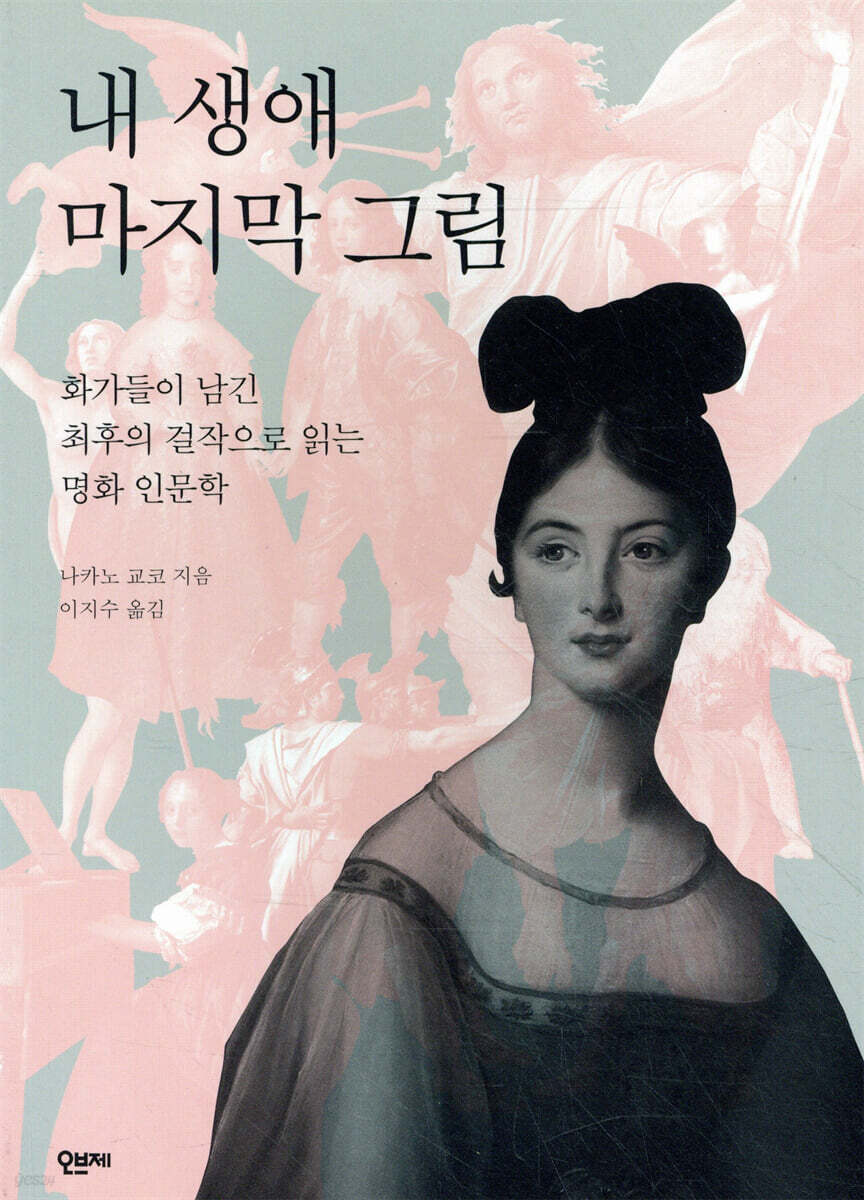
The last painting of my life
 |
Description
Book Introduction
Talking about art with the best works left by the artist
Telling the story of life through the last picture!
Reading paintings from a humanistic perspective that penetrates life
Just as a person's life is condensed in his will, a painter's last work is filled with the brilliance and darkness of life.
What were the lives of the artists hidden behind their shining masterpieces? What were the "life scenes" these artists, bound by the times and forced to live in humble circumstances, desired to leave behind at the end of their lives? "My Last Painting" melds the lives and art of these great artists, focusing on their finest and final works.
Kyoko Nakano, Japan's greatest storyteller of famous paintings, tells the story of the lives of 15 painters who led the Golden Age of European art (15th-19th centuries), from Botticelli to Van Gogh, by telling the story of how they worked to create timeless masterpieces and what they left behind as their last paintings.
This attempt presents a new reading of masterpieces based on a humanistic perspective, and further raises the weighty, life-shaking question, "What kind of painting will you leave behind at the end of your life?"
Telling the story of life through the last picture!
Reading paintings from a humanistic perspective that penetrates life
Just as a person's life is condensed in his will, a painter's last work is filled with the brilliance and darkness of life.
What were the lives of the artists hidden behind their shining masterpieces? What were the "life scenes" these artists, bound by the times and forced to live in humble circumstances, desired to leave behind at the end of their lives? "My Last Painting" melds the lives and art of these great artists, focusing on their finest and final works.
Kyoko Nakano, Japan's greatest storyteller of famous paintings, tells the story of the lives of 15 painters who led the Golden Age of European art (15th-19th centuries), from Botticelli to Van Gogh, by telling the story of how they worked to create timeless masterpieces and what they left behind as their last paintings.
This attempt presents a new reading of masterpieces based on a humanistic perspective, and further raises the weighty, life-shaking question, "What kind of painting will you leave behind at the end of your life?"
- You can preview some of the book's contents.
Preview
index
To begin with
Part 1: Painters and Gods - Painting Religion and Mythology
The Status of Painting | A Treasure Trove of Stories, Mythologization | Religious Painting is Christian Painting
1 Botticelli's The Libel of Apelles
- He who can awaken sensuality also knows how to erase it.
2 Raphael's Transfiguration of Christ
- A genius who took a step forward toward Baroque
3 Titian's Pietà
- A 'happy painter' knows no aging.
4 El Greco's Laocoon
- 'The Greek' was so new
5. Rubens' Landscape with a Dam
- The world that the 'King of Painters' has reached
Part 2: The Painter and the King - Painting the Court
Serving the King | A Court Painter Demanded by the Times | A Court Painter in Turbulent Times
1 Velazquez's Princess Margarita in a Blue Dress
- Realism that illuminates fate
2 Van Dyck's "Princess Henrietta Mary Stuart, Daughter of William II, Duke of Orange and Charles I of England"
- More beautiful than real life
3 Goya's "I am still learning"
- Seeing the abyss of humanity while pursuing worldly desires
4 David's "Mars Disarmed by Venus and the Three Graces"
- You can't draw without a hero
5 Vigée Lebrun's Portrait of a Madame
- 'Antoinette's Painter' who enjoyed a long life
Part 3: Painters and the People - Drawing Civil Society
A taste for genre painting | Establishing a theme | Beginning to appreciate paintings
1 Bruegel's Magpie on the Gallows
- The truth beyond what is depicted
2 Vermeer's "Woman Seated Before a Virginal"
- A painter who was mysterious until the end
3 Hogarth's "The Six Servants of the Hogarths"
- The satirist's heart is warm.
4. Millet's "Bird Hunting by Night"
- An innovator who portrayed the reality of farmers
5 Van Gogh's Wheatfield with Crows
- Drawing a world invisible to anyone
Chronology of major painters
Part 1: Painters and Gods - Painting Religion and Mythology
The Status of Painting | A Treasure Trove of Stories, Mythologization | Religious Painting is Christian Painting
1 Botticelli's The Libel of Apelles
- He who can awaken sensuality also knows how to erase it.
2 Raphael's Transfiguration of Christ
- A genius who took a step forward toward Baroque
3 Titian's Pietà
- A 'happy painter' knows no aging.
4 El Greco's Laocoon
- 'The Greek' was so new
5. Rubens' Landscape with a Dam
- The world that the 'King of Painters' has reached
Part 2: The Painter and the King - Painting the Court
Serving the King | A Court Painter Demanded by the Times | A Court Painter in Turbulent Times
1 Velazquez's Princess Margarita in a Blue Dress
- Realism that illuminates fate
2 Van Dyck's "Princess Henrietta Mary Stuart, Daughter of William II, Duke of Orange and Charles I of England"
- More beautiful than real life
3 Goya's "I am still learning"
- Seeing the abyss of humanity while pursuing worldly desires
4 David's "Mars Disarmed by Venus and the Three Graces"
- You can't draw without a hero
5 Vigée Lebrun's Portrait of a Madame
- 'Antoinette's Painter' who enjoyed a long life
Part 3: Painters and the People - Drawing Civil Society
A taste for genre painting | Establishing a theme | Beginning to appreciate paintings
1 Bruegel's Magpie on the Gallows
- The truth beyond what is depicted
2 Vermeer's "Woman Seated Before a Virginal"
- A painter who was mysterious until the end
3 Hogarth's "The Six Servants of the Hogarths"
- The satirist's heart is warm.
4. Millet's "Bird Hunting by Night"
- An innovator who portrayed the reality of farmers
5 Van Gogh's Wheatfield with Crows
- Drawing a world invisible to anyone
Chronology of major painters
Detailed image

Into the book
It is clear that the female nude has suddenly changed.
Botticelli, before he knew Savonarola, would not have painted such a trivial female figure.
Her appearance is similar to that of Venus, who was carried by the west wind to the island of Cyprus on a seashell, but the difference in their charm is so great that it is pitiful that they are about 10 million light years apart.
He who knew how to arouse the sensuality of the beholder also knew how to erase it.
He is a convicted felon.
Botticelli's popularity quickly waned.
It is only natural that a rich story has been transformed into a dry textbook.
However, he may not have been unhappy, as he still followed Savonarola and believed in his resurrection.
Twelve years after Savonarola's execution, Botticelli died in poverty.
---From Raphael's Transfiguration of Christ
The painting known as El Greco's last work is the Laocoon, his first and last mythological painting.
The famous anecdote from the Trojan War, 'The Trojan Horse', is the subject.
(……) Even when the subject was changed to mythology, his personality did not waver at all.
After El Greco passed away, he was gradually forgotten.
Two centuries later, when the Prado Museum in Madrid opened in 1819, not a single work of his was displayed.
It's something I can't even imagine now.
Surprisingly, it was the 20th-century Expressionist painters who rediscovered El Greco.
Picasso himself admitted that his depictions of figures from his 'Blue Period' were influenced by El Greco.
This is proof that the sensibility of 'the Greek' was truly new, or rather, excessively new.
---From El Greco's Laocoon
This genius, who lived a life 10 or 20 times more concentrated than that of an ordinary person, left behind a kind of self-portrait in black conte in his later years, when he was over eighty.
An old man with unkempt hair and a long white beard stands with his back bent, leaning on two canes in each hand.
The background is dark and gloomy, but the two eyes are still sparkling.
The title of this painting is “I am still learning.”
Goya, long live.
---From Francisco Goya's "I am still learning"
When I look at “Mars Disarmed by Venus and the Three Graces,” I am surprised at how poor my drawing skills have become.
This work is nothing more than a clumsy imitation of his prime work.
This is a trap that academic works centered around neoclassicism easily fall into, namely, paintings that are focused only on form and lack soul.
Originally, David's work seemed to express authoritarianism through painting, so rather than being divisive, it seemed like a textbook of well-drawn paintings.
However, when I drew Napoleon, the hot blood of the character Napoleon himself was conveyed.
But if you take away Napoleon and his position, the picture becomes an empty shell.
---From Jacques-Louis David's "Mars Disarmed by Venus and the Three Graces"
Vigée Lebrun, who lived to the age of eighty-seven, which was rare at the time, spent her later years somewhat lonely after sending her husband and daughter to the other world.
But he never put down his brush until he died.
People wanted portraits of her, and she continued to paint to meet their demands.
There are works left from when he was seventy-six, nearing his later years.
This is a portrait of an unknown woman with a Russian-style hairstyle, and the lively touch belies the artist's age.
The 18th century's greatest professional female painter, renowned for her excellent work, appears to have had a positive outlook on her life.
---From Vigée Lebrun's "Portrait of a Lady"
But his body betrayed him.
About ten years before his death, he suffered from occasional severe headaches and was bedridden, gradually weakening his body.
But I didn't put down the brush.
His last work, "Night Hunting," which he continued to work on until the very end on his sickbed, is so full of a strange power that one cannot help but think that the artist was conscious of his own death.
Why did Millet paint this scene at the very end of his life? Was it his father who took him on a pigeon hunt as a boy? Did his father also wield a club? Numerous questions arise.
Perhaps the artist, who has consistently depicted the sacredness of labor, also wanted to capture a different aspect of hunting, apart from slaughtering livestock? This, too, is a reality of rural life…
Botticelli, before he knew Savonarola, would not have painted such a trivial female figure.
Her appearance is similar to that of Venus, who was carried by the west wind to the island of Cyprus on a seashell, but the difference in their charm is so great that it is pitiful that they are about 10 million light years apart.
He who knew how to arouse the sensuality of the beholder also knew how to erase it.
He is a convicted felon.
Botticelli's popularity quickly waned.
It is only natural that a rich story has been transformed into a dry textbook.
However, he may not have been unhappy, as he still followed Savonarola and believed in his resurrection.
Twelve years after Savonarola's execution, Botticelli died in poverty.
---From Raphael's Transfiguration of Christ
The painting known as El Greco's last work is the Laocoon, his first and last mythological painting.
The famous anecdote from the Trojan War, 'The Trojan Horse', is the subject.
(……) Even when the subject was changed to mythology, his personality did not waver at all.
After El Greco passed away, he was gradually forgotten.
Two centuries later, when the Prado Museum in Madrid opened in 1819, not a single work of his was displayed.
It's something I can't even imagine now.
Surprisingly, it was the 20th-century Expressionist painters who rediscovered El Greco.
Picasso himself admitted that his depictions of figures from his 'Blue Period' were influenced by El Greco.
This is proof that the sensibility of 'the Greek' was truly new, or rather, excessively new.
---From El Greco's Laocoon
This genius, who lived a life 10 or 20 times more concentrated than that of an ordinary person, left behind a kind of self-portrait in black conte in his later years, when he was over eighty.
An old man with unkempt hair and a long white beard stands with his back bent, leaning on two canes in each hand.
The background is dark and gloomy, but the two eyes are still sparkling.
The title of this painting is “I am still learning.”
Goya, long live.
---From Francisco Goya's "I am still learning"
When I look at “Mars Disarmed by Venus and the Three Graces,” I am surprised at how poor my drawing skills have become.
This work is nothing more than a clumsy imitation of his prime work.
This is a trap that academic works centered around neoclassicism easily fall into, namely, paintings that are focused only on form and lack soul.
Originally, David's work seemed to express authoritarianism through painting, so rather than being divisive, it seemed like a textbook of well-drawn paintings.
However, when I drew Napoleon, the hot blood of the character Napoleon himself was conveyed.
But if you take away Napoleon and his position, the picture becomes an empty shell.
---From Jacques-Louis David's "Mars Disarmed by Venus and the Three Graces"
Vigée Lebrun, who lived to the age of eighty-seven, which was rare at the time, spent her later years somewhat lonely after sending her husband and daughter to the other world.
But he never put down his brush until he died.
People wanted portraits of her, and she continued to paint to meet their demands.
There are works left from when he was seventy-six, nearing his later years.
This is a portrait of an unknown woman with a Russian-style hairstyle, and the lively touch belies the artist's age.
The 18th century's greatest professional female painter, renowned for her excellent work, appears to have had a positive outlook on her life.
---From Vigée Lebrun's "Portrait of a Lady"
But his body betrayed him.
About ten years before his death, he suffered from occasional severe headaches and was bedridden, gradually weakening his body.
But I didn't put down the brush.
His last work, "Night Hunting," which he continued to work on until the very end on his sickbed, is so full of a strange power that one cannot help but think that the artist was conscious of his own death.
Why did Millet paint this scene at the very end of his life? Was it his father who took him on a pigeon hunt as a boy? Did his father also wield a club? Numerous questions arise.
Perhaps the artist, who has consistently depicted the sacredness of labor, also wanted to capture a different aspect of hunting, apart from slaughtering livestock? This, too, is a reality of rural life…
---From "Bird Hunting by Night" by Jean-François Millet
Publisher's Review
What did the artist put into his last painting?
From Botticelli to Van Gogh,
The lives and art of great painters unfold in a single painting.
Botticelli's "The Birth of Venus," Vermeer's "Girl with a Pearl Earring," Millet's "The Gleaners"...
This is a famous and widely known painter and his representative works.
These paintings themselves offer a remarkable aesthetic impact.
Except in special cases, the public is interested only in the best works of an artist when he was at the peak of his skill.
However, if we only focus on the representative works among the dozens to hundreds of paintings that an artist produced throughout his or her life, we cannot fully understand the artist's artistic world.
Kyoko Nakano, the author of this book, which explores European art history from a variety of perspectives, said, “It is not often that the last work becomes a masterpiece, but it is truly important to observe the changes in the artist’s state of mind as he or she approaches the end of his or her life.
He argues that we should pay attention to the last painting that runs through the artist's artistic world and life, saying, "A painting is the artist's way of life itself."
The great writer Shakespeare poured his life into the play "The Tempest" that he wrote after retiring from the theater world and sang of reconciliation, and the great musician Beethoven poured his life into the bright and powerful melodies of his last work, "String Quartet No. 16."
Although neither work is considered a masterpiece, the fusion of the masters' lives and art resonates deeply, conveying the realm they reached.
The same goes for Rubens, a master of the Baroque era.
He was praised as the 'King of Painters' for his magnificent works with grand and dynamic expressions, and in his later years he painted simple and peaceful landscapes.
The simple landscape paintings he left behind at the end deeply move us as they convey the unadorned and genuine happiness the artist encountered at the end of his life.
It is said that about a year before his death, his chronic gout got worse and both hands became gradually paralyzed.
There are no people in this landscape painting with a dam, which is believed to be his last work.
There is no rainbow.
Still, what a peaceful scene it is.
The sky, trees, and river are in perfect harmony, and the scenery is so beautiful that it is a natural painting that does not show off at all, as if it were just a sketch.
At sixty-three, Rubens might have thought he had painted everything in life.
I can see his smile.
_ From Rubens's "Landscape with a Dam" (p.97)
Velazquez, who devoted everything to his mission and collapsed, and Goya, who wanted to learn more until the end, were also like Rubens.
On the other hand, there are cases where the last painting brings regret rather than emotion, such as Botticelli, who painted dry religious paintings containing moral lessons thanks to Savonarola's teachings, and David, who painted soulless paintings imitating his prime while being tied to his past self.
But their paintings are also noteworthy in that they show another side of life without embellishment.
The fact that the 'life landscape' that great painters faced at the end was not always beautiful is because it gives us the realization that life is fair to everyone and that we must live each day to the fullest.
True art is the story of the artist's life!
The life philosophy of painters who see with their eyes and feel with their hearts
The 15 painters featured in this book were not free to paint the subjects they liked.
This is because before the modern era, most paintings were commissioned.
The clients varied across countries and eras.
It can be said that Western painting developed alongside Christianity, as most of the subjects of famous paintings in the early Renaissance were from the Bible, and the church was also the biggest patron.
As royal power grew stronger, the main clientele shifted to kings and nobles, who commissioned painters to create splendid mythological paintings for interior decoration and portraits to enhance their authority.
The rising middle class then demanded worldly and everyday conversation.
This book divides the changing times and changing buyer needs into three categories.
Part 1, 'Painters and Gods', features Botticelli, Raphael, Titian, El Greco, and Rubens, who expressed the world of 'religion and mythology' with their own unique painting styles. Part 2, 'Painters and Kings', features Velazquez, Van Dyck, Goya, David, and Vigée-Le Brun, who were active as court painters.
And the main characters of Part 3, 'Painters and the People', are Bruegel, Vermeer, Hogarth, Millet, and Van Gogh, who express the growth of civil society through genre paintings and satirical paintings of people on the periphery, such as merchants and farmers.
"The Last Painting of My Life" deals with the struggles of fifteen painters who had to leave behind works while being conscious of their clients in order to make a living, and reveals that those who are praised as great painters today were not solitary seekers who pursued only art, but worldly and materialistic people.
That's why we are fascinated by their paintings.
This is because we can project our own lives onto the works of painters who created masterpieces that still inspire us today despite realistic constraints.
This book focuses on the artist's last paintings.
However, while there are cases where the final painting is clearly known, such as Raphael's "Transfiguration of Christ" and Bruegel's "The Magpie on the Gallows," there are also many cases where the final painting is controversial, such as Vermeer's "Woman Seated Before a Virginal" and Van Gogh's "Wheatfield with Crows."
However, the author is not interested in finding out what the 'real' last painting the artist created just before his death was.
Because the final painting is the key to revealing the artist's life more clearly, it focuses on the lives of artists who, amidst the shackles of a sordid era, completed works that convey emotion across regions and time.
This book, which tells the story of art through the best works and life through the last paintings, rewrites the history of art, which has been focused solely on works, into the life philosophy of the artist.
Furthermore, it makes us realize that the artistic inspiration that a famous painting gives us is maximized by properly understanding the artist's life beyond the work itself.
From Botticelli to Van Gogh,
The lives and art of great painters unfold in a single painting.
Botticelli's "The Birth of Venus," Vermeer's "Girl with a Pearl Earring," Millet's "The Gleaners"...
This is a famous and widely known painter and his representative works.
These paintings themselves offer a remarkable aesthetic impact.
Except in special cases, the public is interested only in the best works of an artist when he was at the peak of his skill.
However, if we only focus on the representative works among the dozens to hundreds of paintings that an artist produced throughout his or her life, we cannot fully understand the artist's artistic world.
Kyoko Nakano, the author of this book, which explores European art history from a variety of perspectives, said, “It is not often that the last work becomes a masterpiece, but it is truly important to observe the changes in the artist’s state of mind as he or she approaches the end of his or her life.
He argues that we should pay attention to the last painting that runs through the artist's artistic world and life, saying, "A painting is the artist's way of life itself."
The great writer Shakespeare poured his life into the play "The Tempest" that he wrote after retiring from the theater world and sang of reconciliation, and the great musician Beethoven poured his life into the bright and powerful melodies of his last work, "String Quartet No. 16."
Although neither work is considered a masterpiece, the fusion of the masters' lives and art resonates deeply, conveying the realm they reached.
The same goes for Rubens, a master of the Baroque era.
He was praised as the 'King of Painters' for his magnificent works with grand and dynamic expressions, and in his later years he painted simple and peaceful landscapes.
The simple landscape paintings he left behind at the end deeply move us as they convey the unadorned and genuine happiness the artist encountered at the end of his life.
It is said that about a year before his death, his chronic gout got worse and both hands became gradually paralyzed.
There are no people in this landscape painting with a dam, which is believed to be his last work.
There is no rainbow.
Still, what a peaceful scene it is.
The sky, trees, and river are in perfect harmony, and the scenery is so beautiful that it is a natural painting that does not show off at all, as if it were just a sketch.
At sixty-three, Rubens might have thought he had painted everything in life.
I can see his smile.
_ From Rubens's "Landscape with a Dam" (p.97)
Velazquez, who devoted everything to his mission and collapsed, and Goya, who wanted to learn more until the end, were also like Rubens.
On the other hand, there are cases where the last painting brings regret rather than emotion, such as Botticelli, who painted dry religious paintings containing moral lessons thanks to Savonarola's teachings, and David, who painted soulless paintings imitating his prime while being tied to his past self.
But their paintings are also noteworthy in that they show another side of life without embellishment.
The fact that the 'life landscape' that great painters faced at the end was not always beautiful is because it gives us the realization that life is fair to everyone and that we must live each day to the fullest.
True art is the story of the artist's life!
The life philosophy of painters who see with their eyes and feel with their hearts
The 15 painters featured in this book were not free to paint the subjects they liked.
This is because before the modern era, most paintings were commissioned.
The clients varied across countries and eras.
It can be said that Western painting developed alongside Christianity, as most of the subjects of famous paintings in the early Renaissance were from the Bible, and the church was also the biggest patron.
As royal power grew stronger, the main clientele shifted to kings and nobles, who commissioned painters to create splendid mythological paintings for interior decoration and portraits to enhance their authority.
The rising middle class then demanded worldly and everyday conversation.
This book divides the changing times and changing buyer needs into three categories.
Part 1, 'Painters and Gods', features Botticelli, Raphael, Titian, El Greco, and Rubens, who expressed the world of 'religion and mythology' with their own unique painting styles. Part 2, 'Painters and Kings', features Velazquez, Van Dyck, Goya, David, and Vigée-Le Brun, who were active as court painters.
And the main characters of Part 3, 'Painters and the People', are Bruegel, Vermeer, Hogarth, Millet, and Van Gogh, who express the growth of civil society through genre paintings and satirical paintings of people on the periphery, such as merchants and farmers.
"The Last Painting of My Life" deals with the struggles of fifteen painters who had to leave behind works while being conscious of their clients in order to make a living, and reveals that those who are praised as great painters today were not solitary seekers who pursued only art, but worldly and materialistic people.
That's why we are fascinated by their paintings.
This is because we can project our own lives onto the works of painters who created masterpieces that still inspire us today despite realistic constraints.
This book focuses on the artist's last paintings.
However, while there are cases where the final painting is clearly known, such as Raphael's "Transfiguration of Christ" and Bruegel's "The Magpie on the Gallows," there are also many cases where the final painting is controversial, such as Vermeer's "Woman Seated Before a Virginal" and Van Gogh's "Wheatfield with Crows."
However, the author is not interested in finding out what the 'real' last painting the artist created just before his death was.
Because the final painting is the key to revealing the artist's life more clearly, it focuses on the lives of artists who, amidst the shackles of a sordid era, completed works that convey emotion across regions and time.
This book, which tells the story of art through the best works and life through the last paintings, rewrites the history of art, which has been focused solely on works, into the life philosophy of the artist.
Furthermore, it makes us realize that the artistic inspiration that a famous painting gives us is maximized by properly understanding the artist's life beyond the work itself.
GOODS SPECIFICS
- Date of publication: June 20, 2016
- Page count, weight, size: 284 pages | 484g | 152*210*20mm
- ISBN13: 9791130608488
- ISBN10: 1130608484
You may also like
카테고리
korean


korean

![GQ KOREA Mark (Monthly): December [2025]](http://librairie.coreenne.fr/cdn/shop/files/8ef265dbbfbf186523ed75ba7319009d.jpg?v=1765340328&width=3840)


