

Awkward Art Story 1
 |
Description
Book Introduction
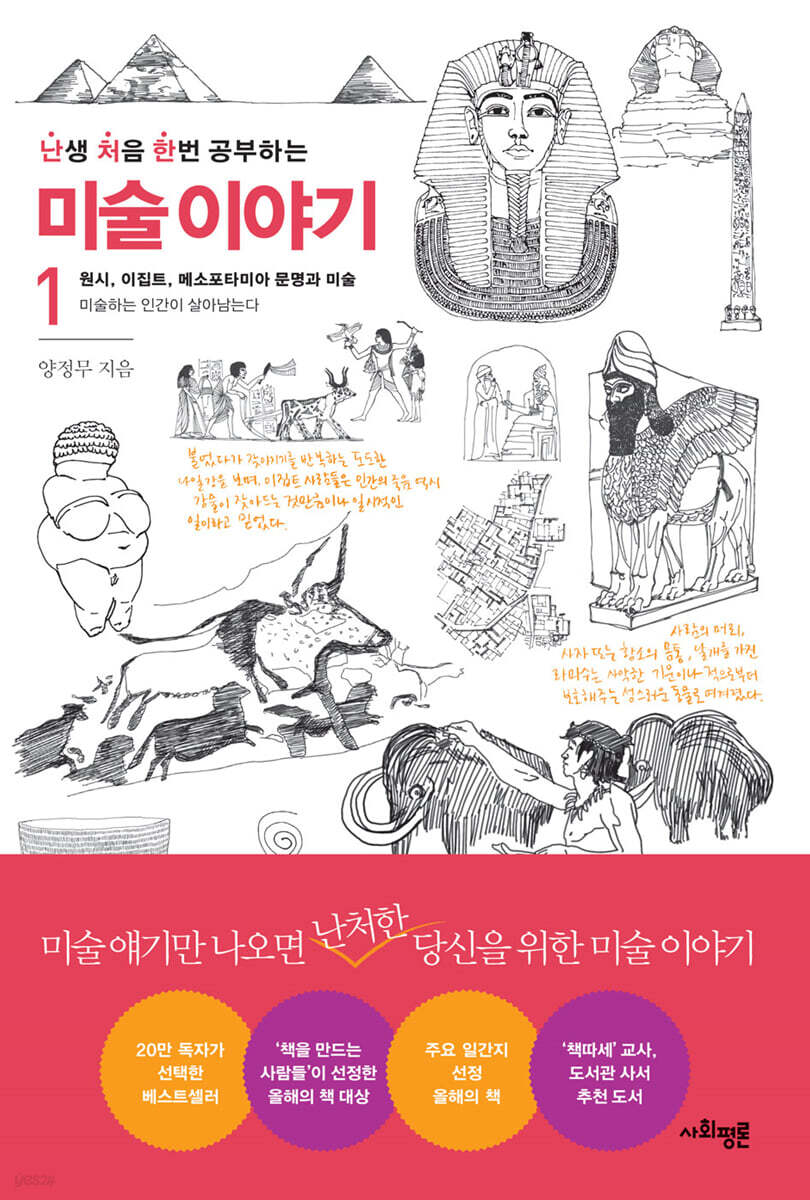
Everything about art history, easy to read and learn properly! Studying art with a long and storied history is not an easy task. Even the most trendy contemporary art pieces are steeped in 40,000 years of human history, making it difficult to understand individual pieces without a knowledge of art history. Moreover, many people gave up on reading existing art history books that were difficult to read after not even getting past ten pages. However, 『Art Story』 is written in a colloquial, one-on-one lecture format, so you can enjoy it comfortably, as if you were listening to an interesting story. Additionally, the illustrations are arranged to follow the reader's gaze without the need to flip through the pages to find pictures, the carefully selected photos and illustrations of works of art of collectible value, and the appropriate questions that prompt answers to any questions that may arise in the mind, adding to the pleasure of reading. That doesn't mean the book is of low quality. Professor Yang Jeong-mu, the author of the book and an authority in the field of art history, has packed a vast amount of information and diverse perspectives into one book. It covers essential basic art knowledge, as well as the latest theories leading the academic world, and includes as much new information and theories as possible, from famous works of art to Korean art that we can easily see around us. All this vast knowledge becomes naturally understandable as you follow the author's lectures, who is also a popular public speaker. At some point, readers will feel as if they are traveling through the world of art with a friendly and knowledgeable guide. |
- You can preview some of the book's contents.
Preview
index
Primitive, Egyptian, and Mesopotamian Civilizations and Art - The Art of Humans Survives
I Primitive Art - Those who know art will survive.
01 The Age of Sexy Pebbles
02 What did they do in the cave?
03 Mystery Codes Hidden in Cave Paintings
04 A story that humanity has been telling for 40,000 years
05 Primitive art near us
II Egyptian Art - They Dreamed of Eternal Life
01 A country that enjoyed the status of the most powerful nation for 3,000 years
02 Drawing a perfect world that never changes
03 The Immortal Dream Told by the Pyramid
04 From Nebamun to Tutankhamun: The Renaissance of Ancient Civilization
05 The splendid light of dusk
06 The eternal theme of art: life and death
III Mesopotamian Art - Life is a desperate struggle
01 The river of civilization opened by waterways
02 Build a temple and make offerings to pray for prosperity
03 The Urban Revolution Begins in the Wilderness
04 The Voice of Power, the Face of Power
05 Persia, the culmination of Mesopotamian civilization
I Primitive Art - Those who know art will survive.
01 The Age of Sexy Pebbles
02 What did they do in the cave?
03 Mystery Codes Hidden in Cave Paintings
04 A story that humanity has been telling for 40,000 years
05 Primitive art near us
II Egyptian Art - They Dreamed of Eternal Life
01 A country that enjoyed the status of the most powerful nation for 3,000 years
02 Drawing a perfect world that never changes
03 The Immortal Dream Told by the Pyramid
04 From Nebamun to Tutankhamun: The Renaissance of Ancient Civilization
05 The splendid light of dusk
06 The eternal theme of art: life and death
III Mesopotamian Art - Life is a desperate struggle
01 The river of civilization opened by waterways
02 Build a temple and make offerings to pray for prosperity
03 The Urban Revolution Begins in the Wilderness
04 The Voice of Power, the Face of Power
05 Persia, the culmination of Mesopotamian civilization
Detailed image

Into the book
Art is beautiful.
However, if we look at the art left behind by those who lived in Egypt and Mesopotamia during the primitive era 40,000 years ago, we realize that art is the result of competition between the harsh nature and the even harsher humans.
---From "Volume 1: 'A Story of Survival, Eternal Life, and Power'"
All works of art, not just modern art, must be viewed in the context of the specific environment that surrounds them.
Depending on where and what material it is drawn with, the message it gives changes 180 degrees.
What this means is that an image has a different message when it appears as a photograph, a painting, or a sculpture.
A bull painted smoothly on canvas and a bull painted on a rough natural rock are two completely different types of art.
---From "Part 1 Primitive Art, Chapter 2, 'What Did They Do in the Caves?'"
After appreciating the cave paintings, Picasso's words, "Humanity has not improved in 20,000 years," really resonate with me.
When I first went there and saw the cave paintings, for a while all other works of art seemed insignificant.
It was hard to believe that he had created such a magnificent masterpiece using only crude tools, incomparable to those of modern painters, and using rudimentary methods like palm impressions and blowing.
---From "Part 1 Primitive Art, Chapter 2, 'What Did They Do in the Caves?'"
The gently flowing Nile River is a great tourist destination for enjoying a leisurely boat ride and taking in the scenery of Egypt.
But 5,000 years ago, the Egyptians believed that human life, like the annual flooding of the Nile River, would be eternal, going back and forth between birth and death.
I thought that life after death would be abundant, like the land becoming fertile when floods subsided.
---From "Part 2: Prologue to Egyptian Art"
The material for thought that Egyptian art provides is, above all, death.
The Egyptians pondered the subject of death and sublimated that concern into their own aesthetics.
So, what meaning and concerns does the "art of death" created by modern civilization hold? Perhaps we are writing a new page in the vast encyclopedia of death created by the ancient Egyptians.
---From "Part 2, Egyptian Art, Chapter 6, 'The Eternal Theme of Art: Life and Death'"
Mesopotamian art is the art of the city.
The monarchs who ruled the city left behind numerous statues and reliefs that were meant to impress the people and intimidate other cities nearby.
In this way, Mesopotamian art can be seen as having gone hand in hand with the rise and fall of the city, and thus, the art also had an urban character.
---From "Part 3 Mesopotamian Art, Chapter 2, 'Building a Temple and Making Offerings to Pray for Prosperity'"
It takes training to read the stories that art tells.
Just as you need to learn the grammar, vocabulary, and pronunciation of a foreign language to understand it, you also need to learn and master the visual language of art to understand it.
I can't say it's an easy process.
But I can promise you one thing.
Just as learning a foreign language opens up a whole new world, becoming familiar with the language of art allows you to experience richer and more vivid communication than written language.
However, if we look at the art left behind by those who lived in Egypt and Mesopotamia during the primitive era 40,000 years ago, we realize that art is the result of competition between the harsh nature and the even harsher humans.
---From "Volume 1: 'A Story of Survival, Eternal Life, and Power'"
All works of art, not just modern art, must be viewed in the context of the specific environment that surrounds them.
Depending on where and what material it is drawn with, the message it gives changes 180 degrees.
What this means is that an image has a different message when it appears as a photograph, a painting, or a sculpture.
A bull painted smoothly on canvas and a bull painted on a rough natural rock are two completely different types of art.
---From "Part 1 Primitive Art, Chapter 2, 'What Did They Do in the Caves?'"
After appreciating the cave paintings, Picasso's words, "Humanity has not improved in 20,000 years," really resonate with me.
When I first went there and saw the cave paintings, for a while all other works of art seemed insignificant.
It was hard to believe that he had created such a magnificent masterpiece using only crude tools, incomparable to those of modern painters, and using rudimentary methods like palm impressions and blowing.
---From "Part 1 Primitive Art, Chapter 2, 'What Did They Do in the Caves?'"
The gently flowing Nile River is a great tourist destination for enjoying a leisurely boat ride and taking in the scenery of Egypt.
But 5,000 years ago, the Egyptians believed that human life, like the annual flooding of the Nile River, would be eternal, going back and forth between birth and death.
I thought that life after death would be abundant, like the land becoming fertile when floods subsided.
---From "Part 2: Prologue to Egyptian Art"
The material for thought that Egyptian art provides is, above all, death.
The Egyptians pondered the subject of death and sublimated that concern into their own aesthetics.
So, what meaning and concerns does the "art of death" created by modern civilization hold? Perhaps we are writing a new page in the vast encyclopedia of death created by the ancient Egyptians.
---From "Part 2, Egyptian Art, Chapter 6, 'The Eternal Theme of Art: Life and Death'"
Mesopotamian art is the art of the city.
The monarchs who ruled the city left behind numerous statues and reliefs that were meant to impress the people and intimidate other cities nearby.
In this way, Mesopotamian art can be seen as having gone hand in hand with the rise and fall of the city, and thus, the art also had an urban character.
---From "Part 3 Mesopotamian Art, Chapter 2, 'Building a Temple and Making Offerings to Pray for Prosperity'"
It takes training to read the stories that art tells.
Just as you need to learn the grammar, vocabulary, and pronunciation of a foreign language to understand it, you also need to learn and master the visual language of art to understand it.
I can't say it's an easy process.
But I can promise you one thing.
Just as learning a foreign language opens up a whole new world, becoming familiar with the language of art allows you to experience richer and more vivid communication than written language.
---From "Part 3 Mesopotamian Art, Chapter 5 'Persia, the Decisive Edition of Mesopotamian Civilization'"
Publisher's Review
★ Learning about the glory, frustration, and challenges of humanity through art history, the 'flower of the humanities'
…read the flow of history, politics, economics, and art as a single picture, a single piece.
★ One-on-one art lectures that are as easy to read as listening.
… An author with authority in the field of art history conveys the fun, emotion, and depth of art through colloquial prose, pointed questions and answers, vivid photographs, and abundant illustrations.
★ The beginning of the story of art, primitive, Egyptian, and Mesopotamian civilization and art
…From primitive cave paintings to Egyptian art that holds the secret of immortality, to Mesopotamian art that invented the first city, we explore the lives of ancient humans and how artists became the rulers of the Earth.
A secret lesson for those who feel awkward whenever art is mentioned.
『The story of studying art for the first time in my life』!
In these times when we're so busy trying to make a living, why should we even read art history?
Recently, large-scale art exhibitions and invitational exhibitions of famous foreign artists have been held frequently in Korea, and the response from visitors has been enthusiastic.
Public interest in art is growing, with artworks being sold for hundreds of millions of won at domestic art auctions.
However, there are many people who want to study art properly but are unsure of where to start or how to approach it.
There are still many who view art as the exclusive domain of the wealthy.
For these people, the book "Art Stories for the First Time in Your Life" has been published, which covers not only how to properly appreciate art, but also the history, politics, economics, and artistic trends contained in art in an easy, fun, and profound way.
When we visit so-called developed countries, we make it a must-visit for museums and art galleries representing that country, such as the British Museum in England, the Louvre Museum in France, and the Metropolitan Museum of Art in the United States.
Countries that have led world history are full of art galleries and museums, and the social elite are passionate about art.
Why do they invest in art galleries, support artists, and collect art? Why are simple stones, bowls, or even a child's scribbles labeled "art" and commanded astronomical prices?
This book answers this by saying that art is a window that shows the past and contains answers that lead to the future.
Art critic John Ruskin said, “A great nation writes its autobiography in three volumes.
One volume is about action, one volume is about writing, and the other volume is about art.
“Neither of the books can be understood without first reading the other two, but of them, Art is the most reliable.”
To see art is to confront the era that gave birth to it head-on, and it is also a path to gaining insight that will lead the future.
That is why art is called the 'flower of the humanities', which is the essence of all academic disciplines such as history, politics, economics, and art.
『Art Stories』, planned as a total of eight volumes, will examine all aspects of art that have accompanied humans, starting with Volume 1, Primitive, Egyptian, and Mesopotamian civilization and art, and Volume 2, Greek and Roman civilization and art, and continuing through medieval Christianity, the Renaissance, modern, and contemporary art.
Everything about art history, easy to read and learn properly!
Studying art with a long and storied history is not an easy task.
Even the most trendy contemporary art pieces are steeped in 40,000 years of human history, making it difficult to understand individual pieces without a knowledge of art history.
Moreover, many people gave up on reading existing art history books that were difficult to read after not even getting past ten pages.
However, 『Art Story』 is written in a colloquial, one-on-one lecture format, so you can enjoy it comfortably, as if you were listening to an interesting story.
Additionally, the illustrations are arranged to follow the reader's gaze without the need to flip through the pages to find pictures, the carefully selected photos and illustrations of works of art of collectible value, and the appropriate questions that prompt answers to any questions that may arise in the mind, adding to the pleasure of reading.
That doesn't mean the book is of low quality.
Professor Yang Jeong-mu, the author of the book and an authority in the field of art history, has packed a vast amount of information and diverse perspectives into one book.
It covers essential basic art knowledge, as well as the latest theories leading the academic world, and includes as much new information and theories as possible, from famous works of art to Korean art that we can easily see around us.
All this vast knowledge becomes naturally understandable as you follow the author's lectures, who is also a popular public speaker.
At some point, readers will feel as if they are traveling through the world of art with a friendly and knowledgeable guide.
Art Stories, Volume 1: Homo Graphicus: The Survival of the Artistic Human
Volume 1 of "The Story of Studying Art for the First Time in My Life" tells the story of how art has been a necessary skill for human survival from the beginning to the present.
The first writing system was created in Mesopotamia around 3000 BC.
Humans have been using writing for about 5,000 years.
Five thousand years is a long time, hard to imagine, but art has dominated the human mind for eight times that amount, a whopping 40,000 years.
Part 1, “Humans Who Know Art Survive,” points out that art has been a core skill that humanity has needed to survive among numerous rivals since 40,000 years ago.
Part 2, “They Dreamed of Eternal Life,” covers Egyptian art.
The ancient Egyptians were deeply preoccupied with the question of death.
They created mummies, crafted jewelry so perfect it seemed as if an alien civilization had suddenly landed on Earth, and built massive tomb pyramids that remain a mystery to this day.
In Egyptian art we see the most beautiful and perfect answers desperately offered to the eternal riddle of life and death.
Part 3, 'Life is a desperate struggle,' examines Mesopotamian art.
The Mesopotamian monarchs, who settled in what is now Iraq and Iran, carved gruesome video advertisements on their city walls to advertise their power.
They realized early on that art had tremendous power as a propaganda tool.
Mesopotamian art, which built the 'city', the basic unit of modern civilization, shows that all art can be propaganda, that is, political propaganda.
…read the flow of history, politics, economics, and art as a single picture, a single piece.
★ One-on-one art lectures that are as easy to read as listening.
… An author with authority in the field of art history conveys the fun, emotion, and depth of art through colloquial prose, pointed questions and answers, vivid photographs, and abundant illustrations.
★ The beginning of the story of art, primitive, Egyptian, and Mesopotamian civilization and art
…From primitive cave paintings to Egyptian art that holds the secret of immortality, to Mesopotamian art that invented the first city, we explore the lives of ancient humans and how artists became the rulers of the Earth.
A secret lesson for those who feel awkward whenever art is mentioned.
『The story of studying art for the first time in my life』!
In these times when we're so busy trying to make a living, why should we even read art history?
Recently, large-scale art exhibitions and invitational exhibitions of famous foreign artists have been held frequently in Korea, and the response from visitors has been enthusiastic.
Public interest in art is growing, with artworks being sold for hundreds of millions of won at domestic art auctions.
However, there are many people who want to study art properly but are unsure of where to start or how to approach it.
There are still many who view art as the exclusive domain of the wealthy.
For these people, the book "Art Stories for the First Time in Your Life" has been published, which covers not only how to properly appreciate art, but also the history, politics, economics, and artistic trends contained in art in an easy, fun, and profound way.
When we visit so-called developed countries, we make it a must-visit for museums and art galleries representing that country, such as the British Museum in England, the Louvre Museum in France, and the Metropolitan Museum of Art in the United States.
Countries that have led world history are full of art galleries and museums, and the social elite are passionate about art.
Why do they invest in art galleries, support artists, and collect art? Why are simple stones, bowls, or even a child's scribbles labeled "art" and commanded astronomical prices?
This book answers this by saying that art is a window that shows the past and contains answers that lead to the future.
Art critic John Ruskin said, “A great nation writes its autobiography in three volumes.
One volume is about action, one volume is about writing, and the other volume is about art.
“Neither of the books can be understood without first reading the other two, but of them, Art is the most reliable.”
To see art is to confront the era that gave birth to it head-on, and it is also a path to gaining insight that will lead the future.
That is why art is called the 'flower of the humanities', which is the essence of all academic disciplines such as history, politics, economics, and art.
『Art Stories』, planned as a total of eight volumes, will examine all aspects of art that have accompanied humans, starting with Volume 1, Primitive, Egyptian, and Mesopotamian civilization and art, and Volume 2, Greek and Roman civilization and art, and continuing through medieval Christianity, the Renaissance, modern, and contemporary art.
Everything about art history, easy to read and learn properly!
Studying art with a long and storied history is not an easy task.
Even the most trendy contemporary art pieces are steeped in 40,000 years of human history, making it difficult to understand individual pieces without a knowledge of art history.
Moreover, many people gave up on reading existing art history books that were difficult to read after not even getting past ten pages.
However, 『Art Story』 is written in a colloquial, one-on-one lecture format, so you can enjoy it comfortably, as if you were listening to an interesting story.
Additionally, the illustrations are arranged to follow the reader's gaze without the need to flip through the pages to find pictures, the carefully selected photos and illustrations of works of art of collectible value, and the appropriate questions that prompt answers to any questions that may arise in the mind, adding to the pleasure of reading.
That doesn't mean the book is of low quality.
Professor Yang Jeong-mu, the author of the book and an authority in the field of art history, has packed a vast amount of information and diverse perspectives into one book.
It covers essential basic art knowledge, as well as the latest theories leading the academic world, and includes as much new information and theories as possible, from famous works of art to Korean art that we can easily see around us.
All this vast knowledge becomes naturally understandable as you follow the author's lectures, who is also a popular public speaker.
At some point, readers will feel as if they are traveling through the world of art with a friendly and knowledgeable guide.
Art Stories, Volume 1: Homo Graphicus: The Survival of the Artistic Human
Volume 1 of "The Story of Studying Art for the First Time in My Life" tells the story of how art has been a necessary skill for human survival from the beginning to the present.
The first writing system was created in Mesopotamia around 3000 BC.
Humans have been using writing for about 5,000 years.
Five thousand years is a long time, hard to imagine, but art has dominated the human mind for eight times that amount, a whopping 40,000 years.
Part 1, “Humans Who Know Art Survive,” points out that art has been a core skill that humanity has needed to survive among numerous rivals since 40,000 years ago.
Part 2, “They Dreamed of Eternal Life,” covers Egyptian art.
The ancient Egyptians were deeply preoccupied with the question of death.
They created mummies, crafted jewelry so perfect it seemed as if an alien civilization had suddenly landed on Earth, and built massive tomb pyramids that remain a mystery to this day.
In Egyptian art we see the most beautiful and perfect answers desperately offered to the eternal riddle of life and death.
Part 3, 'Life is a desperate struggle,' examines Mesopotamian art.
The Mesopotamian monarchs, who settled in what is now Iraq and Iran, carved gruesome video advertisements on their city walls to advertise their power.
They realized early on that art had tremendous power as a propaganda tool.
Mesopotamian art, which built the 'city', the basic unit of modern civilization, shows that all art can be propaganda, that is, political propaganda.
GOODS SPECIFICS
- Date of issue: May 9, 2016
- Page count, weight, size: 544 pages | 830g | 154*225*35mm
- ISBN13: 9788964358290
- ISBN10: 8964358295
You may also like
카테고리
korean


korean

![GQ KOREA Mark (Monthly): December [2025]](http://librairie.coreenne.fr/cdn/shop/files/8ef265dbbfbf186523ed75ba7319009d.jpg?v=1765340328&width=3840)


