

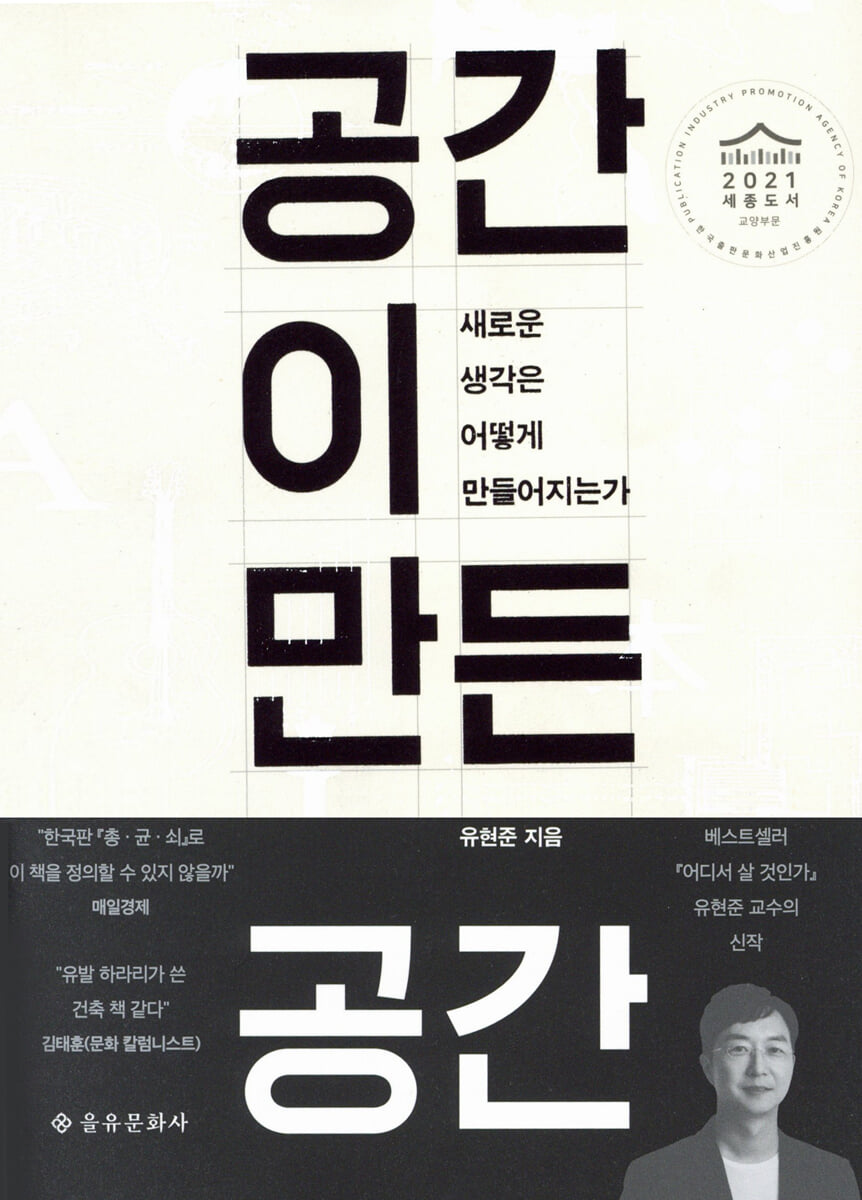
Space created by space
 |
Description
Book Introduction
Books that offer new perspectives are not confined to narrow frameworks. This book is also like that. - Lee Eo-ryeong (former Minister of Culture, literary critic) The agricultural revolution and the formation of cities gave rise to civilization, and efforts to overcome various environmental constraints created culture. In particular, architecture, the physical embodiment of culture, inevitably had to have different styles in the East and the West due to their different climates and environments. This book examines the evolution and genealogy of cultural genes, focusing on space, through which new ideas and cultures are created through cultural exchanges between regions, and through the fusion of fields that gives birth to new cultures. What stage of cultural gene evolution are we at today, and what new things will emerge in the future? The author's intriguing arguments, which explore the origins, creation, exchange, variation, and development of culture, encompassing diverse fields such as science, history, and geography, with a focus on architecture, will provide readers with a captivating reading experience. |
- You can preview some of the book's contents.
Preview
index
Opening Remarks: Climate, Culture, and Varieties
Chapter 1.
Why should we look at the empty spaces in buildings?
space, light, architecture, spatial perception
Chapter 2.
Climate change that gave birth to civilization
Agriculture born from the end of the Ice Age
Adam was expelled from the Garden of Eden
Why the First Civilization Arose in Mesopotamia
Why did it take 6,000 years for the first city to be built?
Giants born in the same era, in different regions
Why is Xi'an further away than Athens?
Chapter 3.
Two Worlds Created by Agriculture
Rice farming or wheat farming?
If you combine two of the following: car, bus, and train
Characteristics of architectural space determined by rainfall
Why Does the East Consider Feng Shui So Important?
What the colors of Dancheong reveal
Western absolute thinking
Socrates, a liberal arts student, and Plato, a science student
What Philosophical Reason and Jesus Have in Common
Eastern relative thinking
The value of emptiness
Chapter 4.
Two different cultural genes
Alphabet vs. Chinese characters
Chess vs. Go
SPACE vs space
Western geometric void
The mathematical evolution of void space in Western architecture
Oriental architecture without any evolution of style
Two children born from rainfall
Same idea, different expressions: painting and architecture
The East is like an ant, the West is like a bee
The Nile River flows north-south vs. the Yellow River flows east-west
Geometry and Taoist Thought Hidden in the Buddhist Temple of Bulguksa
Chapter 5.
How Ceramics Transformed Western Culture
The spatial revolution brought about by the triangular sail
Porcelain that changed Europe
Import of translated books
The transformation of Western space that began with landscaping
From third person point of view to first person point of view
From straight to curved
The Oriental Values Hidden in Calder's Mobiles
Frank Lloyd Wright and the Orient
Chapter 6.
Western spaces that resemble Eastern spaces
Western spaces that resemble the East
Miss van der Rohe and the Orient
Miss van der Rohe, 1st generation.
Brick Country House, 1924: Half a Success
Miss van der Rohe 2nd season.
Barcelona Pavilion, 1929: eaves made of columns
Miss van der Rohe 3rd season.
Hubble House, 1935: A house that looks like jjamppong
Miss van der Rohe 4th generation.
Farnsworth House, 1946: A Korean traditional house made of iron and glass
Le Corbusier's Five Points of Modern Architecture and the Commonalities Between Oriental Architecture
Le Corbusier's first period.
Villa Bacré-Cœur, 1922: Inheriting Western Tradition
Le Corbusier's second period.
Villa Savoye, 1929: Remnants of Geometry
Le Corbusier's third period.
Mill Owners Building, 1954: The emergence of free-form plan
Le Corbusier's 4th period.
Carpenter Center, 1961: Breaking the Square
How Two Masters Created New Ideas: Technology × Different Cultures
Chapter 7.
Second generation of space hybridization
Geometry × Taoism × Jewish culture = Louis Kahn
Reinterpretation of tradition
The Shadow of King Solomon, the Wise King
There is a Lao Tzu inside Louis Kahn
The Dragon Ball of Architecture: Tadao Ando
A fusion of Western geometry and Eastern relationships
Church of Water: Creating Space with Time
Church of the Wind: Relationship Regulator
Architecture that turns the body into a measuring instrument
Oriental layout of Western buildings
Chapter 8.
The era of cross-disciplinary cross-breeding
The End of Geographic Crossbreeding
Crossbreeding with other fields
Crossbreeding with computers
Architecture realized with the help of automobiles and IT
The imagination of computers
Fashion and Architecture: A World of the Same Language
Artificial Intelligence and Architecture
Chapter 9.
The Age of the Virtual New World
Create a new continent
Samsung Electronics, a virtual real estate company
The era of online and offline convergence
A Different Future Dreamed by Hyundai and Toyota
Platform 9 and 3/4 at London King's Cross in Euljiro
Second global warming
How COVID-19 is Changing the Power Structure
Closing Remarks: What Changes and What Doesn't
main
Image source
Chapter 1.
Why should we look at the empty spaces in buildings?
space, light, architecture, spatial perception
Chapter 2.
Climate change that gave birth to civilization
Agriculture born from the end of the Ice Age
Adam was expelled from the Garden of Eden
Why the First Civilization Arose in Mesopotamia
Why did it take 6,000 years for the first city to be built?
Giants born in the same era, in different regions
Why is Xi'an further away than Athens?
Chapter 3.
Two Worlds Created by Agriculture
Rice farming or wheat farming?
If you combine two of the following: car, bus, and train
Characteristics of architectural space determined by rainfall
Why Does the East Consider Feng Shui So Important?
What the colors of Dancheong reveal
Western absolute thinking
Socrates, a liberal arts student, and Plato, a science student
What Philosophical Reason and Jesus Have in Common
Eastern relative thinking
The value of emptiness
Chapter 4.
Two different cultural genes
Alphabet vs. Chinese characters
Chess vs. Go
SPACE vs space
Western geometric void
The mathematical evolution of void space in Western architecture
Oriental architecture without any evolution of style
Two children born from rainfall
Same idea, different expressions: painting and architecture
The East is like an ant, the West is like a bee
The Nile River flows north-south vs. the Yellow River flows east-west
Geometry and Taoist Thought Hidden in the Buddhist Temple of Bulguksa
Chapter 5.
How Ceramics Transformed Western Culture
The spatial revolution brought about by the triangular sail
Porcelain that changed Europe
Import of translated books
The transformation of Western space that began with landscaping
From third person point of view to first person point of view
From straight to curved
The Oriental Values Hidden in Calder's Mobiles
Frank Lloyd Wright and the Orient
Chapter 6.
Western spaces that resemble Eastern spaces
Western spaces that resemble the East
Miss van der Rohe and the Orient
Miss van der Rohe, 1st generation.
Brick Country House, 1924: Half a Success
Miss van der Rohe 2nd season.
Barcelona Pavilion, 1929: eaves made of columns
Miss van der Rohe 3rd season.
Hubble House, 1935: A house that looks like jjamppong
Miss van der Rohe 4th generation.
Farnsworth House, 1946: A Korean traditional house made of iron and glass
Le Corbusier's Five Points of Modern Architecture and the Commonalities Between Oriental Architecture
Le Corbusier's first period.
Villa Bacré-Cœur, 1922: Inheriting Western Tradition
Le Corbusier's second period.
Villa Savoye, 1929: Remnants of Geometry
Le Corbusier's third period.
Mill Owners Building, 1954: The emergence of free-form plan
Le Corbusier's 4th period.
Carpenter Center, 1961: Breaking the Square
How Two Masters Created New Ideas: Technology × Different Cultures
Chapter 7.
Second generation of space hybridization
Geometry × Taoism × Jewish culture = Louis Kahn
Reinterpretation of tradition
The Shadow of King Solomon, the Wise King
There is a Lao Tzu inside Louis Kahn
The Dragon Ball of Architecture: Tadao Ando
A fusion of Western geometry and Eastern relationships
Church of Water: Creating Space with Time
Church of the Wind: Relationship Regulator
Architecture that turns the body into a measuring instrument
Oriental layout of Western buildings
Chapter 8.
The era of cross-disciplinary cross-breeding
The End of Geographic Crossbreeding
Crossbreeding with other fields
Crossbreeding with computers
Architecture realized with the help of automobiles and IT
The imagination of computers
Fashion and Architecture: A World of the Same Language
Artificial Intelligence and Architecture
Chapter 9.
The Age of the Virtual New World
Create a new continent
Samsung Electronics, a virtual real estate company
The era of online and offline convergence
A Different Future Dreamed by Hyundai and Toyota
Platform 9 and 3/4 at London King's Cross in Euljiro
Second global warming
How COVID-19 is Changing the Power Structure
Closing Remarks: What Changes and What Doesn't
main
Image source
Detailed image

Into the book
Following ‘difference’ and ‘fusion’, the element that creates new creations is ‘technology’.
The aforementioned convergence is also a result of advancements in transportation technology.
As transportation develops, the emergence of secondary cultural variants accelerates, and when new technological revolutions are added to this, a major trend emerges in the direction of cultural derivation and combination.
There are many new technological revolutions in different fields.
In architecture, technologies like elevators and reinforced concrete have created new cultural variations.
Masters of modern architecture such as Swiss architect Le Corbusier and German architect Ludwig Mies van der Rohe actively adopted these technologies, which allowed them to create new spaces and open a new era.
--- p.13
The first design field to be influenced by the massive influx of Oriental ceramics into the West was landscaping.
Because the surface of imported porcelain usually had a garden drawn on it.
Westerners were intrigued by the elegant curved roof architecture they had never seen before.
I guess the shock was similar to the shock we felt when we saw curved buildings like Frank Gehry's 'Disney Concert Hall' or Dongdaemun's 'DDP', having grown up seeing only box-like buildings.
While existing European architecture had a rigid, geometric, and straight appearance, the pavilion architecture depicted in the ceramics had a free, curved appearance.
Architecturally, unlike the wall-centered architecture of the West, the buildings depicted in the porcelain paintings were pavilions with only pillars and a roof.
While European gardens had a geometric design of straight lines, the Oriental gardens seen in porcelain had an arrangement of rocks and trees that felt like they had been moved from nature itself.
Westerners began to admire and imitate new gardens and buildings they had never seen before.
The British tradition of building pergolas in their gardens and drinking Chinese tea originated from this time.
This imitation of oriental styles did not stop at gardens but had an impact on the culture as a whole, giving rise to a phenomenon called 'Chinoiserie', which can be said to be a kind of Chinese style similar to today's 'Korean Wave'.
--- p.179
Kahn is an architect who successfully fits the silent void space of the East into the geometric framework of the West.
Louis Kahn is regarded as one of the greatest architects of the late 20th century.
What enabled him to do such creative work lies in his ability to accept and integrate diverse cultures.
If Le Corbusier and Mies, as Western architects, demonstrated the ability to fuse Eastern cultural genes with new modern technologies, Louis Kahn was an architect who, while using modern architectural technologies, simultaneously mixed and fused all the cultural genes he could come into contact with, including Western traditional architecture, Taoist thought, and Jewish culture.
In particular, his unique achievement is that he restored and used the Western traditional cultural genes that had disappeared during the first half of the 20th century.
Solomon's pattern is also a cultural gene from the distant past.
If the fusion achieved by Mies or Le Corbusier is a 'fusion ability that transcends space', borrowing cultural genes from distant places, then Louis Kahn can be said to have a 'fusion ability that transcends time', introducing cultural genes that exist in different time zones.
His 'timeless fusion ability' is what made Khan a great architect.
The aforementioned convergence is also a result of advancements in transportation technology.
As transportation develops, the emergence of secondary cultural variants accelerates, and when new technological revolutions are added to this, a major trend emerges in the direction of cultural derivation and combination.
There are many new technological revolutions in different fields.
In architecture, technologies like elevators and reinforced concrete have created new cultural variations.
Masters of modern architecture such as Swiss architect Le Corbusier and German architect Ludwig Mies van der Rohe actively adopted these technologies, which allowed them to create new spaces and open a new era.
--- p.13
The first design field to be influenced by the massive influx of Oriental ceramics into the West was landscaping.
Because the surface of imported porcelain usually had a garden drawn on it.
Westerners were intrigued by the elegant curved roof architecture they had never seen before.
I guess the shock was similar to the shock we felt when we saw curved buildings like Frank Gehry's 'Disney Concert Hall' or Dongdaemun's 'DDP', having grown up seeing only box-like buildings.
While existing European architecture had a rigid, geometric, and straight appearance, the pavilion architecture depicted in the ceramics had a free, curved appearance.
Architecturally, unlike the wall-centered architecture of the West, the buildings depicted in the porcelain paintings were pavilions with only pillars and a roof.
While European gardens had a geometric design of straight lines, the Oriental gardens seen in porcelain had an arrangement of rocks and trees that felt like they had been moved from nature itself.
Westerners began to admire and imitate new gardens and buildings they had never seen before.
The British tradition of building pergolas in their gardens and drinking Chinese tea originated from this time.
This imitation of oriental styles did not stop at gardens but had an impact on the culture as a whole, giving rise to a phenomenon called 'Chinoiserie', which can be said to be a kind of Chinese style similar to today's 'Korean Wave'.
--- p.179
Kahn is an architect who successfully fits the silent void space of the East into the geometric framework of the West.
Louis Kahn is regarded as one of the greatest architects of the late 20th century.
What enabled him to do such creative work lies in his ability to accept and integrate diverse cultures.
If Le Corbusier and Mies, as Western architects, demonstrated the ability to fuse Eastern cultural genes with new modern technologies, Louis Kahn was an architect who, while using modern architectural technologies, simultaneously mixed and fused all the cultural genes he could come into contact with, including Western traditional architecture, Taoist thought, and Jewish culture.
In particular, his unique achievement is that he restored and used the Western traditional cultural genes that had disappeared during the first half of the 20th century.
Solomon's pattern is also a cultural gene from the distant past.
If the fusion achieved by Mies or Le Corbusier is a 'fusion ability that transcends space', borrowing cultural genes from distant places, then Louis Kahn can be said to have a 'fusion ability that transcends time', introducing cultural genes that exist in different time zones.
His 'timeless fusion ability' is what made Khan a great architect.
--- p.293~294
Publisher's Review
Author Yoo Hyeon-jun usually reads books from other fields rather than those related to his major.
And I like talking to people from other fields or people who think differently from me.
He is good at accepting what the other person is saying and continues the conversation by sharing his own thoughts on what was said.
It is no exaggeration to say that this book was created with this attitude of the author.
This book, which uses a vast range of theories from various fields as solid arguments to support its claims and develops its own ideas based on them, resembles the author himself.
Cultural Evolution Revealed by Spatial Changes
This book tells the story of cultural evolution through exchange, combination, and mutation, focusing on architecture.
Each region has its own geographical and climatic environmental constraints and characteristics, and human efforts to overcome these environmental constraints have created lifestyles and cultures suited to regional characteristics.
Architecture is the physical embodiment of such culture.
Because architecture is a task that requires a tremendous amount of energy and money, it requires the collective wisdom of many people and, on a large scale, social consensus to be able to be created.
Therefore, by looking at the form and shape of the space, we can see the thoughts and culture of the creator.
Therefore, by analyzing and understanding that space, we can understand people and culture.
The author, with his remarkable observation and insight, reinterprets the secrets of the relationships and creations of different cultures, focusing on the process through which different ideas merge and how new ideas are created.
As mentioned earlier, geographical and climatic characteristics create the cultural characteristics of each region.
For example, if the annual rainfall is more than 1,000 millimeters, rice farming is done, and if it is less than that, wheat farming is done, but these two varieties have different farming methods.
Rice farming in areas with a lot of rain required civil engineering work such as building reservoirs, dams, and waterways to prevent damage from floods and droughts.
On the other hand, wheat farming can be done by individuals sowing seeds and does not require large-scale civil engineering work related to water.
Because rice farming required the combined efforts of several people, people in rice farming areas had a strong group consciousness, while wheat farming areas, where people worked alone, showed strong individualism.
These differences in cultural characteristics are also reflected in written language such as the alphabet and Chinese characters, and in game cultures such as chess and baduk.
Climatic differences in rainfall also created differences in architectural design.
Precipitation determines the hardness of the soil.
The land of the West, where there is little rain, is hard.
So Westerners built a wall-centered architecture, using heavy but strong building materials such as stone or brick to support the roof.
On the other hand, in the East, where it rains a lot, the ground becomes soft during the rainy season, so walls made of heavy materials collapse.
Therefore, wood, a light building material, was used, and since wood can rot and collapse when wet, a waterproof material, stone, was used for the part where it met the ground, and a foundation stone was laid, on top of which wooden pillars were erected.
And to prevent the wooden pillars from getting wet from the rain, the eaves were extended to block the rain, and the roof was made to have a steep slope to allow rainwater to flow well.
In this way, oriental architecture became pillar-centered.
Different cultures naturally developed in the East and the West, but as transportation developed and they began to interact with each other, a new culture emerged that fused these different cultures.
Architectural masters such as Frank Lloyd Wright, Mies van der Rohe, and Le Corbusier also adopted the oriental 'column-centered' architecture and created new buildings.
Wall-centered architecture is a structure that inevitably has to be completely divided into the inside and outside, but column-centered architecture has a space with no walls and only a roof, making the boundary between the inside and outside ambiguous.
Spaces like pavilions and verandas are such spaces, and the current 'deck (terrace)' is such a space, becoming an important factor in choosing a house or a cafe to stay in for a while.
Sitting in such a place makes you feel like you are inside while being outside, giving you a sense of openness and stability at the same time.
Following the stories of the world-renowned architects listed above who created buildings influenced by Eastern culture, the emergence of Tadao Ando, an Eastern architect influenced by Kahn and Corbusier, is intriguing.
Tadao Ando joined the ranks of world-renowned architects by creating buildings that fuse Eastern and Western architectural elements, a distinction that sets him apart from existing architects.
Innovation in convergence transcending differences across regions, eras, and fields.
Like creators in various fields, architects have constantly been thinking about creating new spaces.
Such concerns led to the acceptance of cultures from other regions, the application of old cultures, and the creation of new architecture by incorporating various fields such as art, philosophy, IT, and fashion.
Of course, not all fusions were successful.
Deconstructivist architecture, which grafted philosophy onto architecture, ended up being a passing fad, as it created spaces that were far removed from reality, such as staircases with "philosophical concepts" that were blocked even when climbed, and separate bedrooms where couples could not sleep together.
Peter Eisenman, who created bizarre forms with deconstructivism, was able to create free-form architectural designs with the help of new software, but his groundbreaking designs were not supported by construction technology, so few of his buildings were properly built.
Frank Gehry is an architect who has successfully overcome such limitations and turned his curved architectural designs into actual buildings.
He succeeds in reproducing shapes drawn on a computer by adopting techniques used to create cars and airplanes.
Technological advancements have made it possible to present to the world architectural forms that were previously impossible to achieve.
Nowadays, we live in a world where virtual spaces on social media influence real spaces.
So what will influence our culture and space in the coming future? The author argues that a new culture will emerge where digital machines and analog humans converge. He warns that relying solely on technology will lead to the loss of diversity, emphasizing the need to cultivate a sense of humanity.
And he says that what we need in this era is new thinking that can lead conflict to harmony.
And I like talking to people from other fields or people who think differently from me.
He is good at accepting what the other person is saying and continues the conversation by sharing his own thoughts on what was said.
It is no exaggeration to say that this book was created with this attitude of the author.
This book, which uses a vast range of theories from various fields as solid arguments to support its claims and develops its own ideas based on them, resembles the author himself.
Cultural Evolution Revealed by Spatial Changes
This book tells the story of cultural evolution through exchange, combination, and mutation, focusing on architecture.
Each region has its own geographical and climatic environmental constraints and characteristics, and human efforts to overcome these environmental constraints have created lifestyles and cultures suited to regional characteristics.
Architecture is the physical embodiment of such culture.
Because architecture is a task that requires a tremendous amount of energy and money, it requires the collective wisdom of many people and, on a large scale, social consensus to be able to be created.
Therefore, by looking at the form and shape of the space, we can see the thoughts and culture of the creator.
Therefore, by analyzing and understanding that space, we can understand people and culture.
The author, with his remarkable observation and insight, reinterprets the secrets of the relationships and creations of different cultures, focusing on the process through which different ideas merge and how new ideas are created.
As mentioned earlier, geographical and climatic characteristics create the cultural characteristics of each region.
For example, if the annual rainfall is more than 1,000 millimeters, rice farming is done, and if it is less than that, wheat farming is done, but these two varieties have different farming methods.
Rice farming in areas with a lot of rain required civil engineering work such as building reservoirs, dams, and waterways to prevent damage from floods and droughts.
On the other hand, wheat farming can be done by individuals sowing seeds and does not require large-scale civil engineering work related to water.
Because rice farming required the combined efforts of several people, people in rice farming areas had a strong group consciousness, while wheat farming areas, where people worked alone, showed strong individualism.
These differences in cultural characteristics are also reflected in written language such as the alphabet and Chinese characters, and in game cultures such as chess and baduk.
Climatic differences in rainfall also created differences in architectural design.
Precipitation determines the hardness of the soil.
The land of the West, where there is little rain, is hard.
So Westerners built a wall-centered architecture, using heavy but strong building materials such as stone or brick to support the roof.
On the other hand, in the East, where it rains a lot, the ground becomes soft during the rainy season, so walls made of heavy materials collapse.
Therefore, wood, a light building material, was used, and since wood can rot and collapse when wet, a waterproof material, stone, was used for the part where it met the ground, and a foundation stone was laid, on top of which wooden pillars were erected.
And to prevent the wooden pillars from getting wet from the rain, the eaves were extended to block the rain, and the roof was made to have a steep slope to allow rainwater to flow well.
In this way, oriental architecture became pillar-centered.
Different cultures naturally developed in the East and the West, but as transportation developed and they began to interact with each other, a new culture emerged that fused these different cultures.
Architectural masters such as Frank Lloyd Wright, Mies van der Rohe, and Le Corbusier also adopted the oriental 'column-centered' architecture and created new buildings.
Wall-centered architecture is a structure that inevitably has to be completely divided into the inside and outside, but column-centered architecture has a space with no walls and only a roof, making the boundary between the inside and outside ambiguous.
Spaces like pavilions and verandas are such spaces, and the current 'deck (terrace)' is such a space, becoming an important factor in choosing a house or a cafe to stay in for a while.
Sitting in such a place makes you feel like you are inside while being outside, giving you a sense of openness and stability at the same time.
Following the stories of the world-renowned architects listed above who created buildings influenced by Eastern culture, the emergence of Tadao Ando, an Eastern architect influenced by Kahn and Corbusier, is intriguing.
Tadao Ando joined the ranks of world-renowned architects by creating buildings that fuse Eastern and Western architectural elements, a distinction that sets him apart from existing architects.
Innovation in convergence transcending differences across regions, eras, and fields.
Like creators in various fields, architects have constantly been thinking about creating new spaces.
Such concerns led to the acceptance of cultures from other regions, the application of old cultures, and the creation of new architecture by incorporating various fields such as art, philosophy, IT, and fashion.
Of course, not all fusions were successful.
Deconstructivist architecture, which grafted philosophy onto architecture, ended up being a passing fad, as it created spaces that were far removed from reality, such as staircases with "philosophical concepts" that were blocked even when climbed, and separate bedrooms where couples could not sleep together.
Peter Eisenman, who created bizarre forms with deconstructivism, was able to create free-form architectural designs with the help of new software, but his groundbreaking designs were not supported by construction technology, so few of his buildings were properly built.
Frank Gehry is an architect who has successfully overcome such limitations and turned his curved architectural designs into actual buildings.
He succeeds in reproducing shapes drawn on a computer by adopting techniques used to create cars and airplanes.
Technological advancements have made it possible to present to the world architectural forms that were previously impossible to achieve.
Nowadays, we live in a world where virtual spaces on social media influence real spaces.
So what will influence our culture and space in the coming future? The author argues that a new culture will emerge where digital machines and analog humans converge. He warns that relying solely on technology will lead to the loss of diversity, emphasizing the need to cultivate a sense of humanity.
And he says that what we need in this era is new thinking that can lead conflict to harmony.
GOODS SPECIFICS
- Date of issue: April 30, 2020
- Page count, weight, size: 416 pages | 494g | 142*195*30mm
- ISBN13: 9788932474274
- ISBN10: 8932474273
You may also like
카테고리
korean


korean

![GQ KOREA Mark (Monthly): December [2025]](http://librairie.coreenne.fr/cdn/shop/files/8ef265dbbfbf186523ed75ba7319009d.jpg?v=1765340328&width=3840)


