

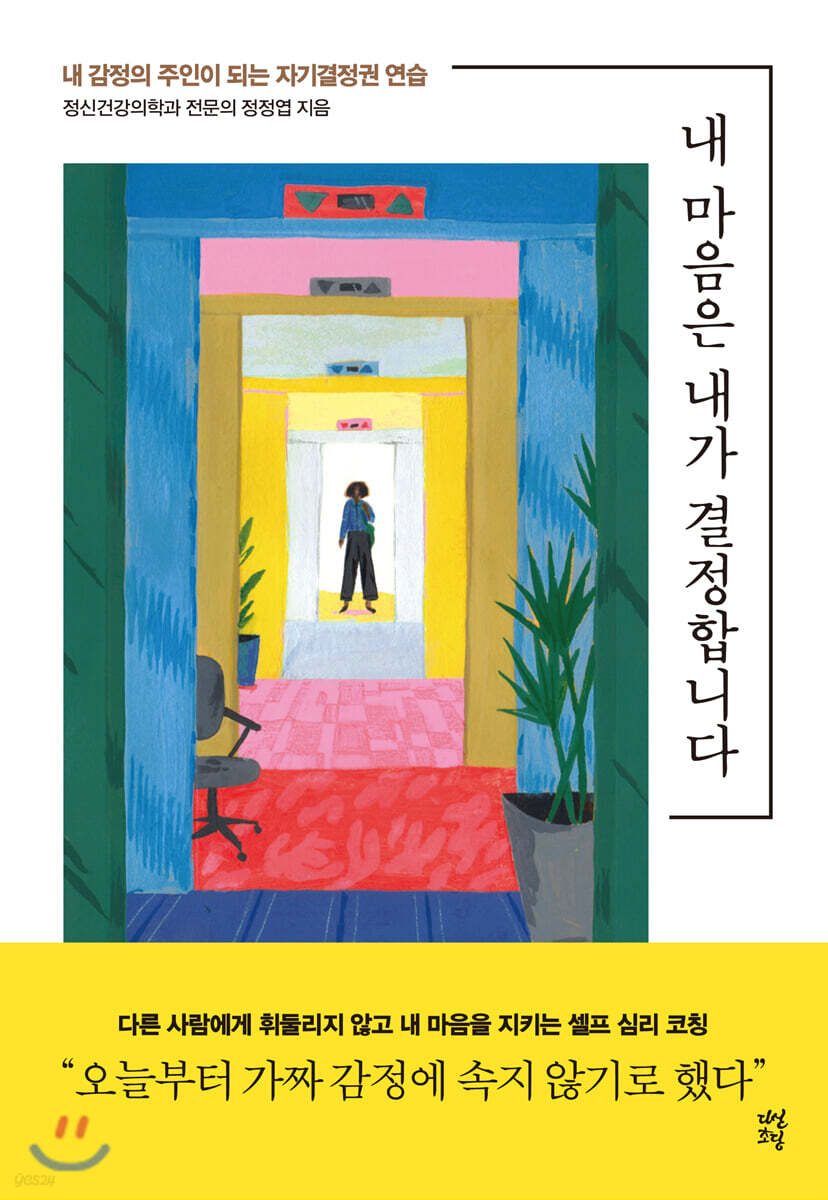
My mind is my decision
 |
Description
Book Introduction
- A word from MD
-
My heart is the most preciousWe live in a time of material abundance, but why are there so many modern people suffering from heartache?
Why do people who seem to have nothing to envy on the outside get depressed?
Could it be that we've neglected our own minds amidst our busy lives? If you're feeling anxious and distressed for no reason, try drawing closer to your heart with this book.
March 27, 2020. Humanities PD Son Min-gyu
Dr. Lee Si-hyung and Professor Yoon Dae-hyun strongly recommend
Free yourself from the trap of the mind that torments you
Self-esteem recovery training that makes you feel positive about yourself
"From today on, I decided not to be fooled by fake emotions."
When did we start prioritizing "must do" over "want to do"? We used to think that once we went to college, got a job, got promoted, and got married, we'd be able to live the way we wanted. But instead, the list of "must dos" as children, lovers, friends, and colleagues only grows longer.
As time goes by, suppressing my thoughts and feelings becomes a habit, and eventually I don't even know what I really want.
Since we have lived according to the gaze of others, it is natural that we feel empty and helpless even when we live diligently.
"My Mind Decides" is a humanistic psychology book that teaches how to manage one's emotions and thoughts written by Dr. Jeong Jeong-yeop, a psychiatrist and founder of Korea's first popular mental health journal, "Psychiatry Newspaper."
People who are smart, observant, quick to notice what others expect of them, take good care of those around them, and work hard are more likely to have a vague sense of self.
When your sense of self is hazy, your emotions, thoughts, and desires are weak, so you easily mistake other people's things for your own. Since everything from small to big choices is in the hands of others, it's only a matter of time before you lose control of your life.
The author recommends that those who have lost control of their lives first take a good look at their own feelings and thoughts.
And for those who don't know where or how to start, we've included a detailed self-psychological coaching process.
Based on psychiatric theory, it faithfully explains how to objectively recognize and digitize emotions and thoughts, and even provides tips that can be applied to daily life based on various clinical experiences.
Life becomes truly free when we know exactly what we want and choose courageously, when the power to decide our lives is in our hands.
Through this book, readers will be freed from the things that have oppressed them, from their work life to their interpersonal relationships, and will come one step closer to becoming the masters of their own lives.
Free yourself from the trap of the mind that torments you
Self-esteem recovery training that makes you feel positive about yourself
"From today on, I decided not to be fooled by fake emotions."
When did we start prioritizing "must do" over "want to do"? We used to think that once we went to college, got a job, got promoted, and got married, we'd be able to live the way we wanted. But instead, the list of "must dos" as children, lovers, friends, and colleagues only grows longer.
As time goes by, suppressing my thoughts and feelings becomes a habit, and eventually I don't even know what I really want.
Since we have lived according to the gaze of others, it is natural that we feel empty and helpless even when we live diligently.
"My Mind Decides" is a humanistic psychology book that teaches how to manage one's emotions and thoughts written by Dr. Jeong Jeong-yeop, a psychiatrist and founder of Korea's first popular mental health journal, "Psychiatry Newspaper."
People who are smart, observant, quick to notice what others expect of them, take good care of those around them, and work hard are more likely to have a vague sense of self.
When your sense of self is hazy, your emotions, thoughts, and desires are weak, so you easily mistake other people's things for your own. Since everything from small to big choices is in the hands of others, it's only a matter of time before you lose control of your life.
The author recommends that those who have lost control of their lives first take a good look at their own feelings and thoughts.
And for those who don't know where or how to start, we've included a detailed self-psychological coaching process.
Based on psychiatric theory, it faithfully explains how to objectively recognize and digitize emotions and thoughts, and even provides tips that can be applied to daily life based on various clinical experiences.
Life becomes truly free when we know exactly what we want and choose courageously, when the power to decide our lives is in our hands.
Through this book, readers will be freed from the things that have oppressed them, from their work life to their interpersonal relationships, and will come one step closer to becoming the masters of their own lives.
- You can preview some of the book's contents.
Preview
index
Prologue_ A Psychological Perspective That Fills the Empty Space in My Heart
Chapter 1 When My Heart Is Not My Own
People who became adults without knowing me
Who has the power to decide my life?
If you see the world in only two colors, black and white
It means that you will soon get sick after being busy.
The right not to be judged, the practice of not judging
Traps of thinking we easily fall into
Chapter 2: Practice Reading My Emotions
No emotions, no decisions
Having a vessel of diverse emotions
Understanding my emotional patterns
Emotions felt unconsciously: depression, anxiety, anger
Learned Emotions: Guilt, Shame
How to make the right decision for the situation
The thoughts behind the emotions
Chapter 3: Breaking Free from Thoughts That Tumble Me Down
Where do the thoughts that bother me come from?
Traps of the Mind, Roots of Thought
I Can't Be Loved: Emotional Deprivation
I'm still lacking: strict standards
I'm Special: A Sense of Privilege
Chapter 4: I Decide Who I Am
Recovering my sense of self
Freedom to choose what I want
Know the reason for the action
What I want to be and what I want to do
Chapter 5: For a Life Free from Anything
The habit of hiding one's heart behind a mask
I want to be recognized, but I don't want to be clingy.
Words that hurt feelings, words that are meant for feelings
Practice ending a relationship
When you have to let go of people who were once precious to you
I, you, and we were not wrong
Epilogue: Our lives have meaning.
Chapter 1 When My Heart Is Not My Own
People who became adults without knowing me
Who has the power to decide my life?
If you see the world in only two colors, black and white
It means that you will soon get sick after being busy.
The right not to be judged, the practice of not judging
Traps of thinking we easily fall into
Chapter 2: Practice Reading My Emotions
No emotions, no decisions
Having a vessel of diverse emotions
Understanding my emotional patterns
Emotions felt unconsciously: depression, anxiety, anger
Learned Emotions: Guilt, Shame
How to make the right decision for the situation
The thoughts behind the emotions
Chapter 3: Breaking Free from Thoughts That Tumble Me Down
Where do the thoughts that bother me come from?
Traps of the Mind, Roots of Thought
I Can't Be Loved: Emotional Deprivation
I'm still lacking: strict standards
I'm Special: A Sense of Privilege
Chapter 4: I Decide Who I Am
Recovering my sense of self
Freedom to choose what I want
Know the reason for the action
What I want to be and what I want to do
Chapter 5: For a Life Free from Anything
The habit of hiding one's heart behind a mask
I want to be recognized, but I don't want to be clingy.
Words that hurt feelings, words that are meant for feelings
Practice ending a relationship
When you have to let go of people who were once precious to you
I, you, and we were not wrong
Epilogue: Our lives have meaning.
Detailed image

Into the book
Before thinking about what to fill my heart with, the first thing to do is to check the empty space in my heart.
If you have never taken care of your mind before, you need to take a fresh look at yourself, discover yourself, and understand yourself, no matter how old you are.
Only then can I live my life firmly without being swayed by the world or pushed around by others.
It means that you will find control over your life.
---From "Prologue_A Psychological Perspective That Fills the Empty Space in My Heart"
What frustrates us is none other than the 'dichotomy' in our minds.
Happiness doesn't come 100 percent.
It always comes with a little bit of misfortune.
Even if you travel to a resort called heaven, you will have to endure some inconveniences.
You may have to haggle with tourist vendors who try to rip you off, and the food may not be to your taste.
Still, I feel happy when I see nice scenery and have a good time.
If you judge by 0:100, there is no happiness in the world.
If we dismiss small joys and pleasures as meaningless and worthless, happiness is excluded from our lives.
---From "If you see the world in only two colors, black and white"
One experiment found that people with damage to the orbitofrontal cortex, which involves emotions in the decision-making process, were unable to make decisions.
The other part of the brain that controls the rational realm was intact, so although I could logically and rationally weigh the pros and cons, I couldn't make any decisions.
The expectation that better decisions would be made without the emotional distractions that interfere with rational action was pleasantly wrong.
The subjects were only able to list the pros and cons, but were unable to choose either option.
The truth is that emotions are the biggest factor in determining behavior.
---From "No Emotions, No Decisions"
People think they see, feel, and live in the same objective world, but in reality, they live in their own subjective world.
The world created by my mind, the subjective world felt by an individual, is called 'psychological reality' in psychological terms.
This is why, when you ask each person later about a situation where three people gathered together and talked, they each remember it differently.
Because each person looks at and accepts things from their own perspective.
So, we must stop judging ourselves negatively and try to see only the objective facts.
---From "The Thoughts Behind Emotions"
Schema, a core term in cognitive behavioral therapy, is simply the root of thought.
It will be easy to understand if you think of it as a basic framework for looking at a situation or your own colored glasses.
Even though the world is made up of tens of thousands of colors, if you wear red glasses and look at it, the world is completely red.
Other colors are excluded. (…) Once this schema takes root, it influences many things because thoughts spread in that direction even without intention.
Self-help books advise us to practice thinking of a half-full glass as “half full” rather than “half empty,” but this is not easy because the roots of our thoughts are so deeply entrenched.
---From "Where do the thoughts that bother me come from?"
British novelist Somerset Maugham said, “The important thing was not to be loved, but to love.”
Of course, the experience of being loved as a child is important.
But we can't stay in the past forever.
Past experiences are not inescapable shackles.
I can't live my life rejecting love, thinking that no one has ever loved me enough, that I've always been unpopular, that no one has ever listened to my story or understood me.
It's a cliché, but there are things that only people can give.
We are too precious to live locked up inside high walls, missing out on the people we love.
---From "I Can't Be Loved: Emotional Deprivation"
At any point in life, at any choice, we must be able to tell ourselves, "Just do it."
Why do we only grant freedom when we're sick and terminally ill? This is like locking yourself in a small prison, perhaps two square meters.
Let's practice making our own decisions, starting with small things.
As you gradually expand the area from 2 pyeong to 4 pyeong, and from 4 pyeong to 8 pyeong, you will come across a field where you can run around freely.
---From "The Freedom to Choose What I Want"
People get scared when I tell them to start revealing themselves little by little and think about becoming more comfortable.
"Will the world change just because I try hard? It's better if I just adapt." Of course, just because I live as myself doesn't mean the world will become more friendly to me the next day.
But then I started to see people similar to me that I hadn't seen before.
It is about discovering the existence of others who lived in a circle in a square country.
We can take comfort in the fact that there are many others who have these concerns.
If you have never taken care of your mind before, you need to take a fresh look at yourself, discover yourself, and understand yourself, no matter how old you are.
Only then can I live my life firmly without being swayed by the world or pushed around by others.
It means that you will find control over your life.
---From "Prologue_A Psychological Perspective That Fills the Empty Space in My Heart"
What frustrates us is none other than the 'dichotomy' in our minds.
Happiness doesn't come 100 percent.
It always comes with a little bit of misfortune.
Even if you travel to a resort called heaven, you will have to endure some inconveniences.
You may have to haggle with tourist vendors who try to rip you off, and the food may not be to your taste.
Still, I feel happy when I see nice scenery and have a good time.
If you judge by 0:100, there is no happiness in the world.
If we dismiss small joys and pleasures as meaningless and worthless, happiness is excluded from our lives.
---From "If you see the world in only two colors, black and white"
One experiment found that people with damage to the orbitofrontal cortex, which involves emotions in the decision-making process, were unable to make decisions.
The other part of the brain that controls the rational realm was intact, so although I could logically and rationally weigh the pros and cons, I couldn't make any decisions.
The expectation that better decisions would be made without the emotional distractions that interfere with rational action was pleasantly wrong.
The subjects were only able to list the pros and cons, but were unable to choose either option.
The truth is that emotions are the biggest factor in determining behavior.
---From "No Emotions, No Decisions"
People think they see, feel, and live in the same objective world, but in reality, they live in their own subjective world.
The world created by my mind, the subjective world felt by an individual, is called 'psychological reality' in psychological terms.
This is why, when you ask each person later about a situation where three people gathered together and talked, they each remember it differently.
Because each person looks at and accepts things from their own perspective.
So, we must stop judging ourselves negatively and try to see only the objective facts.
---From "The Thoughts Behind Emotions"
Schema, a core term in cognitive behavioral therapy, is simply the root of thought.
It will be easy to understand if you think of it as a basic framework for looking at a situation or your own colored glasses.
Even though the world is made up of tens of thousands of colors, if you wear red glasses and look at it, the world is completely red.
Other colors are excluded. (…) Once this schema takes root, it influences many things because thoughts spread in that direction even without intention.
Self-help books advise us to practice thinking of a half-full glass as “half full” rather than “half empty,” but this is not easy because the roots of our thoughts are so deeply entrenched.
---From "Where do the thoughts that bother me come from?"
British novelist Somerset Maugham said, “The important thing was not to be loved, but to love.”
Of course, the experience of being loved as a child is important.
But we can't stay in the past forever.
Past experiences are not inescapable shackles.
I can't live my life rejecting love, thinking that no one has ever loved me enough, that I've always been unpopular, that no one has ever listened to my story or understood me.
It's a cliché, but there are things that only people can give.
We are too precious to live locked up inside high walls, missing out on the people we love.
---From "I Can't Be Loved: Emotional Deprivation"
At any point in life, at any choice, we must be able to tell ourselves, "Just do it."
Why do we only grant freedom when we're sick and terminally ill? This is like locking yourself in a small prison, perhaps two square meters.
Let's practice making our own decisions, starting with small things.
As you gradually expand the area from 2 pyeong to 4 pyeong, and from 4 pyeong to 8 pyeong, you will come across a field where you can run around freely.
---From "The Freedom to Choose What I Want"
People get scared when I tell them to start revealing themselves little by little and think about becoming more comfortable.
"Will the world change just because I try hard? It's better if I just adapt." Of course, just because I live as myself doesn't mean the world will become more friendly to me the next day.
But then I started to see people similar to me that I hadn't seen before.
It is about discovering the existence of others who lived in a circle in a square country.
We can take comfort in the fact that there are many others who have these concerns.
---From "I, you, and we were not wrong"
Publisher's Review
From work life to interpersonal relationships
Psychology classes to free yourself from what oppresses you
"From today on, I decided not to be fooled by fake emotions."
We often find ourselves decorating ourselves without even thinking about it.
Even if you get angry at someone's joke, you try to smile because you think they might be taking it too sensitively. Even if you're worried that things won't go well, you hide your anxiety so you don't look like a weirdo. You choose to do what's required of you rather than what you want to do.
Rather than expressing and following your true feelings, you end up suppressing your emotions and desires and pretending not to know them because you try to fit yourself into a framework of what you think you should do.
Director Jeong Jeong-yeop, author of “I Decide My Mind,” diagnoses that the reason most Koreans feel depressed is because they live with a set standard of living.
And he confesses that he himself has tried very hard to live a life that others would consider decent.
Although I was lucky enough to achieve a few of my goals, the joy of accomplishment was short-lived, and the new goals I set to fill the void continued to pressure me and make things difficult for me.
When we live with the illusion that what is accepted by society is great and that what others expect of us is what we want, life becomes filled with meaninglessness and emptiness.
The author reveals that he found the key to freedom from oppression in psychiatry, and began writing this book for people who, like his former self, are deprived of psychological freedom and have to make important decisions.
This book highlights the author's solid foundation and insight, having treated numerous office workers while running a psychiatric clinic in Gwanghwamun, and having founded and run the [Psychiatry Newspaper], which provides easy and accurate mental health information to the general public, for five years.
Through this book, readers will be freed from the things that have oppressed them, from their work to their relationships, and will get one step closer to a life where they can determine their own emotions and thoughts.
Free yourself from the trap of the mind that torments you
Self-determination exercises that make you feel positive about yourself
Let's say you bump into someone you know on the street and say hello, but they ignore your greeting.
Some people get angry and think, "Are you ignoring me?", others worry, "Did I do something wrong?", and still others shrug it off, saying, "I guess you're busy."
Why do some people waste hours in anger and worry, while others are barely affected by the same situation? Even in the same situation, different emotions can arise depending on how you perceive it.
In other words, if you are often overwhelmed by negative emotions, it means that you often think negative thoughts that trigger those emotions.
People often think that thoughts and emotions are uncontrollable, but that is not true.
The author says that while it's not necessary to examine every thought and emotion, if you're troubled by a thought you can't escape, you should confront and correct the root of that thought.
In any situation, negative thoughts like 'I am not lovable', 'I am not good enough', and 'I am not special' arise because the roots of the thoughts that create those thoughts are deeply rooted in our thoughts.
If we leave it unattended, it becomes a trap in our minds, holding us back from moving forward.
Corrective emotional experience, which is considered a key factor in psychotherapy, changes the roots of thinking.
The author offers words of encouragement to those who cannot love themselves, saying, “It is not that I am lacking, but that the root of my thoughts is what has caused me to suppress myself.”
Life becomes truly free when I can affirm myself and courageously choose my thoughts, when the power to decide my life is in my hands.
If you no longer want to live a life trapped in a narrow world, desperately trying to eliminate fear and sadness, open this book right now.
High self-esteem requires a healthy sense of self.
In recent years, the word "self-esteem" has become popular, and attempts have been made to explain almost every problem in terms of self-esteem.
The word "self-esteem" is commonly used not only on the bestseller shelves of bookstores but also in everyday conversations, and it seems that "high self-esteem" has become another specification.
But is it really all a matter of self-esteem?
The author says that high self-esteem can be built on a healthy sense of self.
If self-esteem is the sense of respecting yourself, then self-awareness is the sense of understanding yourself.
It is important to know how to protect and boost self-esteem without harming it, but what must come first is to establish a correct sense of self, to judge and recognize who you are.
You have to know who you are to be able to respect yourself.
Self-esteem can be easily shaken at any time by surrounding circumstances, reactions from others, etc., but self-sense is fixed and holistic because it is a concept and value system about oneself.
When you have a healthy sense of self, you can respect yourself and be free from the gaze of others.
If you are a reader who has been worried that your self-esteem will not improve no matter how many books you read about self-esteem, let's start with a solid foundation to truly increase self-esteem.
Without being swayed by others
Self-psychological coaching to protect my mind
“There is nothing more dangerous than a life filled only with what others want.”
[Psychiatry Newspaper] receives stories from various people every week in its counseling corner.
Those who sent their stories are all different in where they live, what they do, and their ages, but they all have difficulty taking care of their own hearts.
If you're having trouble maintaining your current situation and want to change something, but don't even know what change you want, you're asking a professional for help.
The author, who realized that many people are unable to hear the voice of their own heart, which is closest to them, has detailed a self-psychological coaching process so that anyone can become the master of their own mind through "My Mind, I Decide" without having to seek out a specialist.
The structure of this book is similar to an actual counseling procedure.
Unlike existing books that list patient cases or illnesses in parallel, this book provides step-by-step solutions so that readers can find the clues to healing themselves.
First, to help discover suppressed emotions, we present an emotion table that classifies about 60 emotions and teach you how to objectively recognize emotions and turn them into data.
It doesn't miss out on finding the root of the thoughts that create painful thoughts and explaining specific actions to correct them.
There are many books that tell us to listen to our hearts, let go of negative thoughts, and look at the world positively, but few books actually teach us how to do it.
This is why the publication of this book is particularly welcome.
The author says, “If you have never taken care of your mind in your life, no matter how old you are, you need to take a fresh look at yourself, discover yourself, and understand yourself.”
If you no longer want to let life take you by surprise, if you find life burdensome and difficult and find yourself feeling helpless, this book will be your most reliable ally in finding a new breakthrough.
Psychology classes to free yourself from what oppresses you
"From today on, I decided not to be fooled by fake emotions."
We often find ourselves decorating ourselves without even thinking about it.
Even if you get angry at someone's joke, you try to smile because you think they might be taking it too sensitively. Even if you're worried that things won't go well, you hide your anxiety so you don't look like a weirdo. You choose to do what's required of you rather than what you want to do.
Rather than expressing and following your true feelings, you end up suppressing your emotions and desires and pretending not to know them because you try to fit yourself into a framework of what you think you should do.
Director Jeong Jeong-yeop, author of “I Decide My Mind,” diagnoses that the reason most Koreans feel depressed is because they live with a set standard of living.
And he confesses that he himself has tried very hard to live a life that others would consider decent.
Although I was lucky enough to achieve a few of my goals, the joy of accomplishment was short-lived, and the new goals I set to fill the void continued to pressure me and make things difficult for me.
When we live with the illusion that what is accepted by society is great and that what others expect of us is what we want, life becomes filled with meaninglessness and emptiness.
The author reveals that he found the key to freedom from oppression in psychiatry, and began writing this book for people who, like his former self, are deprived of psychological freedom and have to make important decisions.
This book highlights the author's solid foundation and insight, having treated numerous office workers while running a psychiatric clinic in Gwanghwamun, and having founded and run the [Psychiatry Newspaper], which provides easy and accurate mental health information to the general public, for five years.
Through this book, readers will be freed from the things that have oppressed them, from their work to their relationships, and will get one step closer to a life where they can determine their own emotions and thoughts.
Free yourself from the trap of the mind that torments you
Self-determination exercises that make you feel positive about yourself
Let's say you bump into someone you know on the street and say hello, but they ignore your greeting.
Some people get angry and think, "Are you ignoring me?", others worry, "Did I do something wrong?", and still others shrug it off, saying, "I guess you're busy."
Why do some people waste hours in anger and worry, while others are barely affected by the same situation? Even in the same situation, different emotions can arise depending on how you perceive it.
In other words, if you are often overwhelmed by negative emotions, it means that you often think negative thoughts that trigger those emotions.
People often think that thoughts and emotions are uncontrollable, but that is not true.
The author says that while it's not necessary to examine every thought and emotion, if you're troubled by a thought you can't escape, you should confront and correct the root of that thought.
In any situation, negative thoughts like 'I am not lovable', 'I am not good enough', and 'I am not special' arise because the roots of the thoughts that create those thoughts are deeply rooted in our thoughts.
If we leave it unattended, it becomes a trap in our minds, holding us back from moving forward.
Corrective emotional experience, which is considered a key factor in psychotherapy, changes the roots of thinking.
The author offers words of encouragement to those who cannot love themselves, saying, “It is not that I am lacking, but that the root of my thoughts is what has caused me to suppress myself.”
Life becomes truly free when I can affirm myself and courageously choose my thoughts, when the power to decide my life is in my hands.
If you no longer want to live a life trapped in a narrow world, desperately trying to eliminate fear and sadness, open this book right now.
High self-esteem requires a healthy sense of self.
In recent years, the word "self-esteem" has become popular, and attempts have been made to explain almost every problem in terms of self-esteem.
The word "self-esteem" is commonly used not only on the bestseller shelves of bookstores but also in everyday conversations, and it seems that "high self-esteem" has become another specification.
But is it really all a matter of self-esteem?
The author says that high self-esteem can be built on a healthy sense of self.
If self-esteem is the sense of respecting yourself, then self-awareness is the sense of understanding yourself.
It is important to know how to protect and boost self-esteem without harming it, but what must come first is to establish a correct sense of self, to judge and recognize who you are.
You have to know who you are to be able to respect yourself.
Self-esteem can be easily shaken at any time by surrounding circumstances, reactions from others, etc., but self-sense is fixed and holistic because it is a concept and value system about oneself.
When you have a healthy sense of self, you can respect yourself and be free from the gaze of others.
If you are a reader who has been worried that your self-esteem will not improve no matter how many books you read about self-esteem, let's start with a solid foundation to truly increase self-esteem.
Without being swayed by others
Self-psychological coaching to protect my mind
“There is nothing more dangerous than a life filled only with what others want.”
[Psychiatry Newspaper] receives stories from various people every week in its counseling corner.
Those who sent their stories are all different in where they live, what they do, and their ages, but they all have difficulty taking care of their own hearts.
If you're having trouble maintaining your current situation and want to change something, but don't even know what change you want, you're asking a professional for help.
The author, who realized that many people are unable to hear the voice of their own heart, which is closest to them, has detailed a self-psychological coaching process so that anyone can become the master of their own mind through "My Mind, I Decide" without having to seek out a specialist.
The structure of this book is similar to an actual counseling procedure.
Unlike existing books that list patient cases or illnesses in parallel, this book provides step-by-step solutions so that readers can find the clues to healing themselves.
First, to help discover suppressed emotions, we present an emotion table that classifies about 60 emotions and teach you how to objectively recognize emotions and turn them into data.
It doesn't miss out on finding the root of the thoughts that create painful thoughts and explaining specific actions to correct them.
There are many books that tell us to listen to our hearts, let go of negative thoughts, and look at the world positively, but few books actually teach us how to do it.
This is why the publication of this book is particularly welcome.
The author says, “If you have never taken care of your mind in your life, no matter how old you are, you need to take a fresh look at yourself, discover yourself, and understand yourself.”
If you no longer want to let life take you by surprise, if you find life burdensome and difficult and find yourself feeling helpless, this book will be your most reliable ally in finding a new breakthrough.
GOODS SPECIFICS
- Date of issue: March 18, 2020
- Page count, weight, size: 280 pages | 398g | 145*210*20mm
- ISBN13: 9791130628776
- ISBN10: 1130628779
You may also like
카테고리
korean


korean

![GQ KOREA Mark (Monthly): December [2025]](http://librairie.coreenne.fr/cdn/shop/files/8ef265dbbfbf186523ed75ba7319009d.jpg?v=1765340328&width=3840)


