

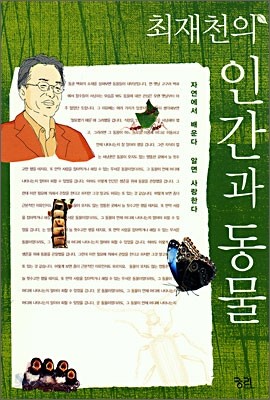
Choi Jae-cheon's Humans and Animals
 |
Description
Book Introduction
The ancient 'ethology' actually began as a practical discipline.
They clearly had a reason to observe animals.
Such animal behaviorism is on the rise again.
It is so pure that it is no longer treated as an antique, but is being reborn as a future discipline with enormous potential for application.
Although humans are the lords of all creation, in fact, human history is incredibly short compared to that of other animals.
We are the youngest animals on Earth, born at most 200,000 years ago.
So, it would be extremely valuable to steal a peek at the answer sheets of other ancestors who were born tens or hundreds of millions of years before us and faced all kinds of problems while living.
Through this book, the author explores animal behavior and the mysterious harmony with nature that we were previously unaware of, and makes us realize how foolish it is for humans to judge the animal world by selfish standards.
Animals are no longer objects of spectacle, objects of capture, or means of making money.
The author strives to understand the animal world 'as it is' and to foster an environmentally friendly attitude that loves nature.
And it makes an interesting comparison between the communication, social life, and sexual life of animals and those of humans.
His lectures are easy, unburdening, and engaging.
This book is a compilation of lectures the author gave on the topic of “Humans and Animals” 26 times a week for six months on the program “EBS World View.”
They clearly had a reason to observe animals.
Such animal behaviorism is on the rise again.
It is so pure that it is no longer treated as an antique, but is being reborn as a future discipline with enormous potential for application.
Although humans are the lords of all creation, in fact, human history is incredibly short compared to that of other animals.
We are the youngest animals on Earth, born at most 200,000 years ago.
So, it would be extremely valuable to steal a peek at the answer sheets of other ancestors who were born tens or hundreds of millions of years before us and faced all kinds of problems while living.
Through this book, the author explores animal behavior and the mysterious harmony with nature that we were previously unaware of, and makes us realize how foolish it is for humans to judge the animal world by selfish standards.
Animals are no longer objects of spectacle, objects of capture, or means of making money.
The author strives to understand the animal world 'as it is' and to foster an environmentally friendly attitude that loves nature.
And it makes an interesting comparison between the communication, social life, and sexual life of animals and those of humans.
His lectures are easy, unburdening, and engaging.
This book is a compilation of lectures the author gave on the topic of “Humans and Animals” 26 times a week for six months on the program “EBS World View.”
- You can preview some of the book's contents.
Preview
index
Author's Note
Lesson 1: If you know, you will love
Lecture 2: Methods and History of Animal Behavior Research
Lecture 3: Evolution and Natural Selection
Lecture 4: The Selfish Gene and Natural Selection
Lesson 5: What is Instinct?
Lesson 6: Animals Teach and Learn Too
Lesson 7: Behavior also resembles parents.
Lesson 8: Visual Men, Auditory Women
Lesson 9: Animals Speak Mainly by Smell
Lesson 10: How Do Ants Speak?
Lesson 11: The Dance of the Bees
Lesson 12 Ritual Behavior in Animal Societies
Lesson 13: Espionage in Animal Society
Lesson 14: Animals' Hide and Seek
Lesson 15: Animals' Sense of Direction
Lesson 16: A Mutually Supportive Society
Lecture 17: The Economics of Behavior
Lesson 18: Behavior and Game Theory
Lesson 19: The Differences Between Male and Female
Lecture 20: Sexual Conflict, Compromise, and Reproduction
Lesson 21: Animals' Love for Their Children
Lesson 22: Are Humans the Only Social Animals?
Lesson 23: Animals Also Participate in Politics
Lecture 24: The Evolution of Body and Mind: Darwinian Medicine
Lesson 25: Why We Should Help Others
Lesson 26: What is Life?
Search
Lesson 1: If you know, you will love
Lecture 2: Methods and History of Animal Behavior Research
Lecture 3: Evolution and Natural Selection
Lecture 4: The Selfish Gene and Natural Selection
Lesson 5: What is Instinct?
Lesson 6: Animals Teach and Learn Too
Lesson 7: Behavior also resembles parents.
Lesson 8: Visual Men, Auditory Women
Lesson 9: Animals Speak Mainly by Smell
Lesson 10: How Do Ants Speak?
Lesson 11: The Dance of the Bees
Lesson 12 Ritual Behavior in Animal Societies
Lesson 13: Espionage in Animal Society
Lesson 14: Animals' Hide and Seek
Lesson 15: Animals' Sense of Direction
Lesson 16: A Mutually Supportive Society
Lecture 17: The Economics of Behavior
Lesson 18: Behavior and Game Theory
Lesson 19: The Differences Between Male and Female
Lecture 20: Sexual Conflict, Compromise, and Reproduction
Lesson 21: Animals' Love for Their Children
Lesson 22: Are Humans the Only Social Animals?
Lesson 23: Animals Also Participate in Politics
Lecture 24: The Evolution of Body and Mind: Darwinian Medicine
Lesson 25: Why We Should Help Others
Lesson 26: What is Life?
Search
Publisher's Review
Born and living tens of millions or hundreds of millions of years before us
Steal the answer sheets of other senior animals who have encountered all kinds of problems!
The diverse landscape of the animal world is just as fascinating as the human world.
1.
Ants demonstrating the prisoner's dilemma game
Aphids are such weak insects that even people who are afraid of insects can kill them by simply rubbing them with their hands.
Ants suck the honeydew of these aphids, but the honeydew that comes out of the aphids is so small that it is almost invisible to the eye, and sometimes it comes out in small drops.
From the ant's point of view, it might be better to just swallow the aphid whole rather than slurp down the sweet nectar little by little.
However, from a long-term perspective, ants do not eat aphids whole because it is advantageous to keep the aphids alive and continue to suck the juice from them.
This habit evolved as ants that began to suck the honeydew from aphids while protecting them rather than eating them eventually achieved greater reproductive success.
This can be explained by the prisoner's dilemma game.
2.
A mandarin duck cheating on his spouse
The mandarin ducks that are given as gifts to married couples in our customs to wish them good luck are not actually the birds we think of.
A male mandarin duck walks around with his wife, and whenever he sees another female, he rapes her in front of her.
In mandarin duck society, the male protects his wife and tries to rape other people's wives.
It's not just mandarin ducks that are like this, but most duck species are like this.
If you look closely enough at the ducks in the park, you will see a common sight.
The story is that many birds we believed to be monogamous were actually cheating, so to speak.
3.
Chimpanzee Three Kingdoms
In chimpanzee societies, males seem to dominate everything, but recent research suggests that in many cases, females are the central force in society.
The so-called political life of a male is very short.
When he is at his strongest, he is on the throne for a while, but if he shows even the slightest weakness, he is attacked by another male and falls over.
Females, on the other hand, enjoy power for a very long time.
Of course, when the dominant male changes, there is the difficulty of having to get along with that dominant male, but in the long run, it is the females who dominate society.
Because females live longer, the idea is that the oldest females eventually dominate society and sit back and dominate.
4.
Animal Spy Wars
Worker ants mistake beetle larvae for ants and bring them home, putting them in their 'baby bag'.
If placed in a room where babies are raised, these larvae will feed on the ant babies.
Although they are clearly different in appearance from ant larvae, the ants are completely unaware of them.
The beetle larvae live a life of incredible espionage, infiltrating the ant larvae and mimicking their codes.
If you dig into an anthill, you will find all sorts of things living there, including beetle larvae and crickets.
The list of insects that live in anthills alone would fill a thick book.
Ultimately, the author's purpose in talking about the world of humans and animals is to think about the essence and meaning of life.
All the stories explored in this book can be said to be, ultimately, an examination of the questions of what it means to live, how we should live, and why we should live, through the eyes of animals.
If we consider the history of the Earth as a day, humans are animals that have only been alive for a few seconds.
Moreover, many biologists believe that it could disappear in a matter of seconds.
It may be recorded as the species that lived the shortest and longest lifespan.
To avoid that, we need to know more about Earth's history and the nature of life.
The more we study, know, and learn about nature, the more we will love ourselves and other animals and plants.
In this way, we can gain the wisdom to live together on this one and only Earth.
Steal the answer sheets of other senior animals who have encountered all kinds of problems!
The diverse landscape of the animal world is just as fascinating as the human world.
1.
Ants demonstrating the prisoner's dilemma game
Aphids are such weak insects that even people who are afraid of insects can kill them by simply rubbing them with their hands.
Ants suck the honeydew of these aphids, but the honeydew that comes out of the aphids is so small that it is almost invisible to the eye, and sometimes it comes out in small drops.
From the ant's point of view, it might be better to just swallow the aphid whole rather than slurp down the sweet nectar little by little.
However, from a long-term perspective, ants do not eat aphids whole because it is advantageous to keep the aphids alive and continue to suck the juice from them.
This habit evolved as ants that began to suck the honeydew from aphids while protecting them rather than eating them eventually achieved greater reproductive success.
This can be explained by the prisoner's dilemma game.
2.
A mandarin duck cheating on his spouse
The mandarin ducks that are given as gifts to married couples in our customs to wish them good luck are not actually the birds we think of.
A male mandarin duck walks around with his wife, and whenever he sees another female, he rapes her in front of her.
In mandarin duck society, the male protects his wife and tries to rape other people's wives.
It's not just mandarin ducks that are like this, but most duck species are like this.
If you look closely enough at the ducks in the park, you will see a common sight.
The story is that many birds we believed to be monogamous were actually cheating, so to speak.
3.
Chimpanzee Three Kingdoms
In chimpanzee societies, males seem to dominate everything, but recent research suggests that in many cases, females are the central force in society.
The so-called political life of a male is very short.
When he is at his strongest, he is on the throne for a while, but if he shows even the slightest weakness, he is attacked by another male and falls over.
Females, on the other hand, enjoy power for a very long time.
Of course, when the dominant male changes, there is the difficulty of having to get along with that dominant male, but in the long run, it is the females who dominate society.
Because females live longer, the idea is that the oldest females eventually dominate society and sit back and dominate.
4.
Animal Spy Wars
Worker ants mistake beetle larvae for ants and bring them home, putting them in their 'baby bag'.
If placed in a room where babies are raised, these larvae will feed on the ant babies.
Although they are clearly different in appearance from ant larvae, the ants are completely unaware of them.
The beetle larvae live a life of incredible espionage, infiltrating the ant larvae and mimicking their codes.
If you dig into an anthill, you will find all sorts of things living there, including beetle larvae and crickets.
The list of insects that live in anthills alone would fill a thick book.
Ultimately, the author's purpose in talking about the world of humans and animals is to think about the essence and meaning of life.
All the stories explored in this book can be said to be, ultimately, an examination of the questions of what it means to live, how we should live, and why we should live, through the eyes of animals.
If we consider the history of the Earth as a day, humans are animals that have only been alive for a few seconds.
Moreover, many biologists believe that it could disappear in a matter of seconds.
It may be recorded as the species that lived the shortest and longest lifespan.
To avoid that, we need to know more about Earth's history and the nature of life.
The more we study, know, and learn about nature, the more we will love ourselves and other animals and plants.
In this way, we can gain the wisdom to live together on this one and only Earth.
GOODS SPECIFICS
- Date of issue: January 15, 2007
- Page count, weight, size: 377 pages | 674g | 153*224*30mm
- ISBN13: 9788958200782
- ISBN10: 8958200782
You may also like
카테고리
korean


korean

![GQ KOREA Mark (Monthly): December [2025]](http://librairie.coreenne.fr/cdn/shop/files/8ef265dbbfbf186523ed75ba7319009d.jpg?v=1765340328&width=3840)


