

The Trap of Intelligence
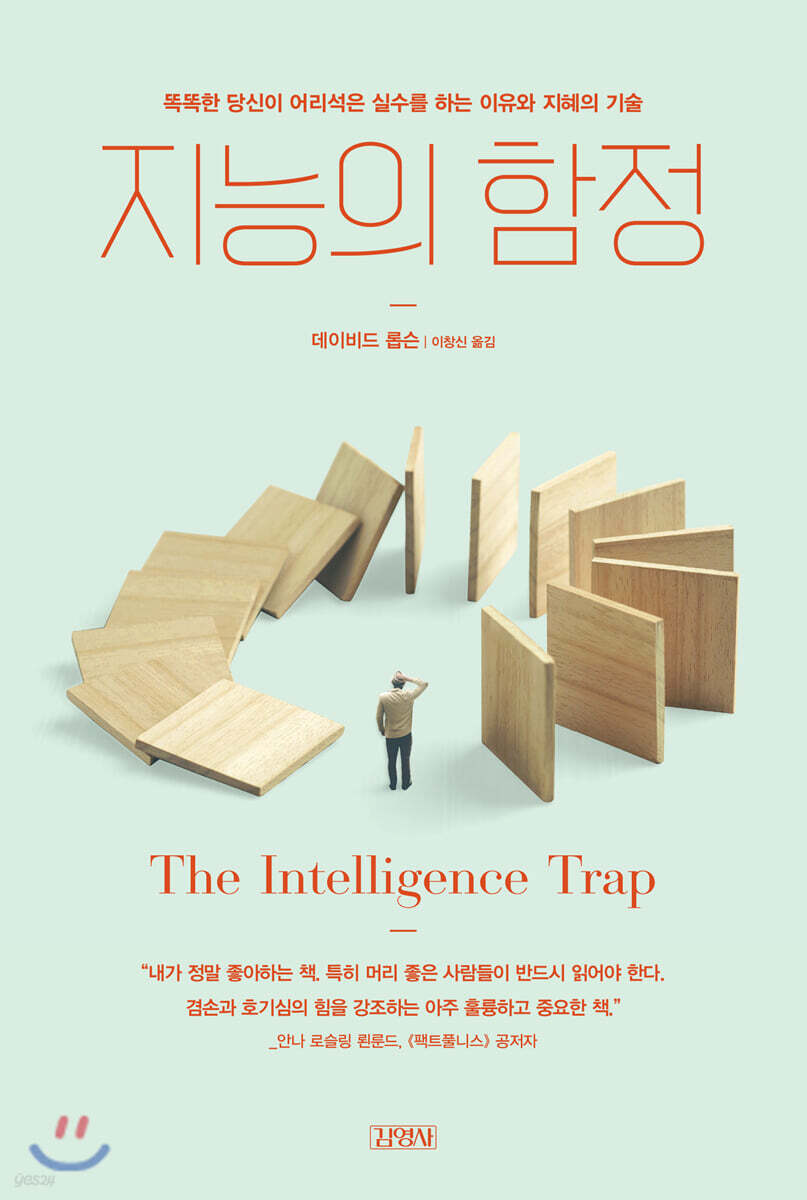 |
Description
Book Introduction
- A word from MD
-
Why is a smart person like that?Sometimes people with exceptional intelligence make ridiculous mistakes or behave strangely.
Carey Mullis, Paul Frampton, and Conan Doyle are examples.
This book teaches you how to become smarter and not become a smart fool by discussing why smart people do stupid things.
January 31, 2020. Humanities PD Son Min-gyu
Why do even the smartest people repeat ridiculous mistakes? Is there a solution?
It is something that cannot be found in existing similar books that have revealed human irrationality.
A concrete way to increase your "realistic wisdom," which is the foundation for balanced thinking and rational judgment!
People with high IQs are more likely to go bankrupt, even if they earn a higher salary.
Experts continue to make bad decisions, and corporate culture encourages "pragmatic stupidity" over critical thinking.
How can intelligence and ability actually lead to misfortune? Drawing on the latest research in psychology and neuroscience, this book reveals why intelligence can be a curse and offers concrete ways to avoid the "intelligence trap."
You are already smart enough.
It just requires the essential wisdom skills to avoid mistakes, avoid being fooled by fake news, and make rational decisions.
It is something that cannot be found in existing similar books that have revealed human irrationality.
A concrete way to increase your "realistic wisdom," which is the foundation for balanced thinking and rational judgment!
People with high IQs are more likely to go bankrupt, even if they earn a higher salary.
Experts continue to make bad decisions, and corporate culture encourages "pragmatic stupidity" over critical thinking.
How can intelligence and ability actually lead to misfortune? Drawing on the latest research in psychology and neuroscience, this book reveals why intelligence can be a curse and offers concrete ways to avoid the "intelligence trap."
You are already smart enough.
It just requires the essential wisdom skills to avoid mistakes, avoid being fooled by fake news, and make rational decisions.
- You can preview some of the book's contents.
Preview
index
Introduction
Part 1: The Intelligence Flaw: How High IQ, Education, and Expertise Encourage Foolish Behavior
Chapter 1: The Rise and Fall of Termites: What Intelligence Is and What It Isn't
Chapter 2: Tangled Arguments: The Dangers of 'Rationality Disorder'
Chapter 3: The Curse of Knowledge: The Advantages and Disadvantages of Expertise
Part 2: Escaping the Intelligence Trap: Tools for Logical Thinking and Decision-Making
Chapter 4: Psychological Algebra: Towards an Evidence-Based Science of Wisdom
Chapter 5: The Emotional Compass: The Power of Self-Reflection
Chapter 6: Bullshit Detection Tools: How to Spot Lies and Misreporting
Part 3: The Art of Learning: How Evidence-Based Wisdom Boosts Memory
Chapter 7: The Tortoise and the Hare: Why Smart People Don't Learn
Chapter 8: The Effects of Seeing the Bitter Taste: Three Principles of East Asian Education and Deep Learning
Part 4: The Foolishness and Wisdom of Crowds: How Teams and Organizations Can Avoid the Intelligence Trap
Chapter 9: Building a "Dream Team": How to Build a Supergroup
Chapter 10: Foolishness Spreads Like Wildfire: Why Disasters Happen and How to Prevent Them
Conclusion
Appendix: Types of Folly and Wisdom
Image/graph source
main
Acknowledgements
Search
Part 1: The Intelligence Flaw: How High IQ, Education, and Expertise Encourage Foolish Behavior
Chapter 1: The Rise and Fall of Termites: What Intelligence Is and What It Isn't
Chapter 2: Tangled Arguments: The Dangers of 'Rationality Disorder'
Chapter 3: The Curse of Knowledge: The Advantages and Disadvantages of Expertise
Part 2: Escaping the Intelligence Trap: Tools for Logical Thinking and Decision-Making
Chapter 4: Psychological Algebra: Towards an Evidence-Based Science of Wisdom
Chapter 5: The Emotional Compass: The Power of Self-Reflection
Chapter 6: Bullshit Detection Tools: How to Spot Lies and Misreporting
Part 3: The Art of Learning: How Evidence-Based Wisdom Boosts Memory
Chapter 7: The Tortoise and the Hare: Why Smart People Don't Learn
Chapter 8: The Effects of Seeing the Bitter Taste: Three Principles of East Asian Education and Deep Learning
Part 4: The Foolishness and Wisdom of Crowds: How Teams and Organizations Can Avoid the Intelligence Trap
Chapter 9: Building a "Dream Team": How to Build a Supergroup
Chapter 10: Foolishness Spreads Like Wildfire: Why Disasters Happen and How to Prevent Them
Conclusion
Appendix: Types of Folly and Wisdom
Image/graph source
main
Acknowledgements
Search
Detailed image

Into the book
According to Kerhan and other scientists who have studied intentional reasoning, smart people don't use their brains properly, but rather "opportunistically" use them to pursue self-interest and protect beliefs that are central to their identity.
In this way, intelligence can become a tool for propaganda rather than truth-seeking.
---「2.
From "Tangled Arguments"
“When you look at a situation from a immersive perspective, it’s easy to focus only on what’s happening to you.
But when you start to give meaning to social distancing, you start to see the situation from a broader perspective and context.”
Cross continued to experiment with distancing himself from me in various ways, but the results were the same each time.
For example, you might imagine me as a fly on the wall or a benevolent observer.
Or I could imagine myself looking back on the past in the distant future, a bit older and wiser.
Just telling my experiences in third person allows me to see things from a different perspective.
---「4.
From "Psychological Algebra"
The benefits of emotional discrimination don't end there.
People who have a precise vocabulary for expressing their emotions not only have easier access to the source of their emotions, but they also have more sophisticated ways to regulate them when they become unmanageable.
If this type of person were to trade stocks, they would likely start over after suffering a series of losses, rather than despairing or taking increasingly risky gambles to recover their losses.
---「5.
From "Emotional Compass"
Porter explained this result:
“When you have a fixed mindset, you always want to know where you stand in the overall hierarchy.
Everyone is arranged in order of rank.
When I'm at the top, I don't want to fall or be dragged down.
So, if I get any indication that I don't know something or that someone else knows more than me, I see it as a threat to oust me from power." This kind of defense of one's position leads to overly defensive behavior.
“I ignore other people’s opinions because I think, ‘I know better, so I don’t need to listen to you.’”
---「7.
From "The Tortoise and the Hare"
Ultimately, the secret to making wise decisions in an organization is very similar to the secret to making wise decisions in an intelligent individual.
Whether you're a forensic scientist, a doctor, a student, a teacher, a financial expert, or an aerospace engineer, if you humbly acknowledge your limitations and fallibility, tolerate ambiguity and uncertainty, embrace new information with curiosity, recognize the potential for growth and learning from your mistakes, and actively question everything, you'll be rewarded.
In this way, intelligence can become a tool for propaganda rather than truth-seeking.
---「2.
From "Tangled Arguments"
“When you look at a situation from a immersive perspective, it’s easy to focus only on what’s happening to you.
But when you start to give meaning to social distancing, you start to see the situation from a broader perspective and context.”
Cross continued to experiment with distancing himself from me in various ways, but the results were the same each time.
For example, you might imagine me as a fly on the wall or a benevolent observer.
Or I could imagine myself looking back on the past in the distant future, a bit older and wiser.
Just telling my experiences in third person allows me to see things from a different perspective.
---「4.
From "Psychological Algebra"
The benefits of emotional discrimination don't end there.
People who have a precise vocabulary for expressing their emotions not only have easier access to the source of their emotions, but they also have more sophisticated ways to regulate them when they become unmanageable.
If this type of person were to trade stocks, they would likely start over after suffering a series of losses, rather than despairing or taking increasingly risky gambles to recover their losses.
---「5.
From "Emotional Compass"
Porter explained this result:
“When you have a fixed mindset, you always want to know where you stand in the overall hierarchy.
Everyone is arranged in order of rank.
When I'm at the top, I don't want to fall or be dragged down.
So, if I get any indication that I don't know something or that someone else knows more than me, I see it as a threat to oust me from power." This kind of defense of one's position leads to overly defensive behavior.
“I ignore other people’s opinions because I think, ‘I know better, so I don’t need to listen to you.’”
---「7.
From "The Tortoise and the Hare"
Ultimately, the secret to making wise decisions in an organization is very similar to the secret to making wise decisions in an intelligent individual.
Whether you're a forensic scientist, a doctor, a student, a teacher, a financial expert, or an aerospace engineer, if you humbly acknowledge your limitations and fallibility, tolerate ambiguity and uncertainty, embrace new information with curiosity, recognize the potential for growth and learning from your mistakes, and actively question everything, you'll be rewarded.
---「10.
From “Foolishness Spreads Like Wildfire”
From “Foolishness Spreads Like Wildfire”
Publisher's Review
Is intelligence a blessing or a curse?
We need to change the formula 'IQ=smart'!
Conan Doyle, the creator of Sherlock Holmes, sincerely believed in ghosts. Apple co-founder Steve Jobs hastened his death by ignoring his doctor's advice and trying to beat cancer with a botched cure. The FBI, investigating the 2004 Madrid bombings that killed 192 people and injured over 2,000, was forced to issue a humiliating apology after falsely blaming an innocent man. And the Miami Heat, despite being overflowing with gifted players, finished last in the NBA's 2010-2011 season.
How on earth does such a remarkable brain and talent produce such absurd results? Is intelligence a blessing, or a curse?
This book shows how the two extremes of intelligence and stupidity are connected, and then argues that the equation 'IQ = smart' needs to be changed.
Just because you're smart doesn't mean you're everything.
The key is to use that good head properly.
Recent research in psychology and neuroscience reveals that the correlation between intelligence and rationality is far from perfect.
Rather, the smarter you are, the more likely you are to become a know-it-all, falling into bias and rationalization.
What are some of these "intelligence traps" that cannot be explained by lack of knowledge or experience, and how can we escape them?
The paradox that the smarter you are, the more stupid you become
From intentional inference to fixation, how the traps of intelligence work.
A person who falls into the trap of intelligence has locked himself in a 'logic blocking room'.
This is because we fall into the trap of intentional inference, bias blind spots, rationality failure, self-inflicted dogmatism, and fixation.
People who are trapped in their own worldview tend to use their brains defensively (intentional inference) only when the conclusion matches their original purpose, and thus tend to find flaws in others while ignoring the biases and errors in their own logic (bias blind spot).
They also tend to rearrange or ignore objective evidence in strange ways, leading to irrational conclusions that confirm their own biases (rationality disorder).
A closed mindset (self-inflicted dogmatism) that believes in one's own expertise and thus has the right to ignore the perspectives of others leads to a phenomenon (fixation) where thoughts and judgments become fixed in one direction and lose flexibility.
After opening his own practice as a doctor, Arthur Conan Doyle, who was so brilliant that he wrote the outstanding detective novels called the Sherlock Holmes series, devoted all his intellectual power to believing in fairies.
The reason why fairies are invisible to the human eye was also explained 'scientifically' by citing electromagnetic theory.
He regarded the 'fairy pictures' made by young students as convincing evidence to spread the word about psychic phenomena, and the pin marks in the pictures appeared to be the fairy's belly button.
It was evidence that fairies were connected to their mothers through the umbilical cord in the womb.
Conan Doyle's case illustrates how a brilliant person can misuse his good head, using it 'opportunistically' to pursue self-interest and protect the beliefs that are most important to his identity.
It emerged to utilize intelligence rationally and creatively.
The Science of Wisdom Presented by 'Evidence-Based Wisdom'
This betrayal of intelligence has given rise to a new science that redefines logical thinking beyond traditional definitions of intelligence.
This is the background to the emergence of 'evidence-based wisdom', which the author emphasizes.
"Evidence-based wisdom" is a new field modeled after "evidence-based medicine," which emphasizes questioning conventional wisdom and considering all relevant evidence when making decisions. It studies wisdom, the practical ability to rationally and creatively solve everyday problems. It presents wisdom techniques that mitigate and prevent the risks inherent in "general intelligence," as measured by IQ tests and the College Scholastic Ability Test (CSAT).
emotional compass
The ability to recognize and dissect one's own thoughts and feelings to understand their true nature is essential to logical thinking.
Research has shown that interviewers are more likely to reject an applicant if the weather is bad when they first see them.
To make rational decisions, you must not believe your feelings at face value, but critically analyze them and ignore them if they are irrelevant.
Psychological Algebra
A method of writing down the pros and cons of an issue, then simultaneously crossing off pros and cons of equal importance from the list, and then making a final judgment based on the contents of the remaining items.
This strategy, devised by Benjamin Franklin, the founder of the U.S. Constitution, can help correct the biased tendency to make decisions based on the first piece of information that comes to mind.
Socratic effect
As a form of looking at it from a different perspective, imagine explaining your problem to a child.
It can reduce the self-centered 'hot' cognition that fuels bias.
Observing yourself from a distance, as a third party, allows you to see things from a broader perspective and context with an open mind, helping you avoid becoming stuck in a rut.
intellectual humility
The ability to acknowledge the limitations of one's own judgment and try to compensate for the possibility of error.
It's an important but often overlooked trait, especially for leaders.
An attitude of acknowledging one's ignorance and limitations promotes a growth mindset and helps prevent dogmatic reasoning.
pre-mortem examination
A narrow-minded and unquestioning attitude can also benefit an organization.
This is a common "practical foolishness" that can be easily found within a company, and a pre-mortem is effective in avoiding it.
Thinking about worst-case scenarios before making decisions and considering all the factors that could lead to that situation can improve your resilience.
“A balanced, wise way of thinking, unlike intelligence, can be learned and improved through effort!”
A guide to practical wisdom like never before
The thinking skills that 'evidence-based wisdom' suggests, unlike intelligence, can be trained, so anyone, regardless of IQ, can learn to think more wisely.
Studies have shown that practicing defining your own problems, exploring different perspectives, imagining different outcomes for an event, and identifying faulty arguments can help you develop the ability to think wisely.
Above all, it is encouraging that qualities such as the ability to understand other people's perspectives and intellectual humility are better predictors of happiness than intelligence alone.
There have already been many similar books published that deal with human irrationality, but they all stop at analyzing the causes of mistakes and errors.
On the other hand, 『The Intelligence Trap』 focuses on redefining intelligence and presenting concrete solutions by introducing the results of scientific research on wisdom.
If you want to understand why, despite the increasing number of intelligent people, more and more are swayed by fake news and indifferent to climate change, and if you want practical ways to correct such irrational tendencies, this book should be your first guide.
We need to change the formula 'IQ=smart'!
Conan Doyle, the creator of Sherlock Holmes, sincerely believed in ghosts. Apple co-founder Steve Jobs hastened his death by ignoring his doctor's advice and trying to beat cancer with a botched cure. The FBI, investigating the 2004 Madrid bombings that killed 192 people and injured over 2,000, was forced to issue a humiliating apology after falsely blaming an innocent man. And the Miami Heat, despite being overflowing with gifted players, finished last in the NBA's 2010-2011 season.
How on earth does such a remarkable brain and talent produce such absurd results? Is intelligence a blessing, or a curse?
This book shows how the two extremes of intelligence and stupidity are connected, and then argues that the equation 'IQ = smart' needs to be changed.
Just because you're smart doesn't mean you're everything.
The key is to use that good head properly.
Recent research in psychology and neuroscience reveals that the correlation between intelligence and rationality is far from perfect.
Rather, the smarter you are, the more likely you are to become a know-it-all, falling into bias and rationalization.
What are some of these "intelligence traps" that cannot be explained by lack of knowledge or experience, and how can we escape them?
The paradox that the smarter you are, the more stupid you become
From intentional inference to fixation, how the traps of intelligence work.
A person who falls into the trap of intelligence has locked himself in a 'logic blocking room'.
This is because we fall into the trap of intentional inference, bias blind spots, rationality failure, self-inflicted dogmatism, and fixation.
People who are trapped in their own worldview tend to use their brains defensively (intentional inference) only when the conclusion matches their original purpose, and thus tend to find flaws in others while ignoring the biases and errors in their own logic (bias blind spot).
They also tend to rearrange or ignore objective evidence in strange ways, leading to irrational conclusions that confirm their own biases (rationality disorder).
A closed mindset (self-inflicted dogmatism) that believes in one's own expertise and thus has the right to ignore the perspectives of others leads to a phenomenon (fixation) where thoughts and judgments become fixed in one direction and lose flexibility.
After opening his own practice as a doctor, Arthur Conan Doyle, who was so brilliant that he wrote the outstanding detective novels called the Sherlock Holmes series, devoted all his intellectual power to believing in fairies.
The reason why fairies are invisible to the human eye was also explained 'scientifically' by citing electromagnetic theory.
He regarded the 'fairy pictures' made by young students as convincing evidence to spread the word about psychic phenomena, and the pin marks in the pictures appeared to be the fairy's belly button.
It was evidence that fairies were connected to their mothers through the umbilical cord in the womb.
Conan Doyle's case illustrates how a brilliant person can misuse his good head, using it 'opportunistically' to pursue self-interest and protect the beliefs that are most important to his identity.
It emerged to utilize intelligence rationally and creatively.
The Science of Wisdom Presented by 'Evidence-Based Wisdom'
This betrayal of intelligence has given rise to a new science that redefines logical thinking beyond traditional definitions of intelligence.
This is the background to the emergence of 'evidence-based wisdom', which the author emphasizes.
"Evidence-based wisdom" is a new field modeled after "evidence-based medicine," which emphasizes questioning conventional wisdom and considering all relevant evidence when making decisions. It studies wisdom, the practical ability to rationally and creatively solve everyday problems. It presents wisdom techniques that mitigate and prevent the risks inherent in "general intelligence," as measured by IQ tests and the College Scholastic Ability Test (CSAT).
emotional compass
The ability to recognize and dissect one's own thoughts and feelings to understand their true nature is essential to logical thinking.
Research has shown that interviewers are more likely to reject an applicant if the weather is bad when they first see them.
To make rational decisions, you must not believe your feelings at face value, but critically analyze them and ignore them if they are irrelevant.
Psychological Algebra
A method of writing down the pros and cons of an issue, then simultaneously crossing off pros and cons of equal importance from the list, and then making a final judgment based on the contents of the remaining items.
This strategy, devised by Benjamin Franklin, the founder of the U.S. Constitution, can help correct the biased tendency to make decisions based on the first piece of information that comes to mind.
Socratic effect
As a form of looking at it from a different perspective, imagine explaining your problem to a child.
It can reduce the self-centered 'hot' cognition that fuels bias.
Observing yourself from a distance, as a third party, allows you to see things from a broader perspective and context with an open mind, helping you avoid becoming stuck in a rut.
intellectual humility
The ability to acknowledge the limitations of one's own judgment and try to compensate for the possibility of error.
It's an important but often overlooked trait, especially for leaders.
An attitude of acknowledging one's ignorance and limitations promotes a growth mindset and helps prevent dogmatic reasoning.
pre-mortem examination
A narrow-minded and unquestioning attitude can also benefit an organization.
This is a common "practical foolishness" that can be easily found within a company, and a pre-mortem is effective in avoiding it.
Thinking about worst-case scenarios before making decisions and considering all the factors that could lead to that situation can improve your resilience.
“A balanced, wise way of thinking, unlike intelligence, can be learned and improved through effort!”
A guide to practical wisdom like never before
The thinking skills that 'evidence-based wisdom' suggests, unlike intelligence, can be trained, so anyone, regardless of IQ, can learn to think more wisely.
Studies have shown that practicing defining your own problems, exploring different perspectives, imagining different outcomes for an event, and identifying faulty arguments can help you develop the ability to think wisely.
Above all, it is encouraging that qualities such as the ability to understand other people's perspectives and intellectual humility are better predictors of happiness than intelligence alone.
There have already been many similar books published that deal with human irrationality, but they all stop at analyzing the causes of mistakes and errors.
On the other hand, 『The Intelligence Trap』 focuses on redefining intelligence and presenting concrete solutions by introducing the results of scientific research on wisdom.
If you want to understand why, despite the increasing number of intelligent people, more and more are swayed by fake news and indifferent to climate change, and if you want practical ways to correct such irrational tendencies, this book should be your first guide.
GOODS SPECIFICS
- Date of issue: January 13, 2020
- Page count, weight, size: 432 pages | 665g | 182*220*24mm
- ISBN13: 9788934900115
- ISBN10: 8934900113
You may also like
카테고리
korean


korean

![GQ KOREA Mark (Monthly): December [2025]](http://librairie.coreenne.fr/cdn/shop/files/8ef265dbbfbf186523ed75ba7319009d.jpg?v=1765340328&width=3840)


