

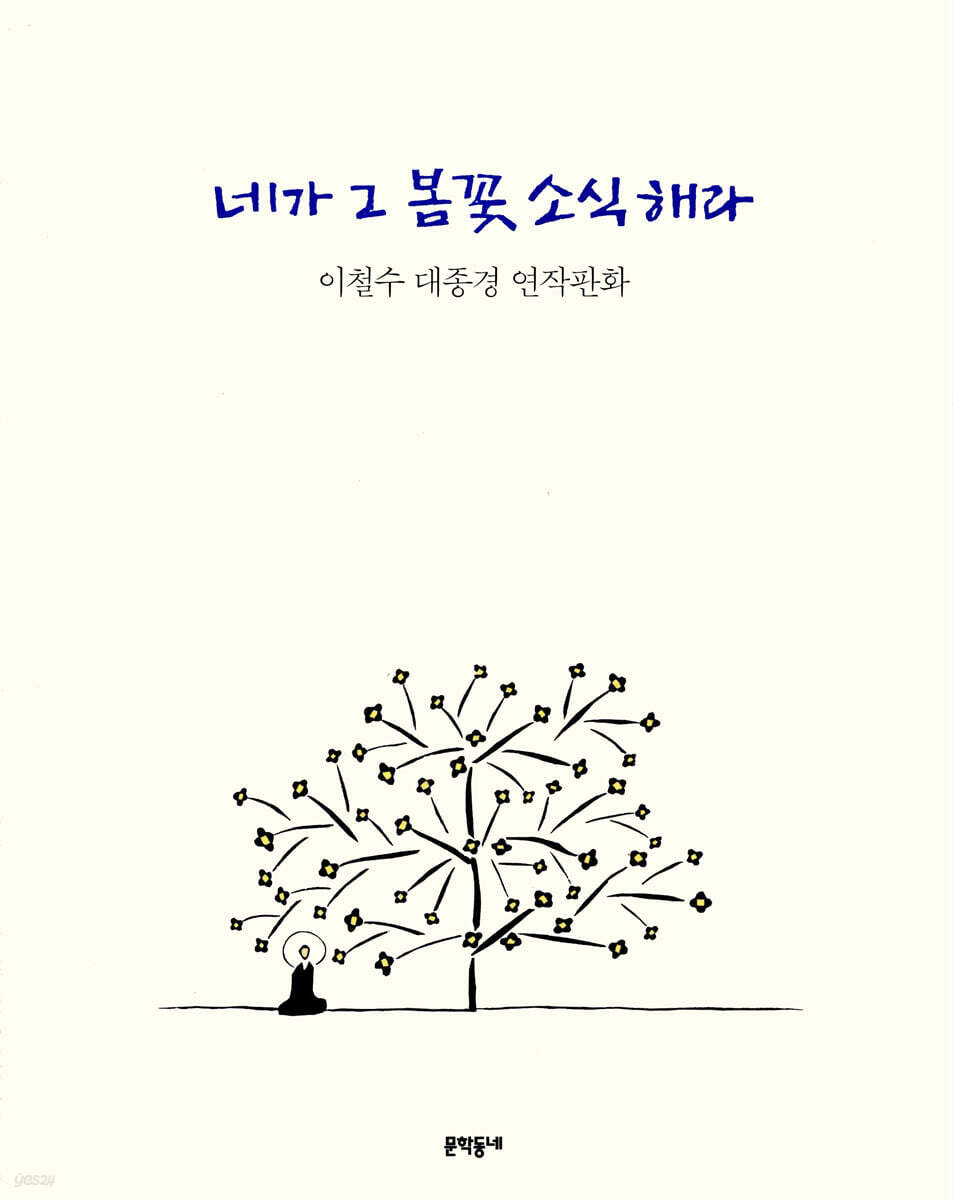
You tell me about the spring flowers
 |
Description
Book Introduction
Lee Cheol-su, a folk printmaker of our time who has been breathing in step with modern Korean history.
He, who has carved enlightenment into everyday life with “the language of the spirit based on the Eastern view of nature” (poet and art critic Jo Jeong-gwon) and an elegant painting style, has published a series of prints of the Daejonggyeong, “You Tell Us About That Spring Flower,” to commemorate the 100th anniversary of Won Buddhism.
After pondering the Won Buddhism scriptures countless times for three years, the meaning was engraved on woodblocks, printed on paper, and colored, resulting in a total of 203 woodblock prints.
It was not originally intended to promote a specific religion.
It is the fruit of deep thought that resonated between the teacher's spirit, which never let go of the topics of the time, and the ideas of Won Buddhism.
The founding motto of Won Buddhism, “As matter is being reformed, let us reform our spirit,” poses a valuable question that modern people should ponder in their hearts at least once, as the human spirit, unable to keep up with the torrent of material things, loses its balance and wavers.
He, who has carved enlightenment into everyday life with “the language of the spirit based on the Eastern view of nature” (poet and art critic Jo Jeong-gwon) and an elegant painting style, has published a series of prints of the Daejonggyeong, “You Tell Us About That Spring Flower,” to commemorate the 100th anniversary of Won Buddhism.
After pondering the Won Buddhism scriptures countless times for three years, the meaning was engraved on woodblocks, printed on paper, and colored, resulting in a total of 203 woodblock prints.
It was not originally intended to promote a specific religion.
It is the fruit of deep thought that resonated between the teacher's spirit, which never let go of the topics of the time, and the ideas of Won Buddhism.
The founding motto of Won Buddhism, “As matter is being reformed, let us reform our spirit,” poses a valuable question that modern people should ponder in their hearts at least once, as the human spirit, unable to keep up with the torrent of material things, loses its balance and wavers.
- You can preview some of the book's contents.
Preview
Detailed image
Into the book
Someone once said that reading a book is a journey that takes place while sitting down.
This trip was a learning journey.
As I was reflecting on the trip, I thought about what was most memorable for me during the entire trip.
My choice is [Zen meditation]. (Page 39) Another print of the teacher I saw some time ago, “An apple fell.”
They say it's because of universal gravitation.
There is a feeling of pleasure like, “It’s because the time has come.”
Everyone is meditating, but where can you find meditation as good as a rock? A rock that stands firm, unshaken by wind and rain, unshaken by time, silently guarding its position, looking in the same direction.
Shouldn't all meditation be like this? I liked that simple gaze.
(…) The word from twenty years ago came to mind again.
No foot support.
It's a blessing.
The fact that I can continue my relationship with a teacher who lives a pure life.
The fact that there is a senior in life who constantly stimulates me.
--- Park Woong-hyun, from “If you read, feel, and if you feel, act”
The world is full of tempting things.
There are many new inventions that break down the barriers between matter and spirit.
It is a world that shakes the very foundation of life.
It's clear that we live in an era where we can feel qualitative change, but it's confusing.
I stand in the midst of a whirlwind of change, bewildered.
Because change is not in our hands.
I'm afraid of being left out one way or another.
Do you know the saying, "As matter is being transformed, let us transform our spirit?" Are we now witnessing the "transformation of matter"? Perhaps! Certainly! We are already living through this transformation.
The chaos and crisis of reality speak volumes about the 'great change' in matter.
It is natural and urgent that there should be a 'great change' in the mind that will not be played around by the tricks of material things.
(…) In the midst of an unprecedented and unprecedented material transformation, we can only make the ‘transformation of the mind’, which will be an infinite challenge for the spirit, the topic of the times.
With that in mind, I created a series of prints.
It is thanks to wisdom that foolishness is pushed aside.
Now I'm putting it out there.
The wisdom of the Great Sutra is great and deep, but what I have brought up is small and shallow.
The great ocean of wisdom must be encountered separately.
This trip was a learning journey.
As I was reflecting on the trip, I thought about what was most memorable for me during the entire trip.
My choice is [Zen meditation]. (Page 39) Another print of the teacher I saw some time ago, “An apple fell.”
They say it's because of universal gravitation.
There is a feeling of pleasure like, “It’s because the time has come.”
Everyone is meditating, but where can you find meditation as good as a rock? A rock that stands firm, unshaken by wind and rain, unshaken by time, silently guarding its position, looking in the same direction.
Shouldn't all meditation be like this? I liked that simple gaze.
(…) The word from twenty years ago came to mind again.
No foot support.
It's a blessing.
The fact that I can continue my relationship with a teacher who lives a pure life.
The fact that there is a senior in life who constantly stimulates me.
--- Park Woong-hyun, from “If you read, feel, and if you feel, act”
The world is full of tempting things.
There are many new inventions that break down the barriers between matter and spirit.
It is a world that shakes the very foundation of life.
It's clear that we live in an era where we can feel qualitative change, but it's confusing.
I stand in the midst of a whirlwind of change, bewildered.
Because change is not in our hands.
I'm afraid of being left out one way or another.
Do you know the saying, "As matter is being transformed, let us transform our spirit?" Are we now witnessing the "transformation of matter"? Perhaps! Certainly! We are already living through this transformation.
The chaos and crisis of reality speak volumes about the 'great change' in matter.
It is natural and urgent that there should be a 'great change' in the mind that will not be played around by the tricks of material things.
(…) In the midst of an unprecedented and unprecedented material transformation, we can only make the ‘transformation of the mind’, which will be an infinite challenge for the spirit, the topic of the times.
With that in mind, I created a series of prints.
It is thanks to wisdom that foolishness is pushed aside.
Now I'm putting it out there.
The wisdom of the Great Sutra is great and deep, but what I have brought up is small and shallow.
The great ocean of wisdom must be encountered separately.
--- Lee Cheol-su, from “To the Sea of Wisdom on a Boat of One”
Publisher's Review
The new Daejonggyeong bloomed from the tip of Lee Cheol-su's sword,
Illuminating the path of clear truth
The doctrines of Won Buddhism are designed to be easily learned by anyone, regardless of age or gender, regardless of academic background or experience.
In particular, the 'Daejonggyeong', which records the words of Daejongsa Sotaesan, the founder of Won Buddhism, is full of truths explained in familiar everyday language, unlike other difficult scriptures.
The sermon that runs through the Daejonggyeong is the phrase, “What everyone in the world can practice is the great way of the world, and what only a few can practice is the small way.”
In addition to the broad vision that anyone can become a Buddha, he added the realization that the path practiced in everyday life is the 'true path'.
This sutra approaches us in a friendly manner without any empty words, lowering its knees and looking into our eyes affectionately as we all live in the everyday world, and teaches us through personal practice.
In front of it, the boundaries of specific religions have already melted away.
The light of Zen, which equally illuminates and comforts all things, is in exquisite harmony with Lee Cheol-su's uniquely refreshing and powerful lines.
The format of printmaking is also perfect.
Printmaking, which allows for the production of the same work over and over again from a single plate, may be the art form closest to the boundless wisdom of ‘having more than enough to use’.
Because a single painting, completed with the effort of one person, reaches an infinite number of people, planting the seeds of infinite enlightenment in each of their hearts.
Moreover, Lee Cheol-su devoted himself solely to woodblock printing, using only a sword as a plow, and diligently pursued woodblock printing throughout his life, as if he were seeking enlightenment.
This is why his work seems to overlap with the asceticism of a monk.
Because of this, woodblock prints gained recognition, and because of this, the taste and style of woodblock prints finally became popular.
He is a 'sword-wielding seeker'.
May a beautiful spring flower bloom in our hearts
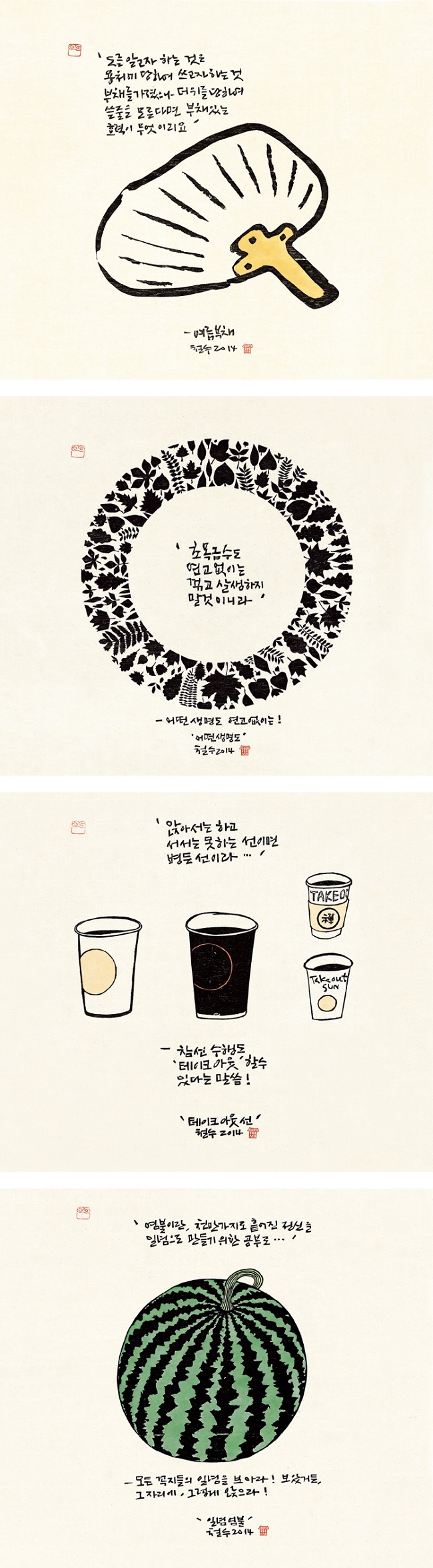
『You tell me about the spring flowers』 contains three woodblock prints arranged in a separate volume and 200 woodblock prints that embody the Buddhist scriptures and sermons in the Won Buddhism Canon and Daejonggyeong.
As explained by Park Woong-hyun, an advertiser and writer, the greatest charm of Lee Cheol-su's prints lies in the thrilling sharpness of his "quick and blunt" jabs.
If you are absorbed in the elegant and simple painting style and the lingering feeling of white space, you will suddenly feel a pang in the back of your head and realize something.
The Zen-like phrases in Lee Cheol-su's woodblock prints often end with exclamation marks, and when I look at those straight lines, I feel as if a firm and solid foundation is being engraved in my heart.
Then, when I encounter a certain piece of work, my mouth falls open in shock as it clears my mind.
It is [Zazen] (page 39).
The state of saying everything in a few lines without using a single sentence or word.
This work, which seems to have been sublimated by embracing the masterpiece [Monk Chanting the Buddha] by Danwon Kim Hong-do on a woodblock, is one of the most sculptural masterpieces that best embodies what Lee Cheol-su pursues.
The text in the prints was translated into English one by one and placed next to the corresponding works.
The purpose is to convey the profound meaning contained in this simple print to people all over the world.
The commentary covering the entire collection of woodblock prints was also carefully included to follow the characteristics of the Daejonggyeong.
Park Woong-hyun removes specialized knowledge about art or religion from his commentary and reads this book from the perspective of a general reader.
Thanks to this, we can read and empathize with this collection of prints without any burden, and naturally understand the world of Lee Cheol-su's prints.
For readers who, after encountering the prints, would like to find and read related scripture passages, excerpts from the scriptures included in the prints have also been added to the end of the book.
It is the hope of Professor Lee Cheol-su that this book will be a complete help in our study of the mind.
The Daejonggyeong, which is given significant treatment in the woodblock print collection, is published separately as a single volume by Munhakdongne.
Like the spring breeze that blows equally because it has no self-interest, the truth of one's unity conveyed by Lee Cheol-su reaches every corner of our hearts through this book.
Now it's our turn to be that 'spring flower news'.
I hope that a beautiful spring flower will bloom in that still rough field of the heart.
Recommendation
Artist Lee Cheol-su, who is loved by many for his unique woodblock prints created while living as a rural farmer, created a series of prints of the Daejonggyeong to commemorate the 100th anniversary of Won Buddhism, the indigenous religion of this land.
I hope that this will be a great blessing for me, and that it will also be an opportunity for the public of our time to become closer to the teachings of Master Sotaesan, and for the religious order to more faithfully fulfill its mission as a new religion that embraces Confucianism, Buddhism, Taoism, Christianity, and even modern scientific civilization.
_- Baek Nak-cheong (literary critic, professor emeritus at Seoul National University)
Illuminating the path of clear truth
The doctrines of Won Buddhism are designed to be easily learned by anyone, regardless of age or gender, regardless of academic background or experience.
In particular, the 'Daejonggyeong', which records the words of Daejongsa Sotaesan, the founder of Won Buddhism, is full of truths explained in familiar everyday language, unlike other difficult scriptures.
The sermon that runs through the Daejonggyeong is the phrase, “What everyone in the world can practice is the great way of the world, and what only a few can practice is the small way.”
In addition to the broad vision that anyone can become a Buddha, he added the realization that the path practiced in everyday life is the 'true path'.
This sutra approaches us in a friendly manner without any empty words, lowering its knees and looking into our eyes affectionately as we all live in the everyday world, and teaches us through personal practice.
In front of it, the boundaries of specific religions have already melted away.
The light of Zen, which equally illuminates and comforts all things, is in exquisite harmony with Lee Cheol-su's uniquely refreshing and powerful lines.
The format of printmaking is also perfect.
Printmaking, which allows for the production of the same work over and over again from a single plate, may be the art form closest to the boundless wisdom of ‘having more than enough to use’.
Because a single painting, completed with the effort of one person, reaches an infinite number of people, planting the seeds of infinite enlightenment in each of their hearts.
Moreover, Lee Cheol-su devoted himself solely to woodblock printing, using only a sword as a plow, and diligently pursued woodblock printing throughout his life, as if he were seeking enlightenment.
This is why his work seems to overlap with the asceticism of a monk.
Because of this, woodblock prints gained recognition, and because of this, the taste and style of woodblock prints finally became popular.
He is a 'sword-wielding seeker'.
May a beautiful spring flower bloom in our hearts
『You tell me about the spring flowers』 contains three woodblock prints arranged in a separate volume and 200 woodblock prints that embody the Buddhist scriptures and sermons in the Won Buddhism Canon and Daejonggyeong.
As explained by Park Woong-hyun, an advertiser and writer, the greatest charm of Lee Cheol-su's prints lies in the thrilling sharpness of his "quick and blunt" jabs.
If you are absorbed in the elegant and simple painting style and the lingering feeling of white space, you will suddenly feel a pang in the back of your head and realize something.
The Zen-like phrases in Lee Cheol-su's woodblock prints often end with exclamation marks, and when I look at those straight lines, I feel as if a firm and solid foundation is being engraved in my heart.
Then, when I encounter a certain piece of work, my mouth falls open in shock as it clears my mind.
It is [Zazen] (page 39).
The state of saying everything in a few lines without using a single sentence or word.
This work, which seems to have been sublimated by embracing the masterpiece [Monk Chanting the Buddha] by Danwon Kim Hong-do on a woodblock, is one of the most sculptural masterpieces that best embodies what Lee Cheol-su pursues.
The text in the prints was translated into English one by one and placed next to the corresponding works.
The purpose is to convey the profound meaning contained in this simple print to people all over the world.
The commentary covering the entire collection of woodblock prints was also carefully included to follow the characteristics of the Daejonggyeong.
Park Woong-hyun removes specialized knowledge about art or religion from his commentary and reads this book from the perspective of a general reader.
Thanks to this, we can read and empathize with this collection of prints without any burden, and naturally understand the world of Lee Cheol-su's prints.
For readers who, after encountering the prints, would like to find and read related scripture passages, excerpts from the scriptures included in the prints have also been added to the end of the book.
It is the hope of Professor Lee Cheol-su that this book will be a complete help in our study of the mind.
The Daejonggyeong, which is given significant treatment in the woodblock print collection, is published separately as a single volume by Munhakdongne.
Like the spring breeze that blows equally because it has no self-interest, the truth of one's unity conveyed by Lee Cheol-su reaches every corner of our hearts through this book.
Now it's our turn to be that 'spring flower news'.
I hope that a beautiful spring flower will bloom in that still rough field of the heart.
Recommendation
Artist Lee Cheol-su, who is loved by many for his unique woodblock prints created while living as a rural farmer, created a series of prints of the Daejonggyeong to commemorate the 100th anniversary of Won Buddhism, the indigenous religion of this land.
I hope that this will be a great blessing for me, and that it will also be an opportunity for the public of our time to become closer to the teachings of Master Sotaesan, and for the religious order to more faithfully fulfill its mission as a new religion that embraces Confucianism, Buddhism, Taoism, Christianity, and even modern scientific civilization.
_- Baek Nak-cheong (literary critic, professor emeritus at Seoul National University)
GOODS SPECIFICS
- Date of publication: October 13, 2015
- Format: Hardcover book binding method guide
- Page count, weight, size: 492 pages | 1,312g | 190*245*30mm
- ISBN13: 9788954637824
- ISBN10: 8954637825
You may also like
카테고리
korean


korean

![GQ KOREA Mark (Monthly): December [2025]](http://librairie.coreenne.fr/cdn/shop/files/8ef265dbbfbf186523ed75ba7319009d.jpg?v=1765340328&width=3840)


