

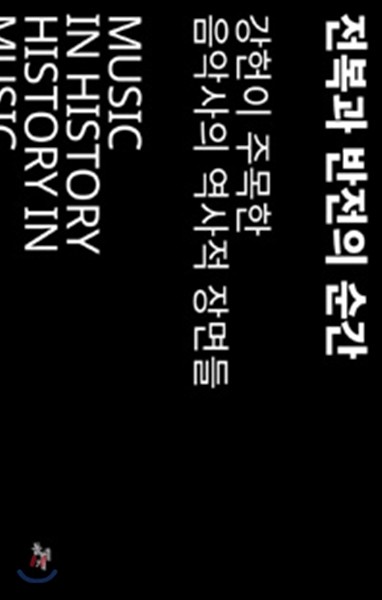
Moments of Subversion and Reversal Vol. 1
 |
Description
Book Introduction
This book, "Moments of Subversion and Reversal," presented to readers with the subtitle "Historical Scenes in Music History Focused on by Kang Heon," presents a new way of reading that discovers the multi-layered meaning of certain moments in past history by indiscriminately questioning things that were taken for granted through music, an art genre closely connected to the public, and is an all-round cultural history that travels the space and time of its meaning both vertically and horizontally.
This book is largely divided into four chapters. Chapter 1, under the title “Art Manifesto of Minority,” talks about “jazz and rock and roll” that shook America in the early and mid-20th century; Chapter 2, under the title “The Wind of Youth Culture Blows,” talks about the acoustic guitar music and group sounds that sprouted and grew in poor Korea when rock and roll was sweeping the world from America; Chapter 3, under the title “Anti-classicism in Classics,” talks about Mozart and Beethoven, who were active mainly in Vienna before and after the French Revolution; and Chapter 4, under the title “Two Conspiracies,” talks about [Ode to Death] and [Tears of Mokpo], which struck and influenced Korean society from just before the Japanese colonial period to after liberation. Although this book is largely divided into four chapters, the four stories do not simply stand side by side. Each of the four chapters seems to be divided into two stories, and then those two stories are re-interpreted as one story. And each of these four stories combines into one large thread that runs through the entire book, ultimately leading to a change in perspective on cultural history as a whole through music, beyond the organization of individual information and facts. |
- You can preview some of the book's contents.
Preview
index
In publishing the book
1 Minority Art Manifesto: Jazz and the Rock and Roll Revolution
Jazz and rock and roll are other names for the revolution in which lower-class African Americans, descendants of slaves, and teenagers who had never had their own culture seized cultural power for the first time in human history.
2. The Winds of Youth Culture Blow: The Guitar Revolution and Group Sound
If there was a rock and roll revolution in the United States in the 1950s, a new wind called the acoustic guitar revolution created the first youth culture on poor college campuses in South Korea in the late 1960s.
Although acoustic guitar music quickly took over the mainstream music market, the Park Chung-hee military regime labeled this youth culture a cultural enemy, and the voices of these young people were executed in broad daylight during the Fourth Republic.
3 Anti-Classical Music in Classical Music: Mozart's Complaints and Beethoven's Struggle
Wolfgang Amadeus Mozart was not a musical prodigy, but a dreamer who dreamed of becoming a citizen artist in the heart of the Viennese court, and his successor, Ludwig van Beethoven, was not a musician, but a realist who sought to realize the ideals of republicanism on the staff.
Both of them were irregular workers their entire lives.
4 Secrets Hidden in Two Conspiracies [Ode to Death] and [Tears of Mokpo]
The history of Korean popular music opens dramatically with the shocking sensationalism of the "double suicide in the Genkai Sea."
[Praise of Death] Behind the syndrome, there was a conspiracy of Japanese imperialist music capital.
With this syndrome as a stepping stone, Japanese enka culture completed its landing on the Korean Peninsula in 1935 with [Tears of Mokpo], and trot, the Korean version of enka, emerged as the first mainstream genre.
Recommended for further reading
1 Minority Art Manifesto: Jazz and the Rock and Roll Revolution
Jazz and rock and roll are other names for the revolution in which lower-class African Americans, descendants of slaves, and teenagers who had never had their own culture seized cultural power for the first time in human history.
2. The Winds of Youth Culture Blow: The Guitar Revolution and Group Sound
If there was a rock and roll revolution in the United States in the 1950s, a new wind called the acoustic guitar revolution created the first youth culture on poor college campuses in South Korea in the late 1960s.
Although acoustic guitar music quickly took over the mainstream music market, the Park Chung-hee military regime labeled this youth culture a cultural enemy, and the voices of these young people were executed in broad daylight during the Fourth Republic.
3 Anti-Classical Music in Classical Music: Mozart's Complaints and Beethoven's Struggle
Wolfgang Amadeus Mozart was not a musical prodigy, but a dreamer who dreamed of becoming a citizen artist in the heart of the Viennese court, and his successor, Ludwig van Beethoven, was not a musician, but a realist who sought to realize the ideals of republicanism on the staff.
Both of them were irregular workers their entire lives.
4 Secrets Hidden in Two Conspiracies [Ode to Death] and [Tears of Mokpo]
The history of Korean popular music opens dramatically with the shocking sensationalism of the "double suicide in the Genkai Sea."
[Praise of Death] Behind the syndrome, there was a conspiracy of Japanese imperialist music capital.
With this syndrome as a stepping stone, Japanese enka culture completed its landing on the Korean Peninsula in 1935 with [Tears of Mokpo], and trot, the Korean version of enka, emerged as the first mainstream genre.
Recommended for further reading
Publisher's Review
A new way of reading music history that transcends time and space,
A comprehensive cultural history that reads the other side of history and the times
Music exists like air in everyday life.
While countless genres of art offer a choice to the public, music is an exception, often being distributed indiscriminately to the public outside of that choice.
If art has the property of reflecting human history, then music, from its birth to its demise, is deeply connected to the political and cultural fields of its time.
Therefore, looking into that era through music or musicians is a very effective window and effective method that goes beyond understanding the music itself and reading the other side of the era to looking at the present day, which is closely connected to the past.
That window can sometimes be a single song, or a genre that suddenly appeared and took the world by storm, or someone who remains a shining star in human history, or someone who was a contemporary trend, a mainstream phenomenon, but has now disappeared into the back alleys of time.
This book, "Moments of Subversion and Reversal," presented to readers with the subtitle "Historical Scenes in Music History Focused on by Kang Heon," presents a new way of reading that discovers the multi-layered meaning of certain moments in past history by indiscriminately questioning things that were taken for granted through music, an art genre closely connected to the public, and is an all-round cultural history that travels the space and time of its meaning both vertically and horizontally.
This book is largely divided into four chapters.
Chapter 1, under the title “Art Manifesto of Minority,” talks about “jazz and rock and roll” that shook America in the early and mid-20th century; Chapter 2, under the title “The Wind of Youth Culture Blows,” talks about the acoustic guitar music and group sounds that sprouted and grew in poor Korea when rock and roll was sweeping the world from America; Chapter 3, under the title “Anti-classicism in Classics,” talks about Mozart and Beethoven, who were active mainly in Vienna before and after the French Revolution; and Chapter 4, under the title “Two Conspiracies,” talks about [Ode to Death] and [Tears of Mokpo], which struck and influenced Korean society from just before the Japanese colonial period to after liberation.
Although this book is largely divided into four chapters, the four stories do not simply stand side by side.
Each of the four chapters seems to be divided into two stories, and then those two stories are re-interpreted as one story.
And each of these four stories combines into one large thread that runs through the entire book, ultimately leading to a change in perspective on cultural history as a whole through music, beyond the organization of individual information and facts.
From American history to the Vienna court and modern and contemporary Korean history
Historical scenes from music history that Kang Heon noticed
Jazz and rock and roll should not be viewed simply as the emergence of new musical genres.
The history of suffering that America endured from the 17th century to the early 20th century served as the backdrop for the birth of jazz and its development into a music for people all over the world.
Chapter 1 begins with a story about the historical background of the birth of jazz in New Orleans, and how it blossomed in New York via Chicago, becoming a global culture.
Centered around this axis, the story unfolds through the wars between Europe and the New World, the Great Depression, and the two World Wars, and the process of the United States becoming the world's hegemon. The story naturally connects to rock and roll after jazz.
Then, from the emergence of Elvis Presley, who stood at the beginning of rock and roll, which was at the end of jazz, to the Beatles, the story unfolds about how a culture that had been the exclusive domain of adults came to be led by American teenagers during this period, how the United States, already a wealthy, powerful nation with a middle class, responded to the emergence of a new culture, and how that response, in turn, expanded its cultural influence.
It is interesting to examine the rough and tumble nature of American adults, or the establishment, in the face of the emergence of a new culture, as well as the meaning of rock and roll fashion, thereby not missing the diverse symbolic world of that culture.
Chapter 2 moves to South Korea.
What happened to us when rock and roll was in full bloom among teenagers in America?
If teenagers were at the center of America's cultural transformation, we have young people in their 20s at the forefront.
The consideration of why it was an acoustic guitar and not rock and roll and how difficult the beginning of the group sound was is clear, but also sad.
However, this book does not make the mistake of comparing our cultural phenomena with the cultural changes centered in the United States.
By describing Western culture, represented by the United States, and at the same time examining the process of accumulating our own cultural history that had already been formed before, we examine in detail the significance of our cultural phenomena during this period.
Moreover, the way the American older generation viewed the newly emerging rock and roll and the heartbreaking stories that unfolded in our cultural history during the Park Chung-hee regime, also known as the Fourth Republic, provide a poignant insight into what happened at the beginning of the musical freedom we enjoy today in the 21st century.
Of course, it goes beyond simply looking into the cultural landscape of the time, and it also makes us look again at the reality of today's popular music scene, which is very different from that time.
The story then jumps forward in time and space, and in Chapter 3, it moves to the court of 18th-century Vienna.
The characters appearing here are Mozart and Beethoven, whom we are familiar with.
However, Chapter 3 does not stop at simply introducing the lives and works of the two people.
By examining the era of Bach and Haydn, which existed before the musical world they dreamed of, we examine in detail how Mozart could be Mozart and how Beethoven could become Beethoven.
With this, we can meet Mozart, free from the superficial label of a genius child prodigy.
Moreover, we can understand how he tried to establish his presence in court society based on his talent, and face the reality of Mozart, who tried to be recognized by the world based solely on his talent, regardless of social status, but was frustrated.
Beethoven is no different.
By revisiting the questions about how he, who wore long pants his entire life and considered himself a republican, expressed his musical world in reality, and how he escaped the conventional view of being called a musical saint and even a musical saint, and the stories that are considered common sense surrounding him, we can gain a much more sophisticated understanding of him.
By examining the lives of Mozart and Beethoven, the book examines the changing course of European history around the French Revolution, the success and failure of the revolution, and the political reality of Vienna, which returned to conservatism thereafter. It examines what was possible in Beethoven's time but not in Mozart's, and what made their lives different.
In short, in Mozart's time, it was impossible to make an independent living as a musician without the support of a noble or courtier.
But the times Beethoven lived in were different.
This completely changed the dreams and lives of the two men as musicians.
When we look at the lives of these two people within the context of the times, we can clearly see that whether or not they achieve their dreams as musicians during their lifetime is not solely a matter of innate talent or personal effort, but rather an absolute causal relationship with the background of the times in which they lived.
Again, the story takes place before the guitar revolution mentioned in Chapter 2, before and after the Japanese colonial period.
Chapter 4 is a truly epic drama that unfolds through two songs: [Hymn of Death], which is known as the tragic ending of the impossible love between the beautiful soprano singer Yun Sim-deok and the Japanese exchange student Kim Woo-jin, and [Tears of Mokpo], in which Lee Nan-young's voice seems to naturally ring in your ears.
Turning the pages is breathless, from the correlation between enka and trot, the process by which Western music was introduced to us in the modern era, the emergence of completely different facts surrounding [Ode to Death], and the rise of pro-Japanese collaborators to the question of how our past, which has not been liquidated since liberation, remains not only in politics but also in our cultural world.
From the Donghak Peasant Revolution in the distant past to the Seoul National University comprehensive presentation after liberation, countless characters from Jeon Bong-jun to Hyeon Je-myeong appear, and you will experience a surprising overturning of your existing perceptions.
The new context created by events in music history,
The meaning and value of historical events revealed in that context
Author Kang Heon does not treat the countless incidents and individual characters covered in this book separately.
By constantly revealing the position each thing occupies within the coordinates of human history, along with other historical events, it allows readers to view things from a broader perspective, rather than confining their gaze to the current era and region they are reading about.
First, let's look at the first chapter, which starts with the story of jazz and rock and roll.
First, it helps you gain a basic understanding of jazz by covering the background of its birth, the origin of its name, and legendary musicians.
This leads the reader into an increasingly detailed story, starting with the basic common sense that jazz originated from black slaves brought to America and the significance of the first album released in 1917 in the history of jazz.
But the story he tells isn't just about jazz.
His unique reading method, encompassing East and West, modern and contemporary, is expressed as follows.
For example, he mentions the year 1917 at the beginning of the first chapter, and while he mentions that this year is an important year in the music genre of jazz, he also reminds us that this was the year that Park Chung-hee, an important figure in the history of the Republic of Korea, was born, the year that Lee Gwang-su's "Heartlessness" was published, and the year that Lenin's Russian Revolution took place.
This allows us to take a macroscopic look at where a historical fact is situated in the coordinates of world history as a whole, rather than fixating it under a regional category.
He also praises jazz and rock and roll as symbols of a great transformation that led to the greatest change in the history of human art, and compares their value to the French Revolution of 1789, clearly explaining the weight of the historical significance of jazz and rock and roll.
That is, by mentioning a historical event and recalling it in a different context and comparing its value and meaning, historical information that was previously known in a linear and fragmentary manner is transformed into a richer, multi-layered meaning.
This book also guides us to understand its essence and meaning much more clearly through various anecdotes of people who were active against the backdrop of cultural history.
Instead of explaining the musical essence of jazz at length, it allows readers to intuitively understand its essence by juxtaposing the definition of classical music by Leonard Bernstein, the permanent conductor of the New York Philharmonic, with an anecdote about Lester Young, the great saxophonist active from the 1930s to the 1950s.
Examples like this abound throughout the text.
By juxtaposing the emergence of Han Dae-soo in 1969 with Park Chung-hee's third constitutional amendment, it allows us to view the misfortunes of modern Korean history that followed for the next 11 years not simply as a struggle between military dictatorship and democracy, but as a history of the struggle of young people against the established generation or vested interests. It also clearly shows how the cultural clashes of this period were specifically revealed through the history of album jacket changes from Im Ja-ja to Patty Kim to Yang Hee-eun, and from Bae Ho to Twin Folio to Kim Min-ki.
Also, in order to understand Mozart and Beethoven, we examine the dispositions of their fathers, and although they were active with a relatively short gap of 14 years, we examine how much the world changed before and after the French Revolution in the meantime, and how such a changed historical background influenced the musical activities of these two men. By doing so, we clearly show how much the times have an impact on a musician, separate from individual talent and effort.
Also, although [Ode to Death] is widely known as the backstory of an impossible love, it focuses on the opportunity and background for Western musical grammar to suddenly flow into our cultural sphere because of it, and the fact that [Tears of Mokpo] was released in 1935, meaning that this song came out a generation after the 1905 Eulsa Treaty, when our sovereignty was effectively taken away by Japan, and that it is a trot format thoroughly derived from enka, serves as evidence that the musical grammar of Japanese enka has been internalized within us, and brings to mind the strange paradox of singing about national resistance with the most imperialistic grammar.
I thought I knew it, but I didn't really know it
A provocative question mark that fills a void in cultural history
The interesting point of this book is not only that it allows us to read history in a new way by recombining information across time and space.
More noteworthy than that are the provocative questions and issues this book poses to readers.
Some of the main ones are as follows:
1.
How Jazz Legend Louis Armstrong Became a Star
-He was an excellent trumpet player and a natural vocalist.
Moreover, he has an outstanding sense of humor.
But that's not all.
When he was at the height of his power, black Americans were fighting fiercely against racial discrimination.
But he never spoke or acted on behalf of black people for even a moment.
From the white people's perspective, he was a loyal Uncle Tom, and for that reason, white people continued to love him.
Louis Armstrong's conformist ideology is what made him a perennial star.
2.
Was Elvis Presley, the King of Rock 'n' Roll, really a representative of teenagers?
-Elvis Presley, who debuted as a white man singing rhythm and blues, a black music genre, coincidentally became a star overnight with a TV appearance at the very moment when rhythm and blues was transitioning into the rock and roll era.
If it took Louis Armstrong 15 years to become a star across America, working his way from New Orleans to Chicago to New York, it took Elvis Presley only a month and a half.
It was thanks to the immense power of TV.
However, the American older generation did not look kindly on rock and roll, which had suddenly emerged as a new cultural mainstream.
They condemned this music as satanic music and even mobilized the FBI to suppress rock and roll musicians.
There has been a sharp increase in the number of rock and roll musicians who were actively working but died or were injured in unexpected accidents or were accused of being criminals.
Where was Elvis Presley?
He volunteered to enlist when the world turned this way.
And by the time he was discharged, the rock and roll singers had already been sorted out.
After that, Elvis Presley became a ballad singer.
The period in which he represented teenage rebellion was at most about 1 year and 10 months.
To call him the spokesperson for American teenagers would be an understatement.
3.
Was Mozart a natural genius, or was Beethoven a truly evil musical saint?
To conclude, Mozart was neither a prodigy nor a genius.
He began composing at the age of six, but most of his most famous works came out after he was twenty-five.
In other words, during his short life of thirty-six years, his masterpieces were produced in the last eleven years.
He achieved musical perfection through painstaking effort.
Rather, what is noteworthy about his life is that he was a musician who denied the class order that was placed before him.
He wanted to be recognized by the Viennese court, but he wanted to be treated as an equal with the nobles through his musical output rather than be incorporated into the hierarchical order.
But the era in which he lived was not yet ready to accept his dream, and he ended up in a fight that could never be won.
So what about Beethoven?
The times he lived in were different from those of Mozart.
Beethoven, who wore long trousers all his life and lived as a republican, was a realist and a republican only in his music.
However, the bourgeoisie of the era in which he lived maintained the purity and nobility of its ideals, and Beethoven passed away before his ideals were frustrated.
In other words, he was a figure who fit well with the ideology of the new bourgeois class that emerged after the French Revolution.
For the bourgeoisie, which later betrayed the proletariat, Beethoven remains a symbol of the most noble and pure era, and as long as the bourgeois era continues, Beethoven will remain the eternal champion of music history.
Ultimately, it can be said that it was the power of the times in which they lived that elevated Mozart, who tried to live as a citizen musician in court society, and Beethoven, who claimed to be a republican but was actually a realist, to the ranks of tragic geniuses and saints.
4.
[Praise of Death] Are Yun Sim-deok and Kim Woo-jin really lovers?
Is their suicide true?
There is no evidence that Yun Sim-deok and Kim Woo-jin were actually lovers.
No one saw them board the boat together, nor did anyone see them fall into the water.
Coincidentally, Yun Sim-deok recorded a song called [Ode to Death] at the suggestion of a Japanese record company just before she died, and committed suicide shortly after.
After they were announced dead, [Praise of Death] sold like hotcakes.
It wasn't just the albums that sold.
Gramophones for listening to music also began to be sold throughout Joseon.
The company that made the phonograph was a Japanese state-owned enterprise, and the record company was a subsidiary of this company.
The enormous success of [Ode to Death] led to Japanese state-run companies selling a huge number of phonographs to Joseon, which opened up both the audio and record markets in Joseon.
Japan gained enormous profits from the deaths of Yun Sim-deok and Kim Woo-jin.
No one knows the truth about their deaths.
However, the love affair that we took for granted may not have been love affair at all.
5.
Is trot our song or Japanese?
The debate over trot music's nationality, first sparked by a question raised by gayageum master Hwang Byeong-gi in 1984, remains unresolved.
In many ways, it is true that trot fits our emotions better than Japanese ones, but it is not right to claim that trot is our culture.
After describing the origins of enka, the process by which it was introduced to our country, and the debate surrounding its nationality, author Kang Heon concludes as follows.
“Trot is a music genre that originated in Japan and was passed down from there, but over time, it has become a staple of the Korean people’s sentiments and is by no means lacking in terms of perfection.”
6.
Why it should be called popular music, not just pop songs
Author Kang Heon criticizes the problem of using the term 'gayo' to refer to our popular music.
If we look into the origins of the word 'gayo' that we commonly use, it becomes clear why we should not use this word.
In 1937, Governor-General of Korea Minami Jiro banned the popular trot music throughout Korea and instead created a "national song" (national song) that meant "song of the imperial subjects" in the style of the Japanese military's military songs, and launched the "national song promotion movement."
As time passed, Park Chung-hee, who was a former Japanese soldier, implemented a ban on Japanese-style songs in the 1960s and created and distributed "Geonjeongyo," a Park Chung-hee version of national songs, which made our popular songs into popular songs.
In other words, the word "gayo" originated from the policy of the Japanese Governor-General who dreamed of the ideal of Greater East Asia Co-Prosperity, and it became a fixed word due to the policy of Park Chung-hee who unconsciously accepted it, so the use of this word should be reconsidered.
Kang Heon finally reveals himself as a book author.
“The only two questions that baffle me are what kind of music I like and what books I have written.
“There are so many things in front, and none in the back, so it’s embarrassing.”
The author of this book, Kang Heon, a renowned music critic, exists in countless stories like a legendary figure.
As soon as he picks up the microphone, he talks for hours about all sorts of things without even a single note, let alone a prepared manuscript.
The expressions of people, regardless of age, gender, or social status, absorbed in his work are a common sight around him.
It's not just his vast knowledge that keeps listeners so engaged.
He not only equips us with a wealth of information, but also combines various stories within it to allow us to see the subject in a completely new way.
All the information and knowledge in the world, when it passes through his head and comes out of his mouth, is not just a collection of individual pieces of information, but is imprinted on the listener's mind by forming an interesting context that transcends boundaries and fields.
The subject of the story he tells is not limited to any one person.
Ordinary people tend to have very broad or narrow interests in many things in the world.
If it's wide, it's bound to be thin, and if it's deep, it's bound to be narrow.
However, he has a wide range of interests and a deep understanding of them.
As befitting his official title of music critic, he is an expert on music, covering jazz, classical music, traditional Korean music, and even popular music.
And that's not all.
His interests are endless in terms of depth and breadth: soccer, which he has loved since childhood; literature, which he has always been interested in as he dreamed of becoming a literary youth; wine, which he was so passionate about that he even ran a club himself, beyond personal interest; food culture, which he has a unique perspective on to the point of hosting a program on SBS radio; and fortune telling, which he has created countless fans through his lectures at Bunker 1 in Daehangno.
He is not called by one name.
The young man who dreamed of becoming a writer also made films, and when he felt that his freedom of thought and expression was being violated, he filed a constitutional petition to revive the value of the Constitution, created his own magazine and took the lead in producing cultural discourse, and is also a performance planner who has staged numerous performances regardless of genre.
Then, even while recuperating from an aortic rupture in 2004, he became absorbed in fortune telling, opening the door to a new field. He is currently giving various lectures covering all aspects of cultural history based on podcasts, a new medium in the Internet age. Recently, he has been sharing various stories through radio, going beyond just food reviews to the cultural background of food.
How can we define him in one word?
There is no book for him.
Those familiar with his writings in numerous media outlets are often surprised to learn that he has never published a single book as a solo author.
Yet, he hasn't published a single book in a while.
In that sense, this book, "The Moment of Subversion and Reversal," in which he first listed himself as the author of a book, is a signal flare announcing the beginning of the feast he will present to readers in the form of books in the future.
A comprehensive cultural history that reads the other side of history and the times
Music exists like air in everyday life.
While countless genres of art offer a choice to the public, music is an exception, often being distributed indiscriminately to the public outside of that choice.
If art has the property of reflecting human history, then music, from its birth to its demise, is deeply connected to the political and cultural fields of its time.
Therefore, looking into that era through music or musicians is a very effective window and effective method that goes beyond understanding the music itself and reading the other side of the era to looking at the present day, which is closely connected to the past.
That window can sometimes be a single song, or a genre that suddenly appeared and took the world by storm, or someone who remains a shining star in human history, or someone who was a contemporary trend, a mainstream phenomenon, but has now disappeared into the back alleys of time.
This book, "Moments of Subversion and Reversal," presented to readers with the subtitle "Historical Scenes in Music History Focused on by Kang Heon," presents a new way of reading that discovers the multi-layered meaning of certain moments in past history by indiscriminately questioning things that were taken for granted through music, an art genre closely connected to the public, and is an all-round cultural history that travels the space and time of its meaning both vertically and horizontally.
This book is largely divided into four chapters.
Chapter 1, under the title “Art Manifesto of Minority,” talks about “jazz and rock and roll” that shook America in the early and mid-20th century; Chapter 2, under the title “The Wind of Youth Culture Blows,” talks about the acoustic guitar music and group sounds that sprouted and grew in poor Korea when rock and roll was sweeping the world from America; Chapter 3, under the title “Anti-classicism in Classics,” talks about Mozart and Beethoven, who were active mainly in Vienna before and after the French Revolution; and Chapter 4, under the title “Two Conspiracies,” talks about [Ode to Death] and [Tears of Mokpo], which struck and influenced Korean society from just before the Japanese colonial period to after liberation.
Although this book is largely divided into four chapters, the four stories do not simply stand side by side.
Each of the four chapters seems to be divided into two stories, and then those two stories are re-interpreted as one story.
And each of these four stories combines into one large thread that runs through the entire book, ultimately leading to a change in perspective on cultural history as a whole through music, beyond the organization of individual information and facts.
From American history to the Vienna court and modern and contemporary Korean history
Historical scenes from music history that Kang Heon noticed
Jazz and rock and roll should not be viewed simply as the emergence of new musical genres.
The history of suffering that America endured from the 17th century to the early 20th century served as the backdrop for the birth of jazz and its development into a music for people all over the world.
Chapter 1 begins with a story about the historical background of the birth of jazz in New Orleans, and how it blossomed in New York via Chicago, becoming a global culture.
Centered around this axis, the story unfolds through the wars between Europe and the New World, the Great Depression, and the two World Wars, and the process of the United States becoming the world's hegemon. The story naturally connects to rock and roll after jazz.
Then, from the emergence of Elvis Presley, who stood at the beginning of rock and roll, which was at the end of jazz, to the Beatles, the story unfolds about how a culture that had been the exclusive domain of adults came to be led by American teenagers during this period, how the United States, already a wealthy, powerful nation with a middle class, responded to the emergence of a new culture, and how that response, in turn, expanded its cultural influence.
It is interesting to examine the rough and tumble nature of American adults, or the establishment, in the face of the emergence of a new culture, as well as the meaning of rock and roll fashion, thereby not missing the diverse symbolic world of that culture.
Chapter 2 moves to South Korea.
What happened to us when rock and roll was in full bloom among teenagers in America?
If teenagers were at the center of America's cultural transformation, we have young people in their 20s at the forefront.
The consideration of why it was an acoustic guitar and not rock and roll and how difficult the beginning of the group sound was is clear, but also sad.
However, this book does not make the mistake of comparing our cultural phenomena with the cultural changes centered in the United States.
By describing Western culture, represented by the United States, and at the same time examining the process of accumulating our own cultural history that had already been formed before, we examine in detail the significance of our cultural phenomena during this period.
Moreover, the way the American older generation viewed the newly emerging rock and roll and the heartbreaking stories that unfolded in our cultural history during the Park Chung-hee regime, also known as the Fourth Republic, provide a poignant insight into what happened at the beginning of the musical freedom we enjoy today in the 21st century.
Of course, it goes beyond simply looking into the cultural landscape of the time, and it also makes us look again at the reality of today's popular music scene, which is very different from that time.
The story then jumps forward in time and space, and in Chapter 3, it moves to the court of 18th-century Vienna.
The characters appearing here are Mozart and Beethoven, whom we are familiar with.
However, Chapter 3 does not stop at simply introducing the lives and works of the two people.
By examining the era of Bach and Haydn, which existed before the musical world they dreamed of, we examine in detail how Mozart could be Mozart and how Beethoven could become Beethoven.
With this, we can meet Mozart, free from the superficial label of a genius child prodigy.
Moreover, we can understand how he tried to establish his presence in court society based on his talent, and face the reality of Mozart, who tried to be recognized by the world based solely on his talent, regardless of social status, but was frustrated.
Beethoven is no different.
By revisiting the questions about how he, who wore long pants his entire life and considered himself a republican, expressed his musical world in reality, and how he escaped the conventional view of being called a musical saint and even a musical saint, and the stories that are considered common sense surrounding him, we can gain a much more sophisticated understanding of him.
By examining the lives of Mozart and Beethoven, the book examines the changing course of European history around the French Revolution, the success and failure of the revolution, and the political reality of Vienna, which returned to conservatism thereafter. It examines what was possible in Beethoven's time but not in Mozart's, and what made their lives different.
In short, in Mozart's time, it was impossible to make an independent living as a musician without the support of a noble or courtier.
But the times Beethoven lived in were different.
This completely changed the dreams and lives of the two men as musicians.
When we look at the lives of these two people within the context of the times, we can clearly see that whether or not they achieve their dreams as musicians during their lifetime is not solely a matter of innate talent or personal effort, but rather an absolute causal relationship with the background of the times in which they lived.
Again, the story takes place before the guitar revolution mentioned in Chapter 2, before and after the Japanese colonial period.
Chapter 4 is a truly epic drama that unfolds through two songs: [Hymn of Death], which is known as the tragic ending of the impossible love between the beautiful soprano singer Yun Sim-deok and the Japanese exchange student Kim Woo-jin, and [Tears of Mokpo], in which Lee Nan-young's voice seems to naturally ring in your ears.
Turning the pages is breathless, from the correlation between enka and trot, the process by which Western music was introduced to us in the modern era, the emergence of completely different facts surrounding [Ode to Death], and the rise of pro-Japanese collaborators to the question of how our past, which has not been liquidated since liberation, remains not only in politics but also in our cultural world.
From the Donghak Peasant Revolution in the distant past to the Seoul National University comprehensive presentation after liberation, countless characters from Jeon Bong-jun to Hyeon Je-myeong appear, and you will experience a surprising overturning of your existing perceptions.
The new context created by events in music history,
The meaning and value of historical events revealed in that context
Author Kang Heon does not treat the countless incidents and individual characters covered in this book separately.
By constantly revealing the position each thing occupies within the coordinates of human history, along with other historical events, it allows readers to view things from a broader perspective, rather than confining their gaze to the current era and region they are reading about.
First, let's look at the first chapter, which starts with the story of jazz and rock and roll.
First, it helps you gain a basic understanding of jazz by covering the background of its birth, the origin of its name, and legendary musicians.
This leads the reader into an increasingly detailed story, starting with the basic common sense that jazz originated from black slaves brought to America and the significance of the first album released in 1917 in the history of jazz.
But the story he tells isn't just about jazz.
His unique reading method, encompassing East and West, modern and contemporary, is expressed as follows.
For example, he mentions the year 1917 at the beginning of the first chapter, and while he mentions that this year is an important year in the music genre of jazz, he also reminds us that this was the year that Park Chung-hee, an important figure in the history of the Republic of Korea, was born, the year that Lee Gwang-su's "Heartlessness" was published, and the year that Lenin's Russian Revolution took place.
This allows us to take a macroscopic look at where a historical fact is situated in the coordinates of world history as a whole, rather than fixating it under a regional category.
He also praises jazz and rock and roll as symbols of a great transformation that led to the greatest change in the history of human art, and compares their value to the French Revolution of 1789, clearly explaining the weight of the historical significance of jazz and rock and roll.
That is, by mentioning a historical event and recalling it in a different context and comparing its value and meaning, historical information that was previously known in a linear and fragmentary manner is transformed into a richer, multi-layered meaning.
This book also guides us to understand its essence and meaning much more clearly through various anecdotes of people who were active against the backdrop of cultural history.
Instead of explaining the musical essence of jazz at length, it allows readers to intuitively understand its essence by juxtaposing the definition of classical music by Leonard Bernstein, the permanent conductor of the New York Philharmonic, with an anecdote about Lester Young, the great saxophonist active from the 1930s to the 1950s.
Examples like this abound throughout the text.
By juxtaposing the emergence of Han Dae-soo in 1969 with Park Chung-hee's third constitutional amendment, it allows us to view the misfortunes of modern Korean history that followed for the next 11 years not simply as a struggle between military dictatorship and democracy, but as a history of the struggle of young people against the established generation or vested interests. It also clearly shows how the cultural clashes of this period were specifically revealed through the history of album jacket changes from Im Ja-ja to Patty Kim to Yang Hee-eun, and from Bae Ho to Twin Folio to Kim Min-ki.
Also, in order to understand Mozart and Beethoven, we examine the dispositions of their fathers, and although they were active with a relatively short gap of 14 years, we examine how much the world changed before and after the French Revolution in the meantime, and how such a changed historical background influenced the musical activities of these two men. By doing so, we clearly show how much the times have an impact on a musician, separate from individual talent and effort.
Also, although [Ode to Death] is widely known as the backstory of an impossible love, it focuses on the opportunity and background for Western musical grammar to suddenly flow into our cultural sphere because of it, and the fact that [Tears of Mokpo] was released in 1935, meaning that this song came out a generation after the 1905 Eulsa Treaty, when our sovereignty was effectively taken away by Japan, and that it is a trot format thoroughly derived from enka, serves as evidence that the musical grammar of Japanese enka has been internalized within us, and brings to mind the strange paradox of singing about national resistance with the most imperialistic grammar.
I thought I knew it, but I didn't really know it
A provocative question mark that fills a void in cultural history
The interesting point of this book is not only that it allows us to read history in a new way by recombining information across time and space.
More noteworthy than that are the provocative questions and issues this book poses to readers.
Some of the main ones are as follows:
1.
How Jazz Legend Louis Armstrong Became a Star
-He was an excellent trumpet player and a natural vocalist.
Moreover, he has an outstanding sense of humor.
But that's not all.
When he was at the height of his power, black Americans were fighting fiercely against racial discrimination.
But he never spoke or acted on behalf of black people for even a moment.
From the white people's perspective, he was a loyal Uncle Tom, and for that reason, white people continued to love him.
Louis Armstrong's conformist ideology is what made him a perennial star.
2.
Was Elvis Presley, the King of Rock 'n' Roll, really a representative of teenagers?
-Elvis Presley, who debuted as a white man singing rhythm and blues, a black music genre, coincidentally became a star overnight with a TV appearance at the very moment when rhythm and blues was transitioning into the rock and roll era.
If it took Louis Armstrong 15 years to become a star across America, working his way from New Orleans to Chicago to New York, it took Elvis Presley only a month and a half.
It was thanks to the immense power of TV.
However, the American older generation did not look kindly on rock and roll, which had suddenly emerged as a new cultural mainstream.
They condemned this music as satanic music and even mobilized the FBI to suppress rock and roll musicians.
There has been a sharp increase in the number of rock and roll musicians who were actively working but died or were injured in unexpected accidents or were accused of being criminals.
Where was Elvis Presley?
He volunteered to enlist when the world turned this way.
And by the time he was discharged, the rock and roll singers had already been sorted out.
After that, Elvis Presley became a ballad singer.
The period in which he represented teenage rebellion was at most about 1 year and 10 months.
To call him the spokesperson for American teenagers would be an understatement.
3.
Was Mozart a natural genius, or was Beethoven a truly evil musical saint?
To conclude, Mozart was neither a prodigy nor a genius.
He began composing at the age of six, but most of his most famous works came out after he was twenty-five.
In other words, during his short life of thirty-six years, his masterpieces were produced in the last eleven years.
He achieved musical perfection through painstaking effort.
Rather, what is noteworthy about his life is that he was a musician who denied the class order that was placed before him.
He wanted to be recognized by the Viennese court, but he wanted to be treated as an equal with the nobles through his musical output rather than be incorporated into the hierarchical order.
But the era in which he lived was not yet ready to accept his dream, and he ended up in a fight that could never be won.
So what about Beethoven?
The times he lived in were different from those of Mozart.
Beethoven, who wore long trousers all his life and lived as a republican, was a realist and a republican only in his music.
However, the bourgeoisie of the era in which he lived maintained the purity and nobility of its ideals, and Beethoven passed away before his ideals were frustrated.
In other words, he was a figure who fit well with the ideology of the new bourgeois class that emerged after the French Revolution.
For the bourgeoisie, which later betrayed the proletariat, Beethoven remains a symbol of the most noble and pure era, and as long as the bourgeois era continues, Beethoven will remain the eternal champion of music history.
Ultimately, it can be said that it was the power of the times in which they lived that elevated Mozart, who tried to live as a citizen musician in court society, and Beethoven, who claimed to be a republican but was actually a realist, to the ranks of tragic geniuses and saints.
4.
[Praise of Death] Are Yun Sim-deok and Kim Woo-jin really lovers?
Is their suicide true?
There is no evidence that Yun Sim-deok and Kim Woo-jin were actually lovers.
No one saw them board the boat together, nor did anyone see them fall into the water.
Coincidentally, Yun Sim-deok recorded a song called [Ode to Death] at the suggestion of a Japanese record company just before she died, and committed suicide shortly after.
After they were announced dead, [Praise of Death] sold like hotcakes.
It wasn't just the albums that sold.
Gramophones for listening to music also began to be sold throughout Joseon.
The company that made the phonograph was a Japanese state-owned enterprise, and the record company was a subsidiary of this company.
The enormous success of [Ode to Death] led to Japanese state-run companies selling a huge number of phonographs to Joseon, which opened up both the audio and record markets in Joseon.
Japan gained enormous profits from the deaths of Yun Sim-deok and Kim Woo-jin.
No one knows the truth about their deaths.
However, the love affair that we took for granted may not have been love affair at all.
5.
Is trot our song or Japanese?
The debate over trot music's nationality, first sparked by a question raised by gayageum master Hwang Byeong-gi in 1984, remains unresolved.
In many ways, it is true that trot fits our emotions better than Japanese ones, but it is not right to claim that trot is our culture.
After describing the origins of enka, the process by which it was introduced to our country, and the debate surrounding its nationality, author Kang Heon concludes as follows.
“Trot is a music genre that originated in Japan and was passed down from there, but over time, it has become a staple of the Korean people’s sentiments and is by no means lacking in terms of perfection.”
6.
Why it should be called popular music, not just pop songs
Author Kang Heon criticizes the problem of using the term 'gayo' to refer to our popular music.
If we look into the origins of the word 'gayo' that we commonly use, it becomes clear why we should not use this word.
In 1937, Governor-General of Korea Minami Jiro banned the popular trot music throughout Korea and instead created a "national song" (national song) that meant "song of the imperial subjects" in the style of the Japanese military's military songs, and launched the "national song promotion movement."
As time passed, Park Chung-hee, who was a former Japanese soldier, implemented a ban on Japanese-style songs in the 1960s and created and distributed "Geonjeongyo," a Park Chung-hee version of national songs, which made our popular songs into popular songs.
In other words, the word "gayo" originated from the policy of the Japanese Governor-General who dreamed of the ideal of Greater East Asia Co-Prosperity, and it became a fixed word due to the policy of Park Chung-hee who unconsciously accepted it, so the use of this word should be reconsidered.
Kang Heon finally reveals himself as a book author.
“The only two questions that baffle me are what kind of music I like and what books I have written.
“There are so many things in front, and none in the back, so it’s embarrassing.”
The author of this book, Kang Heon, a renowned music critic, exists in countless stories like a legendary figure.
As soon as he picks up the microphone, he talks for hours about all sorts of things without even a single note, let alone a prepared manuscript.
The expressions of people, regardless of age, gender, or social status, absorbed in his work are a common sight around him.
It's not just his vast knowledge that keeps listeners so engaged.
He not only equips us with a wealth of information, but also combines various stories within it to allow us to see the subject in a completely new way.
All the information and knowledge in the world, when it passes through his head and comes out of his mouth, is not just a collection of individual pieces of information, but is imprinted on the listener's mind by forming an interesting context that transcends boundaries and fields.
The subject of the story he tells is not limited to any one person.
Ordinary people tend to have very broad or narrow interests in many things in the world.
If it's wide, it's bound to be thin, and if it's deep, it's bound to be narrow.
However, he has a wide range of interests and a deep understanding of them.
As befitting his official title of music critic, he is an expert on music, covering jazz, classical music, traditional Korean music, and even popular music.
And that's not all.
His interests are endless in terms of depth and breadth: soccer, which he has loved since childhood; literature, which he has always been interested in as he dreamed of becoming a literary youth; wine, which he was so passionate about that he even ran a club himself, beyond personal interest; food culture, which he has a unique perspective on to the point of hosting a program on SBS radio; and fortune telling, which he has created countless fans through his lectures at Bunker 1 in Daehangno.
He is not called by one name.
The young man who dreamed of becoming a writer also made films, and when he felt that his freedom of thought and expression was being violated, he filed a constitutional petition to revive the value of the Constitution, created his own magazine and took the lead in producing cultural discourse, and is also a performance planner who has staged numerous performances regardless of genre.
Then, even while recuperating from an aortic rupture in 2004, he became absorbed in fortune telling, opening the door to a new field. He is currently giving various lectures covering all aspects of cultural history based on podcasts, a new medium in the Internet age. Recently, he has been sharing various stories through radio, going beyond just food reviews to the cultural background of food.
How can we define him in one word?
There is no book for him.
Those familiar with his writings in numerous media outlets are often surprised to learn that he has never published a single book as a solo author.
Yet, he hasn't published a single book in a while.
In that sense, this book, "The Moment of Subversion and Reversal," in which he first listed himself as the author of a book, is a signal flare announcing the beginning of the feast he will present to readers in the form of books in the future.
GOODS SPECIFICS
- Date of publication: June 29, 2015
- Page count, weight, size: 360 pages | 511g | 130*204*30mm
- ISBN13: 9788971996775
- ISBN10: 8971996773
You may also like
카테고리
korean


korean

![GQ KOREA Mark (Monthly): December [2025]](http://librairie.coreenne.fr/cdn/shop/files/8ef265dbbfbf186523ed75ba7319009d.jpg?v=1765340328&width=3840)


