

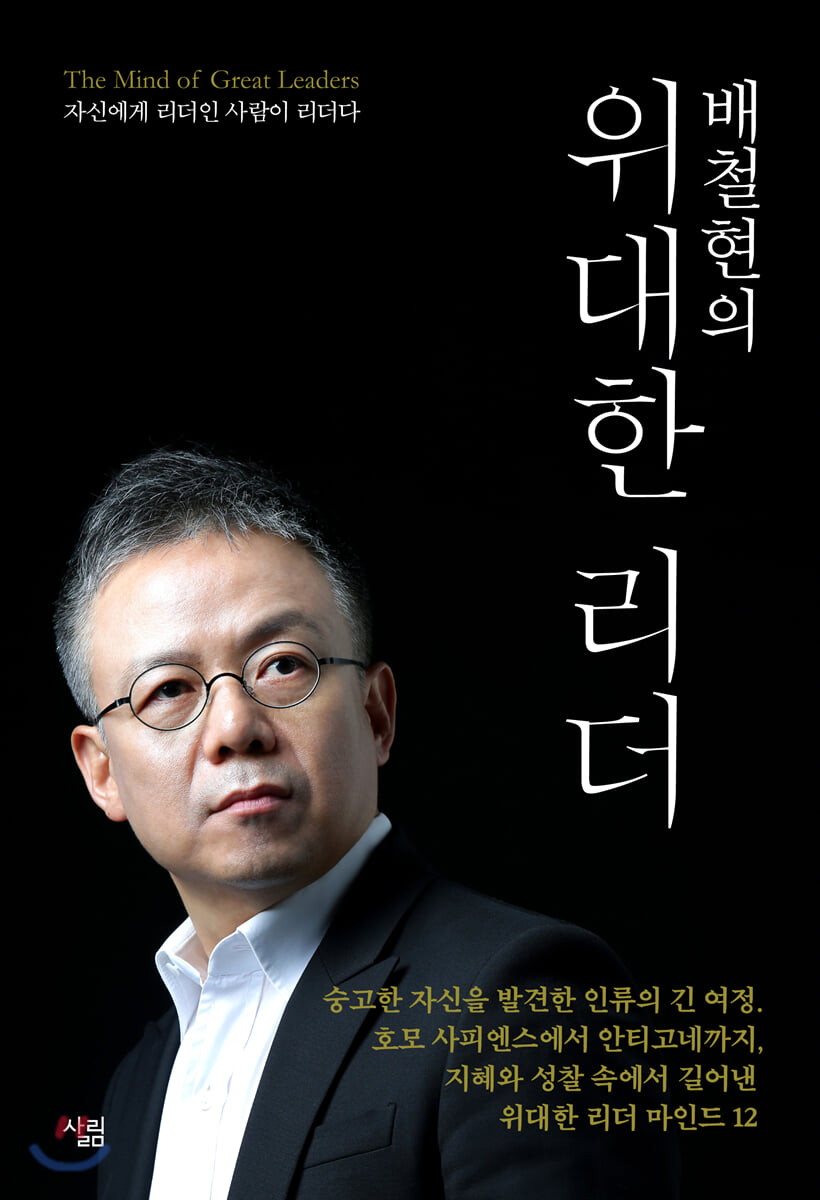
Bae Cheol-hyeon's Great Leader
 |
Description
Book Introduction
“The secret of leadership first deciphered by classical philologist Bae Cheol-hyeon!”
Humanity's long journey to discover its sublime self.
From Homo sapiens to Antigone,
12 Great Leader Mindsets Developed Through Wisdom and Reflection
"Bae Cheol-hyeon's Great Leader" is a book written for individuals seeking a "better self" and those who dream of becoming leaders of their communities.
It deals with the anxiety that inevitably arises in leaders who must choose a path no one has ever taken before, and the journey of searching for clues to reflection, persuasion, and enlightenment in human history.
It no longer matters who the sleeping dragon is.
Bae Cheol-hyeon looked to classics and historical figures for the origins of the mindset a leader should have.
He delved deeply into this point and began to search for the ideal leader in the classics.
By leveraging his expertise and strengths as a classical philologist and religious scholar, he discovered the secrets of leadership in ancient Greek, Latin, ancient Egyptian, Sumerian, Akkadian, Sanskrit, and ancient Persian literature.
The prerequisites for a great leader I found there were charisma, compassion, vision, and principles.
These four major premises are further divided into three keywords, which in turn are divided into the following 12 virtues.
These include contemplative, maat, me, pathos, shalimtu, catharsis, yoga, pronoia, phronesis, nakva, arya, and hosia.
I recommend this book to presidents, politicians, businesspeople, religious leaders, educators, leaders of small groups, heads of households, and anyone who dreams of becoming a future leader.
Humanity's long journey to discover its sublime self.
From Homo sapiens to Antigone,
12 Great Leader Mindsets Developed Through Wisdom and Reflection
"Bae Cheol-hyeon's Great Leader" is a book written for individuals seeking a "better self" and those who dream of becoming leaders of their communities.
It deals with the anxiety that inevitably arises in leaders who must choose a path no one has ever taken before, and the journey of searching for clues to reflection, persuasion, and enlightenment in human history.
It no longer matters who the sleeping dragon is.
Bae Cheol-hyeon looked to classics and historical figures for the origins of the mindset a leader should have.
He delved deeply into this point and began to search for the ideal leader in the classics.
By leveraging his expertise and strengths as a classical philologist and religious scholar, he discovered the secrets of leadership in ancient Greek, Latin, ancient Egyptian, Sumerian, Akkadian, Sanskrit, and ancient Persian literature.
The prerequisites for a great leader I found there were charisma, compassion, vision, and principles.
These four major premises are further divided into three keywords, which in turn are divided into the following 12 virtues.
These include contemplative, maat, me, pathos, shalimtu, catharsis, yoga, pronoia, phronesis, nakva, arya, and hosia.
I recommend this book to presidents, politicians, businesspeople, religious leaders, educators, leaders of small groups, heads of households, and anyone who dreams of becoming a future leader.
- You can preview some of the book's contents.
Preview
index
Preface | Do You Have This? - Mysterium (Mystery) · Thrill (Thrill) · Facinance (Charm)
Prologue | David's Self-Assurance
First Charisma - The God-given quality of a leader
Charisma isn't created, it's built.
1. The Charisma of Homo Sapiens Sapiens, Contemplaccio
2 Narmer's Charisma, Maat
3 The charisma of Annatum, Me
Second Compassion - The Ability to See the World Through Others' Eyes
“Compassion is a leader’s greatest weapon.”
4. Achilles' Mercy, Pathos
5 The Mercy of Cyrus, Shalimtu
6 Pericles' Mercy, Catharsis
The Third Eye: What to See and How to See
“Vision is the courage to imagine the present from the vantage point of death.”
7 Pashupati's Eyes, Yoga
8 Themistocles' Eye, Pronoia
9 Aristotle's Vision, Phronesis
The Fourth Principle: What Are You Willing to Die For?
“Principles are the grammar of a leader’s thoughts, words, and actions.”
10 Gilgamesh's Principles, Naqva
11 The Principles of Darius the Great, Ariya
12 Antigone's Principles, Hosias
main
Epilogue | A Person Who Respects Themselves
Review | Hesitation and Misunderstanding
Search
Prologue | David's Self-Assurance
First Charisma - The God-given quality of a leader
Charisma isn't created, it's built.
1. The Charisma of Homo Sapiens Sapiens, Contemplaccio
2 Narmer's Charisma, Maat
3 The charisma of Annatum, Me
Second Compassion - The Ability to See the World Through Others' Eyes
“Compassion is a leader’s greatest weapon.”
4. Achilles' Mercy, Pathos
5 The Mercy of Cyrus, Shalimtu
6 Pericles' Mercy, Catharsis
The Third Eye: What to See and How to See
“Vision is the courage to imagine the present from the vantage point of death.”
7 Pashupati's Eyes, Yoga
8 Themistocles' Eye, Pronoia
9 Aristotle's Vision, Phronesis
The Fourth Principle: What Are You Willing to Die For?
“Principles are the grammar of a leader’s thoughts, words, and actions.”
10 Gilgamesh's Principles, Naqva
11 The Principles of Darius the Great, Ariya
12 Antigone's Principles, Hosias
main
Epilogue | A Person Who Respects Themselves
Review | Hesitation and Misunderstanding
Search
Into the book
A leader must always choose the better path for the community at a fork in the road.
I feel anxious because I have to choose a path that no one has ever taken before.
A leader imagines and ponders the unknown world that ordinary people cannot imagine, and finds the optimal method.
A leader reflects more deeply than anyone else in his own space and time.
It is always a mystery for leaders to discover the path they must take through this.
--- p.6
I am publishing a book called "Great Leader" for the Republic of Korea, which is living in a time of chaos and seeking a new leap forward.
I hope the twelve virtues in this book will plant seeds in the hearts of individuals seeking to become "better selves" and those who dream of becoming leaders in their communities.
One day, that seed will sprout and become a big tree.
A leader is someone who is a leader to himself.
I dedicate this book to those who aspire to be great leaders.
--- p.7
David, the red-faced boy
He stood before the Philistine giant Goliath.
Goliath, fully armed, is like a primeval mountain range.
David the shepherd drove away the wolves
He put five stones in his bag and slung the sling over his shoulder.
Goliath's voice echoes throughout the mountains and rivers.
“Do you think I am a dog? I will make you food for the wild beasts.”
David stares intently into Goliath's eyes.
The blood in my whole body pulsates and rushes to my right hand holding the stone.
It is as light as a new feather
It is as heavy as the Kaaba in Mecca.
This stone will be embedded in the center of Goliath's forehead.
And he will fall down helplessly like a rotten tree.
David quietly caresses the stone.
In this moment of certainty, he becomes the king of Israel.
David became a hero on the border of taboo where others dare not go.
He now has charisma, compassion, vision, and principles.
You will have this four hearts.
--- p.14~15
Charisma is the charm that a leader possesses.
What makes a leader extraordinary? Leaders acquire and strengthen their charisma through meditation, mission, training, storytelling, and self-affirmation.
First, create a separate space for yourself and dedicate time to the self you admire.
This distinct time and space is loneliness.
Solitude transforms him.
Ordinary people are reborn as extraordinary people through solitude.
He listens to the inner voice that flows from within his abyss and senses his own unique mission within it.
And he tells that mission in an inspiring way to the public, finding the best for the community.
A leader is a person who naturally emerges after acquiring charisma through long-term self-training.
--- p.18~19
If I had to sum up the leader's charisma in one word, it would be compassion.
Charisma is the mother of mercy.
Only those who have acquired charisma through training can bestow mercy, which is the ability to put oneself in another's shoes.
(…) Compassion is not the haste to pour out my unprepared love on the other person, but the effort to imagine the other person’s situation and create an environment where he or she can be happy.
(…) Compassion is the greatest virtue that makes humans human.
Just as a mother does not hesitate to sacrifice her life to protect her child, humans have a heart that cherishes and loves all living things.
Leaders not only inspire loyalty from members of their communities through the active practice of compassion.
He is the one who stimulates their compassion.
--- p.120~121
A leader is one with vision.
Discernment is not the desire to see what everyone else envies.
Discernment is the power to see things that others overlook, in a different way.
Discernment is not the ability to see what is revealed, but the ability to discover and gaze upon what is hidden and unseen.
(…) Discernment is the ability to find the most beautiful and sacred things in the trivialities and simplicity of life.
Those who do not practice for a long time to gain insight blame their environment and fate.
You are the only one who brought about your own misfortune.
A person with discernment sees and sees again.
Through that repeated gaze, he is the one who clearly sees the path the community should take, a path that the public cannot see.
He is a man who listens and listens again.
Through repeated self-listening, one listens to the 'voice of confidence' that flows subtly from within.
A leader is an artist who sees what cannot be seen, hears what cannot be heard, and imagines a world that cannot be felt.
--- p.226~227
A leader is someone who possesses simple yet unshakable principles.
A life that cherishes and upholds such principles will resolutely overcome any storm of adversity or temptation.
The principle is invisible to the eye.
It is as simple as Einstein's 'E=mc2', which explains the operation of the universe.
(…) Principle is the ability to realize one's own unique mission hidden within one's heart and to harmoniously arrange it within one's life.
(…) Principle is the process of considering various priorities in one’s life and choosing the most important one among them.
Principles are the mathematical formulas of life that make your life sublime and excellent.
--- p.306~307
There is a person who defines a community.
He is a leader.
You can tell the level of a community by looking at its leaders.
Because the leader is the best chosen by the community.
Who do we choose as leaders? What are the virtues of a leader who leads a community? Who deserves the title of leader? How do we identify leaders among the crowd?
A leader is someone who is a leader to himself.
A person who is a leader to himself when he is alone is also a leader when he is with others.
The mark of a leader is 'aura'.
Aura appears in a person who has noble aspirations, strives to achieve them, and is humble.
God gives 'charisma' to such people.
A leader is someone who does not take everyday life lightly.
He is a person who lives each day as if it were the first day of his life or as if it were his last day.
--- p.417~418
A leader is someone who practices seizing the moment and turning it into an art.
A leader is someone who constantly destroys the old, outdated 'past self' that tries to control him/her without even realizing it.
(…) I ask myself.
“Am I a leader to myself?”
“Am I in control of my daily life?”
“Do I treat a moment like eternity and eternity like a moment?”
A leader is someone who is complete and perfect to himself in his daily life.
A leader is someone who is worthy of respect.
--- p.419
Everyday life is bound to be a dilemma.
This road looks good, that road looks good too.
People each claim that the path that benefits them is the right path.
This is the difference between a leader and the masses.
People are quick to express their opinions, but leaders listen to everyone's different needs.
And I feel sorry.
So the leader is compassionate.
I hesitate because I feel pity.
He/she 'stands for a long time' with the challenges of everyday life.
The act of ‘standing and looking for a long time’ is different from ‘looking roughly’.
'Seeing roughly' is the act of seeing something in a way that is familiar to oneself, through the knowledge gained through one's own experience.
They even mistakenly believe that other people's opinions are wrong and that their own are right, and even force their ideas onto others as the only alternative.
'Watching for a long time' is an ability that only those who have trained in solitude and silence for a long time can achieve.
--- p.421
A leader is a misunderstood person.
He is more of an object of antipathy and misunderstanding than of sympathy.
The strategy is not good for some interest group, but for everyone.
Not immediately, but permanently.
People have rejected and eliminated such leaders.
What these leaders have in common is that they were objects of hatred and envy from their contemporaries, and they themselves suffered from loneliness and pain.
--- p.422
Leaders are great because they hesitate more than others and are not afraid of being misunderstood.
Leaders practice 'greatness' every day, a life that inspires them.
The practice gives him the charisma of truth and goodness.
A leader instills this virtue in himself and demonstrates it in his thoughts, words, and actions.
'Truthfulness' is a humble attitude of trying to protect and demonstrate the precious values given to oneself.
He/she does not meddle in other people's business.
Completely immersed in oneself, one always practices silence and does not seek praise or recognition from anyone.
That's why we can hardly find a true person.
He/she is like a huge mountain.
Hikers admire the trees planted within and the flowing streams, but they cannot see the entire mountain.
A great leader is like a mountain, its outlines only revealed when seen from afar.
People chase after people who brag about themselves.
To them, Homer, the poet who pioneered Western literature, is nothing more than a blind beggar singing on the street, and Jesus is nothing more than a wandering carpenter's son born into a poor family and never receiving higher education.
Homer is not someone who studies and theorizes about literature.
He is the one who, looking into the eyes of his despairing comrades sitting before him, laughed and shed tears while singing the joys and sorrows of the heroes with his body, voice, and eyes.
Jesus clearly proclaimed the gospel that all humans have divine DNA, and that the value that stimulates and perfects that DNA is not religious doctrine, but love.
Their genius became a truth that spread across time and space to all of humanity.
A leader cannot help but be good.
Good actions and words come from good thoughts.
(…) ‘Line’ is not intentional but natural.
Goodness is the fragrance that naturally permeates a person's body when he or she has been cultivating his or her thoughts, words, and actions for a long time and pursues a simple life.
Because he himself always pursues good.
I feel anxious because I have to choose a path that no one has ever taken before.
A leader imagines and ponders the unknown world that ordinary people cannot imagine, and finds the optimal method.
A leader reflects more deeply than anyone else in his own space and time.
It is always a mystery for leaders to discover the path they must take through this.
--- p.6
I am publishing a book called "Great Leader" for the Republic of Korea, which is living in a time of chaos and seeking a new leap forward.
I hope the twelve virtues in this book will plant seeds in the hearts of individuals seeking to become "better selves" and those who dream of becoming leaders in their communities.
One day, that seed will sprout and become a big tree.
A leader is someone who is a leader to himself.
I dedicate this book to those who aspire to be great leaders.
--- p.7
David, the red-faced boy
He stood before the Philistine giant Goliath.
Goliath, fully armed, is like a primeval mountain range.
David the shepherd drove away the wolves
He put five stones in his bag and slung the sling over his shoulder.
Goliath's voice echoes throughout the mountains and rivers.
“Do you think I am a dog? I will make you food for the wild beasts.”
David stares intently into Goliath's eyes.
The blood in my whole body pulsates and rushes to my right hand holding the stone.
It is as light as a new feather
It is as heavy as the Kaaba in Mecca.
This stone will be embedded in the center of Goliath's forehead.
And he will fall down helplessly like a rotten tree.
David quietly caresses the stone.
In this moment of certainty, he becomes the king of Israel.
David became a hero on the border of taboo where others dare not go.
He now has charisma, compassion, vision, and principles.
You will have this four hearts.
--- p.14~15
Charisma is the charm that a leader possesses.
What makes a leader extraordinary? Leaders acquire and strengthen their charisma through meditation, mission, training, storytelling, and self-affirmation.
First, create a separate space for yourself and dedicate time to the self you admire.
This distinct time and space is loneliness.
Solitude transforms him.
Ordinary people are reborn as extraordinary people through solitude.
He listens to the inner voice that flows from within his abyss and senses his own unique mission within it.
And he tells that mission in an inspiring way to the public, finding the best for the community.
A leader is a person who naturally emerges after acquiring charisma through long-term self-training.
--- p.18~19
If I had to sum up the leader's charisma in one word, it would be compassion.
Charisma is the mother of mercy.
Only those who have acquired charisma through training can bestow mercy, which is the ability to put oneself in another's shoes.
(…) Compassion is not the haste to pour out my unprepared love on the other person, but the effort to imagine the other person’s situation and create an environment where he or she can be happy.
(…) Compassion is the greatest virtue that makes humans human.
Just as a mother does not hesitate to sacrifice her life to protect her child, humans have a heart that cherishes and loves all living things.
Leaders not only inspire loyalty from members of their communities through the active practice of compassion.
He is the one who stimulates their compassion.
--- p.120~121
A leader is one with vision.
Discernment is not the desire to see what everyone else envies.
Discernment is the power to see things that others overlook, in a different way.
Discernment is not the ability to see what is revealed, but the ability to discover and gaze upon what is hidden and unseen.
(…) Discernment is the ability to find the most beautiful and sacred things in the trivialities and simplicity of life.
Those who do not practice for a long time to gain insight blame their environment and fate.
You are the only one who brought about your own misfortune.
A person with discernment sees and sees again.
Through that repeated gaze, he is the one who clearly sees the path the community should take, a path that the public cannot see.
He is a man who listens and listens again.
Through repeated self-listening, one listens to the 'voice of confidence' that flows subtly from within.
A leader is an artist who sees what cannot be seen, hears what cannot be heard, and imagines a world that cannot be felt.
--- p.226~227
A leader is someone who possesses simple yet unshakable principles.
A life that cherishes and upholds such principles will resolutely overcome any storm of adversity or temptation.
The principle is invisible to the eye.
It is as simple as Einstein's 'E=mc2', which explains the operation of the universe.
(…) Principle is the ability to realize one's own unique mission hidden within one's heart and to harmoniously arrange it within one's life.
(…) Principle is the process of considering various priorities in one’s life and choosing the most important one among them.
Principles are the mathematical formulas of life that make your life sublime and excellent.
--- p.306~307
There is a person who defines a community.
He is a leader.
You can tell the level of a community by looking at its leaders.
Because the leader is the best chosen by the community.
Who do we choose as leaders? What are the virtues of a leader who leads a community? Who deserves the title of leader? How do we identify leaders among the crowd?
A leader is someone who is a leader to himself.
A person who is a leader to himself when he is alone is also a leader when he is with others.
The mark of a leader is 'aura'.
Aura appears in a person who has noble aspirations, strives to achieve them, and is humble.
God gives 'charisma' to such people.
A leader is someone who does not take everyday life lightly.
He is a person who lives each day as if it were the first day of his life or as if it were his last day.
--- p.417~418
A leader is someone who practices seizing the moment and turning it into an art.
A leader is someone who constantly destroys the old, outdated 'past self' that tries to control him/her without even realizing it.
(…) I ask myself.
“Am I a leader to myself?”
“Am I in control of my daily life?”
“Do I treat a moment like eternity and eternity like a moment?”
A leader is someone who is complete and perfect to himself in his daily life.
A leader is someone who is worthy of respect.
--- p.419
Everyday life is bound to be a dilemma.
This road looks good, that road looks good too.
People each claim that the path that benefits them is the right path.
This is the difference between a leader and the masses.
People are quick to express their opinions, but leaders listen to everyone's different needs.
And I feel sorry.
So the leader is compassionate.
I hesitate because I feel pity.
He/she 'stands for a long time' with the challenges of everyday life.
The act of ‘standing and looking for a long time’ is different from ‘looking roughly’.
'Seeing roughly' is the act of seeing something in a way that is familiar to oneself, through the knowledge gained through one's own experience.
They even mistakenly believe that other people's opinions are wrong and that their own are right, and even force their ideas onto others as the only alternative.
'Watching for a long time' is an ability that only those who have trained in solitude and silence for a long time can achieve.
--- p.421
A leader is a misunderstood person.
He is more of an object of antipathy and misunderstanding than of sympathy.
The strategy is not good for some interest group, but for everyone.
Not immediately, but permanently.
People have rejected and eliminated such leaders.
What these leaders have in common is that they were objects of hatred and envy from their contemporaries, and they themselves suffered from loneliness and pain.
--- p.422
Leaders are great because they hesitate more than others and are not afraid of being misunderstood.
Leaders practice 'greatness' every day, a life that inspires them.
The practice gives him the charisma of truth and goodness.
A leader instills this virtue in himself and demonstrates it in his thoughts, words, and actions.
'Truthfulness' is a humble attitude of trying to protect and demonstrate the precious values given to oneself.
He/she does not meddle in other people's business.
Completely immersed in oneself, one always practices silence and does not seek praise or recognition from anyone.
That's why we can hardly find a true person.
He/she is like a huge mountain.
Hikers admire the trees planted within and the flowing streams, but they cannot see the entire mountain.
A great leader is like a mountain, its outlines only revealed when seen from afar.
People chase after people who brag about themselves.
To them, Homer, the poet who pioneered Western literature, is nothing more than a blind beggar singing on the street, and Jesus is nothing more than a wandering carpenter's son born into a poor family and never receiving higher education.
Homer is not someone who studies and theorizes about literature.
He is the one who, looking into the eyes of his despairing comrades sitting before him, laughed and shed tears while singing the joys and sorrows of the heroes with his body, voice, and eyes.
Jesus clearly proclaimed the gospel that all humans have divine DNA, and that the value that stimulates and perfects that DNA is not religious doctrine, but love.
Their genius became a truth that spread across time and space to all of humanity.
A leader cannot help but be good.
Good actions and words come from good thoughts.
(…) ‘Line’ is not intentional but natural.
Goodness is the fragrance that naturally permeates a person's body when he or she has been cultivating his or her thoughts, words, and actions for a long time and pursues a simple life.
Because he himself always pursues good.
--- p.422~423
Publisher's Review
To become an inspiring leader to yourself and others
What virtues should we cultivate?
Classical literature scholar Bae Cheol-hyeon published a book under his own name with the intention of making a new leap forward for the Republic of Korea, which is living in a time of turmoil.
That is 『Bae Cheol-hyeon's Great Leader』.
This book is his eighth work, following 『Genesis, Chagall speaks through his paintings』 『God's great questions』 『Man's great questions』 『Man's great journey』 『Abyss』 『Training』 『Silence』.
"Bae Cheol-hyeon's Great Leader" was planned in mid-2016 during President Park Geun-hye's term.
It goes back to when President Park's term was still about a year and a half away, and she became an early lame duck.
A social discourse has begun to emerge about what a new leader should be like.
There was also growing concern about what conditions were necessary for a leader of a country.
There was also discussion about who the sleeping dragon candidates were.
Bae Cheol-hyeon always had the topic of 'noblesse oblige' in his mind, so he thought deeply about the virtues that 'the wealthy' or 'social leaders' should possess.
However, President Park Geun-hye ended up stepping down before completing her term.
The publication date I initially thought of was missed.
But is election season the only time when a leader is needed?
Thanks to this, I was able to delve into leadership more deeply.
About three years have passed.
There are qualities a leader must possess.
Leaders are everywhere, not only in politics, but also in business, education, religion, and even small groups and communities.
Moreover, aren't you the one who leads your own life?
It no longer matters who the sleeping dragon is.
Bae Cheol-hyeon looked to classics and historical figures for the origins of the mindset a leader should have.
He delved deeply into this point and began to search for the ideal leader in the classics.
By leveraging his expertise and strengths as a classical philologist and religious scholar, he discovered the secrets of leadership in ancient Greek, Latin, ancient Egyptian, Sumerian, Akkadian, Sanskrit, and ancient Persian literature.
The prerequisites for a great leader I found there were charisma, compassion, vision, and principles.
These four major premises are further divided into three keywords, which in turn are divided into the following 12 virtues.
① Contemplative, ② Maat, ③ Meh, ④ Pathos, ⑤ Shalimtu, ⑥ Catharsis, ⑦ Yoga, ⑧ Pronoia, ⑨ Phronesis, ⑩ Nakba, ⑪ Ariya, ⑫ Hoshiya, etc.
Taken from the humanities classics
12 Virtues of Great Leaders
First, the quality of a leader bestowed by God and the first condition a leader must have is ‘charisma.’
Charisma means 'attractive authority'.
“Charisma is not something you make, but something you build,” he said, adding that it is an ability that deepens with training, practice, and cultivation.
Here, the charisma of modern humans ① Homo sapiens-sapiens, ‘Contemplatio’ (meditation).
(Contemplation on who one is and one's mission for the community to which one belongs), and ②Ma'at, the charisma of Narmer (the king who united Upper and Lower Egypt), a unique mission.
The principle that all things should follow, and the principle of life that gives meaning and value to life in the moment), ③ Eannatum (King of the Sumerian city of Lagash who ruled for 30 years from 2455 BC to 2425 BC).
The charisma of 'Me' (the principle of the first empire in human history to be formed by conquering surrounding city-states).
It deals with the great principles that govern the national organization, religious rituals, technology, morals, and character and personality of individual human beings that build civilization.
Second, ‘compassion’, the ability to see the world through the eyes of others.
He views compassion as “the greatest weapon a leader has” and emphasizes the importance of empathizing with others.
Here, ④Achilles (a hero in Greek mythology.
Pathos (pity) is the mercy of the immortal, but was killed by an arrow to his heel, his only weakness, by the Trojan prince Paris.
(The ability to empathize with others' pain by imagining it as one's own and actually feeling heartbroken), and ⑤ Cyrus (circa 585 BC - circa 529 BC, founder of the ancient Persian Empire).
Unified Persia and conquered the Neo-Babylonian kingdom.
Respect the systems and religions of conquered peoples and show tolerance.
A person called 'Cyrus' in the Bible.
Reign: 559 BC - 529 BC)'s mercy, 'Shalimtu' (?alimtu, hello.
A state in which a human being born as an individual in a society recognizes the unique mission given to him or her and completes that mission) and ⑥ Pericles (circa 495 BC - 429 BC, politician and soldier of ancient Athens, Greece.
Implement democracy and make Greece prosperous.
Catharsis (excretion and purification) is the mercy of Athens that created the Golden Age.
It explains that rather than killing monsters that hinder the process of escaping from one's past self and transforming into one's future self, one uses them as guides to a hopeful future.
Third, in ‘eyes’, we discuss what to see and how to see it.
“The vision is the courage to imagine the present from the point of death,” and ⑦ the vision of Pashupati (the incarnation of the god Shiva and the king who ruled Mohenjodaro) is ‘Yoga’ (gopi).
(Training to yoke thoughts, words, and actions that have become habits without one's knowledge), and ⑧ Themistocles (circa 524 BC - circa 460 BC, politician of ancient Athens, Greece).
Pronoia (foresight) is the foresight to strengthen naval power and defeat the Persian fleet in the Battle of Salamis.
The purpose of running all things in the universe.
(Imagination to find a solution in a gloomy situation where no solution is visible and to predict the outcome through that clue) and ⑨Aristotle (384 BC - 322 BC, ancient Greek philosopher.
He established the greatest academic system in ancient times and had a great influence on later scholarship, including medieval scholastic philosophy.
'Phronesis' (practical knowledge) is the insight of Plato's disciple and Alexander the Great's teacher.
Knowledge of the process of considering and deciding on the outcome you want.
It deals with the knowledge to anticipate and derive results that are in line with the best life.
Fourth, the 'principle' talks about what one is willing to give one's life for.
He emphasizes that “principles are the grammar of a leader’s thoughts, words, and actions.”
Here is ⑩ Gilgamesh (the main character in the ancient Babylonian epic.
A ruler who actually existed.
He goes to Utnapishtim, who lives in the underworld and enjoys eternal life, and asks him the secret of eternal life. The principle of 'Nakba' (the abyss).
The deepest part of the bottomless pond or sea, the knowledge and wisdom that helps us navigate the rough journey of life safely and happily), ⑪ Darius the Great (550 BC - 486 BC, King of Persia).
In 490 BC, he sent an expeditionary force to Greece, but was defeated by Athens at the Battle of Marathon.
The principle of 'Ariya' (harmony, sublimity, respect, best) is 'Ariya' (reign: 522 BC - 486 BC).
A thought and an event that transcends the dichotomous distinctions of human beings.
Body and mind.
) and ⑫ Antigone (the daughter of Oedipus in Greek mythology).
The principle of 'Hosia' (Hosios, conscience) is that she disobeyed the ban and buried her brother's body in the ground, and was buried alive.
More primal than social norms, more intimate than religious law.
It explains the mother of freedom, which is the core of human dignity and what makes humans human.
Who is a leader? A leader is someone who respects themselves!
A Self-Checklist: 12 Questions Leaders with Godly Majesty Ask Themselves
□ 1.
Do you have a separate time and space for yourself?
□ 2.
What is the unique mission you would give your life for?
□ 3.
Do you have a story that can express yourself in a moving way?
□ 4.
Do you see the world through the eyes of your enemies?
□ 5.
Do you strive for the well-being of others?
□ 6.
Do you strive to uplift the spirit of your citizens?
□ 7.
Are you practicing to better yourself every day?
□ 8.
Do you have an eye for predicting the future?
□ 9.
Is your wisdom feasible?
□ 10.
Have you discovered the 'other you' that exists deep inside your heart?
□ 11.
Do you know the best for yourself and your community?
□ 12.
Aren't you ashamed of yourself?
What virtues should we cultivate?
Classical literature scholar Bae Cheol-hyeon published a book under his own name with the intention of making a new leap forward for the Republic of Korea, which is living in a time of turmoil.
That is 『Bae Cheol-hyeon's Great Leader』.
This book is his eighth work, following 『Genesis, Chagall speaks through his paintings』 『God's great questions』 『Man's great questions』 『Man's great journey』 『Abyss』 『Training』 『Silence』.
"Bae Cheol-hyeon's Great Leader" was planned in mid-2016 during President Park Geun-hye's term.
It goes back to when President Park's term was still about a year and a half away, and she became an early lame duck.
A social discourse has begun to emerge about what a new leader should be like.
There was also growing concern about what conditions were necessary for a leader of a country.
There was also discussion about who the sleeping dragon candidates were.
Bae Cheol-hyeon always had the topic of 'noblesse oblige' in his mind, so he thought deeply about the virtues that 'the wealthy' or 'social leaders' should possess.
However, President Park Geun-hye ended up stepping down before completing her term.
The publication date I initially thought of was missed.
But is election season the only time when a leader is needed?
Thanks to this, I was able to delve into leadership more deeply.
About three years have passed.
There are qualities a leader must possess.
Leaders are everywhere, not only in politics, but also in business, education, religion, and even small groups and communities.
Moreover, aren't you the one who leads your own life?
It no longer matters who the sleeping dragon is.
Bae Cheol-hyeon looked to classics and historical figures for the origins of the mindset a leader should have.
He delved deeply into this point and began to search for the ideal leader in the classics.
By leveraging his expertise and strengths as a classical philologist and religious scholar, he discovered the secrets of leadership in ancient Greek, Latin, ancient Egyptian, Sumerian, Akkadian, Sanskrit, and ancient Persian literature.
The prerequisites for a great leader I found there were charisma, compassion, vision, and principles.
These four major premises are further divided into three keywords, which in turn are divided into the following 12 virtues.
① Contemplative, ② Maat, ③ Meh, ④ Pathos, ⑤ Shalimtu, ⑥ Catharsis, ⑦ Yoga, ⑧ Pronoia, ⑨ Phronesis, ⑩ Nakba, ⑪ Ariya, ⑫ Hoshiya, etc.
Taken from the humanities classics
12 Virtues of Great Leaders
First, the quality of a leader bestowed by God and the first condition a leader must have is ‘charisma.’
Charisma means 'attractive authority'.
“Charisma is not something you make, but something you build,” he said, adding that it is an ability that deepens with training, practice, and cultivation.
Here, the charisma of modern humans ① Homo sapiens-sapiens, ‘Contemplatio’ (meditation).
(Contemplation on who one is and one's mission for the community to which one belongs), and ②Ma'at, the charisma of Narmer (the king who united Upper and Lower Egypt), a unique mission.
The principle that all things should follow, and the principle of life that gives meaning and value to life in the moment), ③ Eannatum (King of the Sumerian city of Lagash who ruled for 30 years from 2455 BC to 2425 BC).
The charisma of 'Me' (the principle of the first empire in human history to be formed by conquering surrounding city-states).
It deals with the great principles that govern the national organization, religious rituals, technology, morals, and character and personality of individual human beings that build civilization.
Second, ‘compassion’, the ability to see the world through the eyes of others.
He views compassion as “the greatest weapon a leader has” and emphasizes the importance of empathizing with others.
Here, ④Achilles (a hero in Greek mythology.
Pathos (pity) is the mercy of the immortal, but was killed by an arrow to his heel, his only weakness, by the Trojan prince Paris.
(The ability to empathize with others' pain by imagining it as one's own and actually feeling heartbroken), and ⑤ Cyrus (circa 585 BC - circa 529 BC, founder of the ancient Persian Empire).
Unified Persia and conquered the Neo-Babylonian kingdom.
Respect the systems and religions of conquered peoples and show tolerance.
A person called 'Cyrus' in the Bible.
Reign: 559 BC - 529 BC)'s mercy, 'Shalimtu' (?alimtu, hello.
A state in which a human being born as an individual in a society recognizes the unique mission given to him or her and completes that mission) and ⑥ Pericles (circa 495 BC - 429 BC, politician and soldier of ancient Athens, Greece.
Implement democracy and make Greece prosperous.
Catharsis (excretion and purification) is the mercy of Athens that created the Golden Age.
It explains that rather than killing monsters that hinder the process of escaping from one's past self and transforming into one's future self, one uses them as guides to a hopeful future.
Third, in ‘eyes’, we discuss what to see and how to see it.
“The vision is the courage to imagine the present from the point of death,” and ⑦ the vision of Pashupati (the incarnation of the god Shiva and the king who ruled Mohenjodaro) is ‘Yoga’ (gopi).
(Training to yoke thoughts, words, and actions that have become habits without one's knowledge), and ⑧ Themistocles (circa 524 BC - circa 460 BC, politician of ancient Athens, Greece).
Pronoia (foresight) is the foresight to strengthen naval power and defeat the Persian fleet in the Battle of Salamis.
The purpose of running all things in the universe.
(Imagination to find a solution in a gloomy situation where no solution is visible and to predict the outcome through that clue) and ⑨Aristotle (384 BC - 322 BC, ancient Greek philosopher.
He established the greatest academic system in ancient times and had a great influence on later scholarship, including medieval scholastic philosophy.
'Phronesis' (practical knowledge) is the insight of Plato's disciple and Alexander the Great's teacher.
Knowledge of the process of considering and deciding on the outcome you want.
It deals with the knowledge to anticipate and derive results that are in line with the best life.
Fourth, the 'principle' talks about what one is willing to give one's life for.
He emphasizes that “principles are the grammar of a leader’s thoughts, words, and actions.”
Here is ⑩ Gilgamesh (the main character in the ancient Babylonian epic.
A ruler who actually existed.
He goes to Utnapishtim, who lives in the underworld and enjoys eternal life, and asks him the secret of eternal life. The principle of 'Nakba' (the abyss).
The deepest part of the bottomless pond or sea, the knowledge and wisdom that helps us navigate the rough journey of life safely and happily), ⑪ Darius the Great (550 BC - 486 BC, King of Persia).
In 490 BC, he sent an expeditionary force to Greece, but was defeated by Athens at the Battle of Marathon.
The principle of 'Ariya' (harmony, sublimity, respect, best) is 'Ariya' (reign: 522 BC - 486 BC).
A thought and an event that transcends the dichotomous distinctions of human beings.
Body and mind.
) and ⑫ Antigone (the daughter of Oedipus in Greek mythology).
The principle of 'Hosia' (Hosios, conscience) is that she disobeyed the ban and buried her brother's body in the ground, and was buried alive.
More primal than social norms, more intimate than religious law.
It explains the mother of freedom, which is the core of human dignity and what makes humans human.
Who is a leader? A leader is someone who respects themselves!
A Self-Checklist: 12 Questions Leaders with Godly Majesty Ask Themselves
□ 1.
Do you have a separate time and space for yourself?
□ 2.
What is the unique mission you would give your life for?
□ 3.
Do you have a story that can express yourself in a moving way?
□ 4.
Do you see the world through the eyes of your enemies?
□ 5.
Do you strive for the well-being of others?
□ 6.
Do you strive to uplift the spirit of your citizens?
□ 7.
Are you practicing to better yourself every day?
□ 8.
Do you have an eye for predicting the future?
□ 9.
Is your wisdom feasible?
□ 10.
Have you discovered the 'other you' that exists deep inside your heart?
□ 11.
Do you know the best for yourself and your community?
□ 12.
Aren't you ashamed of yourself?
GOODS SPECIFICS
- Publication date: November 5, 2019
- Format: Hardcover book binding method guide
- Page count, weight, size: 432 pages | 894g | 161*233*30mm
- ISBN13: 9788952240408
- ISBN10: 8952240405
You may also like
카테고리
korean


korean

![GQ KOREA Mark (Monthly): December [2025]](http://librairie.coreenne.fr/cdn/shop/files/8ef265dbbfbf186523ed75ba7319009d.jpg?v=1765340328&width=3840)


