

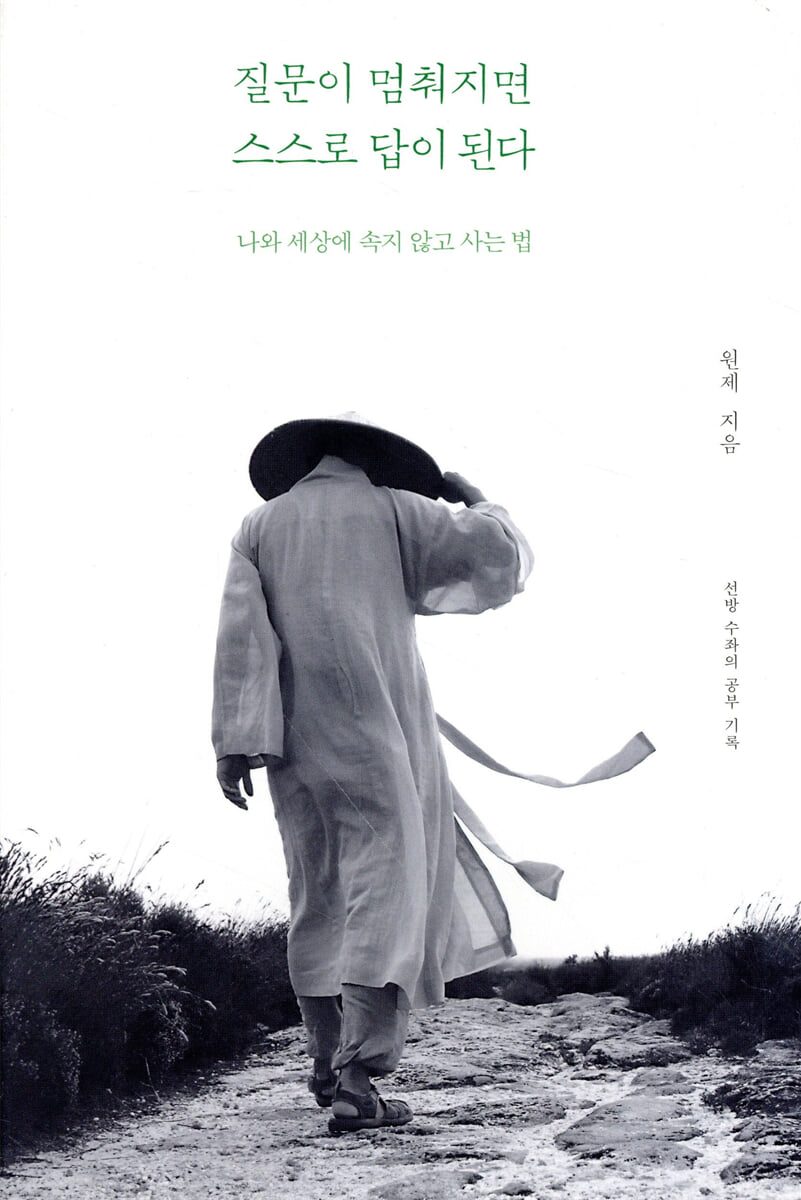
When you stop asking questions, the answers become your own.
 |
Description
Book Introduction
- A word from MD
-
Every moment is a head-on battleThis is the story of the practice of Monk Wonje, who studied religious studies at university, became a monk, and devoted himself to spiritual practice.
Study time, practice time, travel time, game time, every moment is a head-on battle.
I have to ask and answer myself.
I recorded what I encountered, experienced, and felt on my journey to find answers.
November 5, 2019. Humanities PD Son Min-gyu
How to live without being deceived by myself and the world,
13 years of study records from the head of the Seonbang!
This is a collection of writings by Wonje, a monk who became a monk in 2006 and has been posting his practice on his blog and Facebook since 2011, generating fresh responses and sympathy.
When the author was majoring in religious studies in college, he had many questions about life because the world seemed fake.
After wandering so badly that he was on the verge of self-harm, he chose the path of a Buddhist practitioner.
Strict self-discipline and the intense life of a sailor were a process that opened up countless questions.
At the end of that question, what answer did the author seek?
Life is lived to the extent that one knows.
So, on the one hand, I try to endlessly expand what I know.
But that knowledge actually hinders life.
This book, "When Questions Stop, Answers Come True," is a record of the author's study of the essential knowledge that penetrates all questions about life.
Through the conflicts, reflections, and moments of enlightenment experienced during the process of practice, readers will experience understanding and complete acceptance of this 'unknown life.'
13 years of study records from the head of the Seonbang!
This is a collection of writings by Wonje, a monk who became a monk in 2006 and has been posting his practice on his blog and Facebook since 2011, generating fresh responses and sympathy.
When the author was majoring in religious studies in college, he had many questions about life because the world seemed fake.
After wandering so badly that he was on the verge of self-harm, he chose the path of a Buddhist practitioner.
Strict self-discipline and the intense life of a sailor were a process that opened up countless questions.
At the end of that question, what answer did the author seek?
Life is lived to the extent that one knows.
So, on the one hand, I try to endlessly expand what I know.
But that knowledge actually hinders life.
This book, "When Questions Stop, Answers Come True," is a record of the author's study of the essential knowledge that penetrates all questions about life.
Through the conflicts, reflections, and moments of enlightenment experienced during the process of practice, readers will experience understanding and complete acceptance of this 'unknown life.'
- You can preview some of the book's contents.
Preview
index
Entering | People and the world are already the answer
Chapter 1: The Age-Old Question: Who Am I?
intro.
Something more precious than diamonds * Spring breeze
Surfing | The woman I met in my dream | 'I' am a stream | My eyes follow me | When you are not there | The consciousness of the host and the consciousness of the guest | The closest friend | Existence is to have everything | Everything is my work | All existence is inherently like that | Your story | What is my cow | The reason for existence
Chapter 2: Doubts About Life: I am not fooled until I am not 'me'
intro.
Eternal Love * Truth * Do not deceive your own heart
Ha Jung-woo's Last Meal | The Passage Called "I" | A Fallen Persimmon | A Self-Seed and a Park | There Is a Teacher | Gongdeokcheon and the Dark Woman | The Courage to Cross Walls | The Killing Dharma | I Must Turn Off My Light | Blind One, Open Your Eyes | Zombies and Sunflowers | Knowing and Not Knowing
Chapter 3: Problem or Situation: Letting Myself Go with the Flow
intro.
Confidence * Silence * Opportunity
Stop Judging | Practice Letting Go | Why Only Try to Overcome Problems | Bird, Bird | Kim from Junggok Nara | Monk Beopryun is a Fisherman | Situations and Responses | This is Enough | God Answered Before I Asked | What Does the Sign Matter? | The Best Preparation
Chapter 4: To the Edge of the Cliff: When I Have to End the Drama I'm Writing
intro.
Bulhok * Praise and Criticism
Endurance is everything | The effort that works | 15 minutes that changed my life | Right now, spit far away | Unconditionally | Who is suffering from this? | Be moderately healthy and moderately happy | Inn | Purification and inspiration
Chapter 5: From the Net to the Wind: Only when you are nothing can you become anything.
intro.
Nets and Flows * Stumbling Blocks and Stepping Stones * Drizzle
The End of the Drama of Life | The Virtue of Emptiness | The World Breathes | You Don't Know When You're Locked Up | Obedience and Freedom | Empty Fullness | No Possession | Even If We Were Reborn | Silence | Tell Us a Little News | The First Day of the New Year
Chapter 1: The Age-Old Question: Who Am I?
intro.
Something more precious than diamonds * Spring breeze
Surfing | The woman I met in my dream | 'I' am a stream | My eyes follow me | When you are not there | The consciousness of the host and the consciousness of the guest | The closest friend | Existence is to have everything | Everything is my work | All existence is inherently like that | Your story | What is my cow | The reason for existence
Chapter 2: Doubts About Life: I am not fooled until I am not 'me'
intro.
Eternal Love * Truth * Do not deceive your own heart
Ha Jung-woo's Last Meal | The Passage Called "I" | A Fallen Persimmon | A Self-Seed and a Park | There Is a Teacher | Gongdeokcheon and the Dark Woman | The Courage to Cross Walls | The Killing Dharma | I Must Turn Off My Light | Blind One, Open Your Eyes | Zombies and Sunflowers | Knowing and Not Knowing
Chapter 3: Problem or Situation: Letting Myself Go with the Flow
intro.
Confidence * Silence * Opportunity
Stop Judging | Practice Letting Go | Why Only Try to Overcome Problems | Bird, Bird | Kim from Junggok Nara | Monk Beopryun is a Fisherman | Situations and Responses | This is Enough | God Answered Before I Asked | What Does the Sign Matter? | The Best Preparation
Chapter 4: To the Edge of the Cliff: When I Have to End the Drama I'm Writing
intro.
Bulhok * Praise and Criticism
Endurance is everything | The effort that works | 15 minutes that changed my life | Right now, spit far away | Unconditionally | Who is suffering from this? | Be moderately healthy and moderately happy | Inn | Purification and inspiration
Chapter 5: From the Net to the Wind: Only when you are nothing can you become anything.
intro.
Nets and Flows * Stumbling Blocks and Stepping Stones * Drizzle
The End of the Drama of Life | The Virtue of Emptiness | The World Breathes | You Don't Know When You're Locked Up | Obedience and Freedom | Empty Fullness | No Possession | Even If We Were Reborn | Silence | Tell Us a Little News | The First Day of the New Year
Detailed image
.jpg)
Into the book
I am a monk who has left home and lives in a temple.
But that's not all.
I am a son to my parents, a long-time friend to some, a teacher to some scholars, a world traveler, a computer game enthusiast, and a writer in my spare time.
Not only are there many lives in the world, but even a single individual has many different life forms and roles.
If you don't try to fixate on an answer, the answers are already diverse.
I have confirmed through my 'playing games' that if you don't insist on staying in just one role, you can smoothly and smoothly carry out multiple roles simultaneously without any obstacles.
--- From "Entering, 'People and the world are already the answer'"
There is something more expensive, more splendid, and more precious than this diamond.
What is that?
That's light.
Without light, a diamond is nothing more than a small, useless rock.
Because of light, diamonds shine, become gorgeous, and become expensive gems.
But light itself has no value.
Because it is colorless and transparent, it has no flashiness, and because it exists naturally, it has no rarity as an object that can be compared.
More precious than diamonds, don't be fooled by diamonds, look at the light.
This light, which cannot be seen or caught, is the priceless true treasure.
That which is priceless is truly expensive, that which is without flashiness is truly gorgeous, and that which is without rarity is truly precious.
You have to see this light that cannot be seen.
--- p.14
What I keep in mind most when I write is my life experiences.
I try to write about my own experiences as much as possible.
Sometimes I write after hearing someone's experience.
I try not to write explanations of concepts or principles as much as possible.
I read such articles occasionally, but usually I don't.
It's not fun,
Because I have no inspiration.
But we need to look back carefully.
The principle is this, the concept is this, but what is my life like?
Is the life unfolding before my eyes right now in accordance with the truth taught in Buddhist scriptures?
Doesn't that contradict that?
Does that truth unfold in accordance with life experience?
Is my thinking really that adjusted?
Is the presence of another person really that approachable?
--- p.59
Try to erase one by one the objects that I am concentrating on and that I am obsessed with.
What if there were no one I cared for or cared for, no social issues, no work to do, no object to focus on? Can I be content and happy without needing any object? Can the world be filled with my existence alone, without relying on any object? Can I be free, unhindered by any object? --- p.62
Even after that, for about a year, an old man would occasionally come to me in my dreams and massage my thighs again, but after I suddenly got angry and spoke to him firmly, he stopped coming.
You can just take this experience and think, 'I guess that's what the world could feel like.'
However, this should not be taken to mean that such a world ‘exists.’
If you like that world and approach it, that world will 'come to exist'.
The Buddha said to only talk about the law and not to talk about ghosts.
If you like the world of ghosts and approach the world of ghosts, then the world of ghosts will exist.
And if I accept that world of ghosts, I will become a ghost myself.
--- p.106
Sometimes I think, 'Come whatever you want.'
But that's not the kind of confidence that says you can face and overcome anything.
Since I have nothing to take, I am confident that I can give anything.
Come whatever you want.
I'll send them all.
There is also this kind of confidence.
--- p.130
“Should all the truth be revealed?”
"no."
“It’s true, but why?”
“The question is not whether it is true or not, whether it is revealed or not, that is not the case.
The question is whether I can properly handle that truth.
Even if it is true, if you are not ready to accept the truth, it can actually harm you.
If you're not prepared enough, it might be better not to know.
“It is difficult to properly face, properly digest, and properly let go of that truth, and there are not many people who can do that properly… .”
This is a question and answer from a friend who saw the movie [Perfect Strangers].
The truth is, of course, precious.
But more importantly, I need to ask myself carefully whether I am truly ready to accept that truth.
If you are ready, you will live by the truth, but if you are not ready, you will live by being tormented by the truth.
--- p.67
Some people try to find a love that will last forever.
I'm looking for someone who will love me only.
But that is both futile and impossible.
Because the heart of the person seeking such love is constantly changing and turning.
There is no need to fear that the other person's mind will change.
I just need to make it clear to myself that my mind is changing.
But if my heart is one, then there is no need to seek eternal love.
Because I can love with that consistency.
Love is not something you seek.
Love is possible.
--- p.66
'Do not deceive yourself.' It is easy to know when others are deceiving you.
It's not that hard for me to try not to deceive my heart.
But it's hard for me not to be deceived by myself.
It's very difficult.
It's not that other people are deceiving me.
I am lying to myself.
It is difficult to know this right away, difficult to escape from it, and even to write about myself afterwards is a long and difficult journey.
--- p.69
Studying takes courage.
Courage in the world means not yielding to circumstances or objects, and standing up for yourself or your own will.
Courage is the ability to fight and overcome something.
But courage in practice is completely different.
Because the object is not directed outward, but returns directly to myself.
It is the courage to doubt myself and the courage to let go of my obsession with small houses.
It is the courage to let go of all the notions of 'this is me,' of 'knowing something,' of 'having some value that I pursue.'
It is courage to abandon comfort and instead enter into ignorance and anxiety.
--- p.100
When I turn on the lantern, of course the path before my eyes becomes brighter.
The path is clearly visible and even the rocks you might trip over are clearly visible.
But we don't light the lanterns because the moonlight falling on the mountain is bright enough.
That's why when I turn on the lantern, it actually feels darker.
Because only the light right in front of my eyes becomes too bright.
And if you just follow those unusually bright eyes, the entire surroundings will become dark and you won't be able to see them.
A place that was not originally that dark becomes much darker because of the light from the lantern.
--- p.109
If you look closely at the clicker (zombie) appearance, you will see that the zombie does not have any evil personality or do any evil deeds.
It was just reacting to stimuli.
Of course, that reaction is a reaction to maintain one's own life.
The goal is not to harm the other person right away.
So there is no suffering or pain for the clicker.
No living being, which merely reacts to stimuli, suffers from the self-created suffering and desires that we humans do.
Humans are the only beings who create the causes of suffering and desire, become attached to them, and accept the consequences of suffering.
In a way, aren't we worse than the clickers we find so disgusting? --- p.121
There are two main lives in practice.
One is a life of seeking answers, the other is a life of doubt.
A life of seeking answers involves continually searching for something and accumulating what is found.
Never satisfied with what we have accumulated, we keep moving forward.
But a life of doubt looks back on what has accumulated and empties out what is doubtful.
Instead of moving forward, we look back at this very place.
So the two lives produce different results.
A life that seeks will still go outward, and a life that doubts will immediately stop in its tracks.
Answers are never something to be sought.
It is revealed by stopping.
As the seeking stops, all of these things are revealed as answers.
But that's not all.
I am a son to my parents, a long-time friend to some, a teacher to some scholars, a world traveler, a computer game enthusiast, and a writer in my spare time.
Not only are there many lives in the world, but even a single individual has many different life forms and roles.
If you don't try to fixate on an answer, the answers are already diverse.
I have confirmed through my 'playing games' that if you don't insist on staying in just one role, you can smoothly and smoothly carry out multiple roles simultaneously without any obstacles.
--- From "Entering, 'People and the world are already the answer'"
There is something more expensive, more splendid, and more precious than this diamond.
What is that?
That's light.
Without light, a diamond is nothing more than a small, useless rock.
Because of light, diamonds shine, become gorgeous, and become expensive gems.
But light itself has no value.
Because it is colorless and transparent, it has no flashiness, and because it exists naturally, it has no rarity as an object that can be compared.
More precious than diamonds, don't be fooled by diamonds, look at the light.
This light, which cannot be seen or caught, is the priceless true treasure.
That which is priceless is truly expensive, that which is without flashiness is truly gorgeous, and that which is without rarity is truly precious.
You have to see this light that cannot be seen.
--- p.14
What I keep in mind most when I write is my life experiences.
I try to write about my own experiences as much as possible.
Sometimes I write after hearing someone's experience.
I try not to write explanations of concepts or principles as much as possible.
I read such articles occasionally, but usually I don't.
It's not fun,
Because I have no inspiration.
But we need to look back carefully.
The principle is this, the concept is this, but what is my life like?
Is the life unfolding before my eyes right now in accordance with the truth taught in Buddhist scriptures?
Doesn't that contradict that?
Does that truth unfold in accordance with life experience?
Is my thinking really that adjusted?
Is the presence of another person really that approachable?
--- p.59
Try to erase one by one the objects that I am concentrating on and that I am obsessed with.
What if there were no one I cared for or cared for, no social issues, no work to do, no object to focus on? Can I be content and happy without needing any object? Can the world be filled with my existence alone, without relying on any object? Can I be free, unhindered by any object? --- p.62
Even after that, for about a year, an old man would occasionally come to me in my dreams and massage my thighs again, but after I suddenly got angry and spoke to him firmly, he stopped coming.
You can just take this experience and think, 'I guess that's what the world could feel like.'
However, this should not be taken to mean that such a world ‘exists.’
If you like that world and approach it, that world will 'come to exist'.
The Buddha said to only talk about the law and not to talk about ghosts.
If you like the world of ghosts and approach the world of ghosts, then the world of ghosts will exist.
And if I accept that world of ghosts, I will become a ghost myself.
--- p.106
Sometimes I think, 'Come whatever you want.'
But that's not the kind of confidence that says you can face and overcome anything.
Since I have nothing to take, I am confident that I can give anything.
Come whatever you want.
I'll send them all.
There is also this kind of confidence.
--- p.130
“Should all the truth be revealed?”
"no."
“It’s true, but why?”
“The question is not whether it is true or not, whether it is revealed or not, that is not the case.
The question is whether I can properly handle that truth.
Even if it is true, if you are not ready to accept the truth, it can actually harm you.
If you're not prepared enough, it might be better not to know.
“It is difficult to properly face, properly digest, and properly let go of that truth, and there are not many people who can do that properly… .”
This is a question and answer from a friend who saw the movie [Perfect Strangers].
The truth is, of course, precious.
But more importantly, I need to ask myself carefully whether I am truly ready to accept that truth.
If you are ready, you will live by the truth, but if you are not ready, you will live by being tormented by the truth.
--- p.67
Some people try to find a love that will last forever.
I'm looking for someone who will love me only.
But that is both futile and impossible.
Because the heart of the person seeking such love is constantly changing and turning.
There is no need to fear that the other person's mind will change.
I just need to make it clear to myself that my mind is changing.
But if my heart is one, then there is no need to seek eternal love.
Because I can love with that consistency.
Love is not something you seek.
Love is possible.
--- p.66
'Do not deceive yourself.' It is easy to know when others are deceiving you.
It's not that hard for me to try not to deceive my heart.
But it's hard for me not to be deceived by myself.
It's very difficult.
It's not that other people are deceiving me.
I am lying to myself.
It is difficult to know this right away, difficult to escape from it, and even to write about myself afterwards is a long and difficult journey.
--- p.69
Studying takes courage.
Courage in the world means not yielding to circumstances or objects, and standing up for yourself or your own will.
Courage is the ability to fight and overcome something.
But courage in practice is completely different.
Because the object is not directed outward, but returns directly to myself.
It is the courage to doubt myself and the courage to let go of my obsession with small houses.
It is the courage to let go of all the notions of 'this is me,' of 'knowing something,' of 'having some value that I pursue.'
It is courage to abandon comfort and instead enter into ignorance and anxiety.
--- p.100
When I turn on the lantern, of course the path before my eyes becomes brighter.
The path is clearly visible and even the rocks you might trip over are clearly visible.
But we don't light the lanterns because the moonlight falling on the mountain is bright enough.
That's why when I turn on the lantern, it actually feels darker.
Because only the light right in front of my eyes becomes too bright.
And if you just follow those unusually bright eyes, the entire surroundings will become dark and you won't be able to see them.
A place that was not originally that dark becomes much darker because of the light from the lantern.
--- p.109
If you look closely at the clicker (zombie) appearance, you will see that the zombie does not have any evil personality or do any evil deeds.
It was just reacting to stimuli.
Of course, that reaction is a reaction to maintain one's own life.
The goal is not to harm the other person right away.
So there is no suffering or pain for the clicker.
No living being, which merely reacts to stimuli, suffers from the self-created suffering and desires that we humans do.
Humans are the only beings who create the causes of suffering and desire, become attached to them, and accept the consequences of suffering.
In a way, aren't we worse than the clickers we find so disgusting? --- p.121
There are two main lives in practice.
One is a life of seeking answers, the other is a life of doubt.
A life of seeking answers involves continually searching for something and accumulating what is found.
Never satisfied with what we have accumulated, we keep moving forward.
But a life of doubt looks back on what has accumulated and empties out what is doubtful.
Instead of moving forward, we look back at this very place.
So the two lives produce different results.
A life that seeks will still go outward, and a life that doubts will immediately stop in its tracks.
Answers are never something to be sought.
It is revealed by stopping.
As the seeking stops, all of these things are revealed as answers.
--- p.137
Publisher's Review
In the midst of warm healing, comfort, and words of wisdom
Why are we still confused and why does the pain not go away?
If we compare the warm, healing words and small bits of wisdom that comfort us in the face of the countless problems we encounter in life to "cheat keys," the author's words and writings resemble the warrior's correct method.
For example, it tells us not to cover it up but to look straight at it, to enter into the horror of life, to doubt everything that is in front of us now that we think is true, everything that we have believed and relied on up until now.
Because we are better at fooling ourselves than others.
To those who repeatedly blame their misfortunes and problems on the abuse they endured from their fathers in childhood, the author bluntly advises, "Don't use your wounds as a tool to avoid reality."
He says that the excessive pursuit of a dramatic life and a meaningful life starring oneself actually restricts a free life, and that he is telling people to 'get out of the story I am writing right now.'
That's painful advice.
That is why the author's words and writings are often said to be 'killing dharma, not healing dharma.'
Killing means to kill.
It is to get rid of what I know, what I believe I know, what I am holding on to with great care.
Only when it stops completely and disappears can I see my true self and the path I really need to take.
Just like when I turn off the lantern I'm holding on a dark night, the moonlight shines brightly.
“People tend to say, ‘It’s okay to just live the way you were born,’ but the reason I focus on killing rather than healing is probably because of the study method called ‘Zen.’
Zen is the practice of 'doubt'.
“It is to doubt the sense objects and experiences before our eyes, not to accept them at face value, to keep a distance, and not to be deceived.” (-from the text)
Truth is not something to be found, but something to be 'become'.
How Truth Unfolds in Everyday Life
The author chose the path of a Buddhist practitioner in search of truth.
It was a natural attraction for the author, just as other people choose to be scientists, novelists, or architects.
Through studying the scriptures and sayings, practicing Zen meditation, practicing silence, and traveling around the world for two years… amidst many frustrations and conflicts, he went through countless questions and answers directed at himself rather than the outside world, and acquired Buddhist truth with his whole body.
The end of that truth is not to stay with ‘me’ but to live as ‘the whole’.
The author uses all of his experiences, including his life as a monk, his life before becoming a monk, the people he met, books, movies, and games, to explain how these doctrines, which we only know in our heads, such as ego and illusion, impermanence and non-self, emptiness, Buddha-nature, and the true self, should be applied in our daily lives.
As the author often says, it is about 'using' oneself for the life of the 'whole'.
In "Why Do We Only Try to Overcome Problems?", when a monk who was being guided said he wanted to leave the temple because of his relationship with the temple owner, the author told him to just endure it for two weeks.
I thought that over the course of two weeks, time would pass, circumstances would change, problems would change, and the practitioner's mind would also change in dealing with those problems.
After two weeks, the relationship problems that had been so serious that he wanted to run away from the temple became insignificant, and the monk returned to his practice.
The author reminds us through life and experience that everything is impermanent, that is, ‘everything changes.’
In "The Courage to Surpass Walls," which cites Haruki Murakami's novel "The End of the World" as an example, the author explains the solid self-image we create through the contrast between a safe life and an uncertain life, with walls and forests.
He overcomes the anger that was boiling over him to the point of wanting to kill his fellow monk with 'patience' and encourages him that life is something that must be endured, and that if he gets through it safely, the time will come when he will feel true freedom.
What will be the end of these stories, which are varied through the author's honest confessions and strict writing style?
It means to break away from the small and narrow selfish ‘me’ and live as the ‘big me’, the ‘true me’, as the whole universe.
Only then can we truly live fully, facing the essential life as a free person.
The 'plate' called 'you'
Encourage life as play
A national surfer whom the author met while traveling around the world said this.
“Monk, I can’t get off this board.”
His life so far has been a life on a board.
Not only surfers, but we all live on our own boards.
Life is often compared to a sea of suffering.
And waves are said to represent the various pains, big and small, of life.
The author says that he will not look at the waves, analyze them, or define them by imposing various meanings on them, but will jump straight into the sea.
They say that this is because there is a plate called 'original title' and there are technologies called words, writing, and thoughts.
What about our board?
What we face is only a moment, and all we have to do is look at it ‘well’, judge it ‘well’, and respond ‘well’ to each situation that comes our way.
This book will definitely help you develop a sense of rhythm for that 'well'.
This is the author's final request.
There is something that great monks often say at temples.
“That’s what the scriptures say…, but tell me your story, your story.”
For me, every day is a head-on battle.
Today too, I open my eyes wide and face the challenge head on.
(-From the text)
Killing Dharma Talk 9 by Monk Wonje of Seonbang Sujwa
"How to live without fear, without being deceived by yourself or the world."
1 Does life really have to have a great meaning? I want to fill the drama of life with some plausible meaning.
But what is filled changes into another form or tries to be filled with other good things.
When we stop this vicious cycle of desire, life unfolds fully.
2. Doubt Anything: Don't take my thoughts for granted right now.
We must question the very existence of 'I' and the very thought itself.
If you truly doubt, you will experience as much as you are open, and you will encounter as much as you are awakened.
3 Put out the lamp you rely on: When you put out the lamp, the original moonlight will shine brightly.
What are the values and beliefs that I believe in, follow, and cherish like a lamp?
Only when we break free from it does life as a whole become apparent.
4 Stop Judging: 'Don't say, 'Just because I don't know, or because I don't understand, it's wrong or nothing like that.
I just don't know.
If I don't know something, I should just leave it as something I don't know. If I think the other person is wrong and that there is no such thing, I will miss the opportunity to learn.
5 Don't use your own wounds: 'I am like this now because of my past wounds...' Don't use past pain and wounds to avoid the present.
Practice letting go of pain and hurt.
Although it is difficult, if you practice spending time slowly and well, at some point the freedom you originally had will come right before your eyes.
6 There is no problem.
There are just circumstances: there are no fixed problems in our lives.
There are only constantly changing circumstances.
You just have to look at the situation ‘well’, ‘judge’ it ‘well’, and ‘respond’ to it ‘well’.
Don't pre-determine this 'well'.
7 'I' am not something to be defeated and changed: If you get to know me, 'I' am also a situation that can be acknowledged and accepted.
To somehow cope with changing situations, to honestly acknowledge and accept oneself, this is 'patience.'
8 Stop Choosing Only Happiness: Stop choosing only things that are joyful, fun, and happy.
Accept and allow everything that comes to me.
Then, joy, sadness, dark thoughts, anger, all of it has already been revealed as truth.
9 True courage is the courage to let go of myself: not the courage to protect myself, but the courage to let go of myself.
It is when we have nothing to know, nothing to rely on, and nothing to hold onto that we can truly live as ourselves.
Why are we still confused and why does the pain not go away?
If we compare the warm, healing words and small bits of wisdom that comfort us in the face of the countless problems we encounter in life to "cheat keys," the author's words and writings resemble the warrior's correct method.
For example, it tells us not to cover it up but to look straight at it, to enter into the horror of life, to doubt everything that is in front of us now that we think is true, everything that we have believed and relied on up until now.
Because we are better at fooling ourselves than others.
To those who repeatedly blame their misfortunes and problems on the abuse they endured from their fathers in childhood, the author bluntly advises, "Don't use your wounds as a tool to avoid reality."
He says that the excessive pursuit of a dramatic life and a meaningful life starring oneself actually restricts a free life, and that he is telling people to 'get out of the story I am writing right now.'
That's painful advice.
That is why the author's words and writings are often said to be 'killing dharma, not healing dharma.'
Killing means to kill.
It is to get rid of what I know, what I believe I know, what I am holding on to with great care.
Only when it stops completely and disappears can I see my true self and the path I really need to take.
Just like when I turn off the lantern I'm holding on a dark night, the moonlight shines brightly.
“People tend to say, ‘It’s okay to just live the way you were born,’ but the reason I focus on killing rather than healing is probably because of the study method called ‘Zen.’
Zen is the practice of 'doubt'.
“It is to doubt the sense objects and experiences before our eyes, not to accept them at face value, to keep a distance, and not to be deceived.” (-from the text)
Truth is not something to be found, but something to be 'become'.
How Truth Unfolds in Everyday Life
The author chose the path of a Buddhist practitioner in search of truth.
It was a natural attraction for the author, just as other people choose to be scientists, novelists, or architects.
Through studying the scriptures and sayings, practicing Zen meditation, practicing silence, and traveling around the world for two years… amidst many frustrations and conflicts, he went through countless questions and answers directed at himself rather than the outside world, and acquired Buddhist truth with his whole body.
The end of that truth is not to stay with ‘me’ but to live as ‘the whole’.
The author uses all of his experiences, including his life as a monk, his life before becoming a monk, the people he met, books, movies, and games, to explain how these doctrines, which we only know in our heads, such as ego and illusion, impermanence and non-self, emptiness, Buddha-nature, and the true self, should be applied in our daily lives.
As the author often says, it is about 'using' oneself for the life of the 'whole'.
In "Why Do We Only Try to Overcome Problems?", when a monk who was being guided said he wanted to leave the temple because of his relationship with the temple owner, the author told him to just endure it for two weeks.
I thought that over the course of two weeks, time would pass, circumstances would change, problems would change, and the practitioner's mind would also change in dealing with those problems.
After two weeks, the relationship problems that had been so serious that he wanted to run away from the temple became insignificant, and the monk returned to his practice.
The author reminds us through life and experience that everything is impermanent, that is, ‘everything changes.’
In "The Courage to Surpass Walls," which cites Haruki Murakami's novel "The End of the World" as an example, the author explains the solid self-image we create through the contrast between a safe life and an uncertain life, with walls and forests.
He overcomes the anger that was boiling over him to the point of wanting to kill his fellow monk with 'patience' and encourages him that life is something that must be endured, and that if he gets through it safely, the time will come when he will feel true freedom.
What will be the end of these stories, which are varied through the author's honest confessions and strict writing style?
It means to break away from the small and narrow selfish ‘me’ and live as the ‘big me’, the ‘true me’, as the whole universe.
Only then can we truly live fully, facing the essential life as a free person.
The 'plate' called 'you'
Encourage life as play
A national surfer whom the author met while traveling around the world said this.
“Monk, I can’t get off this board.”
His life so far has been a life on a board.
Not only surfers, but we all live on our own boards.
Life is often compared to a sea of suffering.
And waves are said to represent the various pains, big and small, of life.
The author says that he will not look at the waves, analyze them, or define them by imposing various meanings on them, but will jump straight into the sea.
They say that this is because there is a plate called 'original title' and there are technologies called words, writing, and thoughts.
What about our board?
What we face is only a moment, and all we have to do is look at it ‘well’, judge it ‘well’, and respond ‘well’ to each situation that comes our way.
This book will definitely help you develop a sense of rhythm for that 'well'.
This is the author's final request.
There is something that great monks often say at temples.
“That’s what the scriptures say…, but tell me your story, your story.”
For me, every day is a head-on battle.
Today too, I open my eyes wide and face the challenge head on.
(-From the text)
Killing Dharma Talk 9 by Monk Wonje of Seonbang Sujwa
"How to live without fear, without being deceived by yourself or the world."
1 Does life really have to have a great meaning? I want to fill the drama of life with some plausible meaning.
But what is filled changes into another form or tries to be filled with other good things.
When we stop this vicious cycle of desire, life unfolds fully.
2. Doubt Anything: Don't take my thoughts for granted right now.
We must question the very existence of 'I' and the very thought itself.
If you truly doubt, you will experience as much as you are open, and you will encounter as much as you are awakened.
3 Put out the lamp you rely on: When you put out the lamp, the original moonlight will shine brightly.
What are the values and beliefs that I believe in, follow, and cherish like a lamp?
Only when we break free from it does life as a whole become apparent.
4 Stop Judging: 'Don't say, 'Just because I don't know, or because I don't understand, it's wrong or nothing like that.
I just don't know.
If I don't know something, I should just leave it as something I don't know. If I think the other person is wrong and that there is no such thing, I will miss the opportunity to learn.
5 Don't use your own wounds: 'I am like this now because of my past wounds...' Don't use past pain and wounds to avoid the present.
Practice letting go of pain and hurt.
Although it is difficult, if you practice spending time slowly and well, at some point the freedom you originally had will come right before your eyes.
6 There is no problem.
There are just circumstances: there are no fixed problems in our lives.
There are only constantly changing circumstances.
You just have to look at the situation ‘well’, ‘judge’ it ‘well’, and ‘respond’ to it ‘well’.
Don't pre-determine this 'well'.
7 'I' am not something to be defeated and changed: If you get to know me, 'I' am also a situation that can be acknowledged and accepted.
To somehow cope with changing situations, to honestly acknowledge and accept oneself, this is 'patience.'
8 Stop Choosing Only Happiness: Stop choosing only things that are joyful, fun, and happy.
Accept and allow everything that comes to me.
Then, joy, sadness, dark thoughts, anger, all of it has already been revealed as truth.
9 True courage is the courage to let go of myself: not the courage to protect myself, but the courage to let go of myself.
It is when we have nothing to know, nothing to rely on, and nothing to hold onto that we can truly live as ourselves.
GOODS SPECIFICS
- Date of issue: November 1, 2019
- Page count, weight, size: 280 pages | 398g | 142*220*17mm
- ISBN13: 9788974797447
- ISBN10: 8974797445
You may also like
카테고리
korean


korean

![GQ KOREA Mark (Monthly): December [2025]](http://librairie.coreenne.fr/cdn/shop/files/8ef265dbbfbf186523ed75ba7319009d.jpg?v=1765340328&width=3840)


