

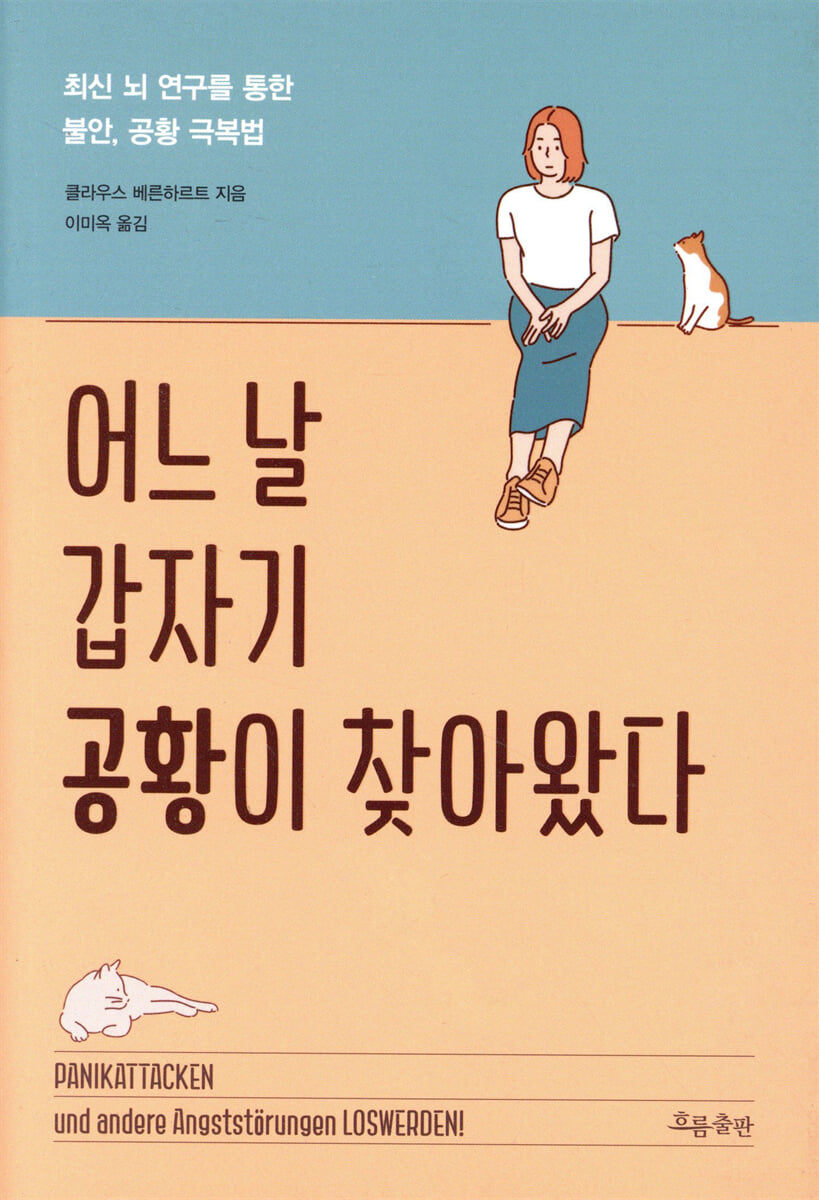
One day, a panic suddenly struck.
 |
Description
Book Introduction
What on earth is going on in our brains?
The most scientifically proven anxiety and panic control solution, treating over a million Europeans.
On the subway on the way to work, I suddenly feel short of breath... I always get a stomachache the day before an exam... Most people experience panic-like situations once or twice in their lives, but they don't realize it's panic.
But panic disorder strikes us suddenly one day when we fool ourselves into thinking we are doing well and ignore the brief panic attacks.
However, even if you go to the hospital and get an endoscopy or blood test, the exact cause cannot be determined.
Klaus Bernhard, a doctor who runs a psychiatric hospital in Berlin and author of the first new panic treatment in Europe, says it's better if there's no cause.
Because the symptoms can be completely eliminated without taking medication or undergoing surgery, using a few tricks discovered through the latest brain research.
This book examines why we feel anxious and experience panic by examining the connections between neurons and synapses discovered through the latest brain science.
It also reveals how and through what pathways panic is detected, and suggests new treatments based on this.
Meanwhile, the author explains that panic is a crisis coping program designed into our bodies, and tells us what we really need to look into in our lives to avoid or overcome panic.
Therefore, this book is a treatment book for those suffering from panic disorder, but it is also a psychological book for all of us who suffer from anxiety.
This book has been a bestseller in the psychology field in Germany for many years, earning the reputation of “the most reliable prescription for panic,” and has led to countless readers reporting healing experiences.
It was also translated and published in 10 European countries, becoming a guide for modern people with anxious minds.
The most scientifically proven anxiety and panic control solution, treating over a million Europeans.
On the subway on the way to work, I suddenly feel short of breath... I always get a stomachache the day before an exam... Most people experience panic-like situations once or twice in their lives, but they don't realize it's panic.
But panic disorder strikes us suddenly one day when we fool ourselves into thinking we are doing well and ignore the brief panic attacks.
However, even if you go to the hospital and get an endoscopy or blood test, the exact cause cannot be determined.
Klaus Bernhard, a doctor who runs a psychiatric hospital in Berlin and author of the first new panic treatment in Europe, says it's better if there's no cause.
Because the symptoms can be completely eliminated without taking medication or undergoing surgery, using a few tricks discovered through the latest brain research.
This book examines why we feel anxious and experience panic by examining the connections between neurons and synapses discovered through the latest brain science.
It also reveals how and through what pathways panic is detected, and suggests new treatments based on this.
Meanwhile, the author explains that panic is a crisis coping program designed into our bodies, and tells us what we really need to look into in our lives to avoid or overcome panic.
Therefore, this book is a treatment book for those suffering from panic disorder, but it is also a psychological book for all of us who suffer from anxiety.
This book has been a bestseller in the psychology field in Germany for many years, earning the reputation of “the most reliable prescription for panic,” and has led to countless readers reporting healing experiences.
It was also translated and published in 10 European countries, becoming a guide for modern people with anxious minds.
- You can preview some of the book's contents.
Preview
index
Recommendation
A treatment method that anyone can easily try
Introduction
We all live with fear in our hearts.
Chapter 1: The Great Fear That Swallows Me, What Causes It?
Uncontrollable extreme fear, panic
Chapter 2: Respect Your Subconscious
Knowing how your brain works can help you cope with fear.
Chapter 3: Don't Be Fooled by Your Own Lies
Knowing the principles of the brain can help you understand what causes fear.
External factors can also be controlled
Psychiatric Drugs: A Blessing or a Curse?
Chapter 4: Fear is simply a learned and acquired behavior.
Fear is a learned experience and can be cured.
Practice using the five senses: sight, hearing, touch, smell, and taste.
Chapter 5: Various Techniques to Stop Fear
You can escape from fear right now
Techniques to escape visual horror
Techniques to overcome auditory fear
Techniques to overcome tactile fear
Chapter 6: Finally Free from Fear
To live life with a happy and light heart
In conclusion
A book that helps you live life without feeling anxious.
References
A treatment method that anyone can easily try
Introduction
We all live with fear in our hearts.
Chapter 1: The Great Fear That Swallows Me, What Causes It?
Uncontrollable extreme fear, panic
Chapter 2: Respect Your Subconscious
Knowing how your brain works can help you cope with fear.
Chapter 3: Don't Be Fooled by Your Own Lies
Knowing the principles of the brain can help you understand what causes fear.
External factors can also be controlled
Psychiatric Drugs: A Blessing or a Curse?
Chapter 4: Fear is simply a learned and acquired behavior.
Fear is a learned experience and can be cured.
Practice using the five senses: sight, hearing, touch, smell, and taste.
Chapter 5: Various Techniques to Stop Fear
You can escape from fear right now
Techniques to escape visual horror
Techniques to overcome auditory fear
Techniques to overcome tactile fear
Chapter 6: Finally Free from Fear
To live life with a happy and light heart
In conclusion
A book that helps you live life without feeling anxious.
References
Detailed image

Into the book
All the techniques introduced in this book have been meticulously refined based on my own experience applying them to patients.
Believe it or not, more than 70 percent of my patients completely overcome their fears before their sixth interview.
--- p.11
There is a question that patients often ask me.
Why do fears strike especially when trying to rest? They said they often feel them suddenly, like when sitting on the couch in the evening, on vacation, or doing something boring or repetitive, like driving on the highway.
The answer to this question is very simple.
The human brain doesn't only react when stressed.
Even at rest, the nerve bundles that are connected in various ways automatically react.
Besides, our brain is constantly wanting to do something.
When we're on the phone with someone, have a task that requires focus, or are pressed for time, our brains perceive that there's a lot to do and distance themselves from fear and anxiety.
But as soon as I have even a little free time, I start tossing and turning and getting lost in my worries.
At this time, our brain tries to find work as quickly as possible.
--- p.26
This technique is called “slow-motion technology,” and it is based on the fact that scary scenes naturally pass quickly in our brains.
Let's take an example.
Watch a crime movie at the theater.
When a scene where something happens quickly comes up, the first thing you do is get startled.
Conversely, if such scenes are played extremely slowly, that is, in slow motion, we are not surprised at all even if we see the same scene.
As you can see, visually generated fear has serious weaknesses.
The point is that it happens very quickly.
--- p.181
Pitching techniques take advantage of the fact that our brains cannot feel two opposing emotions at the same time.
Our inner dialogue is scary because it's our own voice, and when we hear the voice of a character who's funny just by looking at him trying so hard to terrify us, it becomes funny.
Some older patients complained that they were unable to accept the fear after first trying this technique.
Anyone who has used this technique will quickly understand that taking fear seriously is one of the main reasons it spreads so widely.
--- p.191
Neither the vertigo caused by fear nor the persistent vertigo have anything to do with the organs of the inner ear that are responsible for balance.
These two forms of vertigo are caused solely by the brain.
So it can only be made to disappear by the brain.
If you make yourself feel like your brain is swinging from left to right, give it the opposite stimulus.
So imagine that it is rocking back and forth.
However, because the brain cannot process two stimuli simultaneously, the two stimuli have the effect of canceling each other out.
The phenomenon of oppositely oriented stimuli disappearing is by no means new.
This is a fact that has been well known in physics for a long time.
One sound wave can be completely canceled out by an opposite sound wave that is created by shifting its frequency.
One movement is stopped by an opposing movement.
With a little practice, anyone can consciously recognize and counteract the physical symptoms caused by the mind to eliminate them.
Believe it or not, more than 70 percent of my patients completely overcome their fears before their sixth interview.
--- p.11
There is a question that patients often ask me.
Why do fears strike especially when trying to rest? They said they often feel them suddenly, like when sitting on the couch in the evening, on vacation, or doing something boring or repetitive, like driving on the highway.
The answer to this question is very simple.
The human brain doesn't only react when stressed.
Even at rest, the nerve bundles that are connected in various ways automatically react.
Besides, our brain is constantly wanting to do something.
When we're on the phone with someone, have a task that requires focus, or are pressed for time, our brains perceive that there's a lot to do and distance themselves from fear and anxiety.
But as soon as I have even a little free time, I start tossing and turning and getting lost in my worries.
At this time, our brain tries to find work as quickly as possible.
--- p.26
This technique is called “slow-motion technology,” and it is based on the fact that scary scenes naturally pass quickly in our brains.
Let's take an example.
Watch a crime movie at the theater.
When a scene where something happens quickly comes up, the first thing you do is get startled.
Conversely, if such scenes are played extremely slowly, that is, in slow motion, we are not surprised at all even if we see the same scene.
As you can see, visually generated fear has serious weaknesses.
The point is that it happens very quickly.
--- p.181
Pitching techniques take advantage of the fact that our brains cannot feel two opposing emotions at the same time.
Our inner dialogue is scary because it's our own voice, and when we hear the voice of a character who's funny just by looking at him trying so hard to terrify us, it becomes funny.
Some older patients complained that they were unable to accept the fear after first trying this technique.
Anyone who has used this technique will quickly understand that taking fear seriously is one of the main reasons it spreads so widely.
--- p.191
Neither the vertigo caused by fear nor the persistent vertigo have anything to do with the organs of the inner ear that are responsible for balance.
These two forms of vertigo are caused solely by the brain.
So it can only be made to disappear by the brain.
If you make yourself feel like your brain is swinging from left to right, give it the opposite stimulus.
So imagine that it is rocking back and forth.
However, because the brain cannot process two stimuli simultaneously, the two stimuli have the effect of canceling each other out.
The phenomenon of oppositely oriented stimuli disappearing is by no means new.
This is a fact that has been well known in physics for a long time.
One sound wave can be completely canceled out by an opposite sound wave that is created by shifting its frequency.
One movement is stopped by an opposing movement.
With a little practice, anyone can consciously recognize and counteract the physical symptoms caused by the mind to eliminate them.
--- p.197
Publisher's Review
What on earth is going on in our brains?
The most scientifically proven anxiety and panic control solution, treating over a million Europeans.
Panic disorder became famous after being revealed by celebrities such as Kian84, Lee Kyung-kyu, Jung Hyung-don, and Cha Tae-hyun.
In fact, most people experience panic-like situations at least once or twice in their lives.
If you've ever had a sudden heart attack on the subway on your way to work, experienced heartburn before a test, or developed oral herpes due to stress and fatigue, you've probably experienced panic attacks.
I just passed it by without noticing it.
Panic disorder strikes us suddenly one day when we fool ourselves into thinking we are doing well and let the brief panic pass without a second thought.
People who suffer from panic disorder go to the hospital and undergo various tests such as gastroscopy and blood tests, but the cause cannot be found.
I tried to hold on to the doctor and tried hard, but there really was nothing wrong with my body!
Author Klaus Bernhard, who runs a psychiatric hospital in Berlin, says it's fortunate that there is no cause.
Because without taking medication or undergoing surgery, you can completely eliminate the symptoms by using a few tricks discovered through brain research.
This book, written by a former science and medical journalist and now a doctor, examines panic based on the latest brain research, revealing how anxiety and panic overwhelm us and the pathways through which our brains detect them.
This provides a method to identify panic patterns and guides you to scientific and reliable solutions.
Furthermore, it points out what we need to fundamentally look into in our lives to overcome anxiety and panic, and talks about the attitude we need to have to live a healthy and happy life.
To become happy, I encourage you to first be honest with yourself and not be afraid of change.
Panic is not painful,
It's a crisis management program designed into our bodies!
The brain is what controls our minds.
Knowing the principles behind what's going on in your brain can help you overcome anxiety and panic.
The author explains what happens in our brain in an easy-to-understand way based on scientific facts.
According to the author, panic is not a disease, but rather a crisis coping program designed into our bodies.
Our brain is made up of approximately 86 billion nerve cells, called neurons.
Neurons are connected by approximately 100 trillion synapses.
In other words, each brain cell is connected to at least 1,000 other brain cells.
Our reasoning processes take an average of three seconds to form a thought.
So, in the past it was thought that we only use 10 percent of our brain, but recent research has shown that this is not the case.
According to the most recent research, the subconscious mind processes at least 80,000 pieces of information per second.
So, in fact, what controls our brain is not reason, but the subconscious.
The author gives an interesting example of this:
“For example, when choosing a spouse, our brain subconsciously smells the other person and determines whether we can have healthy children with this person.
“It is for this very reason that we can smell some people very well and others completely.”
Page 46
According to the author, the subconscious helps us make smart decisions through intuition.
We continue to analyze data on our current situation and advise on what can be improved.
The author explains that panic is not actually a disease, but rather a natural signal sent by the subconscious.
“One of the most important tasks your subconscious has to solve is to protect you as best as possible and to make sure that you don’t run in the wrong direction for too long and get into danger.
To do this, the subconscious sometimes takes extreme measures.
In that sense, panic is not so much a disease as a service our subconscious provides us out of love.”
Page 49
To protect us, our subconscious mind sends out neurotransmitters that make us feel tachycardia, dizziness, and nausea when we ignore our intuition.
Therefore, panic isn't a disease; it's a crisis coping mechanism designed into our bodies! There's no need to panic or worry about panic attacks any longer.
We just need to recognize that our bodies are programmed to protect us, and focus on how to get us back to normal.
Just practice 15 minutes a day for 6 weeks
Psychological training to help you escape from panic!
10 Sentences and Fear Pattern Blocking Techniques
People suffering from anxiety, panic attacks, and depression often hear these words from those around them:
"It's all about your mindset," "Everyone has a hard time," "It's just nerves, it'll get better soon." Do these phrases really cure our ailments? Can the term "mind control" truly bring us back to normal from a state of panic?
The author does not heal people with just words in this book.
We only introduce certain and rational treatments and expect realistic results.
This treatment involves psychological training using 10 sentences and techniques to block fear patterns.
With just 15 minutes of practice a day, anyone can get back to normal in 6 to 12 weeks.
Dr. Kim Byeong-su, a psychiatrist who read this book, recommended it with the following words:
“The guidelines in this book can be easily tried by anyone without the help of a therapist.
It doesn't cost anything.
“Above all, there are no side effects.”
The psychological training using 10 sentences is a method inspired by the way synapses connect in the brain when we think.
“Regardless of whether the emotion we feel is positive or negative, the stronger the underlying emotion, the more powerful the neural connections in our heads become.
So, if you think negative thoughts frequently, you create a neurobiological basis for panic.
So to speak, people who tend to think negatively are essentially creating pathways in their brains to feel bad emotions and fears.”
Page 25
Questions that cover 10 sentences are very easy.
“What would your life be like if I told you it was great?” Answer this question in 10 sentences, following just five rules.
It is about making sentences without negative words, positively, specifically, by yourself, and in the present progressive tense.
The more you practice this exercise, the more the synapses in your brain that produce positive thoughts are strengthened and the synapses that produce negative thoughts are dismantled.
Only then can we be reborn with a healthy brain.
Fear pattern blocking technology is also based on brain science.
We experience fear through five senses: hearing, sight, touch, taste, and smell.
Fear comes in a similar pattern through this channel.
The key to this technique is observing these patterns and finding and attacking the weaknesses of fear.
This technique can be practiced with just paper and pencil.
Before fear strikes, write down the thoughts that come to mind, categorized by the five senses, and practice using the pitching technique, slow-motion technique, pushing, and counter-sensing techniques mentioned in this book.
There is a popular saying among brain researchers.
“Use it or lose it!” It was previously assumed that our brains remained unchanged from our childhood memories, but modern brain science has revealed that our brains actually change depending on how we use them.
Therefore, if we understand the principles of the brain and use them correctly every day, anyone can live a healthy and happy life free from fear and panic.
The most scientifically proven anxiety and panic control solution, treating over a million Europeans.
Panic disorder became famous after being revealed by celebrities such as Kian84, Lee Kyung-kyu, Jung Hyung-don, and Cha Tae-hyun.
In fact, most people experience panic-like situations at least once or twice in their lives.
If you've ever had a sudden heart attack on the subway on your way to work, experienced heartburn before a test, or developed oral herpes due to stress and fatigue, you've probably experienced panic attacks.
I just passed it by without noticing it.
Panic disorder strikes us suddenly one day when we fool ourselves into thinking we are doing well and let the brief panic pass without a second thought.
People who suffer from panic disorder go to the hospital and undergo various tests such as gastroscopy and blood tests, but the cause cannot be found.
I tried to hold on to the doctor and tried hard, but there really was nothing wrong with my body!
Author Klaus Bernhard, who runs a psychiatric hospital in Berlin, says it's fortunate that there is no cause.
Because without taking medication or undergoing surgery, you can completely eliminate the symptoms by using a few tricks discovered through brain research.
This book, written by a former science and medical journalist and now a doctor, examines panic based on the latest brain research, revealing how anxiety and panic overwhelm us and the pathways through which our brains detect them.
This provides a method to identify panic patterns and guides you to scientific and reliable solutions.
Furthermore, it points out what we need to fundamentally look into in our lives to overcome anxiety and panic, and talks about the attitude we need to have to live a healthy and happy life.
To become happy, I encourage you to first be honest with yourself and not be afraid of change.
Panic is not painful,
It's a crisis management program designed into our bodies!
The brain is what controls our minds.
Knowing the principles behind what's going on in your brain can help you overcome anxiety and panic.
The author explains what happens in our brain in an easy-to-understand way based on scientific facts.
According to the author, panic is not a disease, but rather a crisis coping program designed into our bodies.
Our brain is made up of approximately 86 billion nerve cells, called neurons.
Neurons are connected by approximately 100 trillion synapses.
In other words, each brain cell is connected to at least 1,000 other brain cells.
Our reasoning processes take an average of three seconds to form a thought.
So, in the past it was thought that we only use 10 percent of our brain, but recent research has shown that this is not the case.
According to the most recent research, the subconscious mind processes at least 80,000 pieces of information per second.
So, in fact, what controls our brain is not reason, but the subconscious.
The author gives an interesting example of this:
“For example, when choosing a spouse, our brain subconsciously smells the other person and determines whether we can have healthy children with this person.
“It is for this very reason that we can smell some people very well and others completely.”
Page 46
According to the author, the subconscious helps us make smart decisions through intuition.
We continue to analyze data on our current situation and advise on what can be improved.
The author explains that panic is not actually a disease, but rather a natural signal sent by the subconscious.
“One of the most important tasks your subconscious has to solve is to protect you as best as possible and to make sure that you don’t run in the wrong direction for too long and get into danger.
To do this, the subconscious sometimes takes extreme measures.
In that sense, panic is not so much a disease as a service our subconscious provides us out of love.”
Page 49
To protect us, our subconscious mind sends out neurotransmitters that make us feel tachycardia, dizziness, and nausea when we ignore our intuition.
Therefore, panic isn't a disease; it's a crisis coping mechanism designed into our bodies! There's no need to panic or worry about panic attacks any longer.
We just need to recognize that our bodies are programmed to protect us, and focus on how to get us back to normal.
Just practice 15 minutes a day for 6 weeks
Psychological training to help you escape from panic!
10 Sentences and Fear Pattern Blocking Techniques
People suffering from anxiety, panic attacks, and depression often hear these words from those around them:
"It's all about your mindset," "Everyone has a hard time," "It's just nerves, it'll get better soon." Do these phrases really cure our ailments? Can the term "mind control" truly bring us back to normal from a state of panic?
The author does not heal people with just words in this book.
We only introduce certain and rational treatments and expect realistic results.
This treatment involves psychological training using 10 sentences and techniques to block fear patterns.
With just 15 minutes of practice a day, anyone can get back to normal in 6 to 12 weeks.
Dr. Kim Byeong-su, a psychiatrist who read this book, recommended it with the following words:
“The guidelines in this book can be easily tried by anyone without the help of a therapist.
It doesn't cost anything.
“Above all, there are no side effects.”
The psychological training using 10 sentences is a method inspired by the way synapses connect in the brain when we think.
“Regardless of whether the emotion we feel is positive or negative, the stronger the underlying emotion, the more powerful the neural connections in our heads become.
So, if you think negative thoughts frequently, you create a neurobiological basis for panic.
So to speak, people who tend to think negatively are essentially creating pathways in their brains to feel bad emotions and fears.”
Page 25
Questions that cover 10 sentences are very easy.
“What would your life be like if I told you it was great?” Answer this question in 10 sentences, following just five rules.
It is about making sentences without negative words, positively, specifically, by yourself, and in the present progressive tense.
The more you practice this exercise, the more the synapses in your brain that produce positive thoughts are strengthened and the synapses that produce negative thoughts are dismantled.
Only then can we be reborn with a healthy brain.
Fear pattern blocking technology is also based on brain science.
We experience fear through five senses: hearing, sight, touch, taste, and smell.
Fear comes in a similar pattern through this channel.
The key to this technique is observing these patterns and finding and attacking the weaknesses of fear.
This technique can be practiced with just paper and pencil.
Before fear strikes, write down the thoughts that come to mind, categorized by the five senses, and practice using the pitching technique, slow-motion technique, pushing, and counter-sensing techniques mentioned in this book.
There is a popular saying among brain researchers.
“Use it or lose it!” It was previously assumed that our brains remained unchanged from our childhood memories, but modern brain science has revealed that our brains actually change depending on how we use them.
Therefore, if we understand the principles of the brain and use them correctly every day, anyone can live a healthy and happy life free from fear and panic.
GOODS SPECIFICS
- Date of issue: July 10, 2019
- Page count, weight, size: 236 pages | 320g | 128*188*19mm
- ISBN13: 9788965963288
- ISBN10: 8965963281
You may also like
카테고리
korean


korean

![GQ KOREA Mark (Monthly): December [2025]](http://librairie.coreenne.fr/cdn/shop/files/8ef265dbbfbf186523ed75ba7319009d.jpg?v=1765340328&width=3840)


