

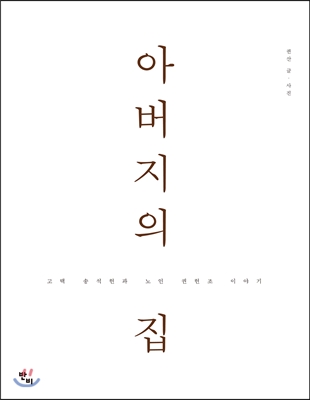
Father's house
 |
Description
Book Introduction
A journey to discover the value of old and outdated things
The beauty of vanishing things, captured in photographs and short texts.
What does the value of old and worn-out things hold in the face of rapidly changing modern trends? A 300-year-old house, Song Seok-heon, is about to undergo major renovations, and its 83-year-old resident, Mr. Kwon Heon-jo, lives there.
The two have the word 'old' in common.
A person's life cannot be summed up in a single word or picture.
However, the past scenery or remnants that we see while tracing the history of the space where that person lived leave a more powerful impression than any record.
Song Seok-heon and Kwon Heon-jo have something in common: the last remaining value in the world.
The author, a documentary producer, records the filming with Song Seok-heon and Kwon Heon-jo, and the gaps in the records seem to be a clash of dichotomous logics such as city and countryside, old and new, but the house with hundreds of years of history and the life of a scholar of Chinese classics are filled with the preciousness that only the original can have.
Sometimes these values reveal a profound universality that transcends time.
The author's camera slowly enters the house, which does not easily reveal its inner self, and captures the beauty of the hanok hidden throughout.
It also captures the memories of those who stayed and then left, which have settled like dust throughout the house.
The camera shutter is pressed without any restrictions even on the face of an old man.
The author's photographs and writings, which capture values that will never be seen again in a few days, are imbued with the lives of the elderly and the houses that have been lived in for hundreds of years, like inner strength.
The beauty of vanishing things, captured in photographs and short texts.
What does the value of old and worn-out things hold in the face of rapidly changing modern trends? A 300-year-old house, Song Seok-heon, is about to undergo major renovations, and its 83-year-old resident, Mr. Kwon Heon-jo, lives there.
The two have the word 'old' in common.
A person's life cannot be summed up in a single word or picture.
However, the past scenery or remnants that we see while tracing the history of the space where that person lived leave a more powerful impression than any record.
Song Seok-heon and Kwon Heon-jo have something in common: the last remaining value in the world.
The author, a documentary producer, records the filming with Song Seok-heon and Kwon Heon-jo, and the gaps in the records seem to be a clash of dichotomous logics such as city and countryside, old and new, but the house with hundreds of years of history and the life of a scholar of Chinese classics are filled with the preciousness that only the original can have.
Sometimes these values reveal a profound universality that transcends time.
The author's camera slowly enters the house, which does not easily reveal its inner self, and captures the beauty of the hanok hidden throughout.
It also captures the memories of those who stayed and then left, which have settled like dust throughout the house.
The camera shutter is pressed without any restrictions even on the face of an old man.
The author's photographs and writings, which capture values that will never be seen again in a few days, are imbued with the lives of the elderly and the houses that have been lived in for hundreds of years, like inner strength.
- You can preview some of the book's contents.
Preview
index
Prologue: What I Want to Do and What I Have to Do
The first visit to the old man and the house were one
An encounter with an old house and old habits
Second visit Beautiful Bones
Home repairs and body repairs
The third visit: The ugly tree protects the village.
On the way to Gwon Heon-jo Ong
Epilogue: Old and New
Chronology of Kwon Heon-jo
The first visit to the old man and the house were one
An encounter with an old house and old habits
Second visit Beautiful Bones
Home repairs and body repairs
The third visit: The ugly tree protects the village.
On the way to Gwon Heon-jo Ong
Epilogue: Old and New
Chronology of Kwon Heon-jo
Detailed image

Into the book
Leading to the mountain
The force of the narrow path is unusual.
Neat, elegant,
Well, this word seemed appropriate.
I have to go up there.
--pp.
32-33
An old man wearing a hat crosses the yard.
It feels slow, but the actual movement is fast.
It may be the speed of 'familiarity' shown by slow but repeated actions.
--- p.45
I desperately wanted to pause for just a second to capture the hand gripping the cane, but I couldn't ask for it.
To express the will of the old man who climbs this mountain every morning and every evening, he holds a cane.
My head told me I had to take that hand, but my breathing was too heavy.
After this moment, I will never have another chance. And I missed my chance.
--- p.55
I thought about the coexistence of houses and people.
The problem was who would stay.
My thoughts have wandered off topic.
love.
What this house needs is
It was a fresh love.
--- p.95
The multi-layered structure created numerous gaps.
There were many thoughts in between.
Architects are the most active when it comes to their work.
I would have enjoyed the time in between.
Perhaps he even created a relationship that only he knew about.
--- p.99
Of course, the neat brush writing on the 200-character manuscript paper
I saw it for the first time.
It was a neat shock.
It was undeniably beautiful.
My writing and the old man's writing were from different worlds.
--- p.116
I'm becoming more and more careless.
To be precise, it has become bolder.
I crossed the threshold and this is for me
Knowing full well that this will be my last chance
To put it bluntly, I took it 'desperately'.
To capture every single movement of the old man
He rushed at me like a demon.
--- p.122
Everything about the old man was fixed.
--- p.143
What remains are memories.
One house,
It starts, it builds, it ends
Written, loved, lasting, and disappearing
Finally leaving a memory.
--- p.161
While Mr. Kwon Heon-jo was in the hospital
Grass rose with every step Kwon Heon-jo took.
The traces were clear and blue.
Whether he is present or not, there is no trace of Kwon Heon-jo.
I did it again.
--- p.200
The old PD said that his death was
He said it was a pity that an old man in his eighties died.
What is his worth? --- p.266
Everyone went down the mountain.
Left alone.
I finally get to meet the elder alone.
I bowed deeply.
Another one that protects the village
The mound made by ugly trees
It was a perfect curve.
The force of the narrow path is unusual.
Neat, elegant,
Well, this word seemed appropriate.
I have to go up there.
--pp.
32-33
An old man wearing a hat crosses the yard.
It feels slow, but the actual movement is fast.
It may be the speed of 'familiarity' shown by slow but repeated actions.
--- p.45
I desperately wanted to pause for just a second to capture the hand gripping the cane, but I couldn't ask for it.
To express the will of the old man who climbs this mountain every morning and every evening, he holds a cane.
My head told me I had to take that hand, but my breathing was too heavy.
After this moment, I will never have another chance. And I missed my chance.
--- p.55
I thought about the coexistence of houses and people.
The problem was who would stay.
My thoughts have wandered off topic.
love.
What this house needs is
It was a fresh love.
--- p.95
The multi-layered structure created numerous gaps.
There were many thoughts in between.
Architects are the most active when it comes to their work.
I would have enjoyed the time in between.
Perhaps he even created a relationship that only he knew about.
--- p.99
Of course, the neat brush writing on the 200-character manuscript paper
I saw it for the first time.
It was a neat shock.
It was undeniably beautiful.
My writing and the old man's writing were from different worlds.
--- p.116
I'm becoming more and more careless.
To be precise, it has become bolder.
I crossed the threshold and this is for me
Knowing full well that this will be my last chance
To put it bluntly, I took it 'desperately'.
To capture every single movement of the old man
He rushed at me like a demon.
--- p.122
Everything about the old man was fixed.
--- p.143
What remains are memories.
One house,
It starts, it builds, it ends
Written, loved, lasting, and disappearing
Finally leaving a memory.
--- p.161
While Mr. Kwon Heon-jo was in the hospital
Grass rose with every step Kwon Heon-jo took.
The traces were clear and blue.
Whether he is present or not, there is no trace of Kwon Heon-jo.
I did it again.
--- p.200
The old PD said that his death was
He said it was a pity that an old man in his eighties died.
What is his worth? --- p.266
Everyone went down the mountain.
Left alone.
I finally get to meet the elder alone.
I bowed deeply.
Another one that protects the village
The mound made by ugly trees
It was a perfect curve.
--- p.310
Publisher's Review
The typical yet unique life of Kwon Heon-jo, an old man
It would be difficult to call him a universal father.
Until the 1990s, there were several instances of 'traditional' fathers and sons being featured on TV during holidays, but this was likely because such fathers and sons were seen as unusual and bizarre.
When his parents were alive, he always paid respectful respects in the morning and evening, when entering and leaving, and tasted their stool to gauge their health condition when they were old and ill, and personally prepared medicine for them every day.
To relieve the frustration, I would tell them in detail everything that happened that day, without leaving anything out.
His wife had also been ill for a long time, so he made caring for someone with such devotion the most important thing in his life.
After his father, mother, and wife passed away, he took care of the 300-year-old house.
It was a house too big for a small-sized old man to care for alone, but the power of habit of 'every day' for eighty years helped him.
In this way, the existence of Kwon Heon-jo left clear traces in every room, on the veranda, in every corner of the yard, on the graves of his parents on the back mountain, and on the grass and trees on the hill leading up to the back mountain.
In my spare time from caring for others, making or refining things, I read, studied etiquette and morality, and taught.
Although he began studying at the age of four, reading and pondering its meaning until he was 83 was a part of his life, along with plowing the fields, chopping firewood, and cooking.
In a sense, he could be considered a model of Confucian life, but he did not achieve great status through Chinese classics or Confucianism.
“Those who could explain Chinese classics stood on the podium, and those who could practice the spirit of Chinese classics ran a household.” For him, Confucianism was “a study to protect and practice on one’s own.”
He took it for granted that his clothes were more worn and older than other people's, and likewise he didn't care that his life was different from other people's.
He thought that it was the natural 'duty' through what he learned from his grandfather, father, mother, and through writing, and he lived according to that thought.
But I didn't force that life on anyone else.
As the author says, Mr. Kwon Heon-jo is a peculiar old man.
“A Confucian scholar who is neither heavy nor serious.
Without packaging or pretense.
“A natural person whose life is taken for granted.” “An old man who does not assert himself.
“You can focus the audience with the quality of your speech, not the quantity.”
He is the eldest son of the Andong Kwon clan and the manager of Song Seok-heon, an old house where the family has lived for eight generations.
Filial son.
A gentle father and husband.
A talented person.
A Confucian scholar with deep learning.
According to those gathered at the funeral, he was an extremely 'good' person.
2 These are words meant to describe the old man Kwon Heon-jo, but none of them fully explain Kwon Ong.
A combination of several seemingly unfamiliar elements.
They are completely integrated into the life of this old man, Kwon Heon-jo, and form ‘Father’s Life.’
And this photo album is a record of that life.
Song Seok-heon, a proud Hanok that yearns for life
Song Seok-heon, an old house built in the 1700s, has witnessed the lives of the Kwon family for eight generations.
This Hanok, designated as Gyeongsangbuk-do Folklore Material No. 95 in 1991 and as a nationally designated important folklore material in 2007, is “a house that has all the features of a nobleman’s residence in the Yeongnam region.”
This old house underwent a complete renovation with government support in 2010, and a documentary was planned to finally record its original form.
And the author begins a short yet long journey from Gurye, Jeollanam-do to Bonghwa, Gyeongsangbuk-do to take still photos for the documentary.
The owner of the house was not in office when it was built, so the main floor was built low. However, because it was built on a slope and the front pedestal was raised, the house appears strangely tall.
“The height of the prime looks powerful, but the height of the decline looks unstable.
That instability creates a stir in the observer's mind.
I felt uneasy at Song Seok-heon.
“That anxiety, that instability was the force that made me photograph the old house called Song Seok-heon.”
As we slowly enter the house, which does not easily reveal its inner self, the author's camera captures the beauty of the 'spaces' hidden throughout this hanok.
And it also captures the memories of those who stayed here and then left, settled like dust throughout the house.
The house misses them as much as the old people.
It is unclear whether the old person's habits support the house or whether the house supports the old person's life.
The old man and the house were one.
Will someone be able to continue to 'maintain' this house after the old man?
I feel that the house needs 'people' and 'love'.
It would be difficult to call him a universal father.
Until the 1990s, there were several instances of 'traditional' fathers and sons being featured on TV during holidays, but this was likely because such fathers and sons were seen as unusual and bizarre.
When his parents were alive, he always paid respectful respects in the morning and evening, when entering and leaving, and tasted their stool to gauge their health condition when they were old and ill, and personally prepared medicine for them every day.
To relieve the frustration, I would tell them in detail everything that happened that day, without leaving anything out.
His wife had also been ill for a long time, so he made caring for someone with such devotion the most important thing in his life.
After his father, mother, and wife passed away, he took care of the 300-year-old house.
It was a house too big for a small-sized old man to care for alone, but the power of habit of 'every day' for eighty years helped him.
In this way, the existence of Kwon Heon-jo left clear traces in every room, on the veranda, in every corner of the yard, on the graves of his parents on the back mountain, and on the grass and trees on the hill leading up to the back mountain.
In my spare time from caring for others, making or refining things, I read, studied etiquette and morality, and taught.
Although he began studying at the age of four, reading and pondering its meaning until he was 83 was a part of his life, along with plowing the fields, chopping firewood, and cooking.
In a sense, he could be considered a model of Confucian life, but he did not achieve great status through Chinese classics or Confucianism.
“Those who could explain Chinese classics stood on the podium, and those who could practice the spirit of Chinese classics ran a household.” For him, Confucianism was “a study to protect and practice on one’s own.”
He took it for granted that his clothes were more worn and older than other people's, and likewise he didn't care that his life was different from other people's.
He thought that it was the natural 'duty' through what he learned from his grandfather, father, mother, and through writing, and he lived according to that thought.
But I didn't force that life on anyone else.
As the author says, Mr. Kwon Heon-jo is a peculiar old man.
“A Confucian scholar who is neither heavy nor serious.
Without packaging or pretense.
“A natural person whose life is taken for granted.” “An old man who does not assert himself.
“You can focus the audience with the quality of your speech, not the quantity.”
He is the eldest son of the Andong Kwon clan and the manager of Song Seok-heon, an old house where the family has lived for eight generations.
Filial son.
A gentle father and husband.
A talented person.
A Confucian scholar with deep learning.
According to those gathered at the funeral, he was an extremely 'good' person.
2 These are words meant to describe the old man Kwon Heon-jo, but none of them fully explain Kwon Ong.
A combination of several seemingly unfamiliar elements.
They are completely integrated into the life of this old man, Kwon Heon-jo, and form ‘Father’s Life.’
And this photo album is a record of that life.
Song Seok-heon, a proud Hanok that yearns for life
Song Seok-heon, an old house built in the 1700s, has witnessed the lives of the Kwon family for eight generations.
This Hanok, designated as Gyeongsangbuk-do Folklore Material No. 95 in 1991 and as a nationally designated important folklore material in 2007, is “a house that has all the features of a nobleman’s residence in the Yeongnam region.”
This old house underwent a complete renovation with government support in 2010, and a documentary was planned to finally record its original form.
And the author begins a short yet long journey from Gurye, Jeollanam-do to Bonghwa, Gyeongsangbuk-do to take still photos for the documentary.
The owner of the house was not in office when it was built, so the main floor was built low. However, because it was built on a slope and the front pedestal was raised, the house appears strangely tall.
“The height of the prime looks powerful, but the height of the decline looks unstable.
That instability creates a stir in the observer's mind.
I felt uneasy at Song Seok-heon.
“That anxiety, that instability was the force that made me photograph the old house called Song Seok-heon.”
As we slowly enter the house, which does not easily reveal its inner self, the author's camera captures the beauty of the 'spaces' hidden throughout this hanok.
And it also captures the memories of those who stayed here and then left, settled like dust throughout the house.
The house misses them as much as the old people.
It is unclear whether the old person's habits support the house or whether the house supports the old person's life.
The old man and the house were one.
Will someone be able to continue to 'maintain' this house after the old man?
I feel that the house needs 'people' and 'love'.
GOODS SPECIFICS
- Publication date: November 25, 2012
- Format: Hardcover book binding method guide
- Page count, weight, size: 332 pages | 976g | 175*230*30mm
- ISBN13: 9788983714428
- ISBN10: 8983714425
You may also like
카테고리
korean


korean

![GQ KOREA Mark (Monthly): December [2025]](http://librairie.coreenne.fr/cdn/shop/files/8ef265dbbfbf186523ed75ba7319009d.jpg?v=1765340328&width=3840)


