

Consolidation
 |
Description
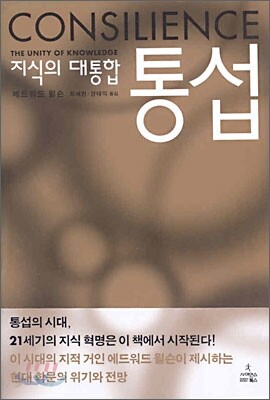
Book Introduction
Edward Wilson, the founder of sociobiology and a persistent advocate of integrating the humanities and natural sciences.
This book is a masterpiece that summarizes that huge project.
He emphasizes that natural science, humanities, and social sciences must cooperate based on the perspective that human knowledge is essentially unified.
To persuasively present this vision of a "grand integration of knowledge," we deeply analyze the various branches that branch off from the main trunk of Western scholarship, and clearly demonstrate the potential for knowledge integration hidden within these branches, yet overlooked by experts in the field.
Starting from the worldview of ancient Greek philosophers, which can be said to be the roots of Western scholarship, through the Enlightenment, which became the mother of modern scholarship and science, and reaching to modern natural science, social science, art, and religious theory, it encompasses the intellectual adventure of humankind diachronically and synchronicly with the prospect of a grand integration of knowledge.
And it seeks to synthesize the two by crossing the major walls that block academic disciplines: the conflict between natural scientists and social scientists, the dichotomy of mind and body, the conflict between geneticists and nurtureists, the debate between empiricists and transcendentalists over ethical standards, and the antagonism between materialists and theists, through the latest scientific achievements.
The original title, 'consilience', is derived from the Latin word 'consiliere', meaning 'jumping together', and means "the 'integration' of knowledge by connecting facts and fact-based theories across fields to create a common basis of explanation."
Professor Choi Jae-cheon of the Department of Life Sciences at Seoul National University, a student of Edward Wilson and the translator of this book, translated this concept as 'consilience' when translating the book.
It is a word created by combining the word ‘tong’ (統), meaning ‘large stem’ or ‘clue’, and the word ‘seop’ (攝), meaning ‘to catch’ or ‘to grasp’, and has the meaning of ‘to catch a large stem.’
Also, when it is used as “supervise the three armies,” it means “rule over everything” or “supervise and govern.”
This book is a masterpiece that summarizes that huge project.
He emphasizes that natural science, humanities, and social sciences must cooperate based on the perspective that human knowledge is essentially unified.
To persuasively present this vision of a "grand integration of knowledge," we deeply analyze the various branches that branch off from the main trunk of Western scholarship, and clearly demonstrate the potential for knowledge integration hidden within these branches, yet overlooked by experts in the field.
Starting from the worldview of ancient Greek philosophers, which can be said to be the roots of Western scholarship, through the Enlightenment, which became the mother of modern scholarship and science, and reaching to modern natural science, social science, art, and religious theory, it encompasses the intellectual adventure of humankind diachronically and synchronicly with the prospect of a grand integration of knowledge.
And it seeks to synthesize the two by crossing the major walls that block academic disciplines: the conflict between natural scientists and social scientists, the dichotomy of mind and body, the conflict between geneticists and nurtureists, the debate between empiricists and transcendentalists over ethical standards, and the antagonism between materialists and theists, through the latest scientific achievements.
The original title, 'consilience', is derived from the Latin word 'consiliere', meaning 'jumping together', and means "the 'integration' of knowledge by connecting facts and fact-based theories across fields to create a common basis of explanation."
Professor Choi Jae-cheon of the Department of Life Sciences at Seoul National University, a student of Edward Wilson and the translator of this book, translated this concept as 'consilience' when translating the book.
It is a word created by combining the word ‘tong’ (統), meaning ‘large stem’ or ‘clue’, and the word ‘seop’ (攝), meaning ‘to catch’ or ‘to grasp’, and has the meaning of ‘to catch a large stem.’
Also, when it is used as “supervise the three armies,” it means “rule over everything” or “supervise and govern.”
- You can preview some of the book's contents.
Preview
index
Translator's Preface
Preface to the Korean edition
Chapter 1: The Magic of Ionia
Chapter 2: The Great Branches of Learning
Chapter 3: Enlightenment Thought
Chapter 4 Natural Sciences
Chapter 5: Ariadne's Thread
Chapter 6: Mind
Chapter 7: From Genes to Culture
Chapter 8: Adaptability of Human Nature
Chapter 9 Social Sciences
Chapter 10: Art and Its Interpretation
Chapter 11: Ethics and Religion
Chapter 12: Where Are We Going?
References
Acknowledgements
Search
Preface to the Korean edition
Chapter 1: The Magic of Ionia
Chapter 2: The Great Branches of Learning
Chapter 3: Enlightenment Thought
Chapter 4 Natural Sciences
Chapter 5: Ariadne's Thread
Chapter 6: Mind
Chapter 7: From Genes to Culture
Chapter 8: Adaptability of Human Nature
Chapter 9 Social Sciences
Chapter 10: Art and Its Interpretation
Chapter 11: Ethics and Religion
Chapter 12: Where Are We Going?
References
Acknowledgements
Search
Publisher's Review
The academic world of the 21st century will be divided into natural sciences and humanities, with social sciences being absorbed into biology and humanities.
And the great challenge of human intelligence to merge science and humanities will continue!
The theme of this book is, in a word, the inherent unity of knowledge.
Does knowledge truly possess an inherent unity? Could there be a more crucial question for understanding ourselves as human beings?
I think this is a central issue in philosophy.
Are there multiple truths in this world? Will knowledge always remain divided into the three academic disciplines currently recognized by Western culture: natural science, social science, and humanities? Will science and religion thus forever be subordinated to their respective spheres of truth?
The unity of knowledge means encompassing causal explanations across different academic disciplines.
For example, it encompasses physics and chemistry, chemistry and biology, and, more difficultly, biology, the social sciences, and the humanities.
Many thinkers, including myself, believe that it is time to consider more seriously than ever the importance of natural science and its integration with the social sciences and humanities.
This is not just about creating a simple partnership, but about integration that lays the foundation for a knowledge system.
- Edward Wilson, from the 'Preface to the Korean Edition'
And the great challenge of human intelligence to merge science and humanities will continue!
The theme of this book is, in a word, the inherent unity of knowledge.
Does knowledge truly possess an inherent unity? Could there be a more crucial question for understanding ourselves as human beings?
I think this is a central issue in philosophy.
Are there multiple truths in this world? Will knowledge always remain divided into the three academic disciplines currently recognized by Western culture: natural science, social science, and humanities? Will science and religion thus forever be subordinated to their respective spheres of truth?
The unity of knowledge means encompassing causal explanations across different academic disciplines.
For example, it encompasses physics and chemistry, chemistry and biology, and, more difficultly, biology, the social sciences, and the humanities.
Many thinkers, including myself, believe that it is time to consider more seriously than ever the importance of natural science and its integration with the social sciences and humanities.
This is not just about creating a simple partnership, but about integration that lays the foundation for a knowledge system.
- Edward Wilson, from the 'Preface to the Korean Edition'
GOODS SPECIFICS
- Date of issue: April 27, 2005
- Page count, weight, size: 558 pages | 912g | 153*224*35mm
- ISBN13: 9788983711601
- ISBN10: 8983711604
You may also like
카테고리
korean


korean

![GQ KOREA Mark (Monthly): December [2025]](http://librairie.coreenne.fr/cdn/shop/files/8ef265dbbfbf186523ed75ba7319009d.jpg?v=1765340328&width=3840)


