

Buddhist Philosophy Lecture at Minnesota State University
 |
Description
Book Introduction
Professor Hong Chang-seong (Professor of Philosophy, Minnesota State University, USA), author of 'Buddhist Philosophy Lectures at Minnesota State University', was at the center of the debate during the 'Enlightenment Debate' that heated up the Korean Buddhist community starting in 2015, contributing more articles (8 pieces) to the media than anyone else, and received a lot of attention.
The 'Buddhist Philosophy Lectures' he gave at a university in the distant land of America were very special.
This is because it is targeting young college students who have never been exposed to anything about Buddhism, and in Minnesota, a state in the northern part of the Bible Belt, which is famous for its strong Christian tradition.
The author completed this book by organizing the sharp questions raised by students and the sharp discussions and arguments that followed, based on the Buddhist philosophy lectures he has given over the past decade.
In this book, the author discusses the core of Buddhist philosophy - from basic doctrines such as 'anatta (anatta),' 'reincarnation (samsara),' and 'causation (dependent origination)' to 'enlightenment' and 'nirvana (nirvana),' which are ideal states of Buddhism - with universal concepts and methods that anyone in this day and age can understand, just as he did with local American students who were unfamiliar with Buddhism.
Moreover, by looking at it through the unique lens of Western philosophy, his own field of expertise, he reveals the sophisticated, intellectual, and logical aspects of Buddhist philosophy more clearly.
This book provides a clue to those who have encountered philosophical difficulties while studying Buddhism.
It also offers a new perspective on our lives and the world to readers who are new to Buddhism, as well as those with a basic knowledge of Buddhism or an interest in Eastern philosophy.
The 'Buddhist Philosophy Lectures' he gave at a university in the distant land of America were very special.
This is because it is targeting young college students who have never been exposed to anything about Buddhism, and in Minnesota, a state in the northern part of the Bible Belt, which is famous for its strong Christian tradition.
The author completed this book by organizing the sharp questions raised by students and the sharp discussions and arguments that followed, based on the Buddhist philosophy lectures he has given over the past decade.
In this book, the author discusses the core of Buddhist philosophy - from basic doctrines such as 'anatta (anatta),' 'reincarnation (samsara),' and 'causation (dependent origination)' to 'enlightenment' and 'nirvana (nirvana),' which are ideal states of Buddhism - with universal concepts and methods that anyone in this day and age can understand, just as he did with local American students who were unfamiliar with Buddhism.
Moreover, by looking at it through the unique lens of Western philosophy, his own field of expertise, he reveals the sophisticated, intellectual, and logical aspects of Buddhist philosophy more clearly.
This book provides a clue to those who have encountered philosophical difficulties while studying Buddhism.
It also offers a new perspective on our lives and the world to readers who are new to Buddhism, as well as those with a basic knowledge of Buddhism or an interest in Eastern philosophy.
- You can preview some of the book's contents.
Preview
index
Starting the lecture
Lecture 1.
What is Buddhism
Lecture 2.
Buddha, enlightenment, anatta
Lecture 3.
The Paradox of Enlightenment
Lecture 4.
There is no reincarnation, but there is reincarnation.
Lesson 5.
The beginning and end of reincarnation
Lesson 6.
Nirvana
Lesson 7.
There is nirvana, but there is no nirvana.
Lesson 8.
A New Understanding of Buddha Nature
Lesson 9.
Selflessness and compassion
Lesson 10.
What is acting?
Lesson 11.
Acting: Causality and Relationships
Lesson 12.
The Paradox of Acting
Lesson 13.
Mahayana and Emptiness
Lesson 14.
It's difficult to act
Lesson 15.
Public, neutral, and non-public
Lesson 16.
The law of opening and closing
Lesson 17.
rational understanding of good
Lesson 18.
14 Questions Buddha Didn't Answer
Lesson 19.
How to live as a Buddhist
Lesson 20.
The Middle Way and the Noble Eightfold Path
Lesson 21.
Harmony and unity
Lesson 22.
Selflessness and the self as a person
Lesson 23.
expedient
Lesson 24.
Problems with Buddhism as Seen by American College Students
At the end of the lecture
Lecture 1.
What is Buddhism
Lecture 2.
Buddha, enlightenment, anatta
Lecture 3.
The Paradox of Enlightenment
Lecture 4.
There is no reincarnation, but there is reincarnation.
Lesson 5.
The beginning and end of reincarnation
Lesson 6.
Nirvana
Lesson 7.
There is nirvana, but there is no nirvana.
Lesson 8.
A New Understanding of Buddha Nature
Lesson 9.
Selflessness and compassion
Lesson 10.
What is acting?
Lesson 11.
Acting: Causality and Relationships
Lesson 12.
The Paradox of Acting
Lesson 13.
Mahayana and Emptiness
Lesson 14.
It's difficult to act
Lesson 15.
Public, neutral, and non-public
Lesson 16.
The law of opening and closing
Lesson 17.
rational understanding of good
Lesson 18.
14 Questions Buddha Didn't Answer
Lesson 19.
How to live as a Buddhist
Lesson 20.
The Middle Way and the Noble Eightfold Path
Lesson 21.
Harmony and unity
Lesson 22.
Selflessness and the self as a person
Lesson 23.
expedient
Lesson 24.
Problems with Buddhism as Seen by American College Students
At the end of the lecture
Detailed image
Into the book
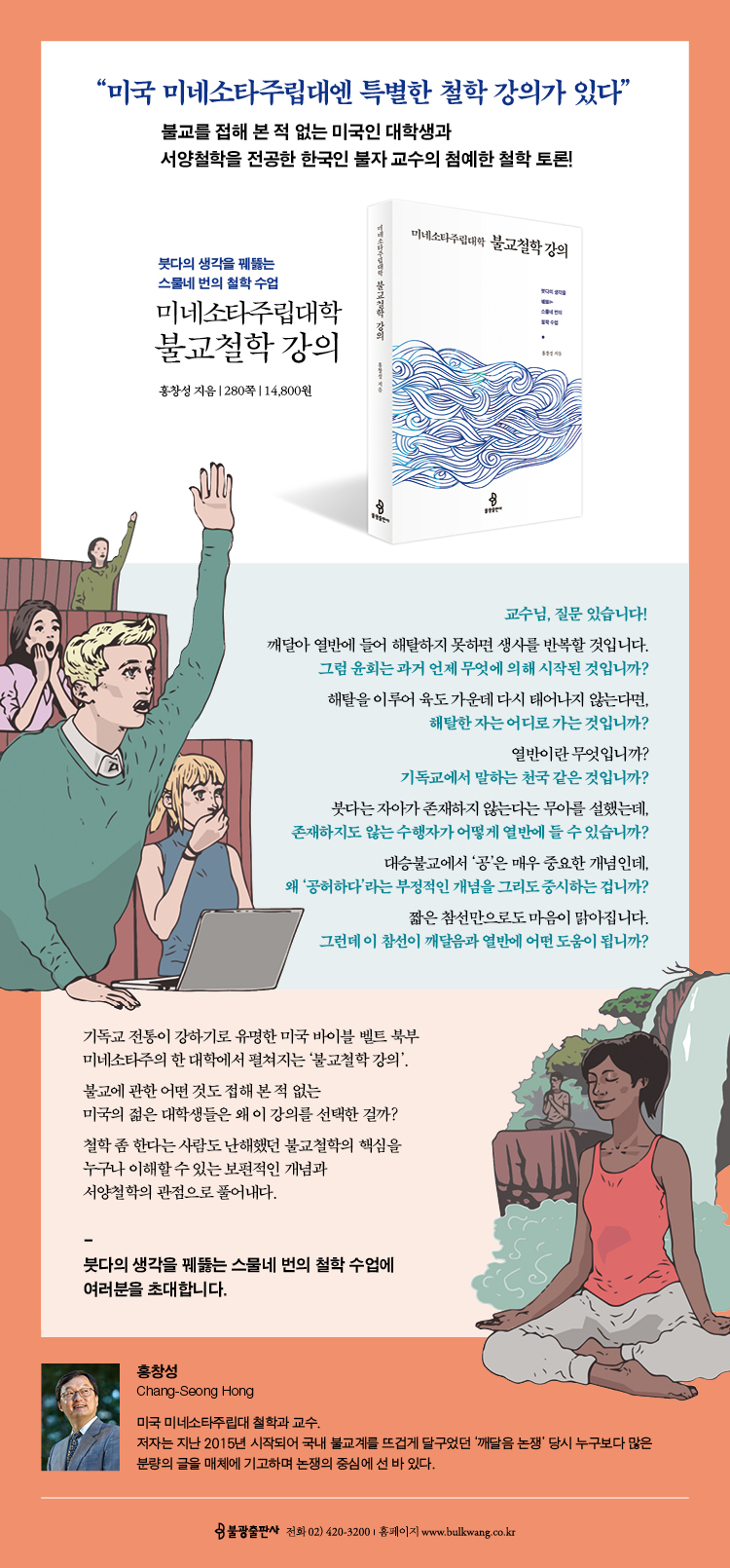
If Buddha refers to Siddhartha Gautama, who lived in ancient India, does the claim that anyone can become a Buddha upon attaining enlightenment mean that anyone can become Siddhartha Gautama? But how can I become identical to Siddhartha Gautama just by attaining enlightenment? This seems like an unreasonable claim.
--- p.25
In Buddhism, isn't the desire for enlightenment not a simple desire like drinking water or eating? It's a tremendous desire to achieve a truly remarkable feat: to completely resolve the problems of life and death and never fall into the cycle of reincarnation again.
If you want enlightenment, you can't free yourself from this attachment to such a grand thing. So how can you achieve enlightenment? --- p.41
I heard that Buddhism teaches reincarnation.
I've also seen a few movies about reincarnation.
But how can reincarnation be possible if the soul doesn't exist? What, then, replaces the soul and reincarnates? --- p.49
If you do not realize it and enter nirvana, you will repeat birth and death.
Since time stretches infinitely into the future, we will be born and die forever.
So, when and by what did reincarnation begin in the past? How can Buddhism, which denies the existence of a creator like the Christian God, explain the beginning of this universe and reincarnation? --- p.62
What happens to someone who attains enlightenment and enters nirvana? If they are not reborn, where do they go? Do liberated beings truly exist, or do they not? In short, what and where is the end of reincarnation? --- p.67
They say that to escape the sea of suffering, we must reach nirvana. But what is nirvana? Only by understanding what nirvana is can we strive to attain it.
Is the world of nirvana like the heaven of Christianity? Or does it refer to a state of consciousness filled with peace and bliss? How exactly should we define and understand nirvana? --- p.73
But who achieves nirvana? Shakyamuni preached anatta, the nonexistence of the self. How can a practitioner who doesn't exist enter nirvana? Is nirvana possible without someone else entering nirvana? --- p.85
Just five minutes of meditation will clear your mind.
So, I often meditate when I get home.
But how does Zen meditation contribute to enlightenment and nirvana? Does enlightenment come when the mind becomes infinitely clear? Or is there some other basis for enlightenment related to meditation? --- p.95
The Buddha nature that everyone has seems to be like a pure soul.
If we regain our original, pure soul through Zen practice, can we achieve Buddhist enlightenment, similar to salvation in Christianity? If so, how does Buddha-nature differ from the soul or Atman? --- p.96
Buddhism does not believe in a creator or absolute god.
How can such a Buddhism be considered a religion? And how can Buddhists who don't even believe in the existence of the soul live morally upright lives? --- p.105
Buddhism is a religion of enlightenment.
But what exactly is the truth that the Buddha attained enlightenment and enlightenment under the Bodhi tree? If we realize this truth, will we also become Buddhas? --- p.115
The world of consciousness and language are ultimately formed by the functioning of our brain cells.
But if brain cells cannot help but follow the causal laws of the natural world, shouldn't the world of consciousness and language also be viewed as areas where causality applies? --- p.134-135
Heraclitus of ancient Greece argued that all things are in constant change.
Then there is the problem that the claim that all things change also changes, so it is not ultimately an eternal truth.
The same goes for the Buddha's teachings of impermanence.
Since impermanence itself is impermanent, doesn't that ultimately make all things impermanent? Dependent arising also asserts that things cannot create, sustain, or annihilate themselves. If dependent arising cannot exist on its own, then wouldn't we have no need to believe and accept that assertion? --- p. 139-140
Tibetan Buddhism is now widely practiced in the United States.
This Tibetan Buddhism also belongs to Mahayana Buddhism, right? However, if you listen to the Dalai Lama's lectures, you'll find many references to emptiness.
According to him, emptiness is a crucial concept and a teaching we must learn well. How can emptiness be something good we should pursue? The word "emptiness" always connotes a negative psychological state, so why does Mahayana Buddhism place such importance on this negative concept? Could this emptiness be the reason Buddhism is sometimes called pessimistic? --- p.151
The claim that acting is a ball is illogical.
Dependent on conditions, all things come into being and die, and emptiness means that things have no self-nature.
But how can these two concepts be identical? Since acting refers to conditions and emptiness denies self-nature, how can acting and emptiness be identical? --- p.159
Just because something possesses magnetism, how can it exist forever? Is there such a thing in this world? --- p.172
If all things are empty, neither annihilated nor enduring, then how does they exist? If they are neither this nor that, can you describe them in positive terms? --- p.174
Buddhism seems to be good at answering and responding to difficult and important questions.
But are there questions Buddhism can't answer or problems it can't theoretically resolve? If so, what are they? --- p.199
I understand that in Korea, we practice in a way that makes us happy by relaxing our body and mind.
however
How can this practice connect with Buddhism's contribution to society? Just because I'm comfortable on my own doesn't mean others will be comfortable too, right? Shouldn't a religion be about bringing happiness to many people? --- p.210
Aristotle of ancient Greece said that the middle way, which avoids the extremes of excess and deficiency and takes the appropriate middle ground, is virtue.
Buddha's Middle Way probably has similar content, right? --- p.221
Is the "one mind" that Wonhyo speaks of an unchanging, unwavering truth? Isn't it a single, unified substance or entity that underlies the claims of all the various Buddhist schools? If so, how does this "one mind" differ from the Brahman or Atman of Hinduism?
--- p.25
In Buddhism, isn't the desire for enlightenment not a simple desire like drinking water or eating? It's a tremendous desire to achieve a truly remarkable feat: to completely resolve the problems of life and death and never fall into the cycle of reincarnation again.
If you want enlightenment, you can't free yourself from this attachment to such a grand thing. So how can you achieve enlightenment? --- p.41
I heard that Buddhism teaches reincarnation.
I've also seen a few movies about reincarnation.
But how can reincarnation be possible if the soul doesn't exist? What, then, replaces the soul and reincarnates? --- p.49
If you do not realize it and enter nirvana, you will repeat birth and death.
Since time stretches infinitely into the future, we will be born and die forever.
So, when and by what did reincarnation begin in the past? How can Buddhism, which denies the existence of a creator like the Christian God, explain the beginning of this universe and reincarnation? --- p.62
What happens to someone who attains enlightenment and enters nirvana? If they are not reborn, where do they go? Do liberated beings truly exist, or do they not? In short, what and where is the end of reincarnation? --- p.67
They say that to escape the sea of suffering, we must reach nirvana. But what is nirvana? Only by understanding what nirvana is can we strive to attain it.
Is the world of nirvana like the heaven of Christianity? Or does it refer to a state of consciousness filled with peace and bliss? How exactly should we define and understand nirvana? --- p.73
But who achieves nirvana? Shakyamuni preached anatta, the nonexistence of the self. How can a practitioner who doesn't exist enter nirvana? Is nirvana possible without someone else entering nirvana? --- p.85
Just five minutes of meditation will clear your mind.
So, I often meditate when I get home.
But how does Zen meditation contribute to enlightenment and nirvana? Does enlightenment come when the mind becomes infinitely clear? Or is there some other basis for enlightenment related to meditation? --- p.95
The Buddha nature that everyone has seems to be like a pure soul.
If we regain our original, pure soul through Zen practice, can we achieve Buddhist enlightenment, similar to salvation in Christianity? If so, how does Buddha-nature differ from the soul or Atman? --- p.96
Buddhism does not believe in a creator or absolute god.
How can such a Buddhism be considered a religion? And how can Buddhists who don't even believe in the existence of the soul live morally upright lives? --- p.105
Buddhism is a religion of enlightenment.
But what exactly is the truth that the Buddha attained enlightenment and enlightenment under the Bodhi tree? If we realize this truth, will we also become Buddhas? --- p.115
The world of consciousness and language are ultimately formed by the functioning of our brain cells.
But if brain cells cannot help but follow the causal laws of the natural world, shouldn't the world of consciousness and language also be viewed as areas where causality applies? --- p.134-135
Heraclitus of ancient Greece argued that all things are in constant change.
Then there is the problem that the claim that all things change also changes, so it is not ultimately an eternal truth.
The same goes for the Buddha's teachings of impermanence.
Since impermanence itself is impermanent, doesn't that ultimately make all things impermanent? Dependent arising also asserts that things cannot create, sustain, or annihilate themselves. If dependent arising cannot exist on its own, then wouldn't we have no need to believe and accept that assertion? --- p. 139-140
Tibetan Buddhism is now widely practiced in the United States.
This Tibetan Buddhism also belongs to Mahayana Buddhism, right? However, if you listen to the Dalai Lama's lectures, you'll find many references to emptiness.
According to him, emptiness is a crucial concept and a teaching we must learn well. How can emptiness be something good we should pursue? The word "emptiness" always connotes a negative psychological state, so why does Mahayana Buddhism place such importance on this negative concept? Could this emptiness be the reason Buddhism is sometimes called pessimistic? --- p.151
The claim that acting is a ball is illogical.
Dependent on conditions, all things come into being and die, and emptiness means that things have no self-nature.
But how can these two concepts be identical? Since acting refers to conditions and emptiness denies self-nature, how can acting and emptiness be identical? --- p.159
Just because something possesses magnetism, how can it exist forever? Is there such a thing in this world? --- p.172
If all things are empty, neither annihilated nor enduring, then how does they exist? If they are neither this nor that, can you describe them in positive terms? --- p.174
Buddhism seems to be good at answering and responding to difficult and important questions.
But are there questions Buddhism can't answer or problems it can't theoretically resolve? If so, what are they? --- p.199
I understand that in Korea, we practice in a way that makes us happy by relaxing our body and mind.
however
How can this practice connect with Buddhism's contribution to society? Just because I'm comfortable on my own doesn't mean others will be comfortable too, right? Shouldn't a religion be about bringing happiness to many people? --- p.210
Aristotle of ancient Greece said that the middle way, which avoids the extremes of excess and deficiency and takes the appropriate middle ground, is virtue.
Buddha's Middle Way probably has similar content, right? --- p.221
Is the "one mind" that Wonhyo speaks of an unchanging, unwavering truth? Isn't it a single, unified substance or entity that underlies the claims of all the various Buddhist schools? If so, how does this "one mind" differ from the Brahman or Atman of Hinduism?
--- p.235
Publisher's Review
What we need to know to eliminate all afflictions
For those studying Eastern philosophy, Buddhism is an important point that cannot be avoided.
Buddhism is one of the world's major religions, but it has long been recognized as an ideology that transcends religious beliefs and offers a path to salvation for modern humanity, which is suffering from mental anguish, and for a society that is becoming sick from the harmful effects of advanced civilization.
Recently, the benefits of Buddhist practice, represented by meditation, have been scientifically proven, attracting public attention regardless of East or West.
Many students taking Buddhist philosophy classes at Minnesota State University also seem to find the brief meditation session before class more impactful than any other moment.
It always amazes me how much my students enjoy the five-minute meditation practiced under my guidance at the beginning of each class.
There are many students who enjoy the practice so much that they practice it at home every day and make it an important part of their daily routine.
- Page 276
However, the author emphasizes that in order to reach the most ideal state of Buddhism, not only the practical aspects of Buddhist practice but also an attitude of understanding Buddhist philosophy are important.
However, the philosophical concepts discussed in Buddhism have some aspects that are difficult for modern people to easily accept.
Perhaps that is why complaints about the difficulty of studying Buddhism are not new.
Even those who study philosophy find Buddha's philosophy difficult to understand.
It's not just beginners who find Buddhist philosophy difficult.
Even for ardent Buddhists and those who pride themselves on their philosophical knowledge, unresolved questions about Buddhist philosophy inevitably arise.
There comes a time when you encounter a 'difficulty' that you don't immediately understand, or that you thought you understood but it doesn't seem to be the case.
Moreover, it is even more disheartening to know that these things that we encounter every time are the core doctrines of Buddhism.
· If you do not realize and enter Nirvana, you will repeat birth and death.
So when and by what did reincarnation begin in the past?
· Buddha taught that there is no self, that there is no self, so how can a practitioner who does not exist enter nirvana?
· Doesn't enlightenment require an object?
So what do you know and what do you realize?
· If liberation means breaking the cycle of reincarnation, then where on earth do enlightened beings go?
· Obsession with enlightenment is still an obsession! Is enlightenment possible?
From basic doctrines such as ‘anatta’, ‘reincarnation’, and ‘causal origin’ to ‘enlightenment’ and ‘nirvana’, which are the ideal states of Buddhism, our questions are endless.
In fact, it is not difficult to understand their dictionary meanings.
But why does the more we delve into these doctrines comprehensively, the more we feel like we're stuck in an inescapable swamp? Perhaps it's because we're clashing with certain "entrenched ideas" we've consciously or unconsciously held onto for decades.
As students in Buddhist philosophy classes have done, things that have been unquestionable to individuals for a long time—for example, the belief in an immutable being (soul) that can be called "I," the idea that all phenomena must have a known beginning, the notion that our lives flow according to a predetermined fate—are bound to clash with the Buddha's philosophy.
What is noteworthy here is that these questions are closely related to the questions raised by American college students as the lectures progress.
Read the most basic things from the most universal concepts
Professor Hong Chang-seong, author of “Minnesota State University Buddhist Philosophy Lectures,” is a fairly well-known figure in our Buddhist community.
He graduated from the Department of Philosophy and the Graduate School of Seoul National University, and went to the United States to receive a doctorate from Brown University Graduate School. He is currently a professor in the Department of Philosophy at the University of Minnesota.
In particular, during the 'Enlightenment Debate' that began in 2015 and heated up the Korean Buddhist community, he contributed more articles (8 pieces) than anyone else and was at the center of the debate.
Although he is an author who is receiving attention in the Buddhist community, it seems that his lectures on Buddhist philosophy in the distant land of America, which he opened with little effort, were not successful.
The author recalls the first hour of the lecture:
'I was the only non-white person in the class, the professor.'
I guess this expression is meant to express the strange feeling one gets when looking at a classroom full of students who don't even know the character 'Buddha' in Buddhism.
Ultimately, the author had to proceed with the lecture using the most 'universal concepts' and 'methods' that 'anyone can understand from basic doctrines without assuming any background knowledge.'
“Don’t we at least use the same name for our entire lives?”
"no.
People change their names.”
“Don’t we live with the same thoughts and feelings?”
“Not at all.
Political and religious beliefs change, and even lovers can change their minds.”
“What does it look like?”
“Even without mentioning plastic surgery, people’s appearance changes as they age.
“Mostly towards becoming less beautiful.”
“Then what about DNA?”
“Parts of DNA also change over time.
Mutations can also occur when exposed to chemicals or radiation.
Meanwhile, the particles that make up DNA are constantly replaced with new particles.
All cells in the human body die and are replaced by new cells according to their respective cell cycles.
“The number of words we have changes, our emotions change, and all the cognitive functions we think of, such as our will and our senses, change.” - p. 32
One of the notable features of the lectures in this book is that it looks at Buddhist philosophy logically, as in the example of the question and answer related to 'anatta' above.
It may be because there are students sitting there who, like Americans who naturally pursue rationality, do not like things to be done hastily.
Moreover, weren't they the ones who were educated in the Western philosophical way of thinking from a young age and lived their entire lives with it?
Of course, the tendency to pursue only what is rational and logical is not limited to the United States.
Moreover, it is not recent that Western thinking has become a part of our lives.
This is precisely why the lecture content from American universities contained in this book is also relevant to domestic readers.
A common question that transcends time and space,
Buddhist philosophy from a Western philosophical perspective
The Pali Sutra, which is considered to be the oldest Buddhist scripture, contains the Milinda Panha, or the Milinda King Sutra.
This sutra, which is included in the Tripitaka Koreana under the title “Seonseongbigugyeong,” is mainly about a Buddhist debate between the Indian monk Nagasena and the Greek King Milinda.
The illicit debate between Easterners and Westerners with different philosophical perspectives resembles the Buddhist philosophy lectures taking place at the University of Minnesota in the 21st century.
What is interesting is that the questions raised by students in the previous lectures, which both amused and at times perplexed the author, are very similar to those raised to the Venerable Nagasena in the past.
[Student's Question]
I heard that Buddhism teaches reincarnation.
I've also seen a few movies about reincarnation.
But how can reincarnation be possible if the soul doesn't exist? What, then, replaces the soul and reincarnates? - Page 49
[King Milinda's Question]
How should we understand the Buddhist teaching that reincarnation is possible even though I do not exist? - pp. 54-55
The common questions raised across time and space are also points that we, even though we have encountered Buddhism more extensively and more frequently than American students, have not fully understood, just like they have.
Just as the author said that he felt a prickle every time he encountered the sharp questions of the students, we too are poised to feel a prickle.
The author provides Buddhist contexts, such as the famous candlelight parable of Venerable Nagasena, to answer the above question and provides examples to help students understand.
However, it has become difficult to fully understand modern audiences with only the classical context in which the Buddha and Venerable Nagasena answered.
Another notable feature of the author's lectures in this book is that he introduces a Western philosophical perspective when teaching the main contents of Buddhist philosophy.
In fact, the author's major is Western philosophy.
This is also a point where synergy can be created in teaching Buddhist philosophy and helping students understand it.
While reading the book, you will often come across passages comparing and analyzing the theories (perspectives) of prominent figures in Western philosophy, such as Aristotle, Kant, and Bertrand Russell, with those of Buddha.
In addition, the basic principle of British utilitarianism, 'the greatest happiness for the greatest number', is applied to the lives of Buddhists who are moving toward enlightenment, and the misunderstanding caused by 'emptiness', a translation of 'emptiness', is examined and analyzed along with our reality of viewing 'emptiness' as a single entity.
Through this process, we can see the Buddha's philosophy more clearly through concepts that are suitable for our current 'foundation' and may even serve as a 'means'.
A moment that even American college students nod their heads in agreement
In this book, the author actively cites the 'aggressive' and 'sharp' questions raised by students in past lectures.
And this philosophical essay is completed by adding sharp discussions and arguments on that question, as well as suggestions on philosophical difficulties that are still the subject of debate even in Buddhist circles.
This book may be suitable for readers with a basic knowledge of Buddhism.
It is especially good for those who are interested in Eastern philosophy or have reached a difficult point while studying Buddhism.
But even beginners, like American college students who knew nothing about Buddhism, have the strength to read it all the way through.
Moreover, the author's sentences, which are sometimes witty and sometimes serious, do not fade.
To understand Buddhist philosophy, an open mind and a change of thinking are necessary above all else.
“You paid expensive tuition to come to college and sit here, so shouldn’t you have the opportunity to learn something new and think differently?
“I hope that you will experience a new outlook on life and a new worldview through Buddhism during this semester.” - Page 33
Some of the stereotypes we have limit our lives by making us see and judge the world in a narrow way.
In that sense, the author's "Buddhist Philosophy Lectures," which actively pursues research in the fields of metaphysics, philosophy of mind, and even Buddhist philosophy, helps us overcome our old notions and misunderstandings and gain a broader and more flexible perspective on reality.
If you are a reader who is tired of clashing with your own philosophical beliefs as you learn more about Buddhism, open this book right now.
You will find hints to the difficult problems you have been searching for and will be amazed.
For those studying Eastern philosophy, Buddhism is an important point that cannot be avoided.
Buddhism is one of the world's major religions, but it has long been recognized as an ideology that transcends religious beliefs and offers a path to salvation for modern humanity, which is suffering from mental anguish, and for a society that is becoming sick from the harmful effects of advanced civilization.
Recently, the benefits of Buddhist practice, represented by meditation, have been scientifically proven, attracting public attention regardless of East or West.
Many students taking Buddhist philosophy classes at Minnesota State University also seem to find the brief meditation session before class more impactful than any other moment.
It always amazes me how much my students enjoy the five-minute meditation practiced under my guidance at the beginning of each class.
There are many students who enjoy the practice so much that they practice it at home every day and make it an important part of their daily routine.
- Page 276
However, the author emphasizes that in order to reach the most ideal state of Buddhism, not only the practical aspects of Buddhist practice but also an attitude of understanding Buddhist philosophy are important.
However, the philosophical concepts discussed in Buddhism have some aspects that are difficult for modern people to easily accept.
Perhaps that is why complaints about the difficulty of studying Buddhism are not new.
Even those who study philosophy find Buddha's philosophy difficult to understand.
It's not just beginners who find Buddhist philosophy difficult.
Even for ardent Buddhists and those who pride themselves on their philosophical knowledge, unresolved questions about Buddhist philosophy inevitably arise.
There comes a time when you encounter a 'difficulty' that you don't immediately understand, or that you thought you understood but it doesn't seem to be the case.
Moreover, it is even more disheartening to know that these things that we encounter every time are the core doctrines of Buddhism.
· If you do not realize and enter Nirvana, you will repeat birth and death.
So when and by what did reincarnation begin in the past?
· Buddha taught that there is no self, that there is no self, so how can a practitioner who does not exist enter nirvana?
· Doesn't enlightenment require an object?
So what do you know and what do you realize?
· If liberation means breaking the cycle of reincarnation, then where on earth do enlightened beings go?
· Obsession with enlightenment is still an obsession! Is enlightenment possible?
From basic doctrines such as ‘anatta’, ‘reincarnation’, and ‘causal origin’ to ‘enlightenment’ and ‘nirvana’, which are the ideal states of Buddhism, our questions are endless.
In fact, it is not difficult to understand their dictionary meanings.
But why does the more we delve into these doctrines comprehensively, the more we feel like we're stuck in an inescapable swamp? Perhaps it's because we're clashing with certain "entrenched ideas" we've consciously or unconsciously held onto for decades.
As students in Buddhist philosophy classes have done, things that have been unquestionable to individuals for a long time—for example, the belief in an immutable being (soul) that can be called "I," the idea that all phenomena must have a known beginning, the notion that our lives flow according to a predetermined fate—are bound to clash with the Buddha's philosophy.
What is noteworthy here is that these questions are closely related to the questions raised by American college students as the lectures progress.
Read the most basic things from the most universal concepts
Professor Hong Chang-seong, author of “Minnesota State University Buddhist Philosophy Lectures,” is a fairly well-known figure in our Buddhist community.
He graduated from the Department of Philosophy and the Graduate School of Seoul National University, and went to the United States to receive a doctorate from Brown University Graduate School. He is currently a professor in the Department of Philosophy at the University of Minnesota.
In particular, during the 'Enlightenment Debate' that began in 2015 and heated up the Korean Buddhist community, he contributed more articles (8 pieces) than anyone else and was at the center of the debate.
Although he is an author who is receiving attention in the Buddhist community, it seems that his lectures on Buddhist philosophy in the distant land of America, which he opened with little effort, were not successful.
The author recalls the first hour of the lecture:
'I was the only non-white person in the class, the professor.'
I guess this expression is meant to express the strange feeling one gets when looking at a classroom full of students who don't even know the character 'Buddha' in Buddhism.
Ultimately, the author had to proceed with the lecture using the most 'universal concepts' and 'methods' that 'anyone can understand from basic doctrines without assuming any background knowledge.'
“Don’t we at least use the same name for our entire lives?”
"no.
People change their names.”
“Don’t we live with the same thoughts and feelings?”
“Not at all.
Political and religious beliefs change, and even lovers can change their minds.”
“What does it look like?”
“Even without mentioning plastic surgery, people’s appearance changes as they age.
“Mostly towards becoming less beautiful.”
“Then what about DNA?”
“Parts of DNA also change over time.
Mutations can also occur when exposed to chemicals or radiation.
Meanwhile, the particles that make up DNA are constantly replaced with new particles.
All cells in the human body die and are replaced by new cells according to their respective cell cycles.
“The number of words we have changes, our emotions change, and all the cognitive functions we think of, such as our will and our senses, change.” - p. 32
One of the notable features of the lectures in this book is that it looks at Buddhist philosophy logically, as in the example of the question and answer related to 'anatta' above.
It may be because there are students sitting there who, like Americans who naturally pursue rationality, do not like things to be done hastily.
Moreover, weren't they the ones who were educated in the Western philosophical way of thinking from a young age and lived their entire lives with it?
Of course, the tendency to pursue only what is rational and logical is not limited to the United States.
Moreover, it is not recent that Western thinking has become a part of our lives.
This is precisely why the lecture content from American universities contained in this book is also relevant to domestic readers.
A common question that transcends time and space,
Buddhist philosophy from a Western philosophical perspective
The Pali Sutra, which is considered to be the oldest Buddhist scripture, contains the Milinda Panha, or the Milinda King Sutra.
This sutra, which is included in the Tripitaka Koreana under the title “Seonseongbigugyeong,” is mainly about a Buddhist debate between the Indian monk Nagasena and the Greek King Milinda.
The illicit debate between Easterners and Westerners with different philosophical perspectives resembles the Buddhist philosophy lectures taking place at the University of Minnesota in the 21st century.
What is interesting is that the questions raised by students in the previous lectures, which both amused and at times perplexed the author, are very similar to those raised to the Venerable Nagasena in the past.
[Student's Question]
I heard that Buddhism teaches reincarnation.
I've also seen a few movies about reincarnation.
But how can reincarnation be possible if the soul doesn't exist? What, then, replaces the soul and reincarnates? - Page 49
[King Milinda's Question]
How should we understand the Buddhist teaching that reincarnation is possible even though I do not exist? - pp. 54-55
The common questions raised across time and space are also points that we, even though we have encountered Buddhism more extensively and more frequently than American students, have not fully understood, just like they have.
Just as the author said that he felt a prickle every time he encountered the sharp questions of the students, we too are poised to feel a prickle.
The author provides Buddhist contexts, such as the famous candlelight parable of Venerable Nagasena, to answer the above question and provides examples to help students understand.
However, it has become difficult to fully understand modern audiences with only the classical context in which the Buddha and Venerable Nagasena answered.
Another notable feature of the author's lectures in this book is that he introduces a Western philosophical perspective when teaching the main contents of Buddhist philosophy.
In fact, the author's major is Western philosophy.
This is also a point where synergy can be created in teaching Buddhist philosophy and helping students understand it.
While reading the book, you will often come across passages comparing and analyzing the theories (perspectives) of prominent figures in Western philosophy, such as Aristotle, Kant, and Bertrand Russell, with those of Buddha.
In addition, the basic principle of British utilitarianism, 'the greatest happiness for the greatest number', is applied to the lives of Buddhists who are moving toward enlightenment, and the misunderstanding caused by 'emptiness', a translation of 'emptiness', is examined and analyzed along with our reality of viewing 'emptiness' as a single entity.
Through this process, we can see the Buddha's philosophy more clearly through concepts that are suitable for our current 'foundation' and may even serve as a 'means'.
A moment that even American college students nod their heads in agreement
In this book, the author actively cites the 'aggressive' and 'sharp' questions raised by students in past lectures.
And this philosophical essay is completed by adding sharp discussions and arguments on that question, as well as suggestions on philosophical difficulties that are still the subject of debate even in Buddhist circles.
This book may be suitable for readers with a basic knowledge of Buddhism.
It is especially good for those who are interested in Eastern philosophy or have reached a difficult point while studying Buddhism.
But even beginners, like American college students who knew nothing about Buddhism, have the strength to read it all the way through.
Moreover, the author's sentences, which are sometimes witty and sometimes serious, do not fade.
To understand Buddhist philosophy, an open mind and a change of thinking are necessary above all else.
“You paid expensive tuition to come to college and sit here, so shouldn’t you have the opportunity to learn something new and think differently?
“I hope that you will experience a new outlook on life and a new worldview through Buddhism during this semester.” - Page 33
Some of the stereotypes we have limit our lives by making us see and judge the world in a narrow way.
In that sense, the author's "Buddhist Philosophy Lectures," which actively pursues research in the fields of metaphysics, philosophy of mind, and even Buddhist philosophy, helps us overcome our old notions and misunderstandings and gain a broader and more flexible perspective on reality.
If you are a reader who is tired of clashing with your own philosophical beliefs as you learn more about Buddhism, open this book right now.
You will find hints to the difficult problems you have been searching for and will be amazed.
GOODS SPECIFICS
- Date of issue: June 3, 2019
- Page count, weight, size: 280 pages | 345g | 130*200*16mm
- ISBN13: 9788974796709
- ISBN10: 8974796708
You may also like
카테고리
korean


korean

![GQ KOREA Mark (Monthly): December [2025]](http://librairie.coreenne.fr/cdn/shop/files/8ef265dbbfbf186523ed75ba7319009d.jpg?v=1765340328&width=3840)


