

The grass and trees of Gwangneung Forest seen in detail
 |
 |
 |
 |
Description
Book Introduction
Botanical illustration is a form of painting that creates a positive synergy between the realism of photography and the artistry of painting.
Capturing every nook and cranny of a plant, which cannot be fully expressed in a photograph, on canvas is a scientific and artistic task at the same time.
A unique method of expression that allows readers who encounter details to simultaneously obtain visual information and artistic inspiration.
This book introduces the precious plants of Gwangneung Arboretum, one of the world's few temperate deciduous forests preserved in its natural state, with detailed illustrations and the wealth of expert knowledge.
We have captured 100 species of plants discovered at Gwangneung Arboretum, the 'pride of Korean forests' that have survived untouched for over 600 years, with meticulous care and attention.
In addition to the names of the plants, their scientific names, and botanical information, each page includes a postscript in which the staff at the National Arboretum's Botanical Detailing Lab directly record the emotional connection they had with the plants while drawing them, capturing the moving moments of empathy between the ecosystem and humans in the tranquility of the forest.
As the Korean Peninsula, once a land of beautiful mountains and rivers, slowly becomes afflicted by ongoing development and environmental pollution, the valuable ecological information on the Korean Peninsula's native plants and their vivid sketches, which show off their delicate yet beautiful forms, provide an opportunity to once again look back on the forests, grasses, and trees around us.
With Arbor Day being abolished as a public holiday starting next year, this book is a great opportunity to realize the value of green forests and the beauty of the many plants that live and breathe within them, and to connect with nature.
Meanwhile, to commemorate the publication, the “Gwangneung Forest Detailed Painting Exhibition” will be held at the National Arboretum from April 1 to April 22.
Capturing every nook and cranny of a plant, which cannot be fully expressed in a photograph, on canvas is a scientific and artistic task at the same time.
A unique method of expression that allows readers who encounter details to simultaneously obtain visual information and artistic inspiration.
This book introduces the precious plants of Gwangneung Arboretum, one of the world's few temperate deciduous forests preserved in its natural state, with detailed illustrations and the wealth of expert knowledge.
We have captured 100 species of plants discovered at Gwangneung Arboretum, the 'pride of Korean forests' that have survived untouched for over 600 years, with meticulous care and attention.
In addition to the names of the plants, their scientific names, and botanical information, each page includes a postscript in which the staff at the National Arboretum's Botanical Detailing Lab directly record the emotional connection they had with the plants while drawing them, capturing the moving moments of empathy between the ecosystem and humans in the tranquility of the forest.
As the Korean Peninsula, once a land of beautiful mountains and rivers, slowly becomes afflicted by ongoing development and environmental pollution, the valuable ecological information on the Korean Peninsula's native plants and their vivid sketches, which show off their delicate yet beautiful forms, provide an opportunity to once again look back on the forests, grasses, and trees around us.
With Arbor Day being abolished as a public holiday starting next year, this book is a great opportunity to realize the value of green forests and the beauty of the many plants that live and breathe within them, and to connect with nature.
Meanwhile, to commemorate the publication, the “Gwangneung Forest Detailed Painting Exhibition” will be held at the National Arboretum from April 1 to April 22.
- You can preview some of the book's contents.
Preview
index
Opening Note - A Detailed Look at Gwangneung Forest, One of the Most Precious Places in This Land
The grass and trees of Gwangneung Forest seen in detail
- March
bachelor's wind flower / primrose / wild chrysanthemum / yellow-spotted fan
- april
Iris / Azalea / White azalea / Primrose / Baby's Breath / Misennamu / Byeonsan windflower / White violet
Pine tree / lotus root / schisandra chinensis / Chinese violet / Taebaek violet / Nadogaegagamchae / Seoul violet / Korean violet
- May
White peony / eucommia / water parsley / bottlebrush tree / yunpannamul / mountain ash
Large-flowered iris / Trifolium pratense / Large-flowered iris / True iris / Hairy yellow violet
bachelor's iris / hollyhock / iris / iris
- June
Silver bell / Cornelian cherry / Cornelian cherry / Cornelian cherry / Cornelian cherry / Cornelian cherry
Gwangneung bone flower / crane's claw / Gastrodia elata / aster / Gwangneung buckwheat
- July
Doraji / Golden pheasant's leg / Bellvine / Crystal orchid / Anchor flower
- August
Snowdrop / Chicken gizzard / Anchovy / Sawdust / Bracken / Rat's eye / Cuckoo / Diptera
- September
Lesser pheasant tree / Round-leaved pheasant's amaranth / Dog's grass / Cornus officinalis / Dianthus chinensis / Baby's breath / Gwangneung water parsley
Lidded ivy / White birch / Snakeberry / Maekmoondong / Bokjagi / Heori / Danyang Aster
Red-and-yellow sagebrush / Japanese oak / Japanese mustard / Japanese mustard greens / Korean mustard / Korean mustard greens / Flower oil
- october
Daerae / Saposhnikovia / Udanilyeop / Sanchong / Sanilyeopcho / Jasmine / Water plum / Yago / Nurijangnamu
King's pea / Pine needle orchid / Bamboo shoot / Pepper tree / Little rock pine / Magpie rhododendron / Gentian dam / Great thistle
- November
Maple leaf bracken fern / Bone bracken fern
Detailed characteristics of each plant family
The world of detail
1.
What is plant detailing?
2.
Plant Detail Pharmacist
3.
Current status of domestic and foreign plant detail production
4.
Production of botanical details
References
Review of the work and biography of the detailed artist
Search
The grass and trees of Gwangneung Forest seen in detail
- March
bachelor's wind flower / primrose / wild chrysanthemum / yellow-spotted fan
- april
Iris / Azalea / White azalea / Primrose / Baby's Breath / Misennamu / Byeonsan windflower / White violet
Pine tree / lotus root / schisandra chinensis / Chinese violet / Taebaek violet / Nadogaegagamchae / Seoul violet / Korean violet
- May
White peony / eucommia / water parsley / bottlebrush tree / yunpannamul / mountain ash
Large-flowered iris / Trifolium pratense / Large-flowered iris / True iris / Hairy yellow violet
bachelor's iris / hollyhock / iris / iris
- June
Silver bell / Cornelian cherry / Cornelian cherry / Cornelian cherry / Cornelian cherry / Cornelian cherry
Gwangneung bone flower / crane's claw / Gastrodia elata / aster / Gwangneung buckwheat
- July
Doraji / Golden pheasant's leg / Bellvine / Crystal orchid / Anchor flower
- August
Snowdrop / Chicken gizzard / Anchovy / Sawdust / Bracken / Rat's eye / Cuckoo / Diptera
- September
Lesser pheasant tree / Round-leaved pheasant's amaranth / Dog's grass / Cornus officinalis / Dianthus chinensis / Baby's breath / Gwangneung water parsley
Lidded ivy / White birch / Snakeberry / Maekmoondong / Bokjagi / Heori / Danyang Aster
Red-and-yellow sagebrush / Japanese oak / Japanese mustard / Japanese mustard greens / Korean mustard / Korean mustard greens / Flower oil
- october
Daerae / Saposhnikovia / Udanilyeop / Sanchong / Sanilyeopcho / Jasmine / Water plum / Yago / Nurijangnamu
King's pea / Pine needle orchid / Bamboo shoot / Pepper tree / Little rock pine / Magpie rhododendron / Gentian dam / Great thistle
- November
Maple leaf bracken fern / Bone bracken fern
Detailed characteristics of each plant family
The world of detail
1.
What is plant detailing?
2.
Plant Detail Pharmacist
3.
Current status of domestic and foreign plant detail production
4.
Production of botanical details
References
Review of the work and biography of the detailed artist
Search
Into the book
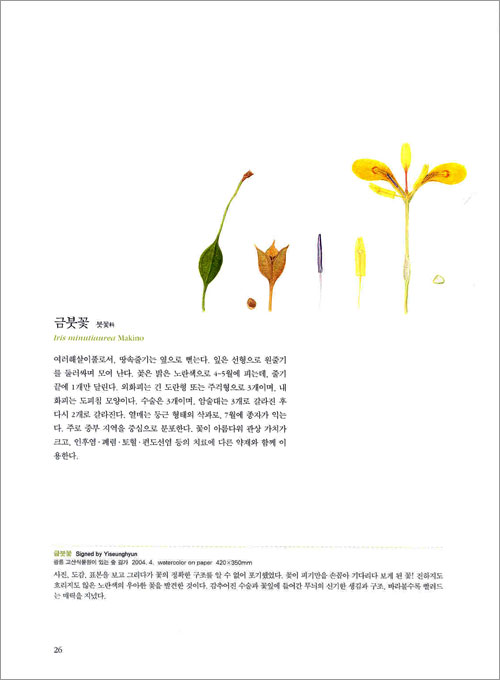
Iris, Iris family
Iris minutiaurea Makino
It is a perennial herb, and its rhizome grows sideways.
The leaves are linear and grow in clusters surrounding the main stem.
The flowers are bright yellow and bloom in April and May, with only one flower at the end of the stem.
The outer perianth is three long, ovate or spatula-shaped, and the inner perianth is lanceolate.
There are three surgeries, and the pistil is divided into three and then into two again.
The fruit is a round capsule, and the seeds ripen in July.
It is mainly distributed in the central region.
The flowers are beautiful and have great ornamental value, and are used together with other medicinal herbs to treat pharyngitis, pneumonia, hemoptysis, and tonsillitis.
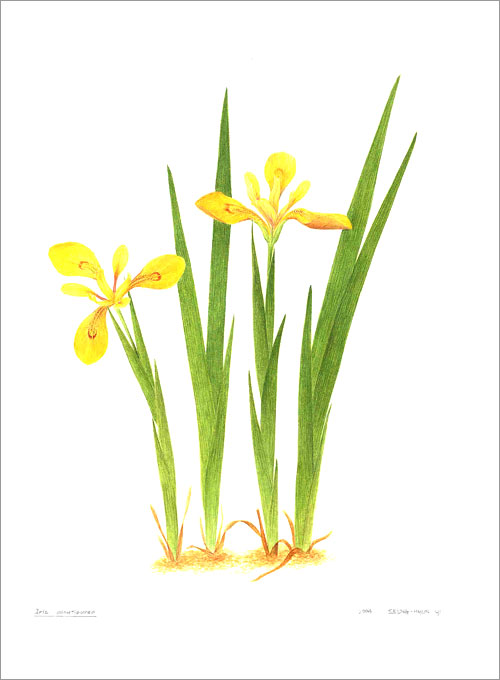
(Image caption and review)
Golden Iris Signed by Yiseunghyun
-On the forest road near Gwangneung Alpine Botanical Garden, 2004.
4. Watercolor on paper, 420X350mm
I tried to draw it by looking at photos, guides, and specimens, but I gave up because I couldn't figure out the exact structure of the flower.
The flower I've been waiting for to bloom finally arrived! I discovered an elegant yellow flower that's neither too bright nor too dull.
The mysterious shape and structure of the hidden surgery and the patterns on the petals have a charm that draws you in the more you look at them.
Iris minutiaurea Makino
It is a perennial herb, and its rhizome grows sideways.
The leaves are linear and grow in clusters surrounding the main stem.
The flowers are bright yellow and bloom in April and May, with only one flower at the end of the stem.
The outer perianth is three long, ovate or spatula-shaped, and the inner perianth is lanceolate.
There are three surgeries, and the pistil is divided into three and then into two again.
The fruit is a round capsule, and the seeds ripen in July.
It is mainly distributed in the central region.
The flowers are beautiful and have great ornamental value, and are used together with other medicinal herbs to treat pharyngitis, pneumonia, hemoptysis, and tonsillitis.
(Image caption and review)
Golden Iris Signed by Yiseunghyun
-On the forest road near Gwangneung Alpine Botanical Garden, 2004.
4. Watercolor on paper, 420X350mm
I tried to draw it by looking at photos, guides, and specimens, but I gave up because I couldn't figure out the exact structure of the flower.
The flower I've been waiting for to bloom finally arrived! I discovered an elegant yellow flower that's neither too bright nor too dull.
The mysterious shape and structure of the hidden surgery and the patterns on the petals have a charm that draws you in the more you look at them.
---p.26 Golden Iris
Publisher's Review
Capturing the spring, summer, and fall of Gwangneung Forest, the most precious place in this land!
A detailed collection of 100 precious plants from Gwangneung Forest!
The green dot of the Earth, the pride of our forest, Gwangneung Forest
Precious grasses and trees are introduced to the world through detailed illustrations!
A detailed collection of illustrations of the precious plants of Gwangneung Forest, a treasure trove of Korea's biodiversity and the envy of botanists around the world, has been published, featuring botanical knowledge from expert researchers at the National Arboretum.
The spring, summer, and fall of Gwangneung Forest are introduced to the world through detailed drawings of complete botanical value, with delicate structures and shapes that cannot be expressed in photographs.
The colors, detailed structures, and even the feelings of nature are vividly expressed, from the leaves blooming in the spring sun, to the fluff on the stems swaying in the gentle breeze, to the petals in colors never seen before.
Gwangneung Forest refers to the 2,240 hectares surrounding the Gwangneung Royal Tomb of King Sejo, the 7th king of the Joseon Dynasty.
The forest, which has been fully protected for 600 years since King Sejo's death, is Korea's best climax forest and holds great academic, cultural, and historical value.
It is one of the world's few temperate deciduous forests preserved in its natural state.
‘Green Spot of the Earth’ and ‘Pride of Our Forest’ are the nicknames that forest scientists have confidently given to Gwangneung Forest.
Gwangneung Forest is home to over 900 species of plants, including those discovered for the first time in Gwangneung, such as Gwangneung yogang flower and Gwangneung water lily. It is also home to 2,881 species of animals, including 20 species of natural monuments, such as the Korean magpie and the long-horned beetle.
This forest contains many ancestral trees that are the forerunners of the trees grown in our country.
Most of the trees planted throughout our country were experimentally planted here and then spread out.
Since liberation, Gwangneung Forest has been managed as an experimental forest by the Korea Forest Research Institute, a research institute under the Korea Forest Service, and since 1999, it has been managed by the newly opened National Arboretum of the Korea Forest Service.
The National Arboretum is a research institute that preserves and manages Korea's plants and serves as an educational center that introduces plants to many people. One-fifth of all plants in Korea grow there.
This book is the first work to contain precise and beautiful detailed illustrations of 100 species of plants growing in Gwangneung Forest, known as a treasure trove of Korea's representative forest biological resources, combining the botanical knowledge of the arboretum's expert researchers with the artistic sensibility of the National Arboretum's botanical detailing studio's specialized artists.
Beneath the botanical information in the book are detailed records of the emotions the artists exchanged with the plants while painting, allowing readers who encounter the book to experience vivid moments of connection with nature.
The back of the book is enriched with information on the history of botanical illustration, information on famous botanical gardens abroad, and explanations of the process of creating botanical illustrations.
A detailed collection of 100 precious plants from Gwangneung Forest!
The green dot of the Earth, the pride of our forest, Gwangneung Forest
Precious grasses and trees are introduced to the world through detailed illustrations!
A detailed collection of illustrations of the precious plants of Gwangneung Forest, a treasure trove of Korea's biodiversity and the envy of botanists around the world, has been published, featuring botanical knowledge from expert researchers at the National Arboretum.
The spring, summer, and fall of Gwangneung Forest are introduced to the world through detailed drawings of complete botanical value, with delicate structures and shapes that cannot be expressed in photographs.
The colors, detailed structures, and even the feelings of nature are vividly expressed, from the leaves blooming in the spring sun, to the fluff on the stems swaying in the gentle breeze, to the petals in colors never seen before.
Gwangneung Forest refers to the 2,240 hectares surrounding the Gwangneung Royal Tomb of King Sejo, the 7th king of the Joseon Dynasty.
The forest, which has been fully protected for 600 years since King Sejo's death, is Korea's best climax forest and holds great academic, cultural, and historical value.
It is one of the world's few temperate deciduous forests preserved in its natural state.
‘Green Spot of the Earth’ and ‘Pride of Our Forest’ are the nicknames that forest scientists have confidently given to Gwangneung Forest.
Gwangneung Forest is home to over 900 species of plants, including those discovered for the first time in Gwangneung, such as Gwangneung yogang flower and Gwangneung water lily. It is also home to 2,881 species of animals, including 20 species of natural monuments, such as the Korean magpie and the long-horned beetle.
This forest contains many ancestral trees that are the forerunners of the trees grown in our country.
Most of the trees planted throughout our country were experimentally planted here and then spread out.
Since liberation, Gwangneung Forest has been managed as an experimental forest by the Korea Forest Research Institute, a research institute under the Korea Forest Service, and since 1999, it has been managed by the newly opened National Arboretum of the Korea Forest Service.
The National Arboretum is a research institute that preserves and manages Korea's plants and serves as an educational center that introduces plants to many people. One-fifth of all plants in Korea grow there.
This book is the first work to contain precise and beautiful detailed illustrations of 100 species of plants growing in Gwangneung Forest, known as a treasure trove of Korea's representative forest biological resources, combining the botanical knowledge of the arboretum's expert researchers with the artistic sensibility of the National Arboretum's botanical detailing studio's specialized artists.
Beneath the botanical information in the book are detailed records of the emotions the artists exchanged with the plants while painting, allowing readers who encounter the book to experience vivid moments of connection with nature.
The back of the book is enriched with information on the history of botanical illustration, information on famous botanical gardens abroad, and explanations of the process of creating botanical illustrations.
GOODS SPECIFICS
- Date of issue: April 1, 2005
- Format: Hardcover book binding method guide
- Page count, weight, size: 280 pages | 1,458g | Checking size
- ISBN13: 9788934917816
- ISBN10: 8934917814
You may also like
카테고리
korean


korean

![ELLE 엘르 스페셜 에디션 A형 : 12월 [2025]](http://librairie.coreenne.fr/cdn/shop/files/b8e27a3de6c9538896439686c6b0e8fb.jpg?v=1766436872&width=3840)


