

Back to the book
 |
Description
Book Introduction
- A word from MD
-
A Warning to a Digital Civilization That Doesn't Read BooksIncreasingly, humanity is losing time to digital devices.
The more this happens, the more we lose the ability to read deeply.
Lack of understanding leads to lack of communication.
For a healthy society, we need to read more often, before it's too late.
As the title of the book suggests, we must go back to the book.
May 21, 2019. Humanities PD Son Min-gyu
How do digital media affect the reading brain?
How will it change the fate of the next generation?
World-renowned researcher in the field of 'reading brain' and author of 'The Reading Brain'
Marion Wolf warns of a "crisis in the reading brain in the digital age."
[Guardian] The Top Stories of 2018
The brain science of reading has been highlighted by global media outlets such as the New York Times, Nature, and the Wall Street Journal!
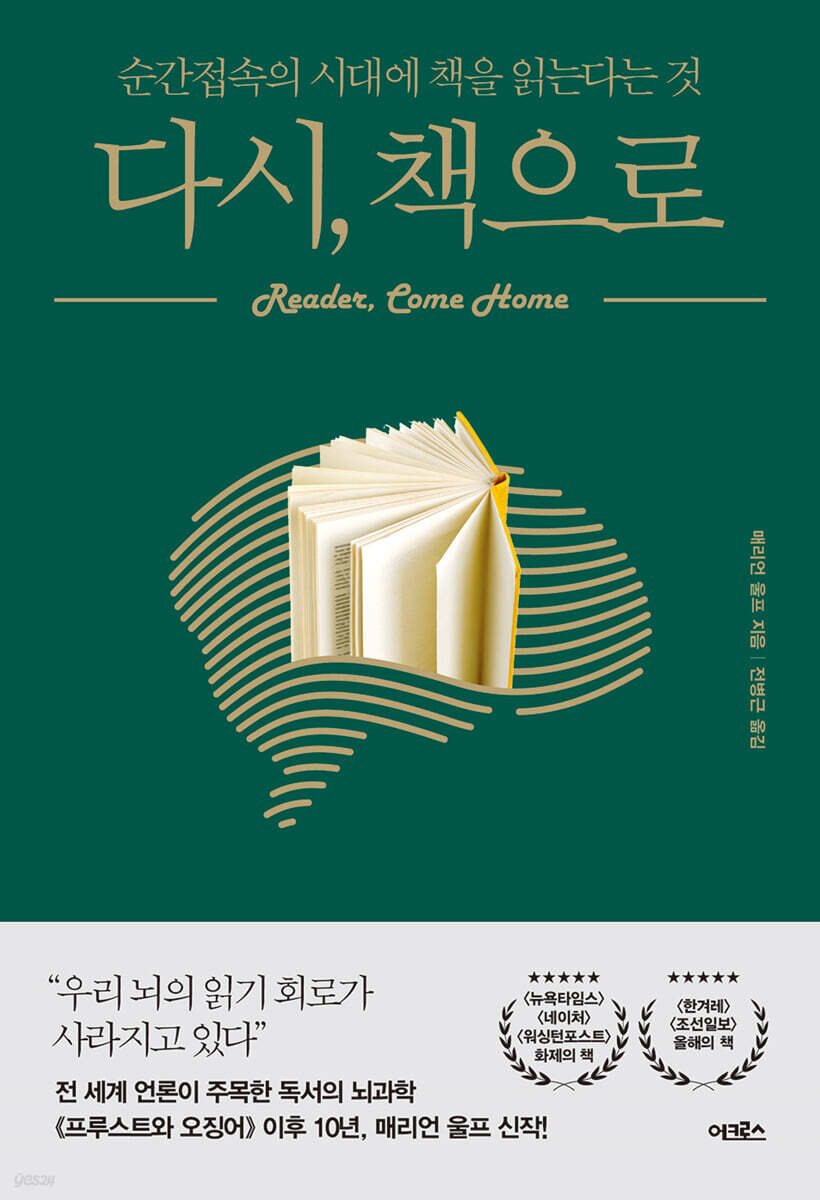
Marion Woolf, who caused a stir by asserting that “humanity was not born to read,” once again talks about our “reading brain” in her new book, “Back to Books.”
This book is an urgent warning that our brains, constantly connected to digital devices and living in an "age of instantaneous connection," may permanently lose the ability to read, humanity's most miraculous invention, especially "deep reading."
Drawing on a wide range of sources and vivid examples from history, literature, and science, it offers profound insights into how technology impacts reading today and what this means for the future of humanity.
After its publication, it received much attention and praise from global media and experts in related fields, and a related article in the British daily newspaper [The Guardian] was shared nearly 40,000 times and was selected as the 'Best Story of 2018.'
This is a must-read for parents concerned about their children being engrossed in digital devices rather than books, teachers and professors who feel their students' comprehension skills are declining, and readers who consider themselves readers but unknowingly avoid long and difficult texts.
Reading through digital media is clearly an irreversible trend of the times.
And for children who are illiterate or have learning disabilities, it can be a great learning tool to help them learn to read in a way that suits their individual circumstances.
Marion Wolf also does not deny the positive aspects of digital devices, and she herself is actively involved in the literacy campaign using digital devices.
But if we leave our children unattended in the digital world, we will never escape the threat of their reading circuits disappearing.
Marion Wolf emphasizes that in this environment, we must do everything we can to restore the ability to read deeply, especially in young children, so that they can remain 'good readers.'
Wolf argues that deep reading is the key to enabling our most fundamental thinking processes—critical, inferential, and reflective thinking—the ability to distinguish truth from falsehood, and the ability to take the perspective of others.
And I assert that this is the secret to the survival of mankind.
Drawing on scientific research and literary imagination, this book offers brilliant insights into the connection between reading and the brain, serving as a hopeful guide for readers navigating the digital age wisely.
How will it change the fate of the next generation?
World-renowned researcher in the field of 'reading brain' and author of 'The Reading Brain'
Marion Wolf warns of a "crisis in the reading brain in the digital age."
[Guardian] The Top Stories of 2018
The brain science of reading has been highlighted by global media outlets such as the New York Times, Nature, and the Wall Street Journal!
Marion Woolf, who caused a stir by asserting that “humanity was not born to read,” once again talks about our “reading brain” in her new book, “Back to Books.”
This book is an urgent warning that our brains, constantly connected to digital devices and living in an "age of instantaneous connection," may permanently lose the ability to read, humanity's most miraculous invention, especially "deep reading."
Drawing on a wide range of sources and vivid examples from history, literature, and science, it offers profound insights into how technology impacts reading today and what this means for the future of humanity.
After its publication, it received much attention and praise from global media and experts in related fields, and a related article in the British daily newspaper [The Guardian] was shared nearly 40,000 times and was selected as the 'Best Story of 2018.'
This is a must-read for parents concerned about their children being engrossed in digital devices rather than books, teachers and professors who feel their students' comprehension skills are declining, and readers who consider themselves readers but unknowingly avoid long and difficult texts.
Reading through digital media is clearly an irreversible trend of the times.
And for children who are illiterate or have learning disabilities, it can be a great learning tool to help them learn to read in a way that suits their individual circumstances.
Marion Wolf also does not deny the positive aspects of digital devices, and she herself is actively involved in the literacy campaign using digital devices.
But if we leave our children unattended in the digital world, we will never escape the threat of their reading circuits disappearing.
Marion Wolf emphasizes that in this environment, we must do everything we can to restore the ability to read deeply, especially in young children, so that they can remain 'good readers.'
Wolf argues that deep reading is the key to enabling our most fundamental thinking processes—critical, inferential, and reflective thinking—the ability to distinguish truth from falsehood, and the ability to take the perspective of others.
And I assert that this is the secret to the survival of mankind.
Drawing on scientific research and literary imagination, this book offers brilliant insights into the connection between reading and the brain, serving as a hopeful guide for readers navigating the digital age wisely.
- You can preview some of the book's contents.
Preview
index
Translator's Note
First letter
Reading, the canary of the mind
Second letter
Under the Big Circus Tent: A Different Perspective on the Reading Brain
Third letter
Deep Reading in Crisis
Fourth letter
“What will become of us, the readers?”
Fifth letter
Digitally Raised Children
Sixth letter
From Knees to Computers in the First Five Years: Don't Move Too Fast
Seventh letter
How to teach reading
Eighth letter
Building an ambidextrous reading brain
Ninth letter
Readers, come home
Acknowledgements
main
Search
First letter
Reading, the canary of the mind
Second letter
Under the Big Circus Tent: A Different Perspective on the Reading Brain
Third letter
Deep Reading in Crisis
Fourth letter
“What will become of us, the readers?”
Fifth letter
Digitally Raised Children
Sixth letter
From Knees to Computers in the First Five Years: Don't Move Too Fast
Seventh letter
How to teach reading
Eighth letter
Building an ambidextrous reading brain
Ninth letter
Readers, come home
Acknowledgements
main
Search
Into the book
How well we read a text or article depends on how much time we devote to the process of deep reading.
The situation is the same no matter what medium you read it through.
Everything we explore in this book—from digital culture to our own and our children's reading habits to the role of meditation in ourselves and in society—depends on how much time we devote to shaping our brain circuits for deep reading.
--- p.72
In this way, Hemingway presented an image that evoked a variety of emotions in the reader with just six words.
The feeling might include the bitter pain of loss, the secret relief that one has never experienced such a thing, followed by guilt, and perhaps even a desperate hope that one never wants to know such a feeling.
Few writers can immerse us in such a crucible of emotions with so few words.
But what's important is not the economical writing style typical of Hemingway, who was a journalist.
More importantly, the power of images helps us penetrate the many layers of meaning that underlie text, helping us understand the thoughts and feelings of others.
--- p.78
Nowadays, we are surrounded by too much information.
Nowadays, the average American reads as many words a day as there are in an average novel.
Unfortunately, this type of reading is usually not continuous, sustained, or focused reading.
Rather, the average 34 gigabytes of information that most of us consume represents a series of sporadic activities.
--- p.121
Students who read on paper were better at reconstructing the plot chronologically than those who read on a screen.
In other words, students who read on digital screens appeared to miss the order of detailed events that are easily overlooked in novels.
Consider what would happen if you skipped over the details in O. Henry's short story collection, where the wife sells her beautiful hair to buy her husband a watch chain, and the husband sells his beloved watch to buy his wife a comb.
--- p.126
When I started reading The Glass Bead Game, I felt like I had been hit in the head.
I couldn't read that book.
The writing style seemed stubbornly opaque.
The writing was dense with unnecessarily difficult words and sentences (!), and the snake-like sentence structure confused me rather than made sense.
I couldn't pick up the speed.
The only image that came to my mind was a group of monks slowly climbing up and down the stairs.
It was as if someone was pouring thick molasses into my brain every time I picked up the book to read The Glass Bead Game.
--- p.154
For children, the amount of information they have to process is increasing, while the time they have to process it is decreasing, which is likely to pose the greatest threat to the development of their attention and memory.
This would have serious adverse effects on the development and use of more sophisticated reading and thinking skills.
Because everything in the deep reading circuit is interdependent.
If children's internal knowledge diminishes as they become increasingly reliant on external sources of knowledge like Google and Facebook, their ability to spot similarities and draw accurate inferences between what they already know and what they're reading for the first time will also undergo significant changes.
Children will only think they know something.
--- p.187
If we are to preserve our collective conscience, which is crucial in the 21st century, we must ensure that all members of our society are able to read and think deeply.
If we don't educate our children and retrain all our citizens to process information critically and wisely, regardless of the medium, we will be a failed society.
And if we do not recognize the capacity for reflective thought in those who disagree with us, our society will surely become as failed as any society in the 20th century.
The situation is the same no matter what medium you read it through.
Everything we explore in this book—from digital culture to our own and our children's reading habits to the role of meditation in ourselves and in society—depends on how much time we devote to shaping our brain circuits for deep reading.
--- p.72
In this way, Hemingway presented an image that evoked a variety of emotions in the reader with just six words.
The feeling might include the bitter pain of loss, the secret relief that one has never experienced such a thing, followed by guilt, and perhaps even a desperate hope that one never wants to know such a feeling.
Few writers can immerse us in such a crucible of emotions with so few words.
But what's important is not the economical writing style typical of Hemingway, who was a journalist.
More importantly, the power of images helps us penetrate the many layers of meaning that underlie text, helping us understand the thoughts and feelings of others.
--- p.78
Nowadays, we are surrounded by too much information.
Nowadays, the average American reads as many words a day as there are in an average novel.
Unfortunately, this type of reading is usually not continuous, sustained, or focused reading.
Rather, the average 34 gigabytes of information that most of us consume represents a series of sporadic activities.
--- p.121
Students who read on paper were better at reconstructing the plot chronologically than those who read on a screen.
In other words, students who read on digital screens appeared to miss the order of detailed events that are easily overlooked in novels.
Consider what would happen if you skipped over the details in O. Henry's short story collection, where the wife sells her beautiful hair to buy her husband a watch chain, and the husband sells his beloved watch to buy his wife a comb.
--- p.126
When I started reading The Glass Bead Game, I felt like I had been hit in the head.
I couldn't read that book.
The writing style seemed stubbornly opaque.
The writing was dense with unnecessarily difficult words and sentences (!), and the snake-like sentence structure confused me rather than made sense.
I couldn't pick up the speed.
The only image that came to my mind was a group of monks slowly climbing up and down the stairs.
It was as if someone was pouring thick molasses into my brain every time I picked up the book to read The Glass Bead Game.
--- p.154
For children, the amount of information they have to process is increasing, while the time they have to process it is decreasing, which is likely to pose the greatest threat to the development of their attention and memory.
This would have serious adverse effects on the development and use of more sophisticated reading and thinking skills.
Because everything in the deep reading circuit is interdependent.
If children's internal knowledge diminishes as they become increasingly reliant on external sources of knowledge like Google and Facebook, their ability to spot similarities and draw accurate inferences between what they already know and what they're reading for the first time will also undergo significant changes.
Children will only think they know something.
--- p.187
If we are to preserve our collective conscience, which is crucial in the 21st century, we must ensure that all members of our society are able to read and think deeply.
If we don't educate our children and retrain all our citizens to process information critically and wisely, regardless of the medium, we will be a failed society.
And if we do not recognize the capacity for reflective thought in those who disagree with us, our society will surely become as failed as any society in the 20th century.
--- p.298
Publisher's Review
“Our brain’s reading circuits are breaking down.”
The dire reality of the "reading brain," revealed through extensive scientific research and survey results.
Marion Wolf explains her motivation for writing this book in Chapter 1.
While I was writing my previous work, The Reading Brain, and focusing on studying how our brains learn to read, the world had rapidly changed from a print-based culture to a digital-based culture.
Witnessing teenagers immersed in digital media for six to seven hours a day, Wolf began exploring how their brains' reading circuits might be altered.
Marion Wolf has emphasized that humans are not born with the ability to read, and that literacy is one of the most important acquired achievements of Homo sapiens.
In particular, deep reading is an important skill that allows readers to feel the emotions contained in sentences, help them move into the perspective of others, and enable critical thinking through inference and inference.
However, the endless stream of information in the digital world brought us novelty and convenience, but also took away our ability to focus and think deeply.
According to a study by the Center for Information Industries at the University of California, San Diego (UCSD), the average person consumes about 34 gigabytes of information per day across various devices.
This is close to 100,000 English words (p. 120). Marion Woolf worries that this type of reading, with its lack of density, does not lead to continuous or focused reading, but rather to light entertainment.
He also points out the limitations of reading through digital devices, citing research by Professor Jiming Liu of San Jose University.
In digital reading, "skimming" has become the standard method: quickly scanning "word spots" in an F-shaped or zig-zag pattern to grasp the context before jumping straight to the conclusion. This approach makes it difficult to remember plot details or grasp the logical structure of an argument (p. 125).
Marion Wolf draws on extensive research, surveys, and a wealth of cutting-edge materials to reveal the stark reality of our reading habits today.
“Use it or lose it.”
The importance of the reading circuit, as discovered by Marion Wolff in her "Glass Bead Game" experiment.
The bigger problem, Marion Wolf points out, is that the more we read digital media, the more our brain circuits reflect the characteristics of those media.
He warns that because of the brain's plasticity, we may end up skimming over words when reading printed material, much like we do with digital media, and thus lose the qualities that deep reading brings: critical thinking, reflection, empathy, understanding, and personal reflection.
This way of reading even changes our writing preferences, accustoming us to shorter, simpler, and skippable sentences.
In "Back to Books," Marion Woolf tells the story of how she began experimenting to re-establish her reading circuitry after realizing that she had lost the experience of being immersed in a book and was reverting to the "beginner-level reading brain" she had discussed in her thesis.
The author confesses that he tried to reread Hermann Hesse's The Glass Bead Game, which had a great influence on him as a child, but was shocked to find that his brain, accustomed to digital reading methods, could no longer process long and complex sentences. He also mentions the efforts he made to regain his ability to read deeply.
It is noteworthy that even readers who read a lot of professional books and reach a considerable intellectual level do not maintain a circuit of deep reading.
How to Become a "Good Reader" and Wisely Navigate the Digital Transition
: Restoring deep reading skills
Reading through digital media is clearly an irreversible trend of the times.
And for children who are illiterate or have learning disabilities, it can be a great learning tool to help them learn to read in a way that suits their individual circumstances.
Marion Wolf also does not deny the positive aspects of digital devices, and she herself is actively involved in the literacy campaign using digital devices.
But if we leave our children unattended in the digital world, we will never escape the threat of their reading circuits disappearing.
Marion Wolf emphasizes that in this environment, we must do everything we can to restore the ability to read deeply, especially in young children, so that they can remain 'good readers.'
Wolf argues that deep reading is the key to enabling our most fundamental thinking processes—critical, inferential, and reflective thinking—the ability to distinguish truth from falsehood, and the ability to take the perspective of others.
And I assert that this is the secret to humanity's continued existence.
Drawing on scientific research and literary imagination, this book offers brilliant insights into the connection between reading and the brain, serving as a hopeful guide for readers navigating the digital age wisely.
The dire reality of the "reading brain," revealed through extensive scientific research and survey results.
Marion Wolf explains her motivation for writing this book in Chapter 1.
While I was writing my previous work, The Reading Brain, and focusing on studying how our brains learn to read, the world had rapidly changed from a print-based culture to a digital-based culture.
Witnessing teenagers immersed in digital media for six to seven hours a day, Wolf began exploring how their brains' reading circuits might be altered.
Marion Wolf has emphasized that humans are not born with the ability to read, and that literacy is one of the most important acquired achievements of Homo sapiens.
In particular, deep reading is an important skill that allows readers to feel the emotions contained in sentences, help them move into the perspective of others, and enable critical thinking through inference and inference.
However, the endless stream of information in the digital world brought us novelty and convenience, but also took away our ability to focus and think deeply.
According to a study by the Center for Information Industries at the University of California, San Diego (UCSD), the average person consumes about 34 gigabytes of information per day across various devices.
This is close to 100,000 English words (p. 120). Marion Woolf worries that this type of reading, with its lack of density, does not lead to continuous or focused reading, but rather to light entertainment.
He also points out the limitations of reading through digital devices, citing research by Professor Jiming Liu of San Jose University.
In digital reading, "skimming" has become the standard method: quickly scanning "word spots" in an F-shaped or zig-zag pattern to grasp the context before jumping straight to the conclusion. This approach makes it difficult to remember plot details or grasp the logical structure of an argument (p. 125).
Marion Wolf draws on extensive research, surveys, and a wealth of cutting-edge materials to reveal the stark reality of our reading habits today.
“Use it or lose it.”
The importance of the reading circuit, as discovered by Marion Wolff in her "Glass Bead Game" experiment.
The bigger problem, Marion Wolf points out, is that the more we read digital media, the more our brain circuits reflect the characteristics of those media.
He warns that because of the brain's plasticity, we may end up skimming over words when reading printed material, much like we do with digital media, and thus lose the qualities that deep reading brings: critical thinking, reflection, empathy, understanding, and personal reflection.
This way of reading even changes our writing preferences, accustoming us to shorter, simpler, and skippable sentences.
In "Back to Books," Marion Woolf tells the story of how she began experimenting to re-establish her reading circuitry after realizing that she had lost the experience of being immersed in a book and was reverting to the "beginner-level reading brain" she had discussed in her thesis.
The author confesses that he tried to reread Hermann Hesse's The Glass Bead Game, which had a great influence on him as a child, but was shocked to find that his brain, accustomed to digital reading methods, could no longer process long and complex sentences. He also mentions the efforts he made to regain his ability to read deeply.
It is noteworthy that even readers who read a lot of professional books and reach a considerable intellectual level do not maintain a circuit of deep reading.
How to Become a "Good Reader" and Wisely Navigate the Digital Transition
: Restoring deep reading skills
Reading through digital media is clearly an irreversible trend of the times.
And for children who are illiterate or have learning disabilities, it can be a great learning tool to help them learn to read in a way that suits their individual circumstances.
Marion Wolf also does not deny the positive aspects of digital devices, and she herself is actively involved in the literacy campaign using digital devices.
But if we leave our children unattended in the digital world, we will never escape the threat of their reading circuits disappearing.
Marion Wolf emphasizes that in this environment, we must do everything we can to restore the ability to read deeply, especially in young children, so that they can remain 'good readers.'
Wolf argues that deep reading is the key to enabling our most fundamental thinking processes—critical, inferential, and reflective thinking—the ability to distinguish truth from falsehood, and the ability to take the perspective of others.
And I assert that this is the secret to humanity's continued existence.
Drawing on scientific research and literary imagination, this book offers brilliant insights into the connection between reading and the brain, serving as a hopeful guide for readers navigating the digital age wisely.
GOODS SPECIFICS
- Date of issue: May 15, 2019
- Page count, weight, size: 360 pages | 578g | 147*215*22mm
- ISBN13: 9791190030052
- ISBN10: 1190030055
You may also like
카테고리
korean


korean

![GQ KOREA Mark (Monthly): December [2025]](http://librairie.coreenne.fr/cdn/shop/files/8ef265dbbfbf186523ed75ba7319009d.jpg?v=1765340328&width=3840)


