

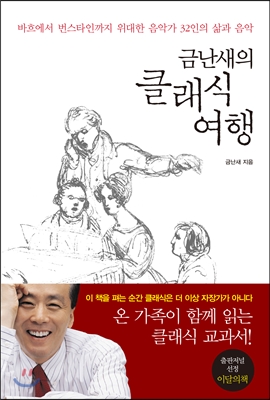
Golden Bird's Classic Journey
 |
Description
Book Introduction
The golden pheasant, the true messenger of classical music
A vivid classic story that couldn't be told on site! This is a revised edition of 『Classical Journey with the Golden Bird』, which has been reprinted and loved as an introductory book to classical music for over ten years. 『Classic Journey with the Golden Bird 1』 and 『Classic Journey with the Golden Bird 2』 were combined into one volume and published with supplementary illustrations throughout. In the previous edition, the history of music up to the early to mid-20th century was summarized, ending with Stravinsky and Bartok, but in the revised edition, the chapter “Progressives who tried to change the world through music” was added, allowing for a look into the history of music up to the mid- to late-20th century. Since 1994, Geumnansae has been hosting a ‘Youth Concert with Commentary’ for over 20 years. This concert broke away from the rigid concert format of the past and helped young people easily enjoy classical music by providing witty commentary on the songs. The audience response was also great, selling out every performance, setting a record and being evaluated as a leader in popularizing classical music. Why does he plan such popular performances? It's because of his golden-faced attitude toward music. He believes that classical music should not be the exclusive domain of a select few, but rather breathe with the public and bring happiness to society. While studying abroad in Berlin during my youth, I experienced a social atmosphere that inspired me to share music with many people. Although I met the audience on site, I couldn't tell them much due to time and space constraints, so I wrote a book to tell the stories I couldn't tell. The sale ended after the first edition of the CD was given away. |
- You can preview some of the book's contents.
Preview
index
What is classical music?
A few questions about classical music
Does classical music mean Western music? | Is classical music difficult? | Is classical music the only high-quality music? | Why I recommend classical music.
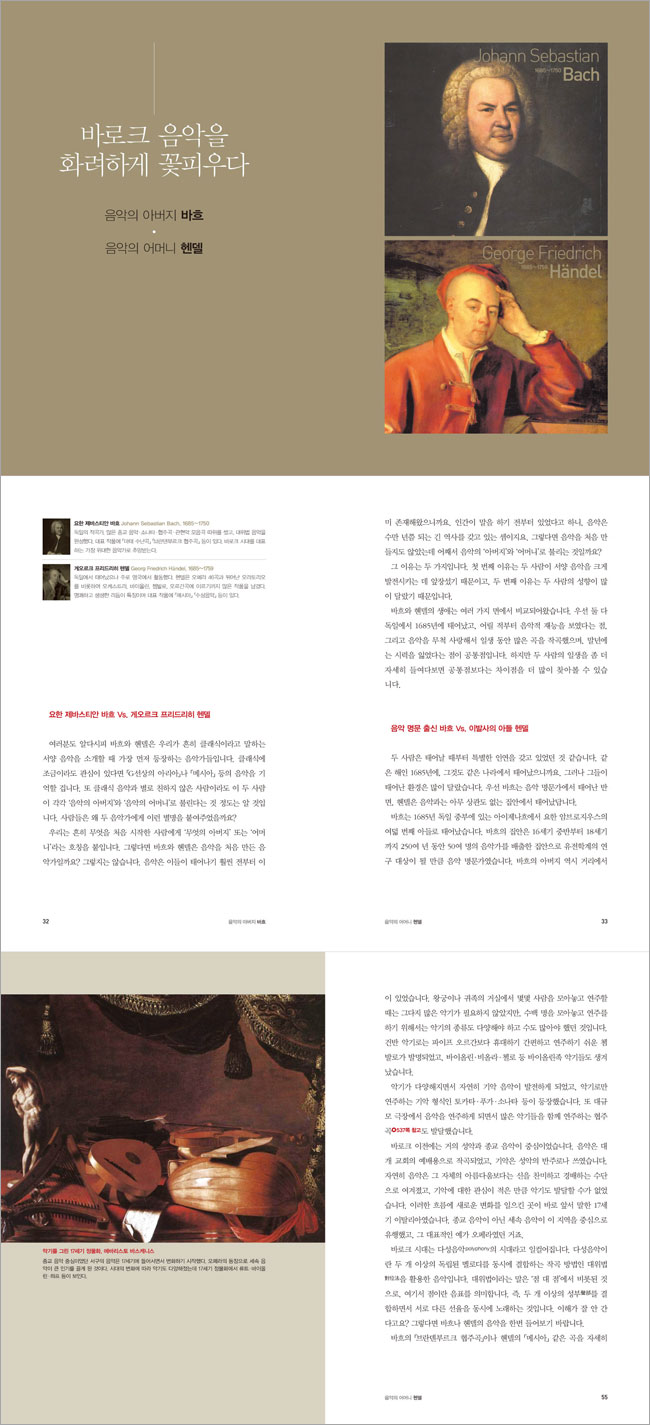
The splendid flowering of Baroque music
The Father of Music Bach Vs.
Handel, the Mother of Music
Johann Sebastian Bach Vs.
George Frideric Handel | Bach Vs. from a prestigious musical family
Handel, the Barber's Son | Bach, the Church Musician | Handel, the Businessman: Another Meaning of 'Mother' | Cosmopolitan Handel | Serious Bach vs.
Popular Handel | Bach with Twenty Children Vs.
Handel, a lifelong bachelor | Another life, a death akin to his own | The Baroque, the mother of classical music | The Baroque, a trend born from the Age of Exploration | Characteristics of Baroque music | Recommended music by Geumnansae
Realizing the ideals of classicism through music
Mozart, the musical prodigy Vs.
Haydn, the father of the symphony
Wolfgang Amadeus Mozart Vs.
Franz Joseph Haydn | Mozart, the Musical Prodigy | Haydn, the Blacksmith's Son | Mozart as a Child Vs.
Haydn, like a father | The last court musician | The father of the symphony | Mozart, who longed for freedom | Mozart's operas | A genius who left too soon | Haydn's later years | Perfecting classical music | Geumnansae's recommended music
Bridging Classicism and Romanticism
Beethoven the agonizing artist Vs.
Rossini, the gourmet of music
Ludwig van Beethoven Vs.
Gioachino Rossini | An unfortunate childhood | A short education, an overflowing thirst for learning | The Enlightenment that awakened Europe | The French Revolution led to the establishment of a republic | Beethoven, who made a name for himself in Vienna | Beethoven, a proud musician | A struggle against hardship | His later years, expressing the world of the heart | Rossini, the Italian boy genius | The audience's popularity | A musician desired by the times | Recommended music by Geumnansae
Opening the door to romantic music
Schubert, the king of poor songs Vs.
Mendelssohn, the handsome man of the classical world
Franz Peter Schubert Vs.
Jakob Ludwig Felix Mendelssohn | Schubert, a boy with exceptional talent | Mendelssohn, a blessed birth | Choosing the path of a poor wanderer for music | A bridge between Classicism and Romanticism | A naive artist | Mendelssohn, reviving Bach | Schubert, the king of songs | Mendelssohn, conductor of the Gewandhaus Orchestra | A masterpiece left at the end of his life, the song collection "Winterreise" | The flow and some characteristics of Romantic music | Recommended music by Geumnansae
Two masters on the piano
Chopin, the Poet of the Piano Vs.
Paganini Liszt for piano
Chopin and Liszt, Who Loved the Piano | A Shy Musical Genius | An Eternal Love for Their Country | A Genius Musician Who Set Paris abuzz | A Musician Who Wrote Poems on the Piano | A Love for George Sand | A Hungarian Boy Genius | A Popular Star Who Led the Oppa Army | A Love for Symphonic Poems and Piano Pieces | Ending His Life as a Priest | Geumnansae's Recommended Music
Unconventional Successors of Late Romanticism
Classical Romantic Brahms Vs.
Wagner, the comprehensive artist
Brahmspa Vs.
The Wagner School | The Poor Genius, Brahms | Two Life-Changing Opportunities | A Single-Minded Devotion to His Master's Wife | Pursuing Classical Romanticism | Program Music or Absolute Music? | The Death that Followed Clara | Wagner's Childhood | The Opera Conductor | Revolution and a Life on the Run | Wagner's Theory of Comprehensive Art | Wagner's Women | Comfortable Later Years Focused on Music | Geumnansae's Recommended Music
Opening a new chapter in French music
Beautiful Outsider Bizet Vs.
Saint-Saëns, the central figure of modern French music
Bizet, the composer who won the Prix de Rome | The failure of "Carmen" and the death of Bizet | Saint-Saëns, the "French Mozart" who failed the Prix de Rome | A Renaissance man ahead of his time | The development of modern French music | Carmen, a masterpiece in the history of opera | Carmen and Delilah, the femme fatales of opera | Recommended music by Geumnansae
Raising Czech national pride through music
Brahms Dvorak Vs. Bohemia
Czech national musician Smetana
Harmony of National Elements and Symphonic Tradition | A Child Prodigy Who Dreamed of Liszt | Smetana, the Father of Czech National Music | A Butcher's Son, Defying Opposition, Pursues a Musical Path | From Obscurity to World-Class Composer | Smetana Creates National Opera | Longing for Home in the New World | A Life of Misfortune Dotted with Misfortune | Burning His Musical Soul amidst Hallucinations and Delusions | Recommended Music by Geumnansae
Achieving the development of Russian music
The Sun of Russian Music Tchaikovsky Vs.
Rimsky-Korsakov, a pioneer of national music
The development of Russian music | Hiding his passion for music | Quitting a stable job to become a musician | Tchaikovsky's love that revealed his introverted personality | Madame von Meck, a patron | Russian music to the world | The symphony "Pathétique" that foreshadowed his own death | A naval officer who loved music | Walking the path of a professional musician | Picturesque music, folk music | The nationalist music quintet | Standing up to the emperor with their works and actions | Recommended music by Geumnansae
Austria's last romantic symphonist
The Romantics of the Fin Decade: Mahler vs.
The fourth great B, Bruckner
The Mahler craze of the 20th century | The fourth great B, Bruckner | His 'double life' as a composer and conductor | A late-blooming composer who began his musical career | Eternal themes: life and death | Nine symphonies sacredly built toward God | Some characteristics of Bruckner's works | The jinx of Symphony No. 9 | Geumnansae's recommended music
The most French, the most modern
Debussy, the founder of impressionist music Vs.
Orchestral Magician Label
Experimenting with Music in an Age of Change | Debussy, the Rebel Who Rejected Form | The Prix de Rome and Life in Italy | Impressionism and Music | Interest in Diverse Music | Harmony of Classical Form and Modern Sensibility | The Magician of Orchestration | The Beauty of Diversity and Harmony | Geumnansae's Recommended Music
A clear and transparent lyric poet from the North
Finland's national treasure musician Sibelius Vs.
Norwegian Chopin Grieg
Sibelius, Finland's musical hero | Grieg, a composer brimming with lyricism | From law student to composer | Awakening to national music through colleagues | Masters met on concert tours | "Finlandia," the forbidden song feared by Russia | Composing at his villa "Ainola" and 30 years of silence | "Solvay's Song," the supreme and pure tetralogy | Recommended music by Geumnansae
Like a painting, like a movie
The Originality of Amateurism Mussorgsky Vs.
Rachmaninoff, the last romantic
The Passion of the Russian Nationalist Five | Music Meets Film, Filled with Excellence | "Pictures at an Exhibition" and "Night on Bald Mountain," and "Boris Godunov" Reborn | Overcoming the Failure of "Symphony No. 1" to Grow as a Composer | Alcoholism and a Harrowing Later Years | The Path of Exile from Which There Is No Return | Recommended Music by Geumnansae
Russian musicians who survived the Stalin era
Shostakovich, the warrior of music Vs.
Prokofiev, the standard-bearer of avant-garde music
The Socialist Realism Movement under Stalin's Regime | Walking the Path of a Musician in the Turmoil of the Times | Between External Pressure and Artistic Desire | Showcasing Sensual and Lively Skills | Embarking on Exile for Music | Overcoming Stalin's Oppression | A Musician Who Gained Attention in the West During the Cold War | A Maestro Unwelcome in the United States | The Unhappy Later Years of the Returned Prodigal Son | Embarking on Film Scores with Eisenstein | Interest in Film Scores and Jazz | A Musician Who Composes Without Rest | A Musical Fairy Tale Written for His Beloved Son | Recommended Music by Geumnansae
Two giants of contemporary music
Stravinsky Vs. the composer who transformed repeatedly
Bartok's originality rooted in Hungarian folk music
The Rite of Spring, which turned the Parisian music scene upside down | A contemporary musician who poured his passion into collecting folk songs | Formal experiments based on the golden section | A fateful encounter with Diaghilev, the genius of box office success | A lonely path of creation unknown to anyone | A lifelong wanderer | A lifelong biography discovered through a friend | A world-renowned composer's triumphant return | Continuing musical experiments in his home country | A burning artistic spirit while battling illness after exile in the United States | Recommended music by Geumnansae
Progressives who tried to change the world through music
Leonardo da Vinci Bernstein vs. 20th Century Music
Piazzolla, the revolutionary of tango music
A world-renowned, multi-talented American conductor | Interest in politics and social issues | A rootless outsider nurtures his dreams of becoming a musician | Shostakovich in America, sparking the Mahler boom | Embracing the bandoneon like a lover | Capturing the spirit of the times in music | Nuevo Tango, ushering in a new era | The unfinished dream of the Tango Emperor | Recommended music by Geumnansae
Dictionary of Music Terms
Western History and Music History Timeline
A few questions about classical music
Does classical music mean Western music? | Is classical music difficult? | Is classical music the only high-quality music? | Why I recommend classical music.
The splendid flowering of Baroque music
The Father of Music Bach Vs.
Handel, the Mother of Music
Johann Sebastian Bach Vs.
George Frideric Handel | Bach Vs. from a prestigious musical family
Handel, the Barber's Son | Bach, the Church Musician | Handel, the Businessman: Another Meaning of 'Mother' | Cosmopolitan Handel | Serious Bach vs.
Popular Handel | Bach with Twenty Children Vs.
Handel, a lifelong bachelor | Another life, a death akin to his own | The Baroque, the mother of classical music | The Baroque, a trend born from the Age of Exploration | Characteristics of Baroque music | Recommended music by Geumnansae
Realizing the ideals of classicism through music
Mozart, the musical prodigy Vs.
Haydn, the father of the symphony
Wolfgang Amadeus Mozart Vs.
Franz Joseph Haydn | Mozart, the Musical Prodigy | Haydn, the Blacksmith's Son | Mozart as a Child Vs.
Haydn, like a father | The last court musician | The father of the symphony | Mozart, who longed for freedom | Mozart's operas | A genius who left too soon | Haydn's later years | Perfecting classical music | Geumnansae's recommended music
Bridging Classicism and Romanticism
Beethoven the agonizing artist Vs.
Rossini, the gourmet of music
Ludwig van Beethoven Vs.
Gioachino Rossini | An unfortunate childhood | A short education, an overflowing thirst for learning | The Enlightenment that awakened Europe | The French Revolution led to the establishment of a republic | Beethoven, who made a name for himself in Vienna | Beethoven, a proud musician | A struggle against hardship | His later years, expressing the world of the heart | Rossini, the Italian boy genius | The audience's popularity | A musician desired by the times | Recommended music by Geumnansae
Opening the door to romantic music
Schubert, the king of poor songs Vs.
Mendelssohn, the handsome man of the classical world
Franz Peter Schubert Vs.
Jakob Ludwig Felix Mendelssohn | Schubert, a boy with exceptional talent | Mendelssohn, a blessed birth | Choosing the path of a poor wanderer for music | A bridge between Classicism and Romanticism | A naive artist | Mendelssohn, reviving Bach | Schubert, the king of songs | Mendelssohn, conductor of the Gewandhaus Orchestra | A masterpiece left at the end of his life, the song collection "Winterreise" | The flow and some characteristics of Romantic music | Recommended music by Geumnansae
Two masters on the piano
Chopin, the Poet of the Piano Vs.
Paganini Liszt for piano
Chopin and Liszt, Who Loved the Piano | A Shy Musical Genius | An Eternal Love for Their Country | A Genius Musician Who Set Paris abuzz | A Musician Who Wrote Poems on the Piano | A Love for George Sand | A Hungarian Boy Genius | A Popular Star Who Led the Oppa Army | A Love for Symphonic Poems and Piano Pieces | Ending His Life as a Priest | Geumnansae's Recommended Music
Unconventional Successors of Late Romanticism
Classical Romantic Brahms Vs.
Wagner, the comprehensive artist
Brahmspa Vs.
The Wagner School | The Poor Genius, Brahms | Two Life-Changing Opportunities | A Single-Minded Devotion to His Master's Wife | Pursuing Classical Romanticism | Program Music or Absolute Music? | The Death that Followed Clara | Wagner's Childhood | The Opera Conductor | Revolution and a Life on the Run | Wagner's Theory of Comprehensive Art | Wagner's Women | Comfortable Later Years Focused on Music | Geumnansae's Recommended Music
Opening a new chapter in French music
Beautiful Outsider Bizet Vs.
Saint-Saëns, the central figure of modern French music
Bizet, the composer who won the Prix de Rome | The failure of "Carmen" and the death of Bizet | Saint-Saëns, the "French Mozart" who failed the Prix de Rome | A Renaissance man ahead of his time | The development of modern French music | Carmen, a masterpiece in the history of opera | Carmen and Delilah, the femme fatales of opera | Recommended music by Geumnansae
Raising Czech national pride through music
Brahms Dvorak Vs. Bohemia
Czech national musician Smetana
Harmony of National Elements and Symphonic Tradition | A Child Prodigy Who Dreamed of Liszt | Smetana, the Father of Czech National Music | A Butcher's Son, Defying Opposition, Pursues a Musical Path | From Obscurity to World-Class Composer | Smetana Creates National Opera | Longing for Home in the New World | A Life of Misfortune Dotted with Misfortune | Burning His Musical Soul amidst Hallucinations and Delusions | Recommended Music by Geumnansae
Achieving the development of Russian music
The Sun of Russian Music Tchaikovsky Vs.
Rimsky-Korsakov, a pioneer of national music
The development of Russian music | Hiding his passion for music | Quitting a stable job to become a musician | Tchaikovsky's love that revealed his introverted personality | Madame von Meck, a patron | Russian music to the world | The symphony "Pathétique" that foreshadowed his own death | A naval officer who loved music | Walking the path of a professional musician | Picturesque music, folk music | The nationalist music quintet | Standing up to the emperor with their works and actions | Recommended music by Geumnansae
Austria's last romantic symphonist
The Romantics of the Fin Decade: Mahler vs.
The fourth great B, Bruckner
The Mahler craze of the 20th century | The fourth great B, Bruckner | His 'double life' as a composer and conductor | A late-blooming composer who began his musical career | Eternal themes: life and death | Nine symphonies sacredly built toward God | Some characteristics of Bruckner's works | The jinx of Symphony No. 9 | Geumnansae's recommended music
The most French, the most modern
Debussy, the founder of impressionist music Vs.
Orchestral Magician Label
Experimenting with Music in an Age of Change | Debussy, the Rebel Who Rejected Form | The Prix de Rome and Life in Italy | Impressionism and Music | Interest in Diverse Music | Harmony of Classical Form and Modern Sensibility | The Magician of Orchestration | The Beauty of Diversity and Harmony | Geumnansae's Recommended Music
A clear and transparent lyric poet from the North
Finland's national treasure musician Sibelius Vs.
Norwegian Chopin Grieg
Sibelius, Finland's musical hero | Grieg, a composer brimming with lyricism | From law student to composer | Awakening to national music through colleagues | Masters met on concert tours | "Finlandia," the forbidden song feared by Russia | Composing at his villa "Ainola" and 30 years of silence | "Solvay's Song," the supreme and pure tetralogy | Recommended music by Geumnansae
Like a painting, like a movie
The Originality of Amateurism Mussorgsky Vs.
Rachmaninoff, the last romantic
The Passion of the Russian Nationalist Five | Music Meets Film, Filled with Excellence | "Pictures at an Exhibition" and "Night on Bald Mountain," and "Boris Godunov" Reborn | Overcoming the Failure of "Symphony No. 1" to Grow as a Composer | Alcoholism and a Harrowing Later Years | The Path of Exile from Which There Is No Return | Recommended Music by Geumnansae
Russian musicians who survived the Stalin era
Shostakovich, the warrior of music Vs.
Prokofiev, the standard-bearer of avant-garde music
The Socialist Realism Movement under Stalin's Regime | Walking the Path of a Musician in the Turmoil of the Times | Between External Pressure and Artistic Desire | Showcasing Sensual and Lively Skills | Embarking on Exile for Music | Overcoming Stalin's Oppression | A Musician Who Gained Attention in the West During the Cold War | A Maestro Unwelcome in the United States | The Unhappy Later Years of the Returned Prodigal Son | Embarking on Film Scores with Eisenstein | Interest in Film Scores and Jazz | A Musician Who Composes Without Rest | A Musical Fairy Tale Written for His Beloved Son | Recommended Music by Geumnansae
Two giants of contemporary music
Stravinsky Vs. the composer who transformed repeatedly
Bartok's originality rooted in Hungarian folk music
The Rite of Spring, which turned the Parisian music scene upside down | A contemporary musician who poured his passion into collecting folk songs | Formal experiments based on the golden section | A fateful encounter with Diaghilev, the genius of box office success | A lonely path of creation unknown to anyone | A lifelong wanderer | A lifelong biography discovered through a friend | A world-renowned composer's triumphant return | Continuing musical experiments in his home country | A burning artistic spirit while battling illness after exile in the United States | Recommended music by Geumnansae
Progressives who tried to change the world through music
Leonardo da Vinci Bernstein vs. 20th Century Music
Piazzolla, the revolutionary of tango music
A world-renowned, multi-talented American conductor | Interest in politics and social issues | A rootless outsider nurtures his dreams of becoming a musician | Shostakovich in America, sparking the Mahler boom | Embracing the bandoneon like a lover | Capturing the spirit of the times in music | Nuevo Tango, ushering in a new era | The unfinished dream of the Tango Emperor | Recommended music by Geumnansae
Dictionary of Music Terms
Western History and Music History Timeline
Detailed image
Into the book
You could say that my work as a musician over the past 30 years has been about finding answers to these questions.
In the meantime, I have performed large-scale symphonies with commentary, as if I were disassembling a bicycle, to help the audience understand the composition of the piece, and I have also staged famous scenes from operas in a concert format, accompanied by vocalists' performances and commentary.
He also led the orchestra to military bases and schools across the country to perform symphonies, and even held concerts in the lobby of a building in the heart of Seoul.
These attempts stemmed from my long-held desire to make classical music accessible to more people. ---p.4
Mahler's ten symphonies, the product of personal experience, each form their own unique world and are so diverse that they defy any precise definition, but what runs through them all is a reflection on life and death.
Mahler, a choleric and perfectionist, had an upright personality like Beethoven who did not know how to compromise with the world.
But unlike Beethoven, he was unable to overcome his agony and achieve joy.
It did not end in a brilliant victory, so I gave up and accepted my fate.
I think this human aspect is precisely why modern people sympathize with and love Mahler so much. ---p.313
"The Four Seasons of Buenos Aires" is an impressive piece with its gliding glissando technique and sharp harmonics.
In 'Summer in the Harbor', a few lines from Vivaldi's 'Winter' are inserted to give a humorous feel.
This is a work that has traces of Vivaldi, but overall Piazzolla's individuality is strongly expressed.
This piece became even more famous when violinist Gidon Kremer mixed it with Vivaldi's "The Four Seasons" and released it on an album titled "The Eight Seasons."
I also enjoy playing this song.
Recently, I performed a piano trio version in the program of a chamber music festival I host, and when I conducted the Costa Rican National Symphony Orchestra, I also performed a version arranged as a violin concerto.
I think it's a truly fascinating piece no matter which version you play it in.
In the meantime, I have performed large-scale symphonies with commentary, as if I were disassembling a bicycle, to help the audience understand the composition of the piece, and I have also staged famous scenes from operas in a concert format, accompanied by vocalists' performances and commentary.
He also led the orchestra to military bases and schools across the country to perform symphonies, and even held concerts in the lobby of a building in the heart of Seoul.
These attempts stemmed from my long-held desire to make classical music accessible to more people. ---p.4
Mahler's ten symphonies, the product of personal experience, each form their own unique world and are so diverse that they defy any precise definition, but what runs through them all is a reflection on life and death.
Mahler, a choleric and perfectionist, had an upright personality like Beethoven who did not know how to compromise with the world.
But unlike Beethoven, he was unable to overcome his agony and achieve joy.
It did not end in a brilliant victory, so I gave up and accepted my fate.
I think this human aspect is precisely why modern people sympathize with and love Mahler so much. ---p.313
"The Four Seasons of Buenos Aires" is an impressive piece with its gliding glissando technique and sharp harmonics.
In 'Summer in the Harbor', a few lines from Vivaldi's 'Winter' are inserted to give a humorous feel.
This is a work that has traces of Vivaldi, but overall Piazzolla's individuality is strongly expressed.
This piece became even more famous when violinist Gidon Kremer mixed it with Vivaldi's "The Four Seasons" and released it on an album titled "The Eight Seasons."
I also enjoy playing this song.
Recently, I performed a piano trio version in the program of a chamber music festival I host, and when I conducted the Costa Rican National Symphony Orchestra, I also performed a version arranged as a violin concerto.
I think it's a truly fascinating piece no matter which version you play it in.
---p.519
Publisher's Review
A revised edition with improved illustrations and text
Geumnansae, the 'bird on the stage' who brings happiness through classical music, has published 'Geumnansae's Classical Journey'.
This book is a revised edition of 『Classical Journey with Geumnansae』, which has been greatly loved as an introductory book to classical music for over ten years, combining 『Classical Journey with Geumnansae 1』 (published in 2003) and 『Classical Journey with Geumnansae 2』 (published in 2007) into one volume and supplementing the illustrations throughout.
The previous edition summarized the history of music up to the early to mid-20th century, ending with Stravinsky and Bartok, but the revised edition includes "Progressives who tried to change the world with music - Leonardo da Vinci of the 20th-century music world Leonard Bernstein Vs.
We added a chapter titled “Astor Piazzolla, the Revolutionary of Tango Music” to cover the history of music in the mid-to-late 20th century.
Bernstein and Piazzolla are representative musicians among many 20th century musicians who combined various genres of music with classical music to make classical music more accessible to the general public.
In addition to his pursuit of popularity, his musical achievements were also remarkable. Bernstein was the first to record all of Mahler's symphonies and developed the New York Philharmonic into a world-class orchestra, earning him the title of "America's 20th-century cultural hero." (In an interview, cellist Han-na Chang revealed that Bernstein was her role model.) Piazzolla also created Nuevo Tango (a tango based on traditional tango but combining jazz and classical elements) and left behind over 3,000 works throughout his life. After his death, many musicians, including Rostropovich, paid tribute to him by recording his music. (This year marks the 20th anniversary of Piazzolla's death.) Let's meet the lives and music of 32 great musicians, from Bach to Bernstein, in this revised edition with vivid illustrations.
The golden pheasant, the true messenger of classical music
A vivid classical story that couldn't be told live! Since 1994, Geumnansae has been hosting "Youth Concerts with Commentary" for over 20 years.
This concert broke away from the rigid concert format of the past and helped young people easily enjoy classical music by providing witty commentary on the songs.
The audience response was also great, selling out every performance, setting a record and being evaluated as a leader in popularizing classical music.
In addition to "Youth Concerts with Commentary," the company has continuously presented fresh performances tailored to the audience's level, including library concerts, POSCO lobby concerts, and operas with commentary.
Why does he plan such popular performances? It's because of his golden-bird-like attitude toward music.
He believes that classical music should not be the exclusive domain of a select few, but rather breathe with the public and bring happiness to society.
He said that the social atmosphere he experienced while studying abroad in Berlin during his youth—the sight of citizens enjoying and being happy with various concerts, including those by the Berlin Philharmonic—led to his desire to share music with many people.
The publication of 『Golden Bird's Classic Journey』 is also an extension of that concern.
Although I met the audience on site, I couldn't tell them much due to time and space constraints, so I wrote a book to tell those stories.
『Golden Bird's Classical Journey』 is rich in episodes that Golden Bird could not fully explain on the spot (such as the story of riding on the same plane with Bernstein on a flight to London in the 1980s) and brief but penetrating interpretations of music (such as the comment that the orchestration of Shostakovich's "Symphony No. 5 Revolutionary" is not thick enough to resemble an unfinished painting).
Another pleasure of reading this book is the historical account that unfolds alongside the world of musicians from the Baroque era to the present day (including Bernstein's restrictions on his activities during the McCarthy period in the 1950s).
From 'Bach vs. Handel' to 'Bernstein vs. Piazzolla'
The fun of comparing and examining the musical characteristics of great composers
Chapter 1 explains what classical music is by answering questions about some prejudices about classical music (e.g., 'Is classical music difficult?', 'Is classical music high-class music?').
Chapters 2 through 17 compare and explain musicians who were active in similar periods of history but had contrasting styles and personalities, from 'Bach vs. Handel' to 'Bernstein vs. Piazzolla', so that the musical characteristics of each composer can be clearly understood.
At the end of each chapter, “Golden Bird’s Recommended Music” introduces the music of the composer and provides commentary on the song.
It consists of several movements.
Rather than a rigid explanation of the song, such as 'what are the musical characteristics', it serves as a guide for readers who want to listen to the music directly, by covering the feeling and appreciation method that the music gives.
The University Orchestra and the Rural Hope Foundation's Hope Orchestra are led by the University Orchestra.
Closer to youth and teenagers
Since 2011, Geum Nan-sae has been the artistic director of the University Orchestra (KUKO, an amateur orchestra formed by students from 25 universities including Kyung Hee University, Korea University, Seoul National University, Yonsei University, and KAIST) and the Hope Orchestra of the Rural Community Hope Foundation (created in 20 regions nationwide by recruiting children from low-income and multicultural families in rural areas), and has been reaching out to younger audiences by guiding them.
The goal is to provide not only the pleasure of listening to classical music but also the pleasure of playing it.
If you can't be there, why not enjoy the classics through the kind commentary of Geumnansae in a book?
If you read the book following the author's philosophy that "music is equal before all and belongs to those who fully understand its value," you will be able to enjoy the joy of immersing yourself in classical music.
Geumnansae, the 'bird on the stage' who brings happiness through classical music, has published 'Geumnansae's Classical Journey'.
This book is a revised edition of 『Classical Journey with Geumnansae』, which has been greatly loved as an introductory book to classical music for over ten years, combining 『Classical Journey with Geumnansae 1』 (published in 2003) and 『Classical Journey with Geumnansae 2』 (published in 2007) into one volume and supplementing the illustrations throughout.
The previous edition summarized the history of music up to the early to mid-20th century, ending with Stravinsky and Bartok, but the revised edition includes "Progressives who tried to change the world with music - Leonardo da Vinci of the 20th-century music world Leonard Bernstein Vs.
We added a chapter titled “Astor Piazzolla, the Revolutionary of Tango Music” to cover the history of music in the mid-to-late 20th century.
Bernstein and Piazzolla are representative musicians among many 20th century musicians who combined various genres of music with classical music to make classical music more accessible to the general public.
In addition to his pursuit of popularity, his musical achievements were also remarkable. Bernstein was the first to record all of Mahler's symphonies and developed the New York Philharmonic into a world-class orchestra, earning him the title of "America's 20th-century cultural hero." (In an interview, cellist Han-na Chang revealed that Bernstein was her role model.) Piazzolla also created Nuevo Tango (a tango based on traditional tango but combining jazz and classical elements) and left behind over 3,000 works throughout his life. After his death, many musicians, including Rostropovich, paid tribute to him by recording his music. (This year marks the 20th anniversary of Piazzolla's death.) Let's meet the lives and music of 32 great musicians, from Bach to Bernstein, in this revised edition with vivid illustrations.
The golden pheasant, the true messenger of classical music
A vivid classical story that couldn't be told live! Since 1994, Geumnansae has been hosting "Youth Concerts with Commentary" for over 20 years.
This concert broke away from the rigid concert format of the past and helped young people easily enjoy classical music by providing witty commentary on the songs.
The audience response was also great, selling out every performance, setting a record and being evaluated as a leader in popularizing classical music.
In addition to "Youth Concerts with Commentary," the company has continuously presented fresh performances tailored to the audience's level, including library concerts, POSCO lobby concerts, and operas with commentary.
Why does he plan such popular performances? It's because of his golden-bird-like attitude toward music.
He believes that classical music should not be the exclusive domain of a select few, but rather breathe with the public and bring happiness to society.
He said that the social atmosphere he experienced while studying abroad in Berlin during his youth—the sight of citizens enjoying and being happy with various concerts, including those by the Berlin Philharmonic—led to his desire to share music with many people.
The publication of 『Golden Bird's Classic Journey』 is also an extension of that concern.
Although I met the audience on site, I couldn't tell them much due to time and space constraints, so I wrote a book to tell those stories.
『Golden Bird's Classical Journey』 is rich in episodes that Golden Bird could not fully explain on the spot (such as the story of riding on the same plane with Bernstein on a flight to London in the 1980s) and brief but penetrating interpretations of music (such as the comment that the orchestration of Shostakovich's "Symphony No. 5 Revolutionary" is not thick enough to resemble an unfinished painting).
Another pleasure of reading this book is the historical account that unfolds alongside the world of musicians from the Baroque era to the present day (including Bernstein's restrictions on his activities during the McCarthy period in the 1950s).
From 'Bach vs. Handel' to 'Bernstein vs. Piazzolla'
The fun of comparing and examining the musical characteristics of great composers
Chapter 1 explains what classical music is by answering questions about some prejudices about classical music (e.g., 'Is classical music difficult?', 'Is classical music high-class music?').
Chapters 2 through 17 compare and explain musicians who were active in similar periods of history but had contrasting styles and personalities, from 'Bach vs. Handel' to 'Bernstein vs. Piazzolla', so that the musical characteristics of each composer can be clearly understood.
At the end of each chapter, “Golden Bird’s Recommended Music” introduces the music of the composer and provides commentary on the song.
It consists of several movements.
Rather than a rigid explanation of the song, such as 'what are the musical characteristics', it serves as a guide for readers who want to listen to the music directly, by covering the feeling and appreciation method that the music gives.
The University Orchestra and the Rural Hope Foundation's Hope Orchestra are led by the University Orchestra.
Closer to youth and teenagers
Since 2011, Geum Nan-sae has been the artistic director of the University Orchestra (KUKO, an amateur orchestra formed by students from 25 universities including Kyung Hee University, Korea University, Seoul National University, Yonsei University, and KAIST) and the Hope Orchestra of the Rural Community Hope Foundation (created in 20 regions nationwide by recruiting children from low-income and multicultural families in rural areas), and has been reaching out to younger audiences by guiding them.
The goal is to provide not only the pleasure of listening to classical music but also the pleasure of playing it.
If you can't be there, why not enjoy the classics through the kind commentary of Geumnansae in a book?
If you read the book following the author's philosophy that "music is equal before all and belongs to those who fully understand its value," you will be able to enjoy the joy of immersing yourself in classical music.
GOODS SPECIFICS
- Date of publication: June 18, 2012
- Format: Hardcover book binding method guide
- Page count, weight, size: 544 pages | 1,110g | 159*232*35mm
- ISBN13: 9788961961103
- ISBN10: 8961961101
You may also like
카테고리
korean


korean

![GQ KOREA Mark (Monthly): December [2025]](http://librairie.coreenne.fr/cdn/shop/files/8ef265dbbfbf186523ed75ba7319009d.jpg?v=1765340328&width=3840)


