

Pictures and shadows
 |
Description
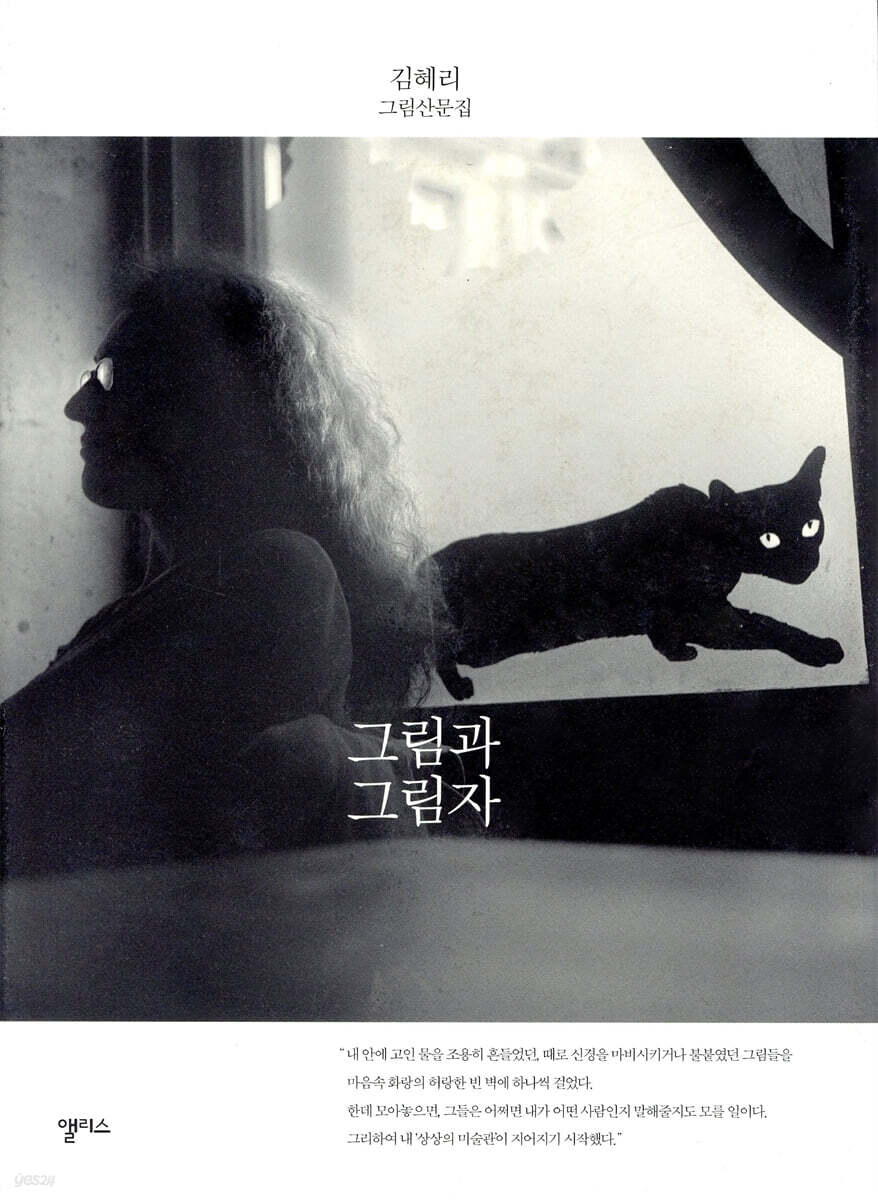
Book Introduction
Kim Hye-ri's Image Essay
Here are forty paintings, forty stories.
There are no boundaries in this bundle, which moves between pictures and stories and the shadows between them.
The author, as if returning to the childhood he longs for, a time when the wall separating the world of novels and paintings from reality was much softer and more transparent, allowing for free movement, passes through the two-dimensional world of paintings and stores fragments of stories one by one.
Then, I return home and summon the paintings I left in the museum and gallery into an imaginary museum, hanging them one by one and carving out fragments of stories one by one.
From the faceless statue of Nike to Lucian Freud's paintings, where the emotions and fatigue of the subject are clearly reflected like the veins under the arm, the paintings that Kim Hye-ri focuses on inevitably show many gaps of loneliness and emptiness.
Whether it's a landscape or a portrait, she captures a handful of 'mindscapes' or images within them, and reaches out from the book, sending a look that seeks empathy.
Her eyes somehow look sad, making the reader enter the book, stand shoulder to shoulder with her, and go back and forth between the picture.
Kim Hye-ri's scattered words make me want to piece them together and create a picturesque prose.
Here are forty paintings, forty stories.
There are no boundaries in this bundle, which moves between pictures and stories and the shadows between them.
The author, as if returning to the childhood he longs for, a time when the wall separating the world of novels and paintings from reality was much softer and more transparent, allowing for free movement, passes through the two-dimensional world of paintings and stores fragments of stories one by one.
Then, I return home and summon the paintings I left in the museum and gallery into an imaginary museum, hanging them one by one and carving out fragments of stories one by one.
From the faceless statue of Nike to Lucian Freud's paintings, where the emotions and fatigue of the subject are clearly reflected like the veins under the arm, the paintings that Kim Hye-ri focuses on inevitably show many gaps of loneliness and emptiness.
Whether it's a landscape or a portrait, she captures a handful of 'mindscapes' or images within them, and reaches out from the book, sending a look that seeks empathy.
Her eyes somehow look sad, making the reader enter the book, stand shoulder to shoulder with her, and go back and forth between the picture.
Kim Hye-ri's scattered words make me want to piece them together and create a picturesque prose.
- You can preview some of the book's contents.
Preview
index
Prologue | In front of the painting
[In front of the picture]
This is not a picture
- Tactics for Gentle Confrontation with Isolation | Édouard Vuillard, "Place des Vintimieux"
- Still Life | Giorgio Morandi, "Still Life"
Faceless Things | Author unknown, "Winged Victory of Samothrace"
Remember Death | Nicola Constantino, "The Nipple Corset"
- Singing the Snake | Dorje Kirsten Sinnoh, "The Cheerful Snake of Spring"
- Finding Hidden Spaces and Hiding Them Again | Daniel Arsham, "Sheet"
A Fragment of the Gray and Ephemeral Universe | Georges-Pierre Seurat, "The Concert of Eden"
- Sleep and Dreams | Wendell Castle, "Hearing, Invisible"
- The Gates of Night | James McNeill Whistler, "Nocturne in Blue and Gold - Old Battersea Bridge"
- Nobody Knows | Kim Jeong-hui, "Sehando"
I stared blankly
- Slow and arduous flash | Kiyoshi Yamashita, "Fireworks"
- The Perfection of a Woman | Leonor Fini, "The Perfection of a Woman"
A World Without Pia | Balthus, "Cathy's Dressing"
A Realist Who Loved Dreamers | Honoré Daumier, "Don Quixote and Sancho Panza"
- Hazy concentration before a mirror | Edgar Degas, "Combing Hair"
- Cozy Desolation | Lawrence S.
Laurie, "People Leaving the Factory"
- A Precisely Depicted Paradise Lost | Norman Rockwell, "The Fugitive"? "Leaving Home"
Portrait of an Old Artist | Marc Chagall, "The Painter with Two Faces"
- A Special Zone of the Human Mind | Joan Yeardley, "Children, Port of Glasgow"
- A Cushion Called a Picture | Edward Ardison, illustration for "The Little Bookshop"
[Behind the picture]
I come face to face with the shadow over there
Lies or Illusions | Felix Vallotton, "Lies"
- Off-screen Mystery | Alex Katz, "Ada"
- Unfinished Drama | Robert Braithwaite Martino, "The Poor Actress's Christmas Dinner"
The earnest manner of Mannerism | Giacomo da Pontormo, "The Descent from the Cross"
Alone with Death | Gustave Moreau, "Saint Sebastian"
- Finding the Right Distance Between the Painting and Me | Wilhelm Sasnal, "Untitled"
The Garden of Innocent Desires | Henri Rousseau, "The Dream"
- People are strange, when you're a stranger | James Ensor, "Strange Masks"
- Eerie Crevice | Choi Yun-jeong, "Nostalgia" Series
- Laying Down Death | Caravaggio, "Sleeping Cupid"
This is your and my shadow
- Obscene Solitude | Philip Guston, "The Head and the Bottle"
The Universe of the Body | Antony Gormley, "Quantum Cloud"
A Piece of Art that Goes Straight to the Heart | Ana Maria Pacheco, "Shadow of the Wanderer"
- Same Yet Different | Author Unknown, "The Cheomri Sisters"
- I am in pain, I am in pain | Albrecht Dürer, untitled sketch
- LOVE & DIY | Lee Ju-yo, "TWO"
A Hand I Want to Hold Still | Auguste Rodin, "The Cathedral"
- After Love | Pierre Bonnard, "Man and Woman"
- Only for Love | Francisco de Goya, "The Dog"
- Robust Coexistence | Lucian Freud, "Portrait of Two"
epilogue | behind the picture
[In front of the picture]
This is not a picture
- Tactics for Gentle Confrontation with Isolation | Édouard Vuillard, "Place des Vintimieux"
- Still Life | Giorgio Morandi, "Still Life"
Faceless Things | Author unknown, "Winged Victory of Samothrace"
Remember Death | Nicola Constantino, "The Nipple Corset"
- Singing the Snake | Dorje Kirsten Sinnoh, "The Cheerful Snake of Spring"
- Finding Hidden Spaces and Hiding Them Again | Daniel Arsham, "Sheet"
A Fragment of the Gray and Ephemeral Universe | Georges-Pierre Seurat, "The Concert of Eden"
- Sleep and Dreams | Wendell Castle, "Hearing, Invisible"
- The Gates of Night | James McNeill Whistler, "Nocturne in Blue and Gold - Old Battersea Bridge"
- Nobody Knows | Kim Jeong-hui, "Sehando"
I stared blankly
- Slow and arduous flash | Kiyoshi Yamashita, "Fireworks"
- The Perfection of a Woman | Leonor Fini, "The Perfection of a Woman"
A World Without Pia | Balthus, "Cathy's Dressing"
A Realist Who Loved Dreamers | Honoré Daumier, "Don Quixote and Sancho Panza"
- Hazy concentration before a mirror | Edgar Degas, "Combing Hair"
- Cozy Desolation | Lawrence S.
Laurie, "People Leaving the Factory"
- A Precisely Depicted Paradise Lost | Norman Rockwell, "The Fugitive"? "Leaving Home"
Portrait of an Old Artist | Marc Chagall, "The Painter with Two Faces"
- A Special Zone of the Human Mind | Joan Yeardley, "Children, Port of Glasgow"
- A Cushion Called a Picture | Edward Ardison, illustration for "The Little Bookshop"
[Behind the picture]
I come face to face with the shadow over there
Lies or Illusions | Felix Vallotton, "Lies"
- Off-screen Mystery | Alex Katz, "Ada"
- Unfinished Drama | Robert Braithwaite Martino, "The Poor Actress's Christmas Dinner"
The earnest manner of Mannerism | Giacomo da Pontormo, "The Descent from the Cross"
Alone with Death | Gustave Moreau, "Saint Sebastian"
- Finding the Right Distance Between the Painting and Me | Wilhelm Sasnal, "Untitled"
The Garden of Innocent Desires | Henri Rousseau, "The Dream"
- People are strange, when you're a stranger | James Ensor, "Strange Masks"
- Eerie Crevice | Choi Yun-jeong, "Nostalgia" Series
- Laying Down Death | Caravaggio, "Sleeping Cupid"
This is your and my shadow
- Obscene Solitude | Philip Guston, "The Head and the Bottle"
The Universe of the Body | Antony Gormley, "Quantum Cloud"
A Piece of Art that Goes Straight to the Heart | Ana Maria Pacheco, "Shadow of the Wanderer"
- Same Yet Different | Author Unknown, "The Cheomri Sisters"
- I am in pain, I am in pain | Albrecht Dürer, untitled sketch
- LOVE & DIY | Lee Ju-yo, "TWO"
A Hand I Want to Hold Still | Auguste Rodin, "The Cathedral"
- After Love | Pierre Bonnard, "Man and Woman"
- Only for Love | Francisco de Goya, "The Dog"
- Robust Coexistence | Lucian Freud, "Portrait of Two"
epilogue | behind the picture
Detailed image
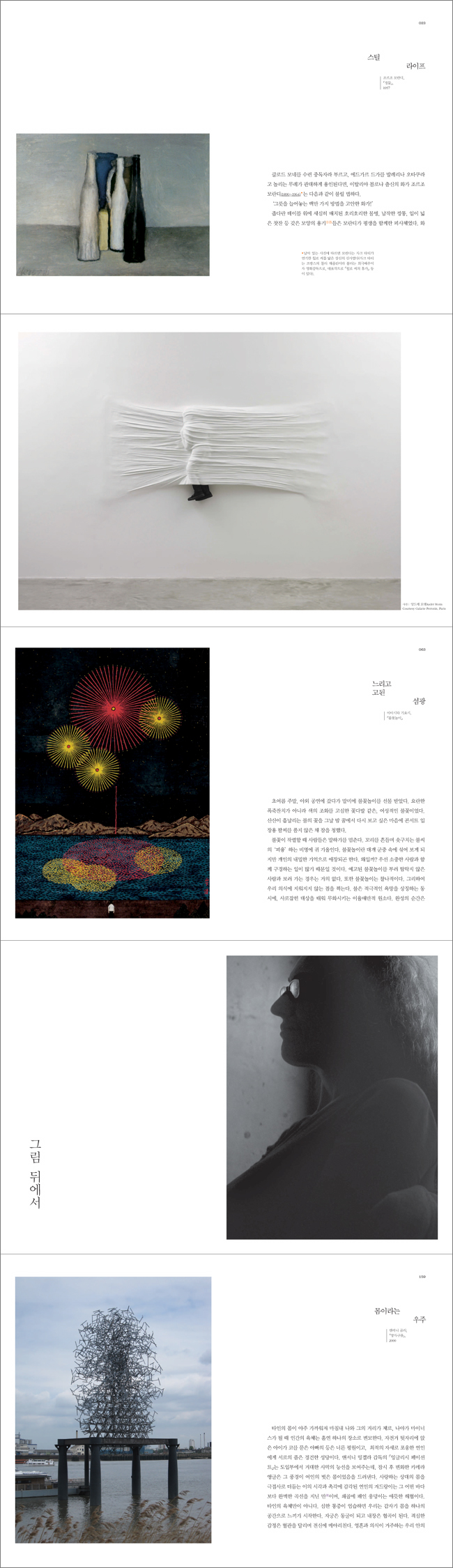
Into the book
When we look at a work of art, we unconsciously look for faces.
This is not a story that only applies to paintings and sculptures that feature human figures.
Flowers in a vase, apples on a plate, a spring lawn—even abstractions—our gaze still instinctively wanders in search of its "face"—a point on which to focus our eyes and project our emotions.
As Jacques Aumont wrote, it is ultimately the face of the other that stimulates our emotions, and as John Berger pointed out in "Pocket Shapes," all painters—and I think the viewer, too—seek a reciprocal gaze from their subject, a gaze that will return the gaze they have sent out.
Therefore, in paintings and sculptures that imitate the human form, the absence of the face causes shock.
Deficiency powerfully evokes what should have been there.
_From "Winged Victory of Samothrace"
Even buildings, often placed opposite nature and considered symbols of inorganic permanence, actually live limited lives.
They rust, they age, they breathe, they vibrate.
Paradoxically, it is after a long absence that we begin to feel that our home is alive.
When you return from a long journey and step into the empty house for the first time, the smell of desolation lingers.
It should be clean since it hasn't been dirty or messy for a while, but for some reason it's shabby and withered.
Only then did the house and I exchange breaths
I know it was there.
It's a somewhat heartwarming realization.
_Daniel Arsham, from "Sheet"
The extremely cautious Seora in front of Yuhwa is swept up in romance when he holds paper and conte.
Unlike oil paintings where the dots of color are clear and distinct, the lines of his sketches are indistinguishable, forming textures like the surface of velvet.
Soft Conté crayons and irregularly textured Michalet paper.
The two materials favored by Seurat embrace and resist each other, depicting shape, distribution of light, and atmosphere with minimal touch.
It seems like it would disappear if I turned my head, like a veil woven from spider threads.
Although Seurat's sketches and oil paintings share the same goal of depicting particles, they evoke different emotions.
In the end, Seurat's persistent pointillism seems like a process of explanation that his sketches deliberately list to prove to the public the answer he intuitively knows.
_Georges Seurat, from "Eden Concert"
The night falls.
The verb 'come down', which does not fit in the morning or daytime, spreads its wings when it takes the night as its subject.
Night covers objects and landscapes, leaving only soft, generous masses, like the massive pavement installations of Christo and Jeanne-Claude.
When the yellow traces of sunlight that have not yet faded meet the dark blue of the approaching night, a deep blue with a hint of green spreads through the air.
The 'time of dog and wolf' that greets us by the river is even more solemn, as the calm blue of the water meets that of the low-hanging sky to create a grand blue harmony.
A moment when the movement of the universe suddenly reveals its identity.
The devout think of God, the lonely sigh in the brief peace of being alone again, and the young are excited by the expectation that the most wonderful thing of the day is about to happen.
_James McNeill Whistler, from "Nocturnes in Blue and Gold: Old Battersea Bridge"
The coloring technique of "Combing Hair," which seems to have been done by gently dabbing terracotta-colored pigments into a pouch onto the canvas, evokes the bridge between the two human activities of makeup and art.
The words comb and brush, which are so similar, the unique properties of pastel and ink that can be used both dry and wet, and the synesthesia that connects the hand that caresses skin and the hand that opens wax make it impossible to ignore them.
Degas's paintings stop us in our tracks for a different reason than the portraits of noble ladies by Rococo painters, who sometimes seem to have used cosmetics as pigments.
Just as a mirror hanging on the wall catches the eyes of passing women.
_Edgar Degas, from "Combing Hair"
The man's right hand and the woman's left hand are clasped tightly near the heart.
Their remaining free arms wrap around each other's shoulders and waists, leaving not a single inch of space between their bodies.
The woman buries her lips in the man's earlobe, and the man closes his eyes.
His legs wrap around his lover's skirt like a fence.
The title of this romantic painting is, absurdly, “Lies.”
_Felix Vallotton, from "Lies"
The feeling of being 'swept away' is familiar to modern people.
The pace of information and labor outpaces our biological rhythms, and a highly stimulating, sentimental culture repeatedly abruptly shifts our minds.
In the midst of the daily events and emotions that wash over us like a tidal wave, we have to swim with all our might to barely maintain our place and sanity.
Moreover, if you want to go against the flow of the world and move forward in the direction you want, it requires almost heroic effort.
One way to cope with the dizzying pace of the world that overwhelms our biological clocks is to 'describe'.
The act of describing has a similar effect to the 'slow replay' screen on television.
It gives me a safe distance from the situation at hand and gives me the space to understand my situation on the edge.
Reality, tuned to a subjective point of view, sometimes generates unimaginable meanings and beauty.
It is a flower that blooms in the valley between ‘seeing’ and ‘looking at’.
_Wilhelm Sasnal, from "Untitled"
The man in the picture is alone.
Maybe you came home drunk after a night out with friends and popped the cork on your last bottle.
But now, even the bottle of alcohol he had been drinking alone had collapsed, spilling red blood, and the man was finally completely alone.
As if to confirm the popular belief that alcohol numbs the body and pumps up the consciousness, the man has only a head and no body.
A forehead furrowed with wrinkles, a chin rough with stubble.
His face has no nose or mouth.
“Only the wide-open, single eye testifies to the glaring, disgusting consciousness.”
This is not a story that only applies to paintings and sculptures that feature human figures.
Flowers in a vase, apples on a plate, a spring lawn—even abstractions—our gaze still instinctively wanders in search of its "face"—a point on which to focus our eyes and project our emotions.
As Jacques Aumont wrote, it is ultimately the face of the other that stimulates our emotions, and as John Berger pointed out in "Pocket Shapes," all painters—and I think the viewer, too—seek a reciprocal gaze from their subject, a gaze that will return the gaze they have sent out.
Therefore, in paintings and sculptures that imitate the human form, the absence of the face causes shock.
Deficiency powerfully evokes what should have been there.
_From "Winged Victory of Samothrace"
Even buildings, often placed opposite nature and considered symbols of inorganic permanence, actually live limited lives.
They rust, they age, they breathe, they vibrate.
Paradoxically, it is after a long absence that we begin to feel that our home is alive.
When you return from a long journey and step into the empty house for the first time, the smell of desolation lingers.
It should be clean since it hasn't been dirty or messy for a while, but for some reason it's shabby and withered.
Only then did the house and I exchange breaths
I know it was there.
It's a somewhat heartwarming realization.
_Daniel Arsham, from "Sheet"
The extremely cautious Seora in front of Yuhwa is swept up in romance when he holds paper and conte.
Unlike oil paintings where the dots of color are clear and distinct, the lines of his sketches are indistinguishable, forming textures like the surface of velvet.
Soft Conté crayons and irregularly textured Michalet paper.
The two materials favored by Seurat embrace and resist each other, depicting shape, distribution of light, and atmosphere with minimal touch.
It seems like it would disappear if I turned my head, like a veil woven from spider threads.
Although Seurat's sketches and oil paintings share the same goal of depicting particles, they evoke different emotions.
In the end, Seurat's persistent pointillism seems like a process of explanation that his sketches deliberately list to prove to the public the answer he intuitively knows.
_Georges Seurat, from "Eden Concert"
The night falls.
The verb 'come down', which does not fit in the morning or daytime, spreads its wings when it takes the night as its subject.
Night covers objects and landscapes, leaving only soft, generous masses, like the massive pavement installations of Christo and Jeanne-Claude.
When the yellow traces of sunlight that have not yet faded meet the dark blue of the approaching night, a deep blue with a hint of green spreads through the air.
The 'time of dog and wolf' that greets us by the river is even more solemn, as the calm blue of the water meets that of the low-hanging sky to create a grand blue harmony.
A moment when the movement of the universe suddenly reveals its identity.
The devout think of God, the lonely sigh in the brief peace of being alone again, and the young are excited by the expectation that the most wonderful thing of the day is about to happen.
_James McNeill Whistler, from "Nocturnes in Blue and Gold: Old Battersea Bridge"
The coloring technique of "Combing Hair," which seems to have been done by gently dabbing terracotta-colored pigments into a pouch onto the canvas, evokes the bridge between the two human activities of makeup and art.
The words comb and brush, which are so similar, the unique properties of pastel and ink that can be used both dry and wet, and the synesthesia that connects the hand that caresses skin and the hand that opens wax make it impossible to ignore them.
Degas's paintings stop us in our tracks for a different reason than the portraits of noble ladies by Rococo painters, who sometimes seem to have used cosmetics as pigments.
Just as a mirror hanging on the wall catches the eyes of passing women.
_Edgar Degas, from "Combing Hair"
The man's right hand and the woman's left hand are clasped tightly near the heart.
Their remaining free arms wrap around each other's shoulders and waists, leaving not a single inch of space between their bodies.
The woman buries her lips in the man's earlobe, and the man closes his eyes.
His legs wrap around his lover's skirt like a fence.
The title of this romantic painting is, absurdly, “Lies.”
_Felix Vallotton, from "Lies"
The feeling of being 'swept away' is familiar to modern people.
The pace of information and labor outpaces our biological rhythms, and a highly stimulating, sentimental culture repeatedly abruptly shifts our minds.
In the midst of the daily events and emotions that wash over us like a tidal wave, we have to swim with all our might to barely maintain our place and sanity.
Moreover, if you want to go against the flow of the world and move forward in the direction you want, it requires almost heroic effort.
One way to cope with the dizzying pace of the world that overwhelms our biological clocks is to 'describe'.
The act of describing has a similar effect to the 'slow replay' screen on television.
It gives me a safe distance from the situation at hand and gives me the space to understand my situation on the edge.
Reality, tuned to a subjective point of view, sometimes generates unimaginable meanings and beauty.
It is a flower that blooms in the valley between ‘seeing’ and ‘looking at’.
_Wilhelm Sasnal, from "Untitled"
The man in the picture is alone.
Maybe you came home drunk after a night out with friends and popped the cork on your last bottle.
But now, even the bottle of alcohol he had been drinking alone had collapsed, spilling red blood, and the man was finally completely alone.
As if to confirm the popular belief that alcohol numbs the body and pumps up the consciousness, the man has only a head and no body.
A forehead furrowed with wrinkles, a chin rough with stubble.
His face has no nose or mouth.
“Only the wide-open, single eye testifies to the glaring, disgusting consciousness.”
(Philip Guston, "The Head and the Bottle")
Publisher's Review
absentmindedly,
In front of the painting, looking beyond it
Behind the painting, I see my own shadow overlapping
Sensing and feeling the countless knots of emotions one by one,
Kim Hye-ri's Image Essay
“The water that had been stagnant inside me was quietly stirred,
Sometimes the pictures that paralyze or set my nerves on fire
I hung them one by one on the empty walls of the gallery in my heart.
If you put them together,
They might be able to tell me what kind of person I am.
And so, my ‘imaginary art museum’ began to be built.”
Interview with the painting
Kim Hye-ri speaks.
To people, to things.
Before speaking, she looks at the subject carefully.
Beyond observing and questioning, it casts its gaze beyond the invisible, such as beyond the shadow of the object.
Then, have a deep conversation with the subject.
There is always room for readers in the interview room.
The moment she finally reveals herself and approaches her subject with sincerity, she always offers her shoulder so that the reader can walk alongside her.
If you accompany Kim Hye-ri, you will encounter her synesthetically sensing the story surrounding a single painting.
Her unique sensibility and sentences are exceptionally fluid, as if they were woven with hands that caressed each and every knot of emotion.
The unknown emotions we felt in front of and behind the paintings, the stories we wanted to know, come to life, however vaguely, through Kim Hye-ri's writing.
The things I wanted to ask the painting are revealing the beginning of a clue.
Ultimately, through this, we find the answer to the reality of emotions that we could not define.
Kim Hye-ri's confession in front of the painting dotted with monologues and blank spaces seeps into my heart, belatedly and quietly, like a pointillism painting.
“The large and small art galleries in distant lands and foreign cities never asked me whether I was a resident or a foreigner.
After entering the main gate, paying my ticket or donation, and leaving my backpack in the locker room, I was able to be alone more naturally and lightly than ever before in my life.
“I spent half a day wandering from room to room with paintings in my hand, and, with a bottle of water as a full meal, I sat on a bench in the exhibition hall and watched the sun, which had been at its highest point, slowly set behind the western window with a full heart.” _From the introduction
“For me, who fundamentally believed that it was impossible for a person today to live a life rich enough to separate his or her main occupation from his or her hobbies, the pleasure of looking at paintings was something close to aristocratic play.
It would be more accurate to say that it was a sweeter escape knowing that I could never escape from my registered address.
Ah, but how foolishly we crave luxury! White, neutral walls, a temperature and humidity that are imperceptible to heat or cold, a comfortable silence and whispers.
I know that many contemporary artists have struggled to break free from the artificial, damp-proof institution of the gallery, but for the average tourist, the corridors of an art museum are a rare, yet captivating, weightless space that allows them to momentarily forget all the conditioning that has clung to them all their lives—even, disturbingly, their era and nationality.
“Each painting was an independent place and a nation.”_From the introduction
An imaginary art gallery completed by hanging a painting on the empty wall of the mind
Here are forty paintings, forty stories.
There are no boundaries in this bundle, which moves between pictures and stories and the shadows between them.
The author, as if returning to the childhood he longs for, a time when the wall separating the world of novels and paintings from reality was much softer and more transparent, allowing for free movement, passes through the two-dimensional world of paintings and stores fragments of stories one by one.
Then, I return home and summon the paintings I left in the museum and gallery into an imaginary museum, hanging them one by one and carving out fragments of stories one by one.
When we stand in front of a painting, we want to enter into the painting.
I thirst for the meaning of thousands of thoughts condensed by the painter in a few brush strokes.
Standing before a painting, we superimpose our own shadows on the world of life and death, created by rough, smooth, and sometimes hazy and blurred brushstrokes.
The time of imagination begins.
Kim Hye-ri willingly takes care of the natural preparations for the interview on our behalf.
I search for pieces of a story contained in a single picture.
Then, choosing between the artist's tastes, backgrounds, thoughts, meanings, dramas, light and colors, he weaves a landscape of the mind by pulling out a few thin warp and weft threads like a spider.
From the faceless statue of Nike to Lucian Freud's paintings, where the emotions and fatigue of the subject are clearly reflected like the veins under the arm, the paintings that Kim Hye-ri focuses on inevitably show many gaps of loneliness and emptiness.
Whether it's a landscape or a portrait, she captures a handful of 'mindscapes' or images within them, and reaches out from the book, sending a look that seeks empathy.
Her gaze somehow looks sad, making the reader feel drawn into the book and move back and forth between the paintings, shoulder to shoulder with her.
Kim Hye-ri's scattered words make me want to piece them together and create a picturesque prose.
In front of the painting, looking beyond it
Behind the painting, I see my own shadow overlapping
Sensing and feeling the countless knots of emotions one by one,
Kim Hye-ri's Image Essay
“The water that had been stagnant inside me was quietly stirred,
Sometimes the pictures that paralyze or set my nerves on fire
I hung them one by one on the empty walls of the gallery in my heart.
If you put them together,
They might be able to tell me what kind of person I am.
And so, my ‘imaginary art museum’ began to be built.”
Interview with the painting
Kim Hye-ri speaks.
To people, to things.
Before speaking, she looks at the subject carefully.
Beyond observing and questioning, it casts its gaze beyond the invisible, such as beyond the shadow of the object.
Then, have a deep conversation with the subject.
There is always room for readers in the interview room.
The moment she finally reveals herself and approaches her subject with sincerity, she always offers her shoulder so that the reader can walk alongside her.
If you accompany Kim Hye-ri, you will encounter her synesthetically sensing the story surrounding a single painting.
Her unique sensibility and sentences are exceptionally fluid, as if they were woven with hands that caressed each and every knot of emotion.
The unknown emotions we felt in front of and behind the paintings, the stories we wanted to know, come to life, however vaguely, through Kim Hye-ri's writing.
The things I wanted to ask the painting are revealing the beginning of a clue.
Ultimately, through this, we find the answer to the reality of emotions that we could not define.
Kim Hye-ri's confession in front of the painting dotted with monologues and blank spaces seeps into my heart, belatedly and quietly, like a pointillism painting.
“The large and small art galleries in distant lands and foreign cities never asked me whether I was a resident or a foreigner.
After entering the main gate, paying my ticket or donation, and leaving my backpack in the locker room, I was able to be alone more naturally and lightly than ever before in my life.
“I spent half a day wandering from room to room with paintings in my hand, and, with a bottle of water as a full meal, I sat on a bench in the exhibition hall and watched the sun, which had been at its highest point, slowly set behind the western window with a full heart.” _From the introduction
“For me, who fundamentally believed that it was impossible for a person today to live a life rich enough to separate his or her main occupation from his or her hobbies, the pleasure of looking at paintings was something close to aristocratic play.
It would be more accurate to say that it was a sweeter escape knowing that I could never escape from my registered address.
Ah, but how foolishly we crave luxury! White, neutral walls, a temperature and humidity that are imperceptible to heat or cold, a comfortable silence and whispers.
I know that many contemporary artists have struggled to break free from the artificial, damp-proof institution of the gallery, but for the average tourist, the corridors of an art museum are a rare, yet captivating, weightless space that allows them to momentarily forget all the conditioning that has clung to them all their lives—even, disturbingly, their era and nationality.
“Each painting was an independent place and a nation.”_From the introduction
An imaginary art gallery completed by hanging a painting on the empty wall of the mind
Here are forty paintings, forty stories.
There are no boundaries in this bundle, which moves between pictures and stories and the shadows between them.
The author, as if returning to the childhood he longs for, a time when the wall separating the world of novels and paintings from reality was much softer and more transparent, allowing for free movement, passes through the two-dimensional world of paintings and stores fragments of stories one by one.
Then, I return home and summon the paintings I left in the museum and gallery into an imaginary museum, hanging them one by one and carving out fragments of stories one by one.
When we stand in front of a painting, we want to enter into the painting.
I thirst for the meaning of thousands of thoughts condensed by the painter in a few brush strokes.
Standing before a painting, we superimpose our own shadows on the world of life and death, created by rough, smooth, and sometimes hazy and blurred brushstrokes.
The time of imagination begins.
Kim Hye-ri willingly takes care of the natural preparations for the interview on our behalf.
I search for pieces of a story contained in a single picture.
Then, choosing between the artist's tastes, backgrounds, thoughts, meanings, dramas, light and colors, he weaves a landscape of the mind by pulling out a few thin warp and weft threads like a spider.
From the faceless statue of Nike to Lucian Freud's paintings, where the emotions and fatigue of the subject are clearly reflected like the veins under the arm, the paintings that Kim Hye-ri focuses on inevitably show many gaps of loneliness and emptiness.
Whether it's a landscape or a portrait, she captures a handful of 'mindscapes' or images within them, and reaches out from the book, sending a look that seeks empathy.
Her gaze somehow looks sad, making the reader feel drawn into the book and move back and forth between the paintings, shoulder to shoulder with her.
Kim Hye-ri's scattered words make me want to piece them together and create a picturesque prose.
GOODS SPECIFICS
- Date of publication: October 7, 2011
- Format: Hardcover book binding method guide
- Page count, weight, size: 200 pages | 510g | 148*205*20mm
- ISBN13: 9788961960953
- ISBN10: 8961960954
You may also like
카테고리
korean


korean

![GQ KOREA Mark (Monthly): December [2025]](http://librairie.coreenne.fr/cdn/shop/files/8ef265dbbfbf186523ed75ba7319009d.jpg?v=1765340328&width=3840)


