

Humanities that fill me
 |
Description
Book Introduction
A series of one hundred books, "Humanities"
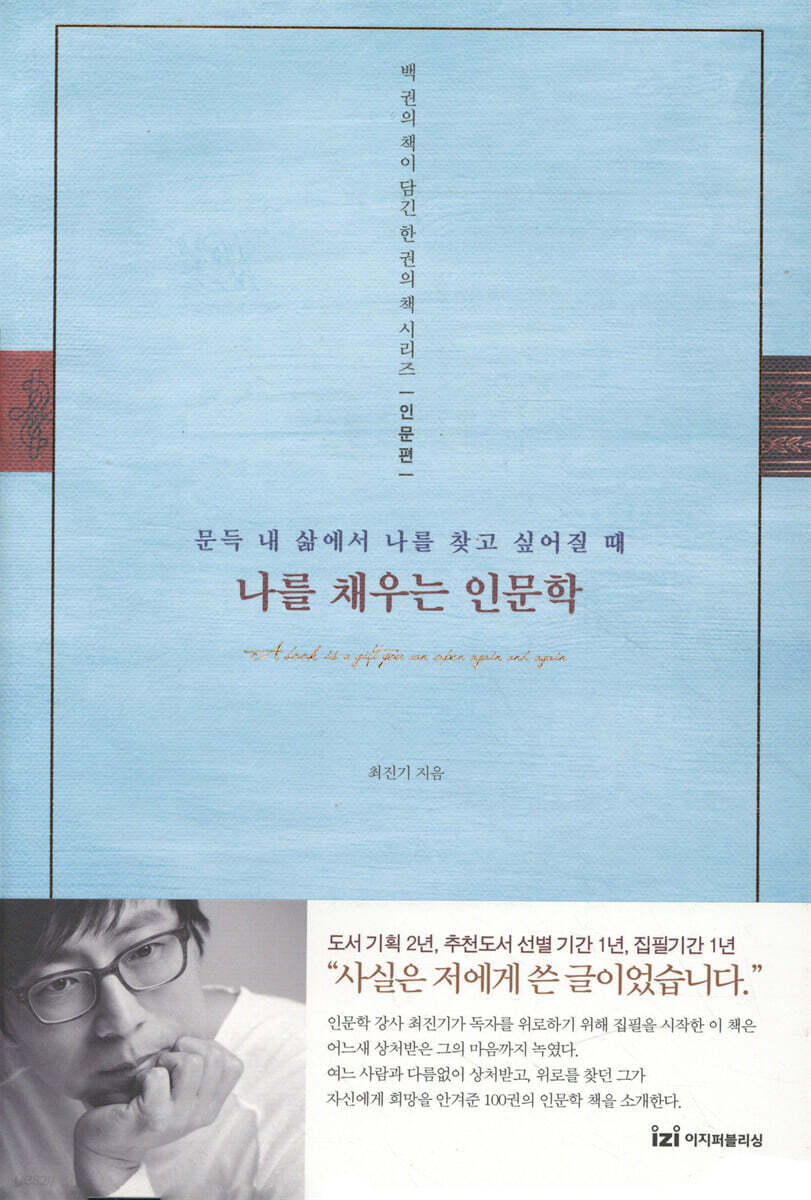
A total of 2 years of book planning, 1 year of recommended book selection, and 1 year of writing. Discover 100 Humanities Books from 10 Topics The "One Book Series Containing a Hundred Books" is a series of books that introduce books personally selected by experts in various fields such as humanities, classics, self-development, economics and management, childcare, and history. It was designed to provide quality books that can be read whenever you need them. This book is the first in a series of one hundred books on humanities. "Humanities that Fill Me" is a selection of books in the humanities that will provide comfort, strength, and solutions to those of us who are struggling with many concerns. Depending on your situation and time, you can always find the book you need in one book containing a hundred books. In other words, 『Humanities that Fill Me』 is a book guide service that tells me which books can be helpful to me right now. In this book, Choi Jin-gi, Korea's leading humanities expert recognized by the public, recommends 100 books on 10 topics: love, work, society, mind, food, travel, art, education, history, and people. Each chapter introduces the main text of the book, its meaning, and reading tips related to the topic. This is a must-read book that must be read at least once, but the general public has had difficulty reading it, so we have interpreted the content in a way that makes it easy to understand, so that they do not have difficulty reading it. Additionally, the book's diverse introduction allows each individual to jump directly to the topic of their choice, serving as a navigational aid to more than a hundred books. The writing of this book, which began with the intention of providing true comfort and hope to the wounded, actually became an opportunity for the author to heal himself, and the author, Jin-gi Choi, confesses this fact in the preface. In this way, 『Humanities that Fill Me』 will be a book for readers who truly want to know themselves and those who want to get closer to the humanities but don't know where to start. |
- You can preview some of the book's contents.
Preview
index
- Preface
- One Book Series Containing 100 Books | Humanities Book List |
Chapter 1: I ask you to shake my hand if you have been hurt in your work life.
The Value of Laziness: A Refreshing Break in a Stagnant, Diligent Society
The Right to Be Lazy / Paul Lafargue
The right of office workers to achieve work-life balance
How to Work-Life Balance / Ahn Seong-min
Precious emotions of our time
Emotional Labor / Arlie Russell Hochschild
Standing still doesn't mean stopping.
For those of you who are feeling overwhelmed by the Fourth Industrial Revolution / Park Jae-yong
Chapter 2: If you're curious about the heart, look farther and closer.
Emotions walking through dreams, hidden love
The Man Who Mistook His Wife for a Hat / Oliver Sacks
Even if the world falls apart, happiness is always there.
The Origin of Happiness / Seo Eun-guk
A Method for Exploring the Mind in an Age of Godlessness
Opening Skinner's Box / Lauren Slater
Chapter 3: The Comforting Colors That Beautiful Things Give Us
A new world born from two different strokes
Painter VS Painter / Heo Na-young
Words from a picture that resembles my heart
Tokyo Art Museum Art Walk / Myung Ro-jin and Lee Gyeong-guk
How to rediscover the beauty of Korea
Oh Ju-seok's Special Lecture on Korean Beauty / Oh Ju-seok
Chapter 4: What Love Left Us
The Art of the Heart as Told by Timeless Classics
The Art of Loving / Erich Fromm
How Our Love Evolves
What the heck is love / Kwak Geum-ju
How does human sex differ from animal sex?
The School of Life: Sex / Alain de Botton
Chapter 5: Small Miracles You Can Gain Through Travel
A trip with a different purpose, but not necessarily to that place
I decided not to postpone my trip any longer / Jeong Eun-gil
Cuba, a place that makes your heart flutter just by hearing about it
Cuba Diary / Kwon Geun-hye
Where hobbies become travel, and travel becomes writing.
The Ryokan I Found / Kashiwai Hisashi
Chapter 6: A Warm Word to Someone Who Has Been Hurt in Social Life
The strange boundary between belonging and non-belonging
Distinction / Pierre Bourdieu
What We Can Protect Through Intergenerational Respect
The World's Greatest Economic Fraud: Generation War / Park Jong-hoon
Within the gap of social contradictions and absurdities
Kim Ji-young, Born 1982 / Jo Nam-joo
Chapter 7 If Food Gives You Comfort
Lessons from the Worst and Best Foods
The Mystery of Food Culture / Marvin Harris
Sometimes you need the truth you don't need to know.
Sweet Empire: The Unpleasant Truth / Kim Kyung-il
Reading that makes the world truly more delicious
The Story of Food That Changed the World / Hong Ik-hee
Cold noodles taste better when you know what you're eating
Cold Noodles War / Baek Heon-seok and Choi Hye-rim
Chapter 8: If Education is Hope
What we want from our schools
What is EBS School? / What is EBS School? Production Team
Embracing the world with the value of endless learning
Learning the Real World at Summerhill / Chae Eun
Chapter 9: History: Looking to the Future Through the Past
You have to be crazy to be crazy / Jeongmin
Western History in All Its Capabilities / Nam Gyeong-tae
The Imjin War as They See It / Kim Si-deok
Japanese History Not Taught in School / Shin Sang-mok
Lecture on the History of the Russian Revolution / Park No-ja
Minor Leagues in World War II / Jong-su Han
Joo Kyung-chul's European Story 1 / Joo Kyung-chul
Paradox / Baek Seung-jong
History / Lee I-hwa
Korean Resistance / Jo Han-seong
Chapter 10 If we could meet again, I want to meet again
Reading in Youth / Yoo Si-min
Frida Kahlo, Na Hye-seok, and Camille Claudel / Jeong Geum-hee
Chinese Story / Kim Myeong-ho
Doctor Zhivago / Boris Pasternak
Che Guevara's Thin Backpack / Gu Gwang-ryeol
Lee Hoe-young's Biography / Kim Sam-woong
Steve Jobs / Walter Isaacson
Modigliani, Bohème / André Salmon
Pablo Neruda's Autobiography / Pablo Neruda
Zorba the Greek / Nikos Kazantzakis
- One Book Series Containing 100 Books | Humanities Book List |
Chapter 1: I ask you to shake my hand if you have been hurt in your work life.
The Value of Laziness: A Refreshing Break in a Stagnant, Diligent Society
The Right to Be Lazy / Paul Lafargue
The right of office workers to achieve work-life balance
How to Work-Life Balance / Ahn Seong-min
Precious emotions of our time
Emotional Labor / Arlie Russell Hochschild
Standing still doesn't mean stopping.
For those of you who are feeling overwhelmed by the Fourth Industrial Revolution / Park Jae-yong
Chapter 2: If you're curious about the heart, look farther and closer.
Emotions walking through dreams, hidden love
The Man Who Mistook His Wife for a Hat / Oliver Sacks
Even if the world falls apart, happiness is always there.
The Origin of Happiness / Seo Eun-guk
A Method for Exploring the Mind in an Age of Godlessness
Opening Skinner's Box / Lauren Slater
Chapter 3: The Comforting Colors That Beautiful Things Give Us
A new world born from two different strokes
Painter VS Painter / Heo Na-young
Words from a picture that resembles my heart
Tokyo Art Museum Art Walk / Myung Ro-jin and Lee Gyeong-guk
How to rediscover the beauty of Korea
Oh Ju-seok's Special Lecture on Korean Beauty / Oh Ju-seok
Chapter 4: What Love Left Us
The Art of the Heart as Told by Timeless Classics
The Art of Loving / Erich Fromm
How Our Love Evolves
What the heck is love / Kwak Geum-ju
How does human sex differ from animal sex?
The School of Life: Sex / Alain de Botton
Chapter 5: Small Miracles You Can Gain Through Travel
A trip with a different purpose, but not necessarily to that place
I decided not to postpone my trip any longer / Jeong Eun-gil
Cuba, a place that makes your heart flutter just by hearing about it
Cuba Diary / Kwon Geun-hye
Where hobbies become travel, and travel becomes writing.
The Ryokan I Found / Kashiwai Hisashi
Chapter 6: A Warm Word to Someone Who Has Been Hurt in Social Life
The strange boundary between belonging and non-belonging
Distinction / Pierre Bourdieu
What We Can Protect Through Intergenerational Respect
The World's Greatest Economic Fraud: Generation War / Park Jong-hoon
Within the gap of social contradictions and absurdities
Kim Ji-young, Born 1982 / Jo Nam-joo
Chapter 7 If Food Gives You Comfort
Lessons from the Worst and Best Foods
The Mystery of Food Culture / Marvin Harris
Sometimes you need the truth you don't need to know.
Sweet Empire: The Unpleasant Truth / Kim Kyung-il
Reading that makes the world truly more delicious
The Story of Food That Changed the World / Hong Ik-hee
Cold noodles taste better when you know what you're eating
Cold Noodles War / Baek Heon-seok and Choi Hye-rim
Chapter 8: If Education is Hope
What we want from our schools
What is EBS School? / What is EBS School? Production Team
Embracing the world with the value of endless learning
Learning the Real World at Summerhill / Chae Eun
Chapter 9: History: Looking to the Future Through the Past
You have to be crazy to be crazy / Jeongmin
Western History in All Its Capabilities / Nam Gyeong-tae
The Imjin War as They See It / Kim Si-deok
Japanese History Not Taught in School / Shin Sang-mok
Lecture on the History of the Russian Revolution / Park No-ja
Minor Leagues in World War II / Jong-su Han
Joo Kyung-chul's European Story 1 / Joo Kyung-chul
Paradox / Baek Seung-jong
History / Lee I-hwa
Korean Resistance / Jo Han-seong
Chapter 10 If we could meet again, I want to meet again
Reading in Youth / Yoo Si-min
Frida Kahlo, Na Hye-seok, and Camille Claudel / Jeong Geum-hee
Chinese Story / Kim Myeong-ho
Doctor Zhivago / Boris Pasternak
Che Guevara's Thin Backpack / Gu Gwang-ryeol
Lee Hoe-young's Biography / Kim Sam-woong
Steve Jobs / Walter Isaacson
Modigliani, Bohème / André Salmon
Pablo Neruda's Autobiography / Pablo Neruda
Zorba the Greek / Nikos Kazantzakis
Into the book
The wounds of the heart are not easily forgotten.
But, but, but, I think it was thanks to books like these that I was able to hold on to my life and shout out, "One more time, one more time, one more time," even in that difficult life.
I hope that comforting humanities books that can become true friends in life will find a place on your bookshelf.
--- From the "Preface"
Do you believe that your work at work can help you become more human and realize your true self? Most people probably don't.
So where, then, do we find our humanity? Lafargue finds a realistic alternative in laziness.
Now, I am arguing that humans must strive to find their humanity in this time of laziness.
Now, in order for humans to become more human, they must escape from work and take a leisurely walk in the park.
And through that walk, we must constantly explore our inner selves and find our humanity.
--- p.31
"The Man Who Mistook His Wife for a Hat" is a collection of interesting cases, but it's not an easy read.
It is by no means a light book, as it contains a lot of medical knowledge and the message it seeks to convey is weighty.
If I were you, I think it would be better to read each chart whenever I have time rather than reading it all in one day.
And let me add, this is a really, really, really good book.
It is the best-selling book of our time, full of fun, depth, and a stimulating mix of reason and emotion.
--- p.98
It may be a difficult and unanswerable debate, as difficult as defining humans as rational beings or emotional beings.
In any case, Matisse and Picasso stand at the final point of this debate, which is still not over.
This is why Shin Yun-bok, who pursued an aesthetic perspective even though they painted the same genre paintings, and Kim Hong-do, who emphasized satire and humor, became rivals.
--- p.159
This is a method I highly recommend when looking at any art book.
If possible, we recommend using a computer with an internet connection.
It's okay to watch it on your phone, but a big screen is better.
Although the descriptions are included, please be sure to check the pictures online before reading the book, as they are not in the book.
As you read, you will come across terms about art history or art that you are not familiar with.
You can just skip that.
Of course, it's good to search it on the Internet.
Anyway, art books go with computers! --- p.159
If you read 『The Art of Loving』, there are some parts that are difficult.
You can just skip over that part.
Please don't stress yourself out trying to read and understand that part.
Please consider it as a translation error and move on, not a philosophical difficulty that I failed to understand.
That doesn't affect the overall reading.
Overall, it's not a fun and easy book to read, but as you read, you'll find yourself flooded with passages that you'll really like.
Just like a verse from the Bible.
It would be nice to underline it with a ballpoint pen and savor it again, and if you have a lover, it would be nice to tell them the passage.
--- p.217
It's no wonder I'm drawn to this book.
This is a book that I read by forcing myself to find a hobby, even though I don't really have one.
And after reading it, I actually went to a few of the ryokans introduced in the book.
The most memorable ryokan was Sanso Murata in Yufuin, Kyushu.
--- p.286
Every year, young people from Spain go abroad to find work.
According to this book, 500,000 young people will go abroad every year until 2020.
Before the global financial crisis, 500,000 people came into Spain every year, but now, on the contrary, 500,000 people are leaving.
In Portugal, where the situation is similar to Spain but slightly worse, 100,000 young people leave every year.
This book sharply points out that if a country with a population of 10 million loses only 100,000 young people every year, does that country have a future?
--- p.328
We have compiled only the most interesting facts about naengmyeon.
I really think that with just this one book, you can enjoy delicious naengmyeon no matter where you go.
I was amazed at how, rather than explaining to readers at length what I knew, I could write a book by picking out only the things that readers might be curious about.
After thinking about why that was, I realized that the answer was with the authors.
--- p.412
Unlike adults, Chae-eun, who had adapted to Summerhill, knew very well that Summerhill was not a utopia.
Let me say this again: there is no utopia or utopian school in the world.
But no matter what school you go to, there's something I always have to tell my students.
This is what is said at the very top of the back page of this book.
“You are already special enough.” I want to rephrase that just one more time.
“I am already special enough,” he said.
But, but, but, I think it was thanks to books like these that I was able to hold on to my life and shout out, "One more time, one more time, one more time," even in that difficult life.
I hope that comforting humanities books that can become true friends in life will find a place on your bookshelf.
--- From the "Preface"
Do you believe that your work at work can help you become more human and realize your true self? Most people probably don't.
So where, then, do we find our humanity? Lafargue finds a realistic alternative in laziness.
Now, I am arguing that humans must strive to find their humanity in this time of laziness.
Now, in order for humans to become more human, they must escape from work and take a leisurely walk in the park.
And through that walk, we must constantly explore our inner selves and find our humanity.
--- p.31
"The Man Who Mistook His Wife for a Hat" is a collection of interesting cases, but it's not an easy read.
It is by no means a light book, as it contains a lot of medical knowledge and the message it seeks to convey is weighty.
If I were you, I think it would be better to read each chart whenever I have time rather than reading it all in one day.
And let me add, this is a really, really, really good book.
It is the best-selling book of our time, full of fun, depth, and a stimulating mix of reason and emotion.
--- p.98
It may be a difficult and unanswerable debate, as difficult as defining humans as rational beings or emotional beings.
In any case, Matisse and Picasso stand at the final point of this debate, which is still not over.
This is why Shin Yun-bok, who pursued an aesthetic perspective even though they painted the same genre paintings, and Kim Hong-do, who emphasized satire and humor, became rivals.
--- p.159
This is a method I highly recommend when looking at any art book.
If possible, we recommend using a computer with an internet connection.
It's okay to watch it on your phone, but a big screen is better.
Although the descriptions are included, please be sure to check the pictures online before reading the book, as they are not in the book.
As you read, you will come across terms about art history or art that you are not familiar with.
You can just skip that.
Of course, it's good to search it on the Internet.
Anyway, art books go with computers! --- p.159
If you read 『The Art of Loving』, there are some parts that are difficult.
You can just skip over that part.
Please don't stress yourself out trying to read and understand that part.
Please consider it as a translation error and move on, not a philosophical difficulty that I failed to understand.
That doesn't affect the overall reading.
Overall, it's not a fun and easy book to read, but as you read, you'll find yourself flooded with passages that you'll really like.
Just like a verse from the Bible.
It would be nice to underline it with a ballpoint pen and savor it again, and if you have a lover, it would be nice to tell them the passage.
--- p.217
It's no wonder I'm drawn to this book.
This is a book that I read by forcing myself to find a hobby, even though I don't really have one.
And after reading it, I actually went to a few of the ryokans introduced in the book.
The most memorable ryokan was Sanso Murata in Yufuin, Kyushu.
--- p.286
Every year, young people from Spain go abroad to find work.
According to this book, 500,000 young people will go abroad every year until 2020.
Before the global financial crisis, 500,000 people came into Spain every year, but now, on the contrary, 500,000 people are leaving.
In Portugal, where the situation is similar to Spain but slightly worse, 100,000 young people leave every year.
This book sharply points out that if a country with a population of 10 million loses only 100,000 young people every year, does that country have a future?
--- p.328
We have compiled only the most interesting facts about naengmyeon.
I really think that with just this one book, you can enjoy delicious naengmyeon no matter where you go.
I was amazed at how, rather than explaining to readers at length what I knew, I could write a book by picking out only the things that readers might be curious about.
After thinking about why that was, I realized that the answer was with the authors.
--- p.412
Unlike adults, Chae-eun, who had adapted to Summerhill, knew very well that Summerhill was not a utopia.
Let me say this again: there is no utopia or utopian school in the world.
But no matter what school you go to, there's something I always have to tell my students.
This is what is said at the very top of the back page of this book.
“You are already special enough.” I want to rephrase that just one more time.
“I am already special enough,” he said.
--- p.460
Publisher's Review
Supporting me and making me a better person
I found a book that was buried deep in my heart.
Have you heard of the book "The Right to Be Lazy?" Author Paul Lafargue's book offers a chance to reflect on the meaning of work in our lives.
The argument is that while labor is absolutely necessary for humans, the instinct for laziness is a natural right and should be guaranteed.
In other words, rather than becoming more human through labor, we must recover our self and find our humanity through diligent laziness.
We can project our current state into the author's persuasion that 'laziness is a sacred right.'
Author Jin-gi Choi suggests that we re-evaluate our goals of achieving excessive professional achievements rather than personal ones by pointing out the right to be lazy.
Chapter 1: The Right to Be Lazy, a book about the workplace, provides an opportunity to gain insight into the meaning of labor in our lives.
In other words, rather than becoming more human through labor, we must recover our self and find our humanity through diligent laziness.
The author also points out implications of this book related to the Fourth Industrial Revolution.
As a book related to labor, I introduce ‘Emotional Labor’ by Arlie Russell Hochschild.
This is to present the background of the period when emotional labor became widespread and became an issue in our society, and to explain the relationship between companies and capital.
Key topics we must understand today include work, life balance, emotional labor, and changes in life due to technological advancements.
In this way, along with the major themes surrounding us, insight into the minds of ourselves and others is deepened.
Oliver Sacks, a world-renowned neurologist, introduces "The Man Who Mistook His Wife for a Hat" as a book that contains true understanding of life.
Additionally, useful information is provided to help you understand the book.
For example, I suggest considering the book's key points, such as the fact that it contains medical knowledge, making it difficult to read, and that it is better to read it chart by chart when you have time rather than reading it all at once.
In addition, we introduce valuable books that will help you deal with various situations in life, such as Lauren Slater's "Opening Skinner's Box", which introduces the characteristics of experimental social psychology and evolutionary psychology; Heo Na-young's "Painter VS Painter", which is a book that is considered to be a dramatic and entertaining book that brings to the forefront the stories of historically recognized artists such as Yi Sun-sin, Van Gogh, and Kandinsky; and Erich Fromm's "The Art of Loving", which is difficult in some places but is enjoyable to read by selecting only sentences that resonate naturally without stressing yourself out to understand, allowing you to encounter books on diverse topics such as the mind, art, and love that you have always wanted to know about but could not easily approach in an easier and more in-depth way.
Life is like a problem that becomes more difficult the more you solve it.
There are times when it's so hard that you want to give up everything, and times when you need comfort.
That's why we need friends with whom we can willingly entrust ourselves and have a heart-to-heart conversation.
That role can be played by no one else but a book on my bookshelf.
Books are the only thing that can give me direction and comfort when I am lost and wandering.
The humanities, in particular, touch every aspect of our lives, fostering the fundamental power within ourselves to solve any problem, no matter what it may be.
It's okay if you're not usually familiar with books.
The reading methods, episodes related to the book, and life insights contained in this book can be a great opportunity to experience a shift in your thinking.
Through "Humanities that Fill Me," let's gradually approach the positive influences that reading can bring us: the gifts of knowledge, culture, inner growth, healing, and comfort.
I hope that through this book, you will learn how to use books effectively and come across life-changing phrases that will empower you at any crucial moment in your life.
I found a book that was buried deep in my heart.
Have you heard of the book "The Right to Be Lazy?" Author Paul Lafargue's book offers a chance to reflect on the meaning of work in our lives.
The argument is that while labor is absolutely necessary for humans, the instinct for laziness is a natural right and should be guaranteed.
In other words, rather than becoming more human through labor, we must recover our self and find our humanity through diligent laziness.
We can project our current state into the author's persuasion that 'laziness is a sacred right.'
Author Jin-gi Choi suggests that we re-evaluate our goals of achieving excessive professional achievements rather than personal ones by pointing out the right to be lazy.
Chapter 1: The Right to Be Lazy, a book about the workplace, provides an opportunity to gain insight into the meaning of labor in our lives.
In other words, rather than becoming more human through labor, we must recover our self and find our humanity through diligent laziness.
The author also points out implications of this book related to the Fourth Industrial Revolution.
As a book related to labor, I introduce ‘Emotional Labor’ by Arlie Russell Hochschild.
This is to present the background of the period when emotional labor became widespread and became an issue in our society, and to explain the relationship between companies and capital.
Key topics we must understand today include work, life balance, emotional labor, and changes in life due to technological advancements.
In this way, along with the major themes surrounding us, insight into the minds of ourselves and others is deepened.
Oliver Sacks, a world-renowned neurologist, introduces "The Man Who Mistook His Wife for a Hat" as a book that contains true understanding of life.
Additionally, useful information is provided to help you understand the book.
For example, I suggest considering the book's key points, such as the fact that it contains medical knowledge, making it difficult to read, and that it is better to read it chart by chart when you have time rather than reading it all at once.
In addition, we introduce valuable books that will help you deal with various situations in life, such as Lauren Slater's "Opening Skinner's Box", which introduces the characteristics of experimental social psychology and evolutionary psychology; Heo Na-young's "Painter VS Painter", which is a book that is considered to be a dramatic and entertaining book that brings to the forefront the stories of historically recognized artists such as Yi Sun-sin, Van Gogh, and Kandinsky; and Erich Fromm's "The Art of Loving", which is difficult in some places but is enjoyable to read by selecting only sentences that resonate naturally without stressing yourself out to understand, allowing you to encounter books on diverse topics such as the mind, art, and love that you have always wanted to know about but could not easily approach in an easier and more in-depth way.
Life is like a problem that becomes more difficult the more you solve it.
There are times when it's so hard that you want to give up everything, and times when you need comfort.
That's why we need friends with whom we can willingly entrust ourselves and have a heart-to-heart conversation.
That role can be played by no one else but a book on my bookshelf.
Books are the only thing that can give me direction and comfort when I am lost and wandering.
The humanities, in particular, touch every aspect of our lives, fostering the fundamental power within ourselves to solve any problem, no matter what it may be.
It's okay if you're not usually familiar with books.
The reading methods, episodes related to the book, and life insights contained in this book can be a great opportunity to experience a shift in your thinking.
Through "Humanities that Fill Me," let's gradually approach the positive influences that reading can bring us: the gifts of knowledge, culture, inner growth, healing, and comfort.
I hope that through this book, you will learn how to use books effectively and come across life-changing phrases that will empower you at any crucial moment in your life.
GOODS SPECIFICS
- Date of issue: February 14, 2019
- Page count, weight, size: 548 pages | 946g | 152*225*31mm
- ISBN13: 9791196376499
- ISBN10: 1196376492
You may also like
카테고리
korean


korean

![GQ KOREA Mark (Monthly): December [2025]](http://librairie.coreenne.fr/cdn/shop/files/8ef265dbbfbf186523ed75ba7319009d.jpg?v=1765340328&width=3840)


