

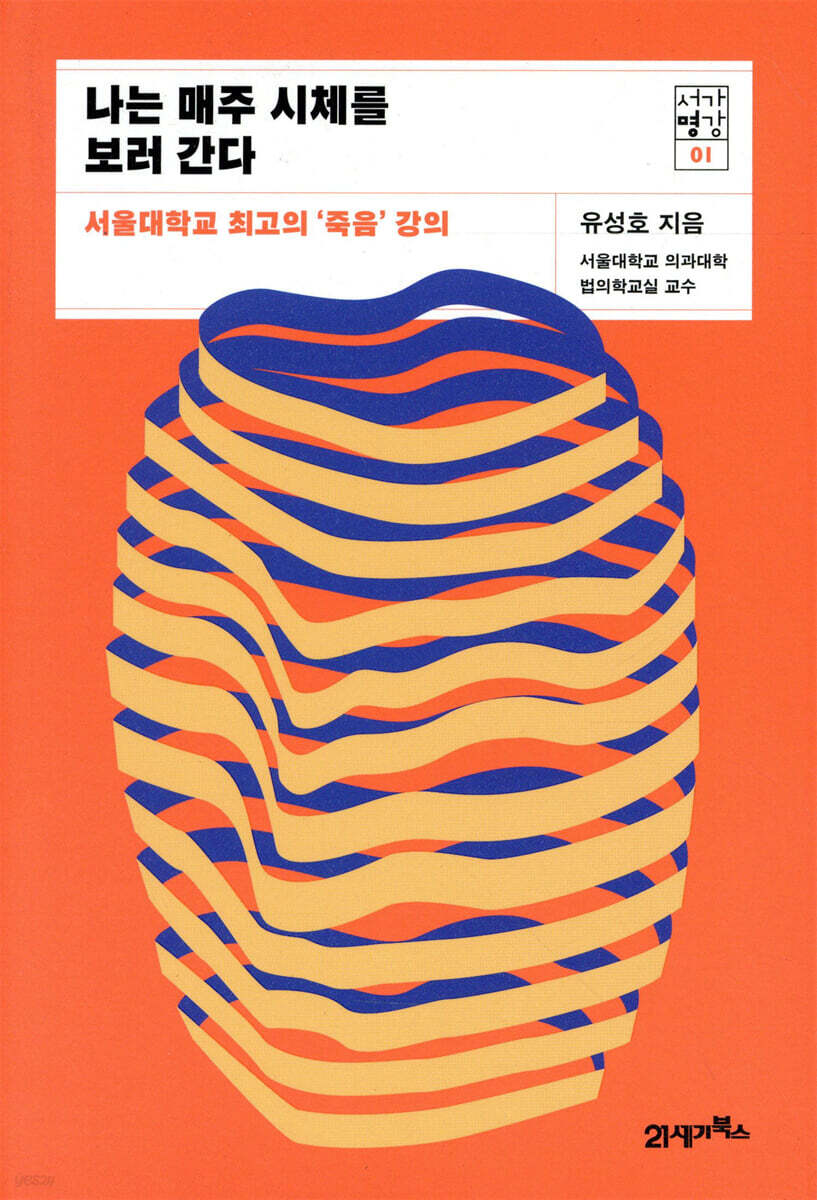
I go to see the corpse every week.
 |
Description
Book Introduction
Popular lectures taken by Seoul National University students What if ordinary people could listen and learn? Discover Korea's finest lectures in book form! The "Seogamyeonggang" series, featuring carefully curated lectures by current Seoul National University faculty, has been published. Since the summer of 2017, Seoul National University's top professors in various fields, including history, philosophy, science, medicine, and art, have been giving lectures on different topics every month under the name of "Seo Ga-myeong-gang." Each lecture drew an audience of around 100, who were deeply moved and enthralled by the feast of these renowned lectures. The Seoga Myunggang series, which has translated this learning experience into a book, will provide readers with the knowledge and culture necessary for life. "I Go to See a Corpse Every Week" is a book based on a general lecture by Professor Seong-ho Yoo, a professor of forensic medicine at Seoul National University College of Medicine and an advisor for [I Want to Know That]. It introduces various cases and experiences of what 'death' is like as seen through the eyes of a forensic scientist, and presents a new understanding of death, which was previously vague and fearful. Moreover, in the process of seriously studying death, you will be able to experience realizing the preciousness of life. * Book21's offline lecture www.book21.com/lecture * Seo Ga-myeong's podcast audioclip.naver.com/channels/345 |
- You can preview some of the book's contents.
Preview
index
Before reading this book - Classification of Academic Studies
Main keywords
Introduction - Studying 'Death' to Enhance the Quality of Life
Part 1
A man you can only meet after death
A forensic scientist's bag holds someone's life story.
Decide to be with death
The truth, I want to know that
There is no perfect crime before forensics.
Part 2
Why do we die
The World's Hottest Debate: The Beginning of Life
Scientific Understanding of Death-
The Right to Die and the Duty to Save
Some deaths change society
Suicide: What Those Left Behind Should Do
Part 3
Why We Should Study Death
“I just realized it now.
“I never knew life was this short” -
Death is the final story of my life
Tango at the funeral!
2045: The Age of Immortality Arrives
Outgoing post
Publishing the Seoga Myunggang series
References
Main keywords
Introduction - Studying 'Death' to Enhance the Quality of Life
Part 1
A man you can only meet after death
A forensic scientist's bag holds someone's life story.
Decide to be with death
The truth, I want to know that
There is no perfect crime before forensics.
Part 2
Why do we die
The World's Hottest Debate: The Beginning of Life
Scientific Understanding of Death-
The Right to Die and the Duty to Save
Some deaths change society
Suicide: What Those Left Behind Should Do
Part 3
Why We Should Study Death
“I just realized it now.
“I never knew life was this short” -
Death is the final story of my life
Tango at the funeral!
2045: The Age of Immortality Arrives
Outgoing post
Publishing the Seoga Myunggang series
References
Detailed image
Into the book
Death is the final stage of our life.
However, we usually try not to think about the topic of death and, if possible, try to avoid mentioning it.
Moreover, modern society, whether intentionally or not, completely separates death from our lives and does not show us the true face of death.
That's why we never think about death, and we just go through life as it comes, easily being seduced by temporary comfort and consolation.
(…) Then, when death actually comes, we are caught up in misery and sadness and lose the opportunity to have a beautiful ending.
You may also become emotionally numb and even indifferent to the death of others.
--- From the "Introductory Note"
Even today, I have two death records in my bag.
And through those records, I trace the life that person has lived.
Some might say that a death record cannot possibly reveal a person's complete life, but even a thin death record feels like the weight of a book, at least to me.
It makes you think about how that person's life progressed and how it ended.
--- From "Part 1: The Man You Can Only Meet After Death"
Meanwhile, on both of my wife's wrists there were marks of binding that could be seen as signs of oppression.
However, the marks on the wrist were faint because the handkerchief was placed on the wrist.
That is, the string is designed to prevent pain when tightening the wrist.
It was an unusual opinion.
If we comprehensively determine the type of death, the husband's death was suicide and the wife's death was murder.
However, the possibility of a murder for hire was very high.
Several people attested to the couple's good relationship, and there was evidence that they had taken out multiple health insurance policies due to their recent health deterioration.
In addition, it was determined that it was very difficult to rule out the possibility of murder by request, given that there were no signs of defense in the act of strangulation and there were almost no signs of resistance on the neck.
--- From "Part 1: The Man You Can Only Meet After Death"
Likewise, the common sense we have about suicide, such as that it is something people do out of a desire to die or that it is the result of a spontaneous decision, is all wrong.
There is no one in this world who truly wants to die.
The reason for death must be found in each person's own life.
--- From "Part 2: Why Do We Die?"
In modern society, we often die from some disease rather than suddenly.
In the past, life would rapidly collapse and lead to death, but now, thanks to advances in medicine, even if you contract a disease, the cure rate and survival rate are gradually increasing.
Moreover, as we will see later, by 2045, the possibility of eternal life will be open to us thanks to the amazing advancements in science.
So it is true that there is a social trend of wanting to avoid death even more.
But that doesn't mean we can give up on death.
If we put eternal life on hold for a moment, we are beings who will inevitably face death.
That is why we should maintain an intimate relationship with death in advance --- from "Part 3: Reasons for Studying Death"
However, only by calmly accepting the fact that the final journey of life is death can we live our present lives more fully.
“Carpe diem!” – Seize the day! These are the words Mr. Keating tells his students in the movie “Dead Poets Society.”
But we must live with death in mind before that.
“Memento mori!” - Remember death! Our lives become richer and more meaningful as we constantly ask and answer what we want to be like at the end of our lives.
However, we usually try not to think about the topic of death and, if possible, try to avoid mentioning it.
Moreover, modern society, whether intentionally or not, completely separates death from our lives and does not show us the true face of death.
That's why we never think about death, and we just go through life as it comes, easily being seduced by temporary comfort and consolation.
(…) Then, when death actually comes, we are caught up in misery and sadness and lose the opportunity to have a beautiful ending.
You may also become emotionally numb and even indifferent to the death of others.
--- From the "Introductory Note"
Even today, I have two death records in my bag.
And through those records, I trace the life that person has lived.
Some might say that a death record cannot possibly reveal a person's complete life, but even a thin death record feels like the weight of a book, at least to me.
It makes you think about how that person's life progressed and how it ended.
--- From "Part 1: The Man You Can Only Meet After Death"
Meanwhile, on both of my wife's wrists there were marks of binding that could be seen as signs of oppression.
However, the marks on the wrist were faint because the handkerchief was placed on the wrist.
That is, the string is designed to prevent pain when tightening the wrist.
It was an unusual opinion.
If we comprehensively determine the type of death, the husband's death was suicide and the wife's death was murder.
However, the possibility of a murder for hire was very high.
Several people attested to the couple's good relationship, and there was evidence that they had taken out multiple health insurance policies due to their recent health deterioration.
In addition, it was determined that it was very difficult to rule out the possibility of murder by request, given that there were no signs of defense in the act of strangulation and there were almost no signs of resistance on the neck.
--- From "Part 1: The Man You Can Only Meet After Death"
Likewise, the common sense we have about suicide, such as that it is something people do out of a desire to die or that it is the result of a spontaneous decision, is all wrong.
There is no one in this world who truly wants to die.
The reason for death must be found in each person's own life.
--- From "Part 2: Why Do We Die?"
In modern society, we often die from some disease rather than suddenly.
In the past, life would rapidly collapse and lead to death, but now, thanks to advances in medicine, even if you contract a disease, the cure rate and survival rate are gradually increasing.
Moreover, as we will see later, by 2045, the possibility of eternal life will be open to us thanks to the amazing advancements in science.
So it is true that there is a social trend of wanting to avoid death even more.
But that doesn't mean we can give up on death.
If we put eternal life on hold for a moment, we are beings who will inevitably face death.
That is why we should maintain an intimate relationship with death in advance --- from "Part 3: Reasons for Studying Death"
However, only by calmly accepting the fact that the final journey of life is death can we live our present lives more fully.
“Carpe diem!” – Seize the day! These are the words Mr. Keating tells his students in the movie “Dead Poets Society.”
But we must live with death in mind before that.
“Memento mori!” - Remember death! Our lives become richer and more meaningful as we constantly ask and answer what we want to be like at the end of our lives.
--- From "Part 3: Why We Must Study Death"
Publisher's Review
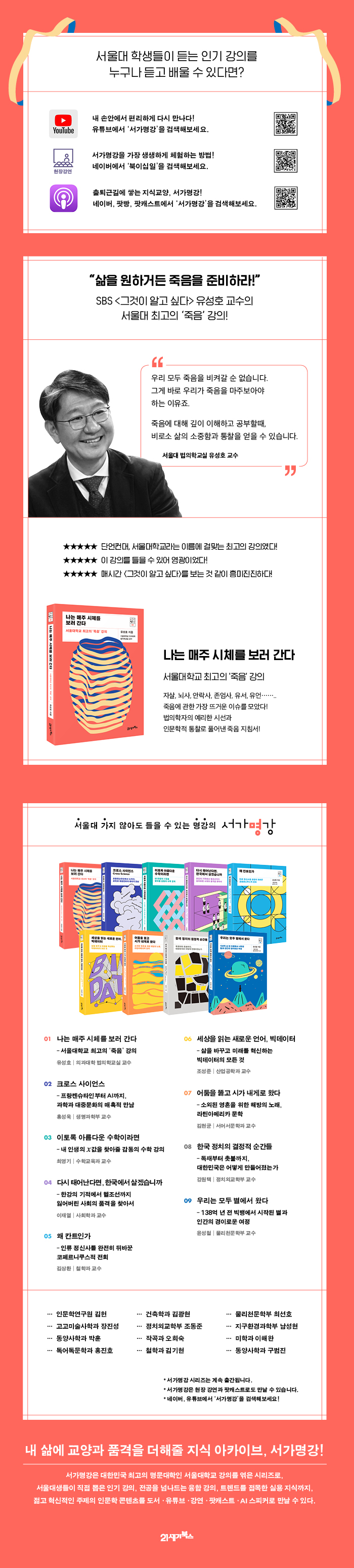
An archive of knowledge that will add sophistication and elegance to your life.
"Seogamyeonggang": A famous lecture you can attend without going to Seoul National University.
It's like a gift to me who is tired of work life!
It was a real study I needed in my life!
A masterpiece lecture that reawakened my passion for learning!
Seoga Myunggang is a series of lectures from Seoul National University, the most prestigious university in Korea. It reconstructs the informative and interesting lectures given by current Seoul National University professors and includes them in a book.
From popular lectures selected directly by Seoul National University students, to interdisciplinary lectures that cross majors, to practical knowledge incorporating trends, the course covers young and innovative topics.
Seo Ga-myeong's diverse humanities content can be found not only in books but also through live lectures and podcasts.
This program provides an opportunity for working professionals seeking to acquire general knowledge during their commute, young people exploring career paths, and all educated individuals in Korea who always harbor a passion for learning to easily watch, listen to, and learn from Korea's best lectures.
“If you want to live, prepare for death!”
SBS [I Want to Know That] Professor Yoo Seong-ho's best 'death' lecture!
Is death something to be feared? What is a dignified death? Can we plan for it? No one can avoid it.
But death is always unfamiliar and distant to us.
Even for forensic scientists who encounter corpses every week, death is always unfamiliar.
What does death mean to a forensic pathologist who encounters corpses every week, and what does it mean? Professor Yoo Seong-ho of the Department of Forensic Medicine at Seoul National University College of Medicine has performed 1,500 autopsies over the past 20 years.
He encountered death more than anyone else and contemplated death more deeply than anyone else, and he eventually realized that paradoxically, when one approaches death, one can discover the value of life.
Professor Yoo Seong-ho opened a general education course at Seoul National University called "Scientific Understanding of Death," combining various topics related to death and autopsy cases, and the results were astonishing.
Students who accepted death and began to see it directly began to navigate their lives more positively and actively.
Students left enthusiastic reviews, saying things like, “This was definitely the best lecture worthy of the name Seoul National University!” and “It was an honor to be able to take this lecture!”
This book, a compilation of representative liberal arts lectures from Seoul National University, introduces a wide range of experiences related to forensic medicine, numerous topics surrounding death, and definitions of death.
For those who are lost in their current lives or dissatisfied with their daily lives, this book will serve as an opportunity to find the value and direction of life.
Suicide, brain death, euthanasia, death with dignity, will, testament… … .
We've gathered the hottest issues related to death!
Death, something we all cannot avoid, but which we never want to think about.
Professor Yoo Seong-ho recommends studying death and preparing for it first.
The moment you realize that life has a clear end, you try to live according to the values you pursue.
In other words, through the process of contemplating death, we can reflect on the meaning of ‘today’ and ‘life.’
This book is a 'death manual' for such a process.
In Part 1, 'The Man You Can Only Meet After Death', death is unraveled through the eyes of a forensic scientist.
We introduce what a forensic scientist does and how death is classified forensically.
And we will look at autopsy cases that were also introduced in [I Want to Know That], [Curious Story Y], and [KBS News].
The unjust and sudden deaths of ordinary people remind us that death is always present in the back of our lives.
Part 2, “Why Do We Die,” explores the definitions of life and death, the evolution of views on death from the past to the present, and the causes of death.
Next, we introduce cases and arguments regarding brain death, death with dignity, euthanasia, and suicide.
Can death be chosen by oneself or by others? Professor Yoo Seong-ho offers clear answers and warm advice to this question.
Part 3, "Why We Must Study Death," introduces wills left behind by those who anticipated death, suggesting that preparation is essential for the final moments of life.
And it introduces several cases of how people think when faced with death and how other people prepare for death.
By sharing a wide range of experiences and topics related to death, readers will be able to think about 'death' more easily and frequently.
And if you study death, the landscape of life with death added will become much more colorful.
"Seogamyeonggang": A famous lecture you can attend without going to Seoul National University.
It's like a gift to me who is tired of work life!
It was a real study I needed in my life!
A masterpiece lecture that reawakened my passion for learning!
Seoga Myunggang is a series of lectures from Seoul National University, the most prestigious university in Korea. It reconstructs the informative and interesting lectures given by current Seoul National University professors and includes them in a book.
From popular lectures selected directly by Seoul National University students, to interdisciplinary lectures that cross majors, to practical knowledge incorporating trends, the course covers young and innovative topics.
Seo Ga-myeong's diverse humanities content can be found not only in books but also through live lectures and podcasts.
This program provides an opportunity for working professionals seeking to acquire general knowledge during their commute, young people exploring career paths, and all educated individuals in Korea who always harbor a passion for learning to easily watch, listen to, and learn from Korea's best lectures.
“If you want to live, prepare for death!”
SBS [I Want to Know That] Professor Yoo Seong-ho's best 'death' lecture!
Is death something to be feared? What is a dignified death? Can we plan for it? No one can avoid it.
But death is always unfamiliar and distant to us.
Even for forensic scientists who encounter corpses every week, death is always unfamiliar.
What does death mean to a forensic pathologist who encounters corpses every week, and what does it mean? Professor Yoo Seong-ho of the Department of Forensic Medicine at Seoul National University College of Medicine has performed 1,500 autopsies over the past 20 years.
He encountered death more than anyone else and contemplated death more deeply than anyone else, and he eventually realized that paradoxically, when one approaches death, one can discover the value of life.
Professor Yoo Seong-ho opened a general education course at Seoul National University called "Scientific Understanding of Death," combining various topics related to death and autopsy cases, and the results were astonishing.
Students who accepted death and began to see it directly began to navigate their lives more positively and actively.
Students left enthusiastic reviews, saying things like, “This was definitely the best lecture worthy of the name Seoul National University!” and “It was an honor to be able to take this lecture!”
This book, a compilation of representative liberal arts lectures from Seoul National University, introduces a wide range of experiences related to forensic medicine, numerous topics surrounding death, and definitions of death.
For those who are lost in their current lives or dissatisfied with their daily lives, this book will serve as an opportunity to find the value and direction of life.
Suicide, brain death, euthanasia, death with dignity, will, testament… … .
We've gathered the hottest issues related to death!
Death, something we all cannot avoid, but which we never want to think about.
Professor Yoo Seong-ho recommends studying death and preparing for it first.
The moment you realize that life has a clear end, you try to live according to the values you pursue.
In other words, through the process of contemplating death, we can reflect on the meaning of ‘today’ and ‘life.’
This book is a 'death manual' for such a process.
In Part 1, 'The Man You Can Only Meet After Death', death is unraveled through the eyes of a forensic scientist.
We introduce what a forensic scientist does and how death is classified forensically.
And we will look at autopsy cases that were also introduced in [I Want to Know That], [Curious Story Y], and [KBS News].
The unjust and sudden deaths of ordinary people remind us that death is always present in the back of our lives.
Part 2, “Why Do We Die,” explores the definitions of life and death, the evolution of views on death from the past to the present, and the causes of death.
Next, we introduce cases and arguments regarding brain death, death with dignity, euthanasia, and suicide.
Can death be chosen by oneself or by others? Professor Yoo Seong-ho offers clear answers and warm advice to this question.
Part 3, "Why We Must Study Death," introduces wills left behind by those who anticipated death, suggesting that preparation is essential for the final moments of life.
And it introduces several cases of how people think when faced with death and how other people prepare for death.
By sharing a wide range of experiences and topics related to death, readers will be able to think about 'death' more easily and frequently.
And if you study death, the landscape of life with death added will become much more colorful.
GOODS SPECIFICS
- Date of publication: January 23, 2019
- Page count, weight, size: 280 pages | 352g | 128*188*20mm
- ISBN13: 9788950979409
- ISBN10: 8950979403
You may also like
카테고리
korean


korean

![GQ KOREA Mark (Monthly): December [2025]](http://librairie.coreenne.fr/cdn/shop/files/8ef265dbbfbf186523ed75ba7319009d.jpg?v=1765340328&width=3840)


