

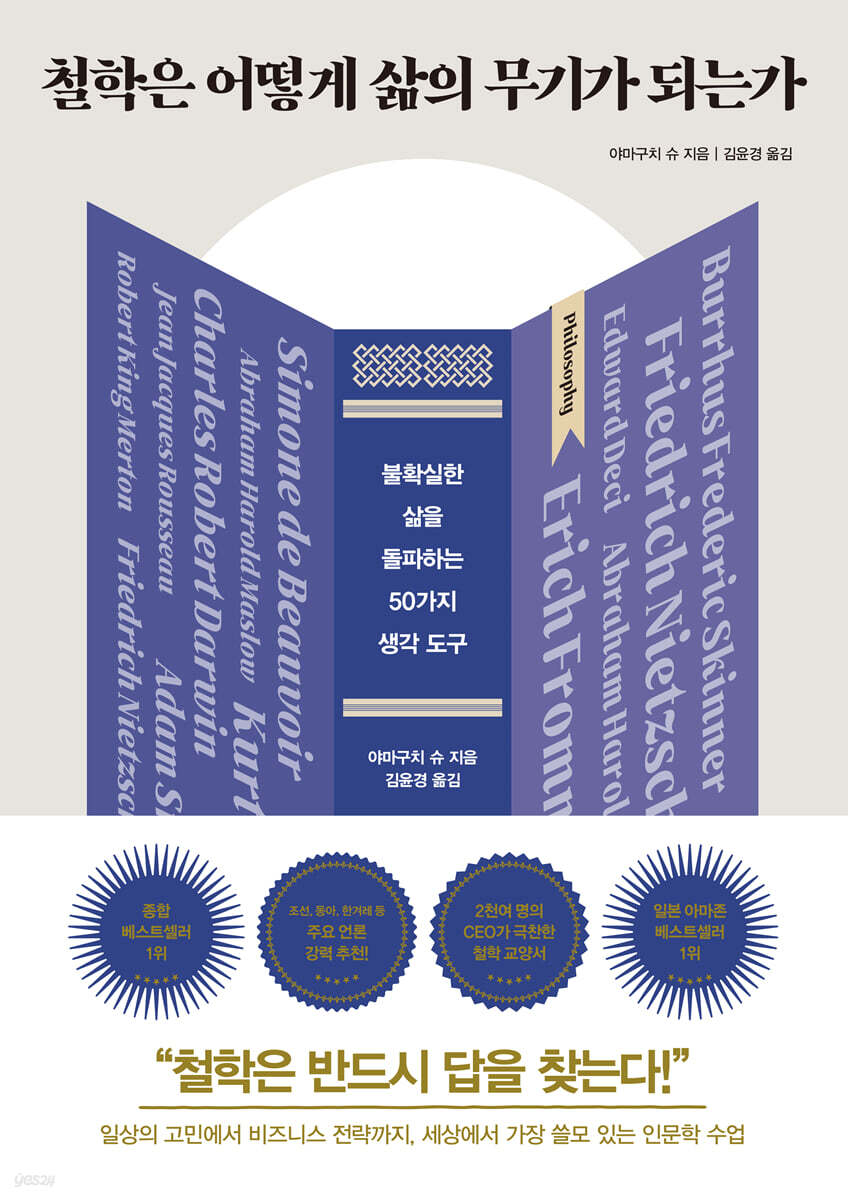
How Philosophy Becomes a Weapon for Life
 |
Description
Book Introduction
- A word from MD
-
Philosophy always finds answersThis book, which advertises itself as a practical guide to philosophy, seeks wisdom from philosophy that can be applied in everyday life and business settings.
The author, who is active as a partner at a global consulting firm, asserts that philosophy is the most powerful knowledge in the workplace.
Here are 50 ways in which a philosopher's thoughts and life can be used as weapons.
January 25, 2019. Humanities PD Son Min-gyu
★★★ #1 Overall Bestseller ★★★
★★★ #1 Bestseller on Amazon Japan ★★★
★★★ Highly recommended by major media outlets such as Chosun Ilbo, Donga Ilbo, and Hankyoreh ★★★
"How Philosophy Becomes a Weapon for Life" Recovered!
From everyday concerns to business strategies, the world's most useful humanities classes.
“Philosophy will always find the answer!”
"How Philosophy Becomes a Weapon for Life," which immediately rose to the top of the general bestseller list upon its publication in 2019 and sparked a "philosophy syndrome," has been republished with a recovered version.
This practical philosophy book that teaches you how to think philosophically and arrive at answers in life and business is highly praised by over 2,000 CEOs and strongly recommended by major media outlets such as the Chosun Ilbo, the Dong-A Ilbo, and the Hankyoreh, and has been named a “humanities classic of our time.” Through this recover, it returns to readers with a luxurious design that visualizes a “dictionary of thoughts that enhances intellectual combat power.”
The author, a senior partner at Conferry Hey Group, the world's leading management and human resources consulting firm, is a 'literary scholar' who majored in philosophy in college and studied aesthetics and art history in graduate school.
Although I have never received any formal training in management, as a consultant I have never had difficulty solving corporate problems across the board.
This is because when I think about the situation in front of me through the lens of philosophical, psychological, or economic concepts, I always find a clue to a solution.
The author, who strongly denies the idea that philosophy is a discipline detached from the real world, diagnoses that the reason people consider philosophy useless is because they do not know how to connect philosophy and business.
Rather, he says that the most necessary weapon for modern people is a philosophical way of thinking that penetrates the essence and finds the optimal solution.
"How Philosophy Becomes a Weapon for Life," which contains 50 philosophies and ideas that he uses in business settings, is the world's most practical philosophy user manual that sheds new light on the usefulness of philosophy.
Let's take a look at this book, which has been considered the "best humanities book" by domestic and international readers for five years now, proving the "usefulness of philosophy" in every aspect of life, from everyday concerns to business strategies.
★★★ #1 Bestseller on Amazon Japan ★★★
★★★ Highly recommended by major media outlets such as Chosun Ilbo, Donga Ilbo, and Hankyoreh ★★★
"How Philosophy Becomes a Weapon for Life" Recovered!
From everyday concerns to business strategies, the world's most useful humanities classes.
“Philosophy will always find the answer!”
"How Philosophy Becomes a Weapon for Life," which immediately rose to the top of the general bestseller list upon its publication in 2019 and sparked a "philosophy syndrome," has been republished with a recovered version.
This practical philosophy book that teaches you how to think philosophically and arrive at answers in life and business is highly praised by over 2,000 CEOs and strongly recommended by major media outlets such as the Chosun Ilbo, the Dong-A Ilbo, and the Hankyoreh, and has been named a “humanities classic of our time.” Through this recover, it returns to readers with a luxurious design that visualizes a “dictionary of thoughts that enhances intellectual combat power.”
The author, a senior partner at Conferry Hey Group, the world's leading management and human resources consulting firm, is a 'literary scholar' who majored in philosophy in college and studied aesthetics and art history in graduate school.
Although I have never received any formal training in management, as a consultant I have never had difficulty solving corporate problems across the board.
This is because when I think about the situation in front of me through the lens of philosophical, psychological, or economic concepts, I always find a clue to a solution.
The author, who strongly denies the idea that philosophy is a discipline detached from the real world, diagnoses that the reason people consider philosophy useless is because they do not know how to connect philosophy and business.
Rather, he says that the most necessary weapon for modern people is a philosophical way of thinking that penetrates the essence and finds the optimal solution.
"How Philosophy Becomes a Weapon for Life," which contains 50 philosophies and ideas that he uses in business settings, is the world's most practical philosophy user manual that sheds new light on the usefulness of philosophy.
Let's take a look at this book, which has been considered the "best humanities book" by domestic and international readers for five years now, proving the "usefulness of philosophy" in every aspect of life, from everyday concerns to business strategies.
- You can preview some of the book's contents.
Preview
index
Prologue: An uneducated expert is dangerous.
Part 1: Philosophy as a Weapon
A New Way to Learn Philosophy
Why are we frustrated by philosophy?
Part 2: 50 Philosophies and Ideas to Maximize Intellectual Power
Chapter 1: Core Concepts About People: "Why Does This Person Act This Way?"
01 Observing the envy of others reveals business opportunities (Friedrich Nietzsche_Resentment)
02 We all live wearing masks (Carl Gustav Jung_Persona)
03 Can Performance-Based Pay Drive Innovation? (Edward Deci, The Price Foretold)
04 People are not moved by logic alone (Aristotle_Rhetoric)
05 God did not say that salvation can be achieved through effort (John Calvin, Predestination)
06 There is no such thing as innate ability; through experience, a person can become anything (John Locke_Tabula Rasa)
07 Freedom brings with it unbearable loneliness and crushing responsibility (Erich Fromm_Escape from Freedom)
08 Human Nature's Attraction to Uncertainty (Burrus Frederick Skinner_Master)
09 If you treat life as a work of art (Jean-Paul Sartre_Engajument)
Anyone can be evil without malice (Hannah Arendt, The Banality of Evil)
10. The more self-actualized a person is, the less likely he or she is to have a wide network of friends (Abraham Maslow, Self-Actualizing Person)
11 People who are willing to change their thoughts to justify their actions (Leon Festinger_Cognitive Dissonance)
12. Individual conscience has no power (Stanley Milgram_Obedience to Authority)
13 When Will I Feel Satisfied at Work? (Mihaly Csikszentmihalyi_Flow)
Chapter 2: Core Concepts About Organizations: "Why Doesn't This Organization Change?"
15 Qualities of an Outstanding Leader (Niccolò Machiavelli_Machiavellianism)
16. Will anyone object to this until the end? (John Stuart Mill, The Devil's Advocate)
17 New Alternatives for Broken Families and Communities (Ferdinand Tönnies_Gemeinschaft and Gesellschaft)
18 Change begins not with new attempts, but with saying goodbye to the past (Kurt Lewin_The Process of Change)
19 Three Elements of Authority (Max Weber_Charisma)
20 Reasons Why We Must Work with Incomprehensible People (Emmanuel Levinas_The Face of the Other)
21 The poor get poorer and the rich get richer (Robert King Merton_Matthew Effect)
22 Cooperate or Betray (John Nash_Nash Equilibrium)
23 Why are accidents more likely to occur when the captain is at the helm? (Heirt Hofstede_Power Disparity)
24. The Risks That Accumulate as Stability Continues (Nassim Nicholas Taleb, Anti-Fragility)
Chapter 3: Core Concepts About Society: "What's Happening Now?"
25 How the System Aliens Humans (Karl Marx_Alienation)
26 Order by Dictatorship vs.
Disorder with Liberty (Thomas Hobbes, Leviathan)
27 Can Google Become a Guardian of Democracy? (Jean-Jacques Rousseau, The General Will)
28 There are limits to the optimal way to think (Adam Smith_Invisible Hand)
29 It is natural for mutations to occur (Charles Darwin_Natural Selection)
30 The Scary Future Ahead of Workplace Reform (Émile Durkheim, Anomie)
31 A New Relationship Unexplained by Economics (Marcel Mauss_Gift)
How Free Are We from Gender Prejudice? (Simone de Beauvoir, The Second Sex)
33 He who knows how to run away quickly wins (Gilles Deleuze_Paranoia and Schizophrenia)
The more equitable a society is, the deeper the wounds of discrimination (Serge Moscovici_Gap)
35 The psychological pressure of being watched (Michel Foucault_Panopticon)
36 People spend money not because they need it, but to appear different (Jean Baudrillard_Differential Consumption)
The Lie That Unseen Efforts Will Someday Be Rewarded (Melvin Lerner, The Fair World Hypothesis)
Chapter 4: Core Concepts on Thinking: "How Can We Avoid Thinking Traps?"
38 Why You Shouldn't Say, "So That's What It Means" (Socrates_The Wisdom of Ignorance)
39 The ideal is just an ideal; do not be captivated by illusions (Plato_Ideas)
There are many types of misunderstanding (Francis Bacon, Idola)
41. Thoughts cannot be outsourced (Rene Descartes, Cogito)
42 Progress is a spiral development (Georg Hegel_Dialectics)
43 If you want to broaden your thinking, develop your vocabulary (Ferdinand de Saussure - Signifier and Signified)
44 Sometimes it helps to suspend judgment (Edmund Husserl_Epoché)
45 What is scientific is not necessarily right (Karl Popper_Falsifiability)
46 Edison invented the phonograph as a replacement for the will (Claude Levi-Strauss_Bricolage)
47 Don't be impatient, the world doesn't change so suddenly (Thomas Kuhn_Paradigm Shift)
48 Beyond Dichotomy (Jacques Derrida_Deconstruction)
49 The best way to predict the future is to create it (Alan Kay_Predicting the Future)
50 People think not only with their brains but also with their bodies (Antonio Damasio_Physical Signs)
Translator's Note: How to Talk Philosophy Without Kant and Spinoza
Part 1: Philosophy as a Weapon
A New Way to Learn Philosophy
Why are we frustrated by philosophy?
Part 2: 50 Philosophies and Ideas to Maximize Intellectual Power
Chapter 1: Core Concepts About People: "Why Does This Person Act This Way?"
01 Observing the envy of others reveals business opportunities (Friedrich Nietzsche_Resentment)
02 We all live wearing masks (Carl Gustav Jung_Persona)
03 Can Performance-Based Pay Drive Innovation? (Edward Deci, The Price Foretold)
04 People are not moved by logic alone (Aristotle_Rhetoric)
05 God did not say that salvation can be achieved through effort (John Calvin, Predestination)
06 There is no such thing as innate ability; through experience, a person can become anything (John Locke_Tabula Rasa)
07 Freedom brings with it unbearable loneliness and crushing responsibility (Erich Fromm_Escape from Freedom)
08 Human Nature's Attraction to Uncertainty (Burrus Frederick Skinner_Master)
09 If you treat life as a work of art (Jean-Paul Sartre_Engajument)
Anyone can be evil without malice (Hannah Arendt, The Banality of Evil)
10. The more self-actualized a person is, the less likely he or she is to have a wide network of friends (Abraham Maslow, Self-Actualizing Person)
11 People who are willing to change their thoughts to justify their actions (Leon Festinger_Cognitive Dissonance)
12. Individual conscience has no power (Stanley Milgram_Obedience to Authority)
13 When Will I Feel Satisfied at Work? (Mihaly Csikszentmihalyi_Flow)
Chapter 2: Core Concepts About Organizations: "Why Doesn't This Organization Change?"
15 Qualities of an Outstanding Leader (Niccolò Machiavelli_Machiavellianism)
16. Will anyone object to this until the end? (John Stuart Mill, The Devil's Advocate)
17 New Alternatives for Broken Families and Communities (Ferdinand Tönnies_Gemeinschaft and Gesellschaft)
18 Change begins not with new attempts, but with saying goodbye to the past (Kurt Lewin_The Process of Change)
19 Three Elements of Authority (Max Weber_Charisma)
20 Reasons Why We Must Work with Incomprehensible People (Emmanuel Levinas_The Face of the Other)
21 The poor get poorer and the rich get richer (Robert King Merton_Matthew Effect)
22 Cooperate or Betray (John Nash_Nash Equilibrium)
23 Why are accidents more likely to occur when the captain is at the helm? (Heirt Hofstede_Power Disparity)
24. The Risks That Accumulate as Stability Continues (Nassim Nicholas Taleb, Anti-Fragility)
Chapter 3: Core Concepts About Society: "What's Happening Now?"
25 How the System Aliens Humans (Karl Marx_Alienation)
26 Order by Dictatorship vs.
Disorder with Liberty (Thomas Hobbes, Leviathan)
27 Can Google Become a Guardian of Democracy? (Jean-Jacques Rousseau, The General Will)
28 There are limits to the optimal way to think (Adam Smith_Invisible Hand)
29 It is natural for mutations to occur (Charles Darwin_Natural Selection)
30 The Scary Future Ahead of Workplace Reform (Émile Durkheim, Anomie)
31 A New Relationship Unexplained by Economics (Marcel Mauss_Gift)
How Free Are We from Gender Prejudice? (Simone de Beauvoir, The Second Sex)
33 He who knows how to run away quickly wins (Gilles Deleuze_Paranoia and Schizophrenia)
The more equitable a society is, the deeper the wounds of discrimination (Serge Moscovici_Gap)
35 The psychological pressure of being watched (Michel Foucault_Panopticon)
36 People spend money not because they need it, but to appear different (Jean Baudrillard_Differential Consumption)
The Lie That Unseen Efforts Will Someday Be Rewarded (Melvin Lerner, The Fair World Hypothesis)
Chapter 4: Core Concepts on Thinking: "How Can We Avoid Thinking Traps?"
38 Why You Shouldn't Say, "So That's What It Means" (Socrates_The Wisdom of Ignorance)
39 The ideal is just an ideal; do not be captivated by illusions (Plato_Ideas)
There are many types of misunderstanding (Francis Bacon, Idola)
41. Thoughts cannot be outsourced (Rene Descartes, Cogito)
42 Progress is a spiral development (Georg Hegel_Dialectics)
43 If you want to broaden your thinking, develop your vocabulary (Ferdinand de Saussure - Signifier and Signified)
44 Sometimes it helps to suspend judgment (Edmund Husserl_Epoché)
45 What is scientific is not necessarily right (Karl Popper_Falsifiability)
46 Edison invented the phonograph as a replacement for the will (Claude Levi-Strauss_Bricolage)
47 Don't be impatient, the world doesn't change so suddenly (Thomas Kuhn_Paradigm Shift)
48 Beyond Dichotomy (Jacques Derrida_Deconstruction)
49 The best way to predict the future is to create it (Alan Kay_Predicting the Future)
50 People think not only with their brains but also with their bodies (Antonio Damasio_Physical Signs)
Translator's Note: How to Talk Philosophy Without Kant and Spinoza
Detailed image

Into the book
A philosopher in the classroom cannot move the world.
Many people may feel uncomfortable with this point, considering the influence that Sartre and Marx once exerted.
But it's true.
It's not those people who run the world, it's people like us who do the work and do our best in our daily lives.
(……) Will we repeat the same tragedy that humanity has endured so far? Or will we live as a new type of humanity, one that demonstrates even higher levels of intelligence, making the expensive tuition already paid worthwhile? ---From "Prologue: Nothing is more dangerous than an uneducated expert."
There is a story in Aesop's Fables called "The Fox and the Sour Grapes."
The fox found some delicious grapes, but no matter how hard he tried, he couldn't reach them.
Finally, the fox said, “These grapes must be very sour.
“Who would eat something like this?” he says and walks away.
This shows the typical reaction of someone caught up in ressentiment.
The fox resolves his resentment about the grapes being out of reach by changing his mind to, "Those grapes are incredibly sour."
Nietzsche took issue with this very point, pointing out that our original cognitive and judgmental abilities could be distorted by ressentiment.
---From "Observing the jealousy of others reveals business opportunities"
Numerous empirical studies have shown that the more open the exchange of opinions in organizations today, the higher the quality of decision-making. Mill was convinced of this fact as long ago as 150 years ago. (...) In On Liberty, Mill pointed out that the 'evil' of one era can become 'good' as the times pass, citing the fact that Socrates and Jesus, who were executed, are now praised as great men and that their ideas are widely accepted.
This suggests, in other words, that the rightness or wrongness of an idea is not determined by the control of the elite of the time, but rather through the multifaceted thinking of many people over a long period of time.
---From "Is there anyone who raises objections until the end?"
According to Levin, an organization with a fixed way of thinking or behavior changes through the process of 'action-confusion-refreezing'.
It is important to note here that this process begins with 'thawing'.
This is because the word ‘Haedong’ contains the meaning of ‘ending’.
When we try something new, we focus only on 'getting started'.
It's a given.
However, Kurt Lewin's point reminds us that the first thing to do when starting something new is to forget the way things have been done so far, that is, to 'put an end to' the old way.
---From "Innovation begins not with new attempts, but with saying goodbye to the past"
While we always love children who understand quickly, we have a bad habit of giving up on children who do not improve their skills very quickly.
This happens because the cost of education is not infinite.
This is true whether it's an investment in training within a company or an educational opportunity as social capital.
We tend to focus our educational investments on those children who are more cost-effective.
Based on early academic results, better performing children are given better opportunities, which in turn leads to higher grades.
On the other hand, a child who does not perform well in his first at-bat is likely to be pushed into increasingly difficult situations.
If this continues, only the worldly-savvy children will be accepted into the organization, and the children who take time to become proficient but are essentially trying to understand things, that is, those who can come up with ideas that will become the seeds of innovation, will be excluded.
---From "The poor get poorer and the rich get richer"
In today's world, where logical thinking is dominant in seeking the optimal solution, the attitude of "I don't know what the right answer is, I'll just decide as things unfold" may be seen as "giving up."
From a management perspective, the attitude of thinking thoroughly for oneself may be considered a virtue.
There are probably few people who would consider it foolish to think only with the head.
But isn't it intellectual arrogance to think that we can come up with all the optimal answers on our own? (...) In modern society, where the interrelationships between all events and situations are becoming increasingly complex and dynamic, the attitude of believing that we can reach optimal solutions by relying on logical, top-down thinking seems ridiculous.
This is an era that requires flexibility to heuristically pursue a "satisfactory solution" rather than simply trying to find the optimal solution with the optimal approach.
---From "There is a limit to the optimal way to think with your head"
Even if we make certain choices unconsciously and without any purpose, a preference is created by 'choosing' certain things and 'not choosing' others.
No one can escape this awkward truth, and Baudrillard emphasized that we live in a hell of signs.
Conversely, this also means that products and services that do not have any symbolic value, or if they do have it, are weak and have little value, will have a hard time surviving in the market.
Self-actualizing consumption usually emerges in the final stage of market growth.
However, if self-realization is not defined voluntarily, but rather defined in the form of "difference from others," as in language, it will be difficult to develop successful products and services unless we are conscious of the differences that each product and service defines.
---From "People spend money not because they need it, but to look different"
So, what significance does understanding Husserl's epoché have for us living in the modern era? Epoché is a perspective that offers a variety of implications, but I'd like to highlight the fact that it helps us recognize the "difficulty of understanding others."
(……) One thing I can say for sure is that by doing so, the room for conversation has widened.
When we don't understand each other, the world we see ourselves and the world the other person sees can be very different.
If both parties have strong convictions about their own worldviews, the chances of their differences being resolved are slim.
(……) The worldview we have cannot help but be subjective from the beginning.
The Epoch is a neutral stance that takes a temporary pause, a so-called intermediate measure, without confirming or abandoning the worldview.
So, isn't this epoch an intellectual attitude that is even more necessary in this day and age?
Many people may feel uncomfortable with this point, considering the influence that Sartre and Marx once exerted.
But it's true.
It's not those people who run the world, it's people like us who do the work and do our best in our daily lives.
(……) Will we repeat the same tragedy that humanity has endured so far? Or will we live as a new type of humanity, one that demonstrates even higher levels of intelligence, making the expensive tuition already paid worthwhile? ---From "Prologue: Nothing is more dangerous than an uneducated expert."
There is a story in Aesop's Fables called "The Fox and the Sour Grapes."
The fox found some delicious grapes, but no matter how hard he tried, he couldn't reach them.
Finally, the fox said, “These grapes must be very sour.
“Who would eat something like this?” he says and walks away.
This shows the typical reaction of someone caught up in ressentiment.
The fox resolves his resentment about the grapes being out of reach by changing his mind to, "Those grapes are incredibly sour."
Nietzsche took issue with this very point, pointing out that our original cognitive and judgmental abilities could be distorted by ressentiment.
---From "Observing the jealousy of others reveals business opportunities"
Numerous empirical studies have shown that the more open the exchange of opinions in organizations today, the higher the quality of decision-making. Mill was convinced of this fact as long ago as 150 years ago. (...) In On Liberty, Mill pointed out that the 'evil' of one era can become 'good' as the times pass, citing the fact that Socrates and Jesus, who were executed, are now praised as great men and that their ideas are widely accepted.
This suggests, in other words, that the rightness or wrongness of an idea is not determined by the control of the elite of the time, but rather through the multifaceted thinking of many people over a long period of time.
---From "Is there anyone who raises objections until the end?"
According to Levin, an organization with a fixed way of thinking or behavior changes through the process of 'action-confusion-refreezing'.
It is important to note here that this process begins with 'thawing'.
This is because the word ‘Haedong’ contains the meaning of ‘ending’.
When we try something new, we focus only on 'getting started'.
It's a given.
However, Kurt Lewin's point reminds us that the first thing to do when starting something new is to forget the way things have been done so far, that is, to 'put an end to' the old way.
---From "Innovation begins not with new attempts, but with saying goodbye to the past"
While we always love children who understand quickly, we have a bad habit of giving up on children who do not improve their skills very quickly.
This happens because the cost of education is not infinite.
This is true whether it's an investment in training within a company or an educational opportunity as social capital.
We tend to focus our educational investments on those children who are more cost-effective.
Based on early academic results, better performing children are given better opportunities, which in turn leads to higher grades.
On the other hand, a child who does not perform well in his first at-bat is likely to be pushed into increasingly difficult situations.
If this continues, only the worldly-savvy children will be accepted into the organization, and the children who take time to become proficient but are essentially trying to understand things, that is, those who can come up with ideas that will become the seeds of innovation, will be excluded.
---From "The poor get poorer and the rich get richer"
In today's world, where logical thinking is dominant in seeking the optimal solution, the attitude of "I don't know what the right answer is, I'll just decide as things unfold" may be seen as "giving up."
From a management perspective, the attitude of thinking thoroughly for oneself may be considered a virtue.
There are probably few people who would consider it foolish to think only with the head.
But isn't it intellectual arrogance to think that we can come up with all the optimal answers on our own? (...) In modern society, where the interrelationships between all events and situations are becoming increasingly complex and dynamic, the attitude of believing that we can reach optimal solutions by relying on logical, top-down thinking seems ridiculous.
This is an era that requires flexibility to heuristically pursue a "satisfactory solution" rather than simply trying to find the optimal solution with the optimal approach.
---From "There is a limit to the optimal way to think with your head"
Even if we make certain choices unconsciously and without any purpose, a preference is created by 'choosing' certain things and 'not choosing' others.
No one can escape this awkward truth, and Baudrillard emphasized that we live in a hell of signs.
Conversely, this also means that products and services that do not have any symbolic value, or if they do have it, are weak and have little value, will have a hard time surviving in the market.
Self-actualizing consumption usually emerges in the final stage of market growth.
However, if self-realization is not defined voluntarily, but rather defined in the form of "difference from others," as in language, it will be difficult to develop successful products and services unless we are conscious of the differences that each product and service defines.
---From "People spend money not because they need it, but to look different"
So, what significance does understanding Husserl's epoché have for us living in the modern era? Epoché is a perspective that offers a variety of implications, but I'd like to highlight the fact that it helps us recognize the "difficulty of understanding others."
(……) One thing I can say for sure is that by doing so, the room for conversation has widened.
When we don't understand each other, the world we see ourselves and the world the other person sees can be very different.
If both parties have strong convictions about their own worldviews, the chances of their differences being resolved are slim.
(……) The worldview we have cannot help but be subjective from the beginning.
The Epoch is a neutral stance that takes a temporary pause, a so-called intermediate measure, without confirming or abandoning the worldview.
So, isn't this epoch an intellectual attitude that is even more necessary in this day and age?
---From "Sometimes it helps to withhold judgment"
Publisher's Review
“Why do the world’s greatest leaders devote time to studying philosophy?”
The Aspen Institute's management seminar, considered one of the world's best management seminars, requires attendees to read over 500 pages of philosophy materials sent three months before the seminar begins.
Global leaders attending the seminar will all turn off their cell phones for a week and study philosophical classics such as Plato, Machiavelli, Hobbes, Locke, and Rousseau.
Why do leaders, who are already pressed for time to make crucial business decisions, willingly devote time to studying philosophy?
The biggest topic in corporate management today is ‘innovation.’
To achieve this, many companies tell their employees to "question common sense," but what we really need is not an attitude of questioning common sense, but the discernment to distinguish between common sense that can be overlooked and common sense that should be questioned.
It is philosophy that cultivates this insight.
By asking the questions philosophers of the past posed to the world and humanity, you can learn the art of intelligent thinking that allows you to coolly analyze the situation before you.
It is the fate of modern people to have to struggle with unclear problems in uncertain times.
It means that we can no longer survive with shallow tactics or improvisation.
The greatest benefit of studying philosophy is that it provides the keys to deeply understanding and interpreting what is happening right before our eyes.
Isn't this the most necessary weapon for us living in today's world where we cannot see even an inch ahead?
“Philosophy will always find the answer!”
The world's most useful humanities, praised by over 2,000 CEOs.
There is a person who rose to an executive position at Conferry Group, the world's leading management and human resources consulting firm, without even a business degree or MBA.
This is Shu Yamaguchi, the author of “How Philosophy Becomes a Weapon for Life.”
He is someone who has used philosophy more effectively in the business field than anyone else. He says that he was able to survive in the consulting industry, which is full of management strategies and numbers, even though he did not major in philosophy or have an MBA, because philosophy became his weapon.
Whenever I had to solve a problem across the business world, I always found a solution by applying the concepts of philosophy, psychology, or economics to the situation.
When looking for a business model, I used Nietzsche's 'ressentiment' to find opportunities in the envy of others. When looking for ways to establish a new system, I used Levin's 'process of change' and when I wanted to obtain a satisfactory solution at a low cost, I applied heuristics by bringing in Smith's 'invisible hand'.
In fact, the author has lectured on "Intellectual Strategy," which contains similar content, at leading business schools. To date, over 2,000 businesspeople have attended his lectures, and leaders who drive the Japanese economy have praised them as the most useful humanities lecture in the world.
Through this, the author, who believed that the reason philosophy had been stigmatized as being disconnected from the real world was because people did not know how to connect philosophy and business, carefully selected 50 of the philosophies and ideas he found useful in the field and included them in “How Philosophy Becomes a Weapon for Life.”
Firmly grounded in reality, this book draws on philosophical concepts to offer a fresh perspective. With vivid examples and profound insights, it offers a more practical approach to philosophy than any other book, guiding readers into a new world of philosophy.
“Philosophy is now your competitive edge.”
From everyday concerns to business strategies, a philosophical way of thinking that maximizes intellectual combat power.
Everyone has probably opened a book to study philosophy at least once and been frustrated by the seemingly boring and hackneyed arguments of ancient philosophers.
When you read a philosopher's claim that 'the world is made of four elements', you naturally think, "What good can I do with learning something like this?"
In fact, many philosophers' claims have been proven wrong or obvious as science has advanced.
Nevertheless, we must learn philosophy because their way of thinking is still valid today.
The claim that 'the Earth floats on nothing' made by the philosopher Anaximander in the 6th century BC is something that is very obvious to us.
But in the time he lived, the prevailing view was that 'water supports the earth.'
Anaximander, who did not accept common sense, questioned, "If the earth is supported by water, what supports the water?" and, after endlessly contemplating to prove it, came up with the claim that "the earth floats on empty space."
Philosophical thinking that penetrates the essence and finds the optimal solution is useful in any era.
By following the thought processes and problem-solving approaches of philosophers, you will soon find yourself armed with the tools to navigate the uncertainties of life.
"How Philosophy Becomes a Weapon for Life" is a book that deals with philosophy, but ultimately, it is a book that talks about the problems of our work and life.
That's why, rather than introducing philosophy in chronological order, we curated it according to four concepts: people, organizations, society, and thought, which are the topics we most frequently encounter in our daily lives.
By confirming through this book that philosophy is no longer a distant concept, a subject that dwells solely on lofty questions, but rather the most powerful intellectual weapon available to solve today's problems, readers will learn how to maximize their intellectual combat power in all areas of life.
The Aspen Institute's management seminar, considered one of the world's best management seminars, requires attendees to read over 500 pages of philosophy materials sent three months before the seminar begins.
Global leaders attending the seminar will all turn off their cell phones for a week and study philosophical classics such as Plato, Machiavelli, Hobbes, Locke, and Rousseau.
Why do leaders, who are already pressed for time to make crucial business decisions, willingly devote time to studying philosophy?
The biggest topic in corporate management today is ‘innovation.’
To achieve this, many companies tell their employees to "question common sense," but what we really need is not an attitude of questioning common sense, but the discernment to distinguish between common sense that can be overlooked and common sense that should be questioned.
It is philosophy that cultivates this insight.
By asking the questions philosophers of the past posed to the world and humanity, you can learn the art of intelligent thinking that allows you to coolly analyze the situation before you.
It is the fate of modern people to have to struggle with unclear problems in uncertain times.
It means that we can no longer survive with shallow tactics or improvisation.
The greatest benefit of studying philosophy is that it provides the keys to deeply understanding and interpreting what is happening right before our eyes.
Isn't this the most necessary weapon for us living in today's world where we cannot see even an inch ahead?
“Philosophy will always find the answer!”
The world's most useful humanities, praised by over 2,000 CEOs.
There is a person who rose to an executive position at Conferry Group, the world's leading management and human resources consulting firm, without even a business degree or MBA.
This is Shu Yamaguchi, the author of “How Philosophy Becomes a Weapon for Life.”
He is someone who has used philosophy more effectively in the business field than anyone else. He says that he was able to survive in the consulting industry, which is full of management strategies and numbers, even though he did not major in philosophy or have an MBA, because philosophy became his weapon.
Whenever I had to solve a problem across the business world, I always found a solution by applying the concepts of philosophy, psychology, or economics to the situation.
When looking for a business model, I used Nietzsche's 'ressentiment' to find opportunities in the envy of others. When looking for ways to establish a new system, I used Levin's 'process of change' and when I wanted to obtain a satisfactory solution at a low cost, I applied heuristics by bringing in Smith's 'invisible hand'.
In fact, the author has lectured on "Intellectual Strategy," which contains similar content, at leading business schools. To date, over 2,000 businesspeople have attended his lectures, and leaders who drive the Japanese economy have praised them as the most useful humanities lecture in the world.
Through this, the author, who believed that the reason philosophy had been stigmatized as being disconnected from the real world was because people did not know how to connect philosophy and business, carefully selected 50 of the philosophies and ideas he found useful in the field and included them in “How Philosophy Becomes a Weapon for Life.”
Firmly grounded in reality, this book draws on philosophical concepts to offer a fresh perspective. With vivid examples and profound insights, it offers a more practical approach to philosophy than any other book, guiding readers into a new world of philosophy.
“Philosophy is now your competitive edge.”
From everyday concerns to business strategies, a philosophical way of thinking that maximizes intellectual combat power.
Everyone has probably opened a book to study philosophy at least once and been frustrated by the seemingly boring and hackneyed arguments of ancient philosophers.
When you read a philosopher's claim that 'the world is made of four elements', you naturally think, "What good can I do with learning something like this?"
In fact, many philosophers' claims have been proven wrong or obvious as science has advanced.
Nevertheless, we must learn philosophy because their way of thinking is still valid today.
The claim that 'the Earth floats on nothing' made by the philosopher Anaximander in the 6th century BC is something that is very obvious to us.
But in the time he lived, the prevailing view was that 'water supports the earth.'
Anaximander, who did not accept common sense, questioned, "If the earth is supported by water, what supports the water?" and, after endlessly contemplating to prove it, came up with the claim that "the earth floats on empty space."
Philosophical thinking that penetrates the essence and finds the optimal solution is useful in any era.
By following the thought processes and problem-solving approaches of philosophers, you will soon find yourself armed with the tools to navigate the uncertainties of life.
"How Philosophy Becomes a Weapon for Life" is a book that deals with philosophy, but ultimately, it is a book that talks about the problems of our work and life.
That's why, rather than introducing philosophy in chronological order, we curated it according to four concepts: people, organizations, society, and thought, which are the topics we most frequently encounter in our daily lives.
By confirming through this book that philosophy is no longer a distant concept, a subject that dwells solely on lofty questions, but rather the most powerful intellectual weapon available to solve today's problems, readers will learn how to maximize their intellectual combat power in all areas of life.
GOODS SPECIFICS
- Date of issue: January 22, 2019
- Page count, weight, size: 336 pages | 560g | 152*215*30mm
- ISBN13: 9791130620459
- ISBN10: 113062045X
You may also like
카테고리
korean


korean

![GQ KOREA Mark (Monthly): December [2025]](http://librairie.coreenne.fr/cdn/shop/files/8ef265dbbfbf186523ed75ba7319009d.jpg?v=1765340328&width=3840)


