

Book of Immortality 77
 |
Description
Book Introduction
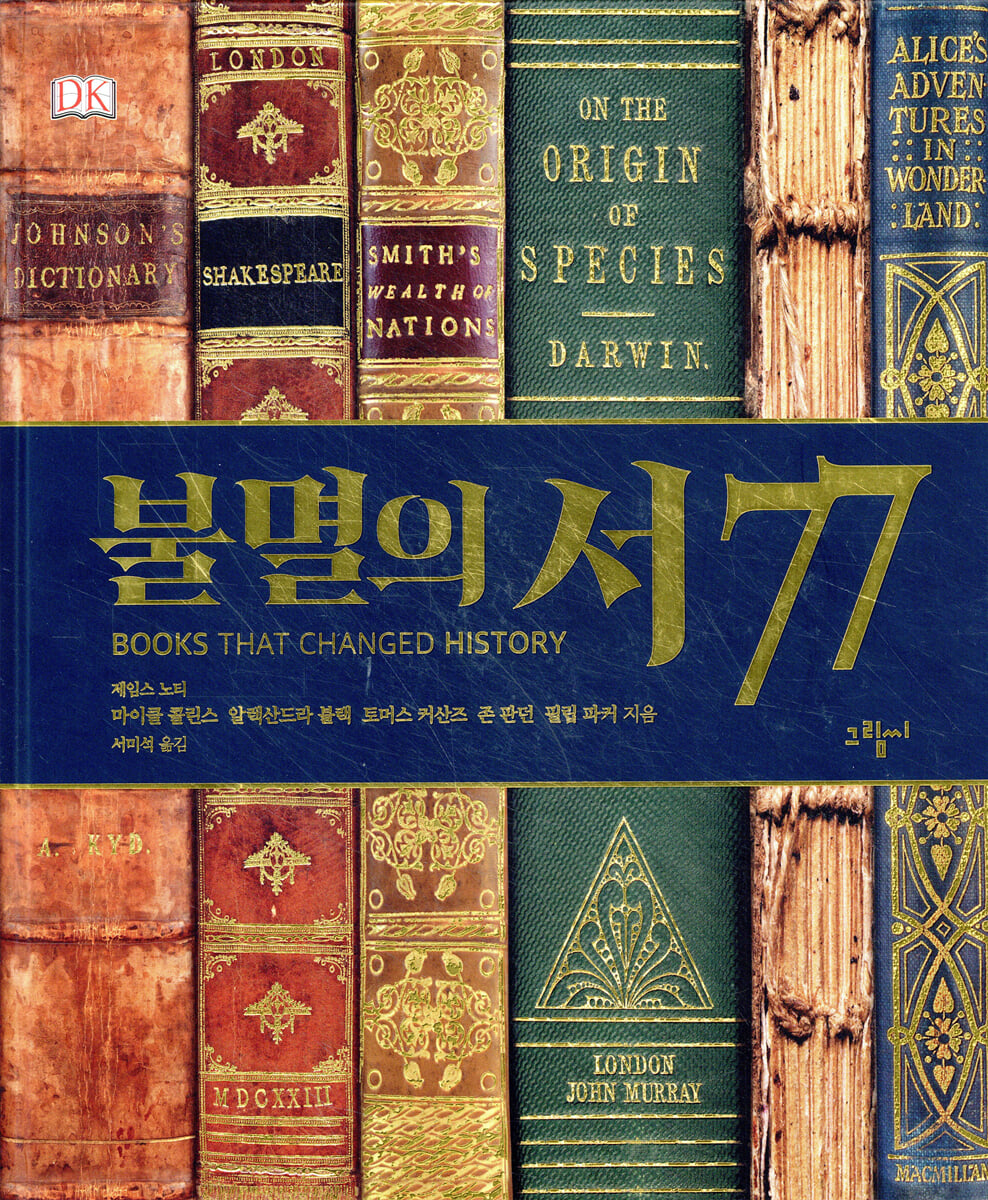
The Book of the Immortal 77: Books That Changed History
A journey through the history of human civilization through the time machine of books.
A unique encyclopedia showcasing the books that shaped history from 3000 BC to the present day!
Let's go on a journey into civilization with books.
『The Book of Immortality 77』 is a collection of 77 works that changed people's lives and awakened humanity's identity.
A beautifully illustrated guide to 77 of the world's most famous, rare, and unique books and manuscripts, with descriptions of their purpose, characteristics, and creators.
Discover 77 immortal civilizations created by humanity, witness wondrous illustrations, and encounter mystical texts.
In it, I can understand humanity, I can understand myself, and I can understand people.
You can understand the socio-cultural context and the causes of the growth of human civilization.
The book's vibrant images and "details" provide a fun way to showcase its features, while the accompanying details also provide a detailed account of the book and its creators.
By introducing books chronologically, it shows the evolution of human knowledge and how the form of books has changed.
A journey through the history of human civilization through the time machine of books.
A unique encyclopedia showcasing the books that shaped history from 3000 BC to the present day!
Let's go on a journey into civilization with books.
『The Book of Immortality 77』 is a collection of 77 works that changed people's lives and awakened humanity's identity.
A beautifully illustrated guide to 77 of the world's most famous, rare, and unique books and manuscripts, with descriptions of their purpose, characteristics, and creators.
Discover 77 immortal civilizations created by humanity, witness wondrous illustrations, and encounter mystical texts.
In it, I can understand humanity, I can understand myself, and I can understand people.
You can understand the socio-cultural context and the causes of the growth of human civilization.
The book's vibrant images and "details" provide a fun way to showcase its features, while the accompanying details also provide a detailed account of the book and its creators.
By introducing books chronologically, it shows the evolution of human knowledge and how the form of books has changed.
- You can preview some of the book's contents.
Preview
index
In publishing the book
introduction
3000 BC - 999 AD
The Ancient Egyptian Book of the Dead / Multiple Authors
Unknown main author
The Art of War / Sun Tzu
Mahabharata / Vyasa
Dead Sea Scrolls / Multiple Authors
Vin Dioscurides / Pedanius Dioscurides
The Book of Kells / Irish Columban Monks
Blue Quran / Author unknown
Diamond Sutra / Author unknown
Exeter Book / Author unknown
Other list
1000~1449
The Tale of Genji / Murasaki Shikibu
Medical Canon / Ibn Sina
Domesday Book / Many Scribes
The Gospel of Henry the Lion / The Monks of Helmarshausen Abbey
The Luxurious Prose of the Duke of Berry / The Brothers Limbourg
Other list
1450~1649
Gutenberg Bible / Johannes Gutenberg
Elements of Geometry / Euclid
The Nuremberg Chronicles / Hartmann Schedel
Divine Comedy / Dante Alighieri
Polyphile's Dream / Author unknown
Odecatone / Ottaviano Petrucci
Codex Leicester / Leonardo da Vinci
The Proportion of the Human Body, Volume 4 / Albrecht Dürer
The Prince / Niccolò Machiavelli
Epitome / Andreas Vesalius
Cosmographia / Sebastian Münster
Prophecies / Nostradamus
Obin Codex / Multiple Authors
The Magical Disclosure / Reginald Scott
Don Quixote / Miguel de Cervantes Saavedra
King James Bible / Translation Committee
The Garden of Eichstätt / Basil Bessler
Complete Works of Architecture and Perspective / Sebastiano Serlio
William Shakespeare's Comedies, Histories, and Tragedies / William Shakespeare
Dialogue on Two World Systems / Galileo Galilei
Bay Psalm Editor / Richard Mather
Other list
1650~1899
Micrographia / Robert Hook
Mathematical Principles of Natural Philosophy / Isaac Newton
The System of Nature / Charlemagne Linnaeus
Encyclopedia / Edited by Denis Diderot and Jean d'Alembert
English Dictionary / Samuel Johnson
Aeneid / Virgil
Tristram Shandy / Lawrence Stern
Aesop's Fables / Aesop
The Wealth of Nations / Adam Smith
The Rights of Man / Thomas Paine
Songs of Innocence and Songs of Experience / William Blake
Birds of North America / John James Audubon
How to write words, music, and simple musical notation using dots / Louis Braille
Baedeker Travel Guide / Karl Baedeker
The Pickwick Papers / Charles Dickens
Holy Land / David Roberts
British Seaweed Photographs: Cyanotype Prints / Anna Atkins
Uncle Tom's Cabin / Harriet Beecher Stowe
Leaves of Grass / Walt Whitman
On the Origin of Species / Charles Darwin
Alice in Wonderland / Lewis Carroll
Capital / Karl Marx
The Works of Chaucer / Geoffrey Chaucer
The Dice Are Thrown / Stéphane Mallarmé
Other list
1900~present
The Wizard of Oz / Lyman Frank Baum
The Tale of Peter Rabbit / Beatrix Potter
The Brothers Grimm's Fairy Tales / Jacob Grimm and Wilhelm Grimm
General Theory of Relativity / Albert Einstein
The Absolutist Story of Two Squares / El Lissitzky
Penguin Books' first 10 paperback volumes / multiple authors
The Diary of Anne Frank / Anne Frank
The Little Prince / Antoine Saint-Exupéry
The Second Sex / Simone de Beauvoir
The Feminine Mystique / Betty Friedan
Silent Spring / Rachel Carson
Quotations from Mao Zedong / Mao Zedong
Other list
Search
Acknowledgements
introduction
3000 BC - 999 AD
The Ancient Egyptian Book of the Dead / Multiple Authors
Unknown main author
The Art of War / Sun Tzu
Mahabharata / Vyasa
Dead Sea Scrolls / Multiple Authors
Vin Dioscurides / Pedanius Dioscurides
The Book of Kells / Irish Columban Monks
Blue Quran / Author unknown
Diamond Sutra / Author unknown
Exeter Book / Author unknown
Other list
1000~1449
The Tale of Genji / Murasaki Shikibu
Medical Canon / Ibn Sina
Domesday Book / Many Scribes
The Gospel of Henry the Lion / The Monks of Helmarshausen Abbey
The Luxurious Prose of the Duke of Berry / The Brothers Limbourg
Other list
1450~1649
Gutenberg Bible / Johannes Gutenberg
Elements of Geometry / Euclid
The Nuremberg Chronicles / Hartmann Schedel
Divine Comedy / Dante Alighieri
Polyphile's Dream / Author unknown
Odecatone / Ottaviano Petrucci
Codex Leicester / Leonardo da Vinci
The Proportion of the Human Body, Volume 4 / Albrecht Dürer
The Prince / Niccolò Machiavelli
Epitome / Andreas Vesalius
Cosmographia / Sebastian Münster
Prophecies / Nostradamus
Obin Codex / Multiple Authors
The Magical Disclosure / Reginald Scott
Don Quixote / Miguel de Cervantes Saavedra
King James Bible / Translation Committee
The Garden of Eichstätt / Basil Bessler
Complete Works of Architecture and Perspective / Sebastiano Serlio
William Shakespeare's Comedies, Histories, and Tragedies / William Shakespeare
Dialogue on Two World Systems / Galileo Galilei
Bay Psalm Editor / Richard Mather
Other list
1650~1899
Micrographia / Robert Hook
Mathematical Principles of Natural Philosophy / Isaac Newton
The System of Nature / Charlemagne Linnaeus
Encyclopedia / Edited by Denis Diderot and Jean d'Alembert
English Dictionary / Samuel Johnson
Aeneid / Virgil
Tristram Shandy / Lawrence Stern
Aesop's Fables / Aesop
The Wealth of Nations / Adam Smith
The Rights of Man / Thomas Paine
Songs of Innocence and Songs of Experience / William Blake
Birds of North America / John James Audubon
How to write words, music, and simple musical notation using dots / Louis Braille
Baedeker Travel Guide / Karl Baedeker
The Pickwick Papers / Charles Dickens
Holy Land / David Roberts
British Seaweed Photographs: Cyanotype Prints / Anna Atkins
Uncle Tom's Cabin / Harriet Beecher Stowe
Leaves of Grass / Walt Whitman
On the Origin of Species / Charles Darwin
Alice in Wonderland / Lewis Carroll
Capital / Karl Marx
The Works of Chaucer / Geoffrey Chaucer
The Dice Are Thrown / Stéphane Mallarmé
Other list
1900~present
The Wizard of Oz / Lyman Frank Baum
The Tale of Peter Rabbit / Beatrix Potter
The Brothers Grimm's Fairy Tales / Jacob Grimm and Wilhelm Grimm
General Theory of Relativity / Albert Einstein
The Absolutist Story of Two Squares / El Lissitzky
Penguin Books' first 10 paperback volumes / multiple authors
The Diary of Anne Frank / Anne Frank
The Little Prince / Antoine Saint-Exupéry
The Second Sex / Simone de Beauvoir
The Feminine Mystique / Betty Friedan
Silent Spring / Rachel Carson
Quotations from Mao Zedong / Mao Zedong
Other list
Search
Acknowledgements
Detailed image

Publisher's Review
Books that helped to sprout human civilization and expand culture!!
Beginning with the ancient Sumerian epic Gilgamesh, written on clay tablets approximately 4,000 years ago and considered the oldest book in human history, we introduce books that laid the foundation for the establishment of the world's great religions.
Representative books include the Bible for Christians, the Torah for Jews, the Koran for Muslims, the Mahabharata for Hindus, and the I Ching for Taoists.
We introduce books that helped humanity develop civilization in ancient times and expand its vast knowledge based on them, such as the Egyptian Book of the Dead, which was made on papyrus to meet the needs of the deceased and therefore has no identical content; the Blue Quran, which was likely made in North Africa and written in gold-leafed Kufic script; the Book of Kells, which is ornately decorated with colorful colors and gold leaf; the Dead Sea Scrolls, discovered in the Qumran caves near the Dead Sea; and the Canon of Medicine, a perfect textbook for doctors.
It tells us that 'books' are something that preserve the memories of the past by recording the achievements of mankind.
Books finally meet printing!!
Metal movable type printing is inextricably linked to the advancement of mankind.
Taking advantage of the newly introduced printing and copperplate technologies, they began publishing original and surprising books that were not simply academic papers but actual expressions of scholarly inquiry.
In other words, the invention of printing not only reduced the labor of scribes, but also opened up a completely new democratic world.
The Gutenberg Bible, which was born from true commercial printing, was so expensive that only the upper class could own it, and the Nuremberg Chronicle, printed in 1493, described the history of the Bible and human history with illustrations.
Ottaviano Petrucci's Odecaton, published in 1501, also made single-sheet music widely available, and each piece had melodies for multiple instruments written on it, allowing performers to look at the page together.
Meet books and literature
Thanks to the printing press, the Aldine Press devoted itself to publishing the classics, reviving interest in Virgil, Homer, Aristotle, and Euclid. Dante's Divine Comedy and The Dream of Polyphile were elevated to the ranks of classics, and these works, with their distinct authorial style, influenced European writers, including Shakespeare.
Lawrence Sterne's novel Tristram Shandy showed the expansion of individual consciousness and imaginative private life, and Dickens's Pickwick Papers, serialized in magazines a year before being published as a book, became popular and was the first example of a book becoming entertainment.
Penguin paperbacks, which changed reading habits in the 20th century, made books cheaper thanks to mass production and made the world of literature accessible to a wider range of readers.
You can see the true nature of many literary works, including Walt Whitman's "Leaves of Grass," which was considered eccentric when he was alive but is now one of the most influential works representing American literature; Lewis Carroll's "Alice's Adventures in Wonderland," which is beloved by children; and Geoffrey Chaucer's "The Collected Works of Chaucer," which is unique for its ornate decoration and extensive illustrations.
At the same time, individual writing activities became active, Cervantes published Don Quixote, and many writers were born throughout Europe, including Shakespeare.
Books Meet Science
In addition, Andreas Vesalius published the revolutionary anatomy book Epitome (Structure of the Human Body), and John James Audubon, filled with a desire to know about nature, published Birds of North America, which depicted all the birds in North America.
Galileo's groundbreaking work, Dialogue Concerning the Two World Systems, which dealt with Earth's position in the universe, helped to rapidly disseminate scientific views.
Thanks to that, I realized that I understood the world better.
Newton promoted the Enlightenment in the scientific field by writing 『Mathematical Principles of Natural Philosophy』, Robert Hooke introduced the previously unimaginable world of the microscopic with 『Micrographia』, Linnaeus showed how to subdivide nature with 『Systema Naturae』, and Darwin showed the process of evolution of life with 『Origin of Species』.
Books Meet the Enlightenment
By the Age of Enlightenment, books had become readily available, people learned to read and write, and a vast readership emerged to understand the world.
Diderot compiled the Encyclopédie to show that knowledge was not the natural right of kings and nobles, but a right of all people.
Thomas Paine wrote "The Rights of Man," which became the foundation of the French Revolution and American independence, Adam Smith presented the theoretical basis for the capitalist economic system with "The Wealth of Nations," and Marx created the theory that gave birth to the revolution that is still ongoing today with "Das Kapital."
The King James Bible, the first authorized Bible in English, was read every weekend in churches across the country, and thus played a major role in establishing the English language in its current form.
Books, Becoming Light
In 1829, Louis Braille, a blind man, published a book titled "How to Write Words, Music and Simple Musical Notation by Using Dots", which introduced the Braille system that allowed the blind to read and write, and Karl Baedeker wrote "Baedeker's Guidebook", which presented the prototype of the modern travel guidebook.
Harriet Beecher Stowe's Uncle Tom's Cabin exposed the plight of black slaves in America and helped abolish slavery.
Saint-Exupéry's The Little Prince warns us of human narrow-mindedness and the importance of exploration for spiritual growth.
Simone de Beauvoir wrote The Second Sex with the famous line, “One is not born, but becomes, a woman,” and Betty Friedan contributed to the feminist movement by publishing The Feminine Mystique and became a light for women by advocating for women’s rights to legislate for equal pay and to protect women’s rights.
Books, a warning to the present
In modern times, Einstein published the General Theory of Relativity, presenting a theory that overturned the view of the universe developed during the Newtonian era and completely changed the perception of time.
Hitler's Mein Kampf was politically and morally controversial, and Lawrence's Lady Chatterley's Lover was briefly banned in the United States and Britain for violating obscenity laws.
Rachel Carson's Silent Spring dramatically changed the way people viewed the environment by warning of the terrible damage it was doing to wildlife.
Beginning with the ancient Sumerian epic Gilgamesh, written on clay tablets approximately 4,000 years ago and considered the oldest book in human history, we introduce books that laid the foundation for the establishment of the world's great religions.
Representative books include the Bible for Christians, the Torah for Jews, the Koran for Muslims, the Mahabharata for Hindus, and the I Ching for Taoists.
We introduce books that helped humanity develop civilization in ancient times and expand its vast knowledge based on them, such as the Egyptian Book of the Dead, which was made on papyrus to meet the needs of the deceased and therefore has no identical content; the Blue Quran, which was likely made in North Africa and written in gold-leafed Kufic script; the Book of Kells, which is ornately decorated with colorful colors and gold leaf; the Dead Sea Scrolls, discovered in the Qumran caves near the Dead Sea; and the Canon of Medicine, a perfect textbook for doctors.
It tells us that 'books' are something that preserve the memories of the past by recording the achievements of mankind.
Books finally meet printing!!
Metal movable type printing is inextricably linked to the advancement of mankind.
Taking advantage of the newly introduced printing and copperplate technologies, they began publishing original and surprising books that were not simply academic papers but actual expressions of scholarly inquiry.
In other words, the invention of printing not only reduced the labor of scribes, but also opened up a completely new democratic world.
The Gutenberg Bible, which was born from true commercial printing, was so expensive that only the upper class could own it, and the Nuremberg Chronicle, printed in 1493, described the history of the Bible and human history with illustrations.
Ottaviano Petrucci's Odecaton, published in 1501, also made single-sheet music widely available, and each piece had melodies for multiple instruments written on it, allowing performers to look at the page together.
Meet books and literature
Thanks to the printing press, the Aldine Press devoted itself to publishing the classics, reviving interest in Virgil, Homer, Aristotle, and Euclid. Dante's Divine Comedy and The Dream of Polyphile were elevated to the ranks of classics, and these works, with their distinct authorial style, influenced European writers, including Shakespeare.
Lawrence Sterne's novel Tristram Shandy showed the expansion of individual consciousness and imaginative private life, and Dickens's Pickwick Papers, serialized in magazines a year before being published as a book, became popular and was the first example of a book becoming entertainment.
Penguin paperbacks, which changed reading habits in the 20th century, made books cheaper thanks to mass production and made the world of literature accessible to a wider range of readers.
You can see the true nature of many literary works, including Walt Whitman's "Leaves of Grass," which was considered eccentric when he was alive but is now one of the most influential works representing American literature; Lewis Carroll's "Alice's Adventures in Wonderland," which is beloved by children; and Geoffrey Chaucer's "The Collected Works of Chaucer," which is unique for its ornate decoration and extensive illustrations.
At the same time, individual writing activities became active, Cervantes published Don Quixote, and many writers were born throughout Europe, including Shakespeare.
Books Meet Science
In addition, Andreas Vesalius published the revolutionary anatomy book Epitome (Structure of the Human Body), and John James Audubon, filled with a desire to know about nature, published Birds of North America, which depicted all the birds in North America.
Galileo's groundbreaking work, Dialogue Concerning the Two World Systems, which dealt with Earth's position in the universe, helped to rapidly disseminate scientific views.
Thanks to that, I realized that I understood the world better.
Newton promoted the Enlightenment in the scientific field by writing 『Mathematical Principles of Natural Philosophy』, Robert Hooke introduced the previously unimaginable world of the microscopic with 『Micrographia』, Linnaeus showed how to subdivide nature with 『Systema Naturae』, and Darwin showed the process of evolution of life with 『Origin of Species』.
Books Meet the Enlightenment
By the Age of Enlightenment, books had become readily available, people learned to read and write, and a vast readership emerged to understand the world.
Diderot compiled the Encyclopédie to show that knowledge was not the natural right of kings and nobles, but a right of all people.
Thomas Paine wrote "The Rights of Man," which became the foundation of the French Revolution and American independence, Adam Smith presented the theoretical basis for the capitalist economic system with "The Wealth of Nations," and Marx created the theory that gave birth to the revolution that is still ongoing today with "Das Kapital."
The King James Bible, the first authorized Bible in English, was read every weekend in churches across the country, and thus played a major role in establishing the English language in its current form.
Books, Becoming Light
In 1829, Louis Braille, a blind man, published a book titled "How to Write Words, Music and Simple Musical Notation by Using Dots", which introduced the Braille system that allowed the blind to read and write, and Karl Baedeker wrote "Baedeker's Guidebook", which presented the prototype of the modern travel guidebook.
Harriet Beecher Stowe's Uncle Tom's Cabin exposed the plight of black slaves in America and helped abolish slavery.
Saint-Exupéry's The Little Prince warns us of human narrow-mindedness and the importance of exploration for spiritual growth.
Simone de Beauvoir wrote The Second Sex with the famous line, “One is not born, but becomes, a woman,” and Betty Friedan contributed to the feminist movement by publishing The Feminine Mystique and became a light for women by advocating for women’s rights to legislate for equal pay and to protect women’s rights.
Books, a warning to the present
In modern times, Einstein published the General Theory of Relativity, presenting a theory that overturned the view of the universe developed during the Newtonian era and completely changed the perception of time.
Hitler's Mein Kampf was politically and morally controversial, and Lawrence's Lady Chatterley's Lover was briefly banned in the United States and Britain for violating obscenity laws.
Rachel Carson's Silent Spring dramatically changed the way people viewed the environment by warning of the terrible damage it was doing to wildlife.
GOODS SPECIFICS
- Date of issue: January 20, 2019
- Format: Hardcover book binding method guide
- Page count, weight, size: 256 pages | 1,604g | 168*307*25mm
- ISBN13: 9791189231026
- ISBN10: 1189231026
You may also like
카테고리
korean


korean

![GQ KOREA Mark (Monthly): December [2025]](http://librairie.coreenne.fr/cdn/shop/files/8ef265dbbfbf186523ed75ba7319009d.jpg?v=1765340328&width=3840)


