

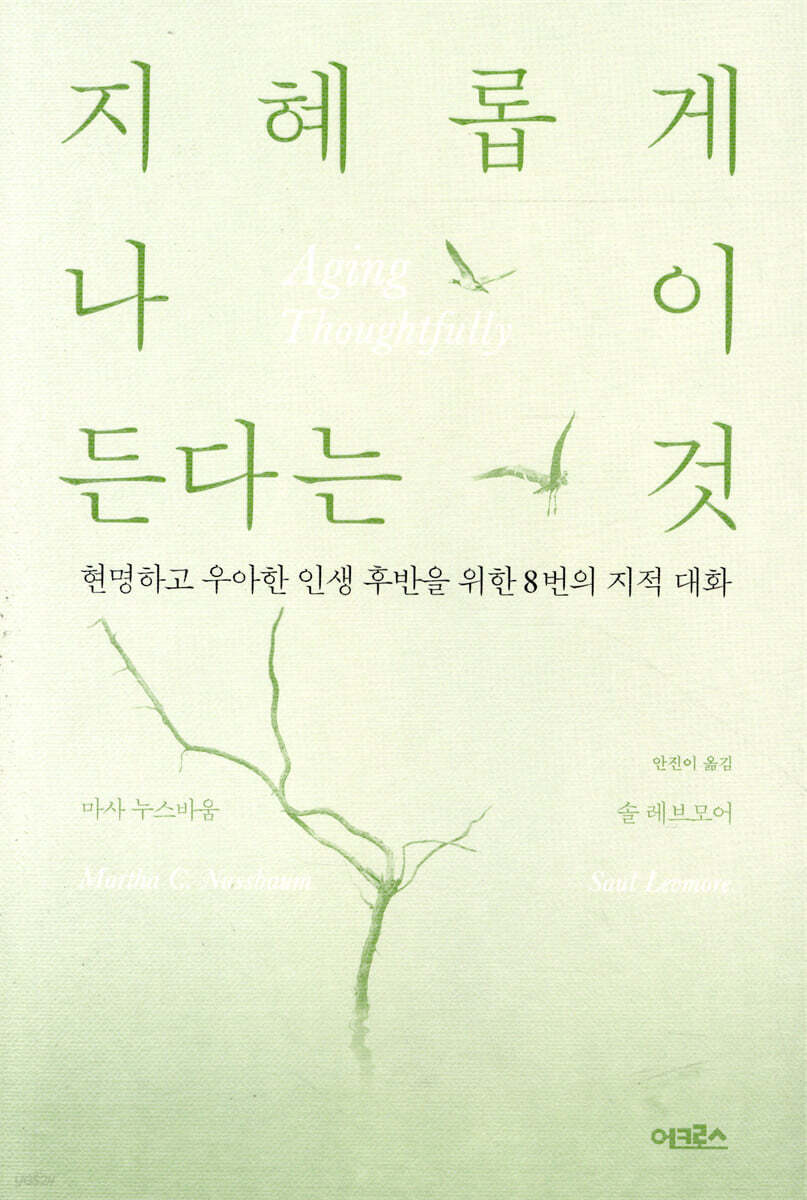
Growing old wisely
 |
Description
Book Introduction
- A word from MD
-
A conversation between two scholars on graceful agingImmortality has been a dream of mankind, but an unprepared old age is a misfortune.
The second half of life is happy only when both material and spiritual abundance are fulfilled.
Philosopher Nussbaum and law and economics expert Revmore explore the prerequisites for a graceful old age.
Let's hear their insights on a dignified old age.
December 28, 2018. Humanities PD Son Min-gyu
What should we prepare to age wisely and gracefully?
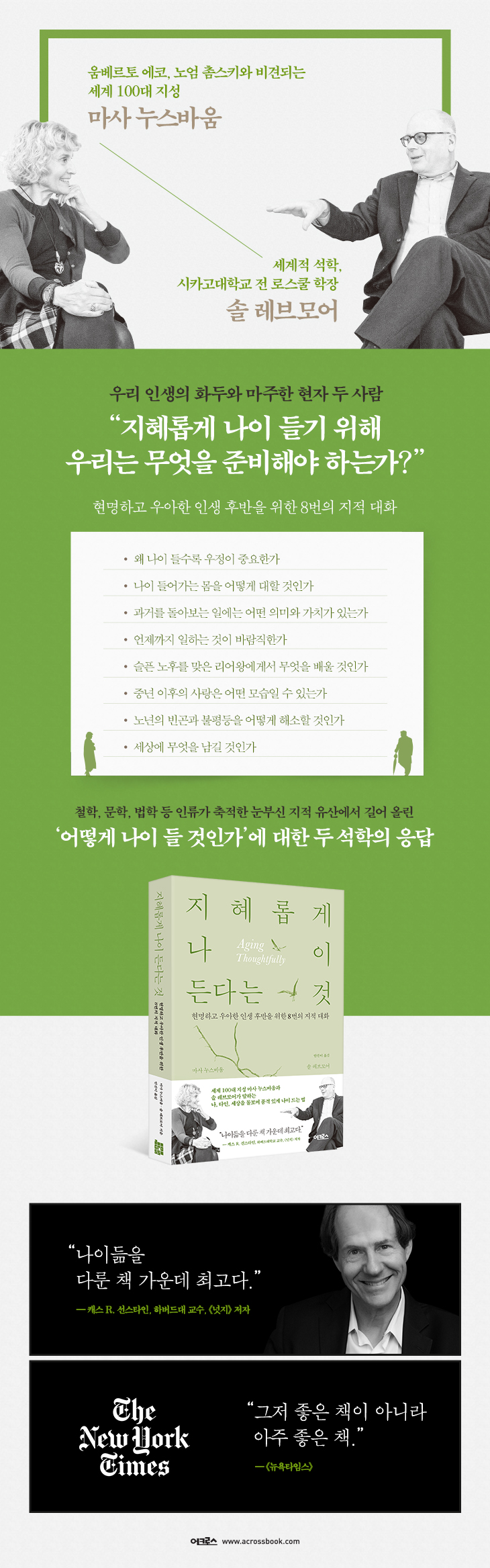
Martha Nussbaum and Saul Revmore, two of the world's top 100 intellectuals,
Guide us to the hidden joys and possibilities of the latter half of life.
“Not just a good book, but a very good book.
“It asks the questions we need as we age and gives the right answers.” - The New York Times
“This is the best book on aging.
“It shares time-tested wisdom and offers surprising and fresh insights.” -Cath R.
Sunstein, Harvard University professor and author of Nudge
"What must we individually prepare to age wisely and gracefully? And what must our nation and society provide?" University of Chicago professor Martha Nussbaum, who was named one of Foreign Policy's "100 Global Intellectuals" alongside Umberto Eco and Noam Chomsky, and former law school dean Saul Revmore answer this question by delving into humanity's deep and broad intellectual heritage to impart the wisdom we need.
The colorful and rich insights on aging, delivered by two people—a philosopher with a humanistic perspective and a legal and economics expert armed with practical knowledge—at times overlapping and at times contradictory, guide us into the joys and possibilities hidden in the latter half of life.
Through this intellectual journey with these two luminaries, we gain insight into the role of friendship in aging, the meaning and value of reflecting on the past, and what we should leave behind in the world.
You'll also gain more practical guidance on life, such as when is the right time to retire and how to appropriately distribute your inheritance.
Through the insights of two leading experts on aging, we can learn what we need to think about and prepare for to age better.
Martha Nussbaum and Saul Revmore, two of the world's top 100 intellectuals,
Guide us to the hidden joys and possibilities of the latter half of life.
“Not just a good book, but a very good book.
“It asks the questions we need as we age and gives the right answers.” - The New York Times
“This is the best book on aging.
“It shares time-tested wisdom and offers surprising and fresh insights.” -Cath R.
Sunstein, Harvard University professor and author of Nudge
"What must we individually prepare to age wisely and gracefully? And what must our nation and society provide?" University of Chicago professor Martha Nussbaum, who was named one of Foreign Policy's "100 Global Intellectuals" alongside Umberto Eco and Noam Chomsky, and former law school dean Saul Revmore answer this question by delving into humanity's deep and broad intellectual heritage to impart the wisdom we need.
The colorful and rich insights on aging, delivered by two people—a philosopher with a humanistic perspective and a legal and economics expert armed with practical knowledge—at times overlapping and at times contradictory, guide us into the joys and possibilities hidden in the latter half of life.
Through this intellectual journey with these two luminaries, we gain insight into the role of friendship in aging, the meaning and value of reflecting on the past, and what we should leave behind in the world.
You'll also gain more practical guidance on life, such as when is the right time to retire and how to appropriately distribute your inheritance.
Through the insights of two leading experts on aging, we can learn what we need to think about and prepare for to age better.
- You can preview some of the book's contents.
Preview
index
Preface: An Intellectual Journey to Aging Wisely
Chapter 1: Aging and Friendship
On Aging, on Friendship: A Fictional Debate with Cicero / Martha
Friend, companion on the adventure of life / Sol
Chapter 2: How to Deal with Your Aging Body
Can wrinkles be attractive? / Sol
Caring for Our Bodies, Ourselves: Aging, Stigma, and Disgust / Martha
Chapter 3: Looking Back
Moving Forward Through the Past: The Value of Retrospective Emotions / Martha
A life of satisfaction instead of regret / Sol
Chapter 4: What Can We Learn from King Lear?
Ready to Lose Control / Martha
Distribution of Legacy, Inheritance, and Payment of Care Costs / Sol
Chapter 5: Thinking About the Right Time to Retire
Why Retirement is Necessary / Sol
Against forced retirement / Martha
Chapter 6: Love After Middle Age
Love and Sex in Aging Women: Richard Strauss's Lies, Shakespeare's Truth / Martha
I want a more adventurous relationship / Sol
Chapter 7: Poverty and Inequality in Old Age
Possibility of Resolving Elderly Poverty and Inequality / Sol
Elderly Poverty and Inequality from a Human Capability Perspective / Martha
Chapter 8: What to Leave Behind
The Paradox of Sharing and My Own Solution / Sol
Aging and Altruism / Martha
Acknowledgements
main
Chapter 1: Aging and Friendship
On Aging, on Friendship: A Fictional Debate with Cicero / Martha
Friend, companion on the adventure of life / Sol
Chapter 2: How to Deal with Your Aging Body
Can wrinkles be attractive? / Sol
Caring for Our Bodies, Ourselves: Aging, Stigma, and Disgust / Martha
Chapter 3: Looking Back
Moving Forward Through the Past: The Value of Retrospective Emotions / Martha
A life of satisfaction instead of regret / Sol
Chapter 4: What Can We Learn from King Lear?
Ready to Lose Control / Martha
Distribution of Legacy, Inheritance, and Payment of Care Costs / Sol
Chapter 5: Thinking About the Right Time to Retire
Why Retirement is Necessary / Sol
Against forced retirement / Martha
Chapter 6: Love After Middle Age
Love and Sex in Aging Women: Richard Strauss's Lies, Shakespeare's Truth / Martha
I want a more adventurous relationship / Sol
Chapter 7: Poverty and Inequality in Old Age
Possibility of Resolving Elderly Poverty and Inequality / Sol
Elderly Poverty and Inequality from a Human Capability Perspective / Martha
Chapter 8: What to Leave Behind
The Paradox of Sharing and My Own Solution / Sol
Aging and Altruism / Martha
Acknowledgements
main
Detailed image
Into the book
This book is absolutely not about death, whether it be a dignified death or any other death.
This book is about how to live wisely.
Growing old is about experiencing things, gaining wisdom, loving, losing things, and feeling comfortable with yourself even when your skin wrinkles.
--- p.8
As we grow older, our friendships deepen, and our understanding of the world deepens.
This is a very valuable benefit and not easily obtained through other means.
--- p.44
Growing old inevitably brings unhappiness.
But humor, understanding, and love don't necessarily follow.
Providing these things is friendship.
--- p.62
Retired seniors seem to finally be comfortable with their appearance.
To be honest, I sometimes find their wrinkles attractive.
For people of a certain age, a wrinkled and creased face looks more beautiful than smooth and clear skin.
When there are wrinkles, the personality hidden behind the skin feels more interesting.
And if their eyes sparkle, I tend to focus on them during a conversation.
My eyes are not drawn to that person's clothes, accessories, or body.
--- p.101
In general, self-reflection is a valuable activity and part of the process of becoming a whole person.
Honestly acknowledging and trying to understand our past actions is a necessary step toward becoming whole people in the present.
--- p.170
We are all like Lear in that, whether we like it or not, we look for signs of how we will be treated when we need care in our old age.
--- p.228
Age discrimination, which primarily occurs in the form of mandatory retirement, is based on social prejudice rather than rational rules.
It is just as unethical as any other discrimination.
--- p.291
Philosophy is largely silent on the subject of the sensual love of aging women.
More generally, none of the philosophers I know have offered a good account of the complex nature of "late-life love" between lovers or couples.
This is neither a mere coincidence nor a product of a culture that is reluctant to discuss love in old age.
In this respect, philosophy must receive help from literature.
Abstract prose alone cannot convey the unique, variable, and concrete love of old age.
Love in old age contains true feelings amidst empty boasts.
--- p.320 - Chapter 6 Love after middle age
It is often thought that it is 'natural' to lose capacity as we age.
It is precisely this very bias that acts as a major obstacle to the discussion we desperately need.
--- p.404
Now we must think not only of our descendants but also of the greater good.
Sharing may be our best opportunity to make the world a better place than when we first found it.
This book is about how to live wisely.
Growing old is about experiencing things, gaining wisdom, loving, losing things, and feeling comfortable with yourself even when your skin wrinkles.
--- p.8
As we grow older, our friendships deepen, and our understanding of the world deepens.
This is a very valuable benefit and not easily obtained through other means.
--- p.44
Growing old inevitably brings unhappiness.
But humor, understanding, and love don't necessarily follow.
Providing these things is friendship.
--- p.62
Retired seniors seem to finally be comfortable with their appearance.
To be honest, I sometimes find their wrinkles attractive.
For people of a certain age, a wrinkled and creased face looks more beautiful than smooth and clear skin.
When there are wrinkles, the personality hidden behind the skin feels more interesting.
And if their eyes sparkle, I tend to focus on them during a conversation.
My eyes are not drawn to that person's clothes, accessories, or body.
--- p.101
In general, self-reflection is a valuable activity and part of the process of becoming a whole person.
Honestly acknowledging and trying to understand our past actions is a necessary step toward becoming whole people in the present.
--- p.170
We are all like Lear in that, whether we like it or not, we look for signs of how we will be treated when we need care in our old age.
--- p.228
Age discrimination, which primarily occurs in the form of mandatory retirement, is based on social prejudice rather than rational rules.
It is just as unethical as any other discrimination.
--- p.291
Philosophy is largely silent on the subject of the sensual love of aging women.
More generally, none of the philosophers I know have offered a good account of the complex nature of "late-life love" between lovers or couples.
This is neither a mere coincidence nor a product of a culture that is reluctant to discuss love in old age.
In this respect, philosophy must receive help from literature.
Abstract prose alone cannot convey the unique, variable, and concrete love of old age.
Love in old age contains true feelings amidst empty boasts.
--- p.320 - Chapter 6 Love after middle age
It is often thought that it is 'natural' to lose capacity as we age.
It is precisely this very bias that acts as a major obstacle to the discussion we desperately need.
--- p.404
Now we must think not only of our descendants but also of the greater good.
Sharing may be our best opportunity to make the world a better place than when we first found it.
--- p.427
Publisher's Review
A response to the question, "How to Age," drawn from a dazzling intellectual heritage.
Two scholars, Martha Nussbaum and Saul Revmore, teach us how to age wisely and gracefully, drawing on and sometimes intertwining philosophy, literature, economics, and law.
It shows how friendship helps to relieve things like boredom, disappointment, and anxiety that come with age through the works of the Roman sage Cicero, “On Aging” and “On Friendship,” and the letters he exchanged with his friend Atticus. It also uses Shakespeare’s “King Lear” as a negative example to solve the concerns about how to divide the inheritance fairly among children and how to maintain good relationships with them in old age.
It also suggests ways to make our lives more meaningful and valuable by connecting the fragments of memories scattered throughout our lives through each person's reflection on the past, citing luminous works in literary history such as Marcel Proust's In Search of Lost Time and Eugene O'Neill's play Long Day's Journey into Night, as well as philosophers such as Aristotle.
As you follow the authors' intellectual exploration of aging, you'll find yourself discovering clues to what it means to "age wisely."
Conversations about aging are a great asset and joy in later life.
This book, which references Cicero's "On Growing Old," takes the form of a conversation between two friends in their sixties.
Each chapter is paired with two essays on aging.
The two authors sometimes respond to or agree with each other's writings, but they also present different ideas because they have different personalities and academic approaches.
For example, philosopher Martha Nussbaum criticizes presentism, the indulging in the pleasures of the moment, found in retirees' communities, while jurist and economist Saul Levmore, from a more realistic standpoint, acknowledges their leisurely retirement.
In this way, readers can gain two insights into a single topic through the perspectives and views of two distinguished scholars.
The authors do not hope that the stories in this book will come across to readers as simple, easy advice.
They hope their conversation will serve as a model, a starting point for more people to seriously think about and discuss aging wisely.
Sharing thoughts and discussions about aging with those around you is not only helpful in real life, but also a great joy in the latter half of life.
How to age gracefully, caring for yourself, others, and the world
This book talks about what we need to prepare to 'age gracefully.'
Thinking about friendships, my aging body, a proper retirement date, my past, etc. is all about taking care of myself, both inside and out, so that I can age better.
This book doesn't stop there, but asks how we can solve problems such as economic inequality in old age, poverty among the elderly, and ageism, and what we can contribute to the world that will continue after we are gone, and it goes beyond caring for ourselves to care for 'others' and 'the world' together.
This may be the true value of this book.
“When children grow up with love and care, they learn to love others as they are, without any ulterior motive.
When children grow up with a truly good education, they develop a valuable set of responsibilities, caring for people beyond their immediate family and friends, and thinking about the greater good of society.
But as we grow older, we all enter a second childhood.
During this time, the urgent demands of the ego and the instinctive needs of the body interfere with the good habits we have formed and distance us from the values of the wider world.
We must be aware of this moral danger and do our best to combat it.
“Showing dignity, humor, and humility as much as possible.” (p. 454)
Two scholars, Martha Nussbaum and Saul Revmore, teach us how to age wisely and gracefully, drawing on and sometimes intertwining philosophy, literature, economics, and law.
It shows how friendship helps to relieve things like boredom, disappointment, and anxiety that come with age through the works of the Roman sage Cicero, “On Aging” and “On Friendship,” and the letters he exchanged with his friend Atticus. It also uses Shakespeare’s “King Lear” as a negative example to solve the concerns about how to divide the inheritance fairly among children and how to maintain good relationships with them in old age.
It also suggests ways to make our lives more meaningful and valuable by connecting the fragments of memories scattered throughout our lives through each person's reflection on the past, citing luminous works in literary history such as Marcel Proust's In Search of Lost Time and Eugene O'Neill's play Long Day's Journey into Night, as well as philosophers such as Aristotle.
As you follow the authors' intellectual exploration of aging, you'll find yourself discovering clues to what it means to "age wisely."
Conversations about aging are a great asset and joy in later life.
This book, which references Cicero's "On Growing Old," takes the form of a conversation between two friends in their sixties.
Each chapter is paired with two essays on aging.
The two authors sometimes respond to or agree with each other's writings, but they also present different ideas because they have different personalities and academic approaches.
For example, philosopher Martha Nussbaum criticizes presentism, the indulging in the pleasures of the moment, found in retirees' communities, while jurist and economist Saul Levmore, from a more realistic standpoint, acknowledges their leisurely retirement.
In this way, readers can gain two insights into a single topic through the perspectives and views of two distinguished scholars.
The authors do not hope that the stories in this book will come across to readers as simple, easy advice.
They hope their conversation will serve as a model, a starting point for more people to seriously think about and discuss aging wisely.
Sharing thoughts and discussions about aging with those around you is not only helpful in real life, but also a great joy in the latter half of life.
How to age gracefully, caring for yourself, others, and the world
This book talks about what we need to prepare to 'age gracefully.'
Thinking about friendships, my aging body, a proper retirement date, my past, etc. is all about taking care of myself, both inside and out, so that I can age better.
This book doesn't stop there, but asks how we can solve problems such as economic inequality in old age, poverty among the elderly, and ageism, and what we can contribute to the world that will continue after we are gone, and it goes beyond caring for ourselves to care for 'others' and 'the world' together.
This may be the true value of this book.
“When children grow up with love and care, they learn to love others as they are, without any ulterior motive.
When children grow up with a truly good education, they develop a valuable set of responsibilities, caring for people beyond their immediate family and friends, and thinking about the greater good of society.
But as we grow older, we all enter a second childhood.
During this time, the urgent demands of the ego and the instinctive needs of the body interfere with the good habits we have formed and distance us from the values of the wider world.
We must be aware of this moral danger and do our best to combat it.
“Showing dignity, humor, and humility as much as possible.” (p. 454)
GOODS SPECIFICS
- Date of issue: December 31, 2018
- Page count, weight, size: 472 pages | 642g | 147*217*30mm
- ISBN13: 9791160560657
- ISBN10: 116056065X
You may also like
카테고리
korean


korean

![GQ KOREA Mark (Monthly): December [2025]](http://librairie.coreenne.fr/cdn/shop/files/8ef265dbbfbf186523ed75ba7319009d.jpg?v=1765340328&width=3840)


