

All About Brian Peterson Photography
 |
Description
Book Introduction
A photography guide by world-renowned photography educator Brian Peterson
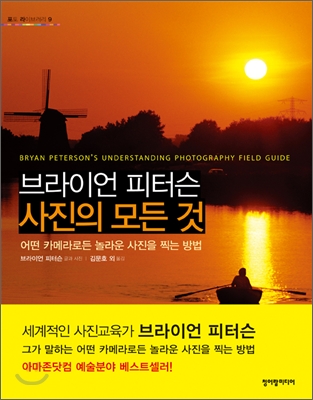
World-renowned photography educator Brian Peterson teaches you how to take amazing photos with any camera.
Whether you use a film camera, DSLR camera, or regular digital camera, we've systematically organized the most basic things about taking pictures.
It will help you take beautiful and creative photos without the constraints of time, place, or equipment, including a solid understanding of exposure, how to 'see' an image, how to compose it more creatively, and how to master the magic of light.
This book contains almost everything about photography that the author has learned through firsthand experience, reflection, and reflection since he first started taking pictures.
The author shares the secrets he has accumulated over 38 years of experience with a variety of practice exercises and example photos, making it easy for beginners to understand and follow.
World-renowned photography educator Brian Peterson teaches you how to take amazing photos with any camera.
Whether you use a film camera, DSLR camera, or regular digital camera, we've systematically organized the most basic things about taking pictures.
It will help you take beautiful and creative photos without the constraints of time, place, or equipment, including a solid understanding of exposure, how to 'see' an image, how to compose it more creatively, and how to master the magic of light.
This book contains almost everything about photography that the author has learned through firsthand experience, reflection, and reflection since he first started taking pictures.
The author shares the secrets he has accumulated over 38 years of experience with a variety of practice exercises and example photos, making it easy for beginners to understand and follow.
- You can preview some of the book's contents.
Preview
index
introduction
A few digital basics
File Format | Return to Original RAW File | 16-bit Mode and Color Space | White Balance
exposure
What is "Exposure"? | The Photography Triangle | The Heart of the Triangle: The Exposure Meter | Six Correct Exposures vs. One Creative Correct Exposure | Seven Creative Exposure Choices
iris
Aperture and Depth of Field | Storytelling Aperture | Isolated Aperture | Depth Preview Button | "I Don't Care" Aperture
Shutter speed and ISO
The Importance of Shutter Speed | The Myth of ISO Exposure | Freezing Action: When to Go Fast | Slow Speed | Panning | Using a Tripod to Illuminate Movement | Background Motion | Low-Light Motion: 1 Second and Beyond
Learn to see
Learning a Language | Getting Started with Lenses | Wide-Angle Lens | Street Zoom Lens | Telephoto Lens | Fish-Eye Lens | Looking Up | Shooting from Above | Identifying a Subject
Designing eye-catching images
Line | Shape | Shape | Texture | Pattern | Color | Scale | Composition | Filling the Frame | Background | Horizontal vs. Vertical Photography | The Rule of Thirds and the Rule of Thirds | Breaking the Rules | Avoiding Overlap | Creating Frames Within Frames | Wrestling with the Subject | Pictures Within Pictures | Composing the Action
The importance of light
Best Light | Front Light | Side Light | Backlight | Clear Day f/16 Rule | Exposure Meter | 18 Percent Reflectance | Sky Brothers | Mr. Green Jeans | Night Photography and Low-Light Photography | HDR Photography
Close-up photo
Close-up vs. Macro Photography | Extension Tubes | Canon Close-up Filters | Backgrounds | Ring Flashes | Non-traditional Subjects
Taking pictures of people
Overcoming Shyness | Approaching and Respecting People | Psychology 101
Non-traditional techniques
Making "Rain" Photos | Painting | Zooming | Attaching the Camera | Taking "Ghost" Photos | Intentional Overexposure
Useful tools
Tripod and tripod head | Self-timer, mirror lock, cable release | Polarizing filter | ND filter | Multi-tone ND filter
Index
A few digital basics
File Format | Return to Original RAW File | 16-bit Mode and Color Space | White Balance
exposure
What is "Exposure"? | The Photography Triangle | The Heart of the Triangle: The Exposure Meter | Six Correct Exposures vs. One Creative Correct Exposure | Seven Creative Exposure Choices
iris
Aperture and Depth of Field | Storytelling Aperture | Isolated Aperture | Depth Preview Button | "I Don't Care" Aperture
Shutter speed and ISO
The Importance of Shutter Speed | The Myth of ISO Exposure | Freezing Action: When to Go Fast | Slow Speed | Panning | Using a Tripod to Illuminate Movement | Background Motion | Low-Light Motion: 1 Second and Beyond
Learn to see
Learning a Language | Getting Started with Lenses | Wide-Angle Lens | Street Zoom Lens | Telephoto Lens | Fish-Eye Lens | Looking Up | Shooting from Above | Identifying a Subject
Designing eye-catching images
Line | Shape | Shape | Texture | Pattern | Color | Scale | Composition | Filling the Frame | Background | Horizontal vs. Vertical Photography | The Rule of Thirds and the Rule of Thirds | Breaking the Rules | Avoiding Overlap | Creating Frames Within Frames | Wrestling with the Subject | Pictures Within Pictures | Composing the Action
The importance of light
Best Light | Front Light | Side Light | Backlight | Clear Day f/16 Rule | Exposure Meter | 18 Percent Reflectance | Sky Brothers | Mr. Green Jeans | Night Photography and Low-Light Photography | HDR Photography
Close-up photo
Close-up vs. Macro Photography | Extension Tubes | Canon Close-up Filters | Backgrounds | Ring Flashes | Non-traditional Subjects
Taking pictures of people
Overcoming Shyness | Approaching and Respecting People | Psychology 101
Non-traditional techniques
Making "Rain" Photos | Painting | Zooming | Attaching the Camera | Taking "Ghost" Photos | Intentional Overexposure
Useful tools
Tripod and tripod head | Self-timer, mirror lock, cable release | Polarizing filter | ND filter | Multi-tone ND filter
Index
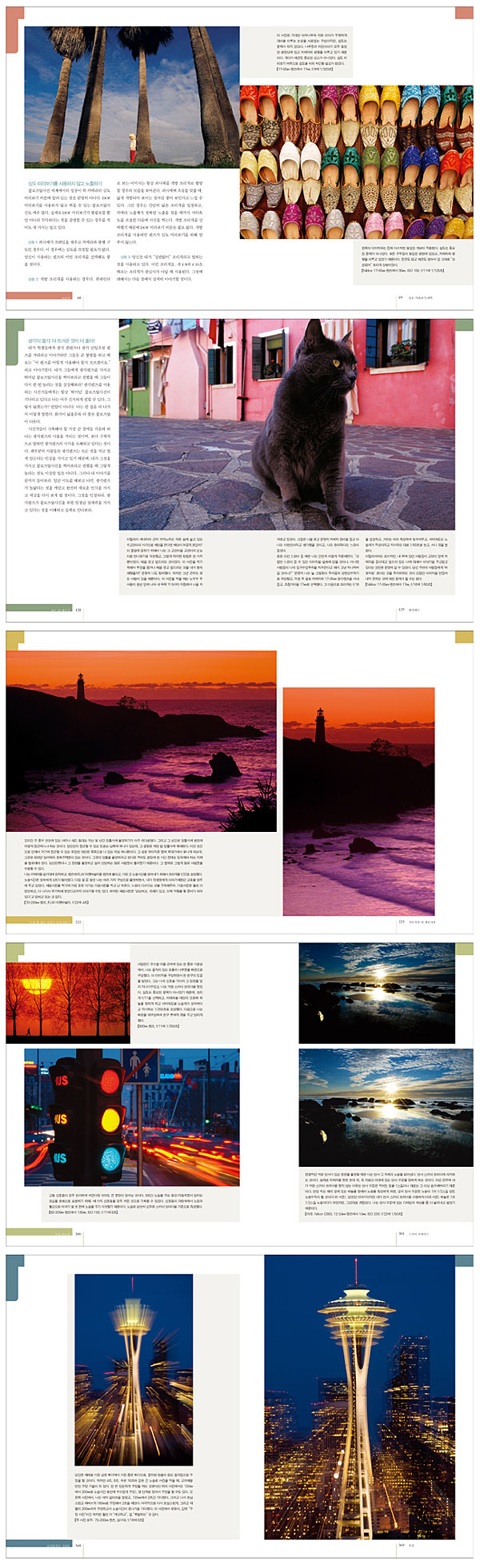
Detailed image
Into the book
Like all my previous books, this one aims to shatter the myth that the art of creating images is reserved for a select few.
You'll quickly grasp and understand the difference between accurate exposure and "creatively accurate exposure." You'll also learn the myth of ISO.
As you work through the many exercises and problems presented in this book, you'll discover ways to see things in ways you never could have imagined before.
--- p.10 'Preface'
If you take 100 shots, no more than 10 will be worth keeping.
If you can be a cool-headed editor and discard those 90 shots you don't think are worth sharing, you'll free up space to store more of the truly valuable images.
If you really need to shoot in both JPEG and RAW, I recommend starting the editing process in camera and immediately deleting any bad JPEG/RAW files.
--- p.17 'A Few Digital Basics'
If you develop the habit of looking at a scene and deciding what aperture and shutter speed to combine to create the most dynamic and creative exposure for that subject, the rewards will be immeasurable.
The choice of such exposure is always yours.
So, wouldn't it be natural to always choose creative exposures whenever taking a photo? --- p.36 'Exposure'
Try my “formula”, it’s absolutely foolproof.
This formula always guarantees success.
First, turn off autofocus.
Use a focal length that provides at least a 75-degree field of view (17mm or 18mm on a non-full-frame DSLR, 28mm on a film camera or full-frame DSLR).
Now, set the aperture to f/22 and focus on an object about 1.5 meters away from the lens.
If you are in manual exposure mode, set the shutter speed to the speed that the light meter indicates as correct exposure and take the picture.
If it's aperture priority auto mode, just shoot.
The camera will determine the shutter speed for you.
--- p.54 'Aperture'
Whether film or digital, most of those fleeting moments you want to record can be captured at shutter speeds within your reach, even at ISO 100.
The idea that you have to go out and use high-sensitivity film (e.g., ISO 400, 800, or 1000) just to freeze motion is a myth! Of course, camera manufacturers have made great strides in reducing noise even in the ultra-high ISO range, from 800 to 2400.
With the promise of “fine grain” at such high ISOs, it’s easy to be tempted to ditch the tripod for good.
Is that really true? --- p.82 'Shutter Speed and ISO'
What's the connection between what we see and what the lens sees? Here's a hint.
If you cover one eye and look around, the human eye sees the same as a 50mm lens.
That's why a lens with a focal length of 50mm is called a 'standard lens'.
If you look at it with both eyes, it's very similar to looking at an 18-70mm lens set to 18mm.
That focal length is as creative as your eye can ever achieve.
The human eye cannot zoom out to bring distant objects closer, nor can it see extreme close-ups with a single turn of the lens, nor can it create fish-eye vision.
But the camera lens can.
--- p.120 'Learning to See'
The most striking photographs are often simple compositions of common subjects.
A successful photograph is one that deals with only one subject, only one idea.
And in those photos, without exception, there is no clutter scattered around.
However, many amateur photographers, in their desire to record an image hastily, end up producing photos with too many focal points, or in some cases, no focal points at all.
Because there is no direction, it ends up being confusing, and so it fails to capture the viewer's attention, and the eye soon leaves the photo in search of visual satisfaction elsewhere.
--- p.161 'Designing Eye-Catching Images'
Does "a certain light" require a completely different aperture and shutter speed? Of course not.
It is still true that accurate exposure is a combination of aperture, shutter speed, and ISO.
And creatively correct exposure is a combination of the right aperture, the right shutter speed, and the right ISO, whether there is light or not.
Light is the best decoration you can put on a cake, not the cake itself.
Is it the same in the past, present and future?
--- p.253 'The Importance of Light'
Until recently, the “rule” in photography was this:
“Keep the horizon level and, above all, focus firmly.” It was also unthinkable for a photographer to handhold a camera and intentionally shoot at a very slow shutter speed.
Those who broke the norm were often ridiculed.
Of course, the reason is that the result is shaky and out of focus.
Fortunately, times have changed, and the idea of what I call “painting with slow shutter speeds” has been embraced by many photographers.
Unlike panning, which requires a lot of practice, this is literally a trial and error exercise.
But when everything falls into place, the results can be truly amazing.
--- p.360 'Non-traditional techniques'
Among the many filters on the market today, if there's one filter every photographer should have, it's a polarizing filter.
The basic purpose of using a polarizing filter is to reduce the glare that reflects off the surface of a subject, such as glass, metal, or water.
On clear days, polarizing filters work best when used at a 90-degree angle to the sun.
This is precisely why side lighting is the best situation to use a polarizing filter.
In other words, the polarizing effect of a polarizing filter is maximized when you are at a 90-degree angle to the sun.
Polarization is not very effective when the sun is behind you or directly in front of you.
You'll quickly grasp and understand the difference between accurate exposure and "creatively accurate exposure." You'll also learn the myth of ISO.
As you work through the many exercises and problems presented in this book, you'll discover ways to see things in ways you never could have imagined before.
--- p.10 'Preface'
If you take 100 shots, no more than 10 will be worth keeping.
If you can be a cool-headed editor and discard those 90 shots you don't think are worth sharing, you'll free up space to store more of the truly valuable images.
If you really need to shoot in both JPEG and RAW, I recommend starting the editing process in camera and immediately deleting any bad JPEG/RAW files.
--- p.17 'A Few Digital Basics'
If you develop the habit of looking at a scene and deciding what aperture and shutter speed to combine to create the most dynamic and creative exposure for that subject, the rewards will be immeasurable.
The choice of such exposure is always yours.
So, wouldn't it be natural to always choose creative exposures whenever taking a photo? --- p.36 'Exposure'
Try my “formula”, it’s absolutely foolproof.
This formula always guarantees success.
First, turn off autofocus.
Use a focal length that provides at least a 75-degree field of view (17mm or 18mm on a non-full-frame DSLR, 28mm on a film camera or full-frame DSLR).
Now, set the aperture to f/22 and focus on an object about 1.5 meters away from the lens.
If you are in manual exposure mode, set the shutter speed to the speed that the light meter indicates as correct exposure and take the picture.
If it's aperture priority auto mode, just shoot.
The camera will determine the shutter speed for you.
--- p.54 'Aperture'
Whether film or digital, most of those fleeting moments you want to record can be captured at shutter speeds within your reach, even at ISO 100.
The idea that you have to go out and use high-sensitivity film (e.g., ISO 400, 800, or 1000) just to freeze motion is a myth! Of course, camera manufacturers have made great strides in reducing noise even in the ultra-high ISO range, from 800 to 2400.
With the promise of “fine grain” at such high ISOs, it’s easy to be tempted to ditch the tripod for good.
Is that really true? --- p.82 'Shutter Speed and ISO'
What's the connection between what we see and what the lens sees? Here's a hint.
If you cover one eye and look around, the human eye sees the same as a 50mm lens.
That's why a lens with a focal length of 50mm is called a 'standard lens'.
If you look at it with both eyes, it's very similar to looking at an 18-70mm lens set to 18mm.
That focal length is as creative as your eye can ever achieve.
The human eye cannot zoom out to bring distant objects closer, nor can it see extreme close-ups with a single turn of the lens, nor can it create fish-eye vision.
But the camera lens can.
--- p.120 'Learning to See'
The most striking photographs are often simple compositions of common subjects.
A successful photograph is one that deals with only one subject, only one idea.
And in those photos, without exception, there is no clutter scattered around.
However, many amateur photographers, in their desire to record an image hastily, end up producing photos with too many focal points, or in some cases, no focal points at all.
Because there is no direction, it ends up being confusing, and so it fails to capture the viewer's attention, and the eye soon leaves the photo in search of visual satisfaction elsewhere.
--- p.161 'Designing Eye-Catching Images'
Does "a certain light" require a completely different aperture and shutter speed? Of course not.
It is still true that accurate exposure is a combination of aperture, shutter speed, and ISO.
And creatively correct exposure is a combination of the right aperture, the right shutter speed, and the right ISO, whether there is light or not.
Light is the best decoration you can put on a cake, not the cake itself.
Is it the same in the past, present and future?
--- p.253 'The Importance of Light'
Until recently, the “rule” in photography was this:
“Keep the horizon level and, above all, focus firmly.” It was also unthinkable for a photographer to handhold a camera and intentionally shoot at a very slow shutter speed.
Those who broke the norm were often ridiculed.
Of course, the reason is that the result is shaky and out of focus.
Fortunately, times have changed, and the idea of what I call “painting with slow shutter speeds” has been embraced by many photographers.
Unlike panning, which requires a lot of practice, this is literally a trial and error exercise.
But when everything falls into place, the results can be truly amazing.
--- p.360 'Non-traditional techniques'
Among the many filters on the market today, if there's one filter every photographer should have, it's a polarizing filter.
The basic purpose of using a polarizing filter is to reduce the glare that reflects off the surface of a subject, such as glass, metal, or water.
On clear days, polarizing filters work best when used at a 90-degree angle to the sun.
This is precisely why side lighting is the best situation to use a polarizing filter.
In other words, the polarizing effect of a polarizing filter is maximized when you are at a 90-degree angle to the sun.
Polarization is not very effective when the sun is behind you or directly in front of you.
--- p.386 'Useful Tools'
Publisher's Review
DSLR basics, exposure, aperture, shutter speed, light, composition, how to view images, etc.
World-renowned photography educator Brian Peterson says:
How to Take Amazing Photos with Any Camera
The ninth book in Cheongoram Media's "Photo Library" series, "All About Bryan Peterson's Photography" (original title: Bryan Peterson's Understanding Photography Field Guide), has been published for readers interested in cameras and visual arts, including photographic mechanisms, photography theory, photography theory, design, and criticism.
The author of this book, Brian Peterson, is a world-renowned photography educator. His previous works, which have already been introduced in Korea, have garnered great responses from readers and have become steady sellers in the art world.
Cheongoram Media's new book, "Everything About Photography by Brian Peterson," is a compilation of six bestselling books by author Brian Peterson ("How to See Images Creatively," "Everything About Exposure for Great Photos," "Everything About DSLRs for Great Photos," "Everything About Portraits," "Everything About Shutter Speed for Great Photos," and "Everything About Macro Photography by Brian Peterson"), and provides a comprehensive overview of photography techniques suited to the new digital environment.
The concept of this book is “How to Shoot Great Photographs with Any Camera.”
Whether you're using a film camera, a DSLR camera, or a standard point-and-shoot camera, we've systematically organized the most basic principles of taking photos.
Therefore, it contains essential information for beginner photographers as well as amateur photographers in general.
Brian Peterson's signature "photography lessons" will help you take amazing, creative photos anytime, anywhere, with any camera, including a solid understanding of exposure, how to "see" an image, how to compose it more creatively, and how to master the magic of light.
Currently ranked 11th in the Amazon Arts category (as of May 11, 2010), this book is worth owning as a 'comprehensive/complete edition' of Brian Peterson's previous bestsellers for readers who have already purchased other books.
Even for readers who are new to Brian Peterson's books, this book alone will provide a great opportunity to master the 'secrets of taking great photographs.'
A comprehensive edition of the best-selling book by world-renowned photography educator Brian Peterson.
Author Brian Peterson is a world-renowned photography educator who has been taking photographs for the past 38 years.
He also founded an online photography school (www.ppsop.com) to provide various photography content and help those who want to learn photography.
This book contains almost everything about photography that the author has learned through firsthand experience, reflection, and reflection since he first started taking pictures.
The author says that no matter how much the photography world changes to digital and technology advances, it cannot affect creativity, which is the element that differentiates images.
It emphasizes that it is solely up to the photographer to capture the 'decisive' moment and 'creatively' compose the image, and presents what, where, and why successful image creation takes place.
Additionally, I advise you not to be caught up in the preconceived notion that you 'have to take it properly.'
Rather, I encourage you to have fun taking photos, as there is no set formula for creating images.
That's why the various exercises and example photos in this book are easy for beginners to understand, friendly, and contain over 38 years of secrets, making them useful for practical use.
The secret to taking great photos in one volume!
This book consists of 400 pages and 11 chapters.
Each chapter is divided into subsections for easy reference, and an index is included so readers can quickly find the page they want using keywords.
1) Some digital basics - It explains the file formats you need to know when working with digital images, the importance of working with RAW files, and helps you understand white balance, color space, etc.
2) Exposure - Explains the basic concepts of exposure, the photographic triangle (3 elements), exposure meters, and the difference between accurate exposure and 'creatively accurate' exposure.
Author Brian Peterson emphasizes that "creative" exposure is more important than accurate exposure for taking great photographs.
3) Aperture - Explains the relationship between aperture and depth of field, how the results of a photograph change depending on the choice of aperture, and teaches about aperture settings and focusing formulas that enable storytelling.
4) Shutter Speed and ISO - The effect of ISO on photography is revealed through the relationship with shutter speed, and that high ISO is not necessary for creating creative images.
Also explained is the appropriate use of fast and slow shutter speeds, panning, and how to set shutter speeds in low-light situations.
5) Learning to See - The author is confident that anyone can learn to see images creatively and introduces a method to do so.
It also teaches you how to choose the right lens, such as a wide-angle lens, telephoto lens, zoom lens, or fish-eye lens, and how to take pictures by looking up or down at the subject depending on the situation.
6) Designing Eye-Catching Images - Learn how to create striking images that capture people's attention using design elements like lines, shapes, forms, textures, patterns, and colors that give order to a photographic composition.
In addition, it teaches you how to design images in Brian Peterson's unique way.
7) The Importance of Light - Explains how to get the best light, how to shoot with front light, side light, and backlight, how to set exposure in various lighting conditions, the 'f/16 rule on a clear day', and even the concept of HDR photography.
8) Close-up Photography - This course introduces the difference between close-up and macro photography, how to use close-up filters, extension tubes, and ring flash, and guides you into the endless world of close-up and macro photography.
9) Photographing People - This course covers the basics of portrait photography, from how to overcome shyness and approach people to how to understand people's psychology to take good portraits.
10) Unconventional Techniques - This book introduces unconventional and unusual photography techniques that the author has found effective, containing unique ideas that are not just about taking pictures, but about irregular methods.
A bonus chapter filled with fun information on creating 'rain' photos, taking 'ghost' photos, and intentional overexposure.
11) Useful Tools - How to choose the necessary equipment among the numerous photographic equipment, introducing useful tools such as tripods and tripod heads, self-timers, mirror locks, cable releases, polarizing filters, ND filters, and multi-tone ND filters.
Main contents of this book
- Digital Basics - File Formats and White Balance
- How to find creative and accurate exposure in any light
- Storytelling aperture and depth of field preview buttons, “don’t care” aperture
- The secret of shutter speed, aperture, and ISO combinations
- How to see things through different lenses
- Design elements such as lines, shapes, forms, textures, patterns, colors, scales, and compositions
- The importance of light and the secret to reading it
- How to take close-up shots using wide-angle and fish-eye lenses
- A variety of subjects, materials, and compositions for intense portraits
- New and unique photography techniques and useful equipment
World-renowned photography educator Brian Peterson says:
How to Take Amazing Photos with Any Camera
The ninth book in Cheongoram Media's "Photo Library" series, "All About Bryan Peterson's Photography" (original title: Bryan Peterson's Understanding Photography Field Guide), has been published for readers interested in cameras and visual arts, including photographic mechanisms, photography theory, photography theory, design, and criticism.
The author of this book, Brian Peterson, is a world-renowned photography educator. His previous works, which have already been introduced in Korea, have garnered great responses from readers and have become steady sellers in the art world.
Cheongoram Media's new book, "Everything About Photography by Brian Peterson," is a compilation of six bestselling books by author Brian Peterson ("How to See Images Creatively," "Everything About Exposure for Great Photos," "Everything About DSLRs for Great Photos," "Everything About Portraits," "Everything About Shutter Speed for Great Photos," and "Everything About Macro Photography by Brian Peterson"), and provides a comprehensive overview of photography techniques suited to the new digital environment.
The concept of this book is “How to Shoot Great Photographs with Any Camera.”
Whether you're using a film camera, a DSLR camera, or a standard point-and-shoot camera, we've systematically organized the most basic principles of taking photos.
Therefore, it contains essential information for beginner photographers as well as amateur photographers in general.
Brian Peterson's signature "photography lessons" will help you take amazing, creative photos anytime, anywhere, with any camera, including a solid understanding of exposure, how to "see" an image, how to compose it more creatively, and how to master the magic of light.
Currently ranked 11th in the Amazon Arts category (as of May 11, 2010), this book is worth owning as a 'comprehensive/complete edition' of Brian Peterson's previous bestsellers for readers who have already purchased other books.
Even for readers who are new to Brian Peterson's books, this book alone will provide a great opportunity to master the 'secrets of taking great photographs.'
A comprehensive edition of the best-selling book by world-renowned photography educator Brian Peterson.
Author Brian Peterson is a world-renowned photography educator who has been taking photographs for the past 38 years.
He also founded an online photography school (www.ppsop.com) to provide various photography content and help those who want to learn photography.
This book contains almost everything about photography that the author has learned through firsthand experience, reflection, and reflection since he first started taking pictures.
The author says that no matter how much the photography world changes to digital and technology advances, it cannot affect creativity, which is the element that differentiates images.
It emphasizes that it is solely up to the photographer to capture the 'decisive' moment and 'creatively' compose the image, and presents what, where, and why successful image creation takes place.
Additionally, I advise you not to be caught up in the preconceived notion that you 'have to take it properly.'
Rather, I encourage you to have fun taking photos, as there is no set formula for creating images.
That's why the various exercises and example photos in this book are easy for beginners to understand, friendly, and contain over 38 years of secrets, making them useful for practical use.
The secret to taking great photos in one volume!
This book consists of 400 pages and 11 chapters.
Each chapter is divided into subsections for easy reference, and an index is included so readers can quickly find the page they want using keywords.
1) Some digital basics - It explains the file formats you need to know when working with digital images, the importance of working with RAW files, and helps you understand white balance, color space, etc.
2) Exposure - Explains the basic concepts of exposure, the photographic triangle (3 elements), exposure meters, and the difference between accurate exposure and 'creatively accurate' exposure.
Author Brian Peterson emphasizes that "creative" exposure is more important than accurate exposure for taking great photographs.
3) Aperture - Explains the relationship between aperture and depth of field, how the results of a photograph change depending on the choice of aperture, and teaches about aperture settings and focusing formulas that enable storytelling.
4) Shutter Speed and ISO - The effect of ISO on photography is revealed through the relationship with shutter speed, and that high ISO is not necessary for creating creative images.
Also explained is the appropriate use of fast and slow shutter speeds, panning, and how to set shutter speeds in low-light situations.
5) Learning to See - The author is confident that anyone can learn to see images creatively and introduces a method to do so.
It also teaches you how to choose the right lens, such as a wide-angle lens, telephoto lens, zoom lens, or fish-eye lens, and how to take pictures by looking up or down at the subject depending on the situation.
6) Designing Eye-Catching Images - Learn how to create striking images that capture people's attention using design elements like lines, shapes, forms, textures, patterns, and colors that give order to a photographic composition.
In addition, it teaches you how to design images in Brian Peterson's unique way.
7) The Importance of Light - Explains how to get the best light, how to shoot with front light, side light, and backlight, how to set exposure in various lighting conditions, the 'f/16 rule on a clear day', and even the concept of HDR photography.
8) Close-up Photography - This course introduces the difference between close-up and macro photography, how to use close-up filters, extension tubes, and ring flash, and guides you into the endless world of close-up and macro photography.
9) Photographing People - This course covers the basics of portrait photography, from how to overcome shyness and approach people to how to understand people's psychology to take good portraits.
10) Unconventional Techniques - This book introduces unconventional and unusual photography techniques that the author has found effective, containing unique ideas that are not just about taking pictures, but about irregular methods.
A bonus chapter filled with fun information on creating 'rain' photos, taking 'ghost' photos, and intentional overexposure.
11) Useful Tools - How to choose the necessary equipment among the numerous photographic equipment, introducing useful tools such as tripods and tripod heads, self-timers, mirror locks, cable releases, polarizing filters, ND filters, and multi-tone ND filters.
Main contents of this book
- Digital Basics - File Formats and White Balance
- How to find creative and accurate exposure in any light
- Storytelling aperture and depth of field preview buttons, “don’t care” aperture
- The secret of shutter speed, aperture, and ISO combinations
- How to see things through different lenses
- Design elements such as lines, shapes, forms, textures, patterns, colors, scales, and compositions
- The importance of light and the secret to reading it
- How to take close-up shots using wide-angle and fish-eye lenses
- A variety of subjects, materials, and compositions for intense portraits
- New and unique photography techniques and useful equipment
GOODS SPECIFICS
- Date of issue: May 12, 2010
- Page count, weight, size: 400 pages | 190*247*30mm
- ISBN13: 9788992492843
- ISBN10: 8992492847
You may also like
카테고리
korean


korean

![GQ KOREA Mark (Monthly): December [2025]](http://librairie.coreenne.fr/cdn/shop/files/8ef265dbbfbf186523ed75ba7319009d.jpg?v=1765340328&width=3840)


