

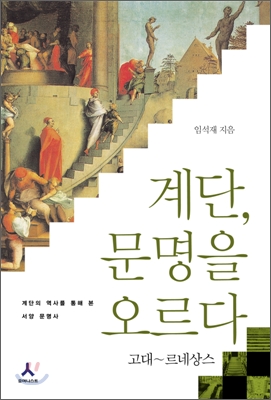
Climbing the Stairs, Civilization Ancient to Renaissance
 |
Description
Book Introduction
Professor Lim Seok-jae (Department of Architecture, Ewha Womans University), an authoritative architectural historian, has written about the history of stairs, the ideas of the times, the perspectives of architects, and stories of our daily lives from a humanities and sociological perspective, using the perspective of the history of civilization.
The author has observed stairs since he began studying architecture, during his graduate school years, and after becoming a professor while traveling domestically and internationally.
This book describes the history of Western civilization through the history of stairs, with extremely ordinary yet very unique observations.
Stairs have been with us throughout human history.
Stairs have been a place that clearly reveals the civilizational phenomena of each era, following the same path as the entire history of Western architecture.
Stairs are a treasure trove where the socio-cultural meaning of each era is intensively stored through architecture.
The author emphasizes that stairs were originally a concentrated cultural symbol representing a civilization.
The 'stairs' inherently embodies the building owner's commissioning intention, the architect's design intention, and the unique way users enjoy and appreciate them, but these are disappearing in the 20th century capitalist history of function and efficiency.
This book, which delves into and interprets the social and humanistic meaning contained in stairs, will allow you to read the history of Western civilization while climbing the stairs.
Volume 1 covers the period from the birth of the staircase through antiquity to the Renaissance.
In ancient times, stairs were built primarily for the purpose of reaching the sky, but in the Greek and Roman era, stairs were built for practical purposes on the ground.
During the Middle Ages, war and Christianity drove the staircase, and during the Renaissance, the staircase was first defined as the work of an individual architect.
Through this book, you will be able to read about the changes in the value and meaning of stairs over time.
The author has observed stairs since he began studying architecture, during his graduate school years, and after becoming a professor while traveling domestically and internationally.
This book describes the history of Western civilization through the history of stairs, with extremely ordinary yet very unique observations.
Stairs have been with us throughout human history.
Stairs have been a place that clearly reveals the civilizational phenomena of each era, following the same path as the entire history of Western architecture.
Stairs are a treasure trove where the socio-cultural meaning of each era is intensively stored through architecture.
The author emphasizes that stairs were originally a concentrated cultural symbol representing a civilization.
The 'stairs' inherently embodies the building owner's commissioning intention, the architect's design intention, and the unique way users enjoy and appreciate them, but these are disappearing in the 20th century capitalist history of function and efficiency.
This book, which delves into and interprets the social and humanistic meaning contained in stairs, will allow you to read the history of Western civilization while climbing the stairs.
Volume 1 covers the period from the birth of the staircase through antiquity to the Renaissance.
In ancient times, stairs were built primarily for the purpose of reaching the sky, but in the Greek and Roman era, stairs were built for practical purposes on the ground.
During the Middle Ages, war and Christianity drove the staircase, and during the Renaissance, the staircase was first defined as the work of an individual architect.
Through this book, you will be able to read about the changes in the value and meaning of stairs over time.
- You can preview some of the book's contents.
Preview
Into the book
“This book is a history of civilization that summarizes the history of Western civilization through the subtle theme of stairs.
If we narrow it down, it provides a wealth of architectural stories and design motifs to architecture majors and general readers interested in the visual arts.
It can be applied practically and can be used to find various topics for humanities and social science research.
In that sense, to enhance the relevance to the present moment, we added examples of modern architects who utilized historical themes in each chapter to create a more realistic feel.”
If we narrow it down, it provides a wealth of architectural stories and design motifs to architecture majors and general readers interested in the visual arts.
It can be applied practically and can be used to find various topics for humanities and social science research.
In that sense, to enhance the relevance to the present moment, we added examples of modern architects who utilized historical themes in each chapter to create a more realistic feel.”
--- From the author's note
Publisher's Review
Restoring the Lost Civilizational Significance of Stairs
One of the things that mankind has been creating since the beginning of time and has always been with us is the staircase.
Because it is such an obvious thing, thinking about 'stairs' itself seems meaningless.
But all around us is a world of stairs.
According to research by historians and architectural historians, stairs have stimulated human vertical desires from ancient times to the present.
Stairs can be said to be human history itself.
Professor Lim Seok-jae (Department of Architecture, Ewha Womans University), Korea's leading architectural historian, has published a new book, "Stairs, Climbing Civilization" (2 volumes), which explores the history of stairs, the ideology of the times, the perspectives of architects, and stories of our daily lives from a humanities and sociological perspective, from the perspective of the history of civilization.
The author has observed stairs since he began studying architecture, during his graduate school years, and after becoming a professor while traveling domestically and internationally.
The history of Western civilization is described through the history of stairs, with extremely ordinary yet very unique observations.
Currently, there are very few staircase experts or staircase architects in Korea.
In this respect, the author's attempt is a very unusual, unique, and meaningful study.
The reality today is that we have lost one of the most interesting, useful, and luxurious structures in human history, yet one that is easily accessible in everyday life: stairs.
The author planned and wrote this book to retrieve this.
"Stairs, Climbing Civilization" restores the original meaning of stairs, a beneficial and interesting cultural heritage of humanity, and provides an opportunity to rediscover the joy felt when climbing stairs in everyday life.
It is no exaggeration to say that the world is truly made up of stairs, and that people's daily lives begin and end with stairs.
Even I didn't realize there were so many stairs around me until I started writing this book.
I realized for the first time that I live surrounded by stairs all day, stepping on them and living in close contact with them.
What is the meaning behind the stairs?
The meaning contained in stairs is endless, from the psychological functioning of an individual to the symbolism of civilization.
A staircase may be a small space or a small part of a building, but the content it contains is comparable to the entire building.
It could be said to be an independent genre.
A history can be made with just stairs.
By tracing just one staircase, you can read the entirety of Western civilization.
--- From 『Stairs, Climbing Civilization: Ancient Times to the Renaissance』 pp. 4-5, 〈Author's Note〉
A History of Western Civilization Seen Through the Stairs: A Treasure Trove of Human History
This building (stairs), which means 'a vertical means of movement connecting two places of different heights', contains the results of human religious, spiritual, and functional activities.
Using Western architectural history as a foundation, the author weaves together the flow of time and concepts and themes, exploring commonalities between the iconic staircases of Western architecture and the countless staircases we see around us. He then explores the everyday experiences of the stairs that make up our lives from a socio-humanistic perspective.
It is about discovering interesting and meaningful examples from a morphological and sociological perspective among stairs that we pass by without noticing, and through this, giving new meaning to the everyday formative environment.
Stairs have been with us throughout human history.
Stairs have been a place that clearly reveals the civilizational phenomena of each era, following the same path as the entire history of Western architecture.
Stairs are a treasure trove where the socio-cultural meaning of each era is intensively stored through architecture.
It is a collection of individual-collective-mental-physical civilizational functions surrounding humans, including religious symbolism, political monumentality, social publicness, economic desire, psychological delicacy, and physiological physicality.
The ancient staircases are represented by the Tower of Babel and the pyramids, which were staircases that inherently represented the vertical desire for heaven.
In Christian civilization, this vertical desire became a curse and a punishment.
During this period, three types of stairs emerged: faith, hope, and love. In the Greco-Roman era, a human-centered staircase faithful to its function also appeared.
In that sense, stairs are a suitable element for expressing humanistic and social meanings.
These humanistic and cultural contents are very important to human history.
What the author wanted to emphasize most in ‘Stairs, Climbing Civilization’ is that ‘stairs were originally a concentrated cultural symbol representing a civilization.’
The author lamented that the 'stairs' inherently embodied the building owner's commissioning intention, the architects' design intention, and the users' unique way of enjoying and appreciating them, and that these were disappearing in the 20th century capitalist history of function and efficiency. He also believed that while function and efficiency are important, they are not worth exchanging entirely for their rich humanities and social science meaning.
This is because the machine-material civilization dominated by function and efficiency lasted only 100 years in the 20th century.
For thousands of years before the modern era, there were brilliant historical civilizations dominated by human spiritual values, and in the 21st century, there is a strong movement to restore those historical values.
In this way, stairs are the most suitable architectural elements to convey various humanistic and sociological meanings.
Historically, there is no building that has as much contemporary and civilizational significance as stairs.
As function and efficiency took over the ladder, human life began to become bleak and brutal.
The important thing is that after function and efficiency became the only values of stairs, safety accidents actually increased.
We need to take a good look at what we have traded for what we have given up… …giving up stairs for elevators and escalators is not a good deal.
The fact that stairs, which were once objects of various pleasures, have become objects of avoidance and that we sigh when we stand in front of them is evidence that our values are seriously distorted.
The social and humanistic meaning that has been saved in the stairs must be restored without fail.
It could be an important part of the mental restoration work that began to emerge in the 21st century to heal the ills of machine-material civilization.
To do so, we must examine what its content is and how those spiritual values are expressed.
In times like these, we need to start again from the very basics.
… … Summarizing the above, it becomes the same as the origin of the birth of stairs.
This common-sense definition is not much different from my theory of the origin of stairs.
I divide the origins of stairs into three main categories: tool instinct, spontaneous generation, and human structure.
These three are the original and fundamental motives of humans before they began to engage in civilized activities through symbolic acts.
Vertical desire is also an important driver, which can be seen as the origin or as a symbolic act that follows from the origin.
The vertical desire is a turning point that connects the fundamental origins and the activities of civilization, and it can be seen that this is the beginning of the history of Western architecture, which we call 'ancient'.
--- From 『Stairs, Climbing Civilization Ancient Times~Renaissance』 pp.19-20, 〈Chapter 1: The Birth of Stairs〉
The only domestic work that deals with the unique theme of 'stairs'
The world is truly made up of stairs, and most of our daily lives begin and end with stairs.
What meaning does a staircase hold? From the psychological functioning of an individual to the symbolism of civilization, the meanings contained within stairs are limitless.
A staircase is a small space or a part within a building, but the content contained within it is comparable to the entire building.
The author believes that a single staircase can create a single history, and that by tracing a single staircase, the entirety of Western civilization can be read.
Stairs are an interesting element from many angles, making them a great place for architects to exercise their imagination when designing their own buildings.
For theorists, architects, or humanities researchers, it is a fascinating subject that allows them to traverse the entire history of Western civilization with a single, small topic.
Despite these advantages, there have been no books in Korea that study or introduce stairs.
There are a few books for architecture students in the West, but they are mostly superficial and the content is very similar.
There is no book in the world that deeply explores and interprets the social and humanistic meaning contained in stairs.
There are about 10 volumes in the West, and as I mentioned in the Author's Note, their contents are surprisingly similar.
In our country, it is so controversial that only the original author's book can be published.
In other words, Western stairs have standardized content.
However, there are many problems with this Western research as well.
First of all, the content is too poor.
It only lists very light and superficial simple information that would fit in a children's encyclopedia, and the amount is too small.
There is little in the way of personal judgment or appreciation, and no content related to humanities, social sciences, history, etc.
It's mostly filled with photos, and the photos are all the same for about 10 books.
The photos ended up being larger than necessary because I was trying to fit them into the book's page count.
There are no books on stairs in Korea.
There are a few cases where it was covered in graduate school theses, but they are only summaries of the Western books mentioned above.
We are proud to say that this is the first attempt of its kind in our country and the world.
--- From the press release “Author Interview”
One of the things that mankind has been creating since the beginning of time and has always been with us is the staircase.
Because it is such an obvious thing, thinking about 'stairs' itself seems meaningless.
But all around us is a world of stairs.
According to research by historians and architectural historians, stairs have stimulated human vertical desires from ancient times to the present.
Stairs can be said to be human history itself.
Professor Lim Seok-jae (Department of Architecture, Ewha Womans University), Korea's leading architectural historian, has published a new book, "Stairs, Climbing Civilization" (2 volumes), which explores the history of stairs, the ideology of the times, the perspectives of architects, and stories of our daily lives from a humanities and sociological perspective, from the perspective of the history of civilization.
The author has observed stairs since he began studying architecture, during his graduate school years, and after becoming a professor while traveling domestically and internationally.
The history of Western civilization is described through the history of stairs, with extremely ordinary yet very unique observations.
Currently, there are very few staircase experts or staircase architects in Korea.
In this respect, the author's attempt is a very unusual, unique, and meaningful study.
The reality today is that we have lost one of the most interesting, useful, and luxurious structures in human history, yet one that is easily accessible in everyday life: stairs.
The author planned and wrote this book to retrieve this.
"Stairs, Climbing Civilization" restores the original meaning of stairs, a beneficial and interesting cultural heritage of humanity, and provides an opportunity to rediscover the joy felt when climbing stairs in everyday life.
It is no exaggeration to say that the world is truly made up of stairs, and that people's daily lives begin and end with stairs.
Even I didn't realize there were so many stairs around me until I started writing this book.
I realized for the first time that I live surrounded by stairs all day, stepping on them and living in close contact with them.
What is the meaning behind the stairs?
The meaning contained in stairs is endless, from the psychological functioning of an individual to the symbolism of civilization.
A staircase may be a small space or a small part of a building, but the content it contains is comparable to the entire building.
It could be said to be an independent genre.
A history can be made with just stairs.
By tracing just one staircase, you can read the entirety of Western civilization.
--- From 『Stairs, Climbing Civilization: Ancient Times to the Renaissance』 pp. 4-5, 〈Author's Note〉
A History of Western Civilization Seen Through the Stairs: A Treasure Trove of Human History
This building (stairs), which means 'a vertical means of movement connecting two places of different heights', contains the results of human religious, spiritual, and functional activities.
Using Western architectural history as a foundation, the author weaves together the flow of time and concepts and themes, exploring commonalities between the iconic staircases of Western architecture and the countless staircases we see around us. He then explores the everyday experiences of the stairs that make up our lives from a socio-humanistic perspective.
It is about discovering interesting and meaningful examples from a morphological and sociological perspective among stairs that we pass by without noticing, and through this, giving new meaning to the everyday formative environment.
Stairs have been with us throughout human history.
Stairs have been a place that clearly reveals the civilizational phenomena of each era, following the same path as the entire history of Western architecture.
Stairs are a treasure trove where the socio-cultural meaning of each era is intensively stored through architecture.
It is a collection of individual-collective-mental-physical civilizational functions surrounding humans, including religious symbolism, political monumentality, social publicness, economic desire, psychological delicacy, and physiological physicality.
The ancient staircases are represented by the Tower of Babel and the pyramids, which were staircases that inherently represented the vertical desire for heaven.
In Christian civilization, this vertical desire became a curse and a punishment.
During this period, three types of stairs emerged: faith, hope, and love. In the Greco-Roman era, a human-centered staircase faithful to its function also appeared.
In that sense, stairs are a suitable element for expressing humanistic and social meanings.
These humanistic and cultural contents are very important to human history.
What the author wanted to emphasize most in ‘Stairs, Climbing Civilization’ is that ‘stairs were originally a concentrated cultural symbol representing a civilization.’
The author lamented that the 'stairs' inherently embodied the building owner's commissioning intention, the architects' design intention, and the users' unique way of enjoying and appreciating them, and that these were disappearing in the 20th century capitalist history of function and efficiency. He also believed that while function and efficiency are important, they are not worth exchanging entirely for their rich humanities and social science meaning.
This is because the machine-material civilization dominated by function and efficiency lasted only 100 years in the 20th century.
For thousands of years before the modern era, there were brilliant historical civilizations dominated by human spiritual values, and in the 21st century, there is a strong movement to restore those historical values.
In this way, stairs are the most suitable architectural elements to convey various humanistic and sociological meanings.
Historically, there is no building that has as much contemporary and civilizational significance as stairs.
As function and efficiency took over the ladder, human life began to become bleak and brutal.
The important thing is that after function and efficiency became the only values of stairs, safety accidents actually increased.
We need to take a good look at what we have traded for what we have given up… …giving up stairs for elevators and escalators is not a good deal.
The fact that stairs, which were once objects of various pleasures, have become objects of avoidance and that we sigh when we stand in front of them is evidence that our values are seriously distorted.
The social and humanistic meaning that has been saved in the stairs must be restored without fail.
It could be an important part of the mental restoration work that began to emerge in the 21st century to heal the ills of machine-material civilization.
To do so, we must examine what its content is and how those spiritual values are expressed.
In times like these, we need to start again from the very basics.
… … Summarizing the above, it becomes the same as the origin of the birth of stairs.
This common-sense definition is not much different from my theory of the origin of stairs.
I divide the origins of stairs into three main categories: tool instinct, spontaneous generation, and human structure.
These three are the original and fundamental motives of humans before they began to engage in civilized activities through symbolic acts.
Vertical desire is also an important driver, which can be seen as the origin or as a symbolic act that follows from the origin.
The vertical desire is a turning point that connects the fundamental origins and the activities of civilization, and it can be seen that this is the beginning of the history of Western architecture, which we call 'ancient'.
--- From 『Stairs, Climbing Civilization Ancient Times~Renaissance』 pp.19-20, 〈Chapter 1: The Birth of Stairs〉
The only domestic work that deals with the unique theme of 'stairs'
The world is truly made up of stairs, and most of our daily lives begin and end with stairs.
What meaning does a staircase hold? From the psychological functioning of an individual to the symbolism of civilization, the meanings contained within stairs are limitless.
A staircase is a small space or a part within a building, but the content contained within it is comparable to the entire building.
The author believes that a single staircase can create a single history, and that by tracing a single staircase, the entirety of Western civilization can be read.
Stairs are an interesting element from many angles, making them a great place for architects to exercise their imagination when designing their own buildings.
For theorists, architects, or humanities researchers, it is a fascinating subject that allows them to traverse the entire history of Western civilization with a single, small topic.
Despite these advantages, there have been no books in Korea that study or introduce stairs.
There are a few books for architecture students in the West, but they are mostly superficial and the content is very similar.
There is no book in the world that deeply explores and interprets the social and humanistic meaning contained in stairs.
There are about 10 volumes in the West, and as I mentioned in the Author's Note, their contents are surprisingly similar.
In our country, it is so controversial that only the original author's book can be published.
In other words, Western stairs have standardized content.
However, there are many problems with this Western research as well.
First of all, the content is too poor.
It only lists very light and superficial simple information that would fit in a children's encyclopedia, and the amount is too small.
There is little in the way of personal judgment or appreciation, and no content related to humanities, social sciences, history, etc.
It's mostly filled with photos, and the photos are all the same for about 10 books.
The photos ended up being larger than necessary because I was trying to fit them into the book's page count.
There are no books on stairs in Korea.
There are a few cases where it was covered in graduate school theses, but they are only summaries of the Western books mentioned above.
We are proud to say that this is the first attempt of its kind in our country and the world.
--- From the press release “Author Interview”
GOODS SPECIFICS
- Date of issue: September 21, 2009
- Page count, weight, size: 296 pages | 526g | 153*224*20mm
- ISBN13: 9788958622888
- ISBN10: 8958622881
You may also like
카테고리
korean


korean

![GQ KOREA Mark (Monthly): December [2025]](http://librairie.coreenne.fr/cdn/shop/files/8ef265dbbfbf186523ed75ba7319009d.jpg?v=1765340328&width=3840)


