

Such unexpected brain science
 |
Description
Book Introduction
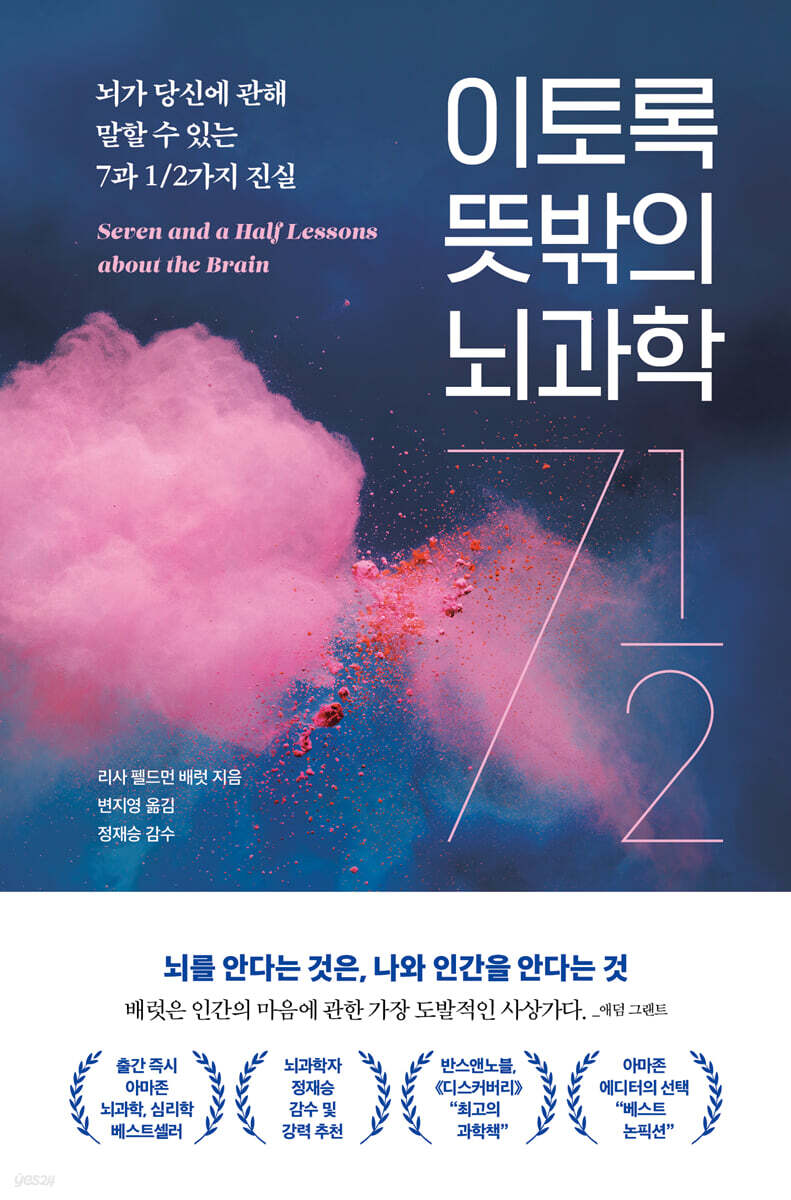
To know the brain is to know myself and humanity. A Very Short Brain Science Lecture from One Percent of Scientists Have you ever wondered why we have brains? Remember nodding along to the "Trinity Brain" narrative in popular journals and marketing books? Have you ever wondered what goes on in someone's head when they post unacceptable thoughts on social media? In her new book, "The Unexpected Brain," world-renowned neuroscientist Lisa Feldman Barrett offers a different perspective on the 3.5-pound gray mass nestled between our ears than you've likely heard in other neuroscience books. According to Professor Jaeseung Jeong of KAIST, who reviewed this book, it is “a very unique lecture series that captures the essence of 21st-century brain science.” Seven short but powerful lectures from the forefront of neuroscience research, plus an even shorter narrative (half a lecture, according to the author) that briefly explores the brain's vast evolutionary history, all in one volume, encompass the major discoveries and discussions of 21st-century neuroscience. The story in this book begins with a brief summary of the history of evolution and neuroscience, but soon expands to major issues in our daily lives and society. It is easy and interesting, yet at the same time, it awakens fundamental questions, broadening the reader's intellectual curiosity and mental world in an instant. |
- You can preview some of the book's contents.
Preview
index
½ A Very Short Evolutionary Lesson
The brain is not meant to think.
Lecture 1: Beyond Old Fiction
The brain is one, throw away the triune brain.
Lecture 2: How the Human Brain Is Made
The brain is a 'network'
Lecture 3: On Human Upbringing
Young brains connect with the world on their own.
4. Your brain knows before you do.
Your brain predicts almost every action you make.
Lesson 5: The Blessing or Hell of Other People's Brains
Your brain is invisible
Moves with other brains
6. Diversity is the standard
The human brain
Creates different types of hearts
Lecture 7: The World Inside the Brain
The human brain creates reality.
Appendix: The Science Behind Science
Epilogue / Translator's Note / Index
The brain is not meant to think.
Lecture 1: Beyond Old Fiction
The brain is one, throw away the triune brain.
Lecture 2: How the Human Brain Is Made
The brain is a 'network'
Lecture 3: On Human Upbringing
Young brains connect with the world on their own.
4. Your brain knows before you do.
Your brain predicts almost every action you make.
Lesson 5: The Blessing or Hell of Other People's Brains
Your brain is invisible
Moves with other brains
6. Diversity is the standard
The human brain
Creates different types of hearts
Lecture 7: The World Inside the Brain
The human brain creates reality.
Appendix: The Science Behind Science
Epilogue / Translator's Note / Index
Detailed image
Into the book
Why did the brain evolve the way yours does? This is a question that's virtually impossible to answer.
Because evolution does not happen with a purpose.
There is no 'why' in evolution.
But at least you can tell what the most important task of your brain is.
The brain's core job is not reason.
It's not even an emotion.
It's not even my imagination.
It's not creativity or empathy.
The brain's most important task is to control the body to perform valuable movements efficiently by predicting when and how much energy will be needed for survival—allostasis.
(syncopation)
Simply put, the most important thing your brain does is not think.
It is about evolving from a small insect to a very, very complex body.
--- 「1/2 class.
From "The brain is not meant to think"
When we think about something, feel an emotion like happiness, anger, or awe, hug someone or be hugged, be kind to someone, or tolerate an insult, we don't feel like we're adding or subtracting resources from our body's metabolic budget.
But inside the body, that's exactly what happens.
The concept of a "body budget" is key to understanding how your brain works and ultimately unlocking the key to living a longer, healthier, and more meaningful life.
--- 「1/2 class.
From "The brain is not meant to think"
Fortunately, we don't have to reconcile these two.
Because one is wrong.
The Trinity Brain hypothesis is one of the most successful and widespread fallacies in all of science.
This story is certainly compelling and sometimes accurately reflects how we feel in our daily lives.
(Omitted) But the human brain doesn't work that way.
Bad behavior does not come from an unbridled ancient beast within.
Good behavior is not the result of reason.
And reason and emotion are not at war with each other, nor do they even reside in separate parts of the brain.
--- 「Lecture 1.
From "The brain is one, throw away the trinity brain"
Scientists recently discovered that the brains of all mammals are built according to a single manufacturing plan, and that reptiles and other vertebrates are likely built according to the same plan.
Many people, including neuroscientists, are still unaware of this research.
Even those who know are only just beginning to think about what these findings mean.
(Omitted) Yes.
As far as scientific knowledge goes, you have the same brain-building plan as the lamprey eel, which survives by sucking the blood of other fish.
--- 「Lecture 1.
From "The brain is one, throw away the trinity brain"
Your brain is one, not three.
To move beyond the inner battle Plato spoke of, we need to fundamentally rethink what it means to be rational, what it means to be responsible for our actions, and even what it means to be human.
--- 「Lecture 1.
From "The brain is one, throw away the trinity brain"
No neuron has just one psychological function.
(Omitted) I am not saying that all neurons can do everything.
Just as an airport can fly planes, sell tickets, and serve crappy food, every neuron can do 'more than one thing.'
It is also true that different groups of neurons can produce the same result.
Right now, try reaching out to grab something in front of you, whether it's a cell phone or a piece of chocolate.
Take your hand away and then try reaching out again in the same way you did before.
Even a simple action like reaching out for something can be accomplished by a different combination of neurons each time you do it.
This phenomenon is called 'degeneracy'.
--- 「Lecture 2.
From "The Brain is a 'Network'"
As I said before, brain networks are not a metaphor, but the best scientific explanation we have for the brain today.
This description makes us think about how a single physical structure can be rewired in an instant to efficiently integrate vast amounts of information.
It also reveals similarities and differences between different types of brains by quantifying their complexity.
It also helps us understand how the brain repairs itself when damaged.
--- 「Lecture 2.
From "The Brain is a 'Network'"
What's truly frustrating is that this tragedy was 'preventable'.
(I hope you understand that I'm stepping aside for a moment as a scientist.) Politicians have been dragging their feet for decades on the problem of lifting children out of poverty.
So, let's put politics aside and try to explain this issue in simple financial terms.
Childhood poverty robs people of tremendous opportunity.
Recent estimates suggest that eradicating poverty now costs far less than addressing its consequences decades later.
We can provide free meal programs to students in need in more areas.
Cities can enact noise ordinances to regulate poor neighborhoods.
These types of measures aren't just about quality of life.
Only by creating an environment where the brain can develop healthily can all children become the next generation of workers, citizens, and innovators.
--- 「3rd lecture.
From “The young brain connects itself to the world”
When it comes to the brain, simple distinctions like nature versus nurture may be tempting, but they are far from the truth.
We have a 'nature that needs nurturing'.
For our genes to create a fully developed brain, they need the right physical and social environment—the right place.
We need a place filled with caregivers who make eye contact with our children, talk to them, set a regular sleep schedule, and maintain their body temperature.
We all know that how we treat our children matters.
But it's more important than we knew a few decades ago.
--- 「3rd lecture.
From “The young brain connects itself to the world”
Just wait a minute.
There is one more fact.
The entire process that constitutes this experience occurs in a 'predictable way'.
Scientists have discovered that our brains begin to detect real-time changes in the world around us before sensory data, including light waves and chemicals, reach the brain.
The same goes for the changes that occur in the body every moment.
Our brain begins to sense data from various bodily systems, including organs and hormones, even before they arrive.
--- 「4th round.
From "Your brain predicts almost all your actions"
Instead, think about an experience where you were thirsty and drank a glass of water.
Your thirst will be quenched within seconds of drinking the last drop.
This phenomenon may seem obvious, but it actually takes about 20 minutes for water to reach the bloodstream.
So, you won't be able to quench your thirst in a few seconds by drinking water.
So what quenches your thirst? It's prediction.
The brain plans and executes the actions of drinking and swallowing, while also anticipating the consequences of drinking water, making you feel less thirsty long before the water has a direct effect on your blood.
--- 「4th round.
From "Your brain predicts almost all your actions"
Since the emergence of philosophy, countless scholars, including philosophers, have continued to debate the existence of free will.
I don't think we'll end the debate here.
But it's worth highlighting one piece of the puzzle that's often been overlooked in that debate.
(syncopation)
Your brain used its predictive power before initiating the action, and you didn't feel like you had done anything yourself.
If I had exercised more self-control at that moment, would I have been able to change my behavior? It probably wouldn't have been easy.
Are we responsible for these actions? Of course.
You have more responsibility than you think.
--- 「4th round.
From "Your brain predicts almost all your actions"
If your brain isn't simply reacting to the world, but actively predicting it and even rewiring itself, who's to blame when you misbehave? You are.
The 'responsibility' I'm talking about here isn't responsibility for the tragedies people experience in their lives or the adversities they experience as a result.
(Omitted) I am talking about something else.
Sometimes we are responsible not because we did something wrong, but because we are the only ones who can change it.
--- 「4th round.
From "Your brain predicts almost all your actions"
Humans are quite unique even in the animal kingdom.
Because we control each other with ‘words’.
After a hard day, hearing a word of encouragement from a friend can be soothing.
When you hear aversive words from a threatening person, your brain anticipates danger and releases a flood of hormones into your bloodstream, which can drain precious resources from your body's budget.
--- 「5th lecture.
From "Your brain moves invisibly with other brains"
Why do the words you encounter have such a profound impact on your inner self? It's because many of the areas of the brain that process language also control the inner workings of the body.
This also includes major organs and systems that support the body budget.
These brain regions, which scientists call the "language network," guide us to increase or decrease our heart rate.
It also regulates the glucose that enters the bloodstream to fuel cells and alters the flow of chemicals that support the immune system.
‘The power of words’ is not a metaphor.
The power of words lies in the wiring of your brain.
--- 「5th lecture.
From "Your brain moves invisibly with other brains"
People in Bali, Indonesia, fall asleep when they are afraid.
Or at least 'it is made of'.
It may seem strange to fall asleep when you feel afraid.
(Omitted) What kind of mind is a mind that falls asleep in fear? It must be a different kind of mind from yours.
--- 「6.
From "The human brain creates various types of minds"
No kind of mind is inherently better or worse than any other mind.
There are just mutations that are better adapted to the environment.
When it comes to the human mind, it is normal for there to be variation.
What we call 'human nature' is really the nature of many humans.
It is not possible to claim that humans are one species without having one universal mind.
All we need is a very complex brain that connects itself to its physical and social environment.
--- 「6.
From "The human brain creates various types of minds"
Social reality may be one of our greatest achievements, but it is also a weapon we can wield against each other.
Social reality is vulnerable to manipulation.
Democracy itself is a social reality.
Social reality is a superpower that emerges from the ensemble of human brains.
This allows us to plan our own destiny and even influence the evolution of our species.
(Omitted) We can influence reality more than we think.
We also have a greater responsibility for reality than we realize.
Because evolution does not happen with a purpose.
There is no 'why' in evolution.
But at least you can tell what the most important task of your brain is.
The brain's core job is not reason.
It's not even an emotion.
It's not even my imagination.
It's not creativity or empathy.
The brain's most important task is to control the body to perform valuable movements efficiently by predicting when and how much energy will be needed for survival—allostasis.
(syncopation)
Simply put, the most important thing your brain does is not think.
It is about evolving from a small insect to a very, very complex body.
--- 「1/2 class.
From "The brain is not meant to think"
When we think about something, feel an emotion like happiness, anger, or awe, hug someone or be hugged, be kind to someone, or tolerate an insult, we don't feel like we're adding or subtracting resources from our body's metabolic budget.
But inside the body, that's exactly what happens.
The concept of a "body budget" is key to understanding how your brain works and ultimately unlocking the key to living a longer, healthier, and more meaningful life.
--- 「1/2 class.
From "The brain is not meant to think"
Fortunately, we don't have to reconcile these two.
Because one is wrong.
The Trinity Brain hypothesis is one of the most successful and widespread fallacies in all of science.
This story is certainly compelling and sometimes accurately reflects how we feel in our daily lives.
(Omitted) But the human brain doesn't work that way.
Bad behavior does not come from an unbridled ancient beast within.
Good behavior is not the result of reason.
And reason and emotion are not at war with each other, nor do they even reside in separate parts of the brain.
--- 「Lecture 1.
From "The brain is one, throw away the trinity brain"
Scientists recently discovered that the brains of all mammals are built according to a single manufacturing plan, and that reptiles and other vertebrates are likely built according to the same plan.
Many people, including neuroscientists, are still unaware of this research.
Even those who know are only just beginning to think about what these findings mean.
(Omitted) Yes.
As far as scientific knowledge goes, you have the same brain-building plan as the lamprey eel, which survives by sucking the blood of other fish.
--- 「Lecture 1.
From "The brain is one, throw away the trinity brain"
Your brain is one, not three.
To move beyond the inner battle Plato spoke of, we need to fundamentally rethink what it means to be rational, what it means to be responsible for our actions, and even what it means to be human.
--- 「Lecture 1.
From "The brain is one, throw away the trinity brain"
No neuron has just one psychological function.
(Omitted) I am not saying that all neurons can do everything.
Just as an airport can fly planes, sell tickets, and serve crappy food, every neuron can do 'more than one thing.'
It is also true that different groups of neurons can produce the same result.
Right now, try reaching out to grab something in front of you, whether it's a cell phone or a piece of chocolate.
Take your hand away and then try reaching out again in the same way you did before.
Even a simple action like reaching out for something can be accomplished by a different combination of neurons each time you do it.
This phenomenon is called 'degeneracy'.
--- 「Lecture 2.
From "The Brain is a 'Network'"
As I said before, brain networks are not a metaphor, but the best scientific explanation we have for the brain today.
This description makes us think about how a single physical structure can be rewired in an instant to efficiently integrate vast amounts of information.
It also reveals similarities and differences between different types of brains by quantifying their complexity.
It also helps us understand how the brain repairs itself when damaged.
--- 「Lecture 2.
From "The Brain is a 'Network'"
What's truly frustrating is that this tragedy was 'preventable'.
(I hope you understand that I'm stepping aside for a moment as a scientist.) Politicians have been dragging their feet for decades on the problem of lifting children out of poverty.
So, let's put politics aside and try to explain this issue in simple financial terms.
Childhood poverty robs people of tremendous opportunity.
Recent estimates suggest that eradicating poverty now costs far less than addressing its consequences decades later.
We can provide free meal programs to students in need in more areas.
Cities can enact noise ordinances to regulate poor neighborhoods.
These types of measures aren't just about quality of life.
Only by creating an environment where the brain can develop healthily can all children become the next generation of workers, citizens, and innovators.
--- 「3rd lecture.
From “The young brain connects itself to the world”
When it comes to the brain, simple distinctions like nature versus nurture may be tempting, but they are far from the truth.
We have a 'nature that needs nurturing'.
For our genes to create a fully developed brain, they need the right physical and social environment—the right place.
We need a place filled with caregivers who make eye contact with our children, talk to them, set a regular sleep schedule, and maintain their body temperature.
We all know that how we treat our children matters.
But it's more important than we knew a few decades ago.
--- 「3rd lecture.
From “The young brain connects itself to the world”
Just wait a minute.
There is one more fact.
The entire process that constitutes this experience occurs in a 'predictable way'.
Scientists have discovered that our brains begin to detect real-time changes in the world around us before sensory data, including light waves and chemicals, reach the brain.
The same goes for the changes that occur in the body every moment.
Our brain begins to sense data from various bodily systems, including organs and hormones, even before they arrive.
--- 「4th round.
From "Your brain predicts almost all your actions"
Instead, think about an experience where you were thirsty and drank a glass of water.
Your thirst will be quenched within seconds of drinking the last drop.
This phenomenon may seem obvious, but it actually takes about 20 minutes for water to reach the bloodstream.
So, you won't be able to quench your thirst in a few seconds by drinking water.
So what quenches your thirst? It's prediction.
The brain plans and executes the actions of drinking and swallowing, while also anticipating the consequences of drinking water, making you feel less thirsty long before the water has a direct effect on your blood.
--- 「4th round.
From "Your brain predicts almost all your actions"
Since the emergence of philosophy, countless scholars, including philosophers, have continued to debate the existence of free will.
I don't think we'll end the debate here.
But it's worth highlighting one piece of the puzzle that's often been overlooked in that debate.
(syncopation)
Your brain used its predictive power before initiating the action, and you didn't feel like you had done anything yourself.
If I had exercised more self-control at that moment, would I have been able to change my behavior? It probably wouldn't have been easy.
Are we responsible for these actions? Of course.
You have more responsibility than you think.
--- 「4th round.
From "Your brain predicts almost all your actions"
If your brain isn't simply reacting to the world, but actively predicting it and even rewiring itself, who's to blame when you misbehave? You are.
The 'responsibility' I'm talking about here isn't responsibility for the tragedies people experience in their lives or the adversities they experience as a result.
(Omitted) I am talking about something else.
Sometimes we are responsible not because we did something wrong, but because we are the only ones who can change it.
--- 「4th round.
From "Your brain predicts almost all your actions"
Humans are quite unique even in the animal kingdom.
Because we control each other with ‘words’.
After a hard day, hearing a word of encouragement from a friend can be soothing.
When you hear aversive words from a threatening person, your brain anticipates danger and releases a flood of hormones into your bloodstream, which can drain precious resources from your body's budget.
--- 「5th lecture.
From "Your brain moves invisibly with other brains"
Why do the words you encounter have such a profound impact on your inner self? It's because many of the areas of the brain that process language also control the inner workings of the body.
This also includes major organs and systems that support the body budget.
These brain regions, which scientists call the "language network," guide us to increase or decrease our heart rate.
It also regulates the glucose that enters the bloodstream to fuel cells and alters the flow of chemicals that support the immune system.
‘The power of words’ is not a metaphor.
The power of words lies in the wiring of your brain.
--- 「5th lecture.
From "Your brain moves invisibly with other brains"
People in Bali, Indonesia, fall asleep when they are afraid.
Or at least 'it is made of'.
It may seem strange to fall asleep when you feel afraid.
(Omitted) What kind of mind is a mind that falls asleep in fear? It must be a different kind of mind from yours.
--- 「6.
From "The human brain creates various types of minds"
No kind of mind is inherently better or worse than any other mind.
There are just mutations that are better adapted to the environment.
When it comes to the human mind, it is normal for there to be variation.
What we call 'human nature' is really the nature of many humans.
It is not possible to claim that humans are one species without having one universal mind.
All we need is a very complex brain that connects itself to its physical and social environment.
--- 「6.
From "The human brain creates various types of minds"
Social reality may be one of our greatest achievements, but it is also a weapon we can wield against each other.
Social reality is vulnerable to manipulation.
Democracy itself is a social reality.
Social reality is a superpower that emerges from the ensemble of human brains.
This allows us to plan our own destiny and even influence the evolution of our species.
(Omitted) We can influence reality more than we think.
We also have a greater responsibility for reality than we realize.
--- 「Lecture 7.
From "The human brain creates reality"
From "The human brain creates reality"
Publisher's Review
Amazon's Brain Science and Psychology Bestseller immediately after publication
Reviewed and strongly recommended by neuroscientist Jaeseung Jeong
Barnes & Noble's Discovery "Best Science Book"
Amazon Editors' Choice 'Best Nonfiction'
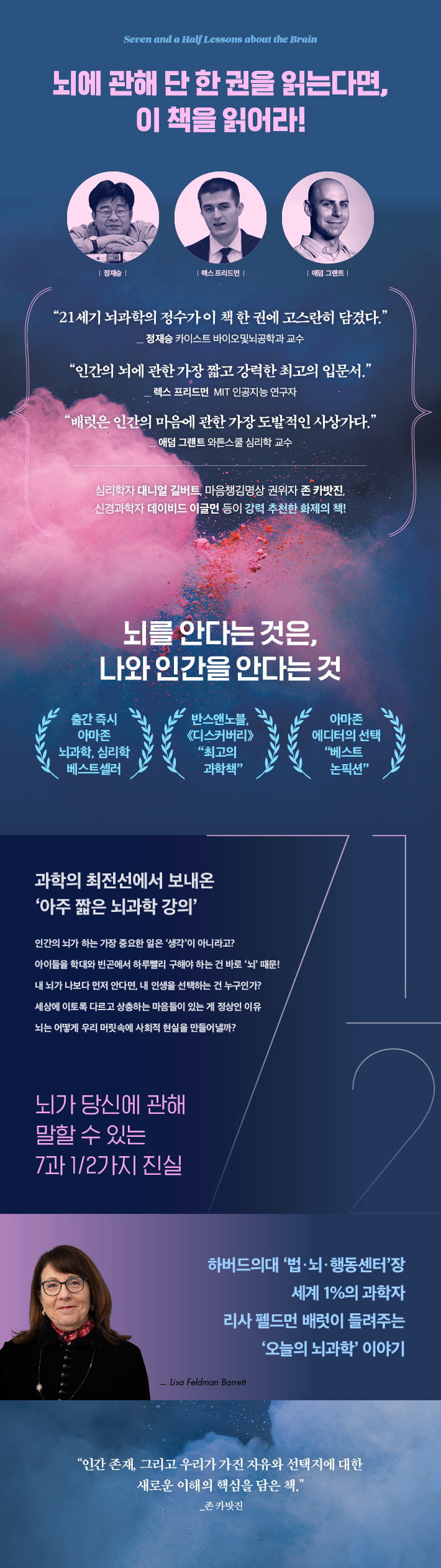
“The essence of 21st-century brain science is contained in this one book.”
Jaeseung Jeong, Professor of Bio and Brain Engineering at KAIST
“The shortest and most powerful introduction to the human brain.”
_Rex Friedman, MIT artificial intelligence researcher
Why did the brain evolve like yours? The obvious answer is "to think."
We often assume that the brain evolved in a kind of 'upward progression'.
In other words, it is assumed that the human brain, which is a 'thinking brain' that is more elaborately designed than that of any other animal, is at the very top of the pyramid, having evolved from lower animals to higher animals.
After all, thinking is the greatest power humans have.
Isn't that right?
But this obvious answer turned out to be wrong.
In fact, the idea that our brains evolved to think has been the source of a huge misunderstanding about human nature.
If you've let go of that precious belief, you've taken the first step toward understanding the brain.
We're one step closer to understanding how our brains actually work, what their most important tasks are, and ultimately, what kind of creatures we really are.
_'1/2 class.
From 'The brain is not meant to think'
“Barrett is the most provocative thinker on the human mind.”
Adam Grant, Wharton School professor of psychology and author of Give and Take and Think Again
A Very Short Brain Science Lecture from One Percent of Scientists
The human brain is not designed for 'rational thinking'.
So what is the brain's highest purpose?
The 'Trinity Brain' is a fiction.
The frame through which we view the human brain has long since changed.
If my brain predicts almost every action I take, who gets to choose and take charge of my life?
The reason we must rescue children from abuse and poverty as soon as possible lies in our brains.
Why and how do chronic stress and verbal abuse actually harm our bodies?
Why it's normal for there to be so many different and conflicting minds in the world
The brain creates all the social realities we experience 'in our heads'.
7 1/2 Doors to the Brain
Have you ever wondered why we have brains? Remember nodding along to the "Trinity Brain" narrative in popular journals and marketing books? Have you ever wondered what goes on in someone's head when they post unacceptable thoughts on social media?
In her new book, The Brain: A Brain Study, world-renowned neuroscientist Lisa Feldman Barrett tells a story quite different from what you might have heard in other neuroscience books about the 1.4-kilogram gray mass that sits between our ears.
According to Professor Jaeseung Jeong of KAIST, who reviewed this book, it is “a very unique lecture series that captures the essence of 21st-century brain science.”
Seven short but powerful lectures from the forefront of neuroscience research, plus an even shorter narrative (half a lecture, according to the author) that briefly explores the brain's vast evolutionary history, all in one volume, encompass the major discoveries and discussions of 21st-century neuroscience.
The story in this book begins with a brief summary of the history of evolution and neuroscience, but soon expands to major issues in our daily lives and society.
It is easy and interesting, yet at the same time, it awakens fundamental questions, broadening the reader's intellectual curiosity and mental world in an instant.
★★★★★
“If you want to know about the brain and its magic, start with this book.”
David Eagleman, neuroscientist at Stanford University
“The core of a new understanding of human existence and the freedom and choices we possess.”
_Jon Kabat-Zinn, mindfulness meditation authority and founder of MBSR
“A fun and smart look at things we think we know about the brain, but actually don’t.”
Daniel Gilbert, Professor of Psychology at Harvard University
We didn't know much about the brain
The definitive guide to today's brain science.
The brain is the center of the human body.
Over the past few decades, as full-scale neuroscience research has become possible, advice based on the findings of neuroscience is pouring out in various fields, from personal relationships to politics, economics, education, marketing, and medicine.
However, keeping up with the flow of knowledge and updating new knowledge is not easy for the public as well as experts.
So, the world we live in is a mix of old knowledge, common sense, distorted facts, and self-serving arguments mixed with interesting and sometimes revolutionary new knowledge.
So, how much do we truly understand about this crucial organ, the brain? And how much could human life change if our perspectives and thoughts on the brain shifted?
Barrett, a professor of psychology at Northeastern University and chief scientific officer at the Center for Law, Brain, and Behavior at Harvard Medical School, is a world-renowned scholar who has changed the paradigm of neuroscience and psychology by focusing on the study of human emotions.
Barrett argued that emotions, previously considered primal human instincts, are social constructs, and presented the view that humans are not passive recipients of emotions, but rather active constructors of emotional experiences.
Barrett's uniquely innovative perspective is evident throughout "The Unexpected Brain Science."
Barrett examines the brain from the best scientific perspective possible, building on the best that science has to offer to explain how it came to be, why it matters, how it's structured, and how it works with other brains to create everything we experience.
Each of the 7 1/2 lectures presents interesting facts about the brain, each of which provides important perspectives on human nature.
Simply put, the most important thing your brain does is not think.
It is about evolving from a small insect to a very, very complex body.
_1/2 class.
The brain is not meant to think.
Barrett opens the book by boldly overturning typical preconceptions about the brain's "most important task."
'Body budget' is a concept that Barrett has mentioned in his research on emotions, and it refers to 'the role of controlling the body for survival by predicting conditions inside and outside the body, that is, performing allostasis.'
The first half of the book concludes with the premise that “the idea of a ‘body budget’ is the key to understanding how your brain works and ultimately solving the problem of how to live a longer, healthier, and more meaningful life.”
In the next seven lectures, we will explore what makes the human brain special—or not—in a kingdom teeming with amazing brains; what the best scientific explanation we have so far for the structure and operation of the human brain; how the brain of a baby, born unformed, gradually transforms into the brain of an adult; how the brain works by “predicting,” and how different human minds can arise from a single brain structure.
About the best life, free and complete
What modern neuroscience tells us
This short, powerful book goes beyond scientific discoveries about the mechanisms of the brain.
Barrett often grapples with real-world questions, asking, “Please forgive me for stepping aside as a scientist for a moment.”
I encourage us to think about what kind of people we are, or what kind of people we want to be, in the social, cultural, and political realms where humans with brains actually live.
The idea that we are 'waging a war in our minds' is deeply embedded in many other social institutions.
In economics, models of investor behavior clearly distinguish between rationality and emotion.
There are leaders in politics who have clear conflicts of interest, such as past lobbying records in the industries they currently oversee, yet they believe they are impervious to emotion and can make rational decisions for the people.
Beneath these arrogant thoughts lurks the fiction of the 'Trinity Brain'.
There are not three brains, there is one.
To move beyond the inner battle Plato spoke of, we need to fundamentally rethink what it means to be rational, what it means to be responsible for our actions, and even what it means to be human.
_Lecture 1.
The brain is one, throw away the triune brain.
For example, appropriate physical and social input stimulation is essential for a baby's brain to develop, and the baby must learn how to properly allocate its 'body budget' through its caregivers (Lecture 3).
Therefore, poverty, which leads to lack of stimulation and social neglect, is an adversity that is difficult to overcome.
But politicians have dragged their feet for decades on the problem of lifting children out of poverty.
Barrett speaks firmly.
Lifting children out of the tragedies of poverty and abuse is not simply a quality of life issue.
Saving children now prevents a greater tragedy, and therefore (politically speaking) is 'far more financially effective.'
It's no surprise that this vicious cycle reinforces negative stereotypes about people living in poverty.
When poverty persists for generations among a group of people, society too readily blames genes.
But it's likely that the brains of those children are being shaped by poverty.
_Lecture 3.
Young brains connect with the world on their own.
In the fourth chapter, the brain is revealed not simply as an organ that responds to and accepts stimuli, but as a predictive organ and a self-rewiring entity.
Here Barrett addresses a long-standing issue.
It's about 'free will'.
“The brain is a prediction organ.
In other words, your actions are controlled by your memories and environment.
Does this mean you have no free will? Who is responsible for your actions?
Of course, this book does not end the debate about free will.
But Barrett's perspective is clear.
People are more responsible for their actions than they think.
If your brain uses past experiences to predict and prepare for your actions, then you have (some degree of) the opportunity to choose to change how you predict.
If your brain refines and prunes its various predictions so that certain behaviors become automatic, and as a result you experience yourself and the world around you differently, then that's a form of free will, or at least something you could call free will, Barrett says.
This is also in line with the perspective on ‘human nature and responsibility’ mentioned in Lecture 1.
If we take these ideas seriously, the very foundations of society's outdated institutions could change.
If your brain isn't simply reacting to the world, but actively predicting it and even rewiring itself, who's to blame when you misbehave? You are.
(Omitted) Sometimes we are responsible not because we did something wrong, but because we are the only ones who can change it.
_Lecture 4.
Your brain predicts almost every action you make.
The fact that humans are social animals may be so important that it is difficult to realize.
We can see this fact very vividly through our brain.
Being a 'social animal' means that we can share and regulate our body budget with each other (Lecture 5).
In other words, although it is not visible, our brains and bodies are strongly connected to the brains in other people's bodies.
And humans uniquely use the tool called 'words' to regulate each other's body budgets.
From this it becomes clear how enormously our daily lives and health can be influenced by other people and their words.
The reason why verbal abuse is actually violence and can cause physical harm to our bodies lies in the structure and mechanisms of the brain.
The idea that 'stress makes you gain weight' is no longer a vague phenomenon.
The existence of 'other people and their brains' actually has a physical impact on how your brain manages its body budget.
Chronic stress is when you are constantly struggling in a sea of stress and your body's budget is accumulating a serious deficit.
This does more than just make you miserable in the moment.
Anything that causes chronic stress can eat away at your brain over time and cause illness in your body.
This includes the many ways in which humans harm one another, including physical abuse, verbal abuse, bullying, and severe neglect.
_Lecture 5_Your brain moves invisibly with other brains.
In addition, “The Unexpected Brain Science” presents topics such as how humans came to have multiple minds, and different minds that are sometimes inevitably in conflict, and what guidance this provides us when dealing with other cultures and other people (Chapter 6), and what empowers us to create customs, rules, and civilization (Lecture 7).
As we follow this journey, we delve into the brain's control over body budgets and predictive processes, and how they play a central role in shaping your actions and experiences.
Finally, at the end of this book, there is an appendix that doesn't seem like an appendix, titled "The Science Behind Science."
This book summarizes scientific details that the author was unable to include in the main text, including important details that go a step further into each lecture topic, issues in the scientific community, and the sources of witty expressions left by scientists.
Unlike the annotations in other books, this can be said to be 'another lecture' that is fun to read in its own right.
In short, this book aims to shatter unfounded myths about the brain, reveal its true, essential aspects, and share what it means for us.
As you follow these short and engaging 7 1/2 lectures, you'll soon discover the entrenched myths of "lizard brain" and the hollowness of ideological constructs like "reason versus emotion" and "nurture versus nature," and begin to consider how you, as a truly "brained" human being, should act and make decisions.
Reviewed and strongly recommended by neuroscientist Jaeseung Jeong
Barnes & Noble's Discovery "Best Science Book"
Amazon Editors' Choice 'Best Nonfiction'
“The essence of 21st-century brain science is contained in this one book.”
Jaeseung Jeong, Professor of Bio and Brain Engineering at KAIST
“The shortest and most powerful introduction to the human brain.”
_Rex Friedman, MIT artificial intelligence researcher
Why did the brain evolve like yours? The obvious answer is "to think."
We often assume that the brain evolved in a kind of 'upward progression'.
In other words, it is assumed that the human brain, which is a 'thinking brain' that is more elaborately designed than that of any other animal, is at the very top of the pyramid, having evolved from lower animals to higher animals.
After all, thinking is the greatest power humans have.
Isn't that right?
But this obvious answer turned out to be wrong.
In fact, the idea that our brains evolved to think has been the source of a huge misunderstanding about human nature.
If you've let go of that precious belief, you've taken the first step toward understanding the brain.
We're one step closer to understanding how our brains actually work, what their most important tasks are, and ultimately, what kind of creatures we really are.
_'1/2 class.
From 'The brain is not meant to think'
“Barrett is the most provocative thinker on the human mind.”
Adam Grant, Wharton School professor of psychology and author of Give and Take and Think Again
A Very Short Brain Science Lecture from One Percent of Scientists
The human brain is not designed for 'rational thinking'.
So what is the brain's highest purpose?
The 'Trinity Brain' is a fiction.
The frame through which we view the human brain has long since changed.
If my brain predicts almost every action I take, who gets to choose and take charge of my life?
The reason we must rescue children from abuse and poverty as soon as possible lies in our brains.
Why and how do chronic stress and verbal abuse actually harm our bodies?
Why it's normal for there to be so many different and conflicting minds in the world
The brain creates all the social realities we experience 'in our heads'.
7 1/2 Doors to the Brain
Have you ever wondered why we have brains? Remember nodding along to the "Trinity Brain" narrative in popular journals and marketing books? Have you ever wondered what goes on in someone's head when they post unacceptable thoughts on social media?
In her new book, The Brain: A Brain Study, world-renowned neuroscientist Lisa Feldman Barrett tells a story quite different from what you might have heard in other neuroscience books about the 1.4-kilogram gray mass that sits between our ears.
According to Professor Jaeseung Jeong of KAIST, who reviewed this book, it is “a very unique lecture series that captures the essence of 21st-century brain science.”
Seven short but powerful lectures from the forefront of neuroscience research, plus an even shorter narrative (half a lecture, according to the author) that briefly explores the brain's vast evolutionary history, all in one volume, encompass the major discoveries and discussions of 21st-century neuroscience.
The story in this book begins with a brief summary of the history of evolution and neuroscience, but soon expands to major issues in our daily lives and society.
It is easy and interesting, yet at the same time, it awakens fundamental questions, broadening the reader's intellectual curiosity and mental world in an instant.
★★★★★
“If you want to know about the brain and its magic, start with this book.”
David Eagleman, neuroscientist at Stanford University
“The core of a new understanding of human existence and the freedom and choices we possess.”
_Jon Kabat-Zinn, mindfulness meditation authority and founder of MBSR
“A fun and smart look at things we think we know about the brain, but actually don’t.”
Daniel Gilbert, Professor of Psychology at Harvard University
We didn't know much about the brain
The definitive guide to today's brain science.
The brain is the center of the human body.
Over the past few decades, as full-scale neuroscience research has become possible, advice based on the findings of neuroscience is pouring out in various fields, from personal relationships to politics, economics, education, marketing, and medicine.
However, keeping up with the flow of knowledge and updating new knowledge is not easy for the public as well as experts.
So, the world we live in is a mix of old knowledge, common sense, distorted facts, and self-serving arguments mixed with interesting and sometimes revolutionary new knowledge.
So, how much do we truly understand about this crucial organ, the brain? And how much could human life change if our perspectives and thoughts on the brain shifted?
Barrett, a professor of psychology at Northeastern University and chief scientific officer at the Center for Law, Brain, and Behavior at Harvard Medical School, is a world-renowned scholar who has changed the paradigm of neuroscience and psychology by focusing on the study of human emotions.
Barrett argued that emotions, previously considered primal human instincts, are social constructs, and presented the view that humans are not passive recipients of emotions, but rather active constructors of emotional experiences.
Barrett's uniquely innovative perspective is evident throughout "The Unexpected Brain Science."
Barrett examines the brain from the best scientific perspective possible, building on the best that science has to offer to explain how it came to be, why it matters, how it's structured, and how it works with other brains to create everything we experience.
Each of the 7 1/2 lectures presents interesting facts about the brain, each of which provides important perspectives on human nature.
Simply put, the most important thing your brain does is not think.
It is about evolving from a small insect to a very, very complex body.
_1/2 class.
The brain is not meant to think.
Barrett opens the book by boldly overturning typical preconceptions about the brain's "most important task."
'Body budget' is a concept that Barrett has mentioned in his research on emotions, and it refers to 'the role of controlling the body for survival by predicting conditions inside and outside the body, that is, performing allostasis.'
The first half of the book concludes with the premise that “the idea of a ‘body budget’ is the key to understanding how your brain works and ultimately solving the problem of how to live a longer, healthier, and more meaningful life.”
In the next seven lectures, we will explore what makes the human brain special—or not—in a kingdom teeming with amazing brains; what the best scientific explanation we have so far for the structure and operation of the human brain; how the brain of a baby, born unformed, gradually transforms into the brain of an adult; how the brain works by “predicting,” and how different human minds can arise from a single brain structure.
About the best life, free and complete
What modern neuroscience tells us
This short, powerful book goes beyond scientific discoveries about the mechanisms of the brain.
Barrett often grapples with real-world questions, asking, “Please forgive me for stepping aside as a scientist for a moment.”
I encourage us to think about what kind of people we are, or what kind of people we want to be, in the social, cultural, and political realms where humans with brains actually live.
The idea that we are 'waging a war in our minds' is deeply embedded in many other social institutions.
In economics, models of investor behavior clearly distinguish between rationality and emotion.
There are leaders in politics who have clear conflicts of interest, such as past lobbying records in the industries they currently oversee, yet they believe they are impervious to emotion and can make rational decisions for the people.
Beneath these arrogant thoughts lurks the fiction of the 'Trinity Brain'.
There are not three brains, there is one.
To move beyond the inner battle Plato spoke of, we need to fundamentally rethink what it means to be rational, what it means to be responsible for our actions, and even what it means to be human.
_Lecture 1.
The brain is one, throw away the triune brain.
For example, appropriate physical and social input stimulation is essential for a baby's brain to develop, and the baby must learn how to properly allocate its 'body budget' through its caregivers (Lecture 3).
Therefore, poverty, which leads to lack of stimulation and social neglect, is an adversity that is difficult to overcome.
But politicians have dragged their feet for decades on the problem of lifting children out of poverty.
Barrett speaks firmly.
Lifting children out of the tragedies of poverty and abuse is not simply a quality of life issue.
Saving children now prevents a greater tragedy, and therefore (politically speaking) is 'far more financially effective.'
It's no surprise that this vicious cycle reinforces negative stereotypes about people living in poverty.
When poverty persists for generations among a group of people, society too readily blames genes.
But it's likely that the brains of those children are being shaped by poverty.
_Lecture 3.
Young brains connect with the world on their own.
In the fourth chapter, the brain is revealed not simply as an organ that responds to and accepts stimuli, but as a predictive organ and a self-rewiring entity.
Here Barrett addresses a long-standing issue.
It's about 'free will'.
“The brain is a prediction organ.
In other words, your actions are controlled by your memories and environment.
Does this mean you have no free will? Who is responsible for your actions?
Of course, this book does not end the debate about free will.
But Barrett's perspective is clear.
People are more responsible for their actions than they think.
If your brain uses past experiences to predict and prepare for your actions, then you have (some degree of) the opportunity to choose to change how you predict.
If your brain refines and prunes its various predictions so that certain behaviors become automatic, and as a result you experience yourself and the world around you differently, then that's a form of free will, or at least something you could call free will, Barrett says.
This is also in line with the perspective on ‘human nature and responsibility’ mentioned in Lecture 1.
If we take these ideas seriously, the very foundations of society's outdated institutions could change.
If your brain isn't simply reacting to the world, but actively predicting it and even rewiring itself, who's to blame when you misbehave? You are.
(Omitted) Sometimes we are responsible not because we did something wrong, but because we are the only ones who can change it.
_Lecture 4.
Your brain predicts almost every action you make.
The fact that humans are social animals may be so important that it is difficult to realize.
We can see this fact very vividly through our brain.
Being a 'social animal' means that we can share and regulate our body budget with each other (Lecture 5).
In other words, although it is not visible, our brains and bodies are strongly connected to the brains in other people's bodies.
And humans uniquely use the tool called 'words' to regulate each other's body budgets.
From this it becomes clear how enormously our daily lives and health can be influenced by other people and their words.
The reason why verbal abuse is actually violence and can cause physical harm to our bodies lies in the structure and mechanisms of the brain.
The idea that 'stress makes you gain weight' is no longer a vague phenomenon.
The existence of 'other people and their brains' actually has a physical impact on how your brain manages its body budget.
Chronic stress is when you are constantly struggling in a sea of stress and your body's budget is accumulating a serious deficit.
This does more than just make you miserable in the moment.
Anything that causes chronic stress can eat away at your brain over time and cause illness in your body.
This includes the many ways in which humans harm one another, including physical abuse, verbal abuse, bullying, and severe neglect.
_Lecture 5_Your brain moves invisibly with other brains.
In addition, “The Unexpected Brain Science” presents topics such as how humans came to have multiple minds, and different minds that are sometimes inevitably in conflict, and what guidance this provides us when dealing with other cultures and other people (Chapter 6), and what empowers us to create customs, rules, and civilization (Lecture 7).
As we follow this journey, we delve into the brain's control over body budgets and predictive processes, and how they play a central role in shaping your actions and experiences.
Finally, at the end of this book, there is an appendix that doesn't seem like an appendix, titled "The Science Behind Science."
This book summarizes scientific details that the author was unable to include in the main text, including important details that go a step further into each lecture topic, issues in the scientific community, and the sources of witty expressions left by scientists.
Unlike the annotations in other books, this can be said to be 'another lecture' that is fun to read in its own right.
In short, this book aims to shatter unfounded myths about the brain, reveal its true, essential aspects, and share what it means for us.
As you follow these short and engaging 7 1/2 lectures, you'll soon discover the entrenched myths of "lizard brain" and the hollowness of ideological constructs like "reason versus emotion" and "nurture versus nature," and begin to consider how you, as a truly "brained" human being, should act and make decisions.
GOODS SPECIFICS
- Date of issue: August 5, 2021
- Format: Hardcover book binding method guide
- Page count, weight, size: 244 pages | 366g | 131*195*21mm
- ISBN13: 9791165215842
- ISBN10: 1165215845
You may also like
카테고리
korean


korean

![GQ KOREA Mark (Monthly): December [2025]](http://librairie.coreenne.fr/cdn/shop/files/8ef265dbbfbf186523ed75ba7319009d.jpg?v=1765340328&width=3840)


