

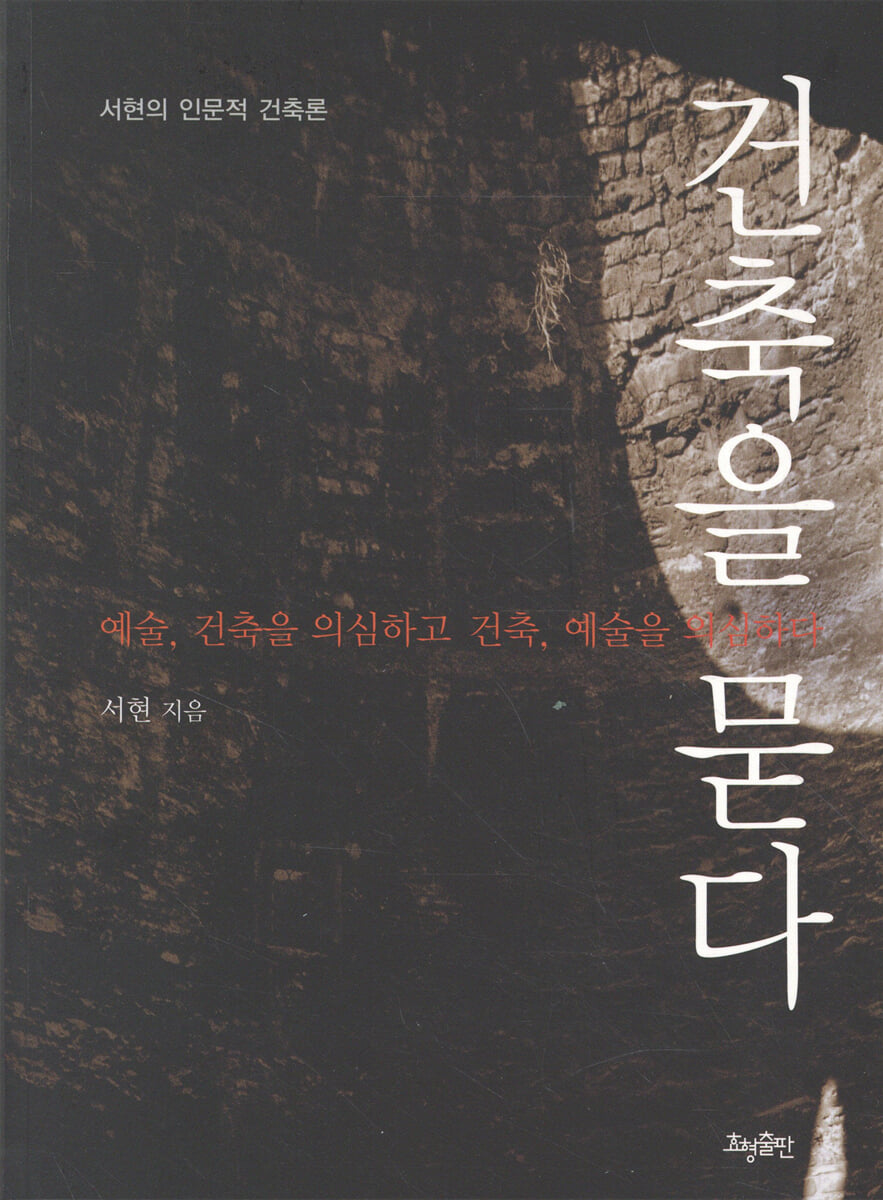
Asking about architecture
 |
Description
Book Introduction
This is a humanistic architectural theory for those who think about and ponder architecture and have a serious interest in architecture.
The author, who had already presented an interesting architectural theory encompassing both humanities and art in his previous work, “Architecture: Listen Like Music, See Like Art,” now delves deeper into the essence of architecture.
The narrative style, which rushes toward the most intimate parts of architecture without taking one's eyes off it, firmly holds the readers' consciousness.
Rather than relying on academic information, the book seeks answers to the fundamental question, "What is architecture?" through lived stories of firsthand experience and observation. While it claims not to dwell on academic details, it is by no means sloppy; it is meticulously structured with a logical and flawless development, maintaining a tense sense of tension throughout the reading.
To explain architecture, various thinkers and artists are introduced, ranging from Aristotle, Plato, and Leonardo da Vinci to modern figures such as Gropius and Le Corbusier.
The author, who unfolds his story by encompassing such a wide range of knowledge, explores the essence of architecture by asking questions and exploiting the gaps in those questions, and seeks to share with readers the purest form of architecture revealed in the process.
The author, who had already presented an interesting architectural theory encompassing both humanities and art in his previous work, “Architecture: Listen Like Music, See Like Art,” now delves deeper into the essence of architecture.
The narrative style, which rushes toward the most intimate parts of architecture without taking one's eyes off it, firmly holds the readers' consciousness.
Rather than relying on academic information, the book seeks answers to the fundamental question, "What is architecture?" through lived stories of firsthand experience and observation. While it claims not to dwell on academic details, it is by no means sloppy; it is meticulously structured with a logical and flawless development, maintaining a tense sense of tension throughout the reading.
To explain architecture, various thinkers and artists are introduced, ranging from Aristotle, Plato, and Leonardo da Vinci to modern figures such as Gropius and Le Corbusier.
The author, who unfolds his story by encompassing such a wide range of knowledge, explores the essence of architecture by asking questions and exploiting the gaps in those questions, and seeks to share with readers the purest form of architecture revealed in the process.
- You can preview some of the book's contents.
Preview
index
preface
Architecture, asking about meaning
What is it?
Questioning art and architecture
Calligraphy and Rice Cake Slicing | Police Chiefs and Posters | Games and Frames | The Art World and Architecture | The Tense of Questioning
Fighter, seek identity
Paragone | The Craftsman and Culture | The Discovery of Vitruvius | The Theory of Architecture | The Craftsman or the Creator | A New System | Branches of Art and Architecture | Art and the Fringe
Architect, get a degree
Nietzsche and Kant | Hegel and Schopenhauer | The Academy | The Academy of Architecture | Conflict and Change in the Academy | The Bauhaus
Art, abandoning its purpose
Immanence and Derivation | Mona Lisa and Aida | The Parthenon's Uses | Buildings and Their Uses | Uses and Their Modes of Production | The Production Mode of Buildings | Birds and Buildings
Architecture, borrowing function
Changing Uses | Emergence of Function | Functionalism | Loss and Restoration of Nature | Functional Architecture | Urban Ideals and Imagination | The Architect's City
Technology Conflicts with Architecture
Art and Technology | Technè and Logos | The Emergence of Engineering | Schools and Professional Organizations | The Neo-Iron Age
Saving Space, Architecture
Rooms and Spaces | The Evolution of Rooms | The Completion of Evolution | The Propagation of Space | The Stagnation of Space | The Diverse Spaces | Architectural Space | The Value of Architectural Space
Architects, revealing their presence
Architect | Architecton | Tecton of the Frontier | Latin Architect | Architect Who Builds
Architecture, Finding Value
Make and construct | Buildings and structures | Buildings and architecture | Architectural assembly
Meaning, translated into architecture
Ideas | Design and Styling | Structure and System
Architecture, Discovering Society
Architecture and Society | City | Road | Library | School | Bank | Market | Apartment | Kitchen
Architecture: Re-Questioning Meaning
Ask the meaning again
References
Search
Architecture, asking about meaning
What is it?
Questioning art and architecture
Calligraphy and Rice Cake Slicing | Police Chiefs and Posters | Games and Frames | The Art World and Architecture | The Tense of Questioning
Fighter, seek identity
Paragone | The Craftsman and Culture | The Discovery of Vitruvius | The Theory of Architecture | The Craftsman or the Creator | A New System | Branches of Art and Architecture | Art and the Fringe
Architect, get a degree
Nietzsche and Kant | Hegel and Schopenhauer | The Academy | The Academy of Architecture | Conflict and Change in the Academy | The Bauhaus
Art, abandoning its purpose
Immanence and Derivation | Mona Lisa and Aida | The Parthenon's Uses | Buildings and Their Uses | Uses and Their Modes of Production | The Production Mode of Buildings | Birds and Buildings
Architecture, borrowing function
Changing Uses | Emergence of Function | Functionalism | Loss and Restoration of Nature | Functional Architecture | Urban Ideals and Imagination | The Architect's City
Technology Conflicts with Architecture
Art and Technology | Technè and Logos | The Emergence of Engineering | Schools and Professional Organizations | The Neo-Iron Age
Saving Space, Architecture
Rooms and Spaces | The Evolution of Rooms | The Completion of Evolution | The Propagation of Space | The Stagnation of Space | The Diverse Spaces | Architectural Space | The Value of Architectural Space
Architects, revealing their presence
Architect | Architecton | Tecton of the Frontier | Latin Architect | Architect Who Builds
Architecture, Finding Value
Make and construct | Buildings and structures | Buildings and architecture | Architectural assembly
Meaning, translated into architecture
Ideas | Design and Styling | Structure and System
Architecture, Discovering Society
Architecture and Society | City | Road | Library | School | Bank | Market | Apartment | Kitchen
Architecture: Re-Questioning Meaning
Ask the meaning again
References
Search
Publisher's Review
Tenaciously tracing the historical and social context surrounding architecture
Architecture, architects, and architectural spirit that permeate two thousand years of European cultural history
A masterpiece ten years after 『Architecture: Listen Like Music, See Like Art』
Seo Hyun (徐顯), do you remember that name? It's a name that readers who broadly study the humanities, arts, and sciences will easily recall.
He is the author of 『Listen to Architecture Like Music, See It Like Art』, which opened a new chapter in the field of architecture books over ten years ago.
At a time when architecture books were usually placed between thick engineering books in bookstores, the Korean architecture book market was turned upside down by the emergence of an innovative method called 'humanistic writing.'
Architecture? Since "Architecture: Listen Like Music, See Like Art," which provided a profound and engaging insight into the true nature of buildings, readers have gained a new and refreshing reading area: architecture.
The genre of architectural stories that blend art and humanities was created by Seo Hyun and continues to this day.
Now, he presents a new humanistic architectural theory, “Asking Architecture.”
If the previous work offered readers a variety of new approaches to the "genre" of architecture, the new work presented today offers a "profound answer" to "thoughtful readers" who seek to understand the essence and value of architecture.
A question I have been preparing for 10 years: “What is architecture?”
The first diary entry in the book is this.
“What is it?” he asks again and again in the book.
“What is architecture?” Faced with the weighty question of “what is it?” that is difficult to bear, he decides to reveal its true nature.
It is completely different from the various architectural books that ask grand questions and then reveal and conceal them appropriately with metaphysical and vague sentences.
So, what about "Asking Architecture"? It's very logical.
Also, there are no gaps.
The author, a self-proclaimed avid reader, faced the fundamental question, “What is architecture?” and resolved not to answer it without a thorough and logical approach.
And then I ask the first question.
“Is architecture art?”
But this first question turns out to be off the mark.
This should be a past tense question, “Is architecture included in the category of art?” and this should be revealed through history, not art.
Since then, many suspect figures, events, and buildings from the architectural world in history have been summoned in his writings.
Not only Greek thinkers like Aristotle and Plato and Roman architectural sites, but also major figures in the world of architecture before and after the Renaissance, such as Vitruvius, Leonardo da Vinci, Michelangelo, Raphael, Alberti, and Bernini, as well as modern and contemporary figures like Gropius, Le Corbusier, and Frank Lloyd Wright, are summoned one after another.
Erase each item one by one, approaching the root of architecture.
In the past, architects, who were nothing more than insignificant beings outside the iron fortress of liberal arts, acquired their own status by preparing various theoretical books and establishing their own systems through internal and external efforts, and even formed an 'academy' to elevate architecture to the ranks of academic disciplines and even acquired 'academic credentials.'
Architecture, which has been exploring the reason for existence and the value of existence as if walking a tightrope at the boundary between art and technology, finally grasps its own essence and reality by forming diverse relationships, such as redefining space and utilizing it.
The author summarizes the meaning of architecture formed through this series of processes in the following sentence.
“Architecture is the work of reorganizing human life through space.” The author’s own words explain the detailed context of this sentence as follows.
*“The reason for the existence of architecture, its meaning, and its value lies in reorganizing human life.
This is the meaning and value of architecture.
The organizer is an architect.
An architect is someone who proposes human life and human systems.
The society depicted in architecture is not a subversive society, but a critical society.
The architect's tool is architectural space.
The architect's weapon is imagination based on critical reflection.
An architect begins with analysis and criticism of society and then uses imagination to create alternatives.
This is the meaning of existence that architects have discovered throughout history.
“This is the present tense of what those who have sought to be socially significant over the centuries have finally found.”
In this way, he visits various architectural sites throughout history, including key architectural events and figures, and asks questions, exploiting the gaps in those questions to get closer to the essence of architecture step by step.
Questions are eliminated one by one, and in the web of questions he has woven, architecture is torn apart through the tight mesh of art, artisanship, use, function, technology, space, meaning, society, etc., and then finds its substance again.
Finally, the author analyzes the etymology of the term 'architecture' from a unique perspective to clarify the meaning of architecture.
*“The meaning of architecture begins with asking about history and society.
It is asking what it is.
That something is the origin (arche).
The result of implementing the answer to the exploration and reflection on the origin in an architectural manner is a certain form of structure.
This is the meaning of architecture.
The social value of an architect.
If I had to give it a name, it would be like this.
“The social existence of the architect.”
What is architecture? What is the value of architecture?
This book, “Asking Architecture,” is not easy.
However, for the prepared reader who wants to understand both the outer and inner meaning of architecture as a humanities, this book will approach you more kindly and earnestly than any other writing.
Architect Seo Hyun's humanistic architectural theory, encountered after 10 years, is armed with more sophisticated and meticulous logic and tackles the fundamental problems of architecture in "Asking Architecture."
Readers who have yet to find a definitive answer to the question, "What is architecture?" will find a sufficient answer in this book.
And soon you will have the curious experience of being reduced to a question again, but finding your own way to the answer.
In a word, 『Asking Architecture』 is the essence of Seo Hyun-style humanistic architectural theory.
Architecture, architects, and architectural spirit that permeate two thousand years of European cultural history
A masterpiece ten years after 『Architecture: Listen Like Music, See Like Art』
Seo Hyun (徐顯), do you remember that name? It's a name that readers who broadly study the humanities, arts, and sciences will easily recall.
He is the author of 『Listen to Architecture Like Music, See It Like Art』, which opened a new chapter in the field of architecture books over ten years ago.
At a time when architecture books were usually placed between thick engineering books in bookstores, the Korean architecture book market was turned upside down by the emergence of an innovative method called 'humanistic writing.'
Architecture? Since "Architecture: Listen Like Music, See Like Art," which provided a profound and engaging insight into the true nature of buildings, readers have gained a new and refreshing reading area: architecture.
The genre of architectural stories that blend art and humanities was created by Seo Hyun and continues to this day.
Now, he presents a new humanistic architectural theory, “Asking Architecture.”
If the previous work offered readers a variety of new approaches to the "genre" of architecture, the new work presented today offers a "profound answer" to "thoughtful readers" who seek to understand the essence and value of architecture.
A question I have been preparing for 10 years: “What is architecture?”
The first diary entry in the book is this.
“What is it?” he asks again and again in the book.
“What is architecture?” Faced with the weighty question of “what is it?” that is difficult to bear, he decides to reveal its true nature.
It is completely different from the various architectural books that ask grand questions and then reveal and conceal them appropriately with metaphysical and vague sentences.
So, what about "Asking Architecture"? It's very logical.
Also, there are no gaps.
The author, a self-proclaimed avid reader, faced the fundamental question, “What is architecture?” and resolved not to answer it without a thorough and logical approach.
And then I ask the first question.
“Is architecture art?”
But this first question turns out to be off the mark.
This should be a past tense question, “Is architecture included in the category of art?” and this should be revealed through history, not art.
Since then, many suspect figures, events, and buildings from the architectural world in history have been summoned in his writings.
Not only Greek thinkers like Aristotle and Plato and Roman architectural sites, but also major figures in the world of architecture before and after the Renaissance, such as Vitruvius, Leonardo da Vinci, Michelangelo, Raphael, Alberti, and Bernini, as well as modern and contemporary figures like Gropius, Le Corbusier, and Frank Lloyd Wright, are summoned one after another.
Erase each item one by one, approaching the root of architecture.
In the past, architects, who were nothing more than insignificant beings outside the iron fortress of liberal arts, acquired their own status by preparing various theoretical books and establishing their own systems through internal and external efforts, and even formed an 'academy' to elevate architecture to the ranks of academic disciplines and even acquired 'academic credentials.'
Architecture, which has been exploring the reason for existence and the value of existence as if walking a tightrope at the boundary between art and technology, finally grasps its own essence and reality by forming diverse relationships, such as redefining space and utilizing it.
The author summarizes the meaning of architecture formed through this series of processes in the following sentence.
“Architecture is the work of reorganizing human life through space.” The author’s own words explain the detailed context of this sentence as follows.
*“The reason for the existence of architecture, its meaning, and its value lies in reorganizing human life.
This is the meaning and value of architecture.
The organizer is an architect.
An architect is someone who proposes human life and human systems.
The society depicted in architecture is not a subversive society, but a critical society.
The architect's tool is architectural space.
The architect's weapon is imagination based on critical reflection.
An architect begins with analysis and criticism of society and then uses imagination to create alternatives.
This is the meaning of existence that architects have discovered throughout history.
“This is the present tense of what those who have sought to be socially significant over the centuries have finally found.”
In this way, he visits various architectural sites throughout history, including key architectural events and figures, and asks questions, exploiting the gaps in those questions to get closer to the essence of architecture step by step.
Questions are eliminated one by one, and in the web of questions he has woven, architecture is torn apart through the tight mesh of art, artisanship, use, function, technology, space, meaning, society, etc., and then finds its substance again.
Finally, the author analyzes the etymology of the term 'architecture' from a unique perspective to clarify the meaning of architecture.
*“The meaning of architecture begins with asking about history and society.
It is asking what it is.
That something is the origin (arche).
The result of implementing the answer to the exploration and reflection on the origin in an architectural manner is a certain form of structure.
This is the meaning of architecture.
The social value of an architect.
If I had to give it a name, it would be like this.
“The social existence of the architect.”
What is architecture? What is the value of architecture?
This book, “Asking Architecture,” is not easy.
However, for the prepared reader who wants to understand both the outer and inner meaning of architecture as a humanities, this book will approach you more kindly and earnestly than any other writing.
Architect Seo Hyun's humanistic architectural theory, encountered after 10 years, is armed with more sophisticated and meticulous logic and tackles the fundamental problems of architecture in "Asking Architecture."
Readers who have yet to find a definitive answer to the question, "What is architecture?" will find a sufficient answer in this book.
And soon you will have the curious experience of being reduced to a question again, but finding your own way to the answer.
In a word, 『Asking Architecture』 is the essence of Seo Hyun-style humanistic architectural theory.
GOODS SPECIFICS
- Date of issue: July 20, 2009
- Page count, weight, size: 344 pages | 618g | 167*218*30mm
- ISBN13: 9788958720805
- ISBN10: 8958720808
You may also like
카테고리
korean


korean

![GQ KOREA Mark (Monthly): December [2025]](http://librairie.coreenne.fr/cdn/shop/files/8ef265dbbfbf186523ed75ba7319009d.jpg?v=1765340328&width=3840)


