

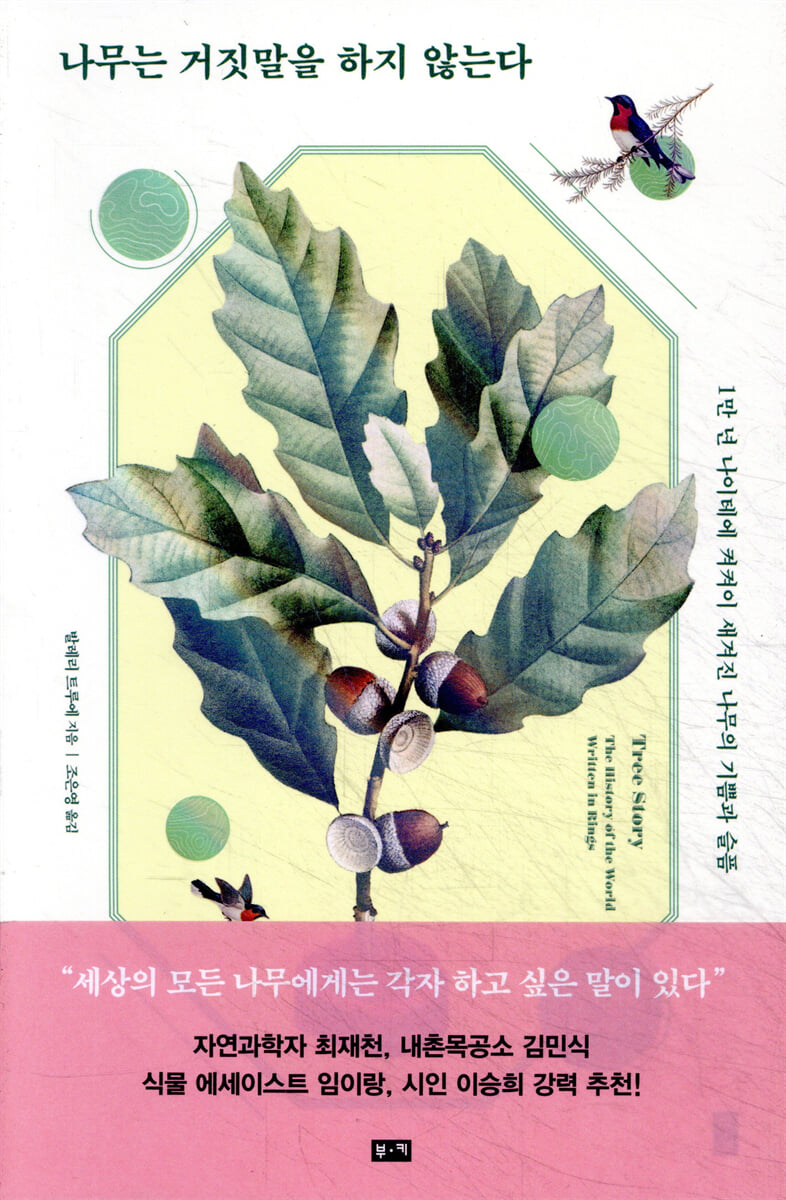
Trees don't lie
 |
Description
Book Introduction
Every tree in the world has something to say. The story of history, culture, and climate recorded by trees and told by rings Every tree in the world has something to say. Trees faithfully create rings year after year, recording history and weather in them. To properly interpret the stories trees tell and the information they share, a tool called 'dendrochronology' is essential. Dendrochronology is the study of past climates and conditions by analyzing tree rings to measure their age. Valerie Troué, the author of this book and a world-renowned dendrochronologist, never imagined that tree rings would contain so much information that they would become a field of science. However, as you count the days, you will embark on an intellectual exploration that crosses various fields and genres, including science, history, geography, climate, architecture, literature, and art. You can also learn about the relationships between seemingly unrelated entities, such as night stars, sunspots, and pirate ships, and examine the influence of climate on the rise and fall of the Roman and Mongol empires. Ultimately, by listening to the story of trees, we can understand the causes and grand trends of climate change. This book is the first science textbook in Korea to introduce dendrochronology in earnest, and is also a remarkable journal of research by a female chronologist. |
- You can preview some of the book's contents.
Preview
index
Recommendation
Preface: I am a scientist who counts nights.
1.
Why an astronomer began studying night rings in the middle of the desert
2.
How to safely count tree rings without cutting them down
3.
Trees that have lived for thousands of years look different from the start.
4.
Wide and narrow Morse code that tells the weather in the past
5.
Travel back 10,000 years in a wooden time machine
6.
The hockey stick graph reveals unprecedented warming in millennium history.
7.
Why heavy rain in Scotland causes drought in Morocco
8.
Dr. Frankenstein, born thanks to the harsh Little Ice Age
9.
As the night spreads, storms subside and pirate ships run wild.
10.
The Haunted Forest tells the story of a major earthquake, a volcanic eruption, and Chernobyl.
11.
The Roman Empire collapsed as the trees shivered in the summer cold.
12.
The forest that led to Genghis Khan's conquest and the fall of the Aztecs
13.
Thirst-sensitive trees herald the worst drought yet
14.
Do trees know the fickle minds of El Niño and La Niña?
15.
Embrace the burnt scars and turn them into night vision
16.
Our past, the present of trees, the future of the Earth
Acknowledgments | Translator's Note | List of Songs in This Book | List of Tree Species in This Book
Recommended Reading | Glossary | References | Index
Preface: I am a scientist who counts nights.
1.
Why an astronomer began studying night rings in the middle of the desert
2.
How to safely count tree rings without cutting them down
3.
Trees that have lived for thousands of years look different from the start.
4.
Wide and narrow Morse code that tells the weather in the past
5.
Travel back 10,000 years in a wooden time machine
6.
The hockey stick graph reveals unprecedented warming in millennium history.
7.
Why heavy rain in Scotland causes drought in Morocco
8.
Dr. Frankenstein, born thanks to the harsh Little Ice Age
9.
As the night spreads, storms subside and pirate ships run wild.
10.
The Haunted Forest tells the story of a major earthquake, a volcanic eruption, and Chernobyl.
11.
The Roman Empire collapsed as the trees shivered in the summer cold.
12.
The forest that led to Genghis Khan's conquest and the fall of the Aztecs
13.
Thirst-sensitive trees herald the worst drought yet
14.
Do trees know the fickle minds of El Niño and La Niña?
15.
Embrace the burnt scars and turn them into night vision
16.
Our past, the present of trees, the future of the Earth
Acknowledgments | Translator's Note | List of Songs in This Book | List of Tree Species in This Book
Recommended Reading | Glossary | References | Index
Detailed image

Into the book
I am a scientist who counts nights.
In the spring of 1998, I was pursuing a master's degree in environmental engineering at Ghent University in Belgium.
I had to decide on a research project for my dissertation, but I had just returned from a semester-long exchange program in Germany, so the decision was quite late.
Interesting topics to study abroad were already taken by my graduate school classmates.
While I was researching hard to decide on a project before summer break, I ended up visiting Professor Hans Beeckman, who teaches vegetation ecology and wood anatomy.
Professor Bigman suggested studying Naite in Tanzania, Africa.
It was the first time I'd heard the term "chronological university," but I agreed without much hesitation. (Omitted)
In our country, there are very few scientists who grew up with the dream of becoming a dendrochronologist from the beginning.
Most people who major in chronology happened to stumble upon a field (outdoor research location, not a lab - translator's note) or lab during their undergraduate years, or like me, happened to stumble upon it during graduate school and ended up staying there.
--- pp.15-16
Why an astronomer began studying night rings in the middle of the desert
In July 2010, I was living in Zurich, Switzerland at the time, and made the unusual decision to move my job to Tucson, Arizona, USA.
People wondered why the scientist Naite would go to the desert.
“Weren’t you studying trees?” (omitted)
The combination of well-preserved archaeological timber with distinct, long-lived, drought-sensitive trees may be the true reason why dendrochronology began in the Arizona desert.
Had the late 19th-century home of American astronomy been a region with greater biodiversity, less unusual tree rings, less drought-prone areas, and fewer and poorer-preserved prehistoric sites than the Southwest, the science of dendrochronology might have taken a very different path.
--- pp.25-41
How to safely count tree rings without cutting them down
Every tree in the world has something to say.
The understory trees that have lived their entire lives in the dark shade of the taller trees would complain more about their neighbors blocking out their light than about the weather.
(Omitted) Basically, trees like to talk about the weather just as much as people.
Trees in the American Southwest grumble and show their discontent with narrow rings when drought strikes.
But trees in the Swiss Alps or Alaska would be more upset by cold weather than drought, and would record cooler summer temperatures on their rings than drier summers.
These 'discontents' that limit the growth of trees are called limiting factors in the world of Naite.
--- p.53
Trees that have lived for thousands of years look different from the start.
Don Currey, then a graduate student in geography at the University of North Carolina, was interested in dating and analyzing bristlecone pines in eastern Nevada in connection with his study of Holocene glaciers in the American Southwest (the Holocene, the geologic epoch we are in today, began about 11,650 years ago).
When he arrived at Wheeler Peak with his night-time measuring device, the first tree he discovered was Prometheus.
(Omitted) Whatever the reason, he requested permission from the Forest Service to log Prometheus and received it.
That night in his hotel room, Curry counted 4,862 rings in a cross-section of Prometheus and was horrified to realize he had just killed the oldest living tree on Earth.
--- pp.66~67
Wide and narrow Morse code that tells the weather in the past
Trees are happy when they have plenty of food and water, and when they are not competing with or being attacked by others.
In a happy year, the tree grows vigorously and forms wide rings.
On the other hand, in unhappy years, when there has been a drought or cold snap, or a hurricane has snapped all the leaves and branches, the plant has less energy to invest in growth, so it forms narrow rings.
Therefore, the happiness of a tree is greatly influenced by the weather.
Trees suffer from seasonal affective disorder (since they hibernate and stop growing during the dark season) as well as annual affective disorder.
That is to say, in years with bad weather, trees become depressed.
Here, 'bad weather' can be cold or drought, depending on the region.
--- p.79
Travel back 10,000 years in a wooden time machine
We know little about the early settlers of Europe.
How large was their population? What language did they speak? How and why did they build megaliths like Stonehenge? Thanks to dendrochronology, we can now pinpoint the exact year and season they felled oak and pine trees 6,000 years ago to build their stilt houses, waterways, and wells.
(Omitted) Dating using Naite has played a significant role in the study of not only cathedrals, universities, and city hall buildings, but also simple historical buildings.
From Viking settlements in Germany, to the Palazzi in Venice, to Salisbury Cathedral in England, to Hagia Sophia in Istanbul, dendrochronology has provided new interpretations of not only the architecture but also the cultures of civilizations around the world.
--- p.99
Why heavy rain in Scotland causes drought in Morocco
The Moroccan Atlas larch is one of the oldest trees in Africa and its distinct annual rings make it a reliable drought recorder suitable for cross-comparison.
From a dendrochronologist's perspective, these trees have very desirable characteristics, so over the years many research teams have visited this forest to collect wood fragments.
(syncopation)
Atlas maple growth is limited by spring drought.
When it's wet, the tree is happy and the rings are plump, and when it's dry, the tree is unhappy and the rings are narrow.
The tree's ring chronology provides a millennium-long reconstruction of the Moroccan drought.
The earliest Naite (ca. 400 AD) is noticeably narrow, perhaps because it records the severe and prolonged drought of the medieval period.
From around 1450 onwards, the trees continued to receive ample water, but around 1980, severe droughts began again.
--- pp.128~129
As the night spreads, storms subside and pirate ships run wild.
We had drinks on the hotel terrace and came up with the idea of combining Big Pine Key Night and Caribbean shipwreck records to reconstruct past hurricane occurrences and extend the timeline back 300 years.
We hypothesized that if hurricanes were behind past shipwrecks in the Caribbean, the number of shipwrecks per year could be used as a proxy for hurricane activity.
This means that years with many shipwrecks can be assumed to have had higher intensity and frequency of hurricanes.
(syncopation)
From Grant's initial analysis, we already knew that many years of stunted tree growth coincided with hurricane years.
But there was a more important fact.
Comparing the tree records with shipwreck records, it was found that the years in which tree growth was suppressed coincided with the years in which many ships sank.
We were also surprised to see that the ship sinking coincided so closely with the growth arrest period of a completely unrelated tree.
--- pp.165~166
The Roman Empire collapsed as the trees shivered in the summer cold.
My journey to the 'Eternal City' began when I was working at the Swiss Institute for Forest, Snow and Geomorphology, extracting climate information from archaeological timber dating back to Roman times.
Using more than 8,500 tree-ring samples from living oaks and pines, as well as semi-fossilized trees, historic buildings, and Roman wells, our team developed a reconstruction of Central European rainfall and temperature over the past 2,400 years (405 BC to AD 2008).
A listing of the harvest years of trees obtained from archaeological artifacts reveals a particularly active period of building activity (300 BC–AD 200), during which a significant number of trees were felled (see Figure 7). This period coincides with the Roman Climate Optimum (Roman Warm Period), when the Roman agricultural economy flourished, the population grew, and the empire reached the peak of its complexity against the backdrop of a generally mild climate.
--- p.194
Our past, the present of trees, the future of the Earth
By burning fossil fuels, we have dramatically accelerated one step in the natural carbon cycle and upset its balance.
(Omitted) Dendrochronologists have a powerful tool at their disposal to help them solve this carbon puzzle.
With a tree-age meter, we can measure how much wood has grown and how much carbon has been stored in trees of different species, ages, soils, and climates.
We can see how the extended growing season affected xylem growth.
We can also learn how drought, extreme weather, and rising temperatures have affected growth, how these effects might change as the climate changes, and how frequent wildfires and insect outbreaks are and how much they affect forest growth.
Naite teaches us how climate change has affected past societies.
In the spring of 1998, I was pursuing a master's degree in environmental engineering at Ghent University in Belgium.
I had to decide on a research project for my dissertation, but I had just returned from a semester-long exchange program in Germany, so the decision was quite late.
Interesting topics to study abroad were already taken by my graduate school classmates.
While I was researching hard to decide on a project before summer break, I ended up visiting Professor Hans Beeckman, who teaches vegetation ecology and wood anatomy.
Professor Bigman suggested studying Naite in Tanzania, Africa.
It was the first time I'd heard the term "chronological university," but I agreed without much hesitation. (Omitted)
In our country, there are very few scientists who grew up with the dream of becoming a dendrochronologist from the beginning.
Most people who major in chronology happened to stumble upon a field (outdoor research location, not a lab - translator's note) or lab during their undergraduate years, or like me, happened to stumble upon it during graduate school and ended up staying there.
--- pp.15-16
Why an astronomer began studying night rings in the middle of the desert
In July 2010, I was living in Zurich, Switzerland at the time, and made the unusual decision to move my job to Tucson, Arizona, USA.
People wondered why the scientist Naite would go to the desert.
“Weren’t you studying trees?” (omitted)
The combination of well-preserved archaeological timber with distinct, long-lived, drought-sensitive trees may be the true reason why dendrochronology began in the Arizona desert.
Had the late 19th-century home of American astronomy been a region with greater biodiversity, less unusual tree rings, less drought-prone areas, and fewer and poorer-preserved prehistoric sites than the Southwest, the science of dendrochronology might have taken a very different path.
--- pp.25-41
How to safely count tree rings without cutting them down
Every tree in the world has something to say.
The understory trees that have lived their entire lives in the dark shade of the taller trees would complain more about their neighbors blocking out their light than about the weather.
(Omitted) Basically, trees like to talk about the weather just as much as people.
Trees in the American Southwest grumble and show their discontent with narrow rings when drought strikes.
But trees in the Swiss Alps or Alaska would be more upset by cold weather than drought, and would record cooler summer temperatures on their rings than drier summers.
These 'discontents' that limit the growth of trees are called limiting factors in the world of Naite.
--- p.53
Trees that have lived for thousands of years look different from the start.
Don Currey, then a graduate student in geography at the University of North Carolina, was interested in dating and analyzing bristlecone pines in eastern Nevada in connection with his study of Holocene glaciers in the American Southwest (the Holocene, the geologic epoch we are in today, began about 11,650 years ago).
When he arrived at Wheeler Peak with his night-time measuring device, the first tree he discovered was Prometheus.
(Omitted) Whatever the reason, he requested permission from the Forest Service to log Prometheus and received it.
That night in his hotel room, Curry counted 4,862 rings in a cross-section of Prometheus and was horrified to realize he had just killed the oldest living tree on Earth.
--- pp.66~67
Wide and narrow Morse code that tells the weather in the past
Trees are happy when they have plenty of food and water, and when they are not competing with or being attacked by others.
In a happy year, the tree grows vigorously and forms wide rings.
On the other hand, in unhappy years, when there has been a drought or cold snap, or a hurricane has snapped all the leaves and branches, the plant has less energy to invest in growth, so it forms narrow rings.
Therefore, the happiness of a tree is greatly influenced by the weather.
Trees suffer from seasonal affective disorder (since they hibernate and stop growing during the dark season) as well as annual affective disorder.
That is to say, in years with bad weather, trees become depressed.
Here, 'bad weather' can be cold or drought, depending on the region.
--- p.79
Travel back 10,000 years in a wooden time machine
We know little about the early settlers of Europe.
How large was their population? What language did they speak? How and why did they build megaliths like Stonehenge? Thanks to dendrochronology, we can now pinpoint the exact year and season they felled oak and pine trees 6,000 years ago to build their stilt houses, waterways, and wells.
(Omitted) Dating using Naite has played a significant role in the study of not only cathedrals, universities, and city hall buildings, but also simple historical buildings.
From Viking settlements in Germany, to the Palazzi in Venice, to Salisbury Cathedral in England, to Hagia Sophia in Istanbul, dendrochronology has provided new interpretations of not only the architecture but also the cultures of civilizations around the world.
--- p.99
Why heavy rain in Scotland causes drought in Morocco
The Moroccan Atlas larch is one of the oldest trees in Africa and its distinct annual rings make it a reliable drought recorder suitable for cross-comparison.
From a dendrochronologist's perspective, these trees have very desirable characteristics, so over the years many research teams have visited this forest to collect wood fragments.
(syncopation)
Atlas maple growth is limited by spring drought.
When it's wet, the tree is happy and the rings are plump, and when it's dry, the tree is unhappy and the rings are narrow.
The tree's ring chronology provides a millennium-long reconstruction of the Moroccan drought.
The earliest Naite (ca. 400 AD) is noticeably narrow, perhaps because it records the severe and prolonged drought of the medieval period.
From around 1450 onwards, the trees continued to receive ample water, but around 1980, severe droughts began again.
--- pp.128~129
As the night spreads, storms subside and pirate ships run wild.
We had drinks on the hotel terrace and came up with the idea of combining Big Pine Key Night and Caribbean shipwreck records to reconstruct past hurricane occurrences and extend the timeline back 300 years.
We hypothesized that if hurricanes were behind past shipwrecks in the Caribbean, the number of shipwrecks per year could be used as a proxy for hurricane activity.
This means that years with many shipwrecks can be assumed to have had higher intensity and frequency of hurricanes.
(syncopation)
From Grant's initial analysis, we already knew that many years of stunted tree growth coincided with hurricane years.
But there was a more important fact.
Comparing the tree records with shipwreck records, it was found that the years in which tree growth was suppressed coincided with the years in which many ships sank.
We were also surprised to see that the ship sinking coincided so closely with the growth arrest period of a completely unrelated tree.
--- pp.165~166
The Roman Empire collapsed as the trees shivered in the summer cold.
My journey to the 'Eternal City' began when I was working at the Swiss Institute for Forest, Snow and Geomorphology, extracting climate information from archaeological timber dating back to Roman times.
Using more than 8,500 tree-ring samples from living oaks and pines, as well as semi-fossilized trees, historic buildings, and Roman wells, our team developed a reconstruction of Central European rainfall and temperature over the past 2,400 years (405 BC to AD 2008).
A listing of the harvest years of trees obtained from archaeological artifacts reveals a particularly active period of building activity (300 BC–AD 200), during which a significant number of trees were felled (see Figure 7). This period coincides with the Roman Climate Optimum (Roman Warm Period), when the Roman agricultural economy flourished, the population grew, and the empire reached the peak of its complexity against the backdrop of a generally mild climate.
--- p.194
Our past, the present of trees, the future of the Earth
By burning fossil fuels, we have dramatically accelerated one step in the natural carbon cycle and upset its balance.
(Omitted) Dendrochronologists have a powerful tool at their disposal to help them solve this carbon puzzle.
With a tree-age meter, we can measure how much wood has grown and how much carbon has been stored in trees of different species, ages, soils, and climates.
We can see how the extended growing season affected xylem growth.
We can also learn how drought, extreme weather, and rising temperatures have affected growth, how these effects might change as the climate changes, and how frequent wildfires and insect outbreaks are and how much they affect forest growth.
Naite teaches us how climate change has affected past societies.
--- pp.294~300
GOODS SPECIFICS
- Date of issue: May 20, 2021
- Page count, weight, size: 340 pages | 498g | 148*224*20mm
- ISBN13: 9788960518667
- ISBN10: 8960518662
You may also like
카테고리
korean


korean

![GQ KOREA Mark (Monthly): December [2025]](http://librairie.coreenne.fr/cdn/shop/files/8ef265dbbfbf186523ed75ba7319009d.jpg?v=1765340328&width=3840)


