

Botanist's Notes
 |
Description
Book Introduction
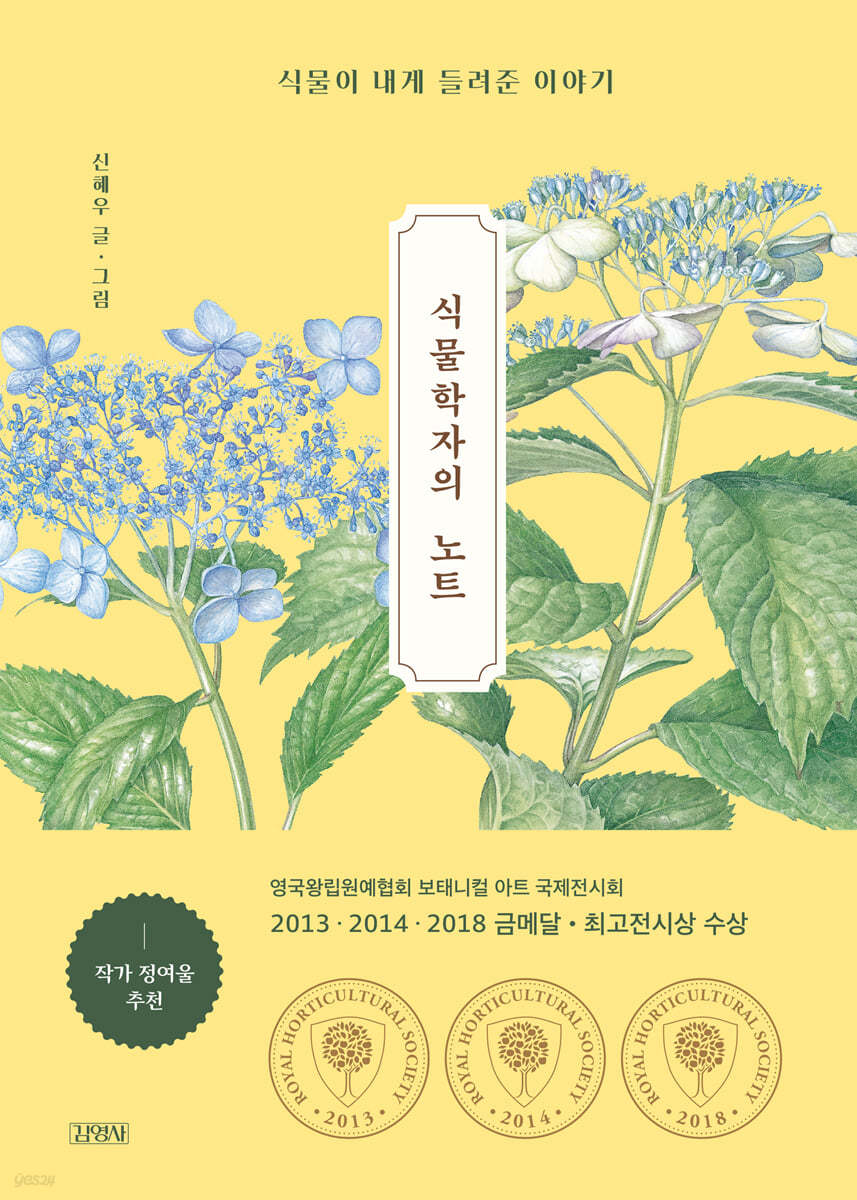
Gold Medal Winner at the Royal Horticultural Society International Exhibition of Botanical Art in 2013, 2014, and 2018 The beauty and wisdom of plants revealed by botanist Shin Hye-woo, who draws and paints. The comfort and encouragement that the green leaves and white flowers convey without words! 『Botanist's Notes』 is the first nature illustration essay by Shin Hye-woo, a recognized emerging botanist who won the gold medal, best exhibition award, and judges' special award for her botanical illustration at the British Horticultural Society International Exhibition. From seeds to stomata, roots, stems, flowers, and fruits, the book examines the role and meaning of each, while conveying with beautiful pictures how fiercely and courageously plants live to protect their own survival, from the fragile stems of Arabidopsis thaliana, to the water-dwelling duckweed, to the orchid that coexists with fungi, and even the Methuselah tree, which is estimated to live for over 5,000 years. The struggle of plants, which dedicate their entire lives to adapting to the place where they first take root and to survive to the end and spread their species, is amazing and mysterious. The sight is so reminiscent of our human form that it even makes us feel sad. This book not only provides comfort and wisdom from the brave ways plants navigate life, each with its own unique survival style, but also makes you feel that even the individual pine cones, which you may have previously overlooked, are precious and meaningful. |
- You can preview some of the book's contents.
Preview
index
Chapter 1.
A shining beginning
Hidden Helpers / Until the Light Comes / Now It's Time to Bloom / Tiny Particles That Move the World / 400 Million Years of Ferns / Leaves That Came Down to Earth
Chapter 2.
Standing alone in the field
Courage to float on water / Even in a place like this, green / The armor of trees / The history of what survived / And yet, the plants of Dokdo
Chapter 3.
Strong dreamers
Turning the direction and getting closer / The reasoned march of leaves / Plants that rule the water / Plant beasts / Where did the three seeds go / Elegant poison
Chapter 4.
Let's gather together and look towards the sky
Towards Harmony / A Forest of Fragrance / A Single Chrysanthemum / The Secret of Hydrangea Petals / The Orchids Darwin Loved / Plants That Color the Earth
Chapter 5.
Heart of the Forest
The world pouring through a small window / The thoughts of roots / The selfless plant / Until a friend comes to me / Respect in names / If we can never meet again / The heart of a plant / A lamp in the wind
A shining beginning
Hidden Helpers / Until the Light Comes / Now It's Time to Bloom / Tiny Particles That Move the World / 400 Million Years of Ferns / Leaves That Came Down to Earth
Chapter 2.
Standing alone in the field
Courage to float on water / Even in a place like this, green / The armor of trees / The history of what survived / And yet, the plants of Dokdo
Chapter 3.
Strong dreamers
Turning the direction and getting closer / The reasoned march of leaves / Plants that rule the water / Plant beasts / Where did the three seeds go / Elegant poison
Chapter 4.
Let's gather together and look towards the sky
Towards Harmony / A Forest of Fragrance / A Single Chrysanthemum / The Secret of Hydrangea Petals / The Orchids Darwin Loved / Plants That Color the Earth
Chapter 5.
Heart of the Forest
The world pouring through a small window / The thoughts of roots / The selfless plant / Until a friend comes to me / Respect in names / If we can never meet again / The heart of a plant / A lamp in the wind
Detailed image

Into the book
Scientists are often seen as representatives of anthropocentrism, creating rules and regulations for nature.
But for me, studying plants is a process of understanding and learning how to explain them from the plants' perspective.
Rather than expressing formal beauty from a human perspective, I paint the forms, ecology, and evolution of plants that survive on Earth from a plant perspective.
The painting is a reflection of my love for plants through scientific training.
I believe that these plant illustrations will provide an opportunity for anyone who sees them to share their love of plants.
--- "Prologue"
Humans also utilize the properties of pollen.
Because of its unchanging nature over time, pollen is a useful resource for archaeology, paleontology, and forensics.
A group of scientists in the UK called 'Fighting Crime' have used pollen on bullets to help identify the shooter.
Once a bullet is fired, the user's fingerprints and DNA are removed from the bullet, making it difficult to identify.
However, if you coat a bullet with pollen, the pollen will retain its unique shape even after the bullet is fired, which can be a useful clue in tracking down the criminal who fired the gun.
--- pp.46~47
During autumn and winter, when the days get colder and the sunlight decreases, trees choose whether to keep their leaves or drop them.
When the weather gets cold, plants can easily freeze because they have a lot of moisture.
Also, winter is not only cold but also very dry.
They lose moisture easily through their large surface area leaves.
Eventually, trees are forced to balance the energy they need to maintain their photosynthetic organs, the leaves, with the energy they produce from sunlight as sunlight diminishes.
Deciduous trees and evergreens make different choices in this matter.
--- pp.58~59
It is commonly thought that the stronger the sunlight, the more active photosynthesis occurs, and that the stomata will open wide to release the oxygen and water produced during this process.
However, the opening and closing mechanism of the pores is not that simple.
When sunlight is too strong, the temperature rises and the air becomes dry, plants actually close their stomata.
Because excessive water loss threatens the survival of the plant.
So, the impact of global warming on plants cannot but be significant.
Even a few degrees of increase in atmospheric temperature, which may seem insignificant to humans, can significantly affect the opening and closing of stomata in plants.
If plant transpiration is suppressed, the amount of moisture in the air will decrease, which can change the humidity of the atmosphere and gradually change the Earth's environment.
The closing of a small pore in a plant can cause a big change on Earth.
--- p.217
You are probably familiar with the notation 'www'.
It is an abbreviation for 'World Wide Web' and is a very familiar notation to us who access the Internet every day.
But botanists have come up with a new idea: www.
It's called 'Wood Wide Web'.
This means that numerous rhizobia, or fungi, attached to plants and plant roots connect and form networks and communicate with each other.
This means that fungi underground act like the Internet.
It is generally known that plants and fungi in the ground live together, with plants providing carbon to the fungi and fungi providing nutrients such as nitrogen to the plants.
At the same time, these fungi provide communication services as liaisons connecting plants to plants.
It conveys information such as warnings about environmental changes, external invaders, and what plants are around.
But for me, studying plants is a process of understanding and learning how to explain them from the plants' perspective.
Rather than expressing formal beauty from a human perspective, I paint the forms, ecology, and evolution of plants that survive on Earth from a plant perspective.
The painting is a reflection of my love for plants through scientific training.
I believe that these plant illustrations will provide an opportunity for anyone who sees them to share their love of plants.
--- "Prologue"
Humans also utilize the properties of pollen.
Because of its unchanging nature over time, pollen is a useful resource for archaeology, paleontology, and forensics.
A group of scientists in the UK called 'Fighting Crime' have used pollen on bullets to help identify the shooter.
Once a bullet is fired, the user's fingerprints and DNA are removed from the bullet, making it difficult to identify.
However, if you coat a bullet with pollen, the pollen will retain its unique shape even after the bullet is fired, which can be a useful clue in tracking down the criminal who fired the gun.
--- pp.46~47
During autumn and winter, when the days get colder and the sunlight decreases, trees choose whether to keep their leaves or drop them.
When the weather gets cold, plants can easily freeze because they have a lot of moisture.
Also, winter is not only cold but also very dry.
They lose moisture easily through their large surface area leaves.
Eventually, trees are forced to balance the energy they need to maintain their photosynthetic organs, the leaves, with the energy they produce from sunlight as sunlight diminishes.
Deciduous trees and evergreens make different choices in this matter.
--- pp.58~59
It is commonly thought that the stronger the sunlight, the more active photosynthesis occurs, and that the stomata will open wide to release the oxygen and water produced during this process.
However, the opening and closing mechanism of the pores is not that simple.
When sunlight is too strong, the temperature rises and the air becomes dry, plants actually close their stomata.
Because excessive water loss threatens the survival of the plant.
So, the impact of global warming on plants cannot but be significant.
Even a few degrees of increase in atmospheric temperature, which may seem insignificant to humans, can significantly affect the opening and closing of stomata in plants.
If plant transpiration is suppressed, the amount of moisture in the air will decrease, which can change the humidity of the atmosphere and gradually change the Earth's environment.
The closing of a small pore in a plant can cause a big change on Earth.
--- p.217
You are probably familiar with the notation 'www'.
It is an abbreviation for 'World Wide Web' and is a very familiar notation to us who access the Internet every day.
But botanists have come up with a new idea: www.
It's called 'Wood Wide Web'.
This means that numerous rhizobia, or fungi, attached to plants and plant roots connect and form networks and communicate with each other.
This means that fungi underground act like the Internet.
It is generally known that plants and fungi in the ground live together, with plants providing carbon to the fungi and fungi providing nutrients such as nitrogen to the plants.
At the same time, these fungi provide communication services as liaisons connecting plants to plants.
It conveys information such as warnings about environmental changes, external invaders, and what plants are around.
--- p.231
Publisher's Review
Thirty-one Worlds Painted by Botanists and Plants
The mysterious mechanisms of life and the brilliance of life revealed by a small seed
Go into the forest and carefully touch the bark of a cherry tree.
Let's also look at the metasequoia fruit that gets trampled underfoot.
It's amazing how the joints close tightly when soaked in water and then open up when dry.
The petals fall in a semicircle and fruit ripens in their place.
Life circulates silently.
The name of the unknown pink flower in the photo I took carelessly last year is said to be 'day primrose'.
Knowing the name made the flower more special.
Even elementary school students know that trees release oxygen through the pores in their leaves, which allows humanity to survive.
Plants, a source of water and oxygen, are essential for human survival.
And that's not all.
Sometimes, it is a friendly presence that can convey a tired and weary heart.
These days, the term 'companion plant' has become trendy, with many people growing plants and finding solace in looking at them.
One day, tired of relationships and people, I go to the forest and the park and listen to the stories the plants tell me.
The author, who dreamed of becoming a botanist because he loved plants since childhood, used his excellent drawing skills to draw academic plant illustrations, but after receiving advice from a senior colleague to try coloring, he colored his drawings for the first time.
Afterwards, the works exhibited at the Royal Horticultural Society International Exhibition of Botanical Art in the UK won gold medals three times.
It is surprising that this is the first time in the history of the Royal Horticultural Society International Exhibition, but looking at his paintings makes you nod in agreement.
If you look closely at the leaves, which are so fine and delicate that you need a magnifying glass to see them, and the shades and luster that are so realistically depicted, you can feel how much the author loves plants.
The story of how he spent a year observing hydrangeas in order to capture the entire flowering process after being commissioned to paint a hydrangea clearly reveals his dedication as a painter and his heart as a botanist who must accurately depict plants.
I was commissioned to paint a hydrangea and was troubled.
The question was whether I could express the beauty of the hydrangea that the client wanted with the botanical academic drawing I was drawing.
The plant drawings I draw are scientific illustrations.
It is an academic drawing for plant research, so it contains the entire life cycle and all information about a plant.
We research and observe the entire process from seed fertilization to bud formation and fruit production, including the color of the petals that changes depending on the acidity of the soil, and collect information.
So, I started to think about how I could express the beauty of the hydrangea that the client wanted within the framework of the painting I was drawing.
-Page 188
It's not that I survived because I was strong,
The strong survive
The author's first book, "The Botanist's Notes," which he published after much deliberation, contains not only his image as an artist, but also his side as a botanist and a dedicated researcher.
Most plants cannot move and must live in one place their entire lives.
No matter where they are or what the environment is, plants adapt to their location with amazing adaptability and survive for a much longer time than humans.
Although it is a plant with strong vitality and environmental adaptability, its beginnings are small and weak.
The saying, “It is not the strong that survive, but the survivors that are strong” comes to life when looking at plants.
Each plant species has its own unique way of growing, and the author extracts from these plants the wisdom of our lives, as complex as the colors of hydrangea petals.
There are about 20,000 species of orchids distributed around the world, accounting for about 8% of the total number of seed plants. The seeds of orchids are so small that they are called 'dust seeds'.
These seeds cannot germinate on their own and require the help of a fungus to sprout.
In the case of leafless saprophytes, they do not photosynthesize and obtain nutrients from fungi.
Along with the Asteraceae family, it is the orchid with the largest number of species on Earth, but six of the nine species designated as Class 1 endangered plants in Korea are also orchids.
Although they are organisms that thrive and coexist in nature, their fate cannot be guaranteed if they are touched by human hands.
The orchid crisis is largely due to indiscriminate harvesting by humans, but environmental changes cannot be ignored.
For orchids to germinate and grow well, the soil must contain a lot of fungi that help the orchid grow.
If the temperature, humidity, and acidity of the soil change due to global warming or acid rain, preventing the fungus from growing well, orchid seeds may never wake up from their long dormancy.
-Page 22
A plant's survival is also related to the time it flowers.
This is closely related to the activity period of pollinators that deliver pollen. Day primroses that bloom during the day use butterflies and bees as pollinators, while evening primroses that bloom at night use moths as pollinators.
Because plants bloom at a time favorable for reproductive activity, the activity time or season of pollinators overlaps with the flowering period.
Wind-pollinated and water-pollinated flowers also bloom when they are well-used and at the right time and season.
Plants bloom at their own appropriate time and move on to the next stage of life.
Each person will have a different time to bloom.
Some people may come early, some may come late.
Isn't the important thing, rather than blooming early, the constant effort to bloom at the right time for you? While anticipating the moment when the flowers bloom?
-Page 39
The story of naturalized plants cannot be left out.
The common plants we see on the road, such as evening primrose, evening primrose, wild chrysanthemum, and Chinese milk vetch, are all alien species that came from abroad.
Plants that were brought from their original habitats by human hands and settled in Korea.
Among these naturalized plants, there are some species, such as Western sedge, that have such strong survival abilities that they cause serious disruption to the ecosystem, while others, such as American wormwood and thornbush, require large-scale eradication efforts.
Among the various forms of plant survival, there are plants like the creeper, which has a weak stem and supports the body of other species by wrapping itself around them; the 'electrophyte' yago, which survives by connecting to the roots or stems of other plants and relies on nutrients; and the ivy, which climbs up walls using suction cups.
The leaf in O. Henry's well-known novel, "The Last Leaf," is ivy.
The tendrils are so active that they can be called 'hands', like the hands of animals.
These hands are specialized structures found only in vines, which are modified leaves, parts of leaves, or stems.
If you look at plants like pumpkins, beans, and grapevines, you will find small tendrils that extend out thinly and curl like springs.
It's about reaching out and twisting the object in your hand and grabbing it.
This is due to the burrowing nature of the vine.
-Pages 113-115
Natural enemies that threaten the survival of plants,
human being
What do we, as humans, are to plants, which provide us with oxygen and water, and which also serve as food sources, animal feed, and medicine? The ginkgo tree, which emerged after the Paleozoic Era, is now nearly extinct in the wild.
The ginkgo forests that Westerners call the oriental landscape are actually created by human hands, and there are not many ginkgo tree habitats left.
“The ginkgo tree is listed on the Red List of the International Union for Conservation of Nature as an endangered species” (p. 237), and is a lonely plant with no close evolutionary relatives.
Due to the extinction of vector animals and climate change, only one species of ginkgo tree has survived, and “currently, wild ginkgo trees are known to inhabit some areas, such as Zhejiang Province in China, and the number of individuals is less than 200” (p. 239).
The cycads we grow as bonsai in pots also suffered a similar fate to the ginkgo trees.
Currently, about 110 species of Cycads survive, and they are also listed on the International Union for Conservation of Nature's Red List.
Let's also hear the story of Metasequoia.
There were other species in the genus Metasequoia, but they too went through the process of evolution and became extinct, leaving only one species, Metasequoia, alive.
Wild metasequoias are now endangered in the wild due to severe deforestation that has reduced their population.
Most of the metasequoias we see are cultivated by humans.
It was not bred naturally, but was propagated by humans through asexual reproduction such as inbreeding and cuttings.
-Pages 241-242
The Jeju Island native orchid, a Class 2 endangered plant, is in danger of extinction because people are indiscriminately picking its fruit to make alcohol.
A quick search on the internet will reveal articles about people making alcohol with the precious orchid, and the author immediately reports it.
Botanists research and report on endangered species to help preserve them, but they always have to wonder if this is really good for the plants.
It is people who protect endangered plants, but ultimately it is people who put the plants in danger of extinction.
The main reason why species that have evolved and survived on Earth for a long time suddenly disappear is not climate change or natural selection.
Direct and indirect human activities are the biggest cause.
-Page 257
With love for plants and life
With the hope that it will continue
If you look at it with interest, it becomes meaningful.
Poet Kim Chun-su sang in his poem “Flower,” “When I called his name, he came to me and became a flower.”
Even the smallest flowers we pass by without a second thought have names, and if we pay even a little attention to their lives, we can discover the grandeur and wonder of nature even in a single, small plant.
The author's hope that readers of "The Botanist's Notes" will discover the beauty of plants in the illustrations, learn to love and appreciate them through the text, and cherish each and every living thing is evident in every page.
The mysterious mechanisms of life and the brilliance of life revealed by a small seed
Go into the forest and carefully touch the bark of a cherry tree.
Let's also look at the metasequoia fruit that gets trampled underfoot.
It's amazing how the joints close tightly when soaked in water and then open up when dry.
The petals fall in a semicircle and fruit ripens in their place.
Life circulates silently.
The name of the unknown pink flower in the photo I took carelessly last year is said to be 'day primrose'.
Knowing the name made the flower more special.
Even elementary school students know that trees release oxygen through the pores in their leaves, which allows humanity to survive.
Plants, a source of water and oxygen, are essential for human survival.
And that's not all.
Sometimes, it is a friendly presence that can convey a tired and weary heart.
These days, the term 'companion plant' has become trendy, with many people growing plants and finding solace in looking at them.
One day, tired of relationships and people, I go to the forest and the park and listen to the stories the plants tell me.
The author, who dreamed of becoming a botanist because he loved plants since childhood, used his excellent drawing skills to draw academic plant illustrations, but after receiving advice from a senior colleague to try coloring, he colored his drawings for the first time.
Afterwards, the works exhibited at the Royal Horticultural Society International Exhibition of Botanical Art in the UK won gold medals three times.
It is surprising that this is the first time in the history of the Royal Horticultural Society International Exhibition, but looking at his paintings makes you nod in agreement.
If you look closely at the leaves, which are so fine and delicate that you need a magnifying glass to see them, and the shades and luster that are so realistically depicted, you can feel how much the author loves plants.
The story of how he spent a year observing hydrangeas in order to capture the entire flowering process after being commissioned to paint a hydrangea clearly reveals his dedication as a painter and his heart as a botanist who must accurately depict plants.
I was commissioned to paint a hydrangea and was troubled.
The question was whether I could express the beauty of the hydrangea that the client wanted with the botanical academic drawing I was drawing.
The plant drawings I draw are scientific illustrations.
It is an academic drawing for plant research, so it contains the entire life cycle and all information about a plant.
We research and observe the entire process from seed fertilization to bud formation and fruit production, including the color of the petals that changes depending on the acidity of the soil, and collect information.
So, I started to think about how I could express the beauty of the hydrangea that the client wanted within the framework of the painting I was drawing.
-Page 188
It's not that I survived because I was strong,
The strong survive
The author's first book, "The Botanist's Notes," which he published after much deliberation, contains not only his image as an artist, but also his side as a botanist and a dedicated researcher.
Most plants cannot move and must live in one place their entire lives.
No matter where they are or what the environment is, plants adapt to their location with amazing adaptability and survive for a much longer time than humans.
Although it is a plant with strong vitality and environmental adaptability, its beginnings are small and weak.
The saying, “It is not the strong that survive, but the survivors that are strong” comes to life when looking at plants.
Each plant species has its own unique way of growing, and the author extracts from these plants the wisdom of our lives, as complex as the colors of hydrangea petals.
There are about 20,000 species of orchids distributed around the world, accounting for about 8% of the total number of seed plants. The seeds of orchids are so small that they are called 'dust seeds'.
These seeds cannot germinate on their own and require the help of a fungus to sprout.
In the case of leafless saprophytes, they do not photosynthesize and obtain nutrients from fungi.
Along with the Asteraceae family, it is the orchid with the largest number of species on Earth, but six of the nine species designated as Class 1 endangered plants in Korea are also orchids.
Although they are organisms that thrive and coexist in nature, their fate cannot be guaranteed if they are touched by human hands.
The orchid crisis is largely due to indiscriminate harvesting by humans, but environmental changes cannot be ignored.
For orchids to germinate and grow well, the soil must contain a lot of fungi that help the orchid grow.
If the temperature, humidity, and acidity of the soil change due to global warming or acid rain, preventing the fungus from growing well, orchid seeds may never wake up from their long dormancy.
-Page 22
A plant's survival is also related to the time it flowers.
This is closely related to the activity period of pollinators that deliver pollen. Day primroses that bloom during the day use butterflies and bees as pollinators, while evening primroses that bloom at night use moths as pollinators.
Because plants bloom at a time favorable for reproductive activity, the activity time or season of pollinators overlaps with the flowering period.
Wind-pollinated and water-pollinated flowers also bloom when they are well-used and at the right time and season.
Plants bloom at their own appropriate time and move on to the next stage of life.
Each person will have a different time to bloom.
Some people may come early, some may come late.
Isn't the important thing, rather than blooming early, the constant effort to bloom at the right time for you? While anticipating the moment when the flowers bloom?
-Page 39
The story of naturalized plants cannot be left out.
The common plants we see on the road, such as evening primrose, evening primrose, wild chrysanthemum, and Chinese milk vetch, are all alien species that came from abroad.
Plants that were brought from their original habitats by human hands and settled in Korea.
Among these naturalized plants, there are some species, such as Western sedge, that have such strong survival abilities that they cause serious disruption to the ecosystem, while others, such as American wormwood and thornbush, require large-scale eradication efforts.
Among the various forms of plant survival, there are plants like the creeper, which has a weak stem and supports the body of other species by wrapping itself around them; the 'electrophyte' yago, which survives by connecting to the roots or stems of other plants and relies on nutrients; and the ivy, which climbs up walls using suction cups.
The leaf in O. Henry's well-known novel, "The Last Leaf," is ivy.
The tendrils are so active that they can be called 'hands', like the hands of animals.
These hands are specialized structures found only in vines, which are modified leaves, parts of leaves, or stems.
If you look at plants like pumpkins, beans, and grapevines, you will find small tendrils that extend out thinly and curl like springs.
It's about reaching out and twisting the object in your hand and grabbing it.
This is due to the burrowing nature of the vine.
-Pages 113-115
Natural enemies that threaten the survival of plants,
human being
What do we, as humans, are to plants, which provide us with oxygen and water, and which also serve as food sources, animal feed, and medicine? The ginkgo tree, which emerged after the Paleozoic Era, is now nearly extinct in the wild.
The ginkgo forests that Westerners call the oriental landscape are actually created by human hands, and there are not many ginkgo tree habitats left.
“The ginkgo tree is listed on the Red List of the International Union for Conservation of Nature as an endangered species” (p. 237), and is a lonely plant with no close evolutionary relatives.
Due to the extinction of vector animals and climate change, only one species of ginkgo tree has survived, and “currently, wild ginkgo trees are known to inhabit some areas, such as Zhejiang Province in China, and the number of individuals is less than 200” (p. 239).
The cycads we grow as bonsai in pots also suffered a similar fate to the ginkgo trees.
Currently, about 110 species of Cycads survive, and they are also listed on the International Union for Conservation of Nature's Red List.
Let's also hear the story of Metasequoia.
There were other species in the genus Metasequoia, but they too went through the process of evolution and became extinct, leaving only one species, Metasequoia, alive.
Wild metasequoias are now endangered in the wild due to severe deforestation that has reduced their population.
Most of the metasequoias we see are cultivated by humans.
It was not bred naturally, but was propagated by humans through asexual reproduction such as inbreeding and cuttings.
-Pages 241-242
The Jeju Island native orchid, a Class 2 endangered plant, is in danger of extinction because people are indiscriminately picking its fruit to make alcohol.
A quick search on the internet will reveal articles about people making alcohol with the precious orchid, and the author immediately reports it.
Botanists research and report on endangered species to help preserve them, but they always have to wonder if this is really good for the plants.
It is people who protect endangered plants, but ultimately it is people who put the plants in danger of extinction.
The main reason why species that have evolved and survived on Earth for a long time suddenly disappear is not climate change or natural selection.
Direct and indirect human activities are the biggest cause.
-Page 257
With love for plants and life
With the hope that it will continue
If you look at it with interest, it becomes meaningful.
Poet Kim Chun-su sang in his poem “Flower,” “When I called his name, he came to me and became a flower.”
Even the smallest flowers we pass by without a second thought have names, and if we pay even a little attention to their lives, we can discover the grandeur and wonder of nature even in a single, small plant.
The author's hope that readers of "The Botanist's Notes" will discover the beauty of plants in the illustrations, learn to love and appreciate them through the text, and cherish each and every living thing is evident in every page.
GOODS SPECIFICS
- Publication date: April 27, 2021
- Format: Hardcover book binding method guide
- Page count, weight, size: 280 pages | 576g | 154*213*20mm
- ISBN13: 9788934986942
- ISBN10: 8934986948
You may also like
카테고리
korean


korean

![ELLE 엘르 스페셜 에디션 A형 : 12월 [2025]](http://librairie.coreenne.fr/cdn/shop/files/b8e27a3de6c9538896439686c6b0e8fb.jpg?v=1766436872&width=3840)


