

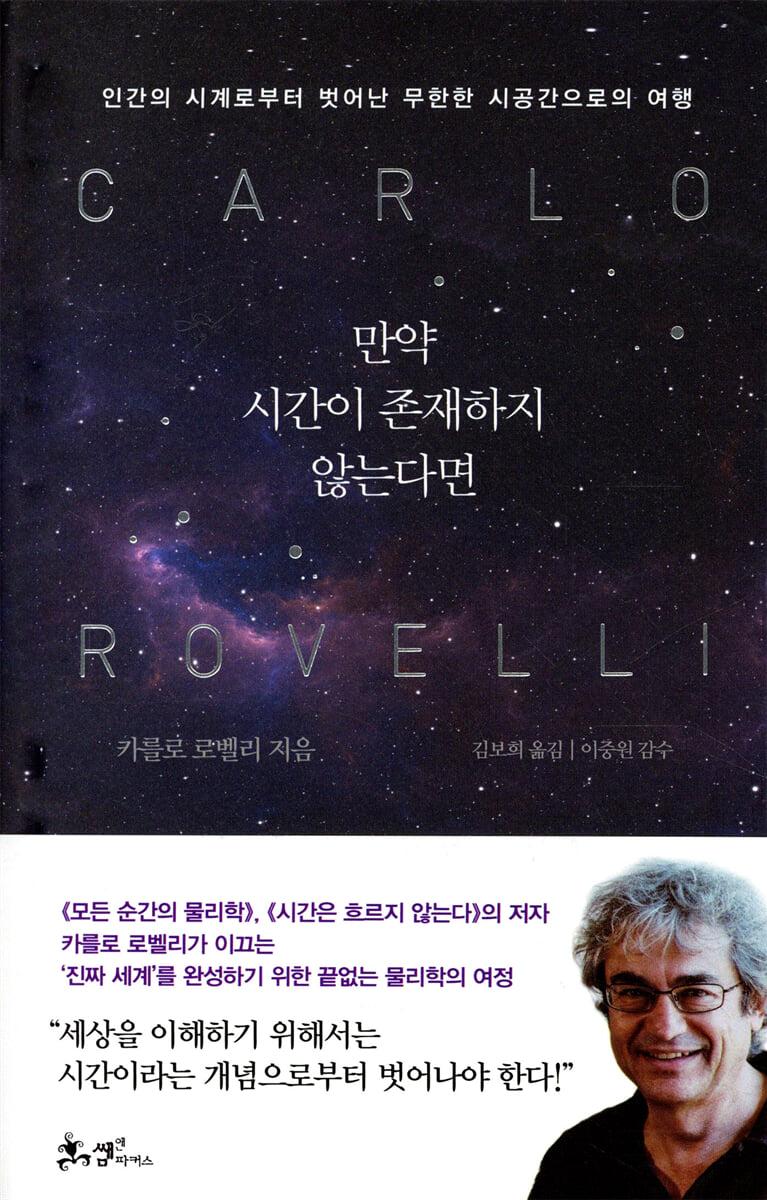
If time does not exist
 |
Description
Book Introduction
- A word from MD
-
Carlo Rovelli, A Journey into Infinite Space and TimeCarlo Rovelli, in "Physics of Every Moment," once again invites us into the realm of infinite space-time.
From my 20s when I first became curious about quantum gravity, to meeting various scholars and developing new theories.
A special journey to find answers in physics that can help us understand the universe, moving beyond the concept of 'time'.
Natural Science PD Kim Tae-hee
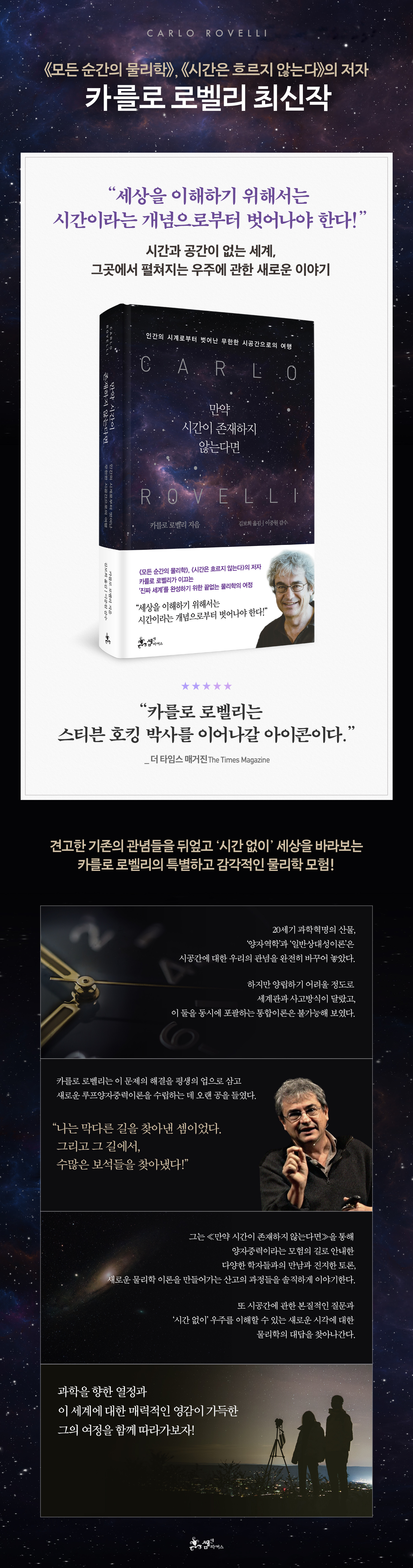
“If time does not exist,
How can we understand this world and universe in which we live?”
Overturning existing, rigid notions and looking at the world 'without time'
Carlo Rovelli's extraordinary and sensational physics adventure
Carlo Rovelli, a world-renowned theoretical physicist known to us for his books 『Physics of Every Moment』, 『The World as We See It is Not Real』, and 『Time Does Not Pass』, has returned with another fascinating story about space-time.
This book, the fourth of Carlo Rovelli's books to be translated and introduced in Korea, begins with a story about 'quantum gravity', a subject that caught his curiosity when he was a college student.
Quantum mechanics and general relativity, products of the 20th century scientific revolution, fundamentally changed our concept of space and time.
However, their worldviews and ways of thinking were so different that they were difficult to reconcile, and a unified theory that encompassed them simultaneously seemed impossible.
Carlo Rovelli made solving this problem his life's work, and spent a long time developing a new theory of loop quantum gravity to replace string theory.
On the path of challenge known as quantum gravity, he encountered various scholars and went through the arduous process of creating a new theory of physics, and was confronted with fundamental questions about space-time.
As he discovers that the universe never lives within the human clock and discovers new perspectives on space and time, he seeks answers from physics that can understand the universe 'without time'.
Join us on his journey through physics, brimming with passion for science and fascinating inspiration about the world.
How can we understand this world and universe in which we live?”
Overturning existing, rigid notions and looking at the world 'without time'
Carlo Rovelli's extraordinary and sensational physics adventure
Carlo Rovelli, a world-renowned theoretical physicist known to us for his books 『Physics of Every Moment』, 『The World as We See It is Not Real』, and 『Time Does Not Pass』, has returned with another fascinating story about space-time.
This book, the fourth of Carlo Rovelli's books to be translated and introduced in Korea, begins with a story about 'quantum gravity', a subject that caught his curiosity when he was a college student.
Quantum mechanics and general relativity, products of the 20th century scientific revolution, fundamentally changed our concept of space and time.
However, their worldviews and ways of thinking were so different that they were difficult to reconcile, and a unified theory that encompassed them simultaneously seemed impossible.
Carlo Rovelli made solving this problem his life's work, and spent a long time developing a new theory of loop quantum gravity to replace string theory.
On the path of challenge known as quantum gravity, he encountered various scholars and went through the arduous process of creating a new theory of physics, and was confronted with fundamental questions about space-time.
As he discovers that the universe never lives within the human clock and discovers new perspectives on space and time, he seeks answers from physics that can understand the universe 'without time'.
Join us on his journey through physics, brimming with passion for science and fascinating inspiration about the world.
- You can preview some of the book's contents.
Preview
index
prolog
Chapter 1: Dead End: Standing Before Quantum Gravity
Chapter 2 Space, Particles, and Fields
Chapter 3: The Birth of Loop Theory
Chapter 4: Time and Space: Basic Concepts of Human Worldview
Chapter 5: The Strange "Time Pump" Called a Black Hole
Chapter 6: Space and Time Do Not Exist
Chapter 7: Towards the Final Theory of Everything
Epilogue
Reviewer's note
Chapter 1: Dead End: Standing Before Quantum Gravity
Chapter 2 Space, Particles, and Fields
Chapter 3: The Birth of Loop Theory
Chapter 4: Time and Space: Basic Concepts of Human Worldview
Chapter 5: The Strange "Time Pump" Called a Black Hole
Chapter 6: Space and Time Do Not Exist
Chapter 7: Towards the Final Theory of Everything
Epilogue
Reviewer's note
Detailed image
Into the book
Quantum mechanics and general relativity have been hugely successful and have been proven through endless experiments.
And now it has become a firmly established part of knowledge.
Although both theories consistently change the conceptual foundations of traditional physics, a conceptual framework that encompasses both has not yet emerged.
As a result, it is completely impossible to predict what happens below 10-33 cm, where gravity begins to exhibit quantum effects.
Of course, this is a very extreme scale, but it should be possible to describe it anyway.
Because our world cannot accommodate both incompatible theories.
In fact, phenomena that occur on such a small scale exist in nature.
It may have existed during the Big Bang and is also present near black holes.
To understand these phenomena, we need to be able to calculate what happens at this scale.
Therefore, we must connect the two theories by any means necessary.
This very task is the core problem of 'quantum gravity'.
--- pp.20-21
This is obviously a difficult problem.
But in my final year of undergraduate school, with the youthful energy of a 20-something, I decided to take on this problem as a challenge to which I would dedicate my life.
What captivated me was the ability to study fundamental concepts like time and space, and above all, the seemingly insoluble problems.
At that time, there were few people in Italy studying this problem.
The professors also strongly discouraged me, saying things like, "It's a dead end," "You'll never find a job," and "You should research a different topic and join a strong research team."
But the adults' advice to be careful only served to strengthen the joyful stubbornness of youth.
--- p.22
People are bound by their own thoughts and do not easily change those thoughts.
Humans always think they know everything.
New ideas that shatter these beliefs can only be frightening.
If you think about it, how absurd must it have been for them to claim that there's no being supporting the Earth from below? Then why doesn't the Earth fall? Indeed, Anaximander naturally faced this question.
But we know the answer.
Because objects do not fall 'downwards', but rather fall 'towards the Earth'.
Therefore, the Earth does not fall in any direction except toward itself.
Based on our understanding of the world today, we can once again confirm that Anaximander's argument is correct.
But at the time, this was a puzzling claim.
Anaximander completely rewrote human concepts of space, the Earth, and gravity, the force that causes objects to fall.
--- pp.87-88
Ten years before the publication of general relativity, Einstein realized that time and space are not separate entities, but rather two aspects of a single entity, a discovery he announced as special relativity.
We usually think that two events (for example, 'Columbus's discovery of the New World' and 'John Lennon's death') can always be arranged chronologically.
It is seen that one event happens 'first' and another event happens 'later'.
We think of time as universal.
That's why I think it's meaningful to ask 'exactly when' something happened, even if it happened somewhere else in the universe, not on Earth.
But in reality, such questions are meaningless.
--- p.138
When two separate events occur in sufficiently distant locations, it is usually meaningless to discuss which event 'came first'.
For example, it is meaningless to ask what happened at what 'time' in the Andromeda galaxy.
Because time does not flow equally everywhere.
We have our time, and Andromeda has its time.
The two times cannot be connected in a universal way.
--- p.141
When we think about time, we shouldn't think of it as if there were a cosmic clock that was set to the life of the universe.
Since every object in the universe has its own unique time, time must be viewed as having local conditions.
It's like a weather forecast.
Just as the weather is different in each region, so is the time.
Moreover, the French word 'temps' also has the meaning of 'weather'.
Meanwhile, when objects with different times encounter or exchange signals, we can also clearly express how those times are connected to each other.
To achieve this, we must use the concept of 'space-time' instead of the separate concepts of 'time' and 'space' when expressing the world through mathematical descriptions.
Space-time is a kind of collection of all times and all spaces.
--- pp.142-143
Recently, in fundamental physics, a new worldview that excludes the existence of space and time has been established.
Just as the concept of the Earth as the 'center of the universe' disappeared from the scientific worldview long ago, the conventional concepts of space and time will also 'disappear' within the scope of fundamental physics.
And the concept of relationships between objects will take its place.
This is a very radical revolution in thinking, but I think we must embrace a different way of understanding the world without introducing a time variable into the equation.
And now it has become a firmly established part of knowledge.
Although both theories consistently change the conceptual foundations of traditional physics, a conceptual framework that encompasses both has not yet emerged.
As a result, it is completely impossible to predict what happens below 10-33 cm, where gravity begins to exhibit quantum effects.
Of course, this is a very extreme scale, but it should be possible to describe it anyway.
Because our world cannot accommodate both incompatible theories.
In fact, phenomena that occur on such a small scale exist in nature.
It may have existed during the Big Bang and is also present near black holes.
To understand these phenomena, we need to be able to calculate what happens at this scale.
Therefore, we must connect the two theories by any means necessary.
This very task is the core problem of 'quantum gravity'.
--- pp.20-21
This is obviously a difficult problem.
But in my final year of undergraduate school, with the youthful energy of a 20-something, I decided to take on this problem as a challenge to which I would dedicate my life.
What captivated me was the ability to study fundamental concepts like time and space, and above all, the seemingly insoluble problems.
At that time, there were few people in Italy studying this problem.
The professors also strongly discouraged me, saying things like, "It's a dead end," "You'll never find a job," and "You should research a different topic and join a strong research team."
But the adults' advice to be careful only served to strengthen the joyful stubbornness of youth.
--- p.22
People are bound by their own thoughts and do not easily change those thoughts.
Humans always think they know everything.
New ideas that shatter these beliefs can only be frightening.
If you think about it, how absurd must it have been for them to claim that there's no being supporting the Earth from below? Then why doesn't the Earth fall? Indeed, Anaximander naturally faced this question.
But we know the answer.
Because objects do not fall 'downwards', but rather fall 'towards the Earth'.
Therefore, the Earth does not fall in any direction except toward itself.
Based on our understanding of the world today, we can once again confirm that Anaximander's argument is correct.
But at the time, this was a puzzling claim.
Anaximander completely rewrote human concepts of space, the Earth, and gravity, the force that causes objects to fall.
--- pp.87-88
Ten years before the publication of general relativity, Einstein realized that time and space are not separate entities, but rather two aspects of a single entity, a discovery he announced as special relativity.
We usually think that two events (for example, 'Columbus's discovery of the New World' and 'John Lennon's death') can always be arranged chronologically.
It is seen that one event happens 'first' and another event happens 'later'.
We think of time as universal.
That's why I think it's meaningful to ask 'exactly when' something happened, even if it happened somewhere else in the universe, not on Earth.
But in reality, such questions are meaningless.
--- p.138
When two separate events occur in sufficiently distant locations, it is usually meaningless to discuss which event 'came first'.
For example, it is meaningless to ask what happened at what 'time' in the Andromeda galaxy.
Because time does not flow equally everywhere.
We have our time, and Andromeda has its time.
The two times cannot be connected in a universal way.
--- p.141
When we think about time, we shouldn't think of it as if there were a cosmic clock that was set to the life of the universe.
Since every object in the universe has its own unique time, time must be viewed as having local conditions.
It's like a weather forecast.
Just as the weather is different in each region, so is the time.
Moreover, the French word 'temps' also has the meaning of 'weather'.
Meanwhile, when objects with different times encounter or exchange signals, we can also clearly express how those times are connected to each other.
To achieve this, we must use the concept of 'space-time' instead of the separate concepts of 'time' and 'space' when expressing the world through mathematical descriptions.
Space-time is a kind of collection of all times and all spaces.
--- pp.142-143
Recently, in fundamental physics, a new worldview that excludes the existence of space and time has been established.
Just as the concept of the Earth as the 'center of the universe' disappeared from the scientific worldview long ago, the conventional concepts of space and time will also 'disappear' within the scope of fundamental physics.
And the concept of relationships between objects will take its place.
This is a very radical revolution in thinking, but I think we must embrace a different way of understanding the world without introducing a time variable into the equation.
--- p.153
Publisher's Review
“To understand the world,
“We must break free from the concept of time!”
The latest work by Carlo Rovelli, author of "The Physics of Every Moment" and "Time Does Not Pass"
To complete the 'real world'
Carlo Rovelli's Endless Journey into Physics
The scientific revolution of the 20th century consisted of two major events.
Quantum mechanics and general relativity.
Both theories have been experimentally confirmed and have made many of our modern technological advances possible.
But the way the two theories describe the world is incompatible.
Each was established as if the other did not exist.
What a general relativity professor lectures on might seem nonsensical to a fellow professor teaching quantum mechanics in the next classroom, and vice versa.
Since our world cannot accommodate two incompatible theories, we had to connect them at all costs.
This task is the core problem of 'quantum gravity'.
Carlo Rovelli, a world-renowned theoretical physicist, decided to dedicate his life to this problem in his twenties.
He was able to study fundamental concepts of space and time, and problems that seemed insoluble captured his mind.
At the time, there were few people studying this problem in Italy, and professors discouraged Carlo Rovelli's challenge, saying, "It's nothing more than a dead end."
But he went down that dead end road, remembering the fable of 'Giovannino' who met the princess on the way and got the jewel.
And he says:
“I found the princess and many jewels in that dead end!”
A world without time and space,
A new story about space unfolds there
Carlo Rovelli has dedicated his life to solving this problem and has spent a long time working on establishing a new 'loop quantum gravity theory' to replace string theory.
In the process, we have continued to have serious meetings and discussions with physicists, mathematicians, and philosophers who are interested in these issues, such as what the problems with the existing concepts of space and time that have become the foundation of physics theory are, why the concept of loop is necessary to solve them, what the loop means, what image of space and time the loop theory conjectures, how the loop theory explains the quantum effect of gravity, and especially how it explains the Big Bang of the early universe and the motion inside a black hole.
This book details his journey.
According to Carlo Rovelli, there is no space or time in the universe as we know it.
Space is a network of granular gravitational fields, and time is merely the relationship between events.
This is difficult to accept with our perception, and it raises many powerful questions.
If time truly doesn't exist, how can we understand the world and universe we live in? What explains our perceptions of the past, present, and future? What is the meaning of distinguishing between "before" and "after"? Where is the clock's second hand, which moves without pause, pointing at this very moment?
Beginning with these fundamental questions about space and time, we explore physics' answers to new perspectives that allow us to understand the universe 'without time.'
As always, Carlo Rovelli brings this adventure to life in simple, clear, and beautiful sentences, without any embellishments.
“We must break free from the concept of time!”
The latest work by Carlo Rovelli, author of "The Physics of Every Moment" and "Time Does Not Pass"
To complete the 'real world'
Carlo Rovelli's Endless Journey into Physics
The scientific revolution of the 20th century consisted of two major events.
Quantum mechanics and general relativity.
Both theories have been experimentally confirmed and have made many of our modern technological advances possible.
But the way the two theories describe the world is incompatible.
Each was established as if the other did not exist.
What a general relativity professor lectures on might seem nonsensical to a fellow professor teaching quantum mechanics in the next classroom, and vice versa.
Since our world cannot accommodate two incompatible theories, we had to connect them at all costs.
This task is the core problem of 'quantum gravity'.
Carlo Rovelli, a world-renowned theoretical physicist, decided to dedicate his life to this problem in his twenties.
He was able to study fundamental concepts of space and time, and problems that seemed insoluble captured his mind.
At the time, there were few people studying this problem in Italy, and professors discouraged Carlo Rovelli's challenge, saying, "It's nothing more than a dead end."
But he went down that dead end road, remembering the fable of 'Giovannino' who met the princess on the way and got the jewel.
And he says:
“I found the princess and many jewels in that dead end!”
A world without time and space,
A new story about space unfolds there
Carlo Rovelli has dedicated his life to solving this problem and has spent a long time working on establishing a new 'loop quantum gravity theory' to replace string theory.
In the process, we have continued to have serious meetings and discussions with physicists, mathematicians, and philosophers who are interested in these issues, such as what the problems with the existing concepts of space and time that have become the foundation of physics theory are, why the concept of loop is necessary to solve them, what the loop means, what image of space and time the loop theory conjectures, how the loop theory explains the quantum effect of gravity, and especially how it explains the Big Bang of the early universe and the motion inside a black hole.
This book details his journey.
According to Carlo Rovelli, there is no space or time in the universe as we know it.
Space is a network of granular gravitational fields, and time is merely the relationship between events.
This is difficult to accept with our perception, and it raises many powerful questions.
If time truly doesn't exist, how can we understand the world and universe we live in? What explains our perceptions of the past, present, and future? What is the meaning of distinguishing between "before" and "after"? Where is the clock's second hand, which moves without pause, pointing at this very moment?
Beginning with these fundamental questions about space and time, we explore physics' answers to new perspectives that allow us to understand the universe 'without time.'
As always, Carlo Rovelli brings this adventure to life in simple, clear, and beautiful sentences, without any embellishments.
GOODS SPECIFICS
- Date of issue: May 10, 2021
- Format: Hardcover book binding method guide
- Page count, weight, size: 220 pages | 330g | 122*187*23mm
- ISBN13: 9791165343422
- ISBN10: 1165343428
You may also like
카테고리
korean


korean

![ELLE 엘르 스페셜 에디션 A형 : 12월 [2025]](http://librairie.coreenne.fr/cdn/shop/files/b8e27a3de6c9538896439686c6b0e8fb.jpg?v=1766436872&width=3840)


